Market Season

Next weekend I’ll be selling books at my stall at the Ōtautahi Crafter’s Market. It’s the first market of what I consider my Christmas market season. I know, I know, Christmas is AGES away, and I won’t start thinking about my own Christmas shopping until at least late November. But thankfully, lots of people start turning their thoughts to gift buying as early as September. Especially, the aunties and grandmas who buy books for their nieces, nephews and grandkids.

So I’ve booked in for a number of markets over the next few months, and I’ve come to realise that, in spite of being a socially awkward introvert who hates crowds and noise, I love selling at markets.

It’s EXHAUSTING, for sure. And it can be really depressing when you have a bad day and don’t even sell enough to cover the cost of your stall. But there’s so much to love about selling at markets.

  1. I love to meet my readers, or the parents/grandparents/aunties of my readers. Anyone who is browsing books at a market where they could instead spend their money on ice cream, hot chips, or cute garden gnomes is serious about books. They’re my kind of people. (Not that I don’t like ice cream, hot chips and garden gnomes, of course). I enjoy hearing what they like to read, who their favourite authors are, and why reading is important to them.
  2. Despite the crowds and noise, I appreciate the festival atmosphere of a market. Aside from the occasional spouse or young child who’s being dragged along against their will, people are there to have a good time. They’re happy. Shopping at a market isn’t like shopping for your groceries, that has to be done whether you want to or not. Market goers are willing victims—er, I mean—customers. And because they’re having fun, it’s easy for me to have fun.
  3. I love the excuse to browse other people’s stalls. I mostly frequent craft markets, and as an avid crafter myself, I love to see what other folks are creating. It’s a great way for me to get my Christmas shopping done, too.
  4. I enjoy the community of market goers. Go to enough markets, and you start to see the same vendors over and over. You say hello, ask how their day is going, whether they’ll be at the next market. For the vendors on either side of your stall, you practically become staff by the end of the day—looking after their stalls while they’re at the loo (and of course they do the same for you), and coming up with clever ways to hawk your own items and theirs together (Look! You can read my great books by the light of those beautiful handmade candles.)
  5. There’s nothing more satisfying than personally sending a copy of one of your books out into the world. Digital sales are fine, but there’s not the same feeling of success as when you actually hand your book to a reader yourself.
  6. I enjoy the creativity involved in creating my stall. Like many authors, I dabble in lots of other creative pursuits. A market stall gives me an opportunity to make use of my sewing, paper crafts, and other creative output to titivate my stall.

In spite of these positive things, I can’t deny that selling at markets can be exhausting and overwhelming. I’ve developed a few techniques to manage the stress that a day among so many people can induce.
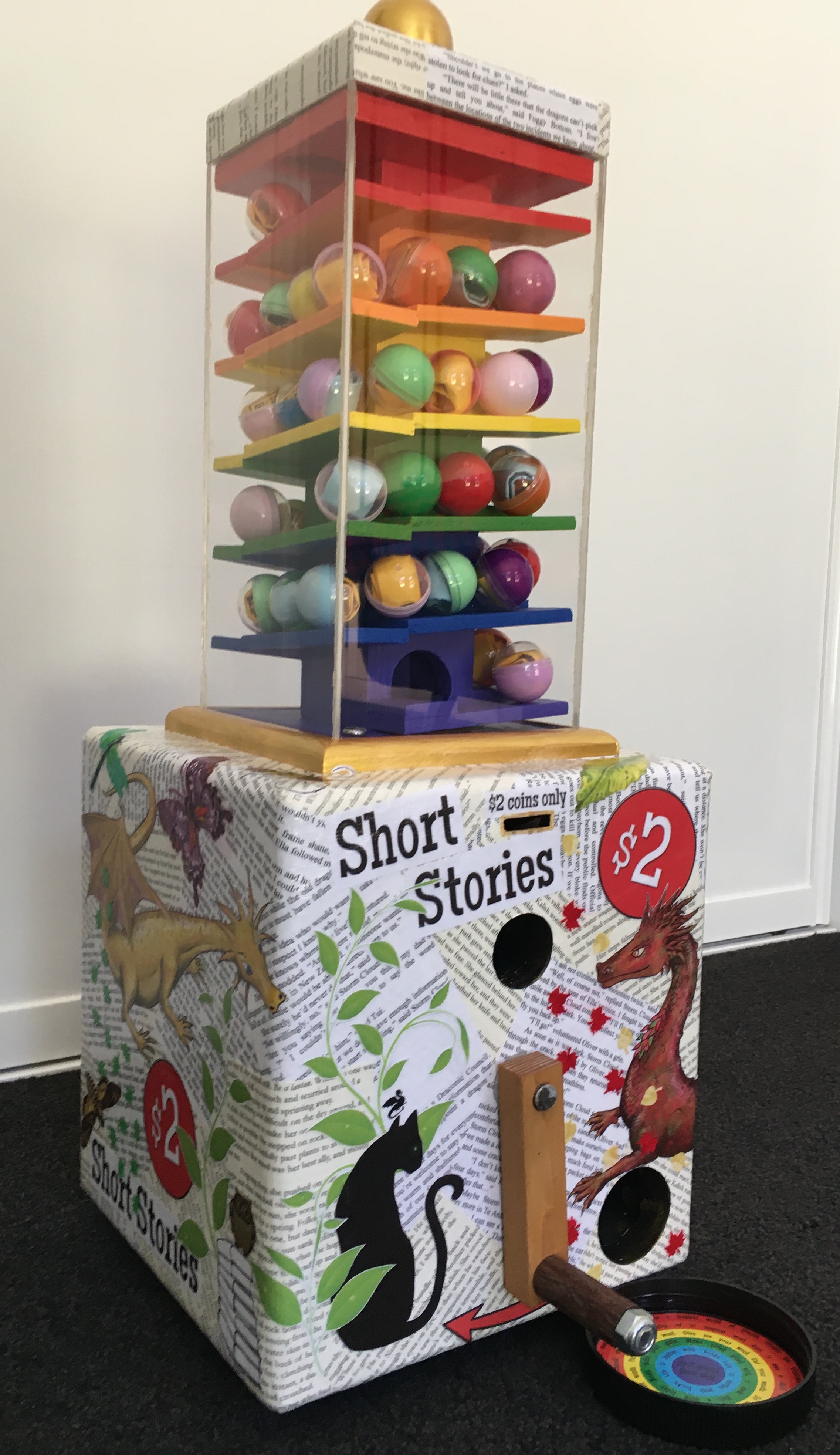
The story ball vending machine adds to my market day fun.
  1. Bring a healthy lunch. It’s so easy to think, “Oh, I’ll treat myself to something from a vendor for lunch.” But sugary, salty, greasy food leads to feeling depleted and icky by the end of the day. I take carrot sticks, fruit, and a sandwich—all prepared in bite-sized pieces so I can snatch a bite between customers throughout the day.
  2. Get there early, but not too early. I know how long it takes me to set up. To avoid being stressed about not being ready, and to avoid awkward standing around before the market starts, I time my arrival with just enough time to set up and use the toilet.
  3. Rehearse my spiel. I know what I want to say about each of my books, making it short and snappy. By thinking in advance, I don’t flounder awkwardly for the right words with a customer.
  4. Remember, books don’t sell themselves. I use this truth to my advantage when I need a social break. When I’m overwhelmed and don’t want to engage with anyone, I simply take a step back and stop talking to people. I smile politely, but if I don’t attempt to engage, most people won’t engage with me, and I get to take a break. 

I’m looking forward to the coming months, hawking my books to readers. Come visit me at these upcoming markets!

Ōtautahi Crafters Market—20 September, 10am – 5pm at South City Mall

Hokitika Christmas Market—16 November, 10am – 2pm at Seaview Lodge

Lincoln Twilight Market—28 November, 5 – 9pm at Lincoln Event Centre

The Goode Christmas Market—30 November, 10am – 3-pm at Pioneer Stadium, Christchurch 

Ōtautahi Crafters Market—20 December, 10am – 4pm at the Air Force Museum of NZ, Wigram
The Writing Life

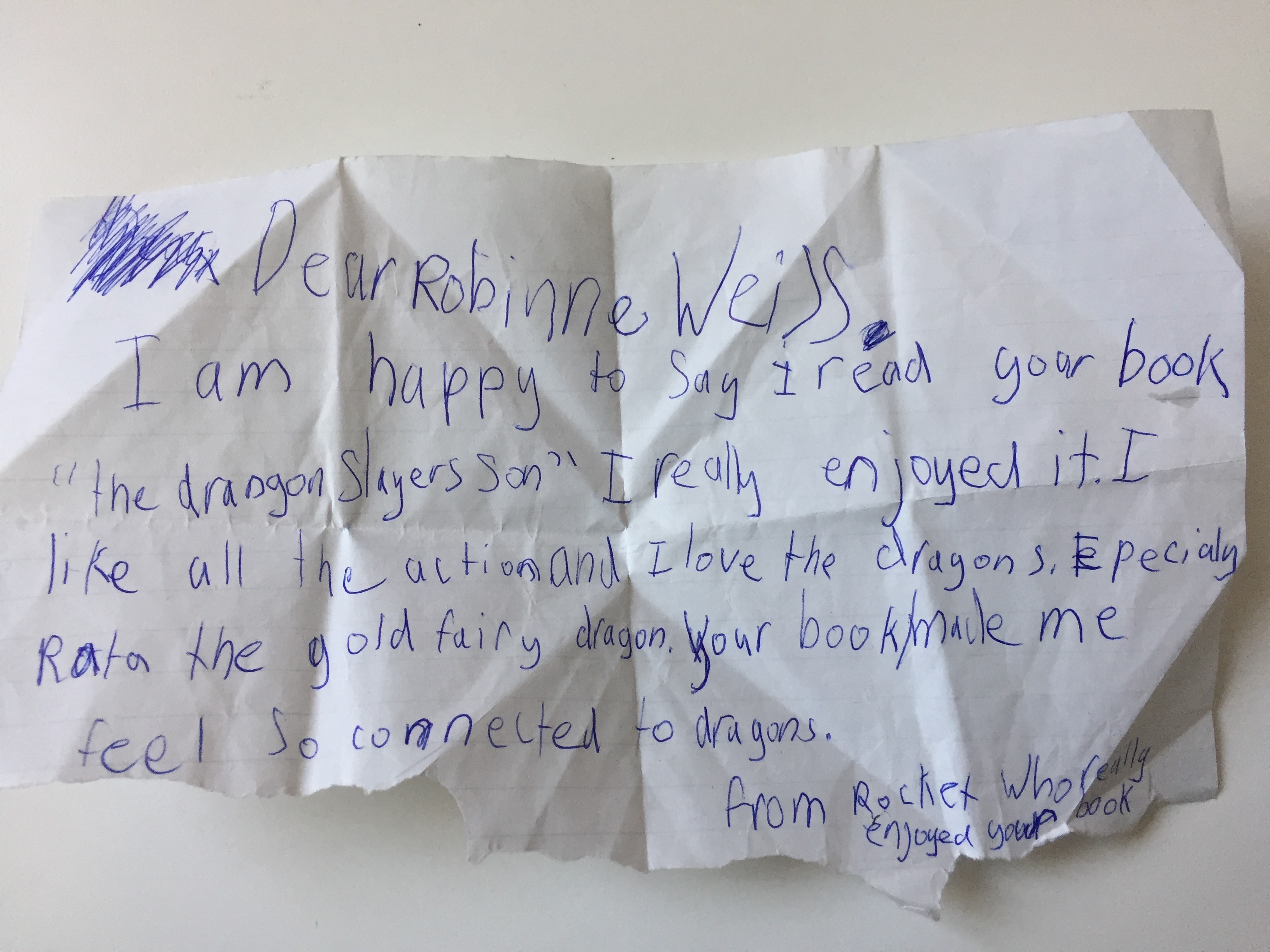
An oldie but a goodie–I love fan mail!

A couple days ago, I sat down at my desk, knowing I had a lot of ‘business’ to deal with. I was determined to complete these necessary but uninspiring tasks (cashbook marketing, etc.) quickly, so that I could get on to the writing I wanted to do.

First job was to check my email.

And this was the first message I opened:

Hi there Robinne
I bought your whole Dragon Defence League Series at the Spencer Park Market and you personalised one of the books for my son Mathew. I just wanted to write to let you know that he absolutely loves the first book and is over half way through and keeps telling us all about what is happening in the book. We have never seen him so glued to a book before and he never tells us what is happening so it has made a massive impression on him so thank you so much for writing them.

Well, there’s no better way to start your day than that! This is exactly the sort of thing I live for as a writer. To make an impression, to capture the imagination of a reader is the whole point of writing. And to have my book be the book that opens a child’s mind to the wonder of stories is something special, indeed.

It reminds me of the real reason I write. Oh, I would love to be able to make a living at this. The validation of a living wage would be amazing.

But it’s not why I write. I write to connect with others through words. There’s something magical about having an impact on a reader you have never met.

And I’m regularly reminded that I’m not the only writer who has to fund their passion with other endeavours. On a recent episode of Writing Excuses (a writing podcast I highly recommend), the topic of the week was how to fund the writing life. The whole point of the episode was that it’s okay, normal, and totally possible to purposely engage in money-making activities to support your writing habit, and that choosing activities that feed into your writing is the key to making the most of your time.

So, yeah, I teach three days a week in order to support the two days a week of writing. And because I teach students within my target audience, I know what my audience likes to read, know what sorts of life experiences they have, understand how current events resonate (or don’t) with them. I have an eager and ready population of beta readers at my fingertips, and a ready source of story inspiration.

It’s no different from when I was running the Bugmobile, my science outreach programme for schools. Bugmobile fees barely covered my costs, though I was charging schools as much as I possibly could. So I funded the Bugmobile by doing much more lucrative heritage interpretation consulting for various local and national agencies and organisations. The consulting work was interesting, but not my passion. But the skills to do both were similar, and it was a way to ensure I could continue to run the Bugmobile.

I will admit I ended 2023 feeling guilty for ‘wasting’ so much time, money and effort writing books and stories that don’t pay the bills. But I’m launching 2024 with a different attitude. And with a new realisation.

Back in 2005, when I first developed the idea for the Bugmobile, I wrote a mission statement. I don’t remember it exactly, but it was something along the lines of connecting people with the amazing nature found in their back yards and encouraging people to explore the world around them. I have realised that I’m still doing that as a writer. When I closed the Bugmobile and started writing, I felt like I’d cut off an arm. How could I stop interpreting the natural world?

The answer is I never did stop. I just don’t think I realised it. My Dragon Defence League books, which captivated Mathew, are a celebration of the landscapes and natural history of Aotearoa New Zealand. Yes, I’ve put dragons in there, but only to illuminate our relationship with the natural world and how it’s evolving over time. Only to give me a tool to envision a different way we might think of the natural world and our place in it. Digging deeply into all my stories—fantasy, science fiction, climate fiction, horror—they all contain elements of heritage interpretation.

The truth is, while I believed I was building a business, first with the Bugmobile and interpretation consultancy, and now with the writing, I’ve actually been building a life. A life with meaning and direction. 

I still have to make sure I’m paying the bills, and I still need to spend time worrying about marketing, but putting my writing in the larger context, and reminding myself of the larger goals I have for my life, helps me to let go of the feeling that net profit from the sales of my books and stories is the primary measure of success.

But that doesn’t mean you shouldn’t buy my books. They’re great! Fun reads, and full of environmental themes … Go on, you know you want to.