Waiting

2016-01-25 20.44.42 smFor the week before our trip to the U.S. I got almost nothing done. I was mentally occupied, with the trip—waiting for it to begin.

When we returned, we were just a week and a half from my husband leaving for a trip, and I got little done that week, either—waiting for him to leave.

While he was gone, I did almost no writing. I was distracted, I was working in odd places at odd times around the extra tasks that fell to me while he was gone. I was waiting for him to return.

Now he’s back, and I feel stuck in the habit of waiting.

I fear I’m stuck in the Waiting Place, as Dr. Seuss so eloquently described it:

“…for people just waiting.
Waiting for a train to go
or a bus to come, or a plane to go
or the mail to come, or the rain to go
or the phone to ring, or the snow to snow
or waiting around for a Yes or No
or waiting for their hair to grow.
Everyone is just waiting.”

Yep, I’m stuck in the waiting place.

It can be a hard place to get out of, but I learned many years ago that waiting rarely brings what you want.

It was in Peace Corps in Panama. My husband and I had been out with our local Corregidor (mayor), Fermín, and were returning to our village by bus. As we waited for the bus, it started to pour. We waited for hours, and when the bus finally came past, it didn’t even stop—it was too full already. The next bus might be hours, or might not come at all, so we decided to just walk, in spite of the rain. Fifteen minutes later, when we were thoroughly soaked, we heard another bus coming up behind us. Fermín smiled and said, “If you don’t walk, the bus won’t come.”

I took that as an important life lesson.

And now, I need to step out into the rain and stop waiting.

Writing By Hand

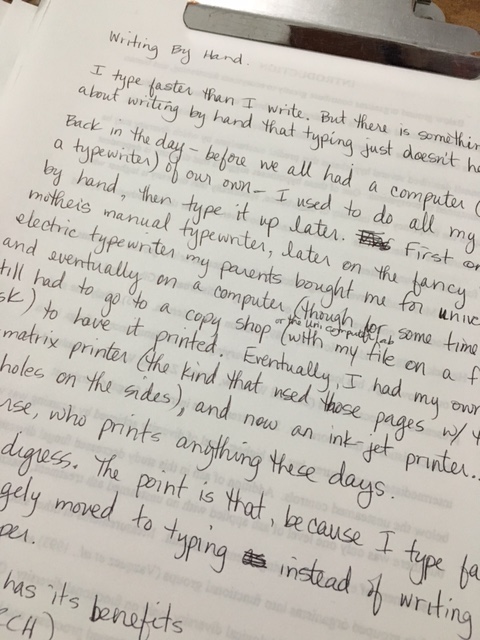
IMG_1739I type faster than I write. But there is something sensual about writing by hand that typing just doesn’t have.

Back in the day—before we all had a computer (or even a typewriter) of our own—I did all my writing by hand, then typed it up later. First on my mother’s manual typewriter, later on the fancy ‘portable’ electric typewriter my parents bought me for university, and eventually on a computer (though for some time I still had to go to a copy shop or the university computer lab with my file on a floppy disk to have it printed). Eventually, I had my own dot-matrix printer (the kind that used those cool pages with the feed-holes down the sides), and now an ink-jet printer. Of course, who prints anything these days…

But I digress. The point is that, because I type fast, I’ve largely moved to typing instead of writing with pen and paper. It’s just more efficient.

But writing has its benefits.

Educational researchers have studied the role of writing in learning, and have found that when we write notes out on paper, we actually think about what we’re writing, and we tend to rephrase things in our own words—we process the information, and learn it. When we type notes, that doesn’t happen—we tend to type verbatim, and it essentially goes in one ear and out our fingertips, bypassing the brain altogether. We don’t learn the material.

That’s fine, but when I’m writing, I’m not learning, per se. I’m expressing what’s in my head already, so it shouldn’t make any difference whether I type it or write it.

But it does.

Writing is slower for me than typing, so I spend more time considering each word as I write it.

I can pack more meaning into each word when it’s written by hand. How I write something is a reflection of my meaning. When I’m typing up a handwritten document, the typed words are often different—trying to capture in the barren lines of Times New Roman what an extra-loopy ‘y’ means, or the precise emphasis meant by an aggressively crossed ‘t’.

When I write by hand, I not only see the words, but I feel them. They have more substance than when I type them. They are more intimate. And if I’m writing something that is emotionally charged, or personal, I need to caress the words—make sure they are just right and formed correctly. I can’t do that through a keyboard.

So I often step away from the computer, pick up a pen and paper, and write by hand. It keeps me in touch with words in a way the keyboard cannot.

Library Complaints

100_3972 smThe interesting thing about working in the public library is watching the people who come in.

Today, one of the notable visitors was a woman who arrived with her husband. As they walked in, they were arguing.

To be more accurate, she was complaining about something to him. He gave monosyllabic answers to her long rants about their plans for the day, and how they were inadequate.

She left him reading the newspaper near the entrance while she descended on the library to plague the librarians with passive-aggressive questions about why they did or did not have the titles she was looking for. When she found a CD she wanted to check out, she complained that the CD wasn’t held in its case well enough—it threatened to fall out when she opened it, she said at great length and with much demonstration to the ever-patient librarian.

As she moved further into the library, I lost track of her, but I’m convinced she complained her way through the shelves, because she was still grumbling when she returned to collect her husband and leave.

I felt sorry for the librarians, who handled her complaints with grace and polite smiles. But I felt more sorry for her.

She was not young—easily in her mid-eighties. She complained with the skill of someone who has made it her life’s work to be unsatisfied, her goal to find fault with everything.

She can’t have had a very nice life.

Not that I think a hard life turned her into a complainer. On the contrary, I expect that complaining made her life hard.

That internal dialogue we play in our heads can colour everything we experience. It’s easy sometimes to let that dialogue turn to complaints.

The library never has the book I want.

Someone ate the last cookie again?

Why can’t people be quiet in the library so I can focus?

I’m not suggesting no one should ever complain. Pointing out problems to those who can do something about it, and standing up for yourself are important things that complaining can sometimes accomplish.

But when every thought becomes a complaint, the complaining turns toxic. Sometimes it pays to turn those complaints around. It doesn’t necessarily solve the problem, but it changes how you feel about it, and that can make all the difference.

The book I want is already checked out? Maybe the librarian has a suggestion for a similar book.

The cookies are gone? What a good excuse to make my favourite kind!

People are distracting me in the library? Maybe I what they do can inspire today’s blog post?

Life never gives us what we want. That’s probably a good thing. If we can remember that, it makes life much better.

The Dog Ate My Homework

2016-05-31 13.41.32First, there was a pair of pants to be made. Zip-offs. A bit tricky. Time consuming.

Then, there were animals to feed. An ornery goat to convince to take her medicine.

Two loads of laundry followed.

Next was a trip to the airport to drop off my husband. And while I was out, a stop at the store to pick up some hardware for the stilts my daughter is making.

When I got home, there was helping to make those stilts.

Next thing I knew, it was time to give the goat her medicine again.

And by the time I finished that, it was time to make dinner.

After dinner, there was a movie to watch.

In the middle of the movie, a dog leaped in through the living room window (which was, unfortunately, closed).

The dog was followed closely by the elephant, who didn’t exactly fit through the window. The elephant sort of took out the wall.

Which naturally let the herd of wapiti in. That was okay. They just wanted to watch the movie. It was the elephant who caused trouble.

She wanted a bath, so I had to pause the movie and go fill the tub for her.

But she needed bubbles, so there was the quick trip to the store for bubble bath.

By the time I got back, she had flooded the bathroom floor.

Which of course, meant the dining room got flooded, too.

When the water started spilling into the living room I got worried, but thankfully it was able to drain out the hole in the wall.

But it’s a cold night, and what, with the hole in the wall, it got chilly indoors. All that water froze, and the wapiti decided to have an ice skating party.

Well, partying wapiti are nothing but trouble. They got into the wine, and next thing you know, the police were knocking on the door—something about a bunch of animals doing burnouts on the road outside?

That took a while to sort out. I had to take the car keys from the wapiti. They were pretty annoyed by that, but by that point, they were all drunk. I drove them all home, including the elephant.

When I got back and assessed the mess, I found that the elephant had not only flooded the house and used an entire bottle of bubble bath, but she had used every single bath towel in the house to dry herself off. There’s a mountain of laundry to do tomorrow.

I did get the hole in the wall boarded up, sort of—the wapiti had broken the kitchen table anyway, so I figured, why not use it?

I’d just hammered the last nail in, when the dog came into the room with a sheaf of papers in his mouth.

It was the story I was writing for today’s Saturday Story! I tried to snatch it from him, but he ran off. I tried to follow, but slipped on what was left of the ice. I fell and broke my arm on an empty wine bottle the wapiti left behind.

Getting the cast on didn’t take too long, I suppose, but by the time I got home three hours later, there was nothing left of my story but a mass of soggy pulp the dog had vomited back up. Guess it wasn’t a very good story.

And now it’s terribly late and I’m struggling to keep my eyes open.

That’s why I’ve got no Saturday Story for you today.

Sorry. It really wasn’t my fault.

The dog ate it.


Saturday Stories: Glint

GlintCoverNEWI’m afraid I’m too tired and jet-lagged to muster a blog post today. So, here’s an excerpt from the beginning of A Glint of Exoskeleton for today’s Saturday Stories.

The Girl Who Talked to Insects

Four

Crick peered into her dollhouse, though she didn’t much like dolls. She was looking for something.

“Oh, there you are!” she exclaimed in her sing-song, four-year-old voice. “You don’t have to hide. I won’t hurt you.”

The object of her attention crept cautiously out from under the loose carpet in what Crick called the yellow bedroom. Its antennae waved busily in Crick’s direction. Crick cocked her head to one side and furrowed her brow.

“Are you some sort of beetle?”

“Not a beetle. I’m a cockroach. An American cockroach.” The animal had a raspy voice like an old transistor radio with bad reception, but the scratchy sound was cheerful and friendly.

“Hi Mister Cockroach! My name’s Crick. That’s short for Cricket, and that’s short for Christina Marie Stolzfus, which is my real name. But you can call me Crick. What’s your name?”

“Pleased to meet you, Crick. I’m Periplaneta americana. I suppose you could call that a nickname, too.”

“What’s your real name?”

“It’s hard to say. Cockroach names are actually smells.”

“Smells?” Crick laughed. “That’s weird!”

“Not for us. We have very sensitive noses, and not so good ears. Smell is easier for us.”

“Oh! Well, I think I’ll call you Peri.”

Peri chuckled. “That would be fine.”

“Do you like my dollhouse?” Crick asked. “I saw you in it yesterday.”

“Yes, it’s quite nice, particularly this loose yellow carpet.”

Crick frowned. “I don’t really like it. I’d rather have a hamster, but mom says I’m not allowed. She says they stink and remind her of rats. Gramma gave it to me for my birthday. That’s when I turned four!” she continued proudly. “How old are you?”

“Well, I’m a lot older than four!” chuckled Peri. “I’ve been alive since 1943. That makes me…let’s see…fifty-three years old.”

“Whoa! That’s old,” replied Crick gravely. Then her brow furrowed. “I didn’t know insects lived that long.”

“Most of us don’t, but I’m…special.”

“How?”

“I’m a leader for my species—something called an über. It’s a bit like a…like a president.”

“Are presidents really old, too?”

“Compared to most insects they are. But insect leaders don’t get old like other insects. We just keep on living.”

“You won’t ever die?”

“I can be killed—I’m not invincible. But I won’t die of old age.”

Just then, Crick’s bedroom door opened and her mother poked her head in.

“Who are you talking to, dear?” she asked. “Oh! You’re playing with your dollhouse! That’s nice.”

“Well, not really. I was talking to my new friend, Peri. He’s going to live forever,” she said brightly, “unless he’s killed. He lives in the dollhouse. He likes the yellow room ‘specially.”

“That’s nice,” responded her mother, a little uncertainly. “Which one of your dolls is Peri?”

“Oh, he’s not a doll. He’s a cockroach.”

Within minutes, Crick’s mother had hauled the dollhouse out onto the lawn and sprayed it with fly spray. Crick kicked up such as fuss about it, screaming and crying, that her mother had to lock her in her room until the deed was done. Crick was screaming and pounding on her door so loudly, it was several minutes before she heard Peri’s voice.

“Crick! Crick! Don’t worry. No harm done. I’m over here.”

“B…b…but you were in the dollhouse,” she sniffed, tears streaking her face.

“I scuttled out as soon as you mentioned I was a cockroach.”

“Why?”

“I’ve been around long enough to know that when most people hear the word cockroach, they don’t react well.”


The dollhouse was returned to Crick’s bedroom a few days later, but Peri didn’t return to the yellow room. Crick made a house for him from an empty cereal box and hid it under her bed. Peri declared it to be the nicest house a cockroach could want.

Saturday Stories: How the Albatross Got its Wings

Photo: Peter Weiss

Photo: Peter Weiss

“Grandma! I dreamt last night that I could fly!”

“Yes, child. Of course you did. All those born of our ancestors do.”

“Why is that, Grandma?”

The old woman sighed. “Because once, we could fly.”

“Fly? How could we fly?”

“Many, many years ago, before I was born, before my grandma was born, before even my grandma’s grandma was born, the People had wings. We spent all day in the sky.”

The girl gazed upward while the old woman continued. “We soared with the kettles of broad-winged hawks in the autumn and kept the arctic tern company on her long migrations. We flitted with the chickadee amidst the winter-bare branches, and swooped silently with the owls in the night.”

The old woman chuckled. “We challenged the peregrine falcon to races—and always lost. We danced with the woodcocks in the air. We explored every bit of this land, from mountain to sea. We followed the Great River to its source in a small trickle welling up from the ground, and then to its wide mouth at the sea.”

The ancient eyes no longer looked at her granddaughter—their vision was focused far away.

“Then the Flightless came, with their treasures from the earth—gold, silver, precious gems. They worshipped these treasures, and taught the People their value. The Flightless showed us how to dig and mine, how to extract these treasures for ourselves. We forgot the sky. The silver ribbon of a river glinting in the sun was replaced by silver chains. The glitter of the northern lakes was lost to the glitter of polished stones. The golden rays of sunset gave way to the gold sheen of metal.

“We fashioned jewellery from these treasures. Bird-shaped earrings, necklaces of delicate feathers, pendants showing our own forms with wings outstretched. But we forgot what those wings were for. The tern flew alone, and the falcon raced only the wind. We dug and we delved into the dark earth, forgoing the sky.

“We began to crave the bright treasures. Those who found more than their share hoarded them jealously. Those who found less, stole.”

“When Albatross came to ask for our wings, we gladly cut them off our own backs. Wings were in the way in the underground mines. We could dig much easier without them.”

“Albatross took our wings and put them on his own back. He flew off, never to return to land again. He soars forever now over the sea, exploring the world, and landing only when he must. He lives with ease and dies with a sigh of contentment, for he has seen the wonders of the earth. Meanwhile, we live in toil, and die with our bodies and spirits spent. Rarely do we even look to the skies. We have forgotten the wind and the sun, the pull of stars, the sight of all the world spread out below us.”

Grandma smiled wistfully and sighed. “I suppose it is just a legend…a legend of flight.”

“But, Grandma…I know I flew last night! I went up and up until our house was just a speck, and the fields were wrapped around it like the quilt on my bed. And the forest was so dark and cool-looking, and I could even see the sea off in the distance, and the sun sparkled off the waves, and…Oh Grandma, it was so beautiful!”

“Yes, child. Don’t ever forget it.”

Saturday Stories: Killers for Hire

“Now, would that be who I pledge to, or whom I pledge to?” muttered Jane chewing on the end of her pen. “Or should it be to whom I pledge?” She sighed and threw the pen down. “This is never going to work.”

“What’s not going to work?” Jane’s colleague, Babs appeared around the corner of her cubicle, munching an apple. She sat on the corner of Jane’s desk and looked down at the paperwork spread out on it.

“You still working on that wedding?”

Jane nodded.

“I don’t get why it’s so hard to stop a wedding. Just pop off the bride or the groom. I mean, that’s what we’re trained for. It’s what being an assassin is all about.”

Jane sighed. “But I’m supposed to be killing love, not the people involved in it.”

“What kind of stupid job is that?” Babs spoke with her mouth full, and droplets of apple juice splattered across Jane’s desk.

“Well, how many real assassination jobs have we had in the past six months?”

“Um…”

“Exactly. Assassination isn’t stylish anymore. It isn’t the trendy thing to do like it was a couple of years ago. Have you seen the ad the boss ran in the paper last week?”

“Nah, I don’t bother with the paper.”

Jane picked a folded newspaper out of her recycling bin and paged through it to the classified section.

“Here,” she said, handing the paper to Babs and tapping at a quarter-page ad.

“Assassinations Incorporated—more than just bodies,” read Babs. “You’ve trusted us to eliminate your enemies and loved ones for over 35 years. Now Assassinations Inc. has expanded our services to meet all your killing needs. Sick of the cat? We can take care of that! Got roaches? No problem. Tired of undying love? We’ve got you covered. We can kill the lights, the fatted calf, the goose that lays the golden egg, and even two birds with one stone. Need to dress to kill? Let our sartorial staff help. Want to kill with kindness? We have gifts for all occasions. Trying to kill the clock? Let our sports team step in. We’ll even kill time for you, if that’s what you need.” She threw the paper down in disgust. “What is this shit?”

“It’s the brave new world, I suppose,” said Jane, shaking her head. “Anyway, the King of Baumgarte has hired us to stop his daughter marrying that poet guy—Julius what’s-his-name.”

“Julius VonStrueben? I love his stuff!”

“Yeah, well, apparently so does Princess Kalla. But the king can’t stand the guy. Being a thoroughly modern monarch, he doesn’t want to tell Kalla she can’t marry him, but he wants to make sure she doesn’t.”

“So, why not just kill the guy?”

“Kill the national poet of his own country?” Jane shook her head. “Every woman in Baumgarte is in love with the guy—the king would have a popular revolt on his hands if he did that.”

“That’s what our Confidentiality Prime service is for—to guarantee no one ever knows who ordered the job. Surely a king can afford the extra for that?”

Jane shrugged. “Maybe, but like I said, assassination just isn’t fashionable anymore. He’s only asked for us to kill the love, not the lover.”

“And so how are you planning on doing that?” asked Babs as she picked up one of the papers off Jane’s desk.

Jane snatched the paper back, but not before Babs had gotten a good look.

“You’re writing poetry?” She sniggered.

“Well, he’s a poet. I figured that if she happened to find some poems he wrote to other women…”

“And you think you can write poetry like Julius VonStrueben?”

Jane sighed. “I suppose it was a bad idea. But how else would a poet express himself to a lover? How else can I convince Princess Kalla that VonStrueben’s a two-timing jerk?”

The women were silent for a moment. Then Babs’ thoughtful expression turned to a smile.

“There’s more than one way to skin a cat. What if you convinced her that VonStrueben was, in fact, completely besotted with her?”

“How would that help?”

“What if VonStrueben were to write poetry for Kalla? Really bad poetry.”

“Huh?”

“Think about it. How would you feel if your boyfriend—”

“I don’t have one.”

Babs dismissed the technicality with a wave.

“Assuming you did, how would you feel if your boyfriend smothered you with really awful love poems?”

Jane wrinkled her nose.

“You see?”

“Yeah, but I’m not a princess. Aren’t princesses supposed to like that sort of thing?”

“Maybe if they’re good poems, but what if Kalla began to think that VonStrueben hadn’t actually written all those poems he’s famous for? What if she thought she was in danger of marrying a guy who not only couldn’t write, but who had become famous by claiming someone else’s writing as his own?”

Jane considered the idea for a moment.

“Not quite as sure as the philanderer tactic.”

Babs picked up a paper off Jane’s desk and read it aloud.

How many ways do I love thee?

I love thee like a tree.

I love thee like a bee.

I love thee like a well-ripened brie.

“You’ve got to be kidding me. Poetry this bad addressed to someone else? She’ll dismiss it for what it is—a ploy to make her ditch VonStrueben. But I’m sure he writes poetry to her—all you’d have to do is exchange the good poetry for your bad stuff, and she’d begin to look for a way out. Half a dozen poems like this, and she’ll be running for the door.”

“You think so?”

“I’m sure of it.”

“And if it doesn’t work?”

Babs shrugged. “You’re an assassin. You’ll figure something out.” She patted Jane on the shoulder and left.

Jane sighed and picked up the poem Babs had read aloud, reading it again to herself.

“Maybe I shouldn’t have included the brie,” she muttered. She tossed the paper aside, pulled out a clean sheet, and got to work.


Saturday Stories: Sledding

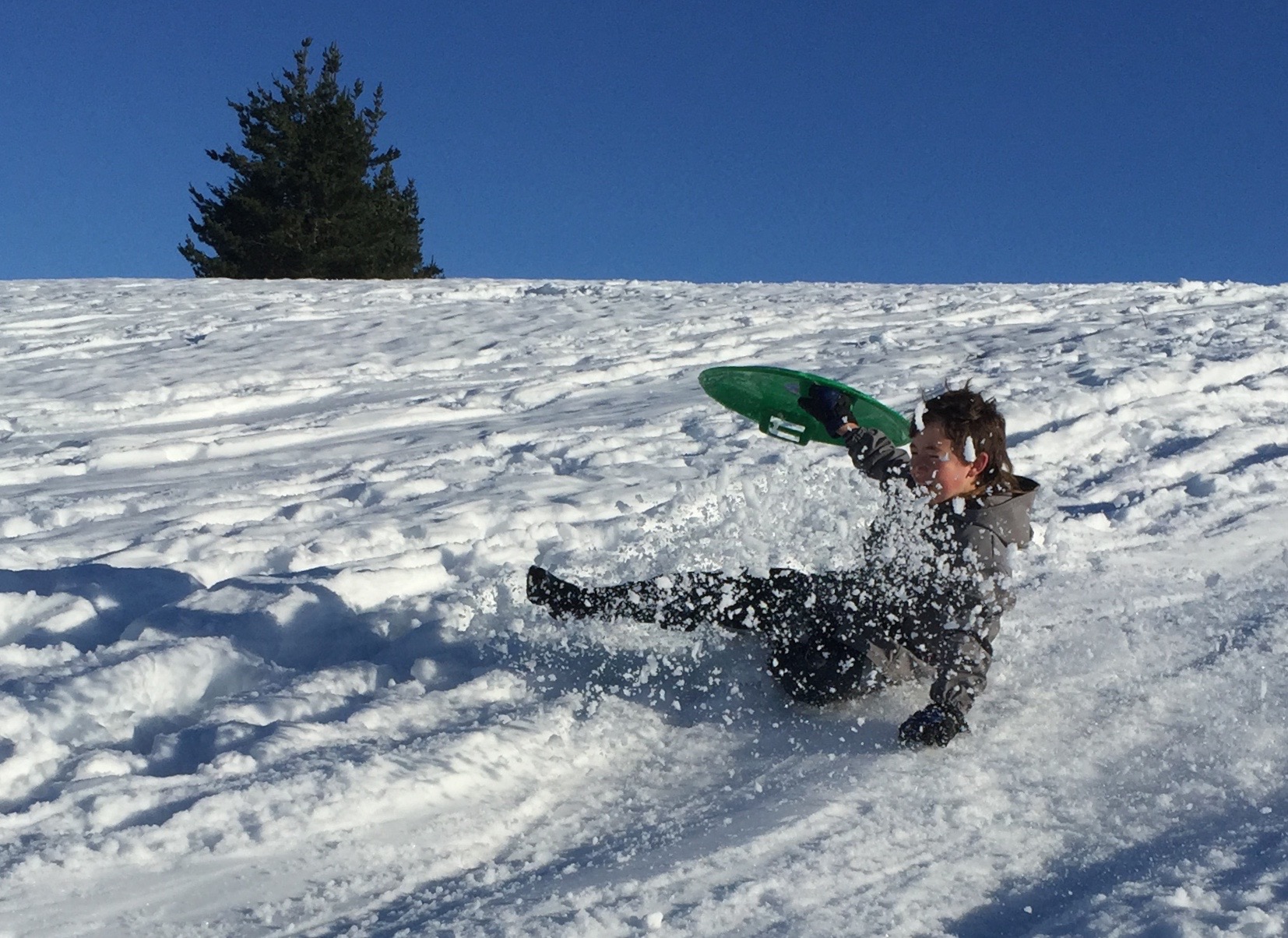
IMG_2918I trudged up the hill behind Haley. The sled she pulled behind her was hardly recognisable as the twenty-dollar plastic toboggan it had once been.

“And you really think this is going to work?” I asked.

“I’m sure it will. As long as you pack the snow first, so I can build up enough speed by the time I hit the ramp.”

I sighed. My little sister had been in the garage for days—no, weeks—modifying her sled, only leaving off to go to school and eat meals. The floor was strewn with papers—fiendish-looking equations, diagrams, and sketches.

Mom and Dad humored her—let her use all the power tools, bought her sheet metal, wire, and who knows what else.

“We don’t want to squash her creativity,” said Mom.

It was creative, all right. The cheap plastic sled now looked like a silver bullet, with a sleek shell over the top. A small Perspex window gave the rider some visibility out the front. Fins and wings stuck out along the sides and back.

We reached the top of the hill and I handed Haley her bike helmet.

“Mom says you have to wear this.” Haley rolled her eyes but snapped the helmet on.

“If this ruins my weight calculations…”

“Better than ruining your head,” I said.

“Help me in.”

I lifted Haley and lowered her gently through the sled’s hatch. She grinned and gave me a thumbs-up before closing the hatch behind her.

Plopping my sled down at the top of the slope, I started down the hill. I hit the ramp at a good clip and soared into the air before landing with a thud in the snow beyond.

I had only just stopped and turned when Haley began her descent. God, she was moving fast! What had she done to her sled to make it go like that? I could see her face through the window, tense and full of excitement.

She hit the ramp and seemed to go straight up. And up. And up.

Then she was gone.

I blinked at the overcast sky and waited.

A few flakes of snow spiralled lazily down.

A crow cawed from a nearby tree.

Then I went home.

Saturday Stories: Why I Always Obey Warning Signs

2016-06-11 10.13.31 smWe didn’t see the sand shark until it was too late.

To tell the truth, I don’t think any of us really believed they existed.

Oh, we’d been warned. Mum and Dad saw the news on television and told us not to go out to the beach after school. But we always went out on the beach after school. Who would walk along the street when you could walk the beach home instead? The street was full of rubbish and car exhaust. On the beach there were shells, and sand hoppers, and sometimes even dolphins out in the waves.

So, naturally, coming home from school the next day, we turned off the street onto the beach path.

Five metres along the path, a big red sign blocked our way: DANGER! SAND SHARKS! DO NOT ENTER!

We laughed and stepped over the rope barrier. Sand sharks—yeah, right. There were plenty of sharks in the water—we knew that—they cruised along the shore, just beyond the breakers. We didn’t always see them, but we saw enough that we could tell the difference between a great white and a tiger shark. But sand sharks? That was ridiculous.

We crested the dunes and raced down the far side, like we did every day. The beach was deserted. I suppose that should have told us something, but like the other warnings, we ignored it.

Jamie and Kate kicked off their shoes and raced down to the water, splashing right into the waves. Mum would have a fit about their soaking wet school pants when we got home, I thought.

I picked up their shoes as I followed more slowly, texting my friend Ellie to see if she wanted to go to the movies on the weekend.

Maybe if I’d been paying attention to something other than my phone, I would have seen it. But it wasn’t until the shark’s massive dorsal fin sliced across the beach that I looked up.

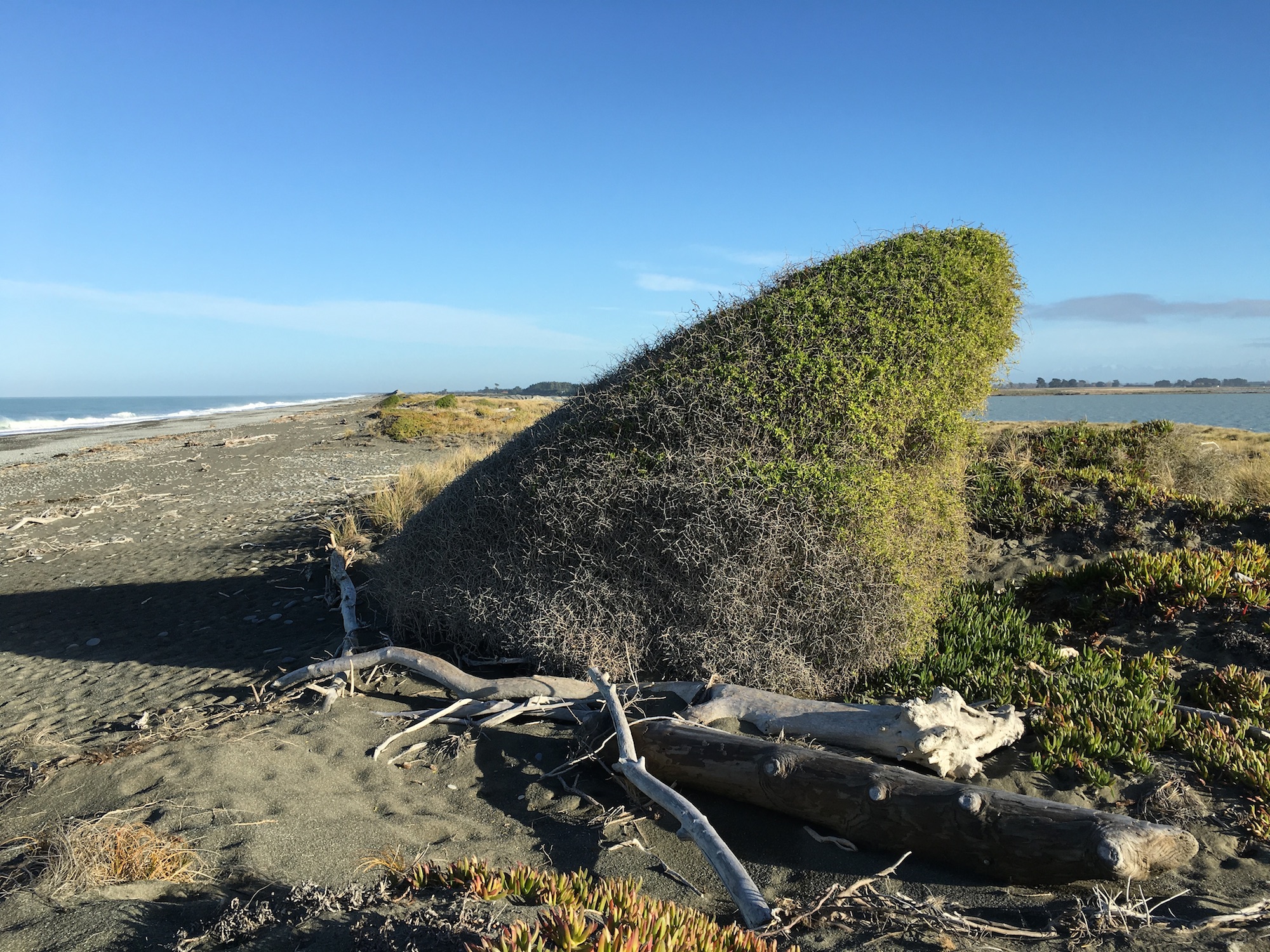
It was speeding down off the dunes, the dorsal fin looking like a wave-sculpted bush. A heaving ripple of sand pushed out in front and to the side, like the wake of a speeding boat.

I screamed at Jamie and Kate and broke into a run, trying to get to them before the shark did. I don’t know what I thought I was going to do if I made it—I was no match for the animal—it must have been at least fifteen metres long, by the size of the dorsal fin.

Jamie and Kate either heard me or saw the shark, because they turned and shrieked. Kate grabbed Jamie’s arm and pulled, but Jamie was frozen in fear. I don’t think running would have saved them anyway—the shark raced toward them at a speed none of us could have matched. A metre from my siblings, it heaved its body out of the sand, jaws wide open, rows of razor teeth gleaming in the sun. The jaws snapped shut and Jamie and Kate were gone.

I was still racing toward them as the shark sank back into the sand and turned toward me. My steps faltered. Then I dropped my phone and the shoes I still carried, and pounded up the beach.

I could hear the hiss of sand as the shark gained on me. I hit the dry sand above high tide line, and my feet slipped as they sank in. Stumbling, I kept going, finally hitting the harder sand of the dunes. I dared a glance behind me, only to wish I hadn’t—the shark was nearly on top of me.

I flew down the path over the dunes, vaulted the rope barrier and kept going toward the street.

I heard the warning sign splinter as the shark hit it and sent it flying. I could feel the sand shift under my feet now as the shark’s wake hit me.

My feet hit the sidewalk, and an instant later the concrete buckled, sending me tumbling to my knees.

The shark’s dorsal fin was jammed into the broken sidewalk, just a metre from where I crouched. Slowly, it sank out of sight, leaving me shaking and unable to move.

A car I recognized pulled up at the kerb.

“Lynn, are you okay?” asked my mother. “Where are your brother and sister?”

My Best Day

I gave a writing prompt to a few students yesterday—describe your best day ever (real or hypothetical). Here’s my response in poetry:

100_4209 cropOn my best day, the sun shines
But it’s not too hot.
I get up before dawn
And the air is soft
The moon full
Sinking gently to the mountains.
I am outdoors all day
With people I love
Or alone.

On my best day, I sweat
And get my hands dirty.
I see endangered wildlife
And pick tomatoes.
I stay out late to watch
Orion rise
And see the aurora australis.

My best day stretches into night
And I sleep
Without dreams.