As though they know What I need When winter returns On the eve of bud burst, Magpies warble On fence posts In the dark.
Spring comes! Spring comes!
Ten years ago I posted a blog titled, It Ain’t Over ’Til the Magpie Sings. The post was prompted by the first morning that a magpie warbled for an hour before dawn. At the old house, where the windows weren’t double glazed, the magpies were my alarm clock in spring and summer, warbling an hour or so before sunrise, urging me up to do the milking and make the most of the day. It’s harder to hear them in our new house, where the double glazed windows deaden outdoor sounds, but I’ve been tuning into the magpies for years.
And I’ve discovered that the magpies are remarkably predictable. Ten years ago, I heard the first pre-dawn magpie song on August 8th. Today (the 8th of August) I heard the first pre-dawn magpie song of the year.
And just like that day a decade ago, the first magpie song was followed by a winter lashing reminding us that, while spring was on its way, winter was still in charge. Today’s weather forecast shows the temperature dropping from a 4 am high (a balmy 12.3℃) all day, to 3℃. We can expect rain and icy wind for the next couple of days.
I love hiking at any time of the year, but there’s something particularly enjoyable about winter hikes.
Part of that enjoyment for me is that it’s the only chance here in Aotearoa New Zealand to walk in snow, because it rarely snows at lower elevations. To get to snow, you’ve got to hike to it. (Yes, you can hike to snow even in summer, but it’s easier to do so in winter, and there’s more of it.)
Last weekend, my husband, daughter and I headed to Red Hill, which sits between Lake Lyndon and Lake Coleridge. At 1640 metres, Red Hill is higher than nearby Porters Skifield, but lacks the snow making machines. So the snow was patchy, even at the top.
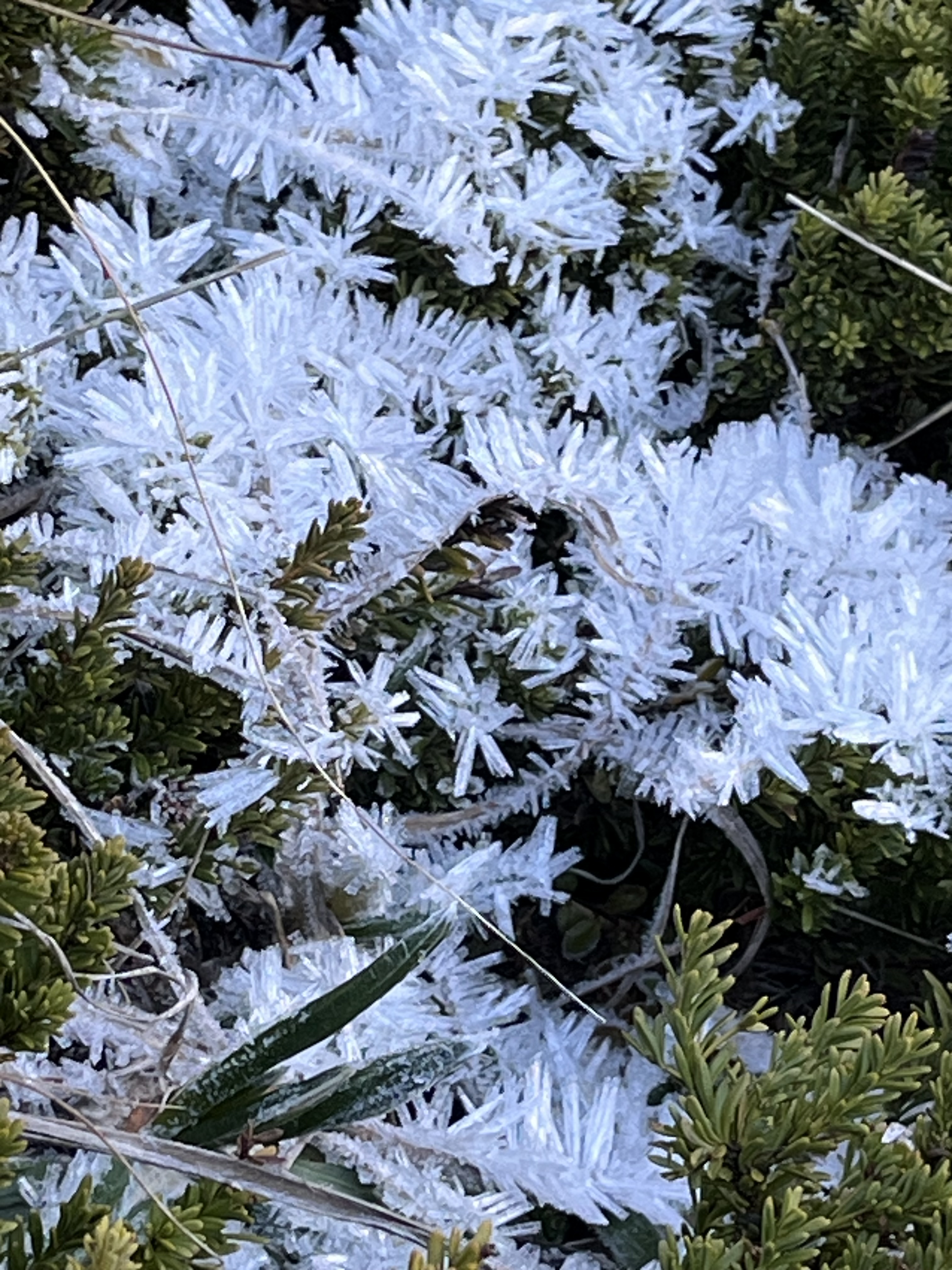
Still, winter hiking was in its full glory. On the way up, we hiked across crunchy frozen mud, pushed up by countless ice needles. We teetered on icy tussock mounds as we crossed a wetland. As we gained altitude, the wind increased and the temperature fell. We passed pockets of spectacular frost, with ice crystals so long, it looked like leaves. Snow in the shady hollows was wind sculpted and hard, more ice than snow.
By the time we hit the open tussock and scree-covered tops, the freezing wind was burning my cheeks, and I was thankful for my snood, which I pulled over my face to block the worst of the wind.
The view from the top was definitely worth the windburn. Winter mountains—covered in snow—stretched across the skyline. Down below us, the water of Lake Coleridge glistened blue in the sun.
The only bad part about winter hiking is that it’s often not pleasant to sit on the top for lunch, and last weekend was absolutely not a weekend to hang out on top of any mountain. After a quick look around and some photos, we hightailed it back down.
But one of the cool things about winter hiking is that, on a sunny day, you can start the hike in winter conditions, and end in spring or summer-like conditions.
Having donned all our warm layers at the top of Red Hill, we began shucking them as we descended. We went from thermals, jacket, hat and gloves to just t-shirts by the time we were back to the car. It was a balmy 17℃. Warm enough for a swim … according to our daughter. (We decided not to swim that day, but she did take a swim the following day after a hike with a friend.)
As someone with mediocre circulation, I struggle with overheating when I hike. I can be sweating, but still have numb fingers and toes, because my body doesn’t push the heat to my extremities. It turns summer hiking into a sweat-fest. But hiking during winter is much more pleasant. I can shuck my jacket to cool my core, but keep hat and gloves on to warm my extremities. It makes for a much more pleasant experience.
We’ve enjoyed some memorable winter hikes: Cragieburn under a freshly fallen 15 centimetres of fluff, a trek to Woolshed Creek Hut in fresh calf-deep snow, followed by barefoot wading in the stream at the top, a winter wonderland of wind-sculpted ice atop Mount Isobel … Winter landscapes are spectacular.
Hopefully, we’ll get out for a few more hikes before the end of winter. Gotta enjoy the snow while it’s there!
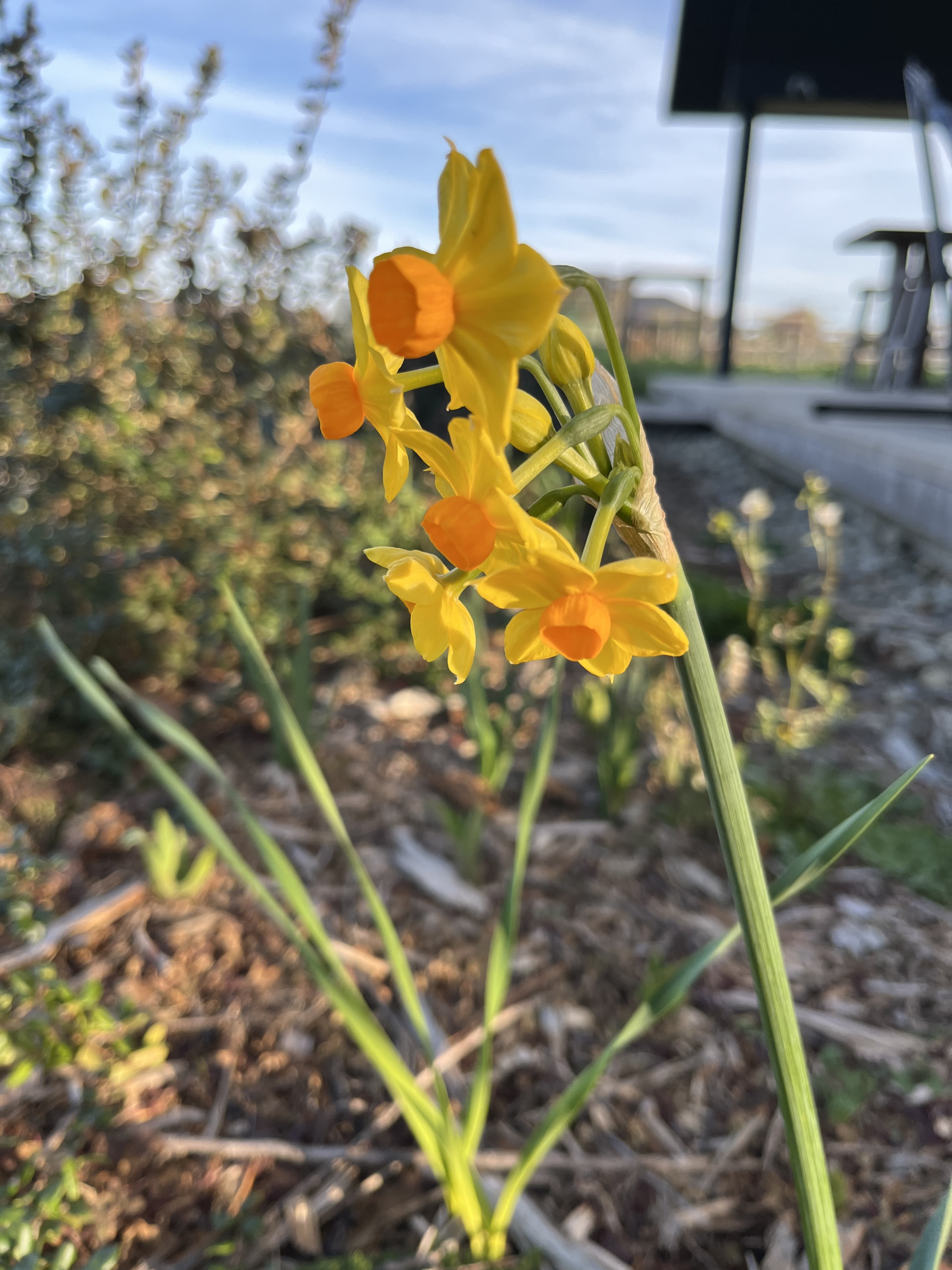
Lately, it has still been light outside on our drive to and from work. The daffodils are up, and a few blooms are even open. When I weeded the asparagus bed last week, the Californian thistles were sprouting new buds 15 centimetres underground.
And most importantly, my seed order has arrived!
Yep. Spring is on its way. Never mind that the frost behind the house hasn’t melted in a week, and the bird bath is skimmed-over with ice at 3 pm. Never mind that much of the country hit yearly lows yesterday. Never mind that our worst winter weather tends to arrive after spring has already officially started.
This weekend, I’ll write my weekly spring to-do list, covering August to December. I’ll tidy the garden shed of winter detritus, and pull out the peppers in the greenhouse which have finally died. And I’ll finish the last of the winter pruning and deadheading. I’ll probably also fret over how little of those winter activities I accomplished—the sewing, spinning and other crafts I enjoy.
And with the windows open (for the few hours it’s warm enough … just), and the house smelling of fresh air and the promise of growing things, I’ll impatiently await spring.
Years ago, struggling with the feeling that I wasn’t pulling my weight in my family because I wasn’t earning much money with my business, I did a few back of the envelope calculations of what my gardening and milking/cheesemaking activities ‘earned’. At the time, I worked out that I was producing about $50,000 worth of food every year. The domestic accounting blew me away and put my mind at ease.
Plenty of food in the winter garden.
I’m no longer concerned about the monetary value of the gardening I do, but I’m still curious, and I love data and numbers. So I’ve decided to do some garden accounting this year.
Beginning at the winter solstice, I started keeping a log of all the food that comes out of the garden. Although the garden year never really ends here, I figured the solstice was as good a place as any to start. I’ve dedicated a notebook to the task and I’m recording as much information as I can about what I harvest—weight, number, variety, etc. I’ll periodically enter the data into a spreadsheet, so I can play around with the numbers.
Okay, yes, I’m a total nerd. But I love playing with data. And we always come to late summer (as we heave yet another laden basket onto the kitchen bench) wondering just how many kilos of courgettes we’ve harvested. But by then it’s too late to go back and weigh them.
Peppers hanging on in the greenhouse.
Besides, there’s always the fascinating harvests, like the 500 grams of hot peppers I harvested yesterday. (in July?! For those in the northern hemisphere, July is the seasonal equivalent of January.) In addition, the exercise might tell me a bit about which varieties are more or less worth growing. Not that it would stop me from growing a crop I love, even if it doesn’t produce a lot, but it never hurts to have the data.
My intent is not to place a dollar value on what we harvest (Who can put a value on a warm, heirloom tomato fresh from the garden?), but to use the exercise to capture the quantity and diversity of food we enjoy.
Winter has definitely arrived this weekend, with squally rain, and chilly winds. The mountain passes have been closed by snow, and no doubt we’ll see some stunning snowy peaks when the clouds finally lift.
In response, I’ve been craving dense, high calorie food (never mind the fact I’ve been indoors most of the weekend and don’t need high calorie food in any way).
Yesterday, I was contemplating today’s breakfast, and imagined pumpkin spice sticky buns. Was there such a thing? And if not, could I invent it?
The answer was, yes! I found several variations online. In my usual fashion, I mixed and matched, picking aspects I liked from a number of recipes to come up with my own take on the dish.
The outcome was quite tasty. Here’s my recipe.
Dough: 3/4 cup milk, warmed to about 43℃ (110℉) 1/4 cup granulated sugar 2 1/4 tsp yeast 1 cup pureed pumpkin 1/4 cup butter, melted 1 egg 2 cups high grade (bread) flour 2 cups wholemeal (whole wheat) flour 1 Tbsp cinnamon 1 tsp cloves 1 tsp ginger 1 tsp allspice 3/4 tsp salt
Filling: 2/3 cup brown sugar 1 1/2 Tbs cinnamon 1/4 cup butter, softened 2/3 cup chopped walnuts
Glaze: 1/2 cup icing (confectioner’s) sugar 2-3 tsp fresh lemon juice
To make the dough, combine milk, granulated sugar and yeast in a small bowl and let sit until foamy. Combine pumpkin, melted butter and egg in a medium bowl. Combine flours, spices and salt in a large bowl.
Combine the yeast mixture with the pumpkin mixture and beat until smooth. Pour this mix into the flour, and stir until a dough forms. Turn the dough out onto a lightly floured surface and knead for about 10 minutes, until smooth and elastic. Allow to rise in a greased, covered bowl for 1-2 hours, until doubled in bulk.
Roll the dough into a large rectangle, about 35 x 40 cm (14 x 16 in). Spread the dough with the softened butter, leaving a narrow strip of dough on one of the shorter sides free of butter. Combine the brown sugar and cinnamon, and sprinkle over the butter. Sprinkle walnuts on top.
Starting at the buttery short edge, roll the dough into a log, pressing the unbuttered edge firmly to seal. With a sharp knife, slice the log into 12 rounds. Place the rounds in a well-greased baking tin 23 x 33 cm (9 x 13 in)*, cover with a damp towel, and let rise about 30 minutes.**
Bake at 180℃ (350℉) for 25 minutes, until nicely browned.
Make the glaze by mixing lemon juice, a little at a time, into the icing sugar until the mixture is thick and pourable. Drizzle over the still-warm buns.
*Knowing this recipe makes enough for 2 breakfasts for my husband and me, I divided my rolls, arranging them into two 25 cm (11 in) round pans. I slipped one pan into the freezer, to bake another week.
**If you want to have these for breakfast, cover the pan with plastic wrap and refrigerate overnight. Allow to stand on the kitchen bench for about 30 minutes to warm up before baking.
A week later … PS: the buns I put in the freezer for a week were every bit as delicious as the ones baked right away. I moved them to the fridge the night before, then let them sit out for 45 minutes before baking. They took about 5 minutes longer in the oven than the first batch, but otherwise, you’d never know they had been frozen. Yum!
It’s not quite winter here yet. There are a few more days until it officially starts. And the weather has been unusually warm.
It’s a far cry from gardening in Minnesota, where I used to hack my parsnips out of the frozen ground in November and December, and the garden spent much of the winter under a blanket of snow.
Here, the garden is reduced and slow growing in winter, but there’s plenty happening.
We’re still picking tomatoes, peppers and eggplants from the greenhouses, though many of the plants are looking pretty sad. They will almost certainly give up in the next month.
The winter broccoli, cauliflower and cabbage are doing nicely. We’ve been enjoying plenty of these cool-weather crops over the past few weeks, and they will continue to give through winter. The leeks are gorgeous and ready to pick. They’ll provide onion flavour in dinners after the stored onions are gone, and before the first spring onions are ready in October.
Leafy greens like Beet Erbette and Silverbeet (Swiss Chard) are in their prime through winter—they’ve been largely ignored through summer while so many other crops were available, but now they offer fresh greens to add to the frozen and bottled vegetables in winter dinners.
Weeds are slow growing in winter, and the vegetables require little work. Much of the vegetable garden is tucked up under mulch or green manures all winter.
But there’s a fair bit of maintenance to be done over winter. Perennial crops like berries and fruit trees need pruning, and winter is a good time to tackle the really pernicious weeds like twitch (couch grass), because the soil is soft and wet. Winter is also a great time to top up mulch and add compost to the soil, to mend fences and bird nets, to shift plants.
The beauty of winter gardening is that the urgency of the spring and summer gardening seasons is gone—there isn’t so much to do that you can’t enjoy a rainy day indoors, but you have a perfect excuse to be outdoors on those glorious sunny winter days.
And speaking of glorious sunny days … I think it’s time to get out of the office and into the garden.
Last weekend was quite warm—temperatures in the mid to upper teens—with sunshine to make me think of spring. It was a gift I didn’t want to waste.
A tidy herb garden. The wooden step had been nearly overgrown by the thymes on either side.
Most years, we have a window of beautiful weather in the depths of winter. It’s a great time to get out and do some tidying in the garden.
So last weekend, I deadheaded and trimmed the herbs and flowers. I had mostly kept up with the deadheading through the autumn, but I trimmed sparingly then, trying to coax a few more blooms out of bedraggled plants. Last weekend, I was ruthless. With fresh new growth just beginning to show, I cut away all of last year’s rangy branches, even if they managed to make it through most of winter with a few leaves intact.
The thyme, finally mostly done blooming, got a major haircut. I reclaimed paths from great swathes of creeping thyme and from bushy thymes muscling out over the edges of their beds. I cut the mint and oregano to the ground to encourage nice lush cushions of leaves in spring. I cut off dense clumps of dead flower spikes from the winter savoury, and hacked a rangy sage back to try to improve its look. I hauled four wheelbarrow loads of dead leaves and flowers and trimmed herbs out of the front gardens.
I actually rescued this path two weeks ago. The wet area shows where the creeping thyme was cut away. Other paths were equally invaded.
Then I turned my sights to the basket willow. It never fully loses its leaves here, but at some point in the winter, it needs to be cut to the ground. I harvested four hefty bundles of long sticks from it. I’ll use those sticks in the garden over the coming year to support plants, frost cloth and bird netting. Once the trees were levelled, it was time to tackle the thick layer of leaves they’d strewn over the path and the stones of the Zen garden. I raked them up and tucked them underneath other plants as mulch.
After the plant tidy-up, there was the garden shed to tackle. In two weeks, I’ll start using the shed weekly for starting seeds and potting up seedlings. It needs to be clean and tidy for that. So I sorted through all the stuff that had carelessly been tossed in there over the past couple of months—sacks of bird netting and potting mix, plant trays, irrigation hoses … everything that came out of the garden at the end of summer and had never been properly put away.
My husband finished a beautiful rack on the back of the shed on Sunday, so the tidying expanded to include going through the pile of wood sitting in the orchard, and organising everything worth saving onto the new rack. Some of the things weren’t worth ‘saving’, but were worth using right away, leading to a new bench in the fern garden that I’m looking forward to sitting on with a cup of tea some day soon.
And of course, while I was at it, it was time to tidy the pile of fencing, hoops and stakes I use in the vegetable garden every summer. These items sit atop a wooden platform beside the compost pile. I hauled everything off the platform and realised the rats had shoved compost under it, nearly filling the space.
So, the platform had to be lifted, and I hauled almost two full wheelbarrow loads of beautiful compost out from underneath and spread it on the garden.
By Sunday afternoon, a walk through the yard was a delight, with everything neat and tidy. I had lunch on the porch, gazing out into an immaculate herb garden. I hadn’t considered it messy before, but the difference was stunning. The Zen garden, visible now that the willows are down, is a little gift every time I step outside. And I can’t wait to start seeds in the tidy garden shed.
Unfortunately, there will be no sitting outside to enjoy the garden this week. The clouds rolled in Monday morning, and by the time we got home from work, the rain had begun. It promises to be a proper winter storm, with wind, rain and temperatures in the single digits. (The snow won’t reach us here, but the mountains should be spectacular when the clouds clear.) I’ll have to enjoy the garden from indoors this week.
I enjoy winter hiking—I enjoy the crisp air, the opportunity to hike without sweating too much, the snow on the peaks.
One of my favourite winter phenomena is frost heave. This is when moisture in the soil freezes. Since water expands when it freezes, the ice crystals push soil and rocks upward. We get frost heave at home, but in the mountains, where there is both more water and colder temperatures, the phenomenon can be spectacular.
On a cold Matariki morning a few weeks ago, I snapped a photo of five-centimetre-long ice needles near Foggy Peak. Each needle was topped by gravel—the whole top centimetre or more of the sloping surface lifted. As the sun rose and melted the ice, every rock fell a few centimetres downhill from where it started. I imagine this process happening daily all through winter—a slow-motion conveyor belt shifting the mountain downhill.
Meanwhile, higher up on the mountain, water seeping into the cracks in rocks and then freezing shatters them day by day into smaller fragments to be added to the icy conveyor belt.
It is such a small thing, frost heave. But its slow action has a big effect.
The Southern Alps are rising at a rate of 10 to 20 millimetres per year—some of the fastest rising mountains in the world. If no erosion had ever occurred, the mountains would currently stand over 20 kilometres tall. Our tallest mountain, Aoraki Mount Cook, is 3754 metres tall.
Of course, when we think of erosion, we think of the big events like landslides and rock avalanches. These events can be spectacular.
On 14 December 1991, a rock avalanche on Aoraki lowered the summit by 10 metres over the course of a few hours. Fourteen million cubic metres of rock and ice tumbled down the mountain at speeds of up to 300 kilometres per hour. The shock waves from the landslide were recorded on seismographs as far as 58 kilometres away.
But without frost heave, the 1991 Aoraki rock avalanche might never have happened. Frost heave slowly weakened the rocks, slowly snapped them into smaller and smaller pieces, slowly shifted their weight. Centimetre by centimetre, those little ice needles brought the mountainside down.
I like to think of frost heave as a metaphor. Each of those tiny ice crystals, by itself, can move a pebble, and together they bring down mountains.
How many varieties of tomato are too many? Do I need green and purple broccoli? Can I fit a sixth variety of carrot into my garden plan? Should I try a new type of runner bean?*
These are just some of the many questions I tackle each winter. July is a relatively quiet month outdoors, so I turn my garden energy to planning this month.
My husband laughs at me every year, because I am obsessive about planning and documenting the garden.
In July, before the new year’s seed catalogue arrives, I create a garden map. Consulting last year’s map to be sure I’m rotating my crops from bed to bed, I mark out where each crop will be planted. That way I’m sure not to plant the potatoes next to the tomatoes (because the potatoes will no doubt sprawl into the tomatoes and make it hard to pick them), or plant my popcorn and sweetcorn next to one another (they’ll cross-pollinate and I’ll get odd corn that’s not particularly sweet and doesn’t pop). It ensures I think about how to make the most of my space. It also ensures I don’t fill up all the space with early crops, leaving no room for the later ones.
Additionally, because I know what’s going into each bed, I can easily assess which beds need to be prepared each weekend in the spring so they’ll be ready in time to receive their crops.
Then I assess my seed situation. I keep a spreadsheet (don’t laugh—I have a lot of seeds) detailing how many seeds of each variety I have, and the plant by date (or harvest date if they’re seeds I’ve saved) of each. With all the seeds catalogued, I can make notes as to what I need to purchase.
In theory, this prevents me from spending a lot on seeds I won’t use.
The reality? I still end up with a large seed order every year. But at least I know I NEED those seeds … or something.
When it comes time to planting, I record all the seeds I plant in a garden notebook, noting how many I planted, when and how (direct seed or in pots). Later, I can then mark which seeds had poor germination or didn’t grow well. These notes get written in red pen, so I can easily locate the information when I’m deciding what varieties to plant the following year and what seeds to throw away.
And if that all sounds excessive, then you can relax—it means you don’t have a gardening problem like I do.
And now, if you’ll excuse me, this year’s seed catalogue arrived today—I need to go choose some seeds.
* The answers to these questions, in order: you can’t have too many, yes, yes, and yes.
Today is Matariki, and like new year celebrations all around the world, it’s a day for assessing the past and planning the future. It’s a day to spend with family and friends. It’s a day to remember and honour our connections with other people, the seasons, and the land.
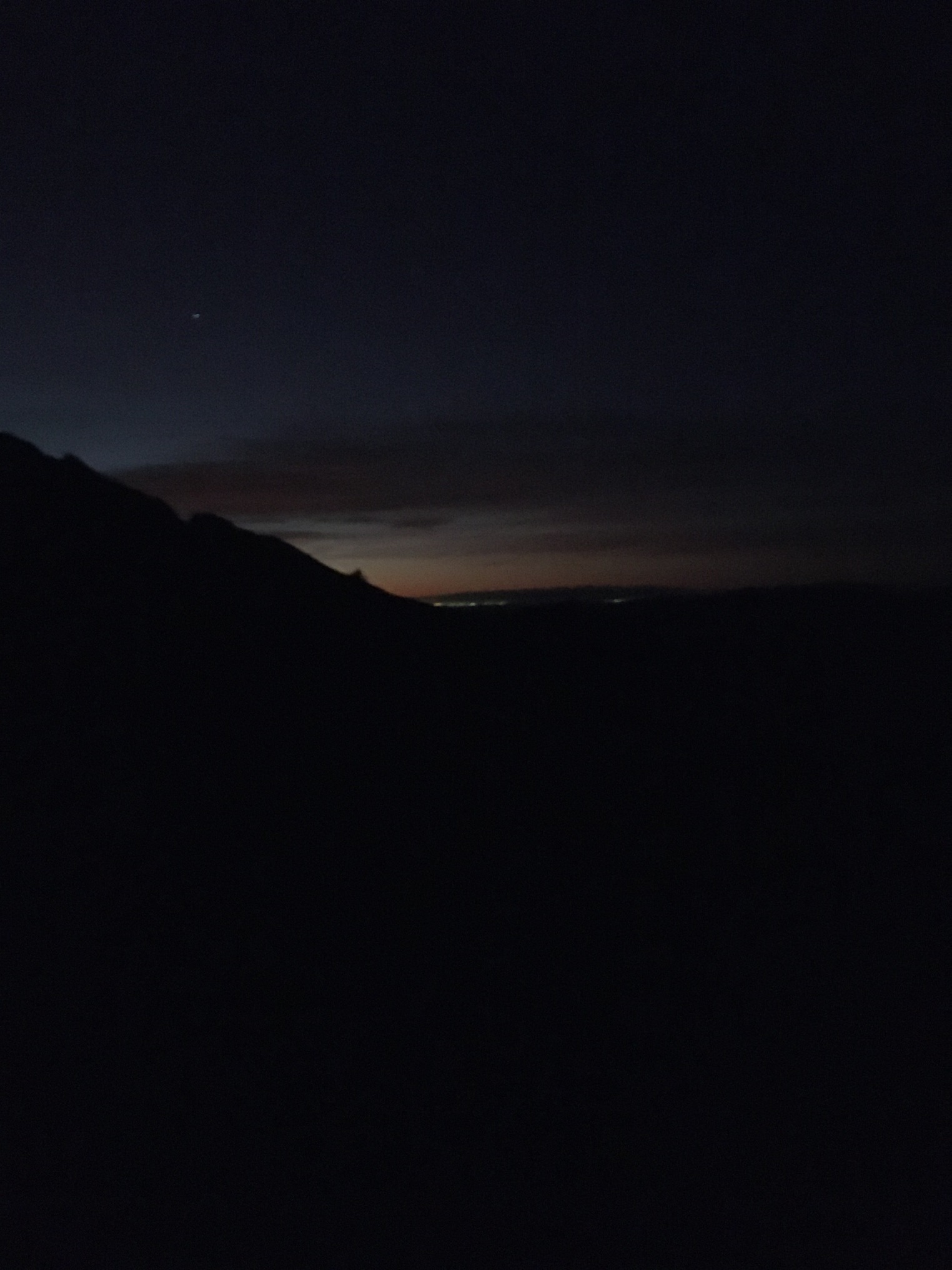
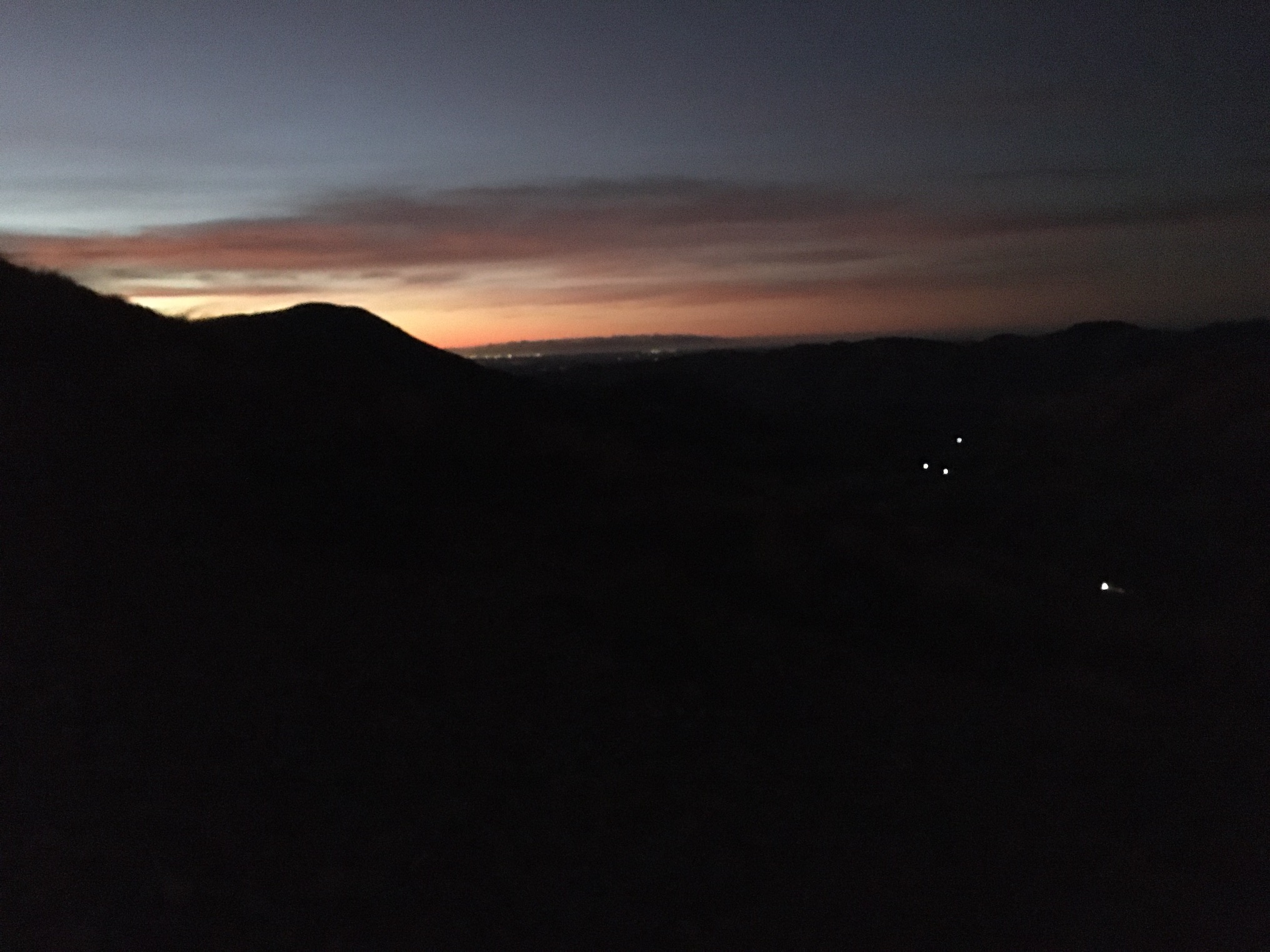
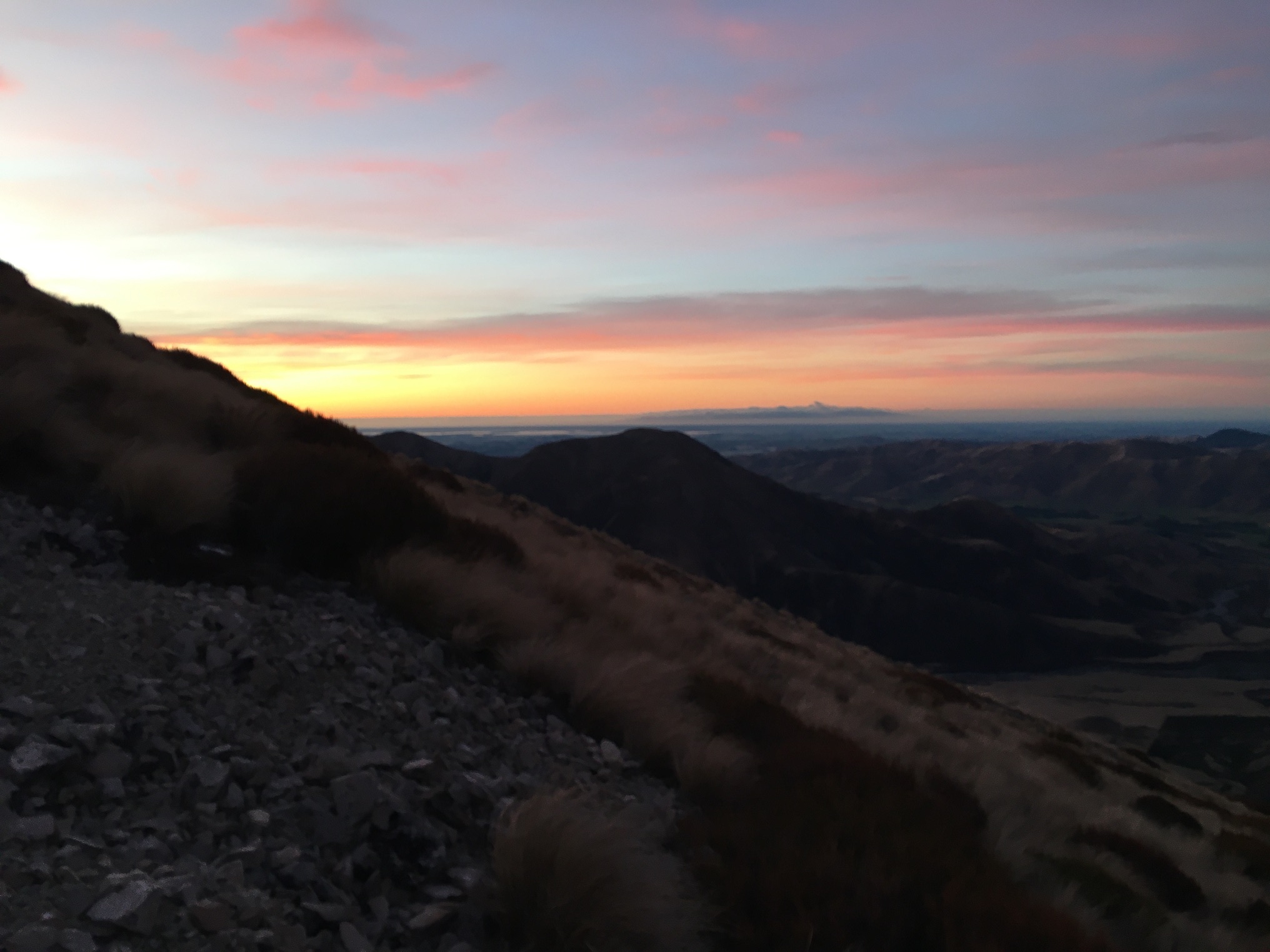
Spending time with whānau wasn’t an option for me today, so I thought I’d celebrate my connections to the seasons and the Earth instead. Before dawn I drove to Porter’s Pass and hiked up towards Foggy Peak. It was dark when I began the ascent, with just a hint of light to the east. I hiked the first 40 minutes or so with my head torch, before it was light enough to see the track.
Being midwinter, I expected it to be cold. It was actually surprisingly warm to start—the air temperature was above freezing. But the wind was stiff, and the temperature was still falling. Thankfully, there was no problem staying warm on the uphill.
But the wind grew more fierce the further up I went. I stopped frequently to enjoy the beauty of dawn in the mountains, to gaze back at the bright smudges of towns dotting the plains, the pinpricks of light from the cars crawling up the mountain to Porters Pass. I never stopped for long, though.
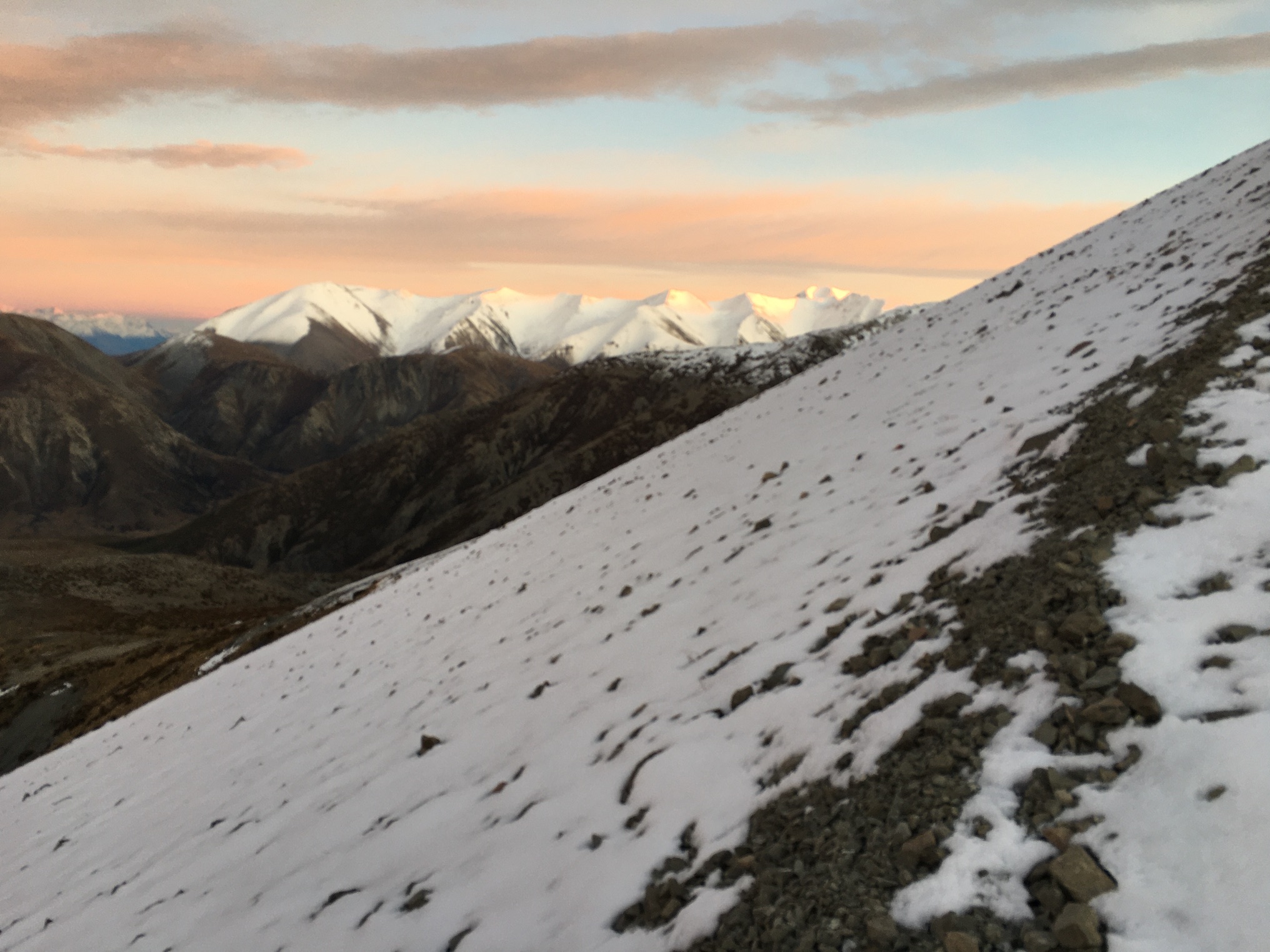
I’d hoped to catch the sunrise from the summit of Foggy Peak, but as the scree gave way to icy snow, my progress slowed, and I wished for crampons. I watched sun strike the snowy peaks of the Craigieburn Range and decided that that would have to be good enough—I could push on to Foggy Peak, but I wasn’t going to sit there with a cup of tea and watch the sun rise as I’d hoped. Even if I’d been in time, it was too windy and cold.
So I had my tea in a sheltered spot lower down, where I could sit and enjoy the view. It wasn’t the summit, but it was a beautiful way to start the new year.





 Robinne Weiss