Wolves

IMG_1524 smToday’s vacation outings included a trip to the Wolf Sanctuary of Pennsylvania. Though wolves and humans alike were wilting in the 94-degree heat, it was an interesting tour.

The animals’ individual stories were sometimes heartbreaking—most of them had been removed from owners who kept them illegally, often in poor conditions.

The wolves, kept in small to medium-sized ‘packs’ throughout the 80 acres of the sanctuary, ranged from the friendly young one who begged the keeper for a scratch through the fence, to the wary animal (kept for nine years on a chain in someone’s back yard) who wouldn’t come near the fence, even for a venison snack.

The wolf pictured here was happy to approach the fence and display his remarkable sense of smell. As you can see in the photo, he is blind—cataracts. In the wild, a blind wolf would be driven from his pack—there’s no room for disability in the wild (at the sanctuary, he is kept in a pack of two to avoid this). In captivity, he clearly thrives, making his way by smell and hearing. While we watched, he sniffed out a chunk of meat thrown into the undergrowth, and our guide related how he had once caught a rabbit that wandered into his enclosure.

Seeing these wolves in captivity was nothing like hearing wild wolves howl at night in northern Minnesota. And the stories of how they cam to be at the sanctuary are a terrible symptom of humans’ desire for mastery over wild animals. But I was glad for the opportunity to see these marvelous animals up close, an to know that in spite of their sad pasts, they are now being cared for with compassion and respect for their physical and social needs.

Cicada Killers

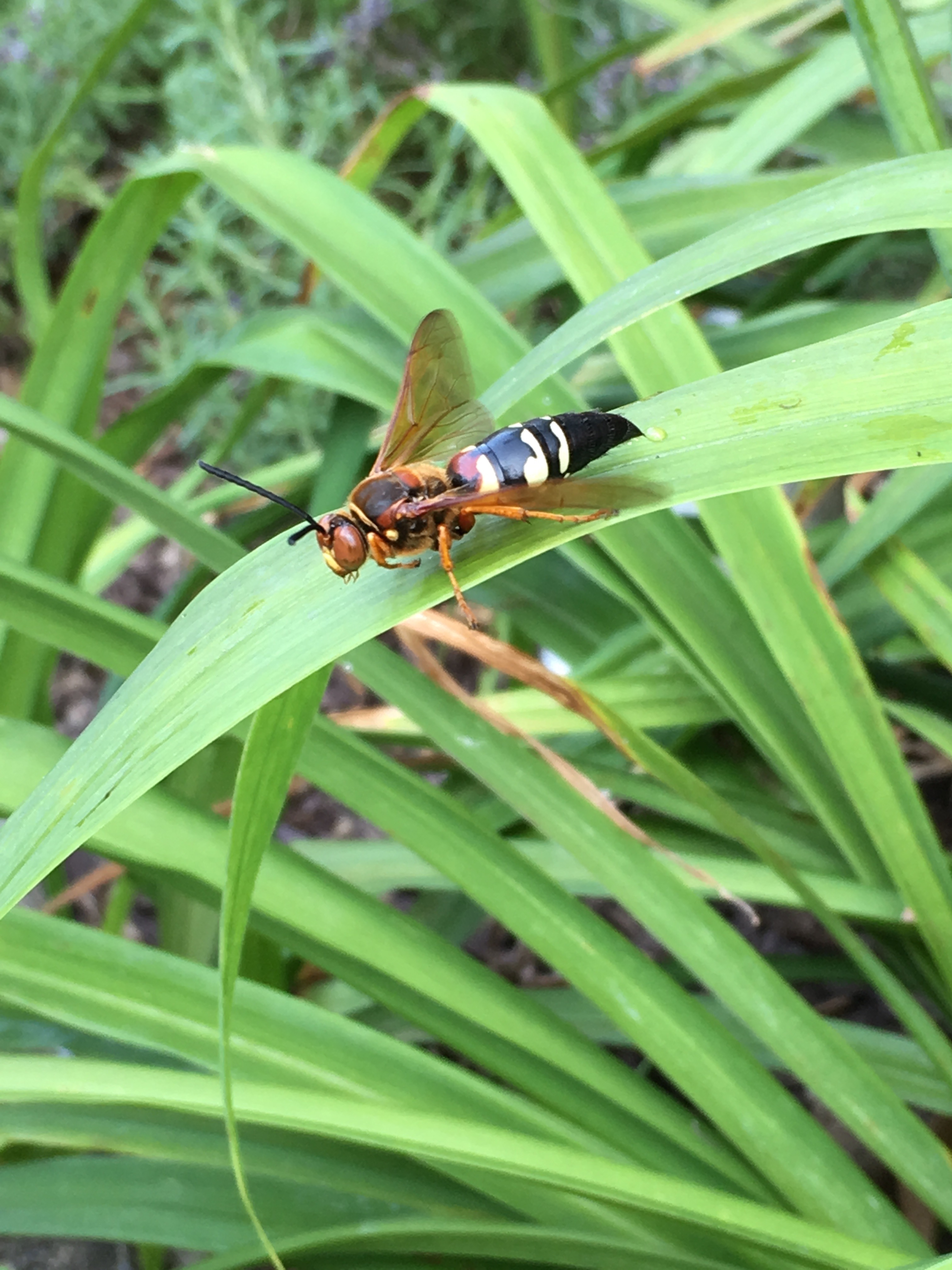
IMG_1470How can you not love an insect called a cicada killer?

The eastern cicada killer (Sphecius speciosus) is a solitary burrowing wasp. One of the largest wasps in eastern North America, the females top out at about 5 cm (2 inches) in length. These beautiful, large wasps are harmless to humans, but deadly to cicadas.

The female catches and stings adult cicadas. The sting paralyses, but doesn’t kill the cicada. The wasp then takes her immobilized prey to her underground burrow where she lays eggs on them. Male eggs get one cicada each, and female eggs get two or three cicadas (because females are bigger and need more food to reach adulthood). The eggs hatch out, and the wasp larvae eat the cicadas.

Cicada killers, looking a lot like giant hornets, strike fear into most people’s hearts. Their behaviour can be frightening, too. Males defend territories from other males, and can be seen fighting one another, grappling in midair. But males have no stinger, so they’re completely harmless to humans. Female cicada killers can theoretically sting, but unlike the social wasps, they don’t sting to defend their nests. You’re only likely to be stung by a cicada killer if you pick it up and squeeze it.

The cicada killer in this photo is a male. His territory is in my mother’s garden, and he is reliably found on a particular plant in the morning sun, sallying forth to challenge other males who get too close.

Confessions of the Resident Exterminator

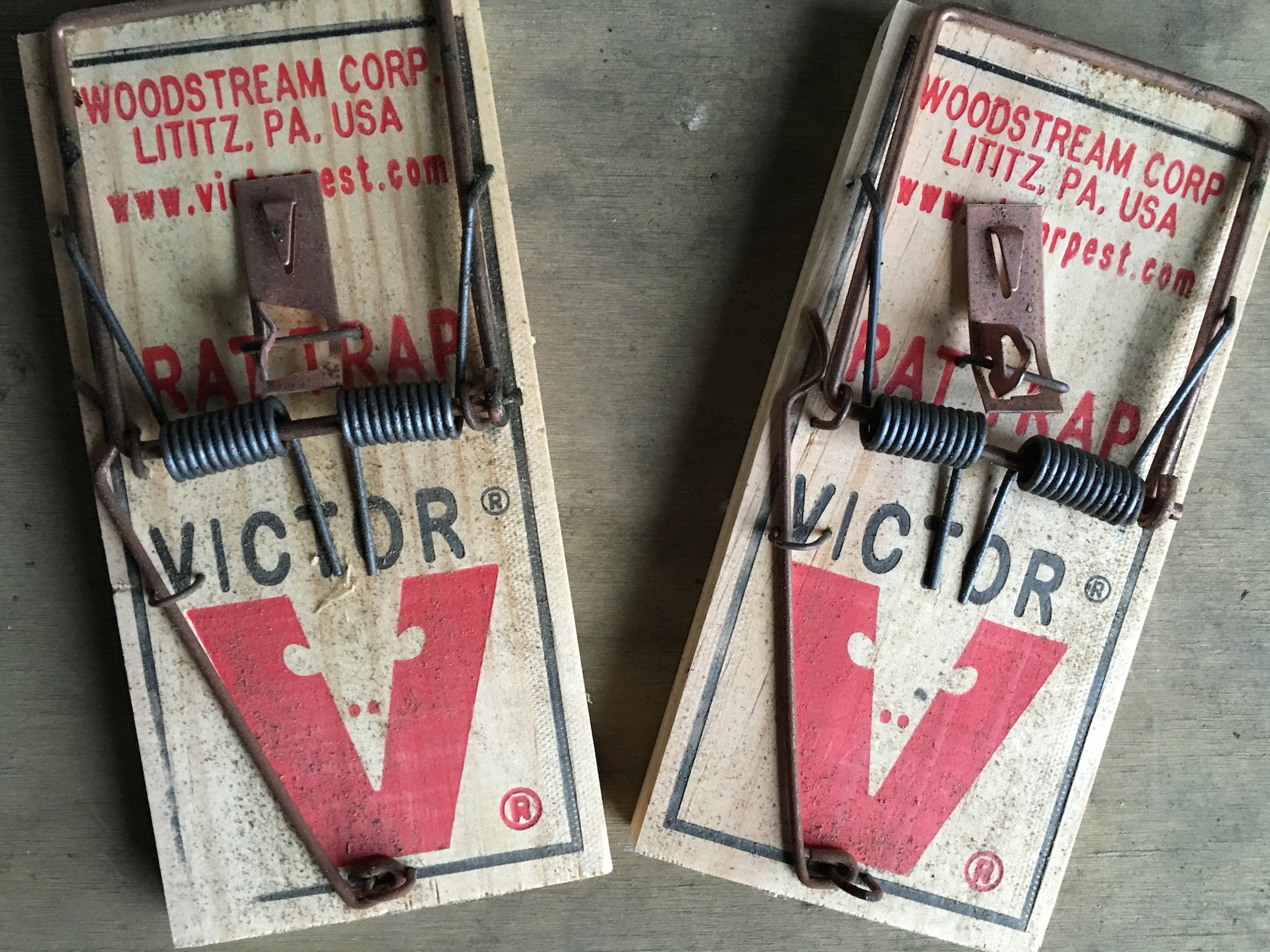
2016-06-20 16.14.21Being the least squeamish member of the household, it falls to me to deal with all members of the animal kingdom on our property.

That means I take care of the livestock, of course (I can’t even imagine anyone else dealing with kidding or mastitis), I dispose of the gifts the cat leaves lying beheaded on the lawn, and I deal with pests.

Though I don’t enjoy killing anything, I have no problem squishing bugs in the garden, and dropping slugs into soapy water (I don’t recommend squishing them—its really slimy). I don’t even flinch at the idea of setting mouse traps or possum traps, either.

But rat traps? *shudder*

I put it off until the rats are so numerous that they’re having loud parties in the attic, keeping me up all night racing around, gnawing on the rafters.

And then I wait longer, until the rest of the family starts to notice the noise in the attic, or a greasy body sliding through the wall cavities.

Then I pull the rat traps out and look at them for a while, screwing up my courage.

Finally, after many excuses, I get out the ladder, prepare some bait (bread with peanut butter is reliable), and make my way to the attic with the traps.

Bait on the trap, set trap in place, pull back the bar to arm it…

SNAP!

Bait goes flying, fingers sting, and I jump, cracking my head on a rafter.

Try again. Bait on the trap, put the trap in place, pull back the arm…

SNAP!

Maybe we can coexist with the rats? I calm myself and try again. Third time’s the charm, right?

Bait, set it in place, hold my breath and pull the arm…

Breathe out slowly. Carefully move my hands away from the trap, willing it not to spring shut.

Get the second trap. Repeat.

The good news…and the bad news is that the traps work. Within 24 hours I’ll have to empty them and reset them. The parties will stop. I’ll be able to sleep.

But I hate setting those traps.

Adventure on Kaitorete Spit

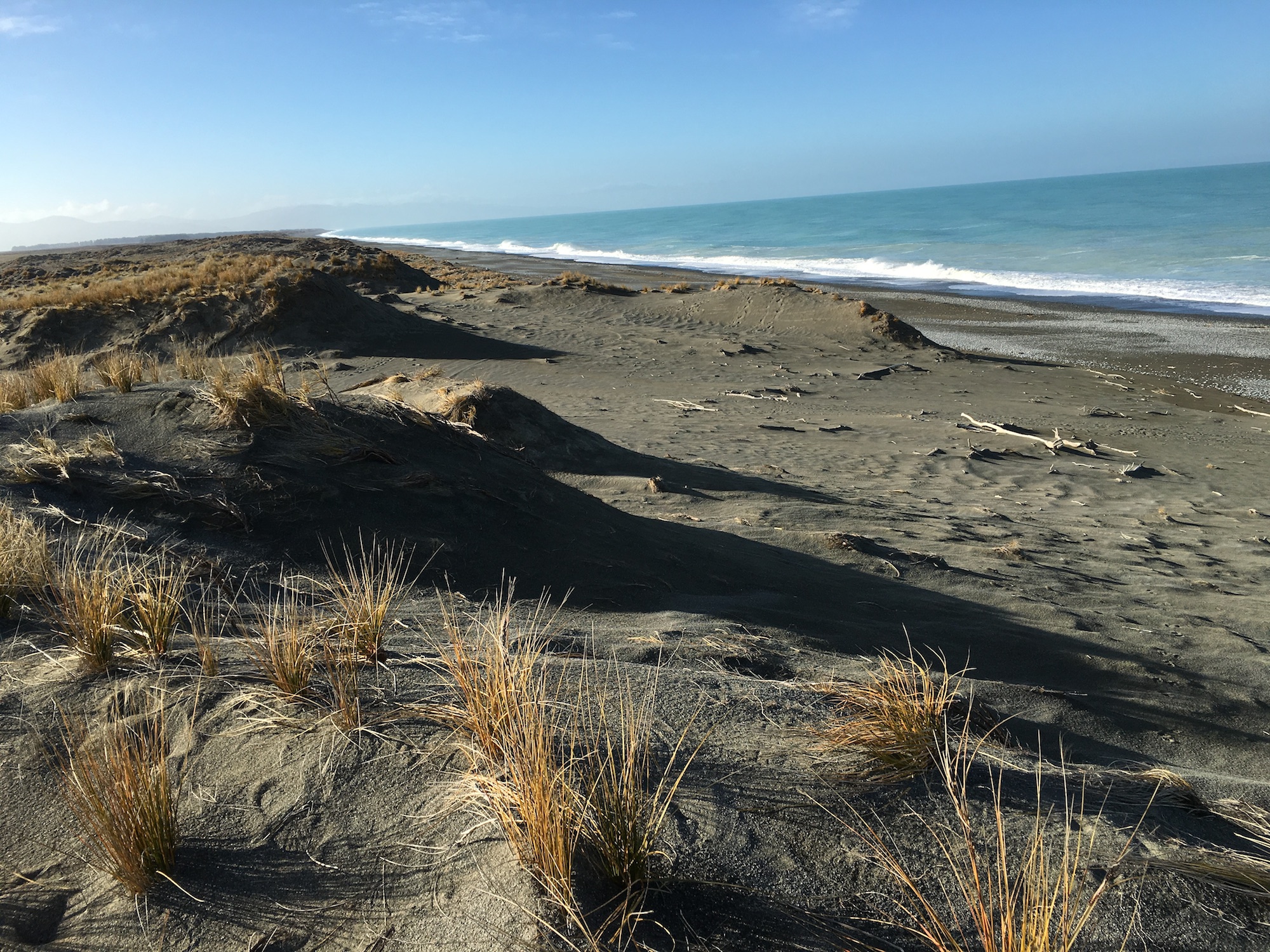
2016-06-11 11.10.09 smSaturday morning, we took advantage of the lovely weather to take a walk out on ‘our’ beach. Not just any old walk, but one that would take us beyond the lake opening onto Kaitorete Spit.

I can’t believe that in the eleven years we’ve lived here, we’ve never done this before. We’ve walked to the lake opening many times, but always when the lake was open to the sea, to see the dolphins and seabirds that congregate there eating the fish migrating in and out of the lake.

But our goal this time was the wild tip of the spit.

You would think that a mere couple of kilometres would make little difference in the beach, but the change was positively stunning.

On ‘our’ part of the beach, the dunes are covered in non-native shrubs and ice plant. Not a native plant to be found.

An hour’s stroll out onto the spit took us into a different world. Non-native plants all but gone on the dunes, replaced by pingao. Behind the dunes, native broom, Raoulia (vegetable sheep), and Muehlenbeckia.

The shape of the dunes was different. The whole effect less verdant and more windswept.

Naturally, we searched for kātipo spiders among the pingao, as this is one of the few places this endangered spider can be found. We found none, but we did find a number of other spiders, lots of spider egg cases, and a couple of sand scarabs (including an adult, which was a first for me).

We knew all this was out there, but knowing and having experienced it are two different things.

And now that we understand what’s out there, I’m sure we’ll be going back again soon.

Saturday Stories: Why I Always Obey Warning Signs

2016-06-11 10.13.31 smWe didn’t see the sand shark until it was too late.

To tell the truth, I don’t think any of us really believed they existed.

Oh, we’d been warned. Mum and Dad saw the news on television and told us not to go out to the beach after school. But we always went out on the beach after school. Who would walk along the street when you could walk the beach home instead? The street was full of rubbish and car exhaust. On the beach there were shells, and sand hoppers, and sometimes even dolphins out in the waves.

So, naturally, coming home from school the next day, we turned off the street onto the beach path.

Five metres along the path, a big red sign blocked our way: DANGER! SAND SHARKS! DO NOT ENTER!

We laughed and stepped over the rope barrier. Sand sharks—yeah, right. There were plenty of sharks in the water—we knew that—they cruised along the shore, just beyond the breakers. We didn’t always see them, but we saw enough that we could tell the difference between a great white and a tiger shark. But sand sharks? That was ridiculous.

We crested the dunes and raced down the far side, like we did every day. The beach was deserted. I suppose that should have told us something, but like the other warnings, we ignored it.

Jamie and Kate kicked off their shoes and raced down to the water, splashing right into the waves. Mum would have a fit about their soaking wet school pants when we got home, I thought.

I picked up their shoes as I followed more slowly, texting my friend Ellie to see if she wanted to go to the movies on the weekend.

Maybe if I’d been paying attention to something other than my phone, I would have seen it. But it wasn’t until the shark’s massive dorsal fin sliced across the beach that I looked up.

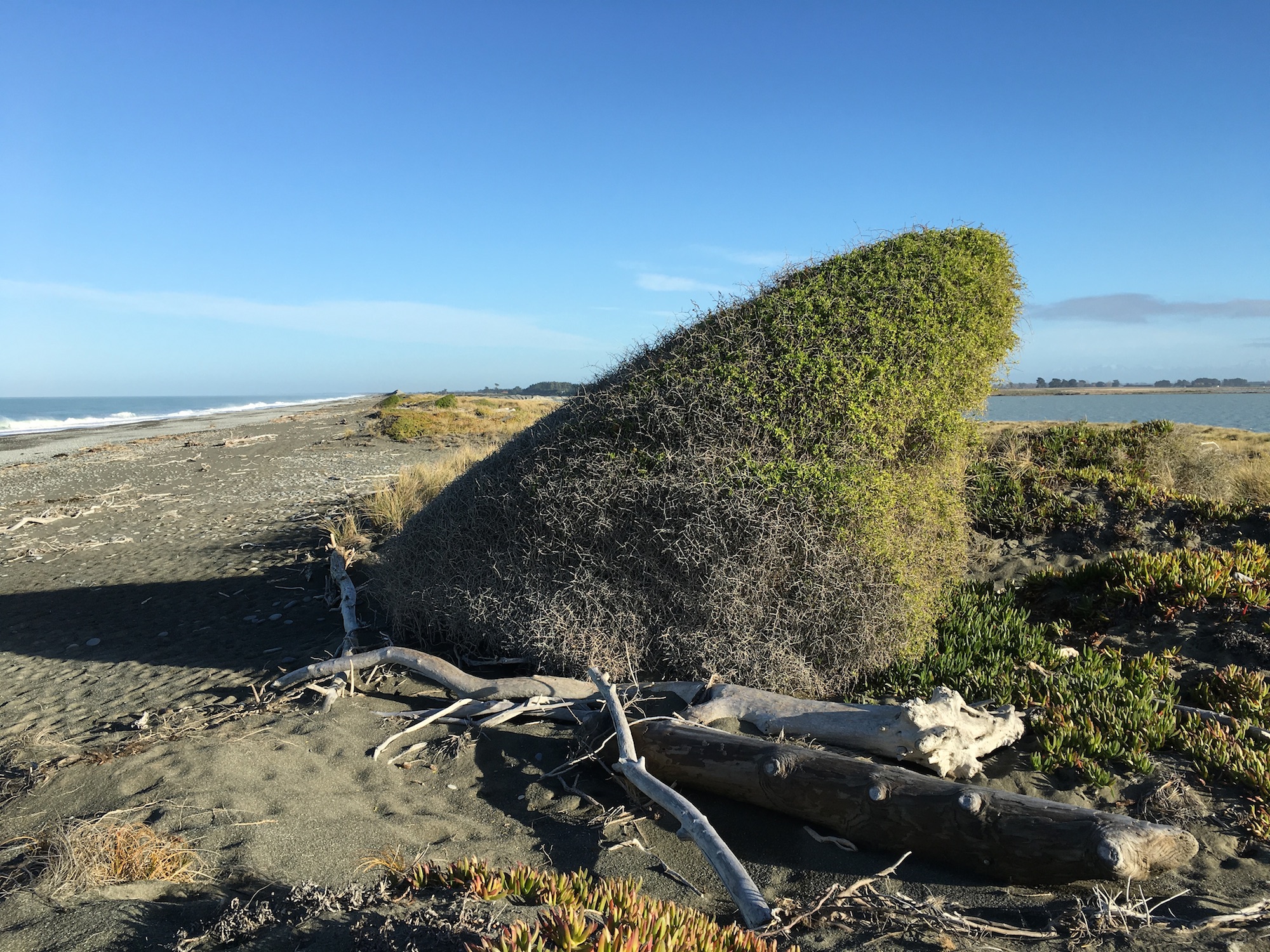
It was speeding down off the dunes, the dorsal fin looking like a wave-sculpted bush. A heaving ripple of sand pushed out in front and to the side, like the wake of a speeding boat.

I screamed at Jamie and Kate and broke into a run, trying to get to them before the shark did. I don’t know what I thought I was going to do if I made it—I was no match for the animal—it must have been at least fifteen metres long, by the size of the dorsal fin.

Jamie and Kate either heard me or saw the shark, because they turned and shrieked. Kate grabbed Jamie’s arm and pulled, but Jamie was frozen in fear. I don’t think running would have saved them anyway—the shark raced toward them at a speed none of us could have matched. A metre from my siblings, it heaved its body out of the sand, jaws wide open, rows of razor teeth gleaming in the sun. The jaws snapped shut and Jamie and Kate were gone.

I was still racing toward them as the shark sank back into the sand and turned toward me. My steps faltered. Then I dropped my phone and the shoes I still carried, and pounded up the beach.

I could hear the hiss of sand as the shark gained on me. I hit the dry sand above high tide line, and my feet slipped as they sank in. Stumbling, I kept going, finally hitting the harder sand of the dunes. I dared a glance behind me, only to wish I hadn’t—the shark was nearly on top of me.

I flew down the path over the dunes, vaulted the rope barrier and kept going toward the street.

I heard the warning sign splinter as the shark hit it and sent it flying. I could feel the sand shift under my feet now as the shark’s wake hit me.

My feet hit the sidewalk, and an instant later the concrete buckled, sending me tumbling to my knees.

The shark’s dorsal fin was jammed into the broken sidewalk, just a metre from where I crouched. Slowly, it sank out of sight, leaving me shaking and unable to move.

A car I recognized pulled up at the kerb.

“Lynn, are you okay?” asked my mother. “Where are your brother and sister?”

Throwback Thursday: Jujuná

d1scans011 smLiving in Panama was sometimes like living in a never-ending episode of David Attenborough’s Life on Earth.

The invertebrates alone were enough there to keep me intrigued for a lifetime—tarantulas, whip scorpions, solifugids, scorpions, grasshoppers, mantids, butterflies, bioluminescent click beetles…every day was an entomological adventure.

And the snakes! Coral snakes, fer-de-lances, palm vipers, vine snakes, boa constrictors…never a dull moment.

And don’t even get me going on the frogs, birds, and lizards—I could spend a week waxing lyrical about the hummingbirds alone.

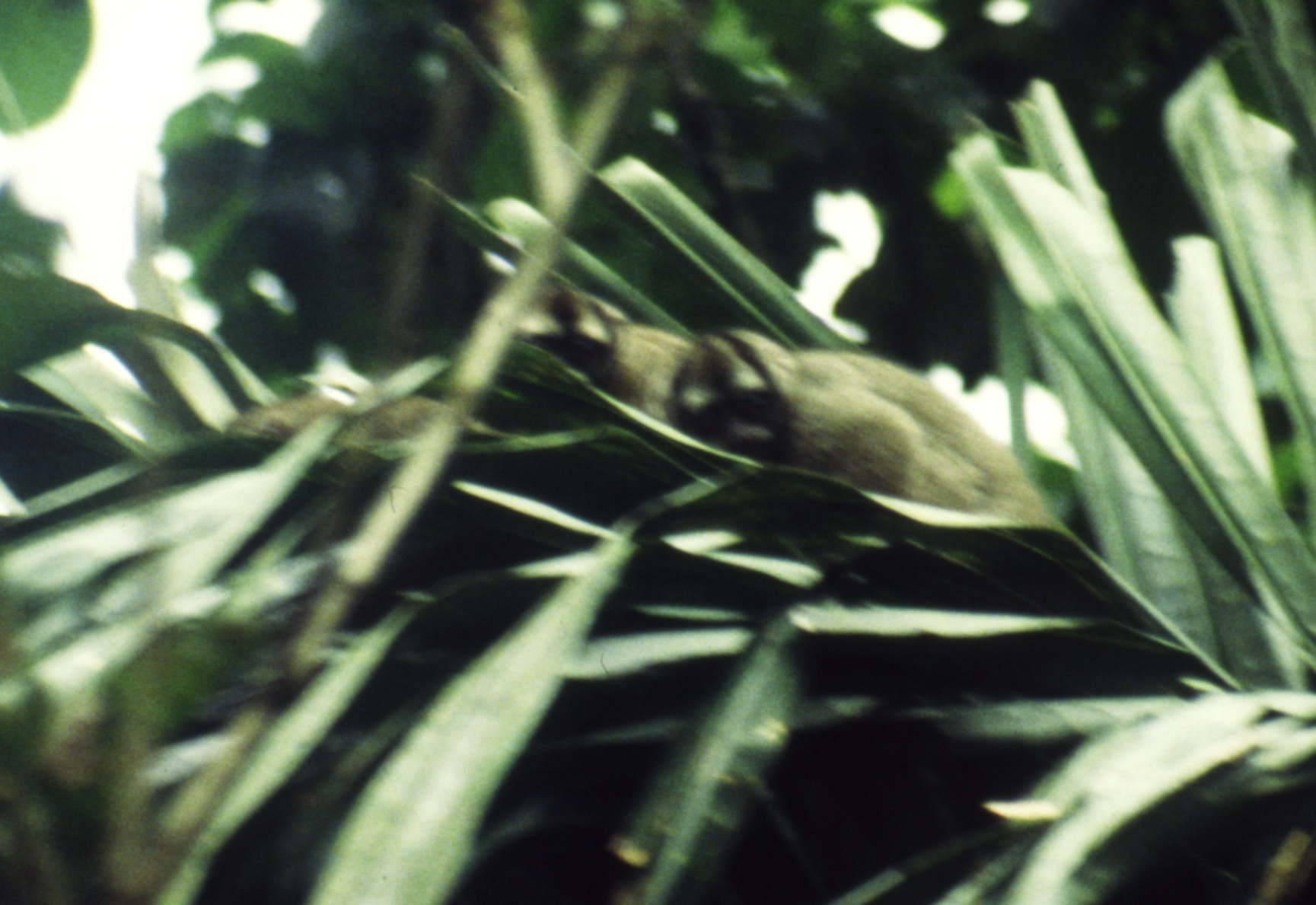
In the rainforest, we could see howler monkeys, spider monkeys, cotton-top tamarins, agouti, and jaguarundi, among other mammals. And even in our far-from-pristine village, where all the forested land was managed by the local farmers, we had mammals—sloths, squirrels, rats the size of small dogs, and one of my favourites—the jujuná or night monkey. We didn’t see them often. As their name implies, they’re nocturnal. The only nocturnal monkey, as it turns out. Its secretive habits are probably why it manages to live where other monkeys don’t.

Night monkeys are interesting, not just because of their unusual nighttime habits, but also because they are one of the few primates other than humans who contract malaria, making them important in medical research on the disease.

Night monkeys live in small family groups. The individuals in this photo are probably a mated pair and their young (the little one is on the left—you can just see its back). Though we seldom saw them, it was fun to know they were there.

Promise of Spring

2016-05-27 12.53.09Tomorrow’s forecast is rather wintery, but I’ve been fortified today. The preying mantises must know their time is short—that one of these storms is going to do them in for good—because over the past couple of days, they’ve been laying eggs all over the place.

There are new clusters on the fence posts, on the rosemary, and even on my office deck.

Though the adults will succumb to the weather, their eggs will rest snug all winter in their cosy egg capsules—a promise of the spring to come.


Pass Me a Brick, Hold the Mayo

The one in the middle used to fill its space...

The one in the middle used to fill its space…

I’ve mentioned the pest birds at our property more than once in this blog. Today I was musing on them again, as I watched a whole flock of them descend upon our brick fire pit.

Yes, our fire pit.

It was the bricks they were after.

Whether for the grit or the nutrients, I don’t know, but I’m inclined to think the latter. The clay for the bricks came from some other location, so it’s bound to contain nutrients our property doesn’t.

As it turns out, this is a worldwide issue with sparrows and finches—they love bricks and mortar. It’s not a particular problem for us—the fire pit isn’t exactly an essential structure. The only bricks that really matter on our property are the ones in the chimney, and the birds don’t seem to like those.

In fact, they’re quite selective about the bricks they eat. Perhaps they go for the softest ones, or perhaps there are subtle differences in the nutrient levels in different bricks. The birds aren’t telling, and as far as I can tell, no one has ever felt the need to study the issue in detail.

Regardless, they’ve foolishly chosen to focus on a brick in the centre of the fire pit. One of these days, they’re going to break through it, and the bricks on top are going to fall on their heads.

A very slow form of pest control?

Stalking the Wild Tardigrade

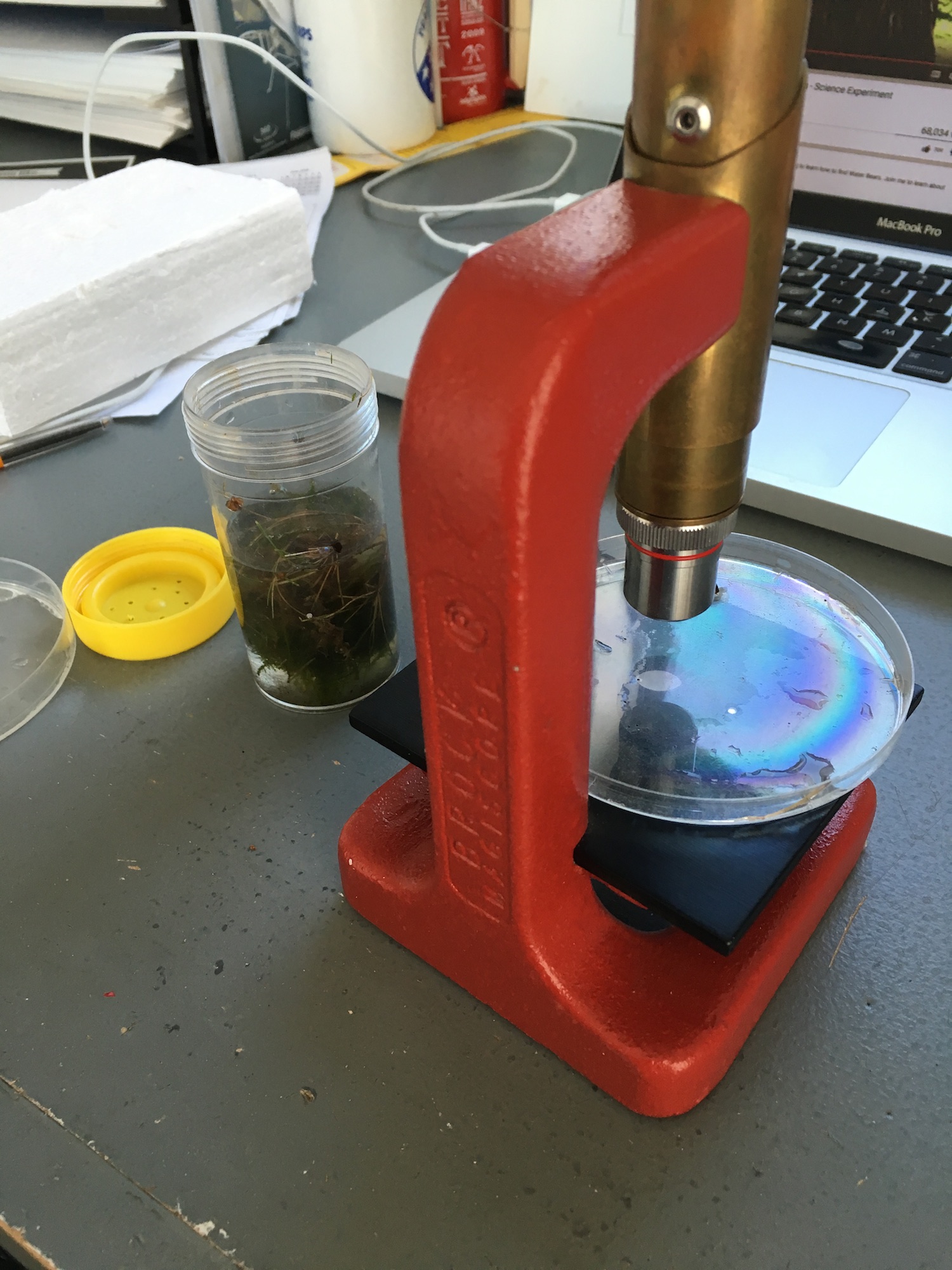
2016-05-25 14.50.00The recent rain has got me thinking about tardigrades. Tardigrades are, of course, one of the most awesome creatures of the animal kingdom–able to survive freezing, desiccation, radiation, intense pressure, and the vacuum of outer space, just to name a few. I mentioned them in a sci-fi short story I wrote over the summer, and have been meaning to go looking for them ever since.

Well, the moss is nice and wet now, so I figured it would be a good time to find some. I collected some moss, soaked it, squeezed out the water and, voila!

I found springtails,

And mites,

And paramecia,

And nematodes,

And some things that looked and acted like microscopic leeches…

But no tardigrades.

I peered down the microscope until my eyes crossed. I squeezed out more water from my moss.

No joy.

No tardigrades.

Of course, that just makes them all the more exciting. Now I have a challenge—stalking the wild tardigrade.

Stay tuned…

Feeling Bad? Consider the Barnacle

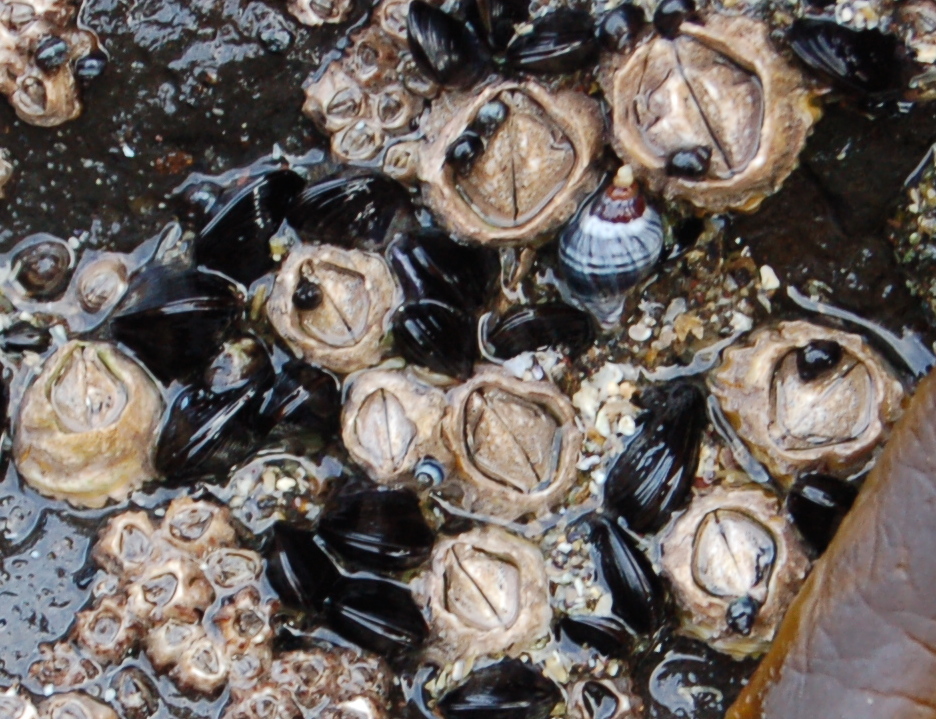
DSC_0027 cropThe lowly barnacle is well-known. Most people can point to one and say, “that’s a barnacle.”

Well done, but how many people know exactly what a barnacle is?

“It’s this…thing…that lives on rocks at the beach.”

“Don’t they grow on whales?”

“Ships get covered in them.”

As an entomologist, I know a bit about barnacles, because they are Arthropods, just like insects, spiders, millipedes, crabs, and lots of other creepy crawlies. In fact, they are crustaceans, closely related to crabs and crayfish.

Wait, you say. Don’t Arthropods have ‘jointed legs’—that’s what the word means, after all—but barnacles don’t have legs.

Or do they?

Barnacles are perhaps the strangest of the Arthropods. The free-living larva is a weird, tiny, spiky creature with one eye. It goes through a metamorphosis, like insects do, in which it changes shape dramatically. In its last larval stage, it finds a nice place to spend the rest of its life, presses its forehead against it, and secretes a calcium-rich cement from near the base of its antennae that permanently affixes its head to the spot.

In its adult form, a barnacle grows a protective shell, complete with a clever two-part ‘door’ that it can snap shut to conserve water at low tide, or to protect itself from predators. Its legs grow long and feathery, and act as tentacles to waft particles of food to its mouth.

As you can imagine, adult barnacles don’t have much of a social life. Most species are hermaphroditic, meaning individuals are both male and female. Surprisingly, though, self-fertilisation is rare. Like other arthropods, most barnacles have what’s euphemistically known as ‘internal fertilisation’—that is, the male has a penis, and he deposits his sperm inside the female. How does an animal glued by its head to a rock get together with another to mate? The answer is a very long penis.

So the next time you feel like your life is rough, be thankful you’re not a barnacle.