Spectacular Stick Insects

One of the first things we did when we bought our new property, even before we built the house, was to establish native plantings. Those plantings have grown spectacularly well, and many of the trees are four metres tall already.
Invertebrate life on the property has increased with the growth of our gardens. Our lush akeake attract katydids, the herb garden is alive with butterflies, native bees, and hover flies. Preying mantids stalk the flowers, snatching up prey. Jumping spiders of several species prowl among the foliage and rocks. And web-building spiders festoon the branches of nearly every plant.

But there are some notable absences. Species that aren’t good at dispersal.

One of those absences is stick insects. Our common native species here in Canterbury are particularly fond of kānuka and mānuka. The kānuka we planted in our gardens has grown beautifully, but is completely devoid of stick insects. 

But not for long …

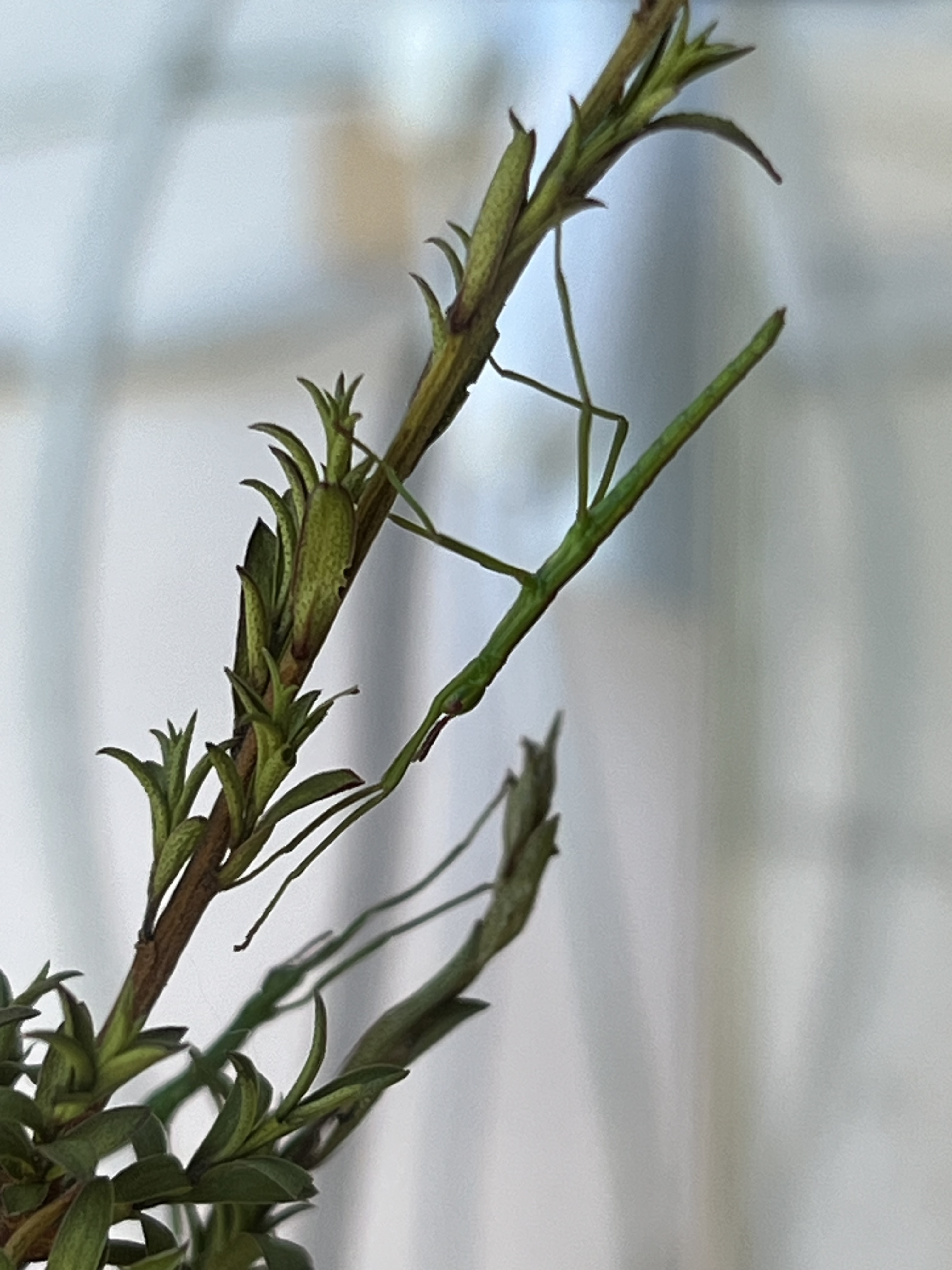
I was recently gifted some stick insect eggs from a researcher who is studying them. I set them up in an aquarium with some kānuka branches and eagerly awaited their hatching. The researcher warned the eggs were a bit old and might not hatch, but over the course of a few days, seven successfully emerged (a few more died in hatching). 

The seven stick babies are now happily munching kānuka in captivity. I’ll release them into our garden when they’re a little older and I’m more confident they’ll survive. For now, I’m enjoying watching them in their tank on my desk. 

Stick insects are some of my favourite bugs. I love their improbable shape. I love their crypsis-enhancing behaviours—sitting with their forelegs stretched out in front to make them look even more stick-like, and swaying in the ‘wind’ when disturbed. 

I also love the fact that many species are parthenogenic—the females can lay fertile eggs without mating with a male. In fact, there are some species of stick insect for which we’ve never found males.

This parthenogenesis is the result of a strange relationship many insects have with the reproductive parasite Wolbachia. Wolbachia is a genus of bacteria that is passed from female insects to their offspring. Because Wolbachia’s spread is only through the females of its host species, it’s in the bacterium’s best interest to eliminate males. It does this by a variety of methods, depending upon the strain of bacteria and the host species. The result is insects in which males are rare or nonexistent and females can reproduce parthenogenically. Its a cool and complex relationship that I find fascinating.

I look forward to establishing stick insects on our native trees. Hopefully my seven lovely babies will grow into a thriving population.
Bioblitz Weekend

Last weekend I had the pleasure of participating in a mini bioblitz at the University of Canterbury’s Cass Mountain Research Station.

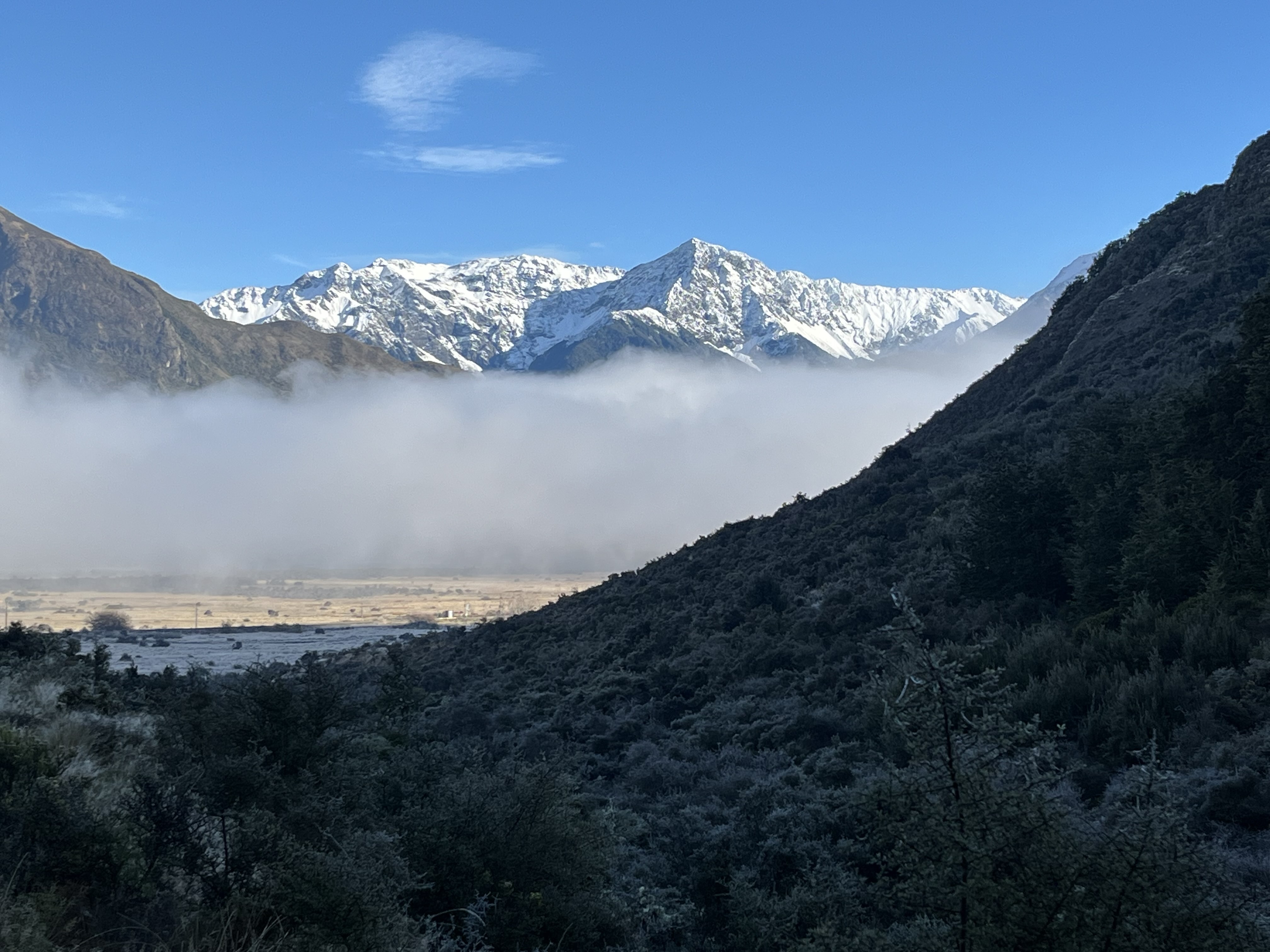
Eleven of us descended on the station on the frosty Saturday morning. Fog enshrouded the mountains, but blue sky above promised a glorious day.

We set a goal for the weekend of increasing the number of iNaturalist observations at Cass to 4,000 and the number of species observed there to 800. Then we embarked on forays into the bush and across the outwash fan to search for life.

I was stuck near the station, because my knee hadn’t yet healed from the previous week’s tramp. But my geographical constraints didn’t prevent me from plenty of discoveries. Instead, it forced me to focus on the small and overlooked species. Mites, springtails, slugs … all manner of life abounds nearby and underfoot.

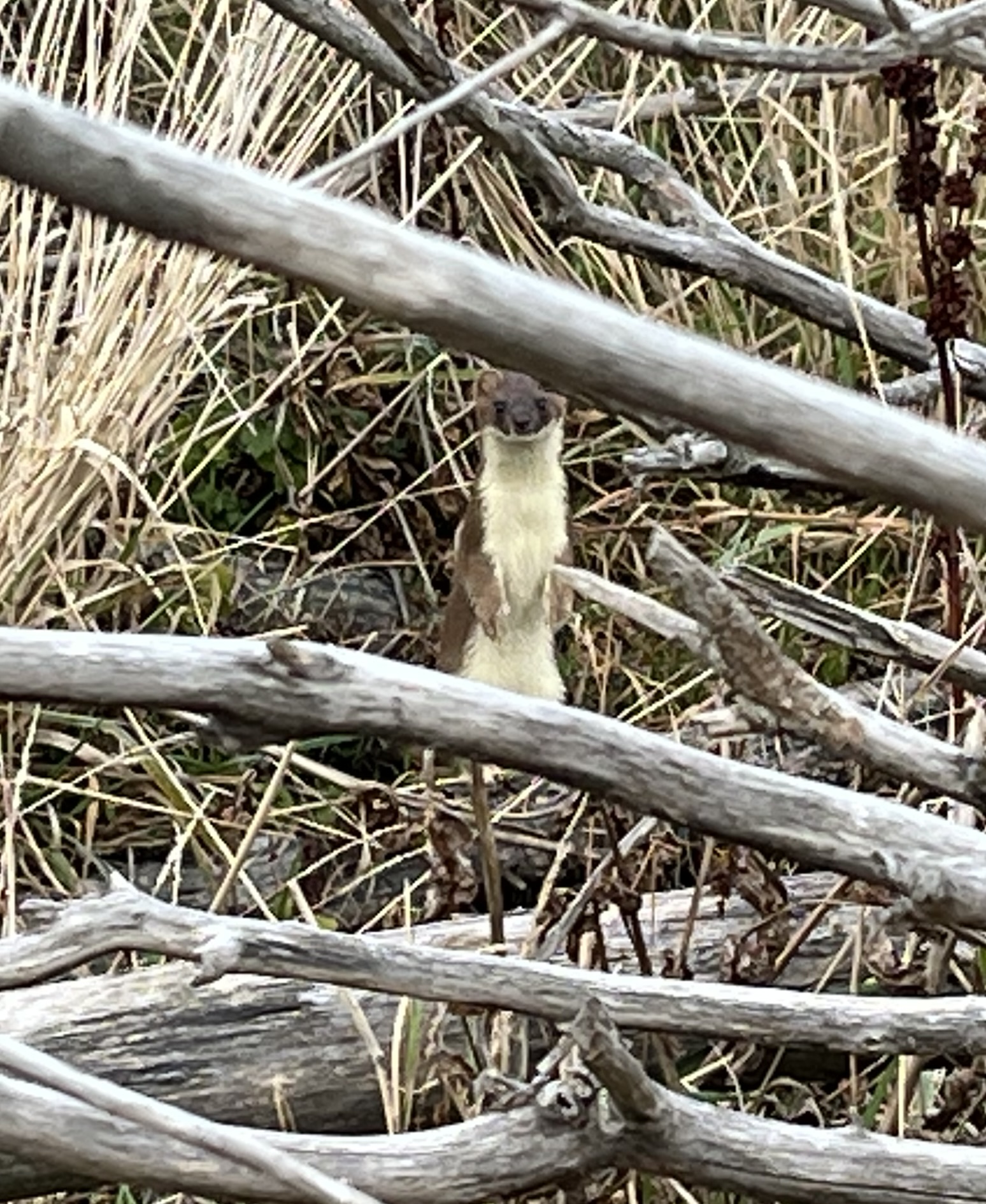
And because I was spending much of my time quietly turning over stones and picking apart rotting logs, larger organisms came to investigate me, including a pair of curious stoats who spent five minutes scurrying around me and popping up out of the vegetation to spy on me. In spite of the fact stoats are terrible pests here, and I would happily kill them, the encounter was pure magic.

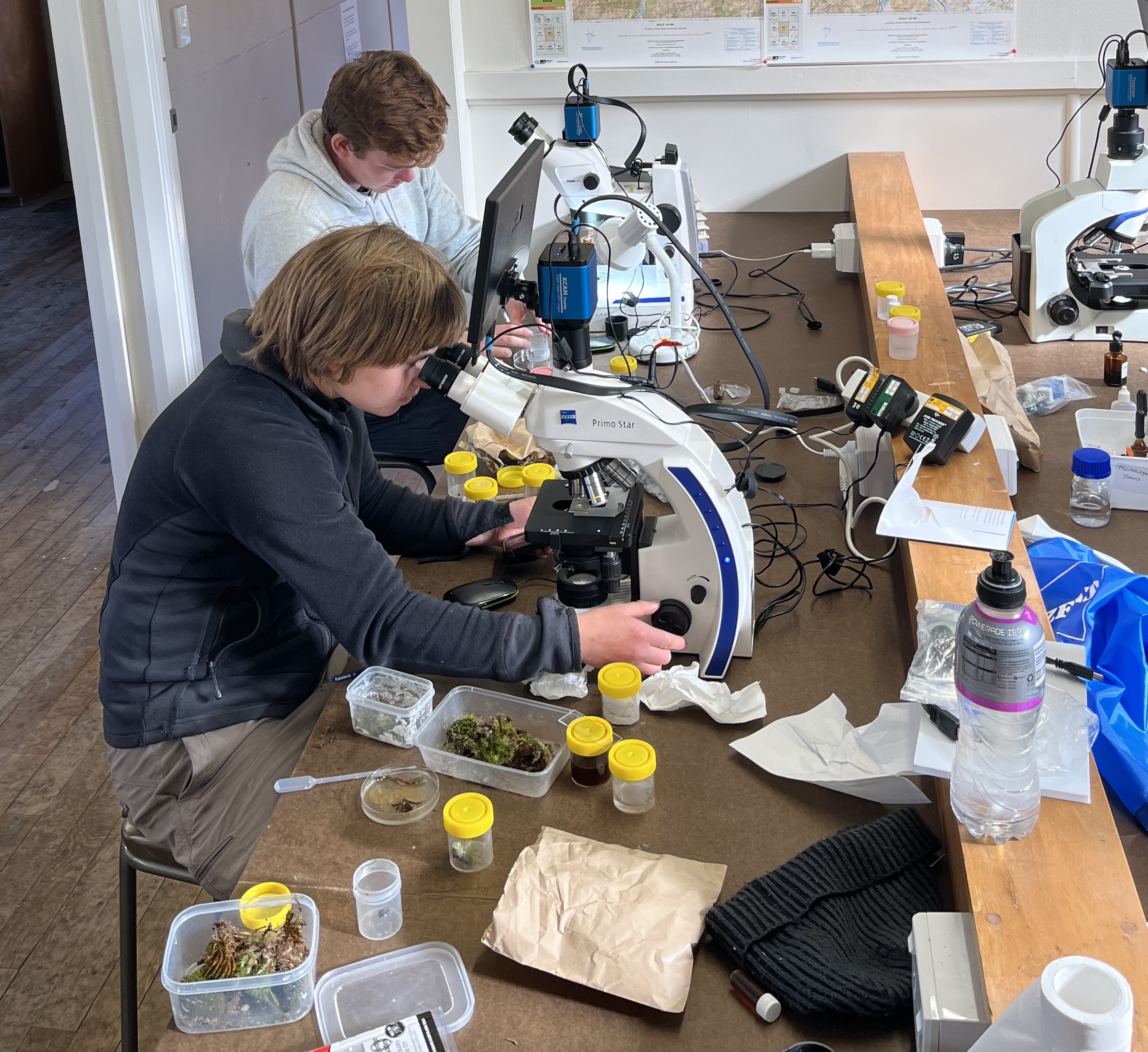
As people returned to the station laden with stories, photos and samples, we moved to the microscopes in the lab, where the geek factor was cranked to 11.

“Oh wow! Look at this!” was a common refrain, as we crowded around the microscopes to examine the smaller finds. As dusk fell, we set up light traps for flying insects, to be checked later in the night.

On Sunday, a group ventured into the bush in search of the giant springtail, which was found at last year’s bioblitz. The quest was successful, and although it didn’t add a new species to the list, it was a highlight of the weekend for many.

In early afternoon, after a busy morning, and a lunchtime spent uploading observations to iNaturalist, we headed home, where we continued to upload our observations from the weekend.

When all was done and dusted, the 11 participants made 871 observations of 321 species. Almost 1 out of 3 observations were of organisms new to the Cass list, bringing the totals for Cass Research Station to 4484 observations of 869 species! An amazing result from a spectacular weekend!

The event reminds me again how important university field stations are for fostering science in general. The people at the two bioblitzes I’ve attended at Cass might never have collaborated or shared ideas in their everyday research life, but the research station brought them together in an atmosphere that fosters collaboration. The research station is a place where scientific curiosity can flourish, where scientists can explore the connections among disciplines and research projects. What an incredible asset for the university!

Weekend Tramp in the Two Thumb Range

Looking up Bush Stream

Last weekend, my husband and I got out for a tramping trip in the Two Thumb Range, in Te Kahui Kaupeka Conservation Park. We parked on Rangitata Gorge Road at Forest Stream, then slogged two hours up the road to Bush Stream—not a very exciting start, but better then than at the end of the tramp. We followed Bush Stream Track up the stream to Crooked Spur Hut. The stream flows through some pretty spectacular scenery, and you ‘get’ to cross the stream quite a few times before a steep climb to the hut.

Crooked Spur Hut is one of several historic musterer’s huts in the area. It’s old and the walls are full of holes and rats. We opted to sleep in the tent, but we hung out in the hut, since we had it all to ourselves.

Kea on a cold tin roof.

On the approach to the hut, a kea came to investigate, watching us climb the hill. It must have invited its friends later, because shortly after dark, while I was reading in the tent, I heard the thump-thump-thump of a couple of kea bouncing around outside. I shooed them away, knowing their penchant for mischief, and eventually they got the hint and left.

But by morning the kea had mustered reinforcements. They started about 4 am, thumping around outside the tent, plucking at the tent strings, and calling loudly right by our heads. By 5 am, we were up out of a sense of self-preservation, retreating to the hut to start our day.

When I stepped out of the hut a few minutes later, there were three kea, each one working on pulling out a tent stake, and more calling in the darkness beyond. We quickly took down the tent in the dark, before the kea tore it to shreds.

We got the billy boiling to the sound of kea on the tin roof. They seemed to have multiplied. The noise was deafening, and grew louder as dawn approached. Our trips out to the loo were accompanied by no less than three kea, who then sat on the loo roof, peering in through the skylight to watch the show. 

Returning from the loo, I counted fifteen kea, most of them on the hut roof, picking at the roofing nails (which thankfully had been replaced with non-leaded ones, because the old lead nails kill kea), and sliding down the tin. It was the most kea I’d ever seen at once. And as obnoxious as the cheeky buggers are, it was the highlight of the trip.

Leaving the kea behind, on day two, we hiked up from the hut through frosty tussocks to a scree-covered saddle where we were treated to some new spectacular scenery—tussock, scree and craggy peaks all around. At Swamps Stream we scared up a herd of 28 tahr—a non-native pest, but cool to see nonetheless. We arrived at Stone Hut at lunchtime, and had a lovely meal next to the stream before carrying on to Royal Hut.

Interior of Royal Hut.

Royal Hut is similar in age and condition to all the old musterer’s huts, but has the distinction of having been visited by royalty. The accounts I’ve found differ in the details—it was either in the 1960s or in 1970, and the royals involved were either Prince Charles and Princess Anne, or Prince Charles and Princess Diana (Diana being highly unlikely, given the date range suggested for the event).

In any case, it is said the royals zipped in by helicopter for a ‘brief’ visit. I doubt they spent the night. With mice scrabbling over our packs within 15 minutes of our arrival at the hut, we opted for the tent again.

Frost heave on the track, with 4 cm-long ice needles.

The morning of day three was fine and frosty (with frost inside the tent!). The DOC signage indicated we had an 11-hour hike to the road, and with daylight only being 11 hours or so long at this time of year, we made an early start, as soon as it was light enough to see the track.

We warmed up quickly, with the first leg of the day being a climb to Bullock Bow Saddle.

By the time we reached the saddle, I knew I’d pushed too hard over the previous couple of days—my left knee was stuffed, and hurt with every step. 

It was a loooong 14 or 15 km from there to the road—the first few kilometres steeply downhill, then a long slog down the Forest Creek riverbed. 

Still, we made it to the car well before dusk, and enjoyed more spectacular scenery (and a few more river crossings) along the way.

Overall, a fun long weekend! Spectacular views, awesome wildlife, and some real character huts. And the weather couldn’t have been better.

Wide-eyed Wonder–Not Just for Kids

I don’t often get to geek out with biologists (other than my own family, of course), so I was pleased to have an opportunity over the weekend to spend a day at Cass Mountain Research Station helping out with a mini bioblitz.

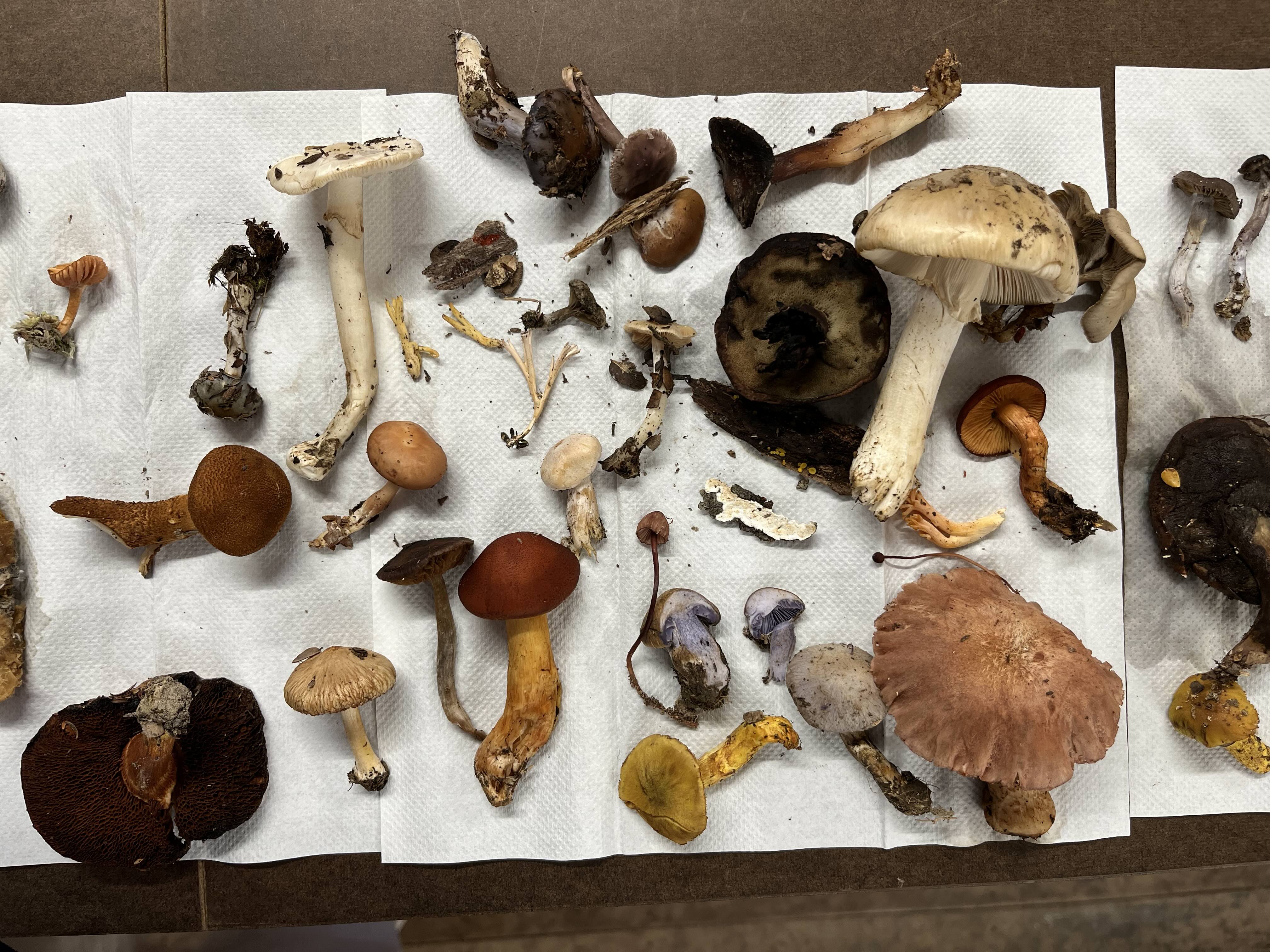
We couldn’t have asked for a better day—warm sun and clear skies made it a pleasure to be wandering around the forests and fields of the research station. And the company was great—everyone eagerly pointing out the mosses, herbs, bugs, birds, fungi and slime moulds we came across.

The enthusiasm was infectious. Back at the lab, folks peered at bugs, fungal spores, slime moulds, and moss, debating and discussing identifications, and calling out in delight when they discovered something awesome.

I was disappointed to have missed the tardigrades under the microscope, though my husband got fabulous footage of one being about as cute as an animal can be.

I was also jealous of the crew who spent the previous night at the station observing the nocturnal creatures—they bagged a giant springtail.

But there were more than enough cool critters to go around. I enjoyed peering at some of the little spiders I swept from the tussocks, and finding a clutch of spiky beetle larvae all curled up together in a rotting stump. The freshwater researchers brought in trays full of wriggling caddisflies, midge larvae, mayflies and other macroinvertebrates. The botanists catalogued a wide variety of orchids, mosses, and shrubs. The soil researchers found slime moulds, fungi, nematodes, and beetles.

When all the specimens were identified and catalogued, we’d logged 579 individual observations of 259 different species. Many of those species were new records for Cass, bringing the total number of species recorded for the field station to 590 and blowing our goal of 500 well out of the water. A fabulous effort, and a thoroughly enjoyable day!

Sometimes it’s easy to forget the simple thrill of discovery—that wide-eyed wonder we had as kids, when everything was new. We get bogged down in daily life, forget to keep our eyes open. It was great to remind myself last weekend that there is joy in simply observing.

There’s No Place Like Home

I’ve been feeling a bit like Dorothy from The Wizard of Oz this week. Having been on a crazy whirlwind of a trip to the U.S. and Scotland, my overwhelming feeling since my return has been, ‘There’s no place like home’.

Don’t get me wrong—I enjoyed my travels. It was great to see family in the U.S. for the first time in six (!) years, and Scotland was new and exciting. I love traveling by train, and enjoyed every minute watching the Scottish countryside roll by. And I’d never set foot in a real castle before, so visiting four of them was a highly educational experience, and something I can’t do in New Zealand. The botanic garden in Glasgow was a real treat as well—I wandered through the massive greenhouses twice, because they were so marvellous.

But I have to admit that the best part of the trip was coming home to my own greenhouse, bursting with vegetables.

Before we left, I set up automatic watering and shut the door, trusting to the automatic window openers to provide enough ventilation if the weather was warm.

Three weeks later, both summer and winter crops had obviously thrived in the warm, humid environment. A bit too humid, actually—the slaters had moved into the tomato plants (and apparently like to eat tomatoes) because it was too moist on the ground.

Aphids thrived, too, while we were gone, but all in all, I was pleased. To arrive home to fresh vegetables was an incredible gift, and it reminded me once again of how blessed we are to live where we do.

So I am happy to be home, pulling weeds, squishing aphids, and doing all the autumnal garden tidying I haven’t yet gotten to. It’s not a vacation, but it is home.

Feathered Friend

The vast majority of the birds in our yard are non-native invasive pests—English sparrows, European starlings, blackbirds, goldfinches and song thrushes wreak havoc in the garden. They eat fruits and vegetables, dig up seedlings, spread mulch all over the lawn, and strip young plants of leaves. If I could net the entire yard to keep them all out I would.

But some of the avian visitors to our place are welcome. The fantails that flit in and out of the house snapping up flies are a delight. The silvereyes picking aphids off the trees are both adorable and helpful. And the magpies may be noisy and aggressive, but they are quite entertaining as they dive bomb the cat or squabble with each other.

The tall trees across the road from our place are home to a host of white-faced herons. They croak and grumble among the branches like modern pterodactyls, and I love to watch them winging home in the evenings, landing awkwardly before settling down for the night. 

They rarely give our yard a second glance, but for the past week, a young heron has taken a liking to our porch and front garden. 

There’s something wrong with him. I say that not because of his interest in our porch—it is a nice place to hang out—but because his legs are oddly splayed and he wobbles when he walks. Still, he seems to be holding his own, and he has no trouble flying out of range of the cat when he comes stalking. It’s possible his flight is impaired as well, and that’s why he’s foraging close to home in our garden. Or maybe he’s discovered our soil has lots of worms to offer. Either way, I wouldn’t mind if this bird stuck around.

Nature Red in Tooth and Claw

Photo: Eric Weiss

It’s not often you witness outright thuggery in nature. Predators hunt prey—they have to, because otherwise they starve. Predation is never pretty, but it is what it is. 

Sitting at my desk, procrastinating … er … writing this morning, I saw brutality, pure and simple. 

A pair of magpies was chasing a starling. They caught it and brought it to the ground. Standing over it, they pecked at its eyes. At first, I thought they were trying to kill and eat it. But after a few minutes, they got bored. The starling managed to fly off. The magpies followed, caught it and brought it back, only to repeat the eye pecking routine. Three times while I watched, they allowed the starling to escape, then brought it back to peck at it. Always at the eyes.

Eventually, they bored of the sport. They wandered away from the hapless starling to forage in the lawn nearby. After a few minutes, starling and magpies flew off in opposite directions.

I suppose it shouldn’t come as a surprise. Australian magpies have a reputation as aggressive, intelligent birds that like to play. They brazenly steal food from the chickens, fighting right back when a chicken lunges at them. And I’ve watched as gangs of juvenile magpies have tormented my cat, swooping low over him as a team, trying to get a peck in while he swats at them. And I’ve been on the receiving end of magpie parents defending their nests with noisy dives at my head.

In general, magpies eat invertebrates—they were originally introduced to New Zealand to help control crop pests. Research on their effects on native birds indicates they only rarely kill other birds, and their aggressive pursuit of larger predators like harriers may even provide some protection to smaller birds.

Still, I can’t help thinking magpies are the bullies of the playground. They’re fine as long as you’re not their target. Fascinating for me as an armchair naturalist, but I’m thankful I’m not a small songbird.

Christmas on the Heaphy Track

Our pre-Christmas tramp this year took us to Kahurangi National Park to walk the Heaphy Track. The trip was simultaneously spectacular and miserable.

The Heaphy Track follows the path of a proposed road, and as such is gently graded—it’s a technically easy walk. So easy it’s almost boring. But it passes through some spectacular landscapes teeming with remarkable flora and fauna.

Day 1 began for us at 5.30 am when we awoke in the Collingwood Campground to our tent being blown flat by the wind and rain. We quickly decamped and retreated to a shelter to wait for the rain to let up before starting our hike.

Unfortunately, the rain outlasted our patience, so we started out under a heavy fall that had us soaked within minutes. The steady climb was largely unremarkable. The rain eventually cleared and we reached Perry Saddle Hut under a sunny sky.

Day 2 was more eventful, with two endangered species sightings by 7 am. The first was a takahe browsing the grasses just outside the hut as we finished breakfast. This critically endangered bird, the world’s largest rail, was presumed extinct for 50 years. Its population now numbers just 445.

Minutes down the track, with rain setting in again, we nearly stepped on our second endangered species of the day—a Powelliphanta snail—a fist-sized carnivorous snail. Without the rain, we never would have seen these nocturnal, moisture-loving animals. We counted ourselves lucky.

Under increasing rainfall, we made our soggy way across Gouland Downs and then the weird and wonderful Mackay Downs. We explored caves and admired huge glacial erratics tossed like giant bowling balls over the landscape. Weka (another endemic rail) with chicks in tow scurried around our legs every time we stopped for a break, waiting for us to let down our guard so they could make off with a snack.

We reached Mackay Hut drenched, but the worst of the rain was yet to come. Half an hour later, the sky opened up and the wind rose. The torrent sheeted down, spilling off the hut roof like someone was tossing buckets of water over the edge. It didn’t let up until nearly 4 am the following day.

Again we set out in the rain, this time into a landscape scoured and still gushing water. But again the rain held delights—another giant snail, sundews lining the track, enormous 700-year-old southern rata trees, waterfalls in all directions, sprays of flowering bamboo orchids dripping from tree trunks, a mistletoe with scarlet flowers … That evening—Christmas eve—drying out in Heaphy Hut, we composed a New Zealand tramping ballad as a family:

T’was the night before Christmas, and all ‘round the hut
I sure wasn’t stirring; I was sitting on my butt.
A cup of tea nestled warm in my hand.
I ate lots of scroggin, expanding my waistband.
Out on the porch, the weka did play,
Hauling our shoes and our stockings away.

When up on the roof there arose such a clatter
I limped from my bench to see what was the matter.
The sun on the roof of the dunny nearby
Made me shade my eyes as I peered up to the sky.
And what to my wondering eyes did appear
But a trio of cheeky, mischievous kea.
With can opener beaks and curious minds
The birds tore apart everything they could find.
When done on the roof they moved on to our packs
Eating their fill of our Christmas Day snacks.

With our stockings all gone and no snacks to eat,
We still had a Christmas that couldn’t be beat.

Christmas morning dawned and the last ragged storm clouds blew away, leaving brilliant blue skies and blooming rata trees for our last leg along the coast under dense stands of nikau palms.

We ended with a quick dip in the Kohaihai River (very quick—it was ice water) and the long drive home. A most enjoyable Christmas!

Hanging Out with the Locals

Sunday’s family hike took us to Avalanche Peak in Arthur’s Pass National Park. Several years ago we’d been to the peak on our way to Crow Hut, but we’d never done the day hike loop from Arthur’s Pass Village to the peak and back. So in the interest of leaving no track unwalked, we did the loop.

Last time we were there, we reached the peak to find it packed with people. So many people jostled to stand at the top, I was worried about being shoved off. Stretched down the mountain, a line of hikers ascended to join us. We didn’t stay long, but quickly dropped off the peak, sidling up the ridge toward our destination, which was similarly crowded (there were 16 people staying at the 10-bunk Crow Hut that night).

Looking down on the Waimakariri River

Sunday’s experience was entirely different, in spite of it being a similar beautiful summer day. With no foreign tourists in the country, the only hikers were Kiwis. 

The long slog to the top was rewarded with a prime seat on the jagged peak (it’s the most uncomfortable mountaintop I’ve ever sat on—rocks like razors). We shared the summit with just two other hikers and three kea.

The weather was perfect—light winds, cool air, warm sun—and we took our time over lunch, chatting with our fellow hikers and fending off the the kea, who angled for our sandwiches, considered ripping open our backpacks and took a swipe at my daughter’s apple.

It was the most intimate kea encounter I’ve had (excepting the time one bit me on the butt). 

Wade, the cheeky kea

For those of you unfamiliar with kea, they are endemic to New Zealand and are the world’s only alpine parrot. They are an endangered species (estimated population of 4000 adults). A large factor in their endangered status is their lack of fear of humans and their incredible curiosity. Combined with a huge beak like a can opener, it means they get into all sorts of things they shouldn’t They have a deadly fondness for the lead heads of roofing nails, they like to tear apart automobiles and camping gear, and they irritate farmers by killing sheep (yes, a sheep-eating parrot—scary eh? Don’t mess with that beak!). 

Two of the birds hanging out with us were banded, and we were able to identify them on the kea database. ‘Wade’ was the most in-your-face bird of the trio—of all the photos I took, only a few didn’t include Wade. And, of course, I took lots of photos, in spite of the fact I have dozens of photos from previous kea encounters. I swear, it’s part of their strategy—one poses for the camera while the others rifle through your bags looking for treats. 

Eventually we said goodbye to our fellow hikers and our feathered companions and descended to a quiet Arthur’s Pass Village—so different from the frenetic activity of summer with overseas tourists. I feel for the tourism industry, suffering this year with a lack of business. But I love the opportunity to enjoy our backyard without teeming masses of people.

I look forward to the day we can invite our overseas visitors back—international tourism is not only an important part of the economy, but also a strong impetus for protecting the stunning and unique natural landscapes, flora and fauna we have here in New Zealand. It’s good to see Aotearoa through the eyes of tourists now and again, to remember just how special our natural heritage is.

But until then, I’ll enjoy hanging out with the locals.

Mount Somers Adventure

The Two Thumb Range with Aoraki peeking up from behind.

The family’s weekend hike took us to the summit of Mount Somers last week. 

We’ve hiked the Mount Somers Track more times than we can remember. Our first visit to the old coal mine along Woolshed Creek was with both children on our backs. Since then we’ve hiked the whole Mount Somers Track both directions and explored all its side tracks and variations. 

Except the summit track. By the time the kids were old enough to do it, we were all bored of Mount Somers. So it was good to tick the summit track off our list.

The summit track isn’t as popular as the other tracks on the mountain. We learned why when we hiked it. At 1688 metres, Mount Somers isn’t the tallest peak, though its volcanic origin is unusual on the South Island. Striking geometric rhyolite columns form cliffs that make finding a good route up or down a challenge and provide homes for an array of unique native wildlife.

The track rises steeply through beech forest from the Sharplin Falls carpark. The climb is unrelenting, taking you over 1200 metres in elevation into the alpine zone to the summit. We reached the summit in 3 1/2 hours, but it’s rated at 5 hours, and I wish we’d taken our time on the punishing ascent. On a hot early summer day, we’d all drunk most of our water by the time we reached the top. Luckily we were able to refill with snow. 

The view from the broad peak was stunning, with the Canterbury Plains spread out on one side, and the Two Thumbs Range jutting into the sky on the other. Aoraki / Mount Cook was visible, looming up behind the Two Thumbs Range.

To make a loop, we took an unofficial route down from the summit following widely spaced cairns to the Mount Somers track’s high point between Pinnacles Hut and Woolshed Creek Hut. It was steep, and involved a fair bit of scree sliding, but it was doable. And once you found the route, there was no getting lost, as you could see the track below.

On the track, we turned toward the Sharplin Falls carpark. An hour’s walking brought us to Pinnacles Hut where we had a welcome rest and chatted to the hut warden.

The track down from Pinnacles Hut follows and crosses numerous streams, and we enjoyed the cool water of the streams and waterfalls on the way. Aside from the relatively short climb over Duke Knob, it’s a gentler way down than the summit track.

All up, it was 8 1/2 hours of pretty steep up and down. Not for the faint of heart, but worth the effort for the views from the top.