Garden Tally Half-year Check-in

We’re nearly at the summer solstice, so I thought it was time to do a check-in on the garden tally project I mentioned back at the winter solstice.

Since 21 June, we’ve been keeping a record of all the food that comes out of the garden. Whenever we bring something into the kitchen, we record it in a little notebook I’ve placed there for the purpose. The months of June, July and August include lots of days when we brought in nothing but eggs. No surprise, the dead of winter is a slow time in the vegetable garden. 

That’s not to say we weren’t eating from the garden. All winter we enjoyed the stored up bounty from last summer—tomato sauces, pickles, jams, chutneys, pesto, pumpkins, frozen corn and peas … There may have been little fresh coming in, but we didn’t lack for delicious vegetables and fruits.

Since September, the incoming volume from the garden has grown rapidly, and some of the half-year numbers are already staggering, despite the fact that the early onset of summer heat wreaked havoc on the spring crops.

If you ever wondered what 6.6kg of gooseberries looked like …

We’ve harvested over 56 kilograms of vegetables, 40 kilograms of fruit, and 335 eggs since the winter solstice.

Those 56 kg of vegetables only covered about half of our theoretical daily need, but that was the ‘lean’ season, when most of what we were eating was stored food from the previous season. Even as a vegetarian, I didn’t feel any lack of vegetables over winter.

There were also some stand-out individual harvests.

The final sweet pepper from last year’s crop was harvested on 2 August! For those of you in the northern hemisphere, that’s like harvesting peppers in early January. The new greenhouse is truly amazing for extending our growing season.

And it not only extends the later crops, it also gives them an early start. This year, I was disappointed, because the zucchini I planted early for the greenhouse never germinated. So the plant I stuck into the greenhouse was sown at the same time as my outdoor zucchini. Despite this, we harvested the first greenhouse zucchini on 13 December, well before my ‘zucchini by Christmas’ goal.

No matter how small, the first tomato is the best.

Oddly, however, the first ripe tomatoes have come from the outdoor tomato plants. These plants are currently less than half the size of the plants in the greenhouses, and honestly look like they’re only barely hanging on. Yet the Gold Nugget cherry tomatoes are already ripening out there.

All these stats make me eager to see what the second half of the growing year has in store. I was blown away by how much we’ve harvested during the leaner half of the year, but the real harvest has yet to begin.

I hope you all have a lovely solstice full of family, friends, and good food. 

Pickling onions, harvested in December, but we’ll eat most of them next winter.

Cardamom Pound Cake

I recently made an excellent cardamom pound cake. Half way through modifying a recipe from the book Sweet, I realised I’d already created a cardamom cake recipe, based on some other cake. But this one might actually be better. Rich, moist, and flavourful—what more can you ask for in a cake?

I now need to make both versions for side-to-side taste tests. Anyone want to join me for cake?

Here’s the new recipe so you can test them too.

110 ml milk
6 eggs
2 tsp vanilla
zest of 1 lemon
300 g all purpose flour
1 tsp baking powder
1/2 tsp salt
200 g caster sugar
1 1/2 tsp cardamom
250 g butter, very soft, cut in chunks
1 cup shredded coconut

Whisk together the milk, eggs, vanilla and lemon zest in a medium bowl.

Sift together the flour salt and baking powder in a large bowl. Add the sugar and cardamom. Add the butter and half the egg mixture and combine with an electric mixer until the dry ingredients are incorporated. Mix 1 minute more, then gradually add the remaining egg mixture. Stir in the coconut.

Spoon the batter into a greased 23 cm Bundt pan or 2 loaf pans. Bake 40-45 minutes at 195℃.

Cool in the pan for 10 minutes before turning out onto a wire rack.

Bread Day, revisited

It’s been a long time since I last blogged about a bread day. I reckoned it was time for a revisit.

For most of our married life, my husband has baked all our bread. When we moved to New Zealand, we applied for a permit to bring his sourdough starter, which was a bit of a family heirloom, having been passed to him by his father (who baked their bread when my husband was growing up).

Once we settled in New Zealand, in a rural location with some land, we built a wood fired bread oven. Our first oven was made of clay we dug from the property, empty wine bottles for insulation, and set atop two overturned concrete livestock water troughs. An oven on the cheap, because we didn’t have much money and weren’t sure we’d use it long term.

We loved it, so when the first oven began to fall apart, we were happy to buy materials for the second. And when we moved, we built a third one, on the new property as one of our first big projects.

A bread oven is different from a pizza oven. Unlike the pizza oven, which relies on a live fire, the bread oven bakes on stored heat.

A bread day starts the day prior, when my husband pulls the sourdough starter out of the fridge and makes his sponge—a wet slurry, more like batter than dough. The sponge bubbles away overnight.

On the actual bread day, the fires is lit early, usually before breakfast. My husband fills the bread oven with wood and lets it burn to coals, then repeats the process in order to ensure the mass of bricks soaks up plenty of heat.

While the fire burns, my husband makes up the dough, using around 7 kg of flour.

By about lunchtime, the dough is ready to be made into loaves, and by early afternoon, the second fire is burnt to coals, which get raked out of the oven. At this point, the oven is running at about gazillion degrees—way too hot for most breads. But each type of bread bakes at a different temperature, and each batch lowers the temperature of the oven.

The first bread in is focaccia—thin and flat, it is in and out of the oven in 5 minutes. Then we throw in a big tray of vegetables to roast. They take 10 to 15 minutes and bring the oven temperature down enough to bake narrow baguettes, which are also out within 10 minutes.

Then come the batards, and then finally the square loves.

At this point, I take over the baking. The oven is now at a good temperature for cakes and pies. I like to bake things like pound cakes on bread days, because they take so long to bake. It’s nice to be able to make them with the ‘free’ heat of the bread oven.

The oven is still quite hot (around 180℃) by the time the cakes are done (usually about dinnertime).

There are a whole bunch of things we’ve done with that heat: toast granola, roast pumpkins, make baked beans, dehydrate fruits and vegetables. As the oven cools further, we’ve made yogurt and dried herbs. There’s useful heat in the oven for a good 48 hours, if we have the time and inclination to use it.

Last weekend we found a new use for the residual bread oven heat—sterilising compost for seed raising mix (which I’m sure I’ll blog about later). I put about 40 litres of compost through in two lots, and I might have gotten a third batch through if I’d had it ready to go.

The final tally from last weekend’s bread day: 1 focaccia, 17 loaves of bread, 2 meals worth of roast vegetables, 2 weeks worth of breakfast granola, 2 cakes, a baker’s dozen of fruit tarts, and 40 litres of sterilised compost. Not bad for a bread day!

Check out this time lapse of a long-ago bread day.

Parsnip Cake

As spring nears, we’re working through the winter vegetables still in the garden. At this point, the remaining parsnips that I planted last spring are monster roots weighing in at nearly 1.5 kilograms. It’s past time to eat them.

So, when I found a recipe for parsnip cake, I had to make it.

The recipe was in the book Sweet, by Yotam Ottolenghi and Helen Goh (I seriously recommend this book, if you don’t already have it). Like many of Ottolenghi’s recipes, it includes flavour combinations and spices I don’t normally work with.

And as with most of Ottolenghi’s recipes, I didn’t have all the right ingredients to make the recipe as it was written, but with a few substitutions, I ended up with some delicious cake. As I often do, I baked the cake as cupcakes—they’re so easy to snag for lunch boxes, and they encourage us to eat less cake, because you can’t cut a big piece like you can with a proper cake.

I love the flavour combinations in this cake—parsnip, orange , nutmeg and aniseed. It’s a fantastic combination that I’m not sure I’ve ever used. 

Here’s my version of the Ottolenghi/Goh recipe:

150 g walnuts
450 g grated parsnip (the original recipe says this is 3 large parsnips, but it was only 3/4 of one of my parsnips)
100 g raisins
finely grated zest of 1 orange (approx. 1 Tbsp)
3 eggs
225 g caster sugar (I would cut this down next time—they’re quite sweet)
280 ml vegetable oil (I would cut this down next time—they’re a little too greasy for me)
190 g all purpose flour
1 tsp cinnamon
1 1/2 tsp baking powder
1 1/2 tsp baking soda
1 tsp nutmeg
1 tsp ground aniseed
3/4 tsp salt

Toast the walnuts in the oven for 10 minutes at 170℃. Cool and then coarsely chop. Combine the walnuts, parsnip, raisins and orange zest in a large bowl.

Beat eggs and sugar together in another bowl until thick and creamy (about 2 minutes). While beating, slowly pour in the oil until it is all combined. 

Sift together the flour, cinnamon, baking powder, baking soda, nutmeg, aniseed and salt in a bowl. Add these to the egg mixture and beat until combined. Fold in the parsnip mix.

Spoon the batter into cupcake tins (greased or lined with papers), and bake about 25 minutes at 210℃.

I found that these cupcakes didn’t rise much—the batter is mostly fruit, vegetables and nuts. If their flat look bothers you, I’d recommend topping them with a cream cheese frosting that includes grated citrus zest. I didn’t make special frosting for mine, but I had a little left over from a previous cake, and it was delicious on the cupcakes. It wasn’t at all necessary, however—they were fantastic with no embellishment at all.

Blackcurrant Twists

Things are slow in the garden during these rainy, dark, cold weeks of winter, and there’s no better excuse to bake.

Over the past three weeks,I’ve baked spice cake, blackcurrant pie, raspberry studded pound cake, molasses crinkle cookies, and lemon chocolate chip cupcakes. 

And two weeks ago, I went overboard on Sunday breakfast. Saturday evening, I made up some blackcurrant twists, which rose in the fridge overnight, to be baked Sunday morning. Half of the twists went into the freezer, to be baked last Sunday morning before I went off to the Tamariki Book Festival. (Because I couldn’t miss my Sunday morning baking just because I was working all weekend, now could I?)

The twists were excellent, and the dough froze well. But they were very messy.

The recipe I was loosely following said something vague like “Twist each strip into a knot.” Um … sure. A twist and a curl, and I called them good enough. All the while, blackcurrant jam was spewing out of them, and I was wondering whether there’d be any jam left inside by the time they baked. 

I wisely baked them on parchment, rather than directly on a tray, because the jam did continue to ooze out. But there was plenty left inside, and those gooey baked jam blobs that escaped were delicious!

I thought they looked a bit rough, coming out of the oven, but my husband loved their rustic look. (he didn’t see the beautiful buns pictured in the online recipes…) Regardless, they really were yummy.

Here’s my variation, based on a couple of online recipes:

Dough:
1 1/4 cup milk
60 g butter
scant Tbs yeast
1 large egg
1/4 cup sugar
2 cups regular flour
2 cups wholemeal flour

Blackcurrant jam:
2 cups frozen or fresh blackcurrants
juice of 1 lemon
1/4 cup sugar
1 Tbsp cornstarch
1 Tbsp water

Filling:
25 g melted butter
1/4 sugar
1/4 brown sugar
1 Tbsp cinnamon

Make the dough: Bring the milk nearly to a boil in a small saucepan. Remove from the heat and add the butter, stirring until melted. Allow to cool to lukewarm. Add the yeast and allow to sit until it begins to foam. Then beat in the sugar and egg.

In a bowl, combine the flours. Add the milk mixture and stir until it comes together in a ball. Turn out onto a floured surface and knead for 10 minutes until smooth and elastic. Place the ball of dough in a greased bowl and cover. Allow to rise about 2 hours, until doubled in bulk.

While the dough rises, make the blackcurrant jam: Combine fruit, lemon juice and sugar in a saucepan. Cook on medium heat until it just begins to thicken. In a small bowl, combine the cornstarch and water, and then add to the blackcurrants. Cook, stirring, for a few more minutes, until it thickens. Remove from the heat and allow to cool.

Once the dough is risen, roll it out on a floured surface into a large square (about 45 cm on a side). It will be quite thin.

Melt the butter for the filling, and spread the dough with it. Combine the sugars and cinnamon, and sprinkle over the butter. Then spread the whole thing with blackcurrant jam (I used ALL the jam, but if you want less messy buns, you could use less).

Fold the dough into thirds, like a letter. Then cut the folded dough into 12 strips with a sharp knife (Yes, jam will spill everywhere. You can lick it up later, I won’t tell anyone). Give each strip a twist, and then coil it into a knot and set it on a baking sheet lined with baking paper.

Cover with plastic wrap and allow the buns to rise 15-20 minutes (or put them into the fridge to rise overnight). Bake at 190℃ (375℉) for 16 minutes. Allow to cool for a few minutes before eating. If you’ve refrigerated or frozen your buns before baking, allow them to warm up on the kitchen bench for about 30 minutes before baking. Frozen buns require a few extra minutes in the oven.

Walnut Acorn Cookies

I was perusing my favourite cookie cookbook, The Gourmet Cookie Book, the other day, looking for inspiration, and decided to make a recipe I hadn’t tried yet. I’m not sure why I’d overlooked these cookies before. Maybe because they look like a lot of work, dipped in chocolate and nuts.

I had no idea what I was missing.

These buttery, nutty nuggets are not only cute and delicious, they’re really not much work to make.

And they seem to get better as they age (though I know they won’t last long—they’re too tasty).

They’re made with English walnuts, but as I was savouring one with a cup of tea this morning, I thought they’d be spectacular with black walnuts. Unfortunately, I can’t test the theory, since black walnuts aren’t available here. I’ll have to let my readers in North America tell me.

Here’s the recipe as I made it. I made a few adjustments from the original, because I like whole grains in my baked goods.

For dough:
1 cup plain (all-purpose) flour
1 cup wholemeal (whole wheat) flour
1/2 tsp baking powder
3/4 tsp salt
220 g (1 cup) butter, melted and cooled
3/4 cup packed brown sugar
1 tsp vanilla
1 cup finely chopped walnuts

For decoration:
225 g (8 oz) dark chocolate, melted*
1/2 cup finely chopped walnuts

Sift together flours, baking powder and salt. Beat together butter, brown sugar and vanilla with an electric mixer until pale and fluffy. Mix in the flour mixture on low speed, then stir in the walnuts. 

Form 2 tsp of dough into an egg shape and arrange them 2.5 cm (1 inch) apart on ungreased baking sheets.

Bake at 190℃ (375℉) for about 10 minutes, until lightly browned on the bottom. Cool on a wire rack.

Once cool, dip the end of each cookie in melted chocolate and then in chopped walnuts. (It helps to have the chocolate and walnuts in the smallest possible bowl they’ll fit in, so they’re deep enough for dipping.) Set on a sheet of baking paper to set.

* I found the proportions off on the recipe—using 2 tsp of dough gave larger cookies than the recipe called for (or maybe my idea of 2 tsp is different … I ended up with 3 dozen instead of the 4 dozen the recipe said it made), so I used less chocolate—only 100 g. But I had just barely enough walnuts for coating.

Pumpkin Cinnamon Buns

Winter has definitely arrived this weekend, with squally rain, and chilly winds. The mountain passes have been closed by snow, and no doubt we’ll see some stunning snowy peaks when the clouds finally lift.

In response, I’ve been craving dense, high calorie food (never mind the fact I’ve been indoors most of the weekend and don’t need high calorie food in any way). 

Yesterday, I was contemplating today’s breakfast, and imagined pumpkin spice sticky buns. Was there such a thing? And if not, could I invent it?

The answer was, yes! I found several variations online. In my usual fashion, I mixed and matched, picking aspects I liked from a number of recipes to come up with my own take on the dish. 

The outcome was quite tasty. Here’s my recipe.

Dough:
3/4 cup milk, warmed to about 43℃ (110℉)
1/4 cup granulated sugar
2 1/4 tsp yeast
1 cup pureed pumpkin
1/4 cup butter, melted
1 egg
2 cups high grade (bread) flour
2 cups wholemeal (whole wheat) flour
1 Tbsp cinnamon
1 tsp cloves
1 tsp ginger
1 tsp allspice
3/4 tsp salt

Filling:
2/3 cup brown sugar
1 1/2 Tbs cinnamon
1/4 cup butter, softened
2/3 cup chopped walnuts

Glaze:
1/2 cup icing (confectioner’s) sugar
2-3 tsp fresh lemon juice

To make the dough, combine milk, granulated sugar and yeast in a small bowl and let sit until foamy. Combine pumpkin, melted butter and egg in a medium bowl. Combine flours, spices and salt in a large bowl.

Combine the yeast mixture with the pumpkin mixture and beat until smooth. Pour this mix into the flour, and stir until a dough forms. Turn the dough out onto a lightly floured surface and knead for about 10 minutes, until smooth and elastic. Allow to rise in a greased, covered bowl for 1-2 hours, until doubled in bulk.

Roll the dough into a large rectangle, about 35 x 40 cm (14 x 16 in). Spread the dough with the softened butter, leaving a narrow strip of dough on one of the shorter sides free of butter. Combine the brown sugar and cinnamon, and sprinkle over the butter. Sprinkle walnuts on top.

Starting at the buttery short edge, roll the dough into a log, pressing the unbuttered edge firmly to seal. With a sharp knife, slice the log into 12 rounds.
Place the rounds in a well-greased baking tin 23 x 33 cm (9 x 13 in)*, cover with a damp towel, and let rise about 30 minutes.**

Bake at 180℃ (350℉) for 25 minutes, until nicely browned.

Make the glaze by mixing lemon juice, a little at a time, into the icing sugar until the mixture is thick and pourable. Drizzle over the still-warm buns.

*Knowing this recipe makes enough for 2 breakfasts for my husband and me, I divided my rolls, arranging them into two 25 cm (11 in) round pans. I slipped one pan into the freezer, to bake another week.

**If you want to have these for breakfast, cover the pan with plastic wrap and refrigerate overnight. Allow to stand on the kitchen bench for about 30 minutes to warm up before baking.

A week later … PS: the buns I put in the freezer for a week were every bit as delicious as the ones baked right away. I moved them to the fridge the night before, then let them sit out for 45 minutes before baking. They took about 5 minutes longer in the oven than the first batch, but otherwise, you’d never know they had been frozen. Yum!

Autumnal Harvest

The weather has turned decidedly autumnal, so while the sun is still summer-hot, the air has gotten chillier, and the weather more unsettled.

And it means I’ve gone into my annual squirrel mode—harvesting and preserving summer’s bounty so we can enjoy it all winter.

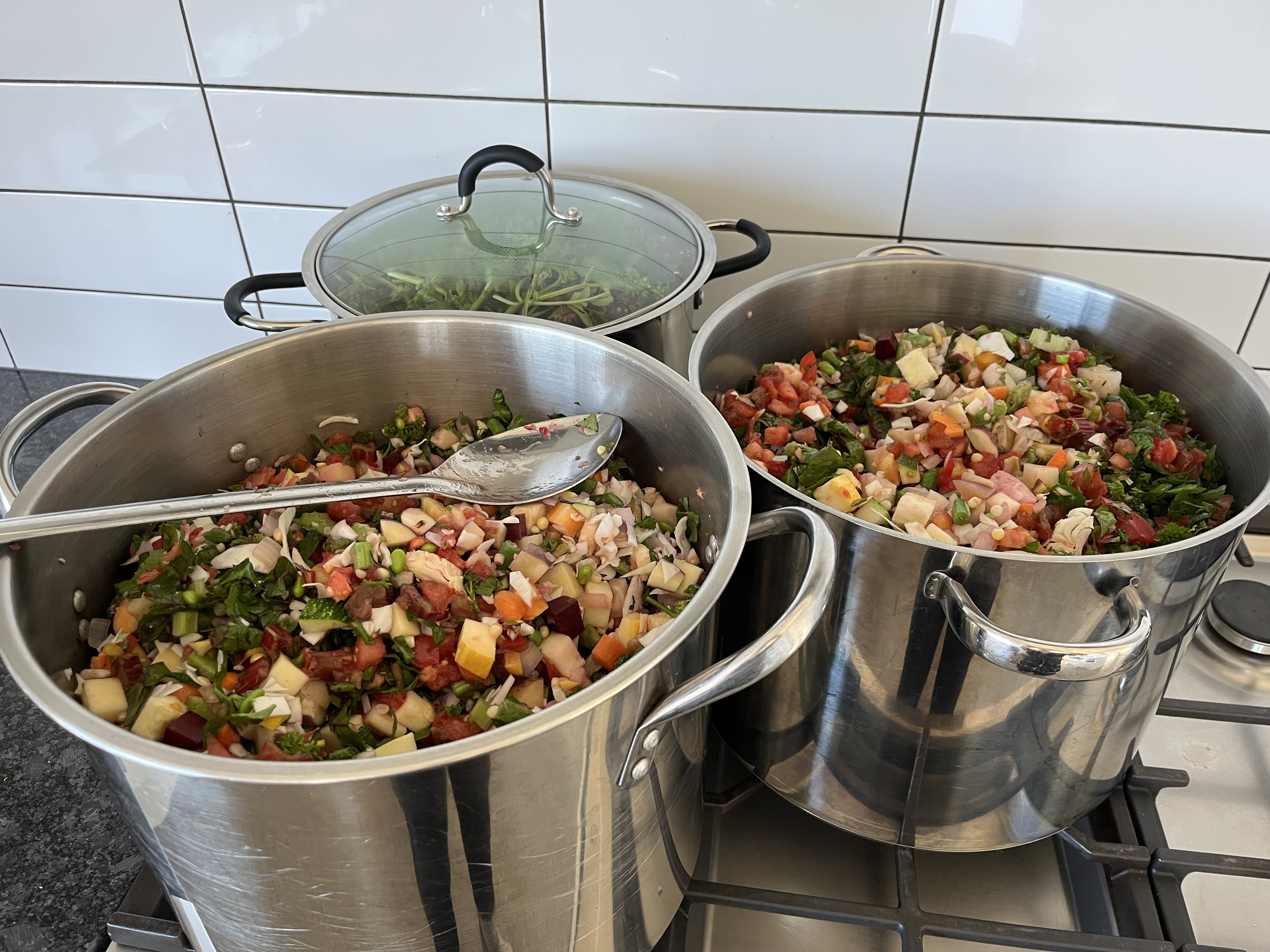
Last Saturday was summer soup day. Long time readers of my blog will know this is a key part of my gardening year. When the children were young, it was a whole-family event, with everyone pitching in to pick and chop vegetables. It’s become a more solitary activity for me in recent years, but no less important in my annual calendar. 

With just my husband and me at home now, I always think I’ll make less soup. And this year, I was a little worried I wouldn’t have enough vegetables for a big batch, because January and February were so cold and wet, the heat-loving vegetables sulked.

I should have known better.

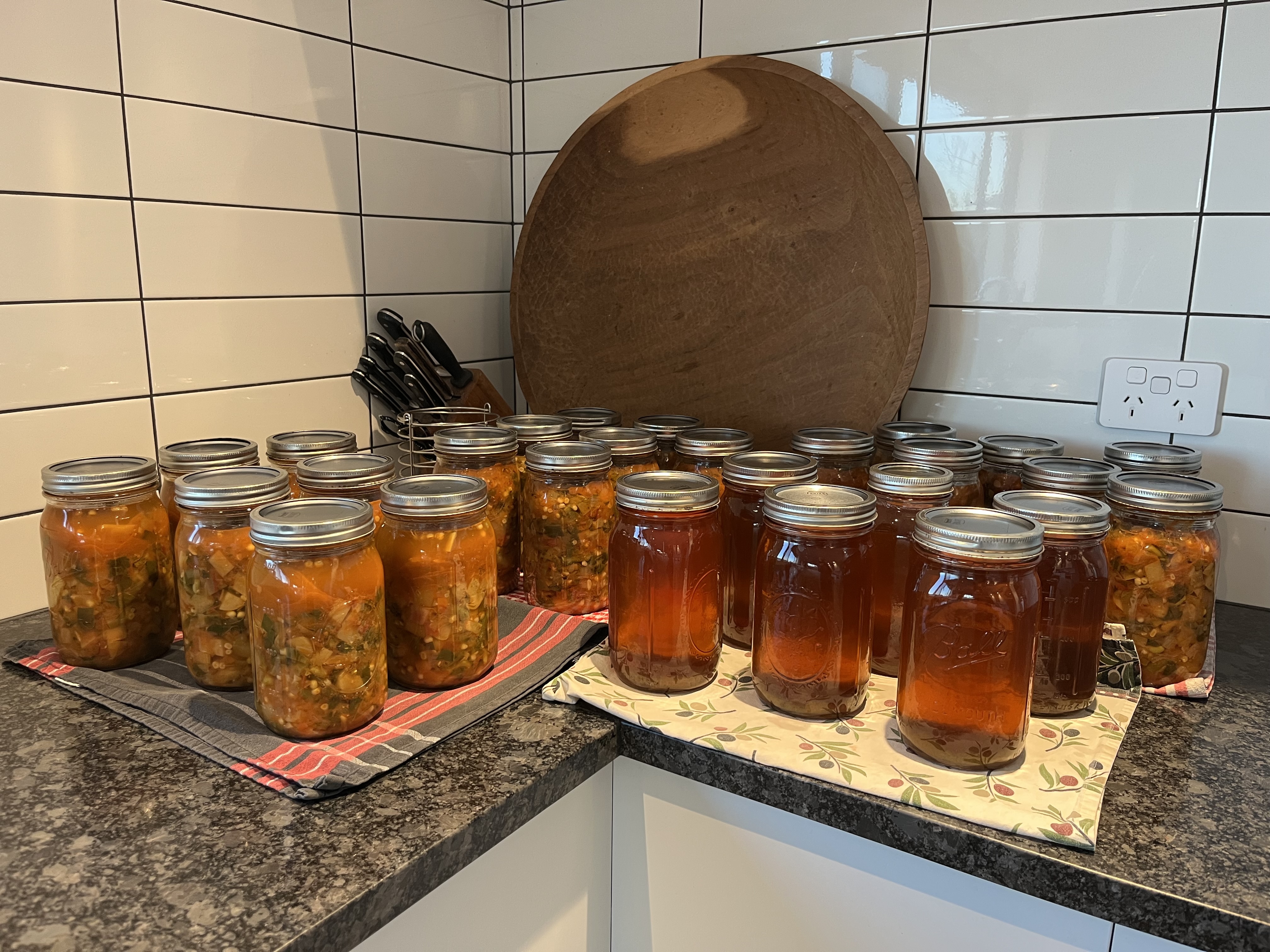
I needed both my 20-litre and 18-litre pots to cook the soup, plus the 12 litre pot for making vegetable stock from the vegetable off-cuts. In the end, I made 23 quarts of soup and 13 pints of stock. That’s Monday dinners for almost six months, plus stock to flavour 13 more meals. Not bad for 13 hours of work.

The day after summer soup day, I tackled the sweet corn. I usually sow three plantings of sweet corn, two weeks apart, in the spring. The first two plantings were desperate to be picked, so I harvested 63 ears of corn. Blanched and cut off the cob, it yielded 5.3 kilograms of corn, which went into the freezer. That’s a year’s supply of sweet corn for us, to be used in casseroles, stews, and side dishes. 

I had hoped to also freeze some soy on Sunday, but I’d waited too long to harvest, and about half the beans were too mature. So we’ll save the majority of this year’s soy as dry beans instead.

And speaking of dry beans, in the last fortnight, I’ve harvested my Borlotti and Black Turtle beans, and have started harvesting the climbing beans: Blue Shackamaxon, Bicolour Peans, Bird’s Egg, and Cherokee Cornfield. The harvest of the climbers will go on for the next month as the plants continue to grow and put out new pods while the older ones mature. Not quite as neat and tidy as the bush beans, which all mature at the same time, but in the end, I’ll get more beans from the same amount of garden space off the climbers than the bush beans.

I’ve also now harvested most of the potatoes, which did beautifully this year, with the cool rain. The spuds are tucked away in a dark corner of the laundry room, and should last through much of the winter.

There are still more vegetables to squirrel away in the next few weeks: pumpkins, hopefully more tomatoes, more basil (in the form of pesto), and the rest of the beans and potatoes. As I do every year, I mourn the end of summer’s bounty, but I look forward to the ease of winter meals that come from the freezer or pantry instead of directly from the garden. There is something delightful about knowing that the hard work has been done, and the food is tucked away, ready to be eaten.

Oven Fried Zucchini Sticks

Many years ago, I posted a blog titled 50 Ways to Eat Zucchini. Since then, I’ve gotten much better about my zucchini planting—I plant half as many as I used to. Of course, that still means we have too many. We’re currently giving away 5 to 10 kg of zucchini a week, eating it in every dinner and baking it into desserts.

I don’t mind having too much zucchini. It’s a versatile vegetable that can be grated into all kinds of dishes (chilli, pasta sauce, enchiladas, burgers …) or featured in beautiful slabs or rounds (zucchini and tomato tart, grilled zucchini, frittata …).

One of my favourite ways to eat zucchini is as breaded, oven fried sticks. These tasty ‘fries’ take a little work, but are well worth the effort. I fill a large jelly roll pan with them, and they vanish, even when it’s just my husband and me for dinner.

I don’t have a set recipe, but here’s an approximation of what I do:

2 small to medium sized zucchini
1 egg
1 cup bread crumbs
3/4 tsp salt
1/2 cup grated Parmesan cheese
2 tsp paprika
1/4 tsp chipotle
1/2 tsp smoked paprika
1 tsp dry oregano
small handful of fresh parsley or basil, finely chopped

Cut the zucchini into thick sticks, about the length and thickness of a finger. Whisk the egg in a small bowl. Combine all other ingredients in a separate bowl. Generously oil a large baking sheet.

Dredge each zucchini stick in the egg, then the breadcrumb mixture and set on the pan.

Bake for about 20 minutes at 200℃, until browned and cooked through.

Serve hot, with your favourite dip, if desired. We love chipotle mayonnaise with them, but they really need no further embellishment—they’re delicious as is.

Cake Season, 2025

Those of you who have followed my blog for years will know that the first three months of the year are birthday months in my family. For years, I called it crazy cake season, because I would obsess over birthday cakes all month, and spend literally weeks designing and making crazy birthday cakes.

Like the octopus:

The geode:

The peripatus:

An alpine botanical scene:

And many others.

But now that the kids are adults, the crazy cake season is far less crazy. It still involves cake, of course, but the cakes are more subdued and geared toward adult tastes.

This year, my daughter said ‘surprise me’ when I asked about her cake preferences.

So, faced with a kitchen full of beautiful ripe peaches from our trees, I made her a three-tiered peach upside down cake using my favourite upside down cake recipe, from King Arthur Flour’s Whole Grain Baking book. 

The cake recipe is meant for nectarines, but I’ve also made variations of it with pears, lemons, peaches, and plums, and it’s fabulous.

I recommend reducing the sugar in the batter, because it can be overly sweet, with the gooey fruity sugar that soaks in from the topping. I also adjust the spicing to suit the fruit and my own tastes. And I always use more fruit than the recipe suggests. 🙂

Here’s the original recipe:

Topping:
3 Tbs butter (43 g), melted
1/2 cup brown sugar
1/4 tsp nutmeg
1/4 tsp cinnamon
2 large nectarines
2 tsp lemon juice

Batter:
1 3/4 cups whole wheat flour
1 3/4 tsp baking powder
1/4 tsp salt
4 Tbs (57 g) butter, softened
3/4 cup brown sugar (I use 1/2 cup)
2 large eggs
1 tsp vanilla or almond extract
1/2 cup milk

To make the topping: Place the melted butter in an ungreased 8-in (20 cm) square baking pan, tilting to coat the bottom evenly. Mix together the brown sugar and spices, and sprinkle evenly over the butter. Slice the fruit (either peeled or unpeeled is fine) 1/4-inch (half a centimetre) thick and arrange the slices in the pan on top of the sugar and butter. Sprinkle with lemon juice. Set aside.

To make the batter: Whisk together the flour, baking powder and salt in a small bowl. Cream together the butter and sugar in a large bowl until light in colour and fluffy. Beat in the eggs, one at a time, and the vanilla. Stir in half the flour mixture, then the milk. Add the remaining flour mixture, stirring until the batter is evenly moistened. Gently pour the batter over the fruit in the pan.

Bake at 375℉ (190℃) for 45 minutes or until the cake begins to pull away from the sides of the pan and a cake tester inserted into the centre comes out clean. Allow to cool 5 minutes in the pan. Then invert the pan onto a serving platter and let sit for 1 minute before removing the pan. Serve warm, with whipped cream or ice cream, if desired.

We enjoyed our peach upside down cake with homemade peach ice cream, made by my husband.