Alpine Delights

The family spent a delightful hour on the Dobson Nature Walk in Arthur’s Pass National Park on Wednesday. The track is an easy one, and hiking it quickly takes about 20 minutes. But it’s not a walk you want to do quickly, especially in summer. It winds through alpine and sub-alpine vegetation, including some beautiful tarns, and in summer, so many plants are blooming, it’s hard to take five steps without finding another lovely orchid, daisy, or hebe in bloom.

For me, the best part of the walk is the abundance of sundews in the tarns. As an entomologist, I’m naturally drawn to carnivorous plants like sundews. Sundews catch insects on the sticky hairs you can see glistening in this photo. The hairs are sensitive to both touch and taste, and when they sense a struggling insect, they fold inward to further entangle their prey. Enzymes exuded by the hairs then digest the insect, and the leaf takes up the nutrients in order to grow in the nutrient-poor alpine wetlands. 

These sundews were just beginning to flower—many plants had flower buds, but none had yet opened. The flowers sit above the leaves—an important adaptation, since the plant needs to be pollinated by the very insects it eats.

The alpine summer is short, so when these plants are done flowering, the leaves will slowly shrink into a structure called a hibernaculum that sits near the soil surface and protects the plant through the winter.

Catlin’s River Walk—a little bit of magic

My family and I were in the Catlins last week, in the southeast corner of the South Island. It’s a wild and remote area, home to more penguins and fur seals than humans. No urban adventures here—it’s a place for outdoor recreation.

One of the things we did was to hike part of the Catlins River Track (we didn’t have time to do the full track). It was unlike any other place I’ve been in New Zealand.

In fact, it reminded me most of eastern Pennsylvania, in spite of the fact that it shares not a single common species of plant or animal.

The track follows the Catlins River, a beautiful waterway that cuts through layers of limestone in one little cascade after another. Swing bridges cross the river several times, providing great aerial views of the water (and a little excitement for those who don’t like heights). The forest is old-growth beech which provides habitat for myriad native birds, carefully protected by intensive predator control. 

In addition to the beech, we were delighted to see two species of orchid on the forest floor, red-flowered mistletoes in the treetops, several species of slime mould, some lovely mushrooms, and a beautiful native harvestman. The birdlife was noisy and varied, but we weren’t lucky enough to see any endangered mohua. And, amazingly, there wasn’t a single sandfly! 

The whole effect was one of an enchanted forest. We were certainly enchanted.

The track is relatively flat—easy hiking for kids or those who can’t face the usual Kiwi hiking track going straight up a mountain, and because there’s no “goal” to reach, you can simply walk as far as you’d like, and then return. The entire length is 12 km one-way, with a return loop option through forestry land away from the river. 

I highly recommend this track. I’ll certainly be going back when I have enough time to do the whole thing.

Kaitorete Spit: An Overlooked Gem

Earlier this week, my daughter and I hiked onto the Banks Peninsula from Birdlings Flat. The walk afforded us gorgeous views of Kaitorete Spit.

Kaitorete Spit is only about 6000 years old, but is an important natural and cultural resource. Te Waihora / Lake Ellesmere, formed by the spit, is home to or visited by 166 species of birds and 43 species of fish which support commercial fisheries, recreational fishing and hunting, and traditional food gathering. In spite of its harsh, exposed environment, Kaitorete Spit is home to a remarkable number of threatened plants and animals, including pīngao (a native sand sedge prized for weaving), a flightless moth, and the katipo spider. A variety of lizards also flourish on the spit. The lake and spit have been important sources of food and fibre for Māori since they arrived in the area. Fragments of the oldest known Māori cloak were uncovered on the spit, dating to around 1500 AD, and many other signs of early Maori use of the spit have also been found there.

In pre-European times, Māori used the spit as a convenient highway as they travelled up and down the island. Unfortunately, the shifting gravel of the spit and the regular opening of the lake to the sea mean the spit isn’t passable in anything but the most capable of four-wheel drive vehicles. Today, travellers make the long trek all around the lake, so our home near the pointy end of the spit is a 40-minute drive from Birdlings Flat, just 25 km away on the fat end of the spit. But I’m happy to leave the spit to foot traffic—it helps protect the unique plants and animals that live there.

On a windy, wet day, Kaitorete Spit is a miserable, exposed place to be, but visit it on a warm sunny day, and you’ll see why it is an overlooked gem.

Still Life with Insects

I’ve written and discarded half a dozen blog posts over the past week. Nothing seems to be quite right. Out of ideas, I resorted to the book of 500 writing prompts I created for my daughter. A random stab at the non-fiction section of the book brought me to the question: What objects tell the story of your life?

I tried to encapsulate everything in four objects:

The fiddle: made by a neighbour in Panama, given to me for my birthday by my husband. The fiddle not only tells the story of our years living and working among the incredible, resourceful people of Panama, but also tells the story of my lifelong interest in learning to play the violin…an interest which always ended up being pushed aside for other interests. Because I’m interested in learning so many things, there simply aren’t enough hours in the day.

The beetle puppet represents my insatiable curiosity about arthropods, and how that curiosity has bled into my other interests. Peanut butter jars full of bugs on my dresser when I was a kid led to the entomology degree, which led to teaching about insects at Penn State University, and then starting the Bugmobile. And the puppet is only one of many insect-themed and inspired artistic projects I’ve done over the years, as art and science mingle in my brain.

The gardening gloves speak of my weeding addiction and my love of growing food. The gloves are never more than a month or two old, because I wear through them in that time. I think that says it all about gardening for me.

The rock represents adventure, the natural world, and the wild places I have visited and lived in. Like me, the rock has traveled far and has been changed by the stresses it has experienced along the way.

Pigeon Bay Walkway

View from the head toward Christchurch.

Yesterday was a beautiful autumnal day. We headed out to the Banks Peninsula and did the Pigeon Bay Walkway.

It has been over a decade since we’ve been to Pigeon Bay. Last time we went, the kids were preschoolers. Then, we’d hoped for some sort of beach where the kids could play in the water, but Pigeon Bay is rocky. The shoreline is covered in cobble-sized rocks teeming with life. Lift any rock and a dozen crabs scuttle away. A decade ago, the pursuit of crabs delighted the kids. Still does. Yesterday, we also noted starfish, chitons, limpets and snails under the rocks.

But the main activity for yesterday was the walkway. It’s rated as a five hour return walk, but is mostly on a well-graded farm track. It’s easy going, and we did it in four hours, including a lunch break.

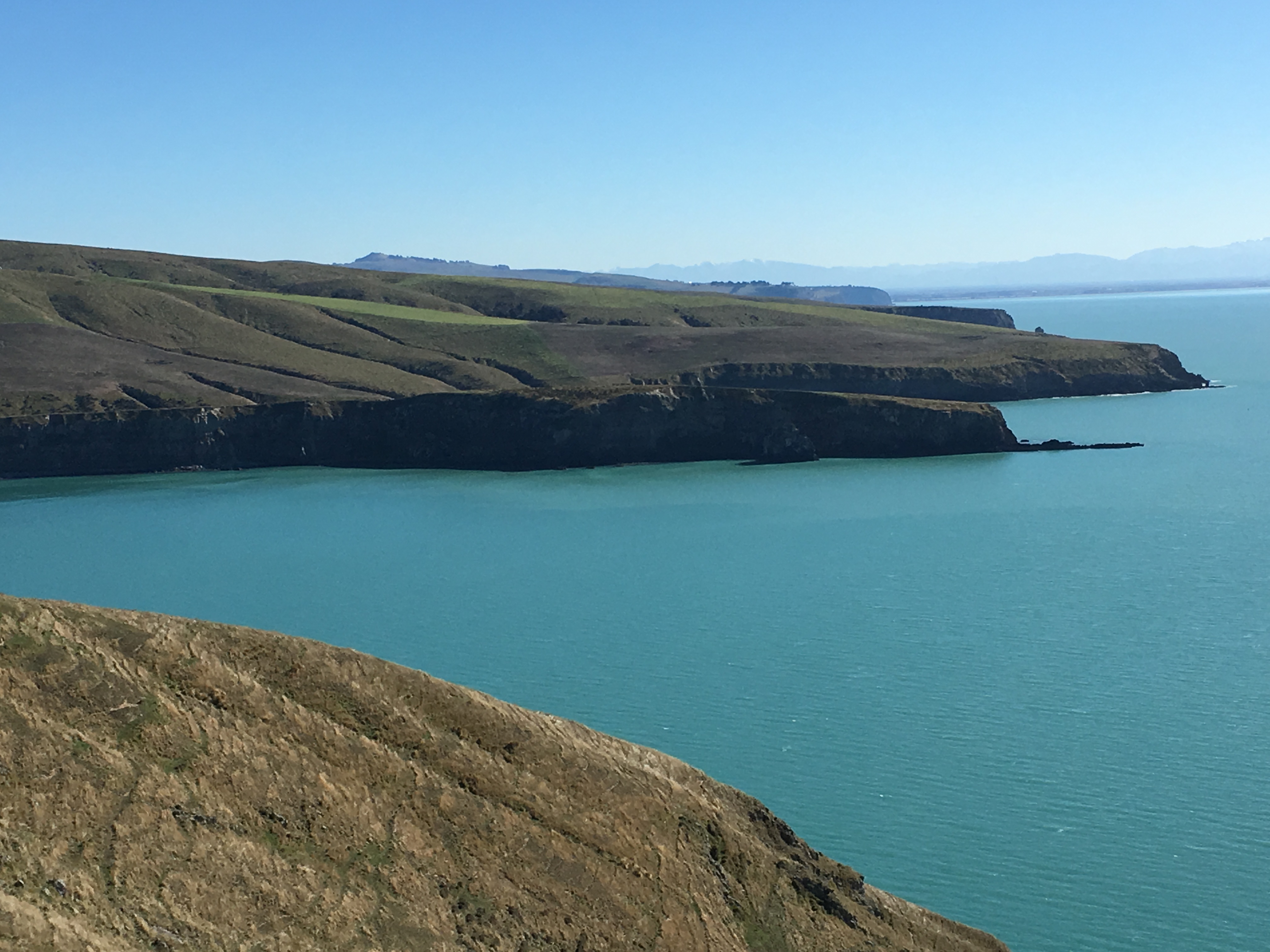
The track runs all the way to the head of the bay. It’s not exactly a wilderness experience—the land is a beef and sheep farm—but the views are spectacular. It’s one of the few places on the Banks Peninsula where you can get right out to the tip of the headland.

Out on the head, the cliffs are quite spectacular, and you can see the layers of volcanic deposits, well-spattered with poo from the shag colonies there. In the clear air yesterday, we could see all the way to the Kaikoura ranges.

The best part of the walk for me was looking down on a small pod of Hector’s dolphins feeding in the bay below. The dolphins were clearly circling and corralling fish, and there was a trio of gulls shadowing them in the air, picking off the fish the dolphins missed.

A lovely walk. Hard to believe it took us this long to get around to doing it.

Moody Skies

Looking up the Waiau River bed toward Franz Josef Glacier

Looking up the Waiau River bed toward Franz Josef Glacier

I’ve been to Westland in brilliant weather—when the sky is clear, the sun is shining, and every snowy peak is visible. It is spectacular when that happens.

But the rainfall on the West Coast is measured in metres. Temperate rainforest covers the lower slopes, and the rivers churn, gushing down the steep mountainsides. Sun is not the normal state of affairs. Clear skies are not what make the West Coast what it is.

More often than not, it’s raining on the West Coast. And if it’s not raining, it’s threatening to rain. So, while blue skies are gorgeous, they’re like a false smile, put on for special occasions. The real skies are brooding, veiling the higher peaks in clouds and the lower ones in misty rain (or pounding rain).

And those moody skies are every bit as spectacular as the blue ones, in my book, and more honest. Just as I appreciate when a friend shows their true colours, I appreciate when the West Coast does, too.

Provided I have a good rain coat, that is…

Cheeky Parrots

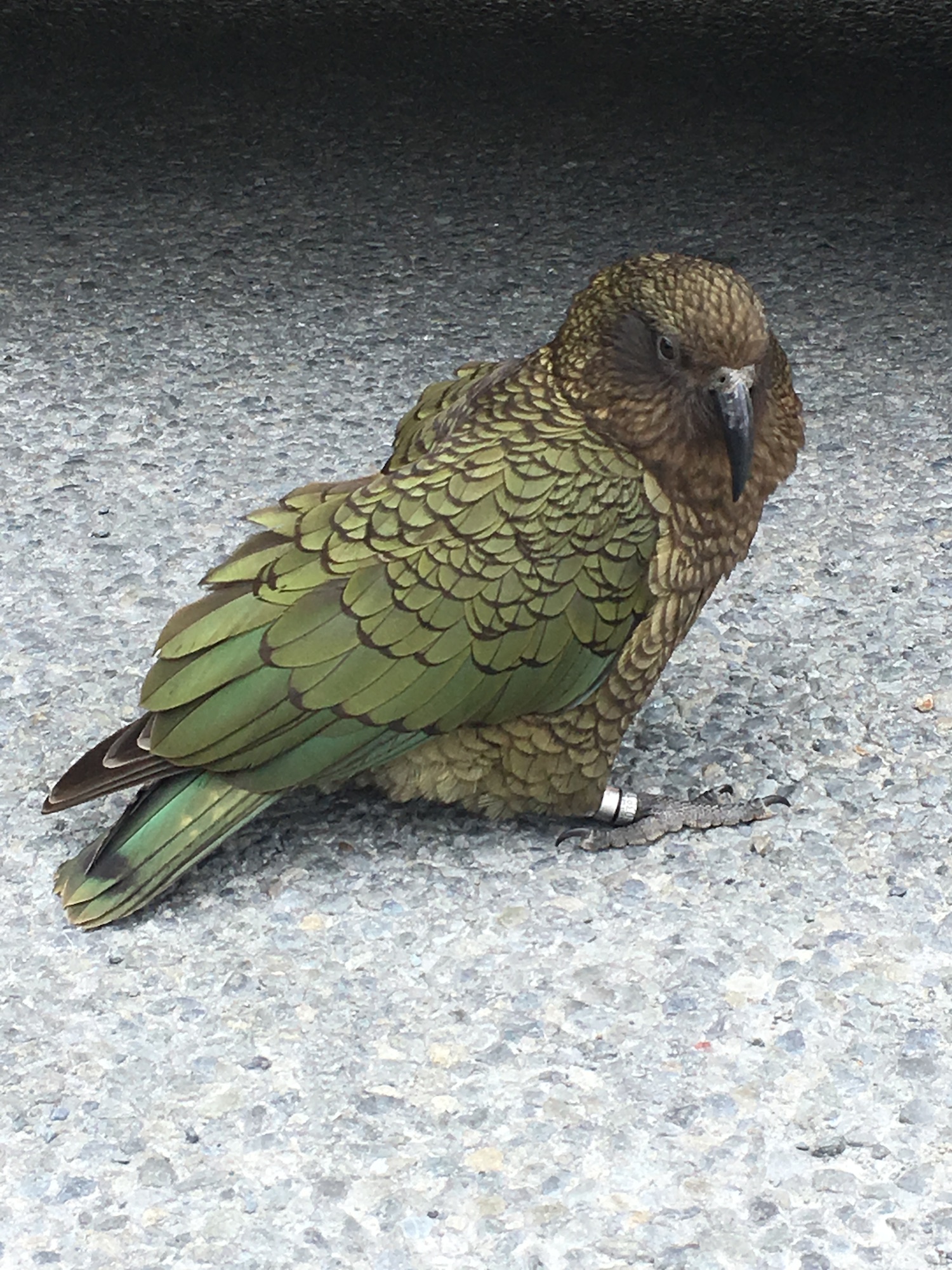
2016-10-10-13-11-37-smIt’s not every day you’re bitten on the bottom by an endangered species.

Yesterday was one of those auspicious days, however. I was travelling through Arthurs Pass, headed to Haast with two colleagues to do a programme at the school there. We stopped to pick up lunch at the Arthurs Pass store, and three kea descended on us.

For those who don’t know, kea are large alpine parrots. Though there are only 2,000 of them left, they are bold and curious animals, unafraid of people. And they’re smart. They understand tourists—how they get so absorbed in taking photos of the parrots that they forget to shut their car doors, or leave a sandwich lying beside them.

They work in gangs—one bird coming in close to pose for pictures, while the others circle in from behind to ransack the vehicle.

We knew this, and had taken appropriate precautions. There were three of us and three of them. We should have been safe.

But, of course, we wanted pictures—you simply can’t not take pictures of them, no matter how many times you’ve seen them. We all crouched down beside the van to snap our photos. That’s when it happened. I was focused on one kea, and another came up behind me and bit me on the bottom. Cheeky bastard!

But I got a photo.

A Delightful Day Hike in Canterbury

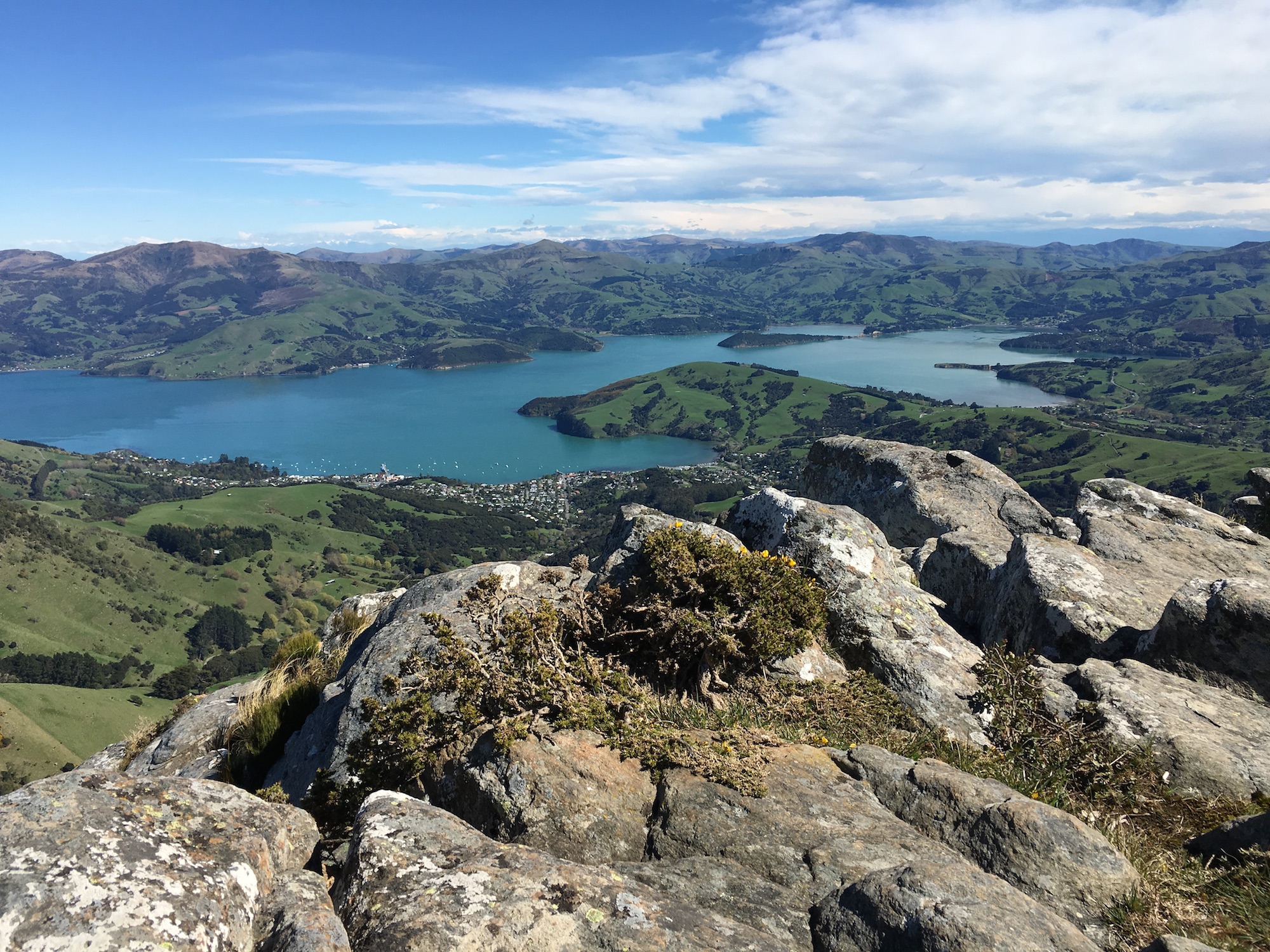
Looking toward Akaroa from Stony Bay Peak.

Looking toward Akaroa from Stony Bay Peak.

With the kids on school holidays, we took the day to go hiking. My daughter chose our destination—the Skyline Circuit, which starts and ends in Akaroa.

It’s an 800m climb to Stony Bay Peak, and down again, and makes a nice day walk.

It’s a typical Banks Peninsula track, climbing mostly through paddocks to a rocky gorse-covered peak. Not exactly a wilderness experience, but varied enough to be interesting, and there are some lovely pockets of native vegetation along the way.

You wouldn’t want to do this walk if the tops were shrouded in cloud—it’s the view from the top that makes the steep climb worthwhile. This morning was clear, and we could see all around the Banks Peninsula and across the plains to the Southern Alps.

Much of the downhill is on Stony Bay Road. I’m not generally fond of hiking roads, but Stony Bay Road isn’t much more than a nice wide gravel path that snakes down through a picturesque patchwork of bush and paddocks.

We ate lunch at the top, and were ready for an afternoon snack by the time we made it back to Akaroa. And, of course, that’s where the beauty of the walk becomes particularly clear—you can end it with a beer and chips at a café in Akaroa (we were even treated to live piano music on the waterfront today).

The clouds rolled in as we left Akaroa, and it was raining by the time we got home, but it was the perfect spring hike.

There and Back Again

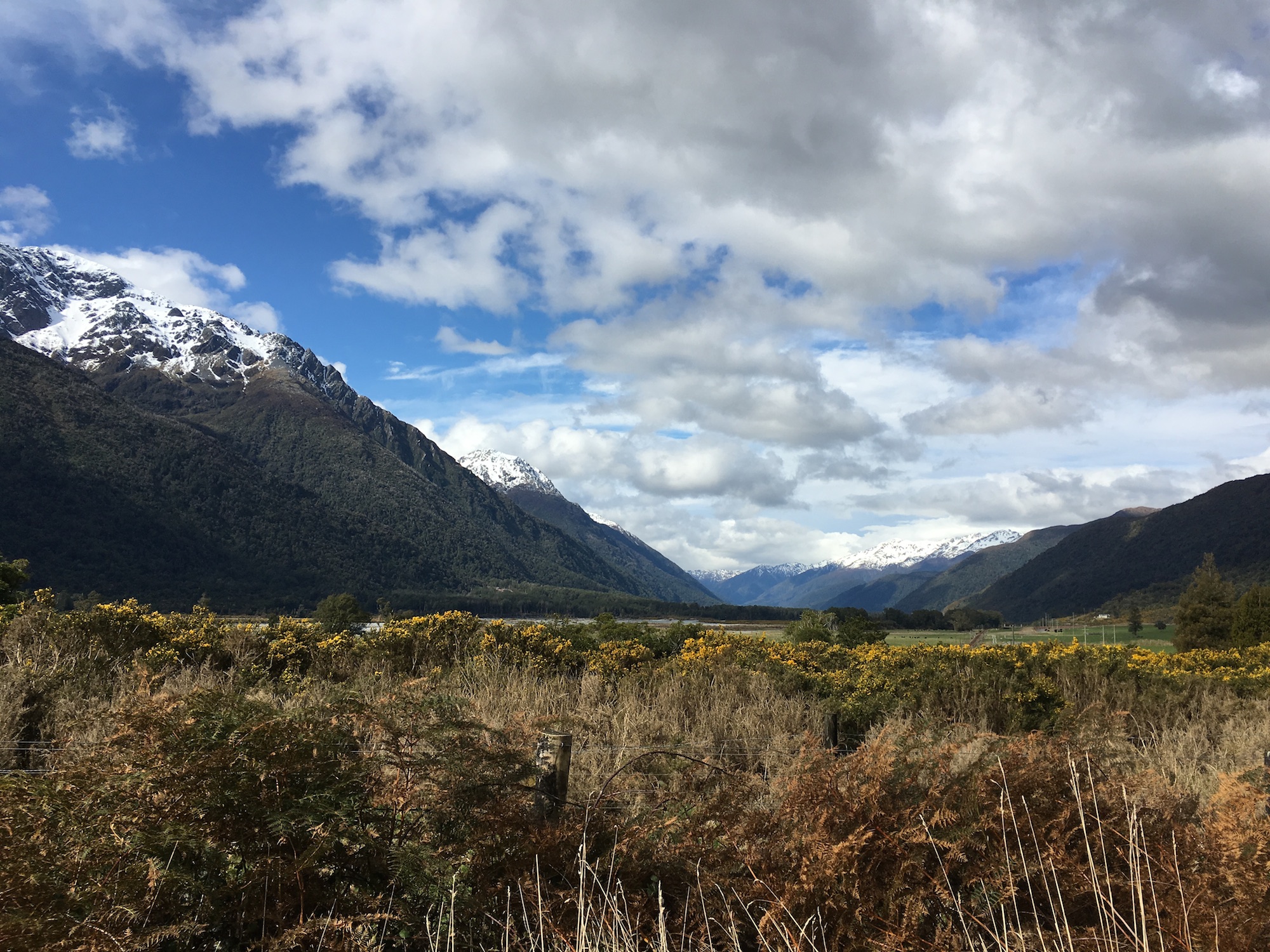
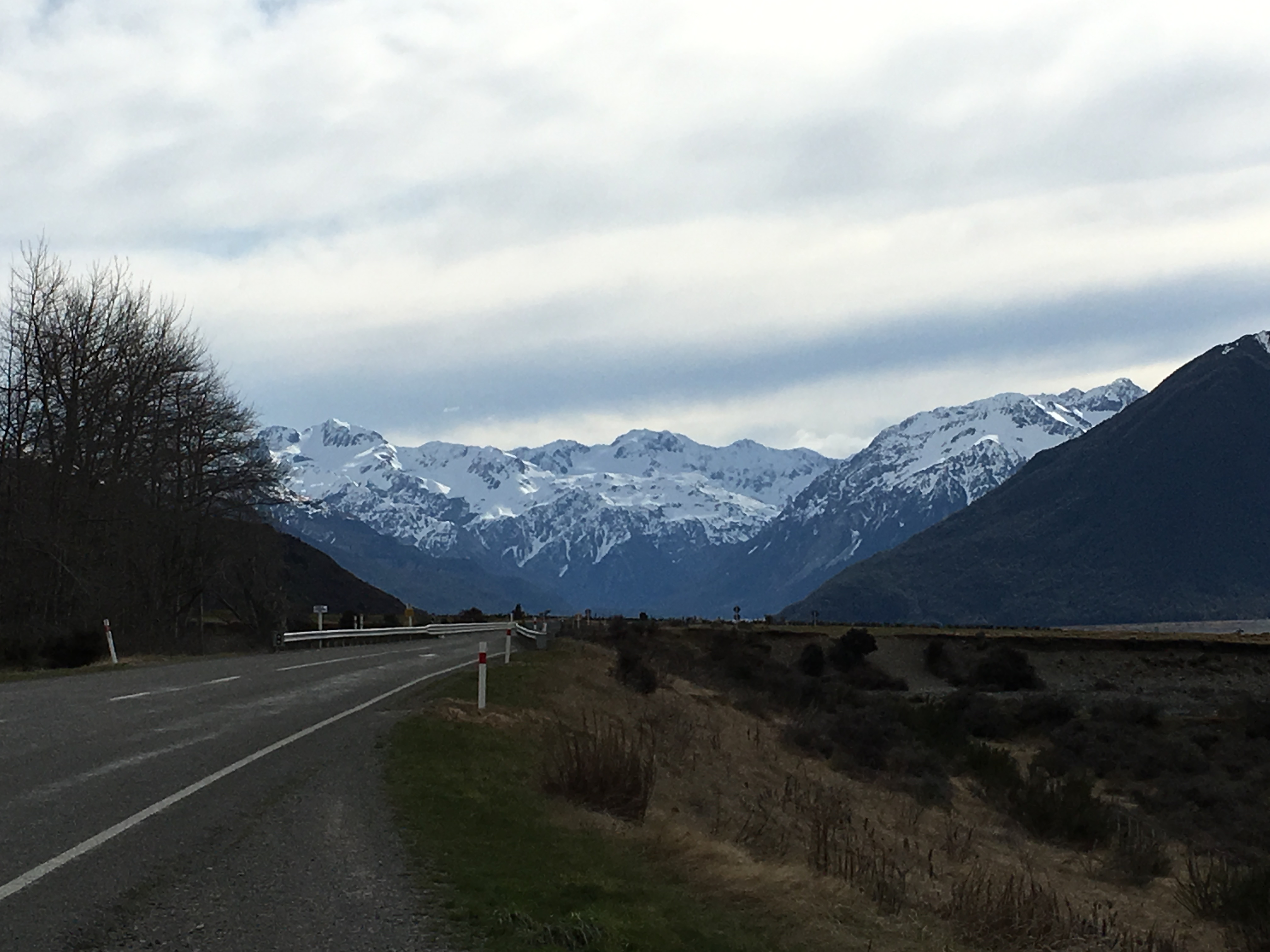
Looking up Otira Valley

Looking up Otira Valley

I slowed into the first curve and began to smile. Within a few short kilometres, the smile had widened to a grin that would remain for nearly two hours.

I will never tire of the drive up and over the Southern Alps. Especially the homeward drive, from Kumara on the West Coast to Springfield on the Canterbury Plains. The first time I made the trip was at night under a full moon that sparkled off the river below and made the snowy peaks shine. How could I not fall in love with it?

I love the first half of the drive, up Otira Valley—the belted galloways grazing in the paddocks on the lower slopes, the rainforest crowding in on the road, the long vistas up-valley to snowy peaks in the distance.

And then, when the road becomes steep and the valley closes in, the craggy peaks loom so close, you have to press your face to the window to see the tops.

And the water! Impossibly long falls coursing down forested slopes, spurting from every little dip and fissure along the roadside, and even soaring out over the road on a concrete sluice.

And then there is the road itself—steep, and as curvy as ribbon candy. There’s the cantilevered half-bridge, and the viaduct that soars out into space over an enormous landslide.

There is the lookout at Death’s Corner, where you can stop and be fleeced by a gang of endangered alpine parrots.

And when you reach the top and plunge down the other side, a whole new set of marvels awaits in the dry, brown, tussock-covered mountains of the eastern ranges.

There are the mountains of scree that look like they’ve been dumped by some enormous gravel truck. There are the limestone outcrops standing like a geologic Stonehenge. There are more snowy peaks, rising out of mounds of alpine tussock. There are lakes hemmed in by massive landslides.

Rear view.

Rear view.

Coming home from the West Coast yesterday afternoon, I was still grinning as I drove through the last of the hills. When I glanced in the rear view mirror, I couldn’t help laughing out loud at the sun glinting off a rank of snow-laden peaks behind me.

Even after nearly twelve years here, I continue to live in wonder at my luck—that I am permitted to call this incredible land home.

It’s All About Perspective

IMG_5709 sm
We headed to the mountains this morning in the hopes of snow. We were disappointed in that—there was no sledding to be had, but we did have a lovely walk at Kura Tawhiti/Castle Hill instead.

Kura Tawhiti, with its fabulous limestone formations and huge boulders, is one of our favourite quick day trips and a regular stop-off on our way to other places. For all our visits, though, we have never actually gone to the top of Castle Hill. So today, that was our destination (with many boulder-scaling detours along the way, of course).

The best part of the top of Castle Hill was the massive boulder jutting up from near the summit (I really think they should have put the trig marker on top of that rock—it really is the summit, more so than the ground below). Though I didn’t measure it, I’d guess the rock adds a good seven metres to the height of the hill. It dwarfed us all as we stood in its shadow.

It was a lovely walk to the top, though we were disappointed that we couldn’t actually make it to the top of that big rock. After a few minutes on top, we made our way down the other side of the hill.

Later, looking back toward the summit from a neighbouring ridge, that massive boulder looked tiny.

“The lesson,” my husband said, “Is that until you reach them, all your problems will seem insignificant. It’s only when they’re upon you that you’ll realise how utterly insurmountable they are.”

It wasn’t exactly the lesson I took (I was thinking that big problems, safely in the past, look small), but it’s a valid point. Sometimes we take on challenges or make decisions we know will lead to challenges in the future. At the time, those challenges might look manageable, but when we finally face them down, they could be huge.

Thankfully, we rarely have to face life’s problems alone unless we choose to do so. In fact, many of the big challenges that matter a great deal to us—raising kids, dealing with illness, facing loss—are really only manageable when shared. Sometimes, the hardest part is asking for help.

And then, once you’re past, the problems look smaller again. They look more manageable, because you did manage them.

So, don’t be afraid of those big challenges. They may be bigger than you think, but once you’ve made it past them, you’ll be able to look back from a distant ridge and say, “Well, maybe that wasn’t so bad after all.”