Weekend Tramp in the Two Thumb Range

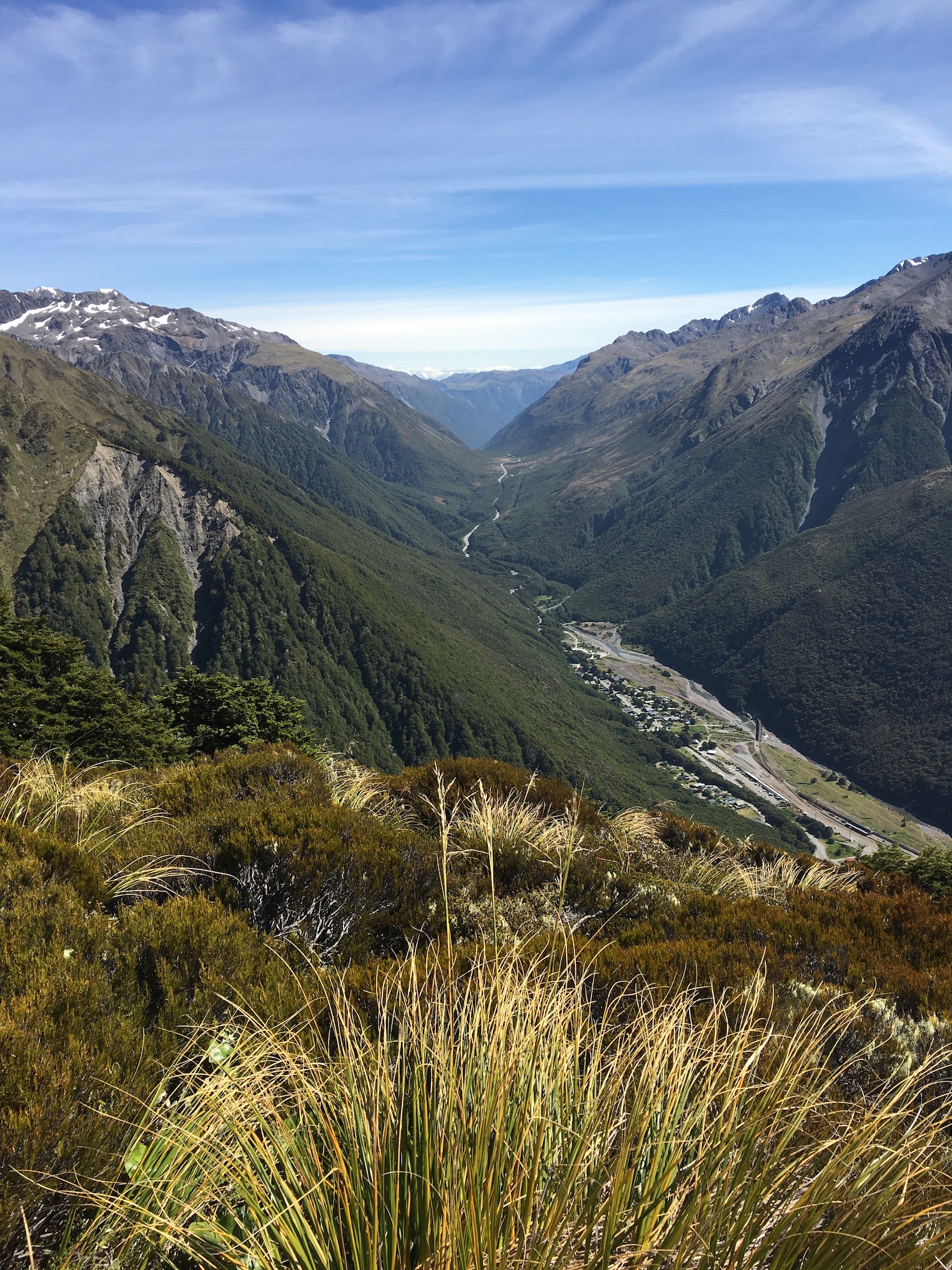
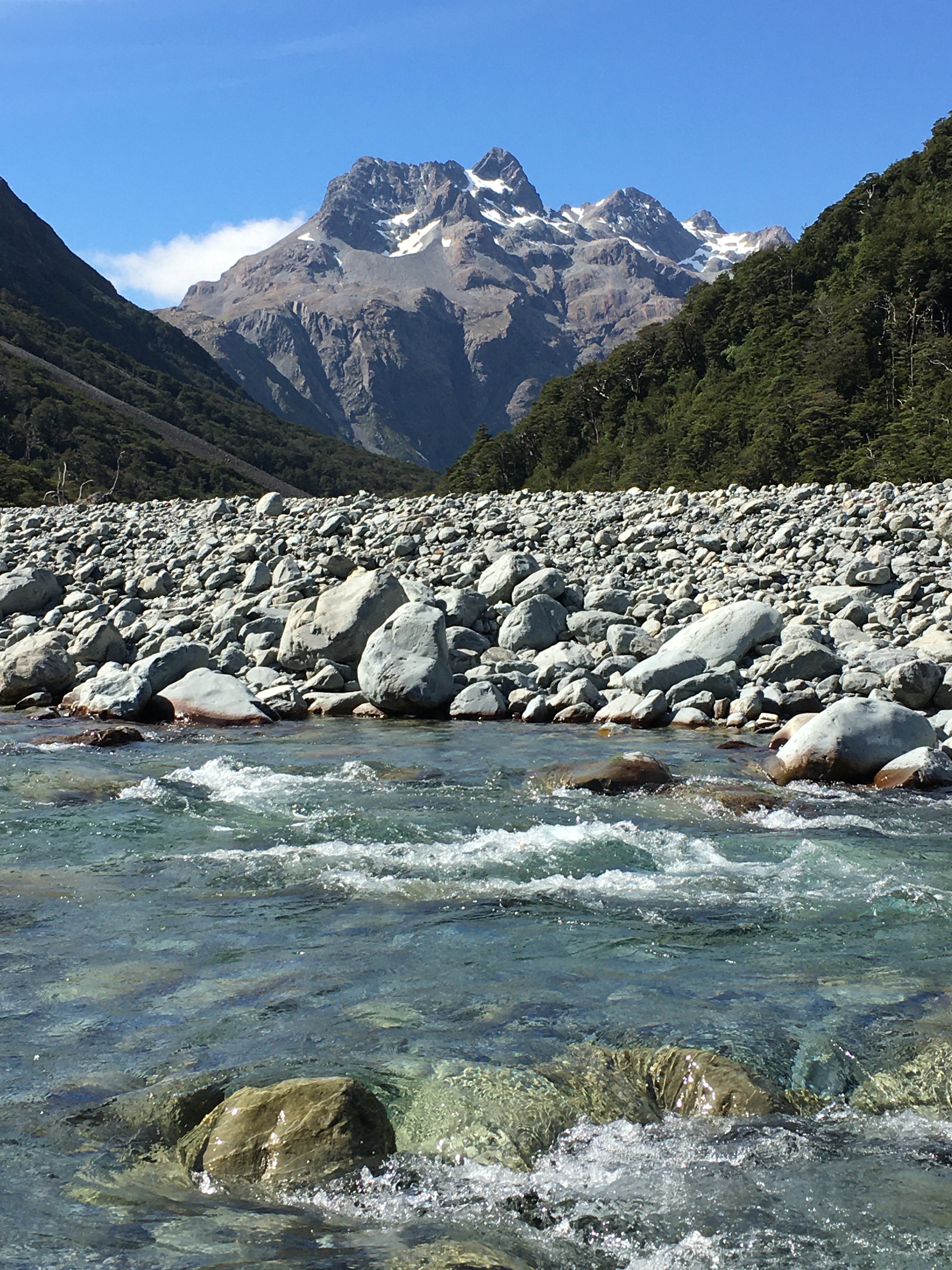
Looking up Bush Stream

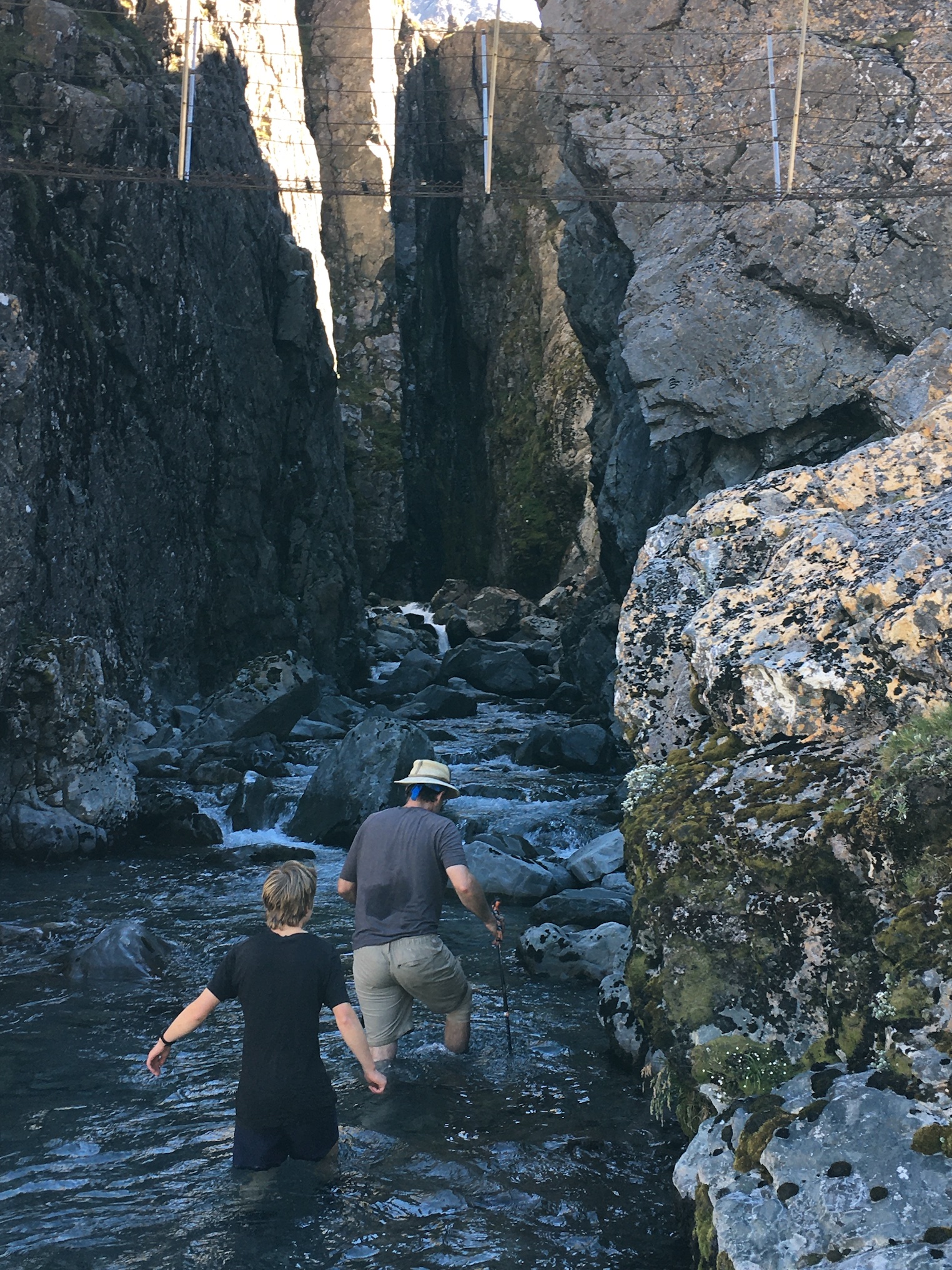
Last weekend, my husband and I got out for a tramping trip in the Two Thumb Range, in Te Kahui Kaupeka Conservation Park. We parked on Rangitata Gorge Road at Forest Stream, then slogged two hours up the road to Bush Stream—not a very exciting start, but better then than at the end of the tramp. We followed Bush Stream Track up the stream to Crooked Spur Hut. The stream flows through some pretty spectacular scenery, and you ‘get’ to cross the stream quite a few times before a steep climb to the hut.

Crooked Spur Hut is one of several historic musterer’s huts in the area. It’s old and the walls are full of holes and rats. We opted to sleep in the tent, but we hung out in the hut, since we had it all to ourselves.

Kea on a cold tin roof.

On the approach to the hut, a kea came to investigate, watching us climb the hill. It must have invited its friends later, because shortly after dark, while I was reading in the tent, I heard the thump-thump-thump of a couple of kea bouncing around outside. I shooed them away, knowing their penchant for mischief, and eventually they got the hint and left.

But by morning the kea had mustered reinforcements. They started about 4 am, thumping around outside the tent, plucking at the tent strings, and calling loudly right by our heads. By 5 am, we were up out of a sense of self-preservation, retreating to the hut to start our day.

When I stepped out of the hut a few minutes later, there were three kea, each one working on pulling out a tent stake, and more calling in the darkness beyond. We quickly took down the tent in the dark, before the kea tore it to shreds.

We got the billy boiling to the sound of kea on the tin roof. They seemed to have multiplied. The noise was deafening, and grew louder as dawn approached. Our trips out to the loo were accompanied by no less than three kea, who then sat on the loo roof, peering in through the skylight to watch the show. 

Returning from the loo, I counted fifteen kea, most of them on the hut roof, picking at the roofing nails (which thankfully had been replaced with non-leaded ones, because the old lead nails kill kea), and sliding down the tin. It was the most kea I’d ever seen at once. And as obnoxious as the cheeky buggers are, it was the highlight of the trip.

Leaving the kea behind, on day two, we hiked up from the hut through frosty tussocks to a scree-covered saddle where we were treated to some new spectacular scenery—tussock, scree and craggy peaks all around. At Swamps Stream we scared up a herd of 28 tahr—a non-native pest, but cool to see nonetheless. We arrived at Stone Hut at lunchtime, and had a lovely meal next to the stream before carrying on to Royal Hut.

Interior of Royal Hut.

Royal Hut is similar in age and condition to all the old musterer’s huts, but has the distinction of having been visited by royalty. The accounts I’ve found differ in the details—it was either in the 1960s or in 1970, and the royals involved were either Prince Charles and Princess Anne, or Prince Charles and Princess Diana (Diana being highly unlikely, given the date range suggested for the event).

In any case, it is said the royals zipped in by helicopter for a ‘brief’ visit. I doubt they spent the night. With mice scrabbling over our packs within 15 minutes of our arrival at the hut, we opted for the tent again.

Frost heave on the track, with 4 cm-long ice needles.

The morning of day three was fine and frosty (with frost inside the tent!). The DOC signage indicated we had an 11-hour hike to the road, and with daylight only being 11 hours or so long at this time of year, we made an early start, as soon as it was light enough to see the track.

We warmed up quickly, with the first leg of the day being a climb to Bullock Bow Saddle.

By the time we reached the saddle, I knew I’d pushed too hard over the previous couple of days—my left knee was stuffed, and hurt with every step. 

It was a loooong 14 or 15 km from there to the road—the first few kilometres steeply downhill, then a long slog down the Forest Creek riverbed. 

Still, we made it to the car well before dusk, and enjoyed more spectacular scenery (and a few more river crossings) along the way.

Overall, a fun long weekend! Spectacular views, awesome wildlife, and some real character huts. And the weather couldn’t have been better.
Thousand Acre Plateau–a Lovely Christmas Getaway

The family’s pre-Christmas tramping trip this year was to the Thousand Acre Plateau in Kahurangi National Park. 

Last time we were in Kahurangi National Park was to hike the Kepler, our pre-Christmas tramp a few years ago. On that trip, it poured relentlessly, and we hiked with few breaks, for fear of hypothermia.

This trip was exactly the opposite. With sunshine and temperatures reaching 29℃ (84℉), we took lots of breaks, for fear of heat stroke. 

The Needle

Our original plan had been to hike an hour to the Lake Matiri Hut on day one. After a leisurely start and five hours driving, it seemed reasonable not to plan too much hiking. But when we reached the first hut, none of us was ready to stop—we’d only just begun, after all.

The DOC time to Poor Pete’s Hut, on the plateau, was listed as 3 hours. It was only four o’clock, and it was the summer solstice—there was plenty of time to push on to Poor Pete’s.

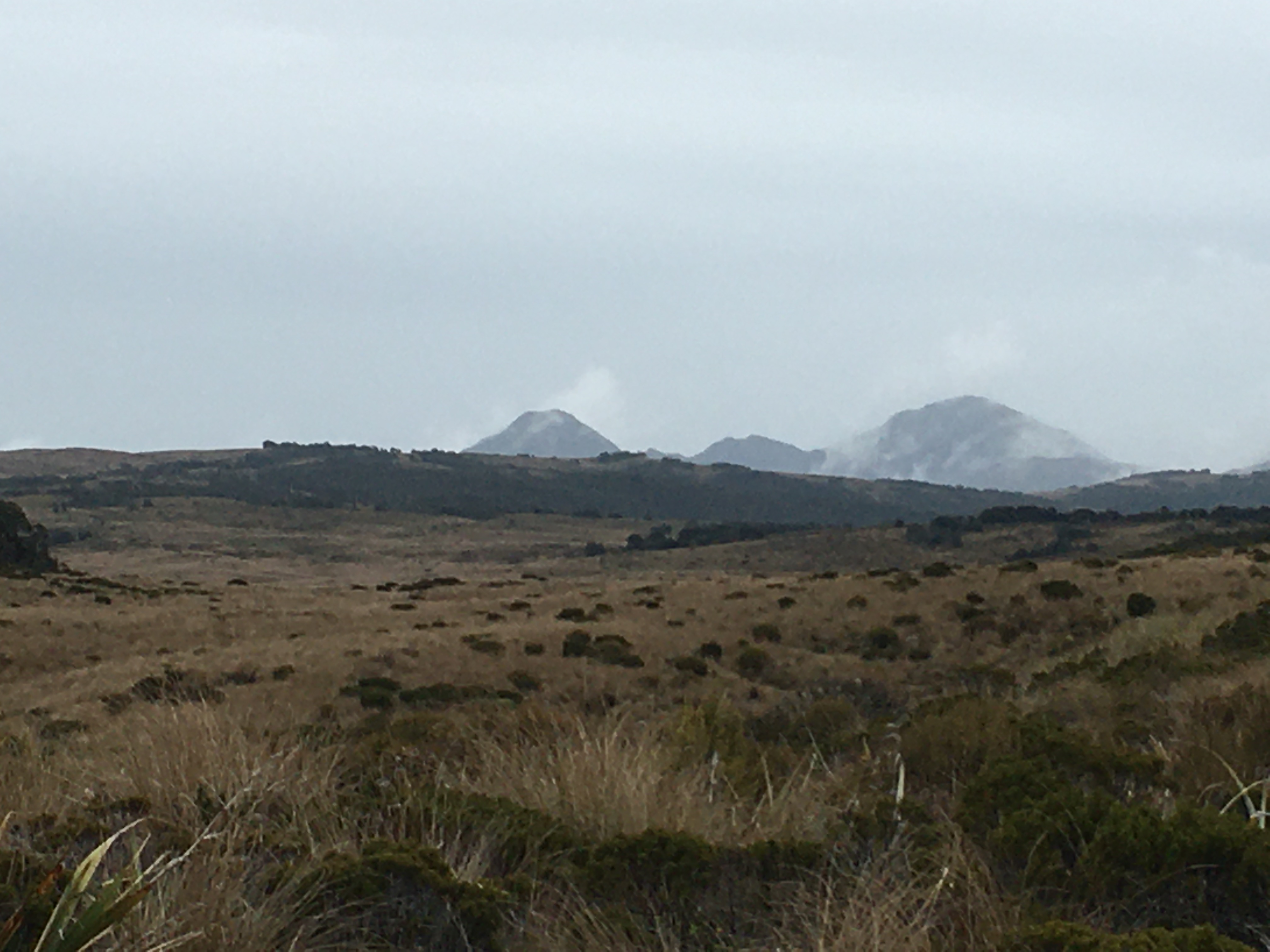
Unfortunately it was straight up to Poor Pete’s, and the temperature remained stubbornly high. By the time we finally crested onto the plateau I was questioning our decision to push on in the heat. But the plateau was painted gold by the evening sun, and our first glimpse of the remarkable limestone landscape was truly spectacular. We reached Poor Pete’s Hut at 8 pm, enjoying the final 20 minutes of flat-ish hiking as the sun set.

Poor Pete’s Hut is a sweet little 2-bunk hut. Unlike last year’s two-bunk huts that our family of four crammed into, Poor Pete’s has a spacious covered porch area that was brilliant for sleeping, so we snoozed in style as the noisy weka and ruru did their best to keep us up all night. And I can’t discuss Poor Pete’s Hut without mentioning the long drop, which isn’t the standard modern DOC vault toilet. Rather it is an old-style wooden box set atop one of the many deep crevices in the Thousand Acre Plateau landscape. And to make a trip to the loo exciting, the path down to the facilities crosses the crevice in an awkward fashion. I nearly slipped in my first time. Classic.

On day two, we hiked across the rolling landscape of the Thousand Acre Plateau to Larrikin Creek Hut. Compared to the first day, it was an easy stroll, but I can imagine in wetter weather it could be an absolute nightmare. The plateau is mostly wetland, with lots of tarns and wet, mossy and muddy ground. Entries in the hut book at Larrikin Creek Hut mentioned ending up waist deep in some of the boggy holes. We managed it with mostly dry feet.

The Hundred Acre Plateau, as seen from the top of The Needle

It was only 9.30 am when we reached Larrikin Creek Hut, nestled at the edge of the forest near the base of The Haystack, a gravelly limestone ridge that kept shedding rock, even in the still and sunny weather. We had a brief rest, dropped most of our gear, and headed up to the top of The Needle, which looks like a child’s drawing of a mountain. There is no official, marked route to the top of The Needle, and it’s a bit of a scramble up Spaniard-infested scrub to get there. I decided there is no good way up, only less bad ways. But the view from the top is fabulous.

The limestone of the plateau is fractured and crumbling, and with landslides clattering down The Haystack, it wasn’t hard to imagine how the entire plateau will eventually tumble into the valleys below.

Evening at Larrikin Creek Hut was filled with birdlife—a cheeky weka kept us vigilant as it eyed up our boots and snacks. A kea called from somewhere on The Haystack, but thankfully didn’t descend to plunder our gear. Weka, bellbirds, and tūī kept up a cacophony until dark, when the ruru joined the weka (do those birds ever sleep?) for the night shift. 

On Day three, we took an early morning jaunt down Larrikin Creek to the point where it plunges off the plateau. There were a couple of lovely pools near the edge, which would be fabulous swimming spots on a hot day (day three dawned coolish and drizzly, so no swimming for us, though we did all take a dip the day before in some shallower pools upstream). Walking across water-smoothed slabs of limestone in the creek bed, we saw lots of fossils and some interesting aquatic invertebrates.

After our stream scramble, we hefted our packs and began the return journey. Lunch at Poor Pete’s Hut in the rain was a real treat—that covered porch working its magic again. The descent off the plateau was not quite as bad as the ascent had been, but the earlier rain only served to make the forest hot and humid, so it was almost as sweaty.

The real treat on the descent was a flock of kākā calling in the treetops, keeping pace with us for a while. 

We spent the night at the heavily sandfly-infested Matiri Hut, which we shared with a group of three others who were on their way up. The sandflies drove us out early on day four, and we were back at the car by shortly after 7 am. A nice little tramp in a spectacular landscape! 

Cheeky weka

There’s No Place Like Home

I’ve been feeling a bit like Dorothy from The Wizard of Oz this week. Having been on a crazy whirlwind of a trip to the U.S. and Scotland, my overwhelming feeling since my return has been, ‘There’s no place like home’.

Don’t get me wrong—I enjoyed my travels. It was great to see family in the U.S. for the first time in six (!) years, and Scotland was new and exciting. I love traveling by train, and enjoyed every minute watching the Scottish countryside roll by. And I’d never set foot in a real castle before, so visiting four of them was a highly educational experience, and something I can’t do in New Zealand. The botanic garden in Glasgow was a real treat as well—I wandered through the massive greenhouses twice, because they were so marvellous.

But I have to admit that the best part of the trip was coming home to my own greenhouse, bursting with vegetables.

Before we left, I set up automatic watering and shut the door, trusting to the automatic window openers to provide enough ventilation if the weather was warm.

Three weeks later, both summer and winter crops had obviously thrived in the warm, humid environment. A bit too humid, actually—the slaters had moved into the tomato plants (and apparently like to eat tomatoes) because it was too moist on the ground.

Aphids thrived, too, while we were gone, but all in all, I was pleased. To arrive home to fresh vegetables was an incredible gift, and it reminded me once again of how blessed we are to live where we do.

So I am happy to be home, pulling weeds, squishing aphids, and doing all the autumnal garden tidying I haven’t yet gotten to. It’s not a vacation, but it is home.

A Perfect Hike–Mount Bealey

A few days ago, my husband, son and I went for a hike up Mount Bealey. This was my husband and my second trip up, but the first was a hastily planned late-autumn post-lockdown get-us-the-f@*k-out-of-the-shed hike, and we ran out of daylight to make it to the summit. This time, we had plenty of time to reach the peak.

The day was absolutely perfect, with early low cloud burning off before we reached the tree line, and just enough breeze at the top to cool off.

The climb up is fairly steep in places—the track more of a ladder than a trail. But that’s to be expected around Arthur’s Pass, and I prefer an interesting scramble over a steady upward slog anytime. The beech forest is lovely, with tantalising peeks down to the ever-receding village of Arthur’s Pass.

Breaking out above tree line makes the scramble worthwhile, with views of multiple 100-metre-tall waterfalls in the valley below, and the snow-covered peaks above.

We had lunch on the summit and spent a long time simply enjoying the 360-degree landscape of jagged peaks and vertiginous valleys. We had the summit (and in fact most of the track) to ourselves. Not even a kea came to visit us on the peak—no doubt they were hanging out with the hoards of people on top of the more popular Avalanche Peak. 

One of the best things about being on the summit was the chance to see other places we’ve hiked and put them all into a cohesive understanding of the landscape. There is satisfaction in that intimate knowledge of a place—to know the chill of the icy river below as well as having the bird’s-eye perspective of the river’s braided channel from the mountain above.

The trip took us a bit under seven hours, with the long lunch break on top, and we reached the car by 4pm. An ice cream at Arthur’s Pass was the perfect end to a perfect hike.

Panorama of the view to the west from the summit

Christmas Adventure

This year’s pre-Christmas tramp took us to the Lewis Pass area for four days of forests, mountains, and lots of water.

Day 1 was up the Nina Valley Track through beautiful beech forest. We bypassed Nina Hut, planning to camp below Devil’s Den Bivvy. Unfortunately, recent rain had rendered the area below Devil’s Den Biv into a swamp. There was no place to pitch a tent, so we carried on to the biv. Then we had to figure out how to bunk four people in a two-person hut. With three in the biv and one in a tent blocking access to the loo, we managed. It was … cosy.

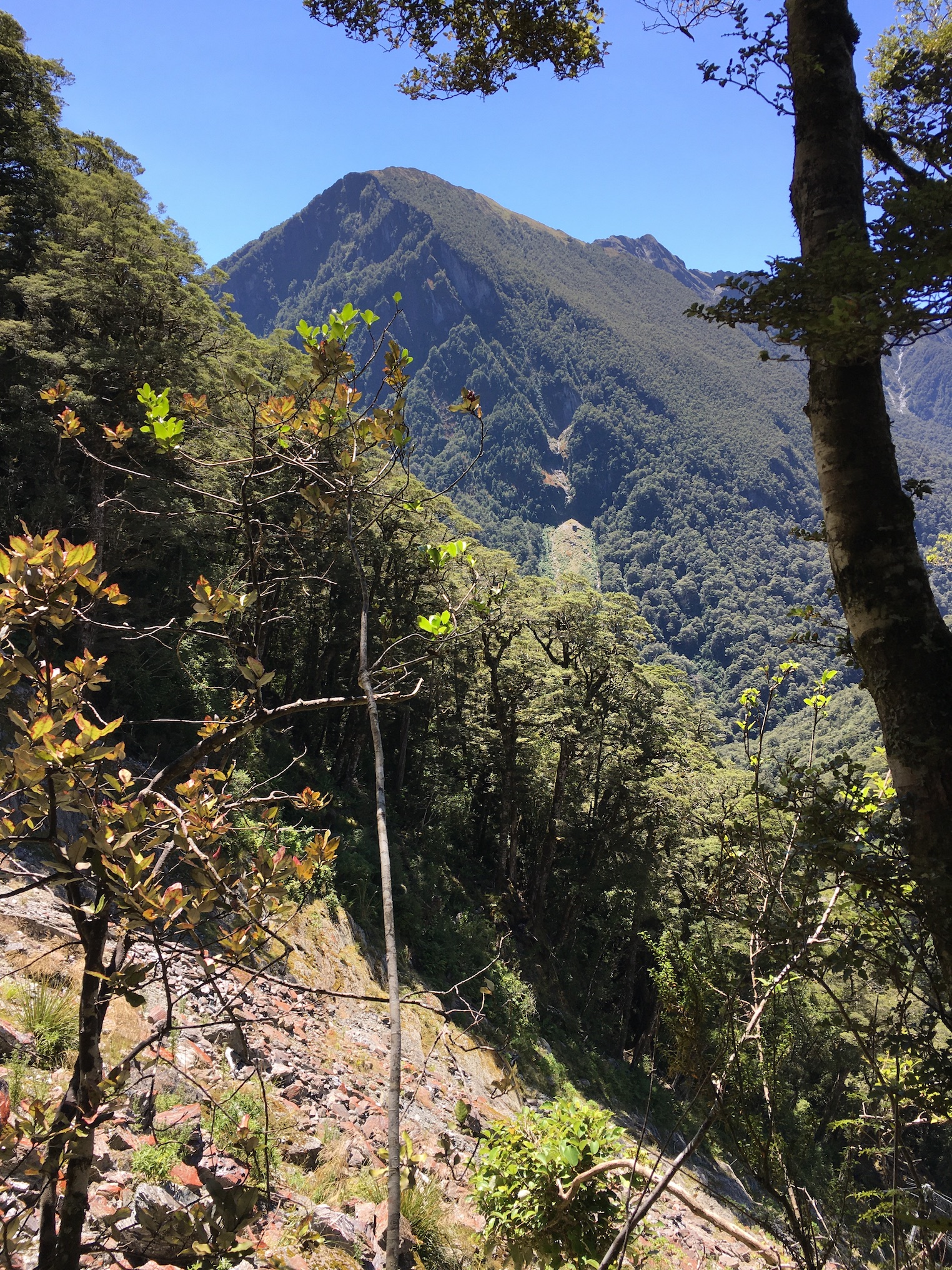
Day 2, we left the biv in dense fog, hiking down to the Doubtful River on a track that has clearly seen no maintenance for a decade. At times it felt like bush bashing, and there was lots of windfall to clamber over, under and around. 

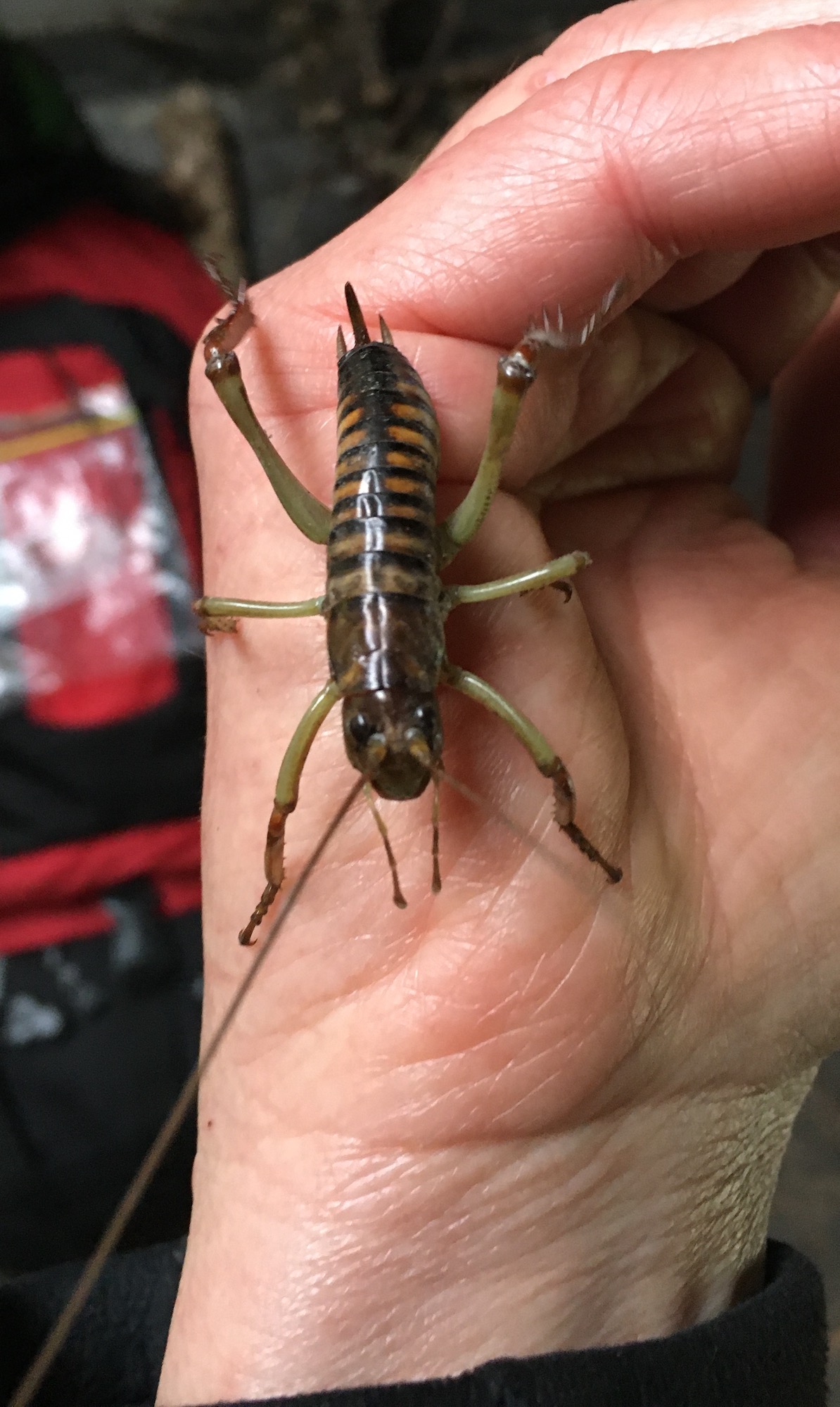
Once at the Doubtful River, a cruisy 40-minute hike took us up to the confluence with the Doubtless River, and shortly thereafter, to the Doubtless Hut, where we had a spacious six bunks to ourselves. Well, almost to ourselves. As we were packing up to leave, we found a beautiful young female Wellington tree wētā in the hut. 

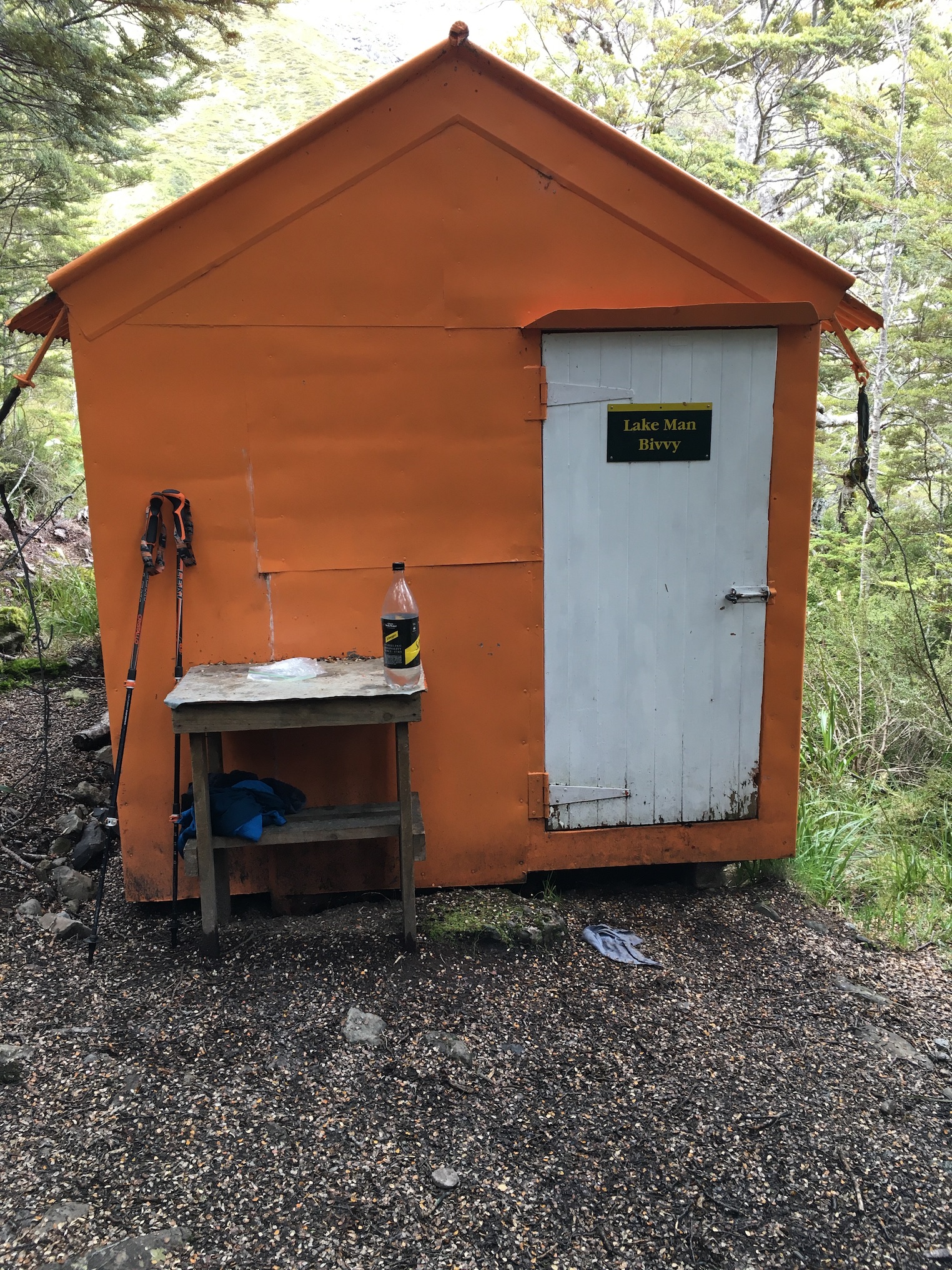
On day 3 we climbed up to Lake Man Biv—another 2-person hut, thankfully with a little more camping space nearby. Lake Man Biv is hobbit-sized. The door is about three-quarters height, and the bunks were so short, even 160-centimetre (5-foot, two-inch) me couldn’t stretch out on them. But in spite of its size, the biv is perfectly appointed, with a small table for cooking (complete with a drawer full of cooking and cleaning supplies) a set of tiny shelves, a fold-down bench, and an empty ammo box for additional seating and mouse-proof storage. Cords along the ceiling provide clothes drying space, and there are even clothes pegs fashioned from beech tree branches. The overall effect is a tidy, fully-functional space, in spite of its size.

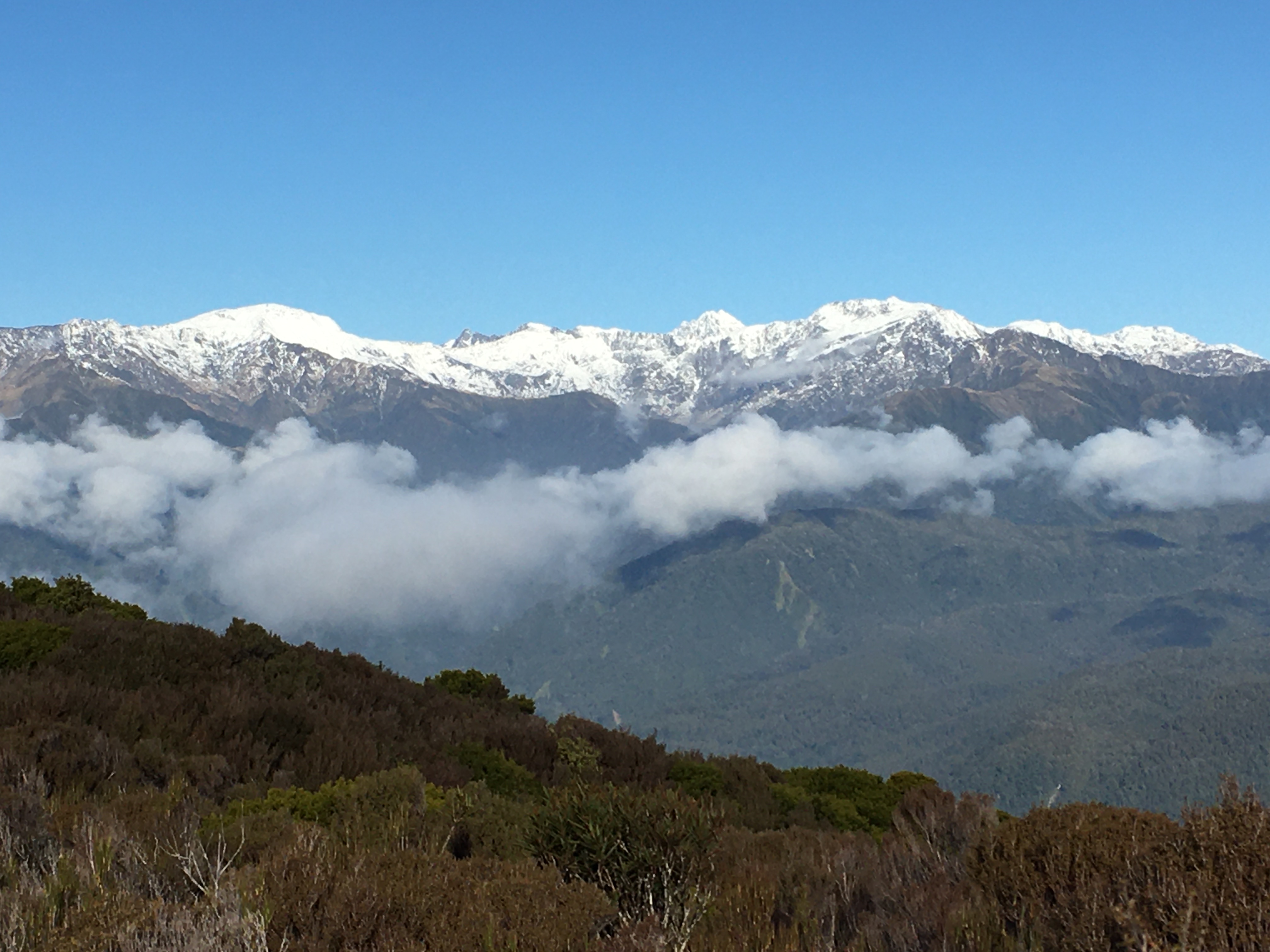
After dropping our gear at Lake Man Biv, we hiked up to Lake Man, an alpine lake where we found our summer solstice snow and had a lovely lunch in the sun, surrounded by awesome alpine vegetation and some cool bugs.

After a cosy night in Lake Man Biv, we hiked out via the Doubtful River. The hike ended with a couple of crossings of the thigh-deep Boyle River and a long river-valley slog—easy hiking, but not terribly exciting.

The trip wasn’t our most strenuous ever, but after having spent the better part of the last six weeks sick, first with Covid, then with a nasty, lingering not-Covid, I was seriously out of shape and thankful for the relatively easy hike.

A Hobbit Adventure

As a writer of fantasy and adventure novels, it’s important to me to get out and have my own adventures. My adventures provide the inspiration and the gritty details for my characters’ escapades. I especially enjoy true wilderness adventures—the less sign of human impact, the better.

view from Mt Isobel
The view from atop snowy Mount Isobel

Of course, not every adventure can be a wilderness experience. Sometimes you want some fun with a little more luxury.

My husband and I recently spent a lovely weekend in Hanmer Springs. While the town is known for its hot pools, we’re not the hot pool type. What we appreciate about Hanmer Springs is the ability to step out the front door of your holiday home, climb a mountain, and end the hike at the pub a few blocks from the holiday home.

It’s hardly a wilderness experience, especially given that Hanmer Springs is surrounded by pine plantations, rather than native bush, but on a winter weekend during the rainiest month on record, it’s just right.

Our main hike for the weekend was up Mount Isobel. This wasn’t our first winter trip to the peak, but it was the first time we’d followed the ridge from the peak in order to descend via Jollies Pass. The last time we were on Mount Isobel, the wind was so fierce, there was only enough time to race to the top, snap a photo or two, and race back down before we froze. This time was entirely different.

It snowed the previous day, so we hiked through a winter wonderland. Light wind and full sun made it a stunning hike. The snow was an easily hikeable fifteen centimetres deep on the ridge—just enough to ensure our feet and lower legs were thoroughly soaked by the end.

There was nowhere dry to stop for lunch, so we ate in short snatches standing up. That was really the only downside to what was a delightful seven-hour hike.

And when your hike ends in Hanmer village, with beer and good food on offer, and a roaring fire at the holiday home to warm your toes, it’s hard to complain about anything. I think of it as a Hobbit adventure—a bit of fun without skipping second breakfast.

From Haast to Haast Pass

My husband and I spent the past four days on the West Coast. I was helping him with some field work involving a lot of bush bashing on steep slopes.

The trip also involved a lot of driving–all the way from Greymouth to Haast, and then over to Wanaka before heading north again. It being the West Coast, the road crossed many creeks, each one named by a small road sign. After a particularly waterway-rich stretch of highway, where  we crossed a creek every 50 metres or so, we began to note ALL the creek names. At some point I began writing them down—they were strangely poetic.

I’ve taken a section—State Highway 6 between Haast and Haast Pass—and have written a poem that uses each creek name, in order starting in Haast, and evokes South Westland. The creek names are the only words capitalised.

you swish through the Grassy paddock
to take a Snapshot,
then fossick for Greenstone
on the beach amidst the strewn blossoms
of southern rata, that seasonal Myrtle
Harris says brings out the colour of
your eyes when he tucks a bloom behind your ear.

ankle deep in the Glitterburn
on a tuesday that sparkles with gold
you fire a text to Roy and Joe,
knowing they are stuck in Dismal london,
while you grow Dizzy trying to track
the flitting movement of a tomtit
in the undergrowth, its Gun Boat grey
blending into the shadows, white breast
winking like a Cron command,
Dancing to its own irregular beat.

and deep in the forest, the Roaring Swine
fill the Gap in the silence and find
the Chink between birdsongs.

your Cache of wonder sits at the Depot,
its Square Top a fitting seat
for Orman,
the Imp with Mossy eyes.
his Eighteen Mile hike on Gout swollen feet
has not dampened his spirits.
he recites MacPherson’s translations,
mixing the ancient gaelic with
lines you’re certain came from Douglas adams.

the Serpentine path you wander tumbles
over boulders soft with moss like grandma Evans’ arms
when she would pull you into those hugs you
hated as a teen, when you and your cousin Chelsea
walked the tired streets of town—
three blocks, then Pivot to retrace
the entirety of main street—hoping
for some excitement.

now it is Solitude you crave.
as Douglas said—space is Big—
surely there is enough of it that you
can carve out your own piece of it
here, among the ancient footprints
of Moa, tangled in a Briar,
imagining Haast eagles soaring overhead.

Diana would have been your goddess,
in this wilderness of rain where The Trickle
of water is more like a roar and
liquid is a Cutter of stone.

you would stay here for decades
like Robinson crusoe, study the
ants at your feet as though you
were e. o. Wilson.

instead you Cross the river
and stand dripping and shiny
as a nugget of gold on the other side.

Wild West

On a whim, my husband and I spent last weekend on the west coast. We stayed in our favourite west coast town—Hokitika—and hiked in the mountains nearby.

view from Mt Greenland
The view from the top of Mt Greenland

Having lived in a rainforest for two and a half years, I know I wouldn’t want to live on the west coast (where rainfall ranges from 2 to 11 metres per year), but I love visiting.

On this visit, we hiked up Mount Greenland. The path up is an abandoned road that used to connect the small gold mining settlement of Veronica to the township of Ross. An article in the West Coast Times in 1888 records Veronica as a promising settlement, complete with a hotel and two stores. Even then, the road from Ross was apparently atrocious—other newspaper accounts from the 1880s colourfully describe knee- and waist-deep mud on the way to Veronica.

The mine near Veronica was abandoned in 1940, and the rainforest has been reclaiming the road ever since. The day we hiked it was sunny and cool, but even without active precipitation, the road streamed with water in places. There were a few short stretches without washouts, deep puddles or slips, but only a few. Ferns leaned over the edges of the narrow track, so that in spots, even hikers were forced into single file. It is clear some informal maintenance of the track still goes on, but the forest is doing its best to erase it.

rainforest

And this is probably what I appreciate most about the west coast—nature is in charge, and humans maintain only tenuous grip. The settlement of Veronica has all but vanished under vines and tree ferns. The gold rush of the 1800s left no ghost towns—the forest has swallowed them all up. Other west coast townships, like Franz Josef Glacier, Fox Glacier, and Kumara Junction, feel equally under siege by Mother Nature, as though it would only take a few moments of inattention before the trees would creep down the streets, and the vines snake over the houses.

As apocalyptic as that vision is, it gives me hope. Hope that one day, the planet will erase the scars of our fleeting presence here and carry on in a riot of life.

Looking back, looking forward

On 26 March 2020, New Zealand went into a nationwide Covid-19 lockdown, and my family moved into a shed. It wasn’t exactly ideal, being homeless during lockdown …

From the comfort of the new home we finally moved into at the end of June, we’ve been reliving that time as we hit milestone after milestone. 

A year ago today, our month-long nationwide lockdown was extended at least two weeks. We were simultaneously devastated and heartened by the news. Covid cases were dwindling—our efforts were working, but would take a while longer.

That day I posted the following poem on the fence:

The storm rages ‘round us
We’re soaked to the skin
Our ship pitched and tossed in the waves.
The captain barks orders,
Hand firm on the wheel.
She knows the relief her crew craves.

But she cannot allow us
Our petty desires,
As much as she longs for them too.
To weather the storm
We must all pull together
Or the tempest takes many, not few.

I don’t think I really understood how true those words would turn out to be. As the world collectively registered over 3 million Covid-related deaths this week, I reflect once again on how different our experience here in New Zealand has been from the rest of the world. Once again I am grateful for the incredible leadership we have in dealing with this crisis, and the collective commitment New Zealanders have shown to doing what needs to be done to protect everyone here.

Yesterday, we reopened our border to Australia, allowing families and friends to reunite, and tourists to travel. It raises our Covid risk as we expand our national ‘bubble’, but both countries have proven quick to respond to the virus, and I believe we will continue to pull together to keep everyone safe.

Weekend Getaway

Carrington Peak

Over the long Waitangi Day weekend, we hiked up the Waimakariri River to Carrington Hut. Using Carrington Hut as a base, we took day walks to Kilmarnock Falls and Waimakariri Falls Hut.

The weather was glorious, and hiking on the riverbed, it was easy to cool off with a quick dip in icy water. The hike to Waimakariri Falls Hut was particularly rewarding: there are two ‘official’ falls on the river, and dozens of smaller streams dropping off the surrounding peaks in spectacular fashion, so you feel as though you’re walking through a watery wonderland.

Wading in to see Waimakariri Falls.

The upper falls, just below the hut, are hidden in a deep, narrow fissure in the rock. Waist deep in icy water is the only way to see the water roaring down—great fun, but not something you’d want to do on a cold day. 

Above the falls, the river is narrow enough to jump across with dry feet, and flows through a fabulous alpine landscape. We didn’t hike all the way to the snowfield where the river actually begins, but we were close. 

The fuzzy flower of a South Island edelweiss

My favourite two things on the hike were the South Island edelweiss (Leucogenes grandiceps), which looks like it was made out of felt by someone named Aunty Flo, and the river water itself. The water was crystal clear, yet colourful (the gorgeous turquoise of glacier-fed rivers) and full of substance. I could have watched it flow over the rocks for hours (come to think, I did watch it flow over the rocks for hours).

Waimakariri Falls Hut. The snowfield visible to the right of the hut is the source of the Waimakariri River.

Least favourite part of the hike was Carrington Hut. It’s a great hut in a stunning location, but last weekend, it felt as though everyone from Christchurch was there. Carrington Hut has 36 bunks, but only 1 toilet and 1 sink. With about 40 people in the hut and another 20 or so tenting nearby, it was way over its capacity. As usual, everyone was considerate and did their best to make it work, but it was still unpleasant.

All in all, a lovely weekend getaway, and an easy hike, as long as you’re comfortable with river crossings.