Escape the Heat

2017-03-02-15-12-14I love my office. The northeast and northwest walls are formed almost entirely by large sliding glass doors. I have sunlight in the office all day. On warm days I can throw open the doors and enjoy feeling like I’m working outdoors.

In winter, I rarely have to run my heater–even ten minutes of sunshine can heat up the room. The insulated and windowless south-facing walls keep the room cosy and draught-free, even in howling storms.

That’s all great…for most of the year…but when the outside temperature climbs above 30°C (86°F), all that sunshine becomes too much. No matter how nice the breeze through those open doors, sitting in the sun becomes unbearable. My attention starts to wander. My brain become sluggish. My hourly word count plummets. At some point I have to either give up work for the day or take it elsewhere.

A pool of shade, a grassy seat, and a clipboard, and I’m back in business. It’s officially autumn here, but it’s still hot enough to need to escape the heat. I’m looking forward to cooler days when I can appreciate my office again.

And the Winner Is…

2017-03-01-19-04-27It’s Oscar season in the garden–the time of year when I start reviewing in my head how various crops performed over the summer. I plant a wide variety of vegetables, because some do well and some don’t every year, and not always the same ones.

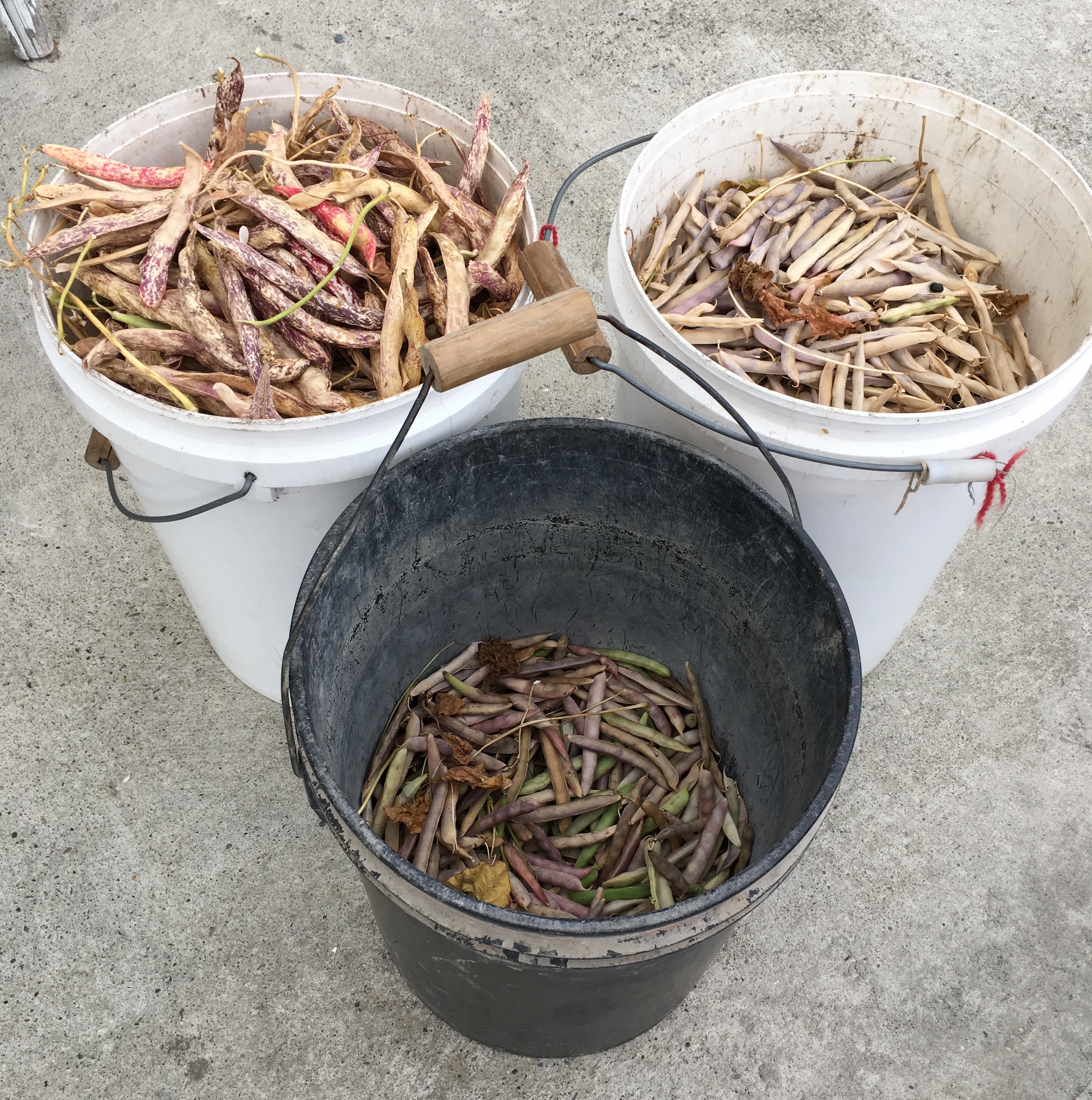
This year, for reasons known only to the plants, the black beans produced spectacularly well. I spent two hours harvesting yesterday and haven’t picked them all yet. I’ve easily got twice as many per square metre as I did last year. Add to that the fact I planted more this year than I did last year, and we’ve got a heap of beans.

You won’t find me complaining about that. Black beans are one of those staple foods for us that I can never produce enough of. I can already taste the burritos, chilli, and plain old beans and rice that will warm our stomachs through the rest of the year.

Of course, shelling them will take ages. I managed to shell about three-quarters of a bucket last night before the boredom got me. My secret to shelling without going crazy is movies. Movies I’ve watched before are best, so I don’t mind having to look away now and again to grab another handful of beans. I can settle in for the whole evening of shelling with a good movie. By the time I get to the final credits, I realise I’ve shelled a bucketful.

Perhaps I should watch Moonlight? Two winners together in one evening.

The price of the beach

img_3170We spent yesterday at the beach–sun, sand, and surf!

It was glorious.

Today I paid for it.

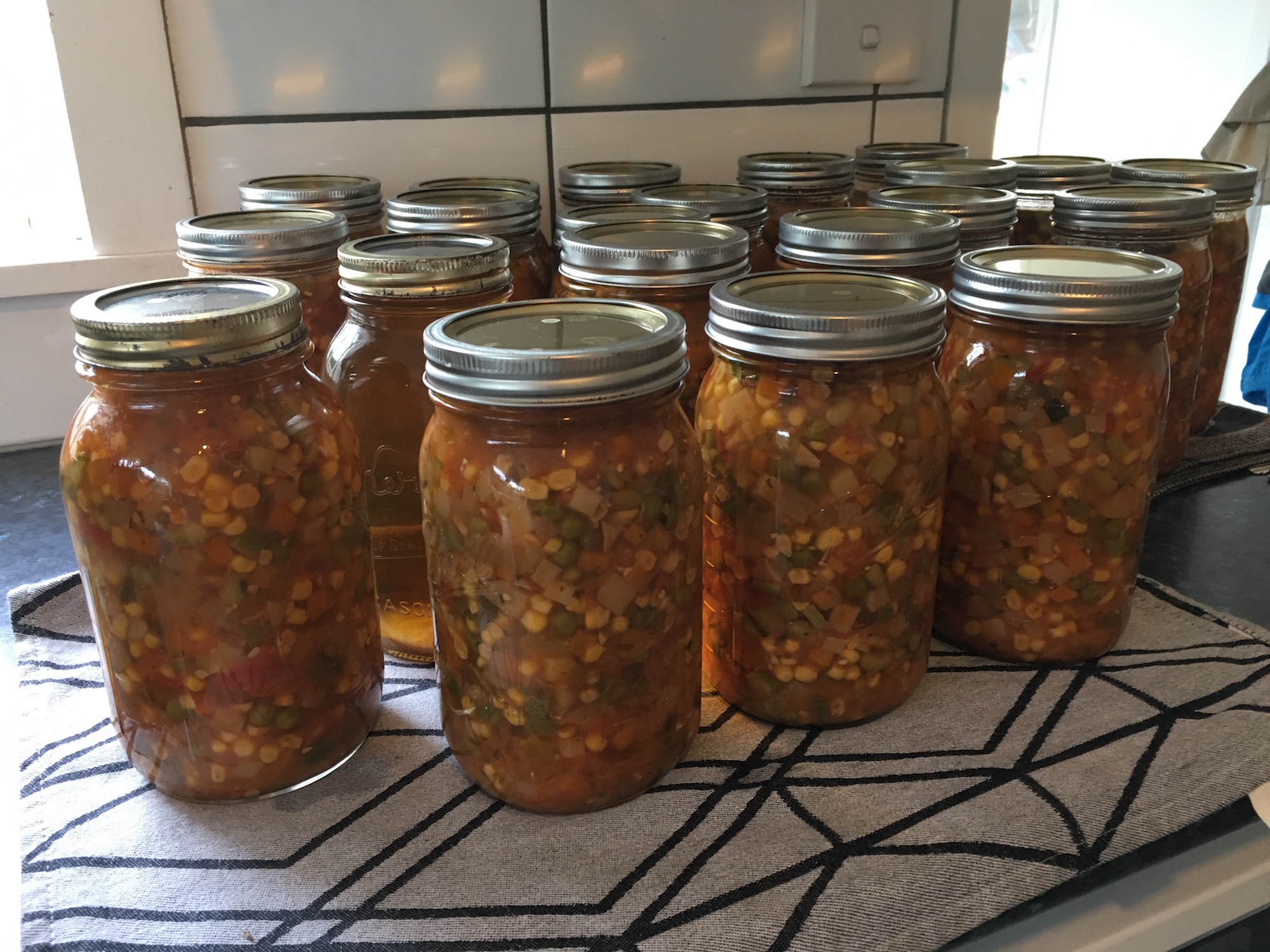
Not in sunburn or sand in my shorts, but in work. It was time to make our annual vat of summer soup, I was milking for the neighbour this weekend, and I had a weekend of cleaning and animal care to do–all in one day.

While I milked the neighbour’s goats, the rest of the family started picking and chopping vegetables. When I got home with a pot of milk, I made cheese around the vegetable prepping, then I joined in.

As the pot of soup came together, we started calculating how many jars we needed to hold it all. It was several more than we had empty.

So I made apple crisp, freeing up two jars (which still held last year’s apples). I baked that while the first load of jars was in the canner.

I had also planned on baking lunchbox desserts this weekend, so after putting the second load of jars in the canner, I made cookies.

I also took down and folded the laundry (and patched a hole in my daughter’s shirt), and washed a ton of dishes.

While the third load of jars was in the canner, I cleaned the house (mostly), and milked my own goat. Before that batch of jars was finished, it was dinnertime. I sat down for the first time since breakfast.

Whew!

The final tally for the day was 23 quarts of soup, 6 quarts of vegetable stock, 6 dozen cookies, one beautiful apple crisp, and a batch of chevre (and a clean house and laundry).

Unfortunately, the chicken house hasn’t gotten cleaned yet, nor has the bathroom. I could probably manage them yet today.

Or I could pour myself a glass of wine and worry about them tomorrow…

Losing Soil, Making Soil

img_3148This time of year is always dusty. The soil is dry. The air is dry. Farmers harvest the summer crops and turn the soil to plant the winter’s grass. It’s not unusual for a wind to kick up, sending newly-turned soil into the air.

I don’t know how much soil farmers in Canterbury lose this way (they’re also getting soil from the farms upwind and loess blown off the mountains), but I do know that where my back yard meets the neighbour’s field, my property is significantly higher. At least some of that soil is being lost.

Interestingly, there seems to be a place on the neighbours’ farms where soil is being made.

A hundred and fifty years ago, farmers in Canterbury were planting gorse hedges for shelter and fencing. Many of those gorse hedges remain (indeed, they’re hard to get rid of). The original plants are almost certainly long gone, as gorse is a short-lived shrub, but new plants are continuously growing from seeds cast by the mature plants.

It’s quite possible that my neighbour’s gorse hedges have been here since Joseph Price took up the original 5000-acre run number 79 in 1853.

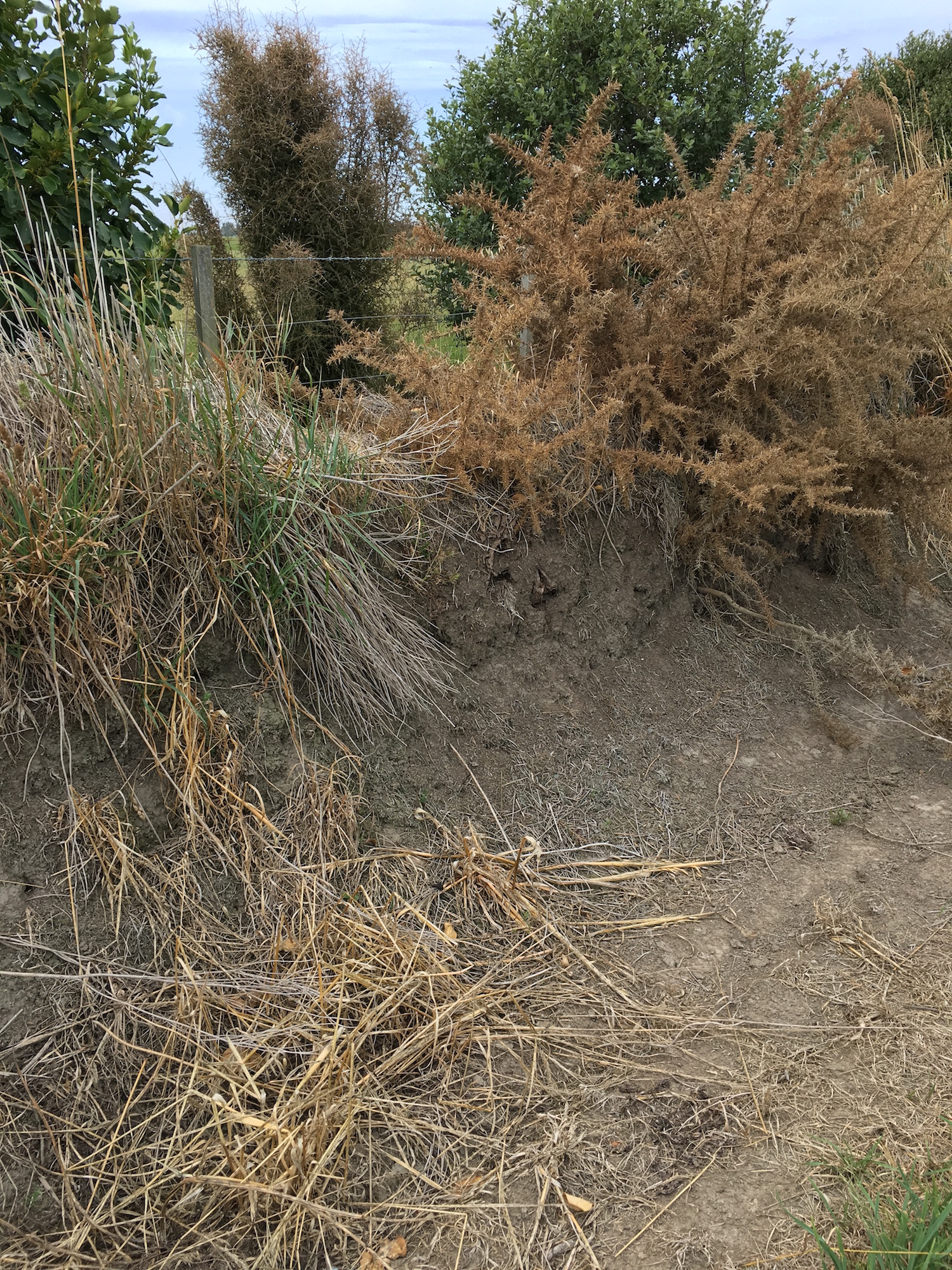
Gorse is dense when pruned into a hedge. New outer growth shades out growth in the middle of the hedge. Thorns and branches fall and form a dense, prickly mass at the base of the plant. Over time, this detritus breaks down and forms soil.

Quite a lot of soil, by the looks of it.

Some gorse hedges were planted on ridges–ditch and dyke, it was called–the farmer dug a ditch to help drain the land, and planted a hedge on the resulting pile of soil scooped out of the ditch. Some hedges were just planted on the level ground. This is how the hedges along my lunchtime walk were planted, but today it looks like they were sown on a tall, narrow wall of soil.

The build-up of soil under the gorse hedges is impressive. In some places, it is as high as my waist. It is most visible where the gorse has been herbicided off to make way for native hedging plants. There you can see how the twisted trunks and branches have caught the detritus and held it in place, even after it has rotted.

How important are these ridges of new soil in a landscape that is losing soil? Probably not terribly important–they cover just a tiny fraction of the landscape–but I find them intriguing, nonetheless. Our agricultural landscapes–as modified, controlled and cultivated as they are–still hold interesting stories.

Uplifted Polenta Lasagne

2017-02-11-18-05-05-smLet me start by saying I had nothing to do with this meal, aside from growing the raw ingredients and making the feta and parmesan cheese. I was off doing other things while my husband cooked this. I didn’t even do the dishes afterwards–the kids washed.

Do I have the best family, or what?

This incredible dish is actually quite simple. My husband started by making firm polenta (flavoured with parmesan cheese, rosemary, salt and pepper) and allowing it to cool in an oiled jelly roll pan. When the polenta was firm, he cut it into squares, and layered the squares at an angle in an oiled lasagne pan with slabs of raw zucchini, slices of tomato, salt and pepper, and a mix of feta and grated edam cheese. He sprinkled fresh basil, chopped garlic, and diced tomato on top, and baked it at 220°C (on fan bake) for about 20 minutes. The result was rich, juicy and flavourful.

My contribution to the dinner was a simple salad of thinly sliced cucumbers tossed with salt, red wine vinegar, olive oil, and chopped fresh fennel leaves–a perfect accompaniment.

Summer cooking just doesn’t get better than this.

Bittersweet Sweet Corn

2017-01-24-15-16-41-smYou wait for it all summer. You watch it grow taller and taller. You marvel when it overtops your head. You cheer when it starts to flower, and you impatiently poke the ears as they grow and fatten.

Then one day–finally–the first ears of sweet corn are ready to pick. Always eaten as corn-on-the-cob, the first ears are celebrated and savoured. They cry out Summer!

They are the beginning of the end, of course.

Once the sweet corn is coming on, the green beans will start to slow down. The peas, already on their last hurrah, will give up. February’s heat and dry will begin to take its toll on all the plants.

There is still plenty of time to enjoy summer’s bounty–the deluge of vegetables won’t be over until mid-April. There is still ketchup to make, and summer soup to bottle. And lots and lots of corn-on-the-cob to eat.

But once the corn is ripe, the clock is ticking. From here on out, the garden will look a little worse each day. I’ll start pulling plants out, clearing beds, harvesting storage crops.

And in a shady corner of the yard are two trays of seedlings, sheltering from the heat and harsh sun. Waiting for the end of the sweet corn. Winter crops.

Because every season’s end is another’s beginning.

Summer Farewell

2017-01-29-06-18-08-smSunrise over
Quiet water.
Waves roll in.

— • —

Anemones and
Starfish rule.
Snail goes slow.

— • —

Cliffs enclose
Sandy bays in
Rocky embrace.

— • —

Footprints
Tell
Stories.

— • —

Paddle slowly.
Quiet now.
Fish are sleeping.

— • —

Beach beckons
Sun is high
School threatens.

Thirsty Bees

img_3051When my husband created a pond in the yard, I expected the damselflies, mayflies, midges, diving beetles, and other aquatic insects to show up. I even expected the heron who occasionally drops by to sample the goldfish.

I didn’t necessarily expect the honey bees.

I wasn’t surprised when they showed up, though. What surprised me was the sheer numbers that have shown up this summer. The edge of the pond has been humming for weeks as hundreds of bees jostle for space on the best perches.

Honey bees, like all animals, need water–at least a litre a day per hive. The bees don’t just drink the water; they also use it to dissolve honey that has crystallised, dilute honey for larval food, and to cool the hive on hot days.

When scout bees find a good water source, they mark it with pheromones that tell the other bees it’s a good spot. I reckon by now, the edge of our pond is sticky with pheromones (or at least stinky with them), because there’s always a crowd there.

And after yesterday’s 31°C (88°F) temperatures and 130 kph (81 mph) wind, the pond was extra crowded today.

I’m happy to oblige the bees. I need them to pollinate my vegetables, and they’re not aggressive when they’re foraging away from the hive, in spite of the potentially frightening crowds. The arrangement is a win-win situation for all of us.

Celebrate January

2017-01-24-15-13-32-smThe golden month is nearly over. January is the sweet spot of the year.

The Christmas frenzy is over. The kids are o vacation. much of the rest of the population goes on holiday too.

Even I get a break. By January, the plants in the garden are large enough to suppress weeds, so there’s little weeding to be done. Te early crops are winding down and the summer crops are ramping up. Full-scale bottling (canning) and dehydrating will come later. January is mostly a time to enjoy the garden’s summer bounty.

There is work to do, of course. Peas, pickling cucumbers, and green beans all peak in January, and they need to be processed. But they are relatively quick and easy crops to preserve.

Along with the garden respite usually comes sunny summer weather. We can go camping and backpacking, and take trips to the beach. January is a month of sand, sun and effortless meals.

February will come, with school, work, and a mountain of vegetables to process. The nationwide party mindset will end, and we’ll all settle in for another year at the grindstone.

But there’s still a week left. Enough time for a bit more fun…