summer
Postcard From New Zealand
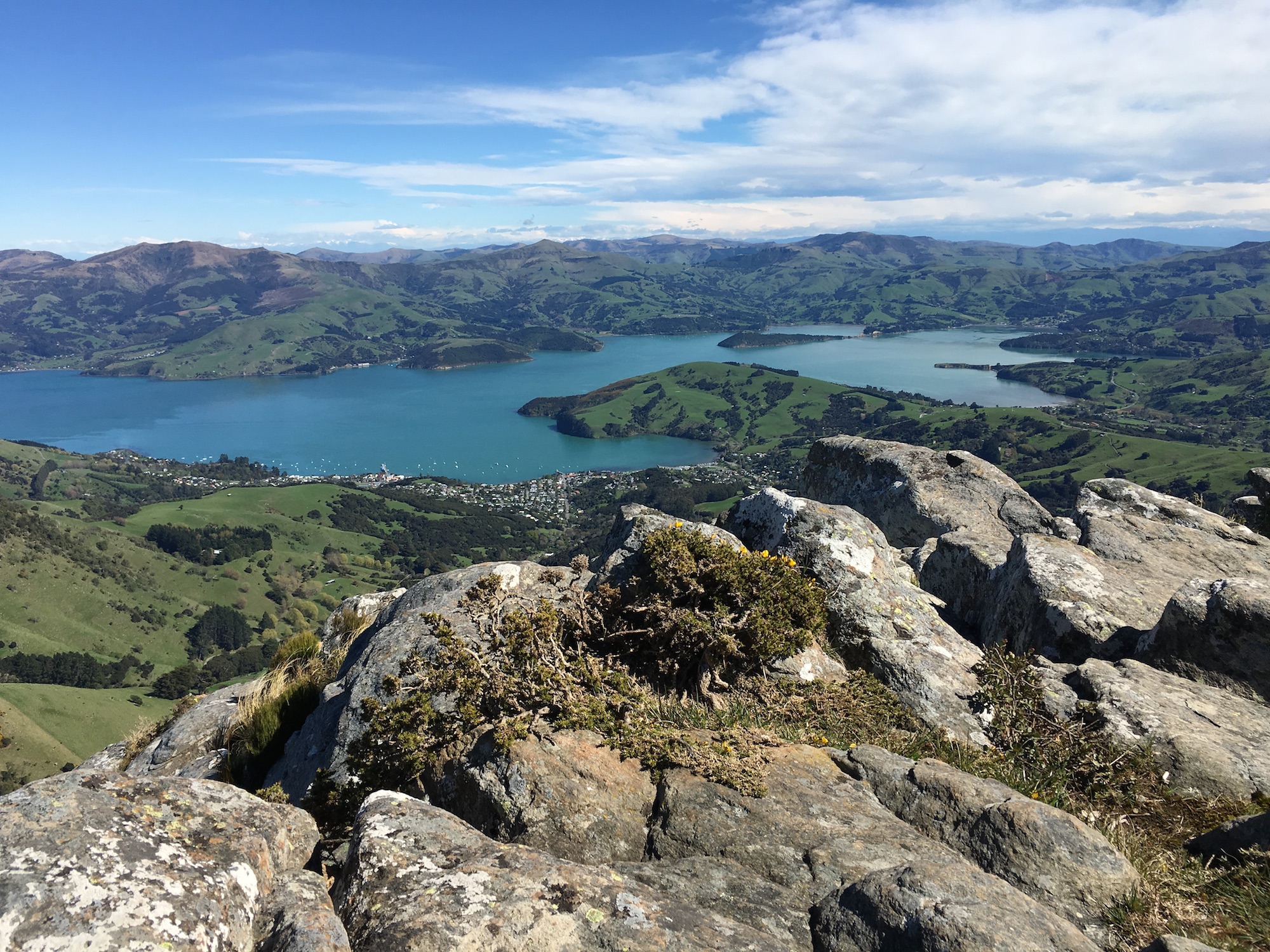
 We spent the day yesterday at the beach (along with the entire population of Canterbury and half a million tourists, judging by the crowds). It was a stellar beach day–hot and sunny. Perhaps a bit too windy at times, but heat and wind are almost inseparable here, so we just go with it. We managed to slip away from the crowds for a while by clambering over the rocks to Little Okains Bay. The water was cold, the sand was hot, the rock pools teemed with cool creatures, and the scenery was stunning, as usual.
The entire day was a full-colour glossy tourism ad for New Zealand. And it was just one of many similar days we’ve experienced recently.
I’m not saying that every day is a vacation–I put in 11-hour workdays (painstaking editing) all last week, and I pull a lot of weeds and have to clean the house and the chicken coop every week–but New Zealand does vacationing well.
All day, I kept coming back to one, glorious, humbling, beautiful thought–this is my home. My family and I are so blessed to have been welcomed into this amazing country. A place where we can stand on the top of a mountain one weekend, and swim in the ocean the next weekend. A place where Christmas/summer vacation lingers through the entire month of January; even once many people are back at work, the vacation mindset remains. A place that embraces a weird and wonderful mix of people from all over the world.
New Zealand has its problems–no human society doesn’t–but I feel honoured to be allowed to make my home here in such an incredibly beautiful place among such incredibly beautiful people.
So you all my Kiwi readers–thank you.
And to all my overseas readers–having a great time. Wish you were here.
Get Outside—See Cool Stuff

The swarm–apologies for the image quality; I’m allergic to bee stings.
I’m trying to make myself go out for a walk at lunchtime every day. I’ll admit that I can be a bit of a slave driver when I’m working, and I don’t always manage it. I have a tendency to simply work through lunch, and then suddenly discover it’s late afternoon.
In truth, the walks available to me from my front door aren’t necessarily all that inspiring—endless agricultural fields in every direction.
But you can’t experience anything if you don’t first go out. Yesterday, I took the most boring of the boring walks from my house—the one that doesn’t offer so much as a mailbox for the first kilometre. Don’t ask why I chose that way—maybe I wanted to clear my mind, as I’d been doing intense editing all morning.
On this most boring of walks, I happened to see something awesome—a honey bee swarm.
We are blessed with many nearby apiaries, and I always have a plentiful supply of bees to pollinate my garden vegetables, but even so, it’s unusual to spot a swarm. This one was hanging in a drooping mass off the neighbour’s fence.
Bees swarm to create a new colony. It’s usually the old queen who leaves her hive with a large portion of the workers. A new queen will hatch in her absence and take over the old hive.
The swarming bees leave the hive and gather nearby while scout bees search for a new hive location. This is what I saw—the resting swarm. It likely flew away to a new home within a few hours. Where those bees are now, I don’t know, but I hope they found a nice place nearby from which to visit my garden.
So, my most boring walk was amazing. That reminds me, I still haven’t gotten out for a walk today. Time to step away from the desk and get outside. Who knows what I might see?
Proof We’re Lame
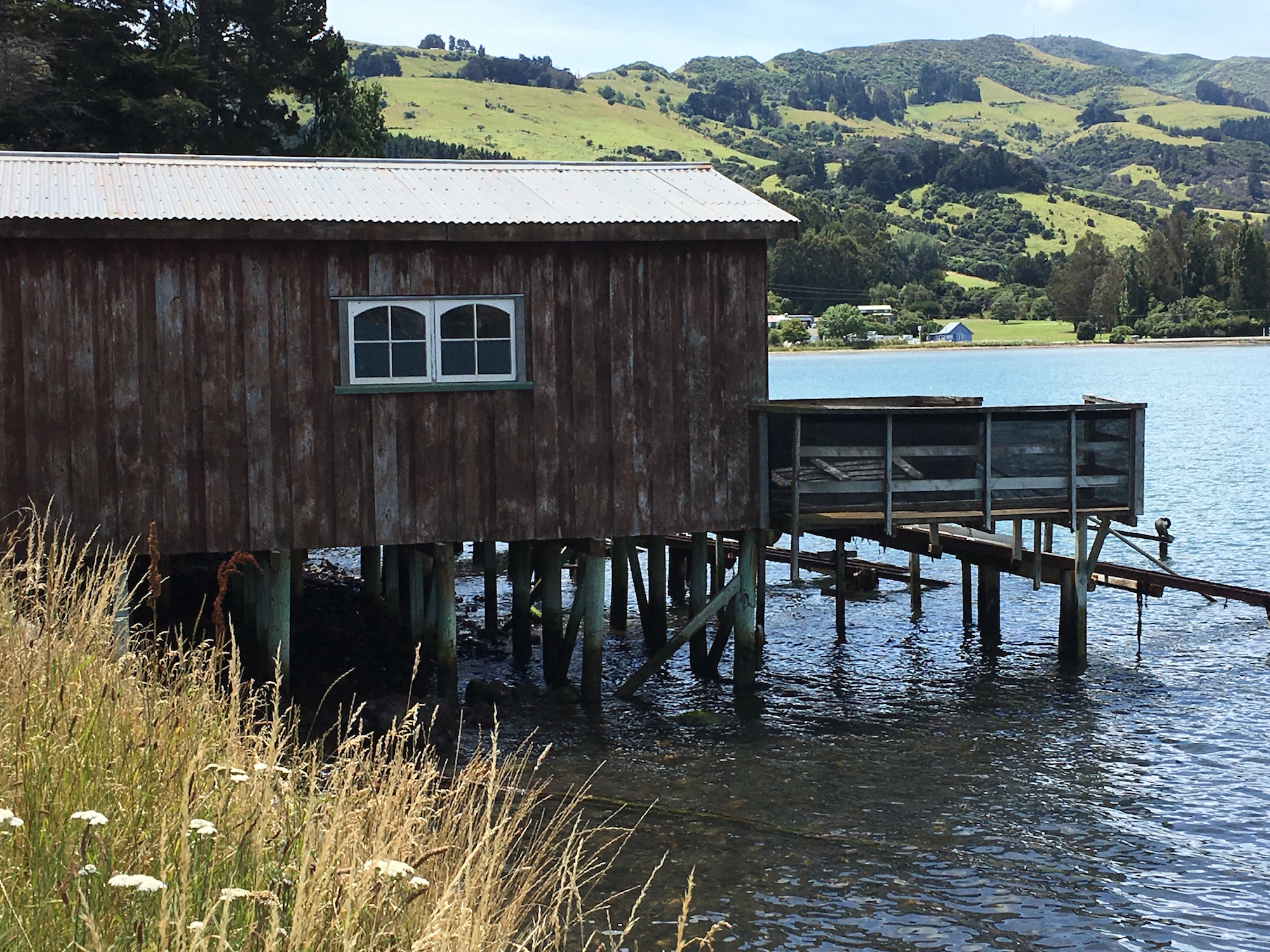
A boat shed in Duvauchelle
It was Mum and Dad’s annual day out today. We dropped the kids off at summer camp in the morning, then had the whole day together with no other obligations.
Yeah! Party time!
Or not.
We brought our wetsuits and snorkels, thinking we might do some snorkelling…
But it was cloudy and chilly.
We drove into Akaroa to visit a couple of art galleries and have lunch on the waterfront…
But a cruise ship had just disgorged 2,000 tourists into the town, and it was so crowded, we left.
We ended up having toasties, chips, and a beer on the deck at the pub in Duvauchelle, watching the wading birds and a luckless pair of hitchhikers. Then we went for a short walk and came home.
Lame, lame, lame.
It was a lovely day, but we could have done all that with the kids. In fact, our summer outings with the kids are usually more exciting than that.
Truth is, I wasn’t surprised. It happens most every year. We have a week with no kids in the house, and what do we do? We go to work, we weed the garden and mow the lawn. Sometimes we might go so far as to rent a movie.
No all-night dancing, no dinners out—just the normal routine, with less washing up needed afterward.
Is that lame? Perhaps. I like to think of it as an indication that our daily life is pretty darned good. I like to think of it as an indication that we enjoy spending time with our kids, and our kids don’t stop us from doing the things we enjoy.
So tomorrow, I’ll have a nice long work day (I have lots of editing to do!), and when my husband comes home from work, we’ll make a delicious dinner. We’ll spend the evening sitting on the couch reading, and then we’ll do it all again the next day. Not really too hard to take.
The View from the Compost
 I finished turning the compost today—a back-breaking, exhausting job I don’t particularly enjoy. After I added each layer, I climbed on top of the pile to even it out and water it. From my two-metre high perch, I had a lovely view. I admired the neighbour’s seed radishes—wide stripes of white and pink flowers marking the two varieties he is crossing this year. It looked more like a curtain than an agricultural field.
Then I turned to admire my own garden. Well, actually I just turned. I’ll admit that I was a little surprised I found the view so nice.
The early January vegetable garden is always gorgeous—everything is at its peak lushness. I expected to find that attractive. But surveying the entire “production” side of the property from my perch, I was pleased to note that the whole place looked surprisingly lush. The berry beds are dense and tidy. The extra vegetables planted in my “overflow beds” (because 300 m2 (3230 ft2) of vegetables naturally wasn’t enough) are growing well, too. The artichokes look a little sad, and the grass paths are brown, but that is to be expected in the heat of summer.
The overall effect was one of lush productivity. I spent a little extra time on top of the compost pile to enjoy the view. It made today’s brutal job a little bit nicer.
End of the Pickle Drought
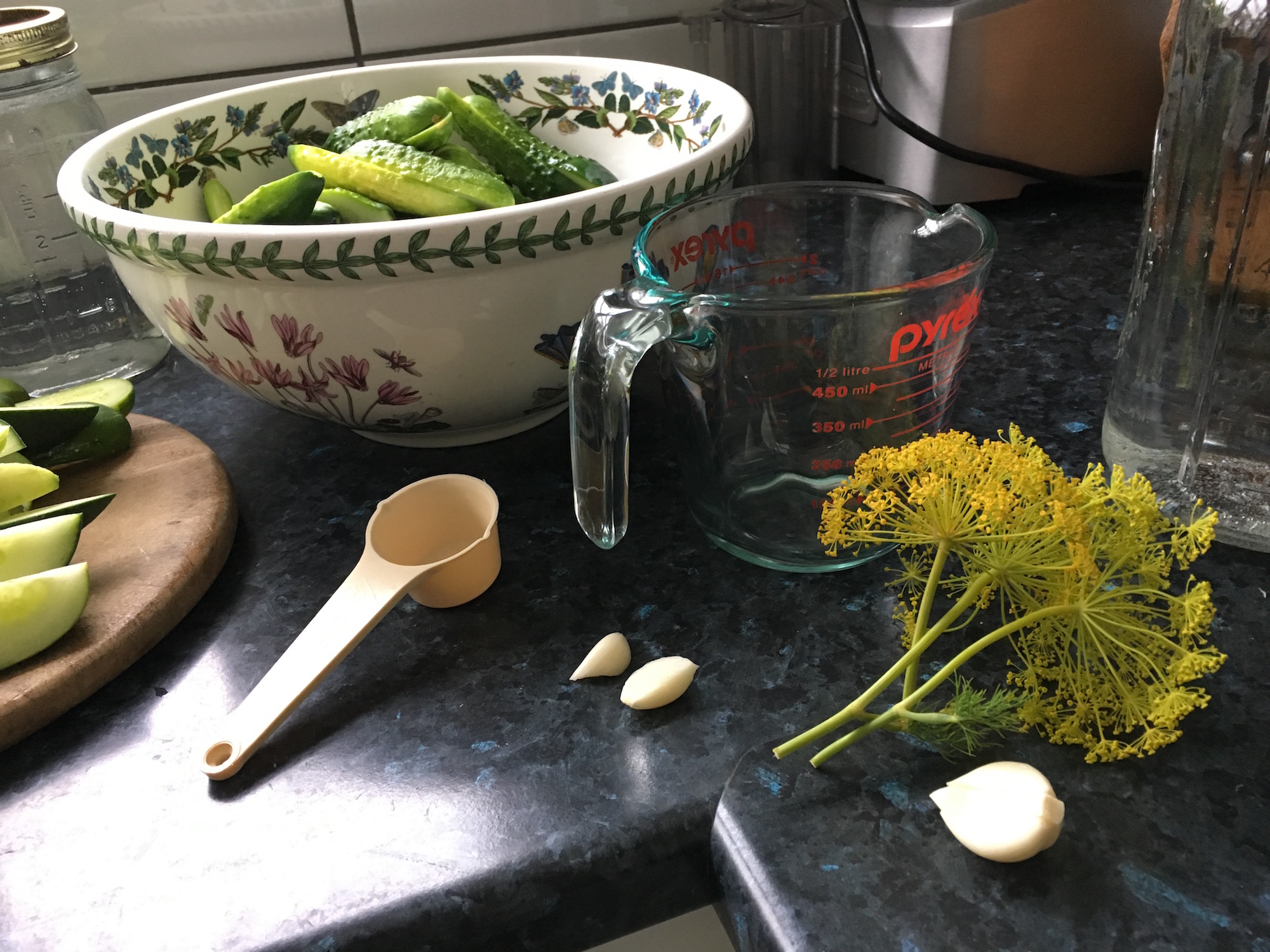 I grow pickling cucumbers every other year, in order to avoid becoming the Pickle Lady. Last year’s crop, however, was killed by frost, and we’ve been out of pickles for some time.
This year, the stars have aligned, and I have a beautiful crop of cucumbers coming on. As a bonus, the dill didn’t get completely wiped out by aphids (as it often does), so it’s perfectly timed with the cucumbers. There will be plenty of dill seed heads to flavour the pickles this year.
So it was with joy that I picked the first cucumbers yesterday. There weren’t enough to make a proper batch of pickles—there’s no point in heating up the canner unless I can fill it at least once—but I was fine with that. In fact, I was quite pleased there weren’t more. It meant I could make a batch of fresh pickles to put in the fridge and eat right away. After a long pickle drought, they’re going to taste fabulous!
What We Don’t Know
 We headed to Tumbledown Bay today, ostensibly to try out the new snorkelling gear Santa brought us for Christmas. The water was murky and absolutely freezing, so it wasn’t exactly the best snorkelling, but it was a great day at the beach, regardless.
The seals were probably the best part of the day. There were lots of them, and they were vocal and active most of the day. A couple of them were even body surfing. They’d catch a wave and leap along with it almost all the way to the shore, then swim out and do it again. It was great fun to watch
The rock pools were great, too, as they always are. We saw some starfish, lots of snails, limpets, and chitons. I never get tired of them. In the sandier pools there were lots of marine isopods (sea slaters). I sat for a while at one pool and watched them. Some were just 3-5 mm long and the colour of sand. Some of the sandy-coloured ones had a white diamond on their backs. One, almost 10 mm long, was rusty orange with a white diamond on its back. The most spectacular was about 8 mm long, and had red and yellow markings, reminding me, oddly, of a European goldfinch.
As I sat there, I realised I had no idea whether I was looking at one species of slater with many colour variations, or twenty species.
A little research at home revealed that I’m not alone in my lack of knowledge of New Zealand’s marine isopod fauna. There are just 211 aquatic isopod species described for New Zealand. Scientists estimate that there are about eight times that many species. It’s not just the deep-water types that are poorly known, but many of the easily seen intertidal species are also undescribed. It seems these common little scavengers have been largely overlooked by science.
So the mystery remains—how many different isopods did I see today? As far as I know, no one can tell me the answer. But rather than disappointing me, the knowledge that we just don’t know excites me.
Anyone who thinks we know everything about planet Earth and the only real frontiers are in space is sorely mistaken. There is so much to be discovered, not just in exotic locations like the Amazon rainforest, but on the beaches that thousands of people visit every year, in the rivers and streams we cross daily on our way to work, even in our own back yards. There is so much about which we understand so little. The scientist in me quivers with excitement.
Did I see one species of isopod or twenty? No one knows. Doesn’t it make you want to go to the beach and peer into tide pools to find out?
Think Like an Entomologist
 We went to the beach today. It was the perfect beach day—hot, and not too much wind (not at the beach, at least). The waves were big and great for body surfing and boogie boarding, and as usual, we ran into friends who also happened to be there, and had a good catch-up.
But the very best part of the beach today was the bees.
Thousands of native bees on the dunes just above high tide line. Swarming in the air, just 30 cm off the soil surface. I couldn’t help but watch, and I was rewarded with a fantastic show.
The bees almost all had loaded pollen baskets, and at first I wondered if they were feeding on something on the sand, because they would dip down to the surface, take a few steps, then fly away. I watched dozens of bees do this, but still couldn’t tell what they might be collecting.
 Then I saw it. A bee landed, then quick as a flash, dove head first into the loose sand. It took her only a moment, and she had vanished, leaving nothing but a slight divot in the sand to show where she’d gone.
Then I knew. They were burrowing into the sand, provisioning nests for their larvae. They had dug the burrows earlier, and the brief touchdowns on the sand were to locate the right burrow. I watched for a long time, and saw several bees dive into their burrows. I even saw one go part way, decide she had the wrong spot, and scramble back to the surface to try again.
Then I saw another insect in the crowd—a wasp. It, too, was hovering over the sand and dropping down now and again to the surface. I surmised that it was a parasite, looking for the hidden bee burrows. I guessed it would enter a burrow and lay an egg on the bee larva, and the wasp larva would eat the bee.
These were all guesses based on my observations. I really didn’t know if there were dune-nesting bees here, or if they were parasitised by wasps.
At home, I was able to confirm my observations. My bees were the native Leioproctus metallicus, and they are parasitised by a gasteruptid wasp that lays its own eggs in the bee burrows.
I was pleased to have pieced together this puzzle by watching bees on the beach. (The only part I couldn’t see was that the bees try to fool the wasps by digging many burrows, not all of which contain larvae.) Entomologist Tom Eisner once wrote, “There is a saying that ‘5 minutes in the library can save you weeks in the laboratory,’ which has considerable merit. I prefer the naturalist’s version, which says that ‘weeks in the field can save you minutes in the library.'”
I’m with Eisner on that one. Watching those bees and trying to piece together what was happening was pure magic.
You have got to be kidding me…
 It frosted Saturday morning. Yeah. It was 30C Friday afternoon, and by Saturday morning it was 2C. It was back up to 30 degrees by Saturday afternoon, and today we went to the pool.
I didn’t even think to check the garden Saturday morning. It never frosts this late in the year. That’s the seasonal equivalent of frost on June 16th, for those of you in the Northern Hemisphere. Even in St. Paul, Minnesota, it never frosted that late. It was a rude surprise when I went out to the garden in the afternoon to pick some vegetables and found the pumpkins and beans blackened.
The plants will survive—it was a light frost and the growing tips of the plants weren’t hit—but it will knock the pumpkins back significantly. They were already behind, because the first planting didn’t germinate, and these plants were my second try at them this year. A frost this late might be the difference between mature pumpkins when the first autumn frost hits or pumpkins that still need a few weeks of growth to reach the right stage for storage.
Unfortunately, the only thing to do at this point is shrug and be thankful the other frost-tender crops weren’t damaged…after the obligatory grumpy farmer complaints are through.
Christmas-lite
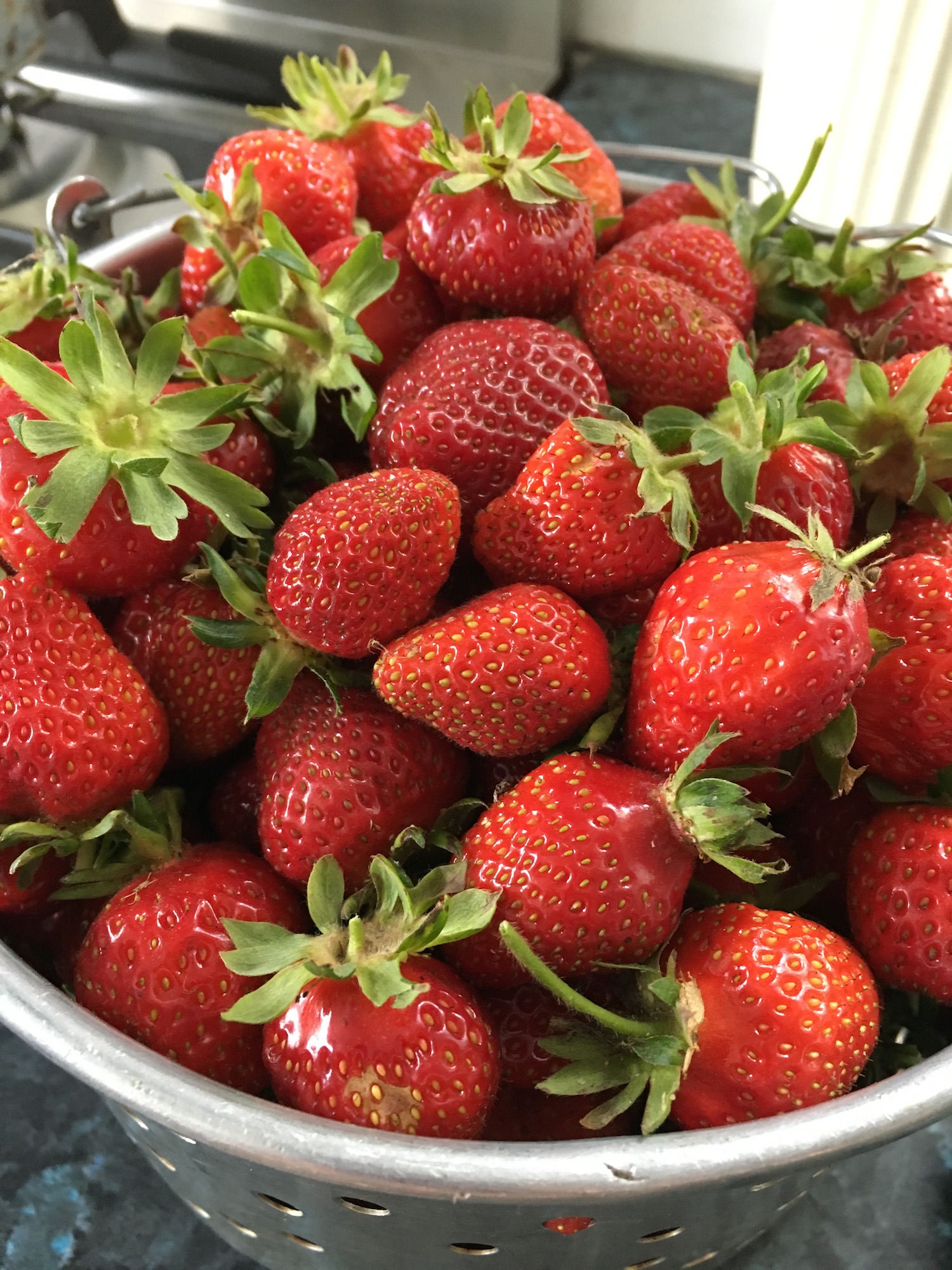 It’s beginning to look a lot like Christmas…
Strawberries, gooseberries, black currants, red currants, cherries, and peas—ah! The signs of Christmas! They’re red and green, just like those in the Northern Hemisphere, but the greens are brighter than pine tree green, and the reds more succulent than holly berries.
They are just as festive as the colours up north, though in a different way. While you look inward, gathering around the hearth on long dark evenings, we look outward, sitting with friends on the beach on long summer days. You dream of white snow, we dream of white sand. You have visions of sugar plums dancing in your heads, we have visions of fresh strawberries dancing in ours. While you sing ‘let it snow’, we sing ‘let us go’ (to the beach).
Now and again I miss the cosy dark of Christmas in the north. And every year, I wish summer gardening, Christmas, and the end of the school year didn’t happen simultaneously. But I’ve grown to appreciate the summer Christmas. I appreciate not having to plan Christmas dinner, but letting it spring from whatever is abundant in the garden. I appreciate being able to sit outside on the porch in the sun after gifts have been opened. I appreciate the barefoot, short-sleeved, nature of Christmas here.
It’s like Christmas-lite.
 Robinne Weiss