Red Currant Orange Muffins

I’ve occasionally noted how alike in smell, flavour and texture red currant jam and cranberry sauce are. And since I’ve got a freezer full of last summer’s currants, I decided to use them in a recipe calling for cranberries.

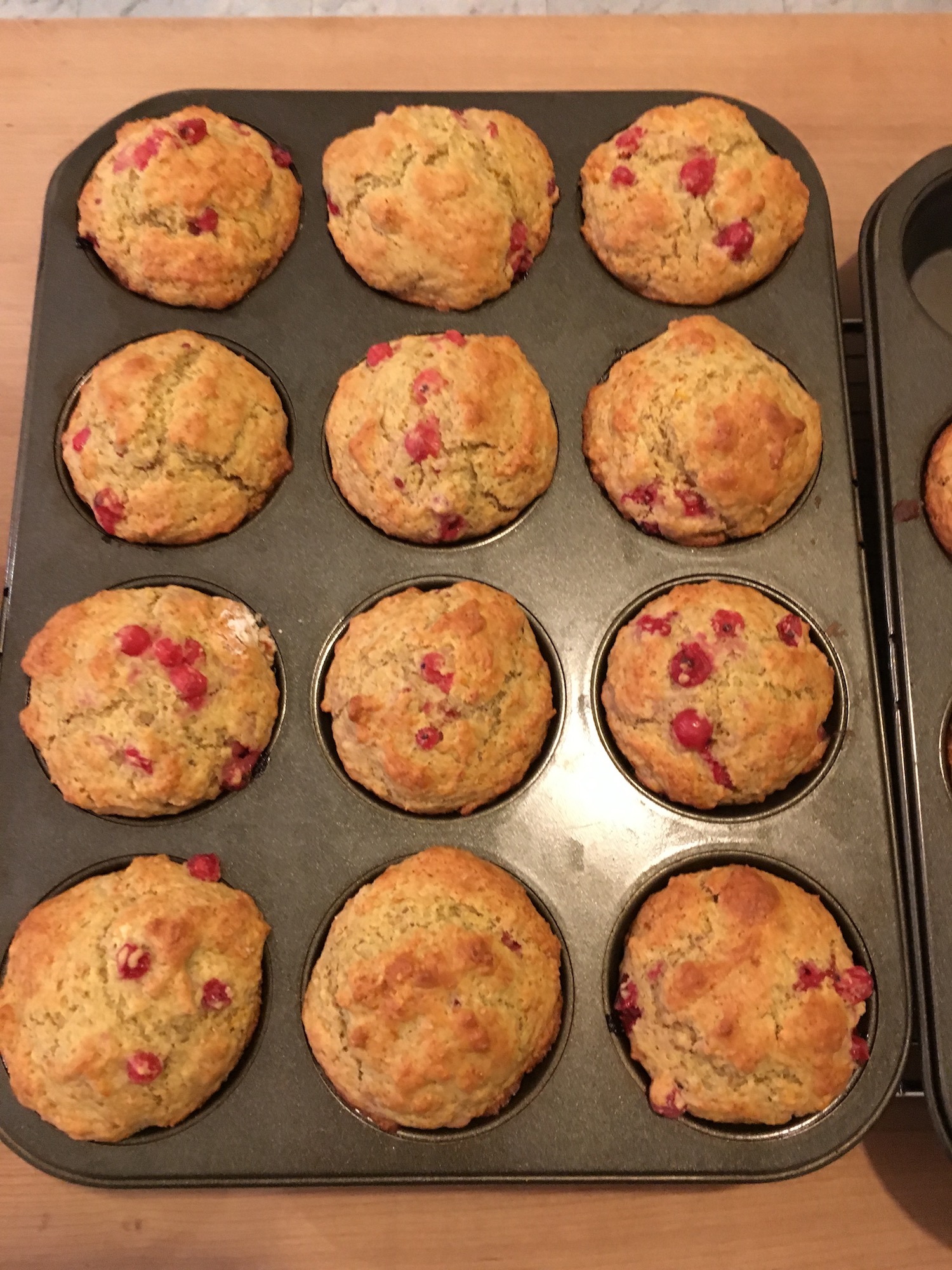
The result was a lovely red currant orange muffin. Even better than the cranberry version, because the fruit came from our own garden.

2 cups all purpose flour
1 c. whole wheat flour
1 Tbs baking powder
3/4 tsp baking soda
1/2 tsp salt
3 eggs
zest of one orange
juice of 1 orange, plus enough yogurt to make 1 1/2 cups
1/2 cup brown sugar
125 g (8 Tbs) melted butter
1 cup fresh or frozen (thawed) red currants

Combine flours, baking powder, baking soda and salt in a large bowl. In another bowl, whisk together the eggs, orange zest, orange juice, yogurt, sugar and butter. Combine wet and dry ingredients, stirring just until evenly moist. Fold in the currants.

Fill well-greased muffin cups—for me, this makes 21 muffins.

Bake 15 minutes at 210ºC (400ºF). Allow to cool in pan 5 minutes before removing.
Pumpkin Pancakes

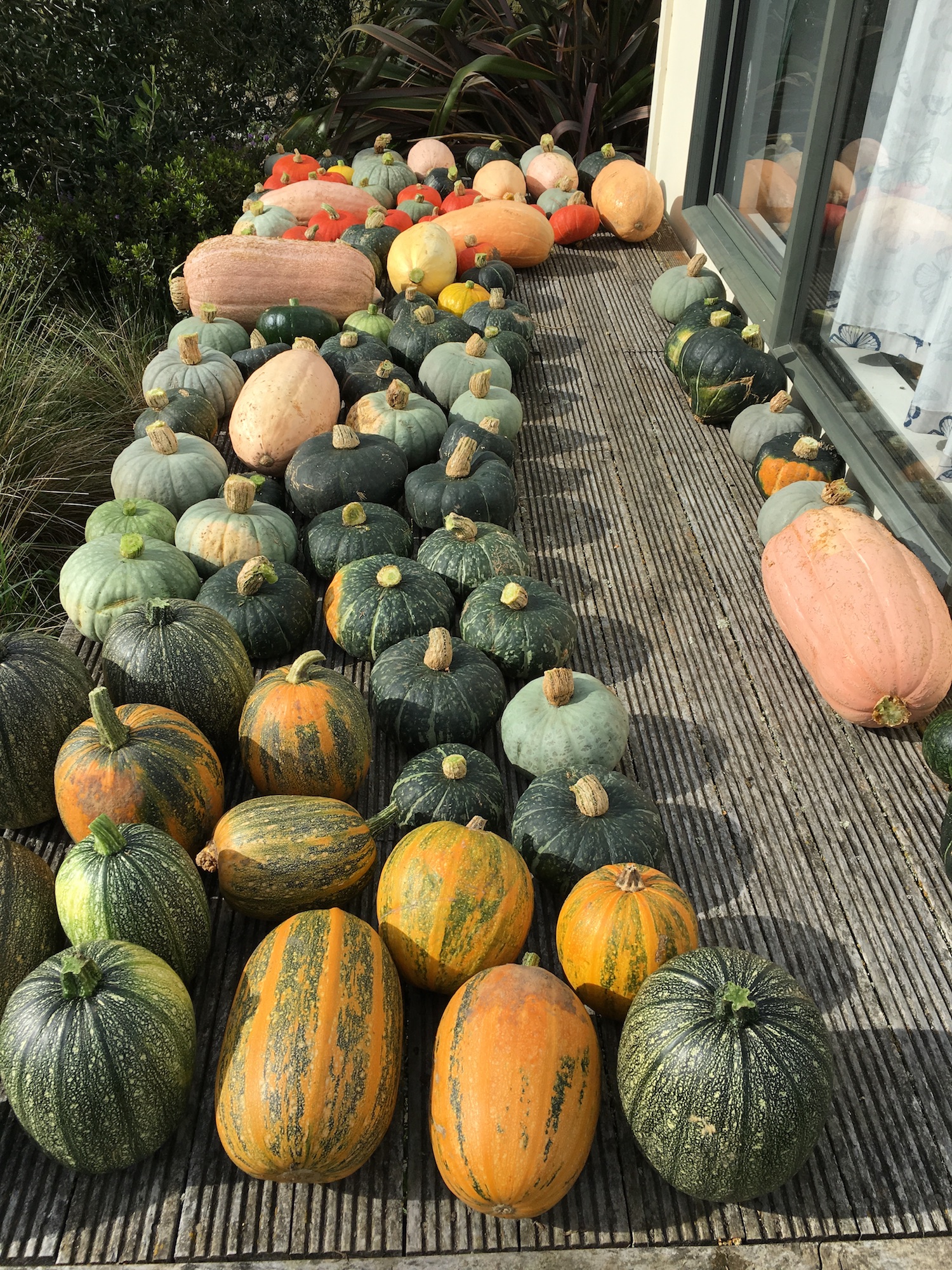
Now that winter has set in, we’ve turned our culinary sights from eggplant and courgettes to pumpkin, pumpkin, and pumpkin. I blogged about our excellent pumpkin harvest earlier this year. That post was written mid-way through the harvest–ultimately we picked nearly 200 pumpkins and other winter squash.

So w’re eating a lot of pumpkin. That’s not a problem.

Yesterday I made lovely pumpkin pancakes for breakfast. They were moist, dense, and spicy—excellent with maple syrup or redcurrant jam.

To make these delicious pancakes, start with a double batch of my World Famous Pancake Recipe. Add 2 tsp cinnamon and 1/2 tsp cloves to the dry ingredients. Add 1 1/2 cups pureed pumpkin (or other winter squash—I used kabocha squash) to the wet ingredients.

If your pumpkin is dry, you may need to increase the milk to achieve the right batter consistency.

We found these pancakes didn’t store/reheat as well as regular pancakes—they became quite fragile upon reheating (though they were still delicious).

Neenish Tarts

Neenish Tarts

The Darfield Bakery is a mandatory stop for us whenever we pass through Darfield.

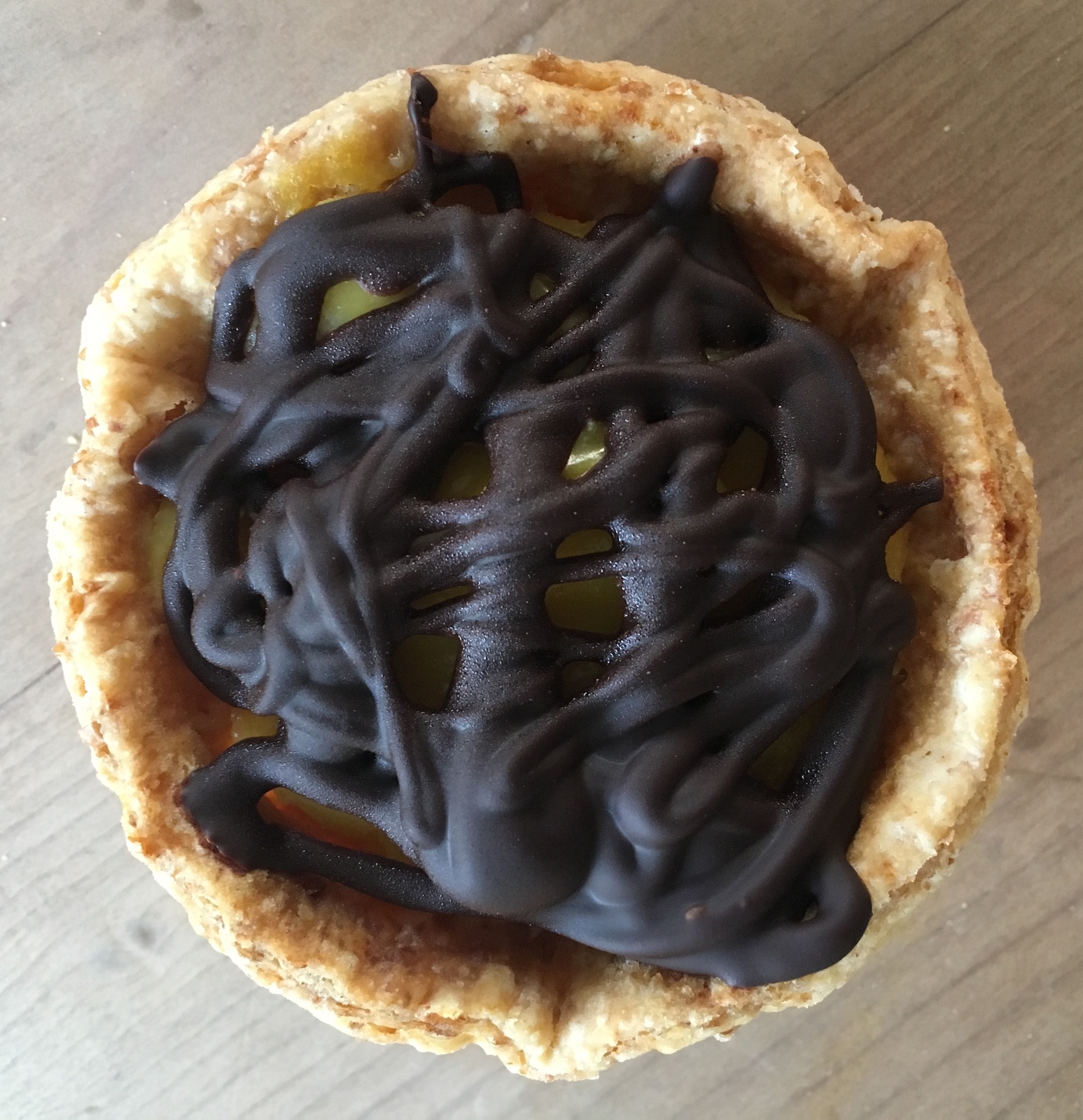
Our most frequent purchase is neenish tarts—little lemon tarts with chocolate drizzled on top. I’ve had neenish tarts from other bakeries and none stacks up to Darfield’s.

Not all neenish tarts are lemon—my understanding is that the ‘traditional’ neenish tart (they originated across the ditch in Australia) has a gelatine-thickened cream filling and is topped with two colours of frosting. I’m not particularly fond of this overly-sweet, bland tart. Lemon neenish tart filling is made with lemon juice, icing (powdered) sugar, and sweetened condensed milk.

My neenish tarts probably shouldn’t even be called neenish tarts, because they bear no resemblance to the ‘original’ ones, and veer off course even from the Darfield Bakery’s tarts. Still, they’re inspired by neenish tarts, and are just as delicious as the ones at the Darfield Bakery.

Make your favourite pie pastry (enough for a one-crust pie). Roll out thinly (roll more thinly for little tarts than for pie, or you end up with a tart that’s all crust), and cut into 10 cm (4-in) rounds. Line the wells of a cupcake pan with the rounds. Bake the shells empty for about 15 minutes at 190ºC (375ºF), until the edges are nicely browned. Turn out of the pan and cool on a wire rack.

While the pastry shells are cooling, make lemon curd. Combine in a saucepan:

3 eggs
1/3 cup sugar
60 g (4 Tbs) butter
zest of 1 lemon
1/2 cup lemon juice

Heat over medium heat, whisking constantly, until thick. Remove from heat and stir in 1/2 tsp vanilla.

Spoon warm lemon curd into each shell and allow to cool.

Melt about 50 g (2 oz) dark chocolate and drizzle over the tarts. Allow lemon curd and chocolate to cool completely before serving.

Cranberry Orange Scones

I wanted lemon scones for breakfast this morning, but had no lemons. I made these instead, based loosely on my lemon scone recipe. I can’t think why I ever wanted lemon…

1 1/2 cups all-purpose flour
2 cups barley flour
1/2 cup brown sugar
1 tsp baking soda
1 tsp baking powder
1/4 tsp salt
125 g (1/2 cup) butter
1 egg
2/4 cup unsweetened yogurt
1/4 cup orange juice
grated rind of 1 orange
3/4 cup dried cranberries

Combine the flours, baking soda, baking powder and salt in a large bowl. Cut in the butter with a pastry knife until the mixture resembles coarse crumbs. Whisk together the egg, yogurt, juice and orange rind in another bowl. Toss the cranberries with the flour mixture, then mix in the wet ingredients. Once all the flour is incorporated, gently knead the dough in the bowl (just 2 or 3 turns). Divide the dough in half. On a floured board, pat each half into a round about 2 cm (3/4 inch) thick. Cut each round into 8 wedges, and arrange the wedges on an ungreased baking sheet.

Bake at 190ºC (375ºF) for 15 to 20 minutes, until nicely browned.

Eat them quickly, before someone else gets to them!

Orange Cranberry Scones

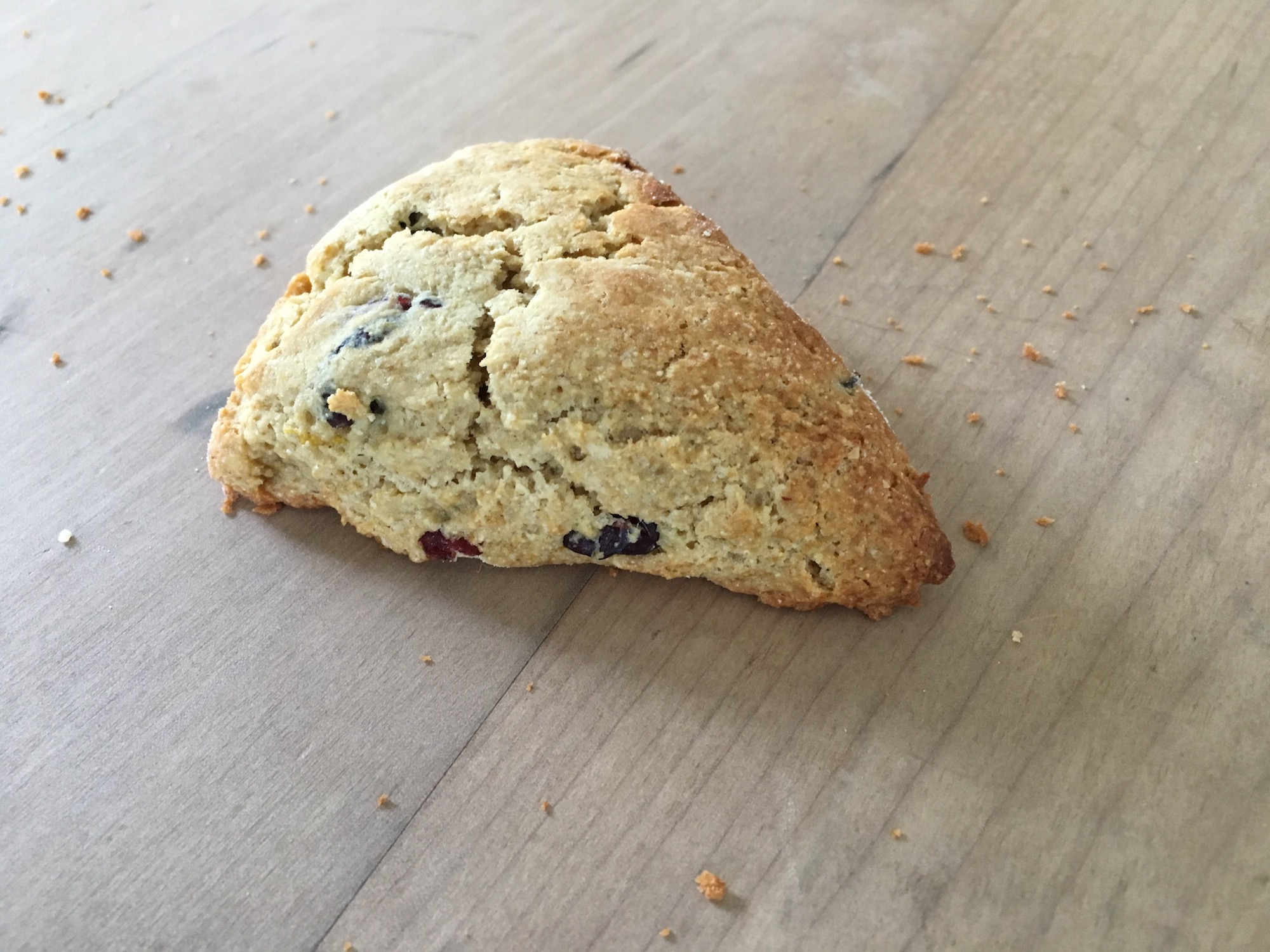
In a nod to Thanksgiving, I made orange cranberry scones for Sunday breakfast. Another wonderful use of barley flour. I’ve grown quite fond of barley flour in cakes and pastries–it lends a softness to the texture that is delightful. It also seems to delay baked goods going stale. The remaining scone, pictured here, was just as tender and moist on Monday morning as it had been fresh out of the oven on Sunday.

2 cups barley flour
1 1/4 cup all-purpose flour
1/2 cup lightly packed brown sugar
1 tsp baking soda
1 tsp baking powder
1/4 tsp salt
125 g (1/2 cup) cold butter
1 egg
1/2 cup buttermilk
1/2 cup orange juice
grated rind of 1 orange

Combine the flours sugar, baking soda, baking powder and salt in a large bowl. Cut the butter into the flour mixture until it resembles coarse crumbs.

Whisk together the egg, buttermilk, orange juice and orange rind in a separate bowl. Add to the flour mixture, stirring until evenly moistened.

Turn the dough onto a floured surface and knead two or three times. Divide dough in half. Pat each half into a circle about 2 cm (3/4-inch) thick, and cut each circle into eight wedges.

Place on an ungreased baking sheet and bake at 190°C (375°F) for 20-25 minutes.

Homemade Oreo Cookies

I’ve had a hankering for my ice cream sandwich cookies for weeks, but it’s midwinter—who wants to eat ice cream sandwiches?

But yesterday I had an idea. What if I turned those same cookies into homemade Oreos?

Oh. Yes.

I took my ice cream sandwich cookie dough and, rolled it out a bit thinner than I do for ice cream sandwiches. Instead of cutting it into rectangles, I cut circles with a cookie cutter. I baked them for 8 minutes at 190ºC (375ºF), and then let them cool completely on a rack.

When cool, I stuck them together with the following icing:

60 g (1/4 cup) softened butter
60 g (1/4 cup) Olivani at room temperature (shortening will work, for those in the US)
1 tsp vanilla
1 1/2 cups icing (confectioners) sugar

Beat butter and Olivani until smooth and light. Add vanilla and beat thoroughly. Sift confectioners sugar over the butter mixture and beat until smooth.

The icing was too soft at first and tended to squeeze out of the cookie when we bit into them, but it hardened overnight into the perfect Oreo filling consistency. I found this quantity of icing perfect for the number of cookies, but if you like double-stuff Oreos, make twice as much filling.

It has been decades since I last ate a real Oreo cookie, so I can’t say whether they are exactly like Oreos or not. But they are FANTASTIC!

Cinnamon Biscuits

The line between biscuits (in the American sense of the word) and scones is a blurry one—add an egg and little sugar to a biscuit and, hey presto, you’ve got a scone! Take away the egg from a scone and, voila, you’ve got biscuits!

This morning, wanting scones but facing an egg shortage, I found myself improvising. The biscuit variation I came up with was absolutely marvellous, particularly when eaten with a dollop of honey.

This is a giant Sunday morning quantity of biscuits—enough for breakfast for four, plus extra snacking through the day. Easily halved, if you’re not feeling like Sunday decadence.

2 cups all-purpose flour
1 1/2 cups whole wheat flour
2 Tbsp baking powder
3/4 tsp salt
1 tsp cinnamon
3 Tbsp brown sugar
125g (8 Tbsp) cold butter
1 1/2 cups milk

Combine all dry ingredients in a large bowl. Cut butter into the flour mixture until it resembles coarse meal. Stir in milk. Briefly knead dough, just until smooth. Roll to 1.5 – 2 cm (1/2 – 3/4 inch) thickness and cut into squares, rounds, or whatever biscuity shape you like. Bake on an ungreased sheet at 210ºC (425ºF) for about 15 minutes, until browned.

Nostalgic Baking

I made Irish soda bread to go with dinner today. As I mixed up the dough, I remembered making soda bread back when the kids were preschoolers. The recipe I have is easily quartered, so I would make a full batch, and each of the kids would make their own quarter-sized loaf. It didn’t even require any calculations—I simply gave them a smaller measuring cup (1/4-cup and 1/4 tsp to my one-cup and 1 tsp measures) and they could follow the recipe just like I did.

They loved baking their very own loaf, and then seeing it next to their plate at the dinner table.

Of course, these days, the teenagers are less keen on baking the bread and more keen on eating it, but I reckon one day they might make their own Irish soda bread again and remember making mini-loaves with Mum.

The recipe I use comes from Beard on Bread, by James Beard. I don’t know if this wonderful little cookbook is still in print, but I encourage you to find a copy—if you’ve never made bread before, Beard will walk you through it. If you’re a seasoned baker, Beard’s comprehensive selection of recipes will give you plenty to riff off as you experiment.

3 cup wholemeal flour
1 cup all-purpose flour
2 tsp salt
1 tsp baking soda
3/4 tsp baking powder
2 cups buttermilk

Combine dry ingredients. Mix in enough buttermilk to make a soft dough. Knead on a lightly floured board for 2-3 minutes. Form a round loaf and place on a buttered baking sheet. Cut a cross in the top with a sharp knife. Bake at 190ºC (375ºF) for 40-45 minutes.

A Bite of Summer for the (winter) Solstice

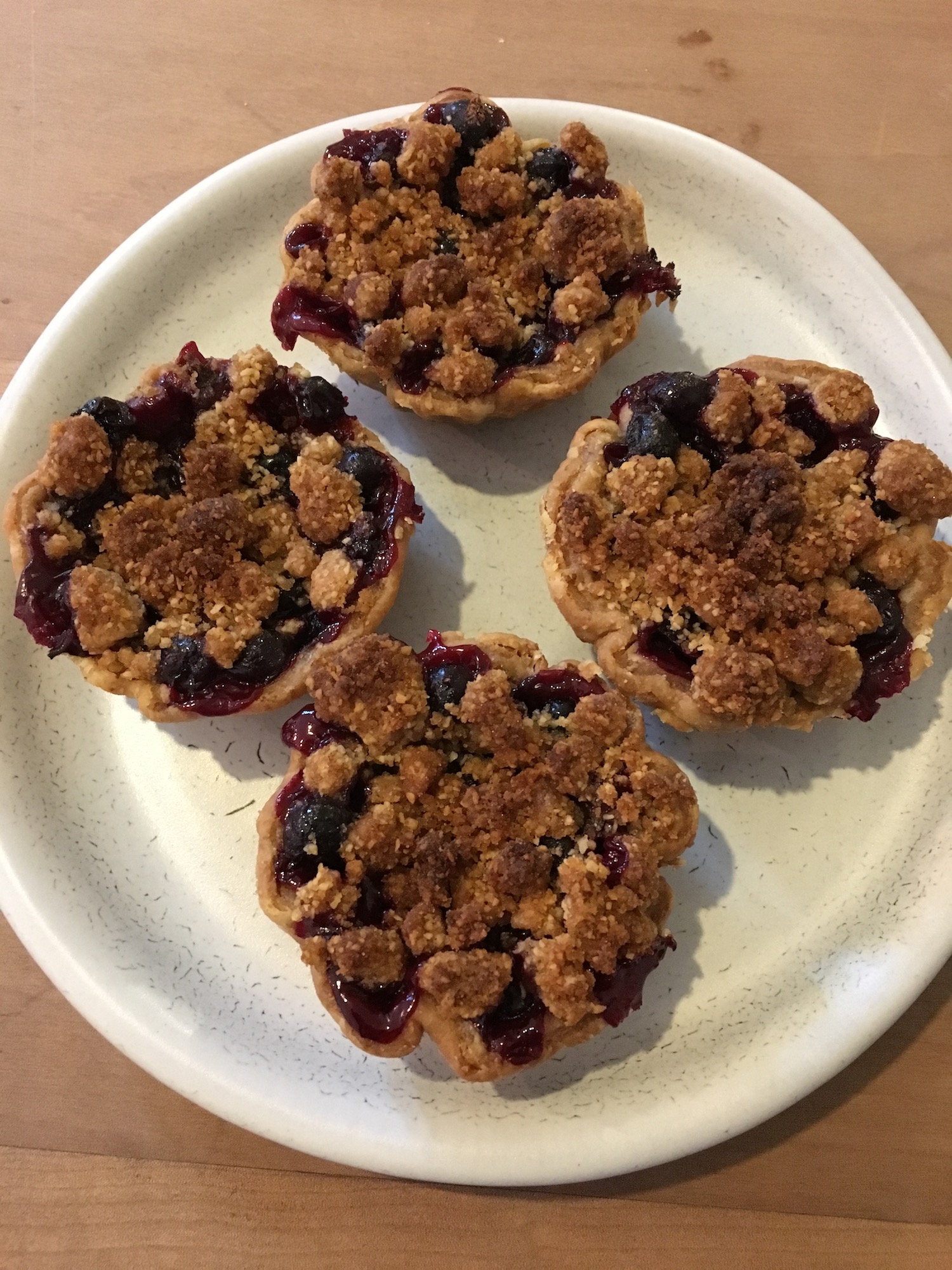
I’ve been celebrating the winter solstice in little ways all week–candles at dinner, an extra log on the fire, sunny-coloured food on dark plates…Yesterday I pulled out the last of the blackcurrants to make blackcurrant tarts for dessert.

I’d been saving them for a special occasion, and I thought the solstice was an appropriate one, since the blackcurrants were picked and frozen around the summer solstice.

Biting into one was like biting into a piece of summer–bright and sharp.

In case you missed my blackcurrant pie recipe from 2015, check it out here. It is incredibly simple, and oh-so good! In summer, it goes particularly well with a dollop of vanilla ice cream. In winter, I recommend a cup of strong coffee, some whipped cream, and a crackling fire.


The Queen’s Carrot Cake

A very happy birthday to Her Majesty this weekend. And many thanks for the extra day off and the excuse to go all out on a cake.

Carrot cakes are so easy to make, they’re rarely considered special occasion cakes, but in my family we’re all rather fond of it.

My favourite carrot cake recipe is a modification of a recipe in King Arthur Flour’s Whole Grain Baking book. This recipe creates a cake packed full of goodies that is delicious even without icing. The addition of cream cheese frosting makes it a thoroughly decadent celebration cake.

2 cups whole wheat flour
2 tsp baking soda
1 1/2 tsp baking powder
1 tsp salt
1 Tbsp cinnamon
1/2 tsp nutmeg
1/2 tsp ginger
4 eggs
1 cup vegetable oil
2 tsp vanilla
1 cup packed brown sugar
2 1/2 cups grated carrot
1 cup chopped walnuts
1 1/2 cups raisins
1/2 cup chopped crystallised ginger


Combine flour, baking soda, baking powder, salt and spices in a medium bowl.

In a large bowl, beat eggs. Slowly add the vegetable oil while continuing to beat. Add the vanilla, then gradually add the sugar until the mixture is thick and foamy.

Add the dry ingredients to the egg mixture and mix until smooth. Stir in the carrot, walnuts, raisins and crystallised ginger.

Spread the batter in two greased and floured 23 cm (9 in) layer pans. Bake at 188°C (350°F) for 35-40 minutes. Cool 10 minutes in the pans, then turn out onto a rack to cool completely before frosting.


Frosting:

1 package (250g/8 oz) cream cheese, softened
85 g (6 Tbsp, 3 oz) butter, softened
1 tsp vanilla
2 cups icing sugar

Beat the cheese, butter, and vanilla until light and fluffy. Gradually add the sugar. If the icing is too stiff, add milk by the teaspoon until it reaches the right spreading consistency (I generally don’t need to add any milk).