A Bird in the Bush

bellbird

photo: Sid Mosell (CCBY2.0)

Last Thursday was frenetic—I had a challenging work day and then ran errands in heavy afternoon traffic. By the time I arrived at my husband’s work to pick him up, I was tired, and my brain restlessly analysed the day’s events.

The day was warm, and I sat in the car with the windows down waiting for my husband. Time to catch up on my e-mail …

Twee-dle … A lone bellbird called lazily from a nearby tree, cutting through the sounds of the city and the clamour inside my head.

Twee-dle

I pocketed my phone and closed my eyes as the sound transported me to the bush where I lay in a tent listening to the forest wake up. The clamour in my head stilled. Somehow my email no longer seemed important. The conundrums of the day lost their urgency. My shoulders relaxed and I took a deep breath.

Twee-dle

There was time to savour. No need to worry.

Twee-dle

Trouble could wait. I needed a few minutes in the bush.

Twee-dle

All I needed to do was listen.

Wear Your Hair with Pride

“Why do you have white hair?” asked the young girl, impertinent as only a seven-year-old can be.

“Because I’m getting old,” I replied.

“No, I mean why don’t you dye it?”

“Because my white hair is beautiful–it’s actually silver and sparkly.”

She wrinkled her nose. “It’s not silver. It’s white.” She snorted and stroked her own hair, brown and straight. “When I get that old, I’ll dye my hair.”

There was no point arguing with her. Silver hair is a beauty a seven-year-old can’t possibly appreciate.

But even beyond the fact that my silver hair has come in with body and curl that my youthful hair never had (it sat on my head like a wet dish rag), my silver hair is beautiful for what it represents.

Like ANZAC poppies that remind us to never forget those who died for our freedom, each silver hair is a reminder.

Lest we forget the struggles over which we have triumphed:

• As a parent, the screaming newborns, toddler tantrums and teenage rebellion
• Mental health lows
• Physical pain and illness
• Emotional pain—loved ones lost, relationships shattered
• Natural disasters and those made by humans
• The acts of violence against ourselves, against those we love, against our neighbours.

Every silver hair reminds me I have not only survived, but thrived. Every silver hair is a badge of honour, a challenge met, a goal surpassed.

Dye my hair?

Why would I ever hide my hard-won medals?

Strength.
Bravery.
Perseverance.
Patience.
Sheer bloody-minded stubbornness.

I wear these badges of honour with pride—my silver sparkling medals that streak my hair and remind me what I’m made of.

Knickers for Posterity

I visited the Otago Museum a few days ago. Among the many artefacts on display, two in particular caught my eye.

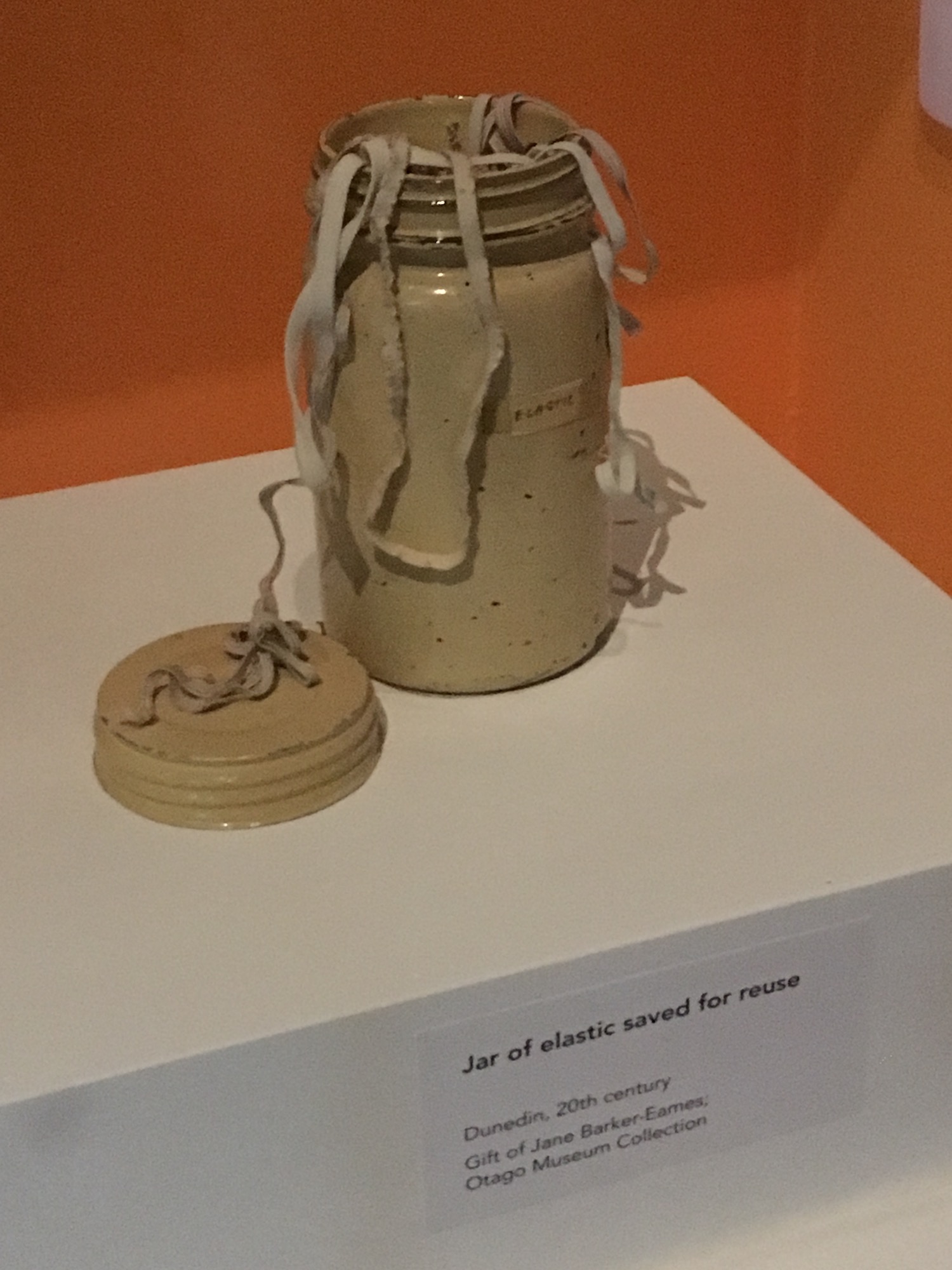
The first was a jar of elastic, saved for reuse and donated to the museum by one Jane Barker-Eames. I immediately thought of my grandmother. Every day for at least fifty years, she’s had the paper delivered to her doorstep. Every day she’s taken the rubber band off the rolled-up paper and carefully saved it. By my calculations, that’s over 18,250 rubber bands, dutifully saved for reuse. No doubt many of those rubber bands went on to perform useful tasks elsewhere, but they added up, filling multiple coffee cans (reused, of course), and forming small drifts in kitchen drawers. 

When Grandma recently moved into a rest home, my mother threw away her large rubber band stash (don’t tell Grandma!).

I suspect Jane Barker-Eames was the daughter of a Mrs. Barker, careful re-user of elastic, and that at some point, she faced my own mother’s conundrum—what do do with Mum’s stuff?

Maybe she didn’t even know that jar of elastics was there, tucked inside a sagging cardboard box in the attic along with a dozen empty thread spools, a moth-eaten sweater, and a small tin of safety pins—the entirety of Mum’s estate was packed off to the Otago Museum. Maybe they could figure out what to do with it.

And upon passing through the museum’s doors, Mum’s stuff was instantly elevated from rubbish to artefact, never to be used again.

I think Mrs. Barker would be disappointed her elastic stash wasn’t used in a new pair of knickers.

And speaking of knickers, the second item that caught my eye was a scrap of woven textile identified as a loincloth. It made me think about the pair of underwear I recently tossed out—the elastic had failed and they no longer stayed up (Where was Mrs. Barker’s elastic when I needed it?). I wondered if the loincloth in the museum had been similarly discarded at the end of its useful life. Little could its wearer have imagined that their dirty old knickers would someday sit enshrined in glass to be ogled at by thousands of people, most of whom would be mortified to have their own underwear similarly on display.

It made me wonder if, someday, my underwear might be displayed alongside Mrs. Barker’s jar of elastic as a lesson in frugal living—for want of a piece of used elastic, this poor 21st-century woman went bare-bottomed. Mrs. Barker, on the other hand, always kept her knickers firmly in place.

Hang on to your elastic, ladies.

The Ghost of Christmas Trees Past

Growing up, my parents had an artificial Christmas tree. It was hauled out of the attic the weekend after Thanksgiving and assembled and decorated, ushering in the Christmas season.

I remember one year having a real tree—I loved the smell in the closed-up winter house.

When my husband and I married, we spent a few years finding our Christmas tree tradition. For the first two years, we had an eight-inch tall artificial tree in our mud house in Panama. After we returned to the US, we wanted something bigger. So we spent months making a six-foot papier-mache tree, binding on raffia needles and painting bark on the branches. It was a labour of love, and we used it until we had to move across the country, and knew it wouldn’t survive the experience. 

Then babies happened, and for a few years, our Christmas trees were real trees—there was no time or energy for creativity in those early years.
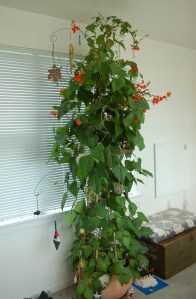
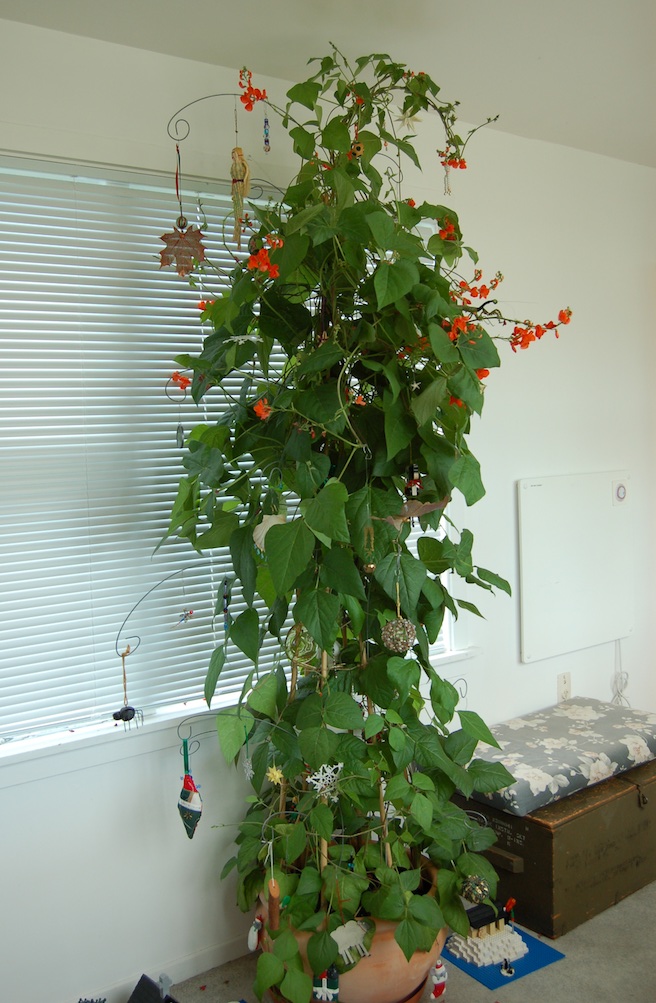
By the time we moved to New Zealand, we were settled into the parent routine enough to be creative again. And summer Christmases invited creativity. We fashioned trees out of driftwood, dead branches pruned off trees in the yard, an old fishing net, fencing wire and flax stalks, copper plumbing, live runner beans—most trees were inspired by what was lying around the property at the time.

Last year, we fashioned a DNA strand as a Christmas tree. Elegant and simple.

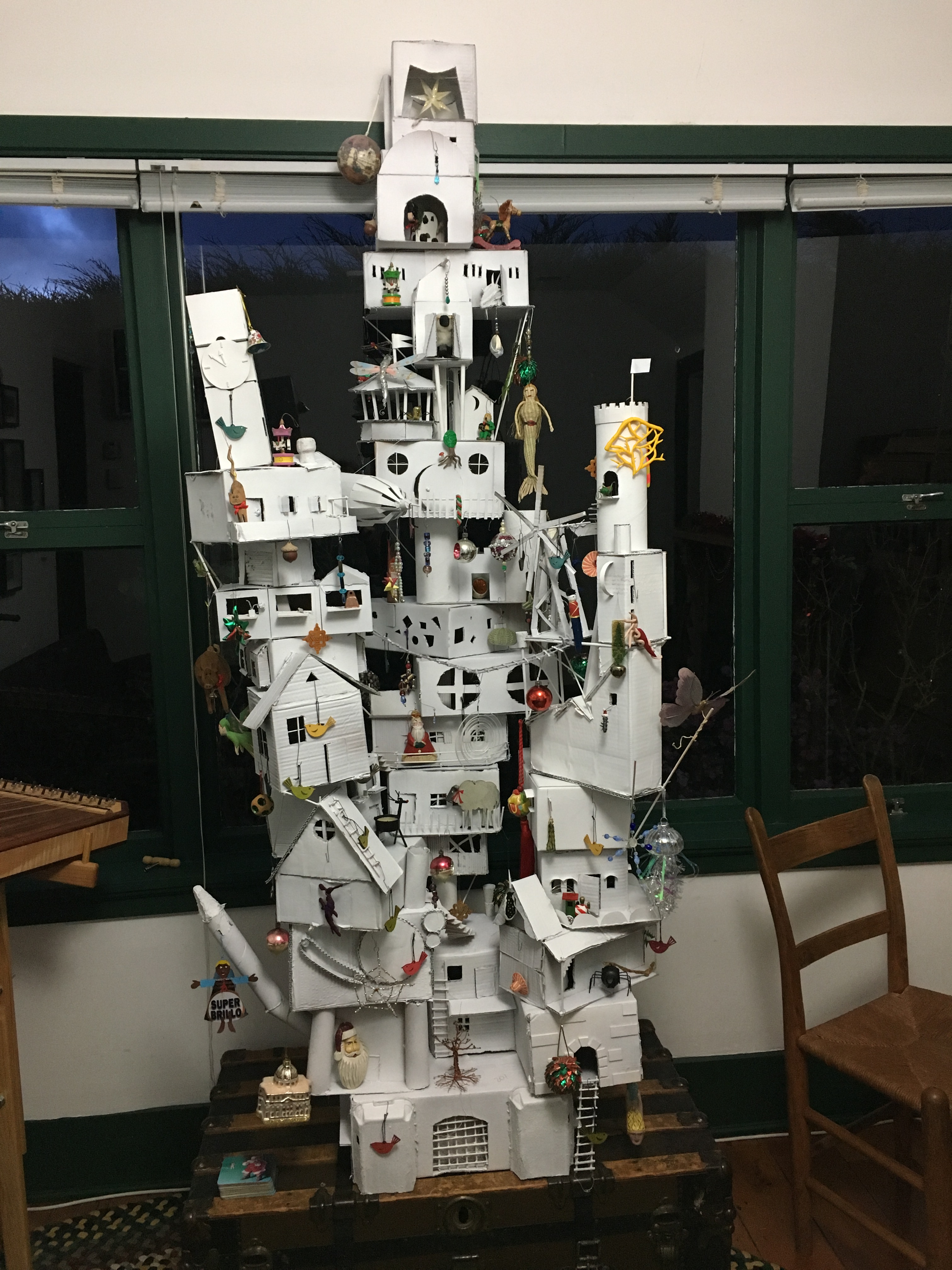
This year, we went for crazy, creating an architectural monstrosity from cardboard boxes.

You might wonder what the point is—wouldn’t it be easier and more, well, Christmasy to do a more traditional tree? Yes. But what is a Christmas tree for?

I view a Christmas tree as a focal point—somewhere for family to gather. Our trees have always been decorated with ornaments that have a history—maybe they were made by someone special, or given by a friend, or came from an exotic location. Decorating the tree has always been a time to celebrate the family stories behind the ornaments.
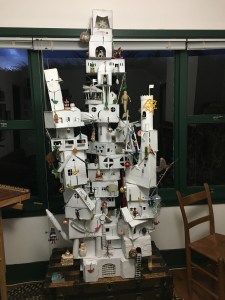
Why shouldn’t that family activity extend to making the tree itself? This year’s tree took a lot of time to make, and we spent several evenings as a whole family working on it—making a tremendous mess of the living room, laughing, and enjoying each other’s company and creativity. That’s exactly what Christmas traditions should do.

So, perhaps our trees don’t meet the traditional definition of a Christmas tree, but I think they embody the spirit of the season.

Random acts of poetry

Random Acts of Poetry Day was apparently the 3rd of October. I didn’t know about it until the following day, but it seems to me that it’s even more fitting to celebrate Random Acts of Poetry Day on some other, random, day. And since I’m feeling random today, here is a poem for you all. 

Chaos Theory:
Sammy Sandoval meets Sargent Shriver and Edward Lorenz in a young brain on a narrow footpath after dark.

The base beat
of Sammy’s accordion
faded into the night
like a heartbeat
after a long run.

Silence
save for the tap of rubber sole on packed earth,
the trill of the tropical screech owl,
the whisper of moth wings.

Those tiny wingbeats,
creating a tornado,
not on the other side of the world,
But here.
Inside.
Peeling back the roof to expose the beams,
rearranging the furniture,
toppling trees across the path,
hurling the neighbour’s car into my kitchen,
shattering mirrors,
slamming the door to the past.

And the folded bellows
of the future
breathed in and out,
humming in my ears,
masking the click
of the lock behind.

Take Risks. Chase the Truth. Repeat.

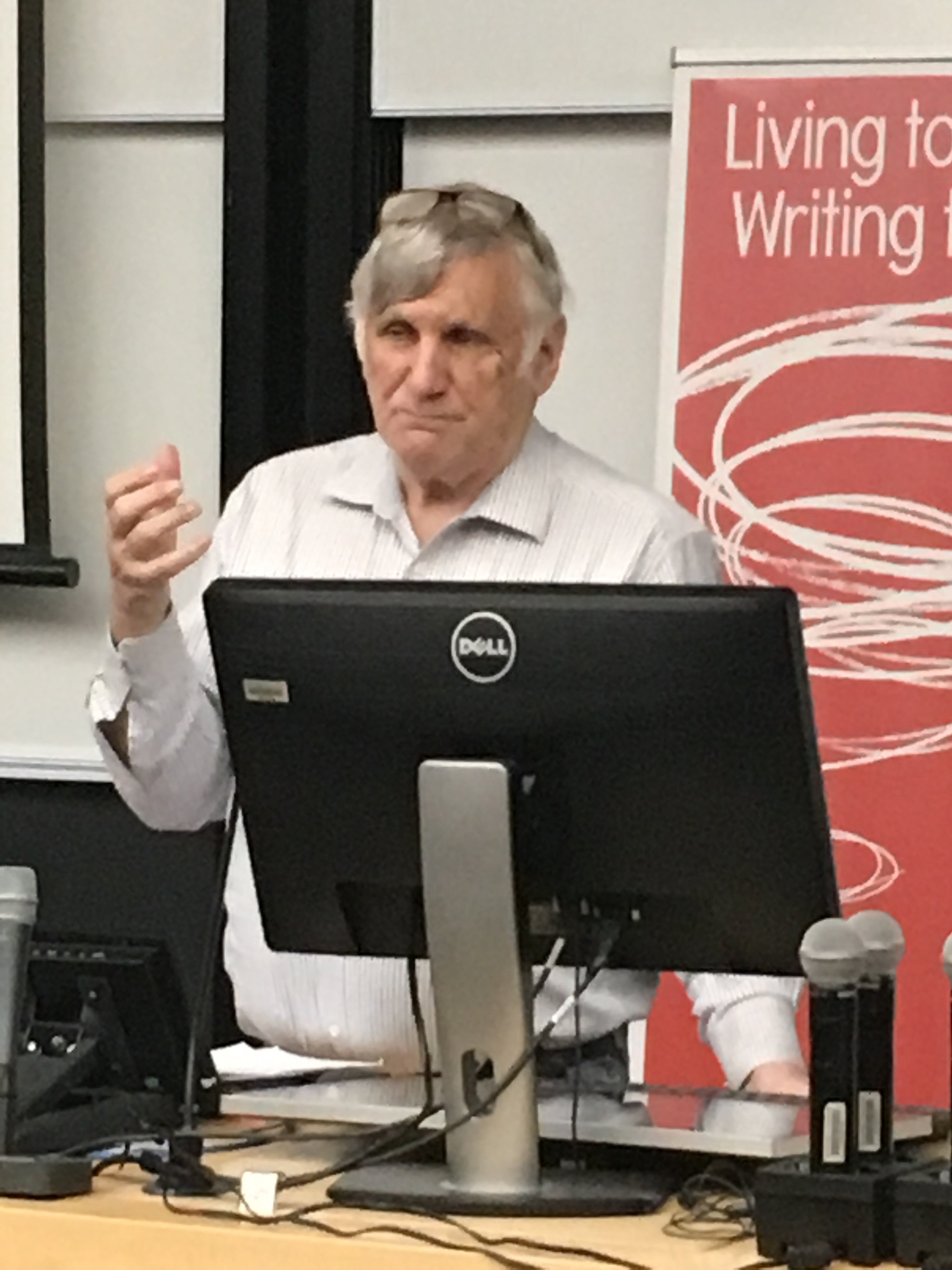
Author John Marsden, speaking at the National Writers Forum

I spent the weekend at the National Writers Forum, where I had opportunities to meet lots of other writers and attend sessions on many aspects of the craft and business of putting words on paper to be read by others.

One of the highlights for me was a keynote address by John Marsden, author of Tomorrow When the World Began and many other popular young adult books.

Marsden had many words of wisdom for writers, but two things in particular I thought were actually great advice for life in general, not just for writing.

Marsden encouraged us to take risks, to not write the mundane, the predictable.

Should we not also take risks in life in general? Not the stupid kind like robbing banks or snorting cocaine, but risks that force us to grow. I think about some of the risks I’ve taken in life—serving in the Peace Corps, moving to New Zealand, starting my own business, closing my business in order to write. Every one of those risks taken has caused me grief—emotional, financial, physical—and every one of those experiences has forced me to grow and learn and improve myself.

Even small risks are important to take. For me, going to an event like the writers forum is a terrifying proposition. As an introvert, I have to force myself to attend. I have to plan what I will say to people, come up with a list of questions I can ask well in advance of the event. It takes enormous energy for me to mix and mingle with strangers, and I have to take time out sometimes—take a walk, sit in a quiet corner, or retreat to a toilet stall. This past weekend, the effort took its toll—I slept poorly and have returned emotionally shattered and with a head cold. But I learned a lot and made contacts with other writers. Once I catch up on sleep and the head cold clears, I’ll be a better writer for having gone.

So, where should risk taking be leading us?

Marsden touched on this, too. He said great writing chases the truth but doesn’t reach it.

And a great life chases the truth, recognising we will never reach it, and will always be learning and growing.

Take risks. Chase the truth. Repeat.

Still Life with Insects

I’ve written and discarded half a dozen blog posts over the past week. Nothing seems to be quite right. Out of ideas, I resorted to the book of 500 writing prompts I created for my daughter. A random stab at the non-fiction section of the book brought me to the question: What objects tell the story of your life?

I tried to encapsulate everything in four objects:

The fiddle: made by a neighbour in Panama, given to me for my birthday by my husband. The fiddle not only tells the story of our years living and working among the incredible, resourceful people of Panama, but also tells the story of my lifelong interest in learning to play the violin…an interest which always ended up being pushed aside for other interests. Because I’m interested in learning so many things, there simply aren’t enough hours in the day.

The beetle puppet represents my insatiable curiosity about arthropods, and how that curiosity has bled into my other interests. Peanut butter jars full of bugs on my dresser when I was a kid led to the entomology degree, which led to teaching about insects at Penn State University, and then starting the Bugmobile. And the puppet is only one of many insect-themed and inspired artistic projects I’ve done over the years, as art and science mingle in my brain.

The gardening gloves speak of my weeding addiction and my love of growing food. The gloves are never more than a month or two old, because I wear through them in that time. I think that says it all about gardening for me.

The rock represents adventure, the natural world, and the wild places I have visited and lived in. Like me, the rock has traveled far and has been changed by the stresses it has experienced along the way.

Good Things Take Time

I’ve had a fascination with reflective fabrics for a while. The amazing reflective fabrics being manufactured today have so many creative possibilities that I itch to get my hands on some of them. Unfortunately, most aren’t available here.

Recently I managed to get my hands on some reflective fabric tape, and designed a new jacket with the tape in mind.

But first I had to turn the tape into piping.

Then I made a few test seams with the piping and the wind-block fleece I’d chosen for the jacket. I found the combination of fabric and piping was singularly unforgiving—the fabric stretched too much, and the seam had to be sewn perfectly to look good. Even the slightest sloppiness caused it to look awful.

That meant hand basting the piping to one side of the seam first, and then hand basting the seam together before sewing it on the machine.

Then each seam needed topstitching to make the most of that precise seam.

The upshot is that every seam on this jacket (to which I added seams for style purposes) has to be sewn five times (two of those times by hand through four layers of quite tough fabric).

What was I thinking?!

I’ll admit that by the time I’d managed the first seam (having had to rip it out twice because it wasn’t perfect), I was nearly ready to scrap the project.

Then I looked at the gorgeous seam I’d just finished.

When I finally do complete this garment, it’s going to be lovely. I’ve chosen fabric I know will look good for a decade or more of hard use. Its reflective piping will give me a measure of safety for the nighttime walks I enjoy. It will be warm, windproof and nearly waterproof. Yes, it will take me quite a bit longer than I’d hoped to make. But, as they say, good things take time.

Throwback Thursday: A Journey with Sammy Sandoval

Home sweet home

I started writing a post about the winter weather we’re experiencing this week, but it was as grey and dull as the sky.

Then my husband played a song by Sammy and Sandra Sandoval, and I was transported back 25 years and 11,000 kilometres to the tropical heat and sun of Panama in 1993, where we served in the Peace Corps.

Like all our neighbours in the province of Coclé, my husband and I loved Sammy and Sandra Sandoval. They would play in the little villages sometimes, and we’d go see them whenever we could. Their music was loud and joyful, and we’d walk hours to pack into a crowded room and dance to it.

But what I remember most is the silent walk home from the first of those dances. Leaving the noise and sweat of the dance hall, we stepped into the dark night of the campo. No lights, no roads, just a packed clay footpath and the sound of music receding behind us.

That walk was magical. I don’t know if the buzz was from the music, the beer (Cold beer! What a luxury!), or the faint glint of moonlight off the palm trees. Most likely, it was from the blessed silence and the recognition that, in walking an hour and a half to dance Panamanian tipico, we’d stepped irrevocably out of our previous lives.

Navigating our way home on a familiar path lit only by moonlight, we traveled much further than the few kilometres of hilly mountain terrain between the dance hall and our house. In that short space, we traversed a one-way path that left our past lives behind. Yes, we’d already made many steps along that path before, but that night was the moment I knew we could never go back. The magic of that moment is that I never heard the door click shut behind us; I only saw the landscape open out in front.

Home Fires Burning

Cat enjoying a good book by the fire.

I woke yesterday morning shivering under the summer quilt on the bed after a restless night listening to icy rain on the roof.

Time to switch to winter mode, I suppose.

I lit the first fire of the season.

It wasn’t long before the cat joined me by the fire. Then my daughter, then my husband, then my son…Nothing like a hearth to draw everyone together.

I think about the angst over today’s youth, separated from face-to-face interactions by their devices, and I think that perhaps what we all need are small, poorly insulated houses heated by inefficient wood burners. In a big, centrally heated house, it’s easy for everyone to retreat to their own rooms—shut the door, pull out the phone and troll the internet. But in our house, the only comfortable room in the winter is the 3×4 m living room. A teen who retreats to their room and shuts the door pretty quickly returns to warm up by the fire.

Yes, we may all sit here doing our own thing, but by gathering around the fire together, we share what we’re doing with each other. Someone might share a good line from the book they’re reading, or show a dumb cat video they thought was funny, or ask for help on a maths problem. Simply by virtue of proximity, we connect in other ways.

I will admit that on winter mornings, crawling out of a warm bed into the freezing air to light the fire, I dream of luxuries like heat pumps. And sometimes it would be really nice to have some space to myself, rather than do my knitting cheek-by-jowl with a teenager practicing a new juggling trick. But on the whole, I suspect the benefits outweigh the drawbacks. We humans are hardwired to sit around the fire talking to one another. Our ways of relating to one another, passing on wisdom and culture, and finding our place in a community evolved around the fire.

So, again this winter, I will keep the home fires burning.