Pandemic Poetry–2021 Edition, #8

pansies in a pot

Another glorious spring-like day today. I suspect it will require me to spend the afternoon in the garden again. If I’m not careful I’ll get ahead of schedule for my springtime prep. Or maybe I just won’t end up behind schedule like usual. 

The garden is weeded and clean.
We’ve read all the books we can borrow.
We’ve polished the floors to a sheen.
Now what will we do tomorrow?

Pandemic Poetry–2021 Edition, #5

daffodils in bud
Spring blooms are on their way!

In spite of lockdown, spring continues to show itself. Daffodils are blooming, and tree buds are swelling. I spent yesterday morning planting vegetable seeds, kicking off my gardening season for the year. So life is not all bad, stuck here at home with plants to tend.

The northwest wind cries Spring!
And the magpies, they all start to sing.
It’s hard to be sad
And think everything’s bad,
When nature is having a fling.

Pandemic Poetry–2021 edition, day 2

unicorn pool toy
Photo by James Lee on Unsplash

Yesterday’s writing went poorly, as I might have expected. But the weather was crisp, and our lockdown walk was a highlight of the day. 

Kia kaha New Zealand. Our bodies may be stuck at home, but our imagination doesn’t need to be.

A lockdown walk
Is a great time to talk
Of fantasy, fiction and fun.

If you had useless powers
What would they be?
Where would you go
If travel were free?

If the cat could speak
What would he say?
What would you do as
PM for a day?

If the sky were pink
And unicorns flew
Over lollipop meadows
Could you ride on them too?

If your body was stuck,
As surely it is,
In a physical rut
With your mind in a fizz,

Could you picture a world
Full of magic and light
Where your spirit could soar
On the wings of a kite?

Youthful Adventure / Parental Angst

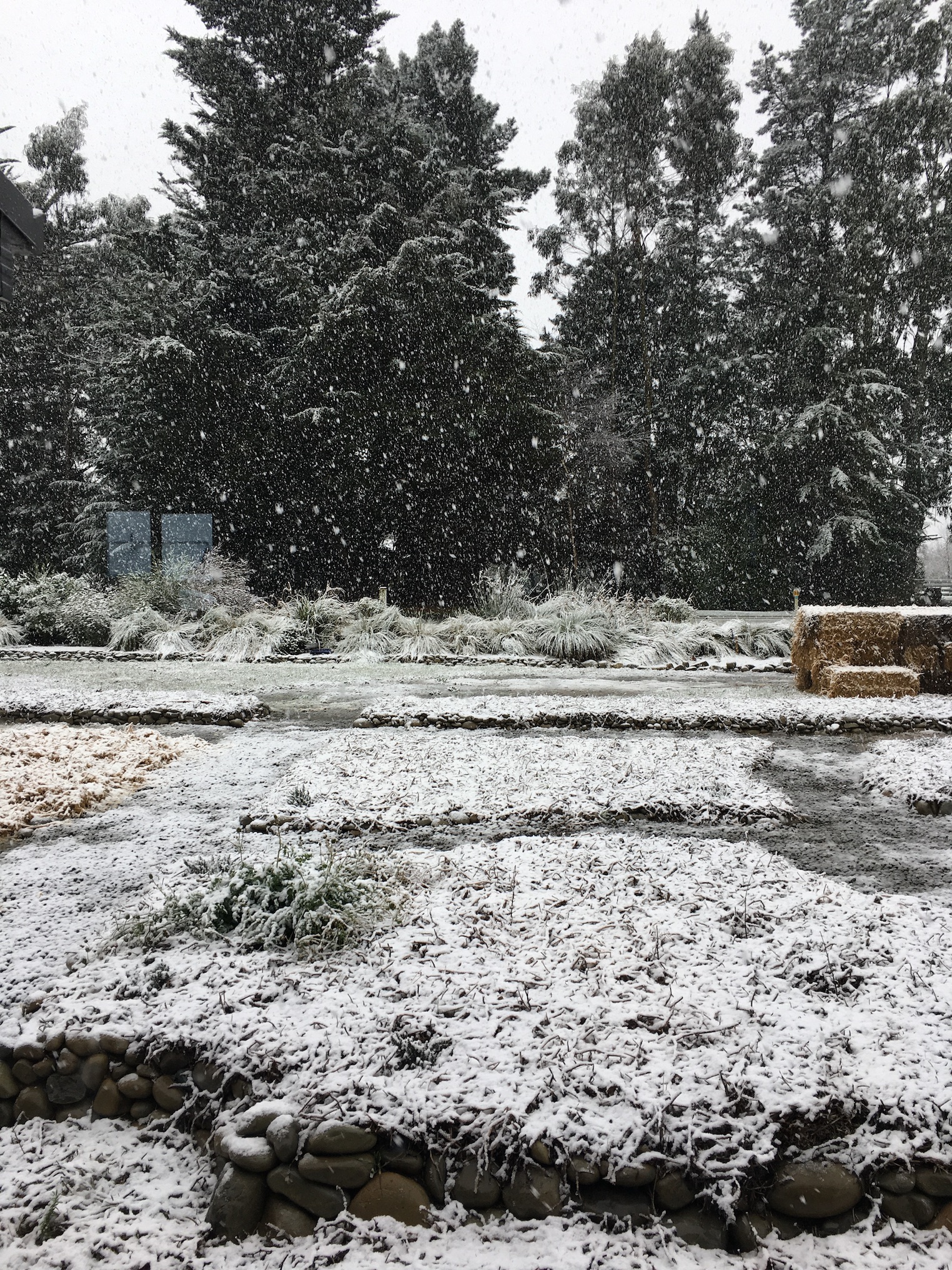
I find myself pacing the living room floor, gazing out the window at the swirling snow.

par

Stop. She’ll be fine.

My daughter is snowed into a cabin in the mountains. Porter’s Pass is closed and I cannot reach her by any means. I cannot supply her with the food I know she does not have for the 24-48 hours it will be until she can escape.

She is with friends. I know the cabin they’ve holed up in—it is warm and dry. There is water and even electricity.

She’s probably having a blast. No doubt they’ve pooled their food and are concocting some strange dinner tonight from instant soup packets and half a package of pasta of unknown provenance and indeterminate age left in the cabin by a previous inhabitant. It won’t be enough, but they’ll make do.

I know this because I remember my own adventures as a young adult. A day of hiking fuelled only by a pair of bananas purchased from a family in a small mountain village. A trek across the isthmus of Panama that involved an ill fated bus, hitching a ride in the back of a pickup, sleeping on the concrete floor of the police station in an unknown village, hiring a villager and his canoe, and begging meals and accomodation in another unknown village. Cowering in a tent as tornadoes ripped through the forest nearby. Carrying a chicken to a friend, on foot, three hours distant. … The list is long.

Every one of those adventures involved hardship—hunger, exhaustion, fear, danger. My mother would have freaked out had she known what I was doing.

Just as part of me wants to freak out right now.

But I know what those adventures did for me as a young adult. I can’t imagine having not had them. They’ve woven their way into the fabric that is me today. They are who I am.

My husband and I have taught our children how to prepare for adventure, how to be safe, how to face the inevitable difficulties, how to enjoy the hardships. The most important thing we can do now is trust that we’ve taught them well, and keep our own worries to ourselves so they don’t dim our children’s sense of adventure.

So I will pace the room, but never tell her I did so. I can’t wait to hear all about her adventure when she returns.

Sun’s Return

It’s only a few weeks past the solstice. Nights are below freezing, and the worst of winter is still to come. In shady spots the frost lingers all day.

Spinach seedlings in the greenhouse

But plants are already responding to the increase in sunlight. There is a haze of new green growth in the chickens’ winter-bare paddock, daffodils are poking their shoots out of the flower beds, and the grass will soon need to be mown.

In the greenhouse, the lettuce and spinach seedlings that have been sitting there unchanging for weeks have finally begun growing again. The broccoli in the winter garden has begun thinking about heading up (at least until yesterday when the chickens got in there and stripped the leaves).

I too have responded to the sun. I’ve drawn my garden map for the upcoming season. I’ve assessed my seed needs in preparation for the arrival of the new year’s seed catalogue. I’ve nearly completed incorporating manure into the entire vegetable garden.

The weeks will go quickly. Before I know it, it will be time to start seeds, mark out garden beds and spread compost. Now is the time I should be buckling down to complete winter tasks—sewing, organising, cleaning … But like the plants stretching out their tentative leaves, I can’t help but respond to the sun, reaching for spring and looking forward to the new season to come.

A Warm Winter Solstice

The winter solstice passed this week, cold and rainy. It was also the anniversary of moving into our new house. It was truly a delight not to endure the run-up to the solstice in an unheated, uninsulated shed. To have a warm, dry place to eat and sleep; to have electricity and plumbing—what a luxury!

8 am with the sun barely rising …

Indeed, I still sort of feel I’m living in someone else’s house. Until a year ago, my husband and I had never owned a house less than a hundred years old. Then suddenly we had square corners and level floors. We had double glazing and insulation. We had doors that opened and closed properly, walls without fifty coats of paint, and not a speck of rot anywhere.

It was a bit of a shock.

And now I wonder if I’m going soft. I don’t wake up to a freezing house and have to light the fire. I don’t worry that the roof will leak every time it rains. I don’t have to venture to the attic to empty and re-set the rat traps. I don’t wake wondering if today is the day the water heater, septic system, or well pump is going to die.

Sometimes I miss the character of an old house—a house that is old enough to have a life of its own, a house that tells stories. Sometimes I feel guilty—a new house is such an unnecessary luxury.

But truth is, modern life is pretty good, especially in the cold, rainy days around the winter solstice. So for the moment, I’ll simply be thankful for all those luxuries that make the dark days brighter.

Nature Red in Tooth and Claw

Photo: Eric Weiss

It’s not often you witness outright thuggery in nature. Predators hunt prey—they have to, because otherwise they starve. Predation is never pretty, but it is what it is. 

Sitting at my desk, procrastinating … er … writing this morning, I saw brutality, pure and simple. 

A pair of magpies was chasing a starling. They caught it and brought it to the ground. Standing over it, they pecked at its eyes. At first, I thought they were trying to kill and eat it. But after a few minutes, they got bored. The starling managed to fly off. The magpies followed, caught it and brought it back, only to repeat the eye pecking routine. Three times while I watched, they allowed the starling to escape, then brought it back to peck at it. Always at the eyes.

Eventually, they bored of the sport. They wandered away from the hapless starling to forage in the lawn nearby. After a few minutes, starling and magpies flew off in opposite directions.

I suppose it shouldn’t come as a surprise. Australian magpies have a reputation as aggressive, intelligent birds that like to play. They brazenly steal food from the chickens, fighting right back when a chicken lunges at them. And I’ve watched as gangs of juvenile magpies have tormented my cat, swooping low over him as a team, trying to get a peck in while he swats at them. And I’ve been on the receiving end of magpie parents defending their nests with noisy dives at my head.

In general, magpies eat invertebrates—they were originally introduced to New Zealand to help control crop pests. Research on their effects on native birds indicates they only rarely kill other birds, and their aggressive pursuit of larger predators like harriers may even provide some protection to smaller birds.

Still, I can’t help thinking magpies are the bullies of the playground. They’re fine as long as you’re not their target. Fascinating for me as an armchair naturalist, but I’m thankful I’m not a small songbird.

Weekend Getaway

Carrington Peak

Over the long Waitangi Day weekend, we hiked up the Waimakariri River to Carrington Hut. Using Carrington Hut as a base, we took day walks to Kilmarnock Falls and Waimakariri Falls Hut.

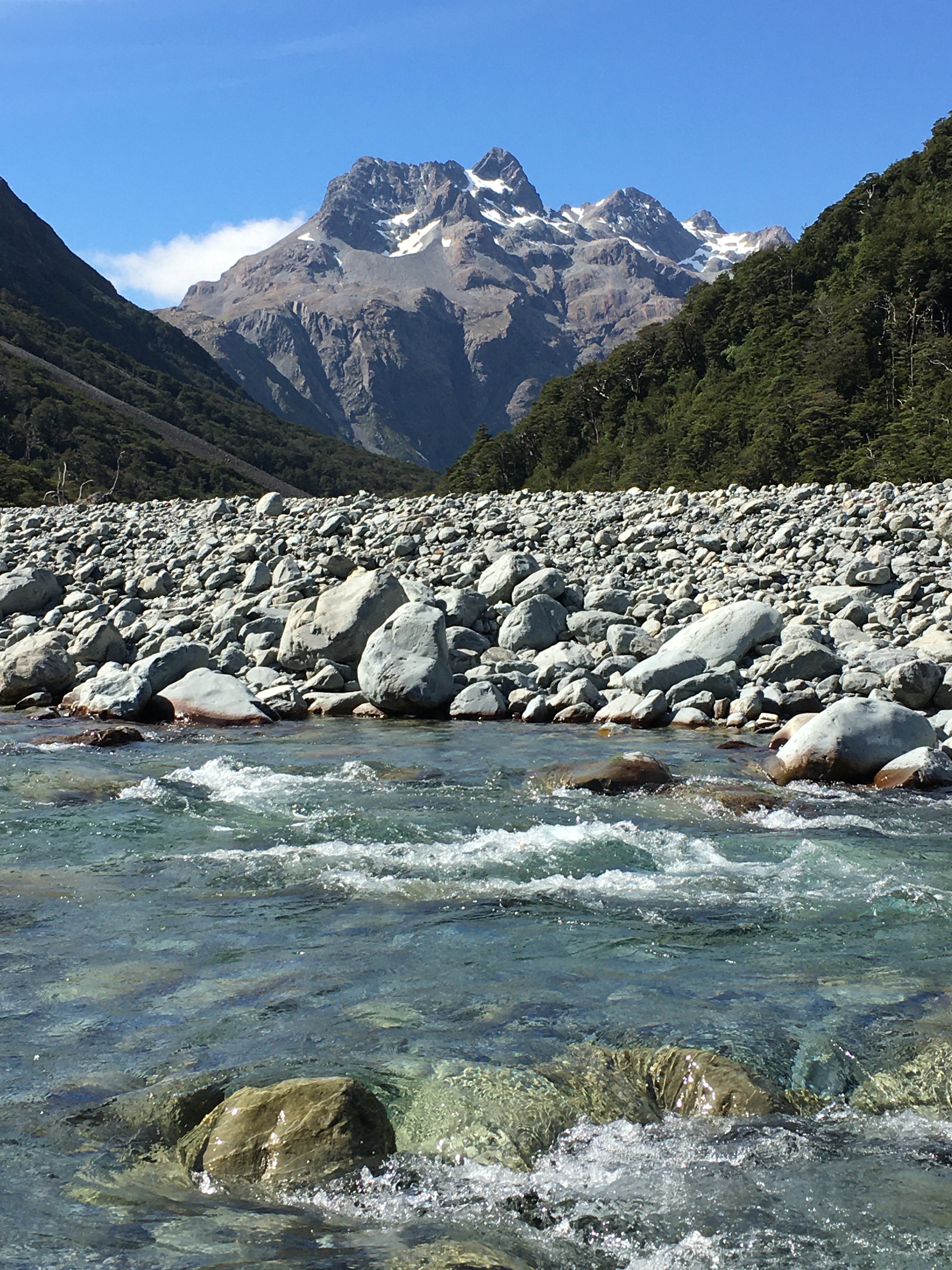
The weather was glorious, and hiking on the riverbed, it was easy to cool off with a quick dip in icy water. The hike to Waimakariri Falls Hut was particularly rewarding: there are two ‘official’ falls on the river, and dozens of smaller streams dropping off the surrounding peaks in spectacular fashion, so you feel as though you’re walking through a watery wonderland.

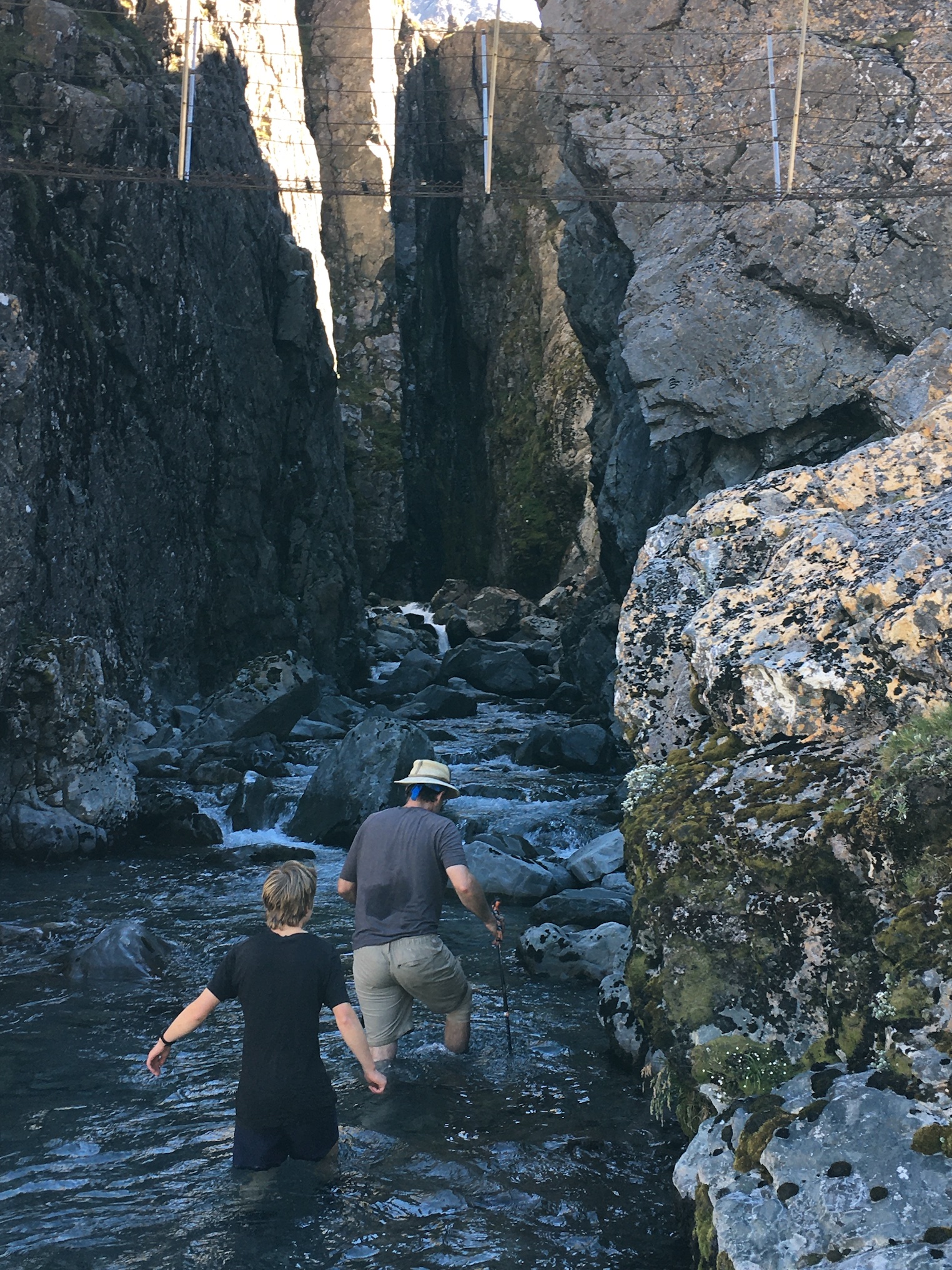
Wading in to see Waimakariri Falls.

The upper falls, just below the hut, are hidden in a deep, narrow fissure in the rock. Waist deep in icy water is the only way to see the water roaring down—great fun, but not something you’d want to do on a cold day. 

Above the falls, the river is narrow enough to jump across with dry feet, and flows through a fabulous alpine landscape. We didn’t hike all the way to the snowfield where the river actually begins, but we were close. 

The fuzzy flower of a South Island edelweiss

My favourite two things on the hike were the South Island edelweiss (Leucogenes grandiceps), which looks like it was made out of felt by someone named Aunty Flo, and the river water itself. The water was crystal clear, yet colourful (the gorgeous turquoise of glacier-fed rivers) and full of substance. I could have watched it flow over the rocks for hours (come to think, I did watch it flow over the rocks for hours).

Waimakariri Falls Hut. The snowfield visible to the right of the hut is the source of the Waimakariri River.

Least favourite part of the hike was Carrington Hut. It’s a great hut in a stunning location, but last weekend, it felt as though everyone from Christchurch was there. Carrington Hut has 36 bunks, but only 1 toilet and 1 sink. With about 40 people in the hut and another 20 or so tenting nearby, it was way over its capacity. As usual, everyone was considerate and did their best to make it work, but it was still unpleasant.

All in all, a lovely weekend getaway, and an easy hike, as long as you’re comfortable with river crossings.

Christmas on the Heaphy Track

Our pre-Christmas tramp this year took us to Kahurangi National Park to walk the Heaphy Track. The trip was simultaneously spectacular and miserable.

The Heaphy Track follows the path of a proposed road, and as such is gently graded—it’s a technically easy walk. So easy it’s almost boring. But it passes through some spectacular landscapes teeming with remarkable flora and fauna.

Day 1 began for us at 5.30 am when we awoke in the Collingwood Campground to our tent being blown flat by the wind and rain. We quickly decamped and retreated to a shelter to wait for the rain to let up before starting our hike.

Unfortunately, the rain outlasted our patience, so we started out under a heavy fall that had us soaked within minutes. The steady climb was largely unremarkable. The rain eventually cleared and we reached Perry Saddle Hut under a sunny sky.

Day 2 was more eventful, with two endangered species sightings by 7 am. The first was a takahe browsing the grasses just outside the hut as we finished breakfast. This critically endangered bird, the world’s largest rail, was presumed extinct for 50 years. Its population now numbers just 445.

Minutes down the track, with rain setting in again, we nearly stepped on our second endangered species of the day—a Powelliphanta snail—a fist-sized carnivorous snail. Without the rain, we never would have seen these nocturnal, moisture-loving animals. We counted ourselves lucky.

Under increasing rainfall, we made our soggy way across Gouland Downs and then the weird and wonderful Mackay Downs. We explored caves and admired huge glacial erratics tossed like giant bowling balls over the landscape. Weka (another endemic rail) with chicks in tow scurried around our legs every time we stopped for a break, waiting for us to let down our guard so they could make off with a snack.

We reached Mackay Hut drenched, but the worst of the rain was yet to come. Half an hour later, the sky opened up and the wind rose. The torrent sheeted down, spilling off the hut roof like someone was tossing buckets of water over the edge. It didn’t let up until nearly 4 am the following day.

Again we set out in the rain, this time into a landscape scoured and still gushing water. But again the rain held delights—another giant snail, sundews lining the track, enormous 700-year-old southern rata trees, waterfalls in all directions, sprays of flowering bamboo orchids dripping from tree trunks, a mistletoe with scarlet flowers … That evening—Christmas eve—drying out in Heaphy Hut, we composed a New Zealand tramping ballad as a family:

T’was the night before Christmas, and all ‘round the hut
I sure wasn’t stirring; I was sitting on my butt.
A cup of tea nestled warm in my hand.
I ate lots of scroggin, expanding my waistband.
Out on the porch, the weka did play,
Hauling our shoes and our stockings away.

When up on the roof there arose such a clatter
I limped from my bench to see what was the matter.
The sun on the roof of the dunny nearby
Made me shade my eyes as I peered up to the sky.
And what to my wondering eyes did appear
But a trio of cheeky, mischievous kea.
With can opener beaks and curious minds
The birds tore apart everything they could find.
When done on the roof they moved on to our packs
Eating their fill of our Christmas Day snacks.

With our stockings all gone and no snacks to eat,
We still had a Christmas that couldn’t be beat.

Christmas morning dawned and the last ragged storm clouds blew away, leaving brilliant blue skies and blooming rata trees for our last leg along the coast under dense stands of nikau palms.

We ended with a quick dip in the Kohaihai River (very quick—it was ice water) and the long drive home. A most enjoyable Christmas!

Hanging Out with the Locals

Sunday’s family hike took us to Avalanche Peak in Arthur’s Pass National Park. Several years ago we’d been to the peak on our way to Crow Hut, but we’d never done the day hike loop from Arthur’s Pass Village to the peak and back. So in the interest of leaving no track unwalked, we did the loop.

Last time we were there, we reached the peak to find it packed with people. So many people jostled to stand at the top, I was worried about being shoved off. Stretched down the mountain, a line of hikers ascended to join us. We didn’t stay long, but quickly dropped off the peak, sidling up the ridge toward our destination, which was similarly crowded (there were 16 people staying at the 10-bunk Crow Hut that night).

Looking down on the Waimakariri River

Sunday’s experience was entirely different, in spite of it being a similar beautiful summer day. With no foreign tourists in the country, the only hikers were Kiwis. 

The long slog to the top was rewarded with a prime seat on the jagged peak (it’s the most uncomfortable mountaintop I’ve ever sat on—rocks like razors). We shared the summit with just two other hikers and three kea.

The weather was perfect—light winds, cool air, warm sun—and we took our time over lunch, chatting with our fellow hikers and fending off the the kea, who angled for our sandwiches, considered ripping open our backpacks and took a swipe at my daughter’s apple.

It was the most intimate kea encounter I’ve had (excepting the time one bit me on the butt). 

Wade, the cheeky kea

For those of you unfamiliar with kea, they are endemic to New Zealand and are the world’s only alpine parrot. They are an endangered species (estimated population of 4000 adults). A large factor in their endangered status is their lack of fear of humans and their incredible curiosity. Combined with a huge beak like a can opener, it means they get into all sorts of things they shouldn’t They have a deadly fondness for the lead heads of roofing nails, they like to tear apart automobiles and camping gear, and they irritate farmers by killing sheep (yes, a sheep-eating parrot—scary eh? Don’t mess with that beak!). 

Two of the birds hanging out with us were banded, and we were able to identify them on the kea database. ‘Wade’ was the most in-your-face bird of the trio—of all the photos I took, only a few didn’t include Wade. And, of course, I took lots of photos, in spite of the fact I have dozens of photos from previous kea encounters. I swear, it’s part of their strategy—one poses for the camera while the others rifle through your bags looking for treats. 

Eventually we said goodbye to our fellow hikers and our feathered companions and descended to a quiet Arthur’s Pass Village—so different from the frenetic activity of summer with overseas tourists. I feel for the tourism industry, suffering this year with a lack of business. But I love the opportunity to enjoy our backyard without teeming masses of people.

I look forward to the day we can invite our overseas visitors back—international tourism is not only an important part of the economy, but also a strong impetus for protecting the stunning and unique natural landscapes, flora and fauna we have here in New Zealand. It’s good to see Aotearoa through the eyes of tourists now and again, to remember just how special our natural heritage is.

But until then, I’ll enjoy hanging out with the locals.