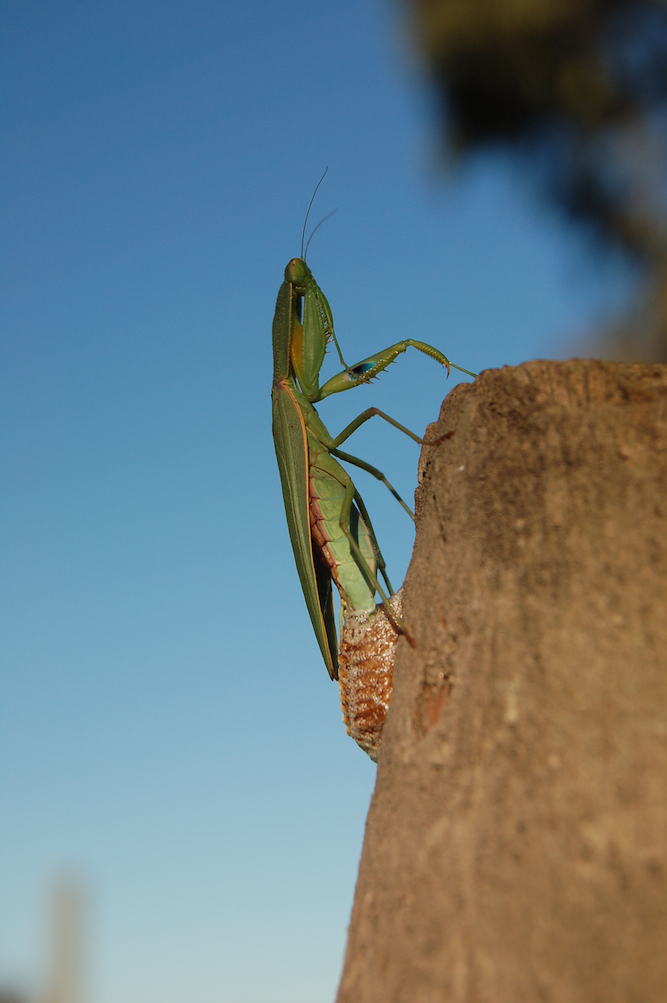
NZ mantis laying eggs
There’s no question why I’ve been known as The Bug Lady most of my life. I have a weakness for anything with more than four legs.
Preying mantids are some of my favourites. Not just because they eat pests in the garden, but because they are simply fun to watch.
How often can you watch a cheetah bring down an antelope in real life? Um…never. But it’s easy to watch a mantis snatch a fly—all the drama of the Discovery Channel, right in your back yard.
Sometimes the drama is a little too close for comfort.
When we lived in Panama, a beautiful 10 cm long green mantid with bright pink hind wings often came to our light at night. It would sit on our table and snatch moths attracted to the oil lamp. It was a cheeky insect, and had no compunctions about perching on our faces or arms to get a better vantage point for its nightly hunting. We laughed that it would follow us to bed some night.
We weren’t quite right, but one morning I slipped on my jeans, only to feel something enormous crawling up my thigh. With a yelp of surprise (and visions of scorpions, which were common in our house) I tore the jeans back off and peered down the leg to find our cheeky mantid scrambling out. It looked distinctly ruffled by the experience, but that didn’t stop it from returning to our light.
But from then on, we trapped it in a jar every night before we went to bed.
We are blessed with a healthy population of New Zealand mantids here at Crazy Corner Farm. Like most mantids, they enjoy hanging out on flowering plants, particularly herbs which attract huge numbers of flies and bees. Sometimes, I sit in the middle of the herb garden with my morning coffee, just to watch the mantids. I’m always surprised and impressed by the size of prey they can take down. I’ve even seen them snatch more than one fly at a time—one in each “hand”. Indeed, they will keep snatching prey as long as it keeps coming—even once they are fully sated and can’t possibly eat any more—their predatory instinct is so strong, they can’t stop themselves.
Of course, everyone has heard that female preying mantids eat their mates, and in species in which the female is much larger than the male, I’m sure it happens. But male preying mantids are just as fierce as the females, and they don’t go without a fight. The female New Zealand mantid is only slightly larger than the male, and I have kept males and females together in captivity. Only once did I see a female try to eat her mate. It was an epic struggle, worthy of the best wildlife documentary. It went on for at least fifteen minutes, and in the end, the male got away.
So turn off the TV. Get outside and watch the drama unfold!





 Robinne Weiss