2024–Year of the Rat?

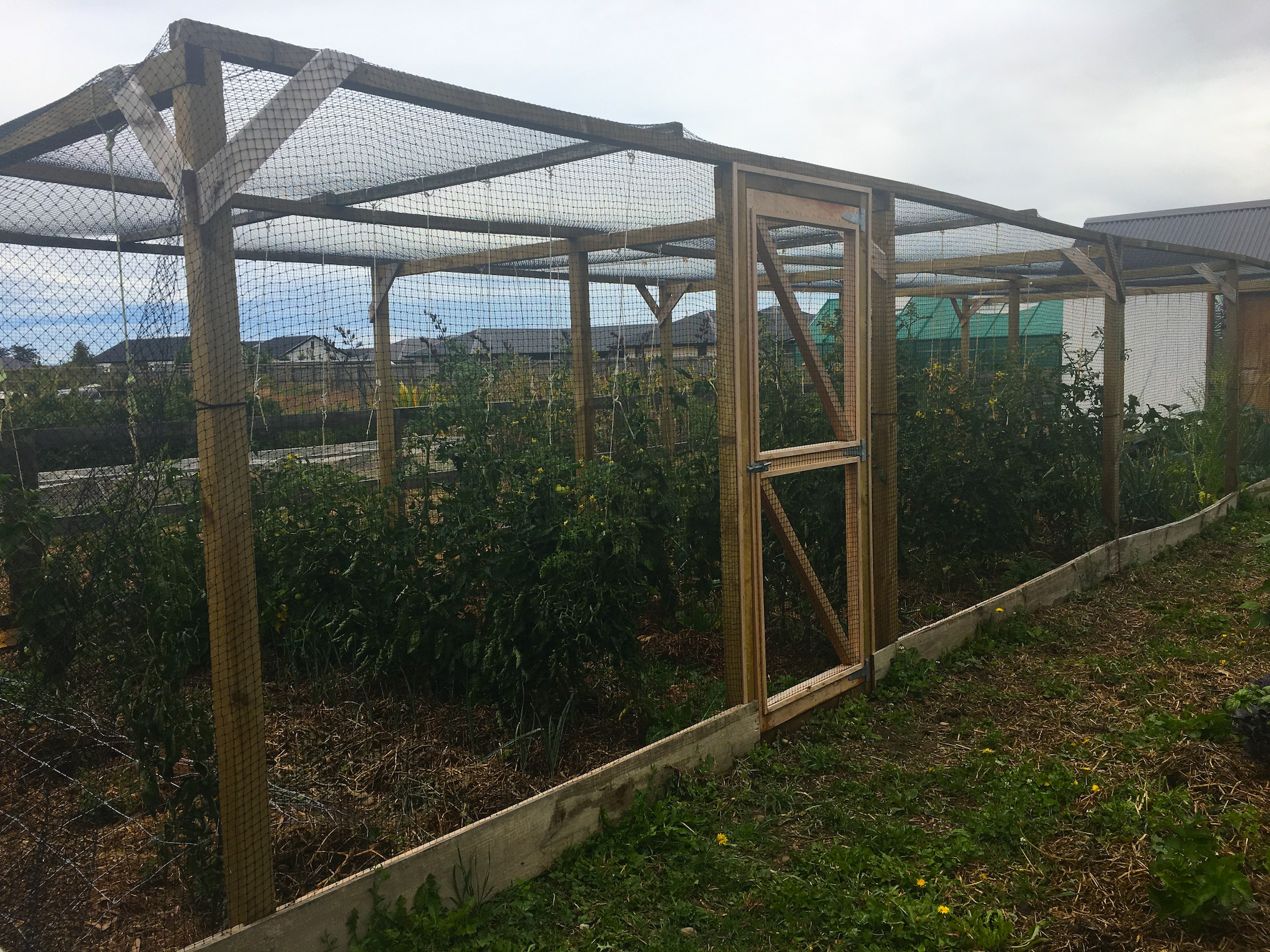
The netted ‘room’ is excellent at keeping birds out, but does nothing to thwart rats.

With a third of my garden protected with permanent bird netting this year, I was pretty smug about pests this spring. Silly me …

2023 may have been the year of the rabbit in the Chinese Zodiac, but in my garden it was year of the rat, and it seems to be continuing in 2024.

In the spring, rats ate all my pea seedlings … twice … On one of those occasions, they plundered the seedlings in the three hours the tray sat in the garden before I planted them out. I was working (planting other things) just metres away while the rat collected all the seedlings and tucked them away in its nest (I found them later when I uncovered the nest).

The rats also did good work on my first planting of corn, melons, cucumbers, and pumpkins, eating the seeds and uprooting the seedlings.

I went through three cheap rat traps (none of which actually caught a rat, and all of which quickly broke), before spending an excessive amount of money on a DOC 200 trap. This terrifying stainless-steel beauty caught its first rat within 24 hours. It has nabbed 3 rats, a hedgehog, and an English sparrow in the three months I’ve had it, which I’m quite pleased about.

Unfortunately, it has not solved my rat problem. Last week I discovered a rat (or rats) had tunnelled straight down my potato bed, eating nearly every potato in the entire bed, and damaging some plants so badly they were dying. Yesterday, I went to pick a gorgeous Black Brandywine tomato that was ripening on my now bird-protected tomato plants. I found the tomato on the ground, half eaten by little rat teeth.

I’m beginning to wonder if I will get anything off the garden this year. So far, the rats don’t seem to like courgettes or cucumbers, but my beans are planted right next to the compost pile where the rats seem to nest. Once they start plumping out, they’ll be primo rat food. And the corn? You know those rats will be scampering right up the plants to gnaw at the ears. Makes it hard to lure them to a trap when the garden is a smorgasbord of delicious food.

Makes me wish I still had a cat—the rats didn’t start to become a real problem until he was gone.

I’ve also got my first ever infestation of whitefly this year. Pretty embarrassing for someone whose Master’s degree was on greenhouse pest management. Whitefly wasn’t even on my radar, so I missed early signs of the infestation. They’re not only in the greenhouse, but outdoors as well. The key to effective integrated pest management is paying attention and catching infestations before they’re a problem, and I failed spectacularly at it. Now I’m playing catch up. My only consolation is that it looks like lots of other people are, too, because both suppliers of whitefly biocontrol agents in New Zealand are sold out. Serves me right, I guess.

So as we enter 2024, officially year of the Dragon, I’m wondering if there’s a dragon that eats rats …

Wide-eyed Wonder–Not Just for Kids

I don’t often get to geek out with biologists (other than my own family, of course), so I was pleased to have an opportunity over the weekend to spend a day at Cass Mountain Research Station helping out with a mini bioblitz.

We couldn’t have asked for a better day—warm sun and clear skies made it a pleasure to be wandering around the forests and fields of the research station. And the company was great—everyone eagerly pointing out the mosses, herbs, bugs, birds, fungi and slime moulds we came across.

The enthusiasm was infectious. Back at the lab, folks peered at bugs, fungal spores, slime moulds, and moss, debating and discussing identifications, and calling out in delight when they discovered something awesome.

I was disappointed to have missed the tardigrades under the microscope, though my husband got fabulous footage of one being about as cute as an animal can be.

I was also jealous of the crew who spent the previous night at the station observing the nocturnal creatures—they bagged a giant springtail.

But there were more than enough cool critters to go around. I enjoyed peering at some of the little spiders I swept from the tussocks, and finding a clutch of spiky beetle larvae all curled up together in a rotting stump. The freshwater researchers brought in trays full of wriggling caddisflies, midge larvae, mayflies and other macroinvertebrates. The botanists catalogued a wide variety of orchids, mosses, and shrubs. The soil researchers found slime moulds, fungi, nematodes, and beetles.

When all the specimens were identified and catalogued, we’d logged 579 individual observations of 259 different species. Many of those species were new records for Cass, bringing the total number of species recorded for the field station to 590 and blowing our goal of 500 well out of the water. A fabulous effort, and a thoroughly enjoyable day!

Sometimes it’s easy to forget the simple thrill of discovery—that wide-eyed wonder we had as kids, when everything was new. We get bogged down in daily life, forget to keep our eyes open. It was great to remind myself last weekend that there is joy in simply observing.

Wanted Weeds

A baby lancewood! Isn’t it cute?

Over the weekend, I was weeding the native plantings at the front of the property and discovered a wee lancewood seedling. We’re quite fond of lancewood, and have planted several around the property, but none of ours have set seed yet—they’re all still in their stick-like juvenile form. So the volunteer came in from someone else’s property, no doubt dispersed by a bird.

Normally, weeds are a source of dismay, but I was thrilled to find the little lancewood. I’ve been surprised at how many ‘volunteer’ plants we get at our new property—there’s more rainfall here than at the old place, and plants tend to establish on their own, without my help. It means the unwanted weeds grow better, too, but I’ve been thrilled by what has popped up.

Among the native weeds, we’ve got coprosma, akeake, poroporo, NZ iris, snow tussock and hebes. Some, of course, sprout where we don’t want them, and I have to weed out a fair few. But many get transplanted elsewhere or potted up and given away. I love the thought that our native plantings might one day be self-perpetuating.

Rampant fumitory, rampant along the garden fence.

Among the non-natives there are some welcome weeds, too. Pansies, flax, thyme, oregano, sage, cilantro, peas and fennel are all desirable—in the right place. 

I will also admit to appreciating the flowers of daisy, scarlet pimpernel, scrambling speedwell, and rampant fumitory wherever they grow, but only because these plants are a minor nuisance and easy to pull out. Other pretty weeds, like bindweed, yarrow and vetch are on my hit list, regardless of their flowers.

Then there’s stinging nettle. I hate nettles. But lush nettles are a good sign of fertile soil, so I admit I like to see them pop up and grow well, even if I do pull them out.

Is a plant a weed if I like it? Maybe not. But all these volunteer plants do make for extra work in the garden, whether I appreciate them or not.

The volunteer pansy brigade. Who can complain about that?

It was the best of times. It was the worst of times.

Spring is a season of contrasts. Not just the weather, which can change on a dime from cold and rainy to dry and hot, and then back again, but the spring gardening season has more ups and downs than other seasons.

Take the past two weeks, for instance. The fruit trees are in bloom, daffodils and tulips are flowering, the asparagus is up, and the berries are leafing out—the garden is green and lush, a real delight! The seeds I’ve planted over the past month are growing well, and I’ve begun planting out the frost-tolerant crops. The sun has warmed the soil, and the worms are going crazy, incorporating all the manure I added to the garden over the winter. It’s the best of times.

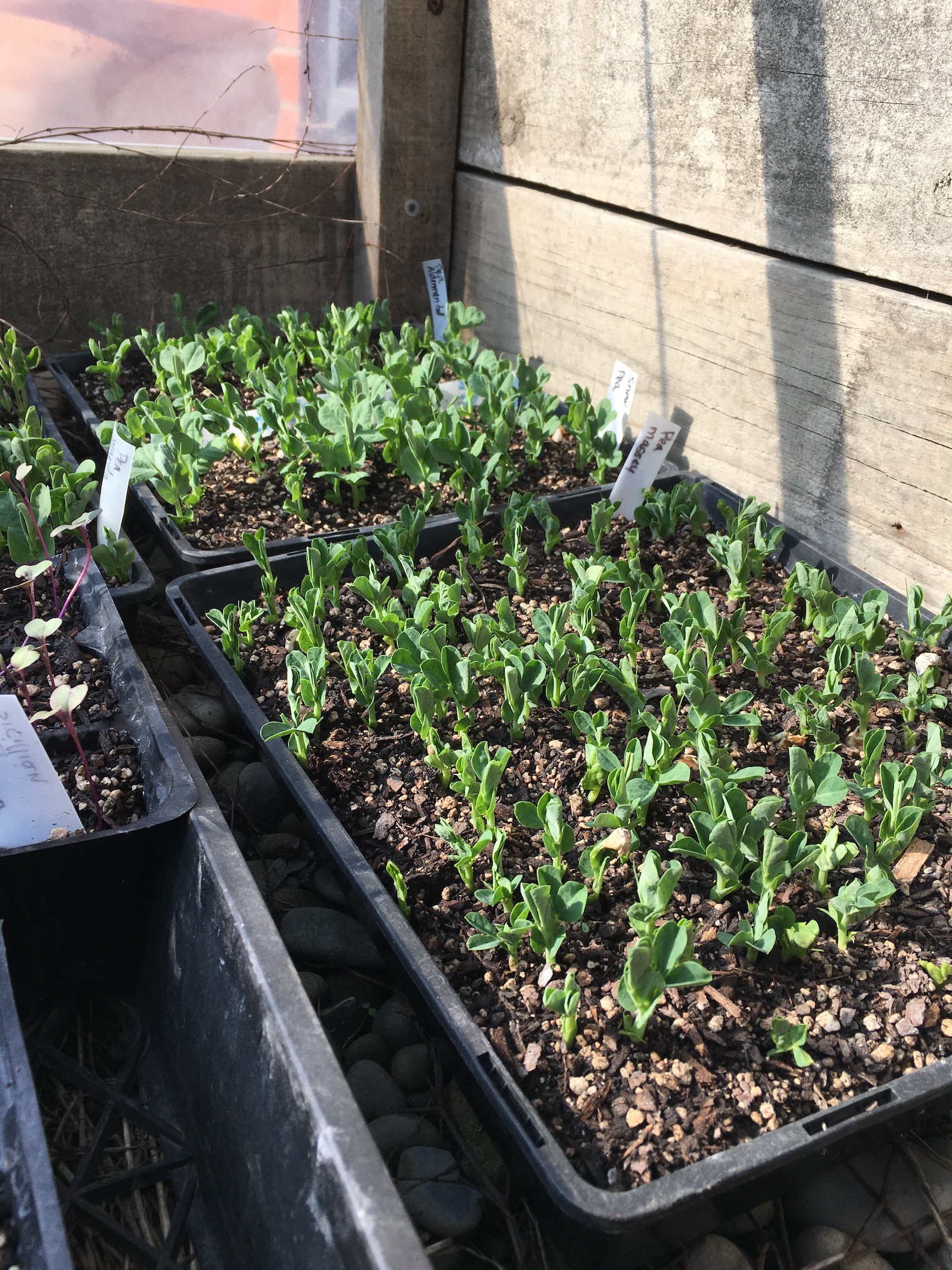
On the other hand, when I put the freshly sprouted peas in the greenhouse to grow for a week before planting them out, the rats and mice got into them and ate about a quarter of them. Disappointing, but to be fair, when it came time to plant them out, I had the perfect quantity for the area I had prepared, so no harm done. I set some rat traps, and planted my second planting of peas in a tray indoors.

Saturday morning, I set the new tray of beautifully sprouted peas in the greenhouse, just until afternoon when I planned on planting them out.

By the time I was ready to plant, a rat had eaten them all. Yes, during the day, while I worked just a few metres away in the garden. Gutting, especially after two weeks of having the sneaky rodent eat the bait out of my rat traps without getting caught. Grr! To add insult to injury, when I removed the pile of bricks I knew the rat was nesting under, I found a huge stash of peas and wilted pea sprouts—the little stinker wasn’t even eating them all—he was stockpiling. I have since ordered a DOC200 trap—I’m gonna get this guy one way or another before he eats more peas. 

On Sunday, we experienced a typical springtime nor’wester—warm dry wind racing across the plains at 100 kph or more. Just after lunch, a particularly violent gust blew two panels out of our new greenhouse, including one panel we’d lost in a previous wind and had reinforced so it wouldn’t happen again. Later gusts tore a third panel out as well. This greenhouse was advertised as being designed in New Zealand for New Zealand conditions. Clearly they didn’t test the thing on the Canterbury Plains. Arg! It’s the worst of times.

In spite of the delights of spring, it seems there’s always another pest, another problem to deal with. By summer, I know that most of the problems will be either solved, or abandoned as a lost cause, but in springtime, hopes run high, and disasters feel truly disastrous.

I complain, even though I know that the springtime garden disasters are fixable (for the most part). But I suppose part of why I enjoy gardening so much is the challenge. Outsmarting pests; growing crops out of season; battling poor soil, wind, drought, flooding … sometimes I think that’s half the fun.

So I look to the weather forecast for the next 24 hours—severe wind warnings and a high of 20 today, followed by snow tomorrow—and buckle up for the roller coaster ride.

Pest Management: Control

Yesterday I wrote about strategies for preventing pest problems. If you’ve taken all the measures you can to prevent pests, but the pests arrive anyway, there are different questions to ask:

Centipedes are predators of many garden pests.
  1. Do I need to worry? Low levels of pests aren’t a big deal. A few aphids, a caterpillar here or there, the odd bite out of a leaf—these things aren’t going to have a big impact on the quality or quantity of your harvest. Just keep an eye on them to be sure the problem doesn’t get worse.
  2. Can I physically remove them? I’m a huge fan of squishing and hosing pests off plants. For example, I have problems every spring with aphids on my roses. If I do nothing, the plants become completely covered, and the blooms are destroyed. So in spring, I keep an eye on the plants, and once the aphids start reproducing, I hose the plants down once a week, knocking off most of the aphids. Usually I only have to do this about three times before the aphids’ natural enemies build up enough to keep them under control without my help.
  3. Can you disrupt a critical part of your pest’s life cycle? Is there a life stage that can be easily killed, or has specific requirements you can disrupt? For example, I keep a close eye on my brassica seedlings, looking out for cabbage white butterfly eggs on the undersides of the leaves. All it takes is a quick swipe of the thumb across the bottom of each leaf to squash the eggs and eliminate future problems with caterpillars. Another example is my recent problems with slaters in my greenhouses. Discovering that the slaters are congregating between cement blocks stacked beside the greenhouse, I’ve started regularly checking and squashing all the slaters in those blocks. (I could also have moved the blocks, to eliminate the slaters’ shelter, but since the population was quite high, I thought squishing a whole lot of them would be more effective for now. Later I will probably move the blocks to make the area around the greenhouse less attractive to slaters). 
  4. Can I make use of them? Pest-covered plants, grass grubs and slugs all get thrown over the fence to my chickens, who turn them into beautiful eggs for me and save me from the disgusting task of squishing the bugs. 
  5. Can I pull out badly infested plants? If there’s a couple of plants badly infested, but the pests haven’t spread much, rip out those infested plants and destroy the pests on them. You’ll lose a few plants, but you’ll protect the rest of your crop.
Pest-gobbling chickens.

In an IPM system, you don’t consider any sort of chemical control until you’d exhausted all the possibilities above. In practice in my garden, I almost never need anything else. Occasionally, if I’ve missed an aphid infestation on a crop that can’t handle a strong spray of water, I’ll use a soap solution to kill aphids. That’s the extent of my chemical control. But if you do need to resort to chemicals, it’s important to choose the right one. The more specific it is to your pest, the better. Many modern pesticides are narrowly focused, and target specific pests, and that’s great. With a narrow target, the pesticide is less likely to kill beneficial insects or harm people and pets. Stay away from broad spectrum pesticides. Also, if you do use pesticides, be sure to follow the label directions carefully, wear protective gear, and dispose of leftover product and empty containers properly. 

Pest Management: prevention

It’s nearly spring, so naturally my thoughts turn to the subject of pests. Our big pest-related project in the garden this year is bird netting a third of the vegetable garden, so we don’t lose most of our tomatoes and peas to the feathered rats.

Aphids–the one on the right is healthy, the one on the left has been parasitised by a wasp, one of the many natural enemies that keep aphids under control in the garden.

As an entomologist whose research focused on Integrated Pest Management, I always have a lot to say about pests. And it’s an important topic—globally, 30-40% of crop yield is lost to pests (interestingly, this figure didn’t change with the advent of chemical pesticides—insect pests are incredibly quick to evolve pesticide resistance). That’s a lot of wasted food!

For home gardeners, fighting pests is a daily task. Every place I’ve gardened has its own unique pest problems. Growing up in Lancaster Country, Pennsylvania, I remember the rabbits munching through the garden. In State College, Pennsylvania it was flea beetles that shot so many holes through my eggplants’ leaves they never had a chance to grow, and the squash bugs that clustered in masses under the leaves of my zucchinis. In Panama, leaf cutter ants could strip a plant bare in no time. 

In my first garden in New Zealand, aphids and rabbits were my main problems. When we first arrived on the property, there were so many rabbits I wondered if I’d be able to grow anything. A rabbit-proof fence was the first garden project there.

In my current garden, birds are my worst enemy—mostly English sparrows and European blackbirds. They strip seedlings bare, eat tomatoes, pull out onions, and scratch away mulch and soil, leaving plant roots to dry out (never mind the amount of chicken feed they snarf down every day!). 

Fortunately for me (and unfortunately for the pests), my masters degree focused on Integrated Pest Management (IPM), so I’m well-armed when it comes to tackling pest problems.

IPM is often called common sense pest control. In IPM, the goal isn’t to eliminate pests, but to minimise the damage pests cause, while choosing the most environmentally-friendly control methods that do the job.

To successfully use IPM, you must first know your enemy. What conditions does it like? What’s its life cycle? What are its natural enemies? How does it find your plants, and how does it travel? Books and the internet can tell you a lot, but careful observation of the pests in your garden is key. The particular conditions in your garden will affect how pests behave, and where their weaknesses are. If you know exactly where pests are and what they’re doing in your garden, you can begin to tackle them more effectively. For example, I know that in my current garden, there are particular varieties of squash the aphids like. By keeping an eye on those particular plants, I can catch aphid infestations early and deal with them before they spread to more plants.

Bird netting protecting pea seedlings

Once you know your pest’s habits, you can begin to consider control methods. Questions to ask:

  1. Can you time your plantings to avoid the damaging stage of the pest’s life cycle? For example, I don’t grow brassicas during the summer here—I have an early spring crop and a winter crop. By avoiding brassicas in summer, I eliminate bad problems with cabbage white butterflies, which tend to reach damaging levels around Christmas. I still have to be on the lookout for butterfly eggs on my seedlings, but once the plants are growing, they easily stay ahead of the caterpillars.
  2. Can you exclude the pests from your crops during critical time periods? For example, psyllids can transmit disease to potatoes and tomatoes, leading to poor growth and damaged tubers. By covering the plants with a fine mesh cloth, I can keep the psyllids out for most of the summer (until the plants are too big for the covers, by which point the psyllids don’t seem to be much of a problem). I do the same for my peas and lettuces—netting out birds until the plants are large enough to handle losing a few leaves. I also net my berry crops and olives before the fruits start ripening, so the birds don’t pick them before I do.
  3. Can you plant varieties the pests don’t like as much? For example, I plant mostly red varieties of lettuce, because the aphids take longer to discover them than they do the green ones. Usually, by the time the aphids find my red lettuces, they’re bolting and ready to pull out anyway.
  4. Can you plant a ‘trap’ crop that the pests like more than your favourite vegetables? I haven’t done this explicitly, but as I mentioned earlier, there are certain varieties of plants I know are particularly tasty to pests, and I closely monitor them and kill the pests on them before they can spread to other crops. A true trap crop is something you’re willing to pull out entirely when it is infested by your pest, in order to destroy the pest.
  5. Can you prevent pests from finding your crop? Interplanting different crops can help disrupt the spread of pests, because they struggle to find new plants to feed on. It can also help you make the most of the space in your garden. For example, I sometimes plant summer lettuces in the shade of my sweetcorn—not only does the shade help prevent the lettuce from bolting, it also seems to hide the lettuce from aphids.
  6. Can I encourage the pests’ natural enemies? Many pest insects are preyed upon or parasitised by the larvae of beetles , flies and wasps. The adults often eat pollen and nectar, so planting herbs and flowers is a great way to encourage many pests’ natural enemies.

All six of the questions above will help you avoid a pest problem in the first place. They are changes in the way you plant or grow your crops that make it less likely you’ll have pest problems. Tomorrow, I’ll look at what you can do once you’ve discovered pests in your garden.

Mt Richardson–a beautiful winter hike

View across Lees Valley from Mt Richardson

Injuries and weather have conspired to keep me out of the mountains for months, but my husband and I finally made it to the hills a few weekends ago.

It wasn’t a big trip—just a little jaunt to the top of Mt Richardson, one of the foothills around Oxford.

At only 1047 metres tall, Mt Richardson doesn’t get above tree line, but a clearing at the top provides a great view of the ‘real’ mountains beyond.

The day we went was sunny and nearly windless. There was snow on the ground, but we ate lunch at the top in our t-shirts, enjoying the stunning panorama spread out around us.

I would say that the only things that diminished the perfection were the mud, the slip that took out a section of track (necessitating a bit of bushwhacking) and the washed-out bridge that meant wading through an icy stream, but those things only added to the fun. 

I look forward to better weather and more outdoor adventures as we head into spring.

Ready, Set, Plant!

Looking forward to scenes like this in the coming weeks …

My seed order arrived last week, and I’ve stocked up on seed raising mix in preparation for this coming weekend.

The middle of August marks the start of spring planting, even though officially spring is still two weeks away (in spite of this week’s cold and snow).

This weekend I will plant hundreds of vegetable seeds—broccoli, cauliflower, cabbage, lettuces, spinach, onions, peppers, eggplants, herbs—a combination of early crops that can handle the cold and slow-growing late crops that need a long time in the greenhouse or indoors. 

This weekend is always a bit exciting and a bit daunting. Daunting because whatever winter projects I had going are doomed to the back burner until next April. Daunting because of the vast amount of work to get done in the coming months. And exciting because of the pleasure I get out of growing delicious food, and the joy of trying out new varieties of vegetables each year (this year, I’m trying Bartowich Parsley for the first time, a purple snow pea, a new hot pepper, and a couple of new tomato varieties).

I used to get overwhelmed at this time of year by the sheer amount of work ahead, but I’ve learned to manage the work, and more importantly the stress, by creating a weekend-by-weekend to-do list that runs from mid-August through the end of November. The list includes all the annual garden tasks associated with spring—planting seeds, potting up seedlings, preparing garden beds, setting up trellises, cleaning greenhouses, maintaining irrigation lines, fertilising weeding, mulching … With everything on the list, I know I won’t miss any tasks and everything will be done on time.

Obsessive compulsive? Yeah, probably. But it means I can fully enjoy each and every task without stressing about the fact I’m NOT doing something else. 

So from tomorrow, if you need to catch me on the weekend, I’ll be in the garden. 

Autumnal Assessment

April is upon us, and it’s time to assess how the garden year went.

In a word, it was disappointing. 

It started off bad, with my seedlings in fungal-infected seed raising mix. That problem was made worse when I contracted Covid and couldn’t move those seedlings into better mix quickly, so they languished for a while. Many were planted out late or small.

And the problems continued once plants were in the garden. Flooding last winter sucked the nitrogen out of the soil in about half the garden, leaving my pumpkins, corn, peppers and eggplants all looking anaemic. To be fair, I harvested pumpkins—enough to enjoy fresh, but not my usual quantity that lasts us all year. We also ate sweet corn, but had none extra to freeze. The peppers and eggplants were so slow to grow this year that they’re only now ripening fruits—just in time to be killed off by winter temperatures.

The tomatoes and peas grew well this year, but were decimated by birds.

The cucumbers and melons were slammed by phytophthora during an early summer wet period—most died, and those that survived grew slowly. The only cucumbers that grew well turned out inedibly bitter, and I tore the plants out of the ground.

On the positive side, the potatoes were great—died off a little earlier than I expected, but produced plenty of tubers, with little trouble in the way of pests and disease. 

The perennial fruits did well overall, too, and the freezer is stuffed with berries for the winter. Even the 3-year-old fruit trees gave us crops this year (small ones, but the trees are still tiny themselves).

So, as usual, there were wins and losses, and now I’m looking forward to how to increase the wins for next year. I spent the past several weekends digging a drainage ditch and soak pit to draw flood water off the garden this winter. Hopefully that will help retain the nutrients I’m hauling to the garden in the form of manure each week. My husband and I have also been discussing improving our bird defences before next spring—permanently netting an area of the garden for the most bird-ravaged crops. I’ve also identified some new varieties of bean that are doing better in the new garden than my standards from the old garden, and I’ll adjust next year’s planting to allow more space for the more vigorous varieties. 

That’s the best part of gardening, really. You always get another chance to do it better. So I head into autumn a little disappointed in last year’s garden, but with high hopes for what next year will bring.

Enjoying the Shoulder Season

sunflowers
Summer sunflowers are still in full swing.

The end of February marks the end of official summer in New Zealand. The shift to autumn is full of ups and downs. The first half of this week was as hot as it gets here, with temperatures in the low 30s (around 90℉). On Tuesday, it was hot enough that my husband and I headed to the beach for a swim after work, and I didn’t even need my wetsuit—the water and the air were both warm. 

But on Wednesday, a front came through, bringing rain and a decidedly autumnal chill. By Thursday, the porcini were sprouting—a sure sign of autumn.

Of course, also on Thursday we harvested plenty of summer vegetables from the garden—zucchini, eggplant, tomatoes, peppers. The transitions between seasons are drawn out, messy affairs. The weather forecast for next week includes more summery weather intermixed with the rain and chill of autumn.

Autumn mushrooms are coming on.

So for now, we get to enjoy the delights of both seasons, harvesting summer’s bounty amidst the treats autumn brings. This weekend, I’ll plant out my winter crops, giving them time to establish during the shoulder season, before summer’s warmth leaves entirely. I’ll also harvest the soy beans and bottle up some summer soup before the vegetables are gone. Summer’s not over yet, but it’s time to start packing up.