Meet Katie Cochrane, budding restauranteur. She has no idea what she’s in for when her crazy Aunt Rachael gifts her the burnt out Rifton Pub for her birthday. Before long, it’s clear that renovations are the least of her worries. She always knew running a restaurant would be challenging, but she never expected it to involve witchcraft.
This cosy urban fantasy can be read as a standalone, but, Rifton being a small town, it includes many of the characters from book 1 of the series. I was excited to have a chance to spend more time with the quirky ladies of the Rifton garden group and Rifton’s demonic felines.
So pull out your gardening gloves and secateurs, and pop on down to the Rifton pub for some supernatural fun!
Preorder today, and be the first to read Demonic Summoning for the Modern Gardener!
Release date is 31 January, so you won’t have to wait long!
Our daughter wanted to go to the west coast for professional reasons (to photograph mosses for a project she’s doing), so my husband and I happily agreed to accompany her for a weekend getaway.
We left Friday evening, stopping at Lake Pearson (Moana Rua) for a lovely picnic dinner, and then carrying on over the mountains to camp at Goldsborough Campsite near Kumara. We pulled into the campsite around eight o’clock and set up camp. With the light already fading, we decided to wander up one of the tracks that followed old gold mining tracks through the bush.
Old mining water race tunnelling through the hillside
We started up German Gully Track, thinking we’d just go up a little ways, then return. The track passed an old mining water race that looked like a cathedral-shaped tunnel as it snaked steadily up the hill. Soon we were close enough to the end of the track that, of course, we had to finish.
We popped out onto a broad, modern gold mining road. The sign at the road indicated that we could either return to the track the way we came (30 minutes, according to the sign), or return via Goff’s Track (65 minutes). It was 8.55 pm. To take Goff’s Track would, theoretically, have us arriving back at the campsite at 10 pm. After ascertaining we all had our head torches with us, we powered up the road towards Goff’s Track.
German Gully track–an old mining road
The west coast was unusually dry, for which I was glad as we picked our way down Goff’s Track in the gloom—while most of the track was easy going, the steeper sections would have been slick and no fun in low light.
Knowing we were racing the light, we kept the pace up, and didn’t even need to use our torches, arriving back at the campsite around 9.30. A nice little evening hike!
The following day, we got an early start and hiked up Mount French, near Lake Brunner. None of the track descriptions have much to say, except that the hike is a steady climb of over 1000 vertical metres. Telling, however, are the listed track length and times: 7 km return, 8 hours return. That’s a walking speed of only 875 metres per hour.
View from the top of Mount French towards the Tasman Sea
We did slightly better, making the 3.5 kilometre trip to the summit in 3 hours forty-five minutes, for a walking speed of 933 metres per hour. Most of the hike up is through dense west coast rainforest, so other than the forest itself, there’s not much to see. When we hit the alpine vegetation near the top, the views opened up and it was spectacular. At first we were a little worried we’d struggle to find our way across the multiple false peaks to the actual summit, because clouds obscured the tops. In hindsight, I’m glad the cloud was there, because when it did clear and we finally got a view of the summit, I was disappointed at how far away it still was. LOL! Though the elevational change from the bottom to the top is officially a bit over 1000 metres, there are several significant dips along the ridge, so I suspect the actual amount of climbing you do to reach the summit is more like 1200 metres.
Looking back down the ridge from the summit of Mount French
But we made it, and by the time we were on the summit the clouds had cleared entirely. We had stunning views to the Tasman Sea on one side, and to the mountains on the other. Lake Brunner glittered in the sun far below us.
We had lunch on the peak and spent a good bit of time enjoying the view and exploring the plants and insects at the top before tackling the descent.
Lake Brunner seen from the summit of Mount French
Going down was faster than going up, and we reached the car shortly after 3 pm, hot and sweaty and ready for a swim. After a quick dip in Lake Brunner, and a change of clothes, we headed to Hokitika for dinner and a short stroll on the beach.
All of us were in bed and asleep early Saturday night.
Sunday, we packed up camp and headed to Lake Kaniere to hike the Lake Kaniere walkway. We’ve done part of this walk several times. It’s a mostly flat, well maintained track that follows the entire western edge of the lake. There are multiple stony beaches to stop at along the way, and amazing lowland rainforest vegetation.
A reflective early morning Lake Kaniere
On Sunday, it was also really hot (28 degrees by early afternoon). And even on the flat, we were sweating. My husband turned back about a third of the way into the hike, in order to drive the car to the end of the one-way track. My daughter and I continued on, stopping for a quick skinny dip at Lawyer’s Delight beach, before meeting my husband walking back towards us from the far end, about a kilometre from the end of the track.
Carové’s giant dragonfly at Dorothy Falls
We had lunch, a stop a Dorothy Falls, and another swim in Lake Kaniere, then headed home.
The entire weekend on the west coast was hot and sunny, so it was a bit of a shock to hit Porter’s Pass and drive into drizzle and 12 degrees. It was a chilly 15 at home under overcast skies. Poor Canterbury—this summer has been anything but summery here. It’s no wonder the west coast was absolutely packed with vacationing families.
And now I have one week left before returning to the day job. My summer to-do list is getting shorter, but I will definitely not accomplish everything on it. But it’s been a good summer for getting out and hiking, so I can’t complain. Now I just need to knuckle down and get some writing in while I can.
This year was something of a milestone—it was the first year in about 16 that we didn’t do a pre-Christmas backpacking trip with the kids. It was bound to happen sometime soon, since the kids are all grown up now and doing their own things.
Instead, my husband and I had a post-Christmas hike all on our own. Let me say right now that I loved tramping with the kids, but doing the Christmas hike with just my husband was REALLY nice—just like old times … except that we’re a lot older. It was nice hiking at 54-year-old pace (instead of being dragged along by impatient 20-something kids), and we could also go places that appealed to us, without considering if the kids would enjoy it.
So we stayed relatively close to home, but took a route we hadn’t ever explored.
Day one began with dropping a car at the far end of our hike, near Kelly Creek. There was a bit of faffing around to charge the electric car (with the charger in Arthur’s Pass out of order, and the one in Otira busy), but it gave us an excuse to have a coffee at the Otira Hotel, which is an experience of its own.
Then we drove back to the Waimakariri River, parked car number two at Klondyke Corner, and hiked up the Waimakariri to Carrington Hut.
This hike is a bit of a slog and involves crossing the river a couple of times. In fact, the first river crossing comes within the first five minutes of hiking, which was fine—we were going to spend four and a half days walking rivers. There was no way we were going to have dry feet.
In spite of the dull nature of the actual hiking up to Carrington Hut, the scenery is fabulous, and only improves as you go further up the watershed. We were lucky to have a tern hunting the river alongside of us for a while, and we scared up a pair of banded dotterels, too.
After passing Anti Crow Hut, we left the riverbed to follow a track over a couple of roche moutonnée—rocky mounds left behind by glaciation. A series of tarns on the mounds give them a magical sort of quality, and the short break from river walking is nice.
The last time we were at Carrington Hut, it was incredibly crowded and unpleasant, so we carried a tent this time, just in case. But the 36-bunk hut housed only five of us that night, and we barely saw one another.
Day 2, we hiked over Harman Pass—up the Taipoiti River (click here for a video), then down Mary Creek. Again, the first act of the day was crossing a river, and then it was river crossings all day, back and forth across the Taipoiti as it rushed through a narrow valley which at times could be more properly called a gorge. It was another fabulous day, weather-wise, and the scenery was spectacular. So were the alpine plants. It seemed like EVERYTHING was in flower, and it was a slow hike up to the pass, because we were photographing all the way.
At the pass, we took a little jaunt up to see some tarns higher up, and then hung out for a while with a curious kea (click here for a video). Kea are an odd mix of highly endangered (there are 1,000-5,000 of them left), and incredibly pesky, thanks to their intelligence, curiosity and a beak shaped like a giant can opener (their peskiness is unfortunately part of the reason they’re endangered). The world’s only alpine parrot, it’s common to encounter them at elevation near Arthur’s Pass, but it never gets old.
Mary Creek was more of the same—river crossings, beautiful scenery, endangered birds. We spent some time watching a pair of whio (blue ducks) having a nap on a rock in the middle of the stream. There are only 3000 whio left and unfortunately the population is skewed strongly to males, because females are vulnerable to introduced predators when sitting on the nest. We were lucky enough to encounter two pairs on our trip.
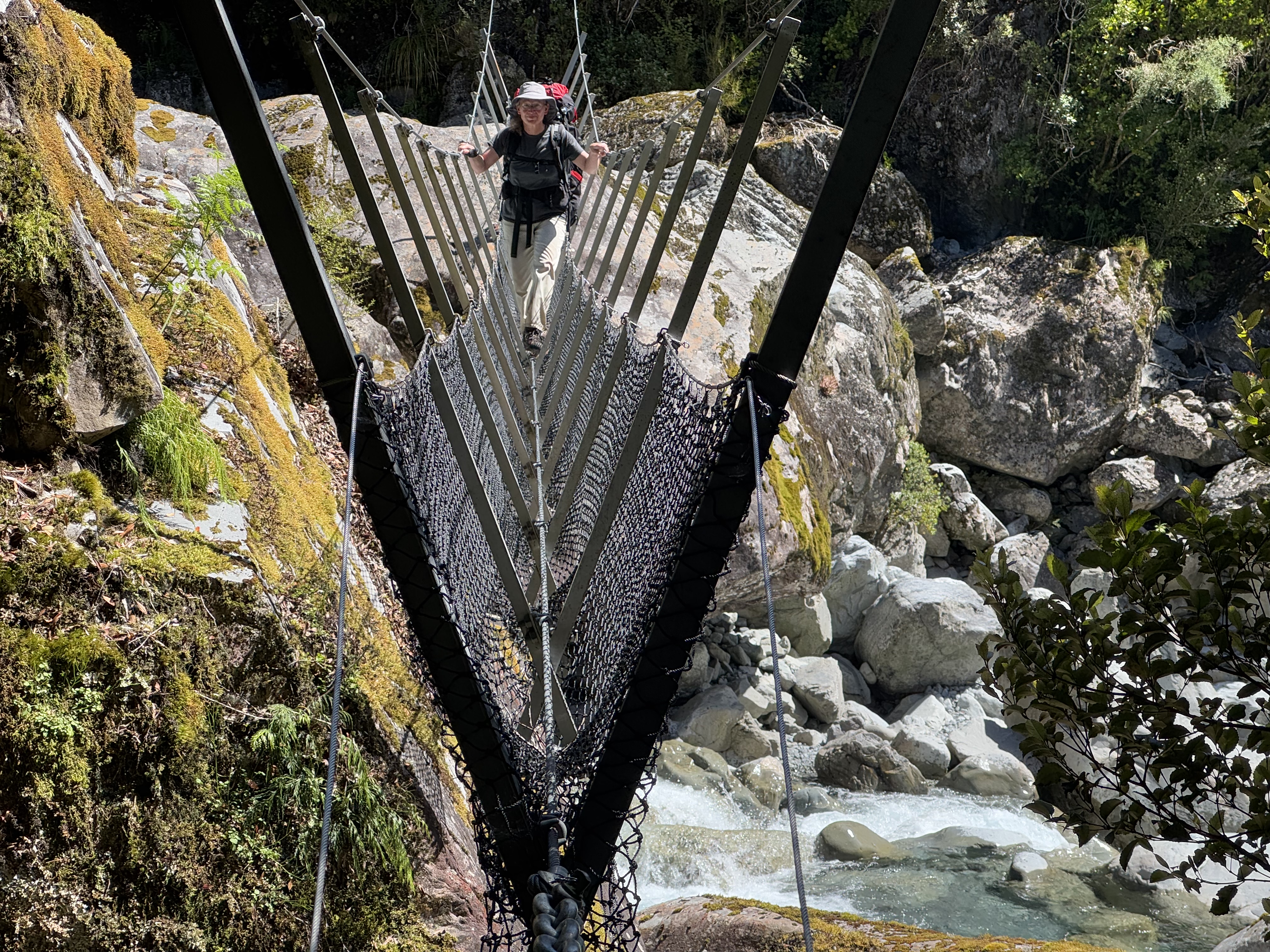
After a 3-wire bridge crossing at the bottom of Mary Creek, we arrived at Julia Hut. The hut is relatively small, and with another couple there already, we decided to tent. After setting up the tent and settling in, we had the rest of the sunny afternoon to explore. A natural hot spring was our destination. Only five minutes walk from the hut, next to the icy, swiftly flowing Julia Creek (click here for a video), the hot pool did not disappoint. It was initially too hot to sit in, and we had to redirect some river water into it to temper the heat.
After a sweaty hike, I have to say I wasn’t all that interested in sitting in a hot pool, but I took a dunk in the river first, and then the hot pool was pretty nice. You couldn’t fault the setting—two days hike from a road, on an absolutely stunning mountain stream in the bush. It beat Hanmer Springs by a mile!
There is clearly a lot of geothermal activity in the area—the smell of sulphur was prevalent all along Julia Creek—and I suspect if you fossicked around, you’d find more hot pools.
Day 3 was a lot of river walking (again), punctuated by a couple more three-wire bridges. We hiked down Julia Creek and the Taipo River to Dillon Hut. Well, we intended to stay at Dillon Hut, but when we arrived we were informed by a very cute four-year-old that there were ‘no more mattresses’ (Dillon hut is only a 2-hour hike from the road, and is clearly a great destination for a short family hike). So we moved on to Dillon Homestead Hut, just 500 metres down the track.
Dillon Homestead Hut is just that—an old homestead. Built of hand-hewn timber and clad in whatever the original owners could scrounge, it is quite the historical experience to spend the night there. It’s clearly beloved by local four-wheel drivers and dirt bikers, but is in sore need of some upkeep. Still, it was shelter when the skies opened up and dumped rain all night, and if it had been cold, there was a big open fireplace surrounded by three tatty, 1950s-era armchairs. And once you brushed the rat droppings off the sleeping platforms, tables and chairs, it had everything you needed to spend the night.
Fortunately the rats weren’t as active inside the hut as I had feared, and we spent a reasonably comfortable night (if a bit smelly) in the hut. In the morning, however, I trudged out to the long drop through soaking wet, waist-high grass. The loo is as old as the hut, and was stocked with three mouldy, rat-poo-festooned rolls of toilet paper. I didn’t stop to investigate the myriad spider webs (there may have been some interesting native spiders), but in retrospect I should have inspected my surroundings a bit more. Leaving the door open for light and ventilation, I dropped my pants to do my business.
A scuttling overhead was all the warning I got before a rat leapt out of the rafters and landed on my head. I may have sworn. But the four-letter word had barely left my lips before the rat was off again, leaping for the toilet seat and then the floor before racing off into the bush.
So, a warning to you—the Dillon Homestead Hut loo is guarded by an attack rat.
After that exciting start, the rest of Day four was a hard climb. From Dillon Homestead Hut, we followed Seven Mile Creek briefly to a track that climbs steeply through dense west coast forest up to the Kelly Range. It was dark and humid in the forest. At one point, the track passed through a narrow gorge that was almost tunnel-like. It felt like we were crawling uphill, and often it was literally true, as it took both hands and feet. Pīwakawaka kept flitting around us, taunting us with their darting flight and chittering voices—what was so difficult about this slope, they seemed to ask.
At one point, the track met a huge slip hundreds of metres across and hundreds of metres tall. A blaze remained on a lone tree suspended at the top of the slip. The rerouted track scrambled precariously around the top of the slip, and I breathed easier once we were past it.
After 700 metres of elevation gain, we reached tree line and got a view back down to where we’d come from that morning—it was a long way down, and we still had more climbing to do.
The tops were dotted with tarns, and even where there wasn’t standing water, it was wet. We walked through fields of sundew plants, and took our breaks amid alpine orchids and daisies.
Clouds prevented us from having great views, but turned the views we did have into a dramatic, ever-changing landscape. By the time we’d reached the top of our climb—a thousand metres above Dillon Homestead Hut—the clouds were swirling around us.
A relatively short descent brought us to Caroll Hut just as the first raindrops began to fall. We had a late lunch of soup and peanut butter crackers as the wind picked up and the rain lashed the hut.
We shared Caroll Hut with a UK expat who lives in Wellington, a pair from Whanganui, and a fellow from Adelaide. It was a great mix, and we had a nice afternoon and evening chatting with them all. The best of hut life.
All night the wind howled, and I was thankful for the steel cables tethering the hut in place. Although the rain ended before dark, the wind continued through to morning, so it was a cold and windy start to Day 5. An early morning treat at the hut was a family of weka with fluffy chicks fossicking around the hut.
Day 5 was a short (hour and a half) jaunt out to the road from Caroll Hut. The ‘jaunt’ involved a good 800 metre elevation change, steeply downhill, but not bad going, with some nice views from time to time. And just when we thought we were done with wet boots, there was a stream crossing in the last 20 metres.
We were home by lunchtime, wet and tired, but having had an excellent five days. It was a fabulous way to spend the Christmas-New Year gap.
At this time of year, I love chatting with others about their holiday traditions. Every family’s traditions are unique—a combination of family history, ancestry, and geography all mashed together with individual preferences.
Trifle has mostly replaced cookies as my Christmas baking of choice.
And they evolve over time. The Christmas traditions I grew up with are not the ones I practise today. They took a dramatic shift twenty years ago when we moved to New Zealand from Minnesota—northern hemisphere traditions make no seasonal sense here, where Christmas and the summer school holidays coincide.
So my husband and I adapted. Like most Kiwis, our holidays involve travel—we have a tradition of a family backpacking trip the week before Christmas. I always carry a little stuffed reindeer, strapped to the top of my pack, as our holiday hike mascot. We pack Christmas cookies, and usually include one ‘fancy’ camp meal (especially if the tramp extends over Christmas Day).
Our Christmas tree isn’t a pine tree—a cut tree would last about three minutes in the summer heat and wind. Instead, we make our ‘tree’ each year out of whatever materials we have on hand. Making, then decorating the tree is usually a whole-family event.
The LEGO tree of 2019 was one of my favourites, with a motor powering moving parts.
Our big Christmas meal (if we’re not on the trail) is on Christmas Eve—calzones full of vegetables from the garden. We make extras, and enjoy the leftovers for lunch on Christmas Day.
The big day is meant to be a day of relaxation for everyone, so Christmas breakfast sticky buns are made the night before, and rise in the fridge overnight, to be popped into the oven in the morning. After a lunch of leftover calzones, dinner is a big salad accompanied by cheese and bread. Simple as. No slaving in the kitchen on a beautiful summer day.
Boxing Day is beach day for us—along with most of the population of New Zealand—a day to relax with the family and celebrate summertime.
It’s a long way from the hot cocoa, turkey dinners, and carolling of Christmases in my youth, but our traditions do what all good holiday traditions do—they provide opportunities to spend time with family while enjoying seasonal delights.
So happy holidays to you all, and may you enjoy your own traditions, whatever they are! Add a comment with your own traditions!
Today is Thanksgiving in the United States. Since we’ve been in Aotearoa New Zealand, we don’t celebrate the holiday—who has a harvest festival in springtime? Add to the seasonal disconnect the dumpster fire that is world politics at the moment, and you could be forgiven for not feeling terribly thankful this Thanksgiving.
But it’s good to set aside all the frustrations in life (like the frost that has hit the vegetable seedlings every single night since our ‘frost free’ date), and reflect on the good things.
This Thanksgiving, I am thankful for a multitude of things …
My coworkers at my day job—teachers, teaching assistants, and support staff—who are all absolute legends, working under stressful conditions for lousy pay, usually without any recognition of the amazing work they do.
The fellow authors in various author communities I’m a part of, who are supportive of all writers and work together to support, encourage, and promote authors, books, and reading. You are rock stars!
The members of my local garden group, who share freely of their gardens, knowledge, and experience. You are inspiring!
My garden. Maybe it is weird to be thankful for it, because it doesn’t just happen—my husband and I have worked hard to turn this sad paddock into an oasis of food and flowers. But I am thankful for all the plants and soil organisms that have worked with us to make our efforts pay off.
My husband, who is my best friend, greatest fan, and partner in all things.
My kids, whose passion for the people and the world around them remind me that all is not lost yet.
Do you notice the pattern? It’s all about communities—of people, of living things.
I don’t know what’s going to happen in the world over the next few years. Much of it will be pretty bad, I’m guessing. But there are communities around us working for good. There are people who want all our tamariki to be able to read, to have healthy food to eat, clean water to drink, health care and mental health support. There are people around us who don’t think in terms of ‘us’ and ‘them’, but embrace humanity as a whole, in all its diversity. There are people everywhere who care about the people and the world around them.
I am so thankful that these people exist. I am thankful to be part of some of the communities who put this caring into practice in their daily lives.
So, while the world burns around us, I give thanks for the small communities that work tirelessly to put out the fires.
I’m part of a local group of keen vegetable gardeners who meet fortnightly throughout the growing season. Each meetup involves a tour around someone’s garden, and then a cup of tea, while we discuss our gardens and gardening, complain about the weather, and generally catch up with each other.
Our most recent gathering was at a garden just 200 metres down the road from our house. Bev’s been gardening there for over 20 years, and the property is beautifully sheltered by large hedges and mature plantings.
And even though we live only a three minute walk away from one another, our gardens grow remarkably differently.
Bev’s is almost always a week or two ahead of mine. And not just because she plants earlier than I do—her tree and berry crops leaf out, bloom and fruit before mine do. She plants out her tomatoes before I do, her carrots germinate more rapidly and grow more quickly, her peas outstrip mine within weeks of germination, her green beans produce pods a week ahead of mine. The differences are remarkable.
We are so close to one another, the temperature and rainfall on our two gardens is all but identical. But Bev has created an amazing microclimate for her plants with rich soil and excellent shelter.
Other women in the group have done similar wonders on their properties, creating striking pockets of abundance by carefully manipulating the microclimate in their gardens. In fact, my garden is sometimes behind other group members’ gardens in colder locations.
It’s something to aspire to. Having started with a bare paddock with no topsoil four and a half years ago, we’ve come a long way on our property, but we also have a long way to go. We are incredibly fortunate to have amazing gardeners nearby to inspire us to keep working towards our own pocket of abundance.
The natural microclimate of our property is apparently perfect for dandelions, because they are abundant and healthy everywhere.We haven’t managed a good microclimate for citrus yet, except in the greenhouse.We do manage to grow great broad beans!
We’re two days away from the official start of spring here in Aotearoa New Zealand, and the atmosphere is definitely vernal.
The daffodils are up, and I expect them to be in full bloom within a week. The tulips are following close behind them.
Artichoke buds are beginning to form, nestled among winter’s leafy growth, ready to shoot up and deliver gourmet meals for the coming three months, and the fruit trees and berry bushes are flowering and leafing out, despite the fact there are frosts to come.
In the tunnel house and cold frame, vegetable seedlings bask in the sun. The first ones will be ready for planting out this weekend. In the warmth of the living room indoors, seeds germinate by a sunny window. They, too, will end up in the tunnel house and cold frame before long.
The bumble bees and honey bees are blundering around in dandelion blossoms, the ladybugs are out and about, and I’m keeping an eye on a preying mantis egg case which should hatch before too long.
The sounds have become spring-like as well—frogs trilling at night, magpies warbling before dawn, and white-faced herons croaking in the treetops.
Along with the bucolic scenes of flowers and bumble bees, spring in Canterbury brings howling wind. The wind whips up clouds of pine and wattle tree pollen, which settles like gritty mustard powder on every surface. The windows are hazy with it, and I find myself swiping my computer screen clear several times a day.
The wind makes springtime a challenging season—blossoms blown off the trees; fresh growth flattened to the ground; trees (and the occasional camper van or centre pivot irrigator) tipped over; trampolines, greenhouse panels and rubbish bins flying free … A lot of people struggle with springtime wind here. And of course, there will be more frost. There may even be snow yet to come. Plants out in the cold frame will have to be hauled back into the house and out again several times, tender plants will have to be covered with frost cloth. Invariably it will be too hot and dry for the early crops one week, then too cold and wet for the late crops the following week. There will be multiple disasters in the garden due to weather, pests, irrigation malfunction, or any number of other factors. I’ll struggle and I’ll stress …
Moody springtime sky, with rain obscuring the mountains.
But there will be moments when the wind stills, the sun is warm, and I can sit among the spring blossoms drinking a cup of tea and watching the bees and dreaming of summer.
Last weekend was quite warm—temperatures in the mid to upper teens—with sunshine to make me think of spring. It was a gift I didn’t want to waste.
A tidy herb garden. The wooden step had been nearly overgrown by the thymes on either side.
Most years, we have a window of beautiful weather in the depths of winter. It’s a great time to get out and do some tidying in the garden.
So last weekend, I deadheaded and trimmed the herbs and flowers. I had mostly kept up with the deadheading through the autumn, but I trimmed sparingly then, trying to coax a few more blooms out of bedraggled plants. Last weekend, I was ruthless. With fresh new growth just beginning to show, I cut away all of last year’s rangy branches, even if they managed to make it through most of winter with a few leaves intact.
The thyme, finally mostly done blooming, got a major haircut. I reclaimed paths from great swathes of creeping thyme and from bushy thymes muscling out over the edges of their beds. I cut the mint and oregano to the ground to encourage nice lush cushions of leaves in spring. I cut off dense clumps of dead flower spikes from the winter savoury, and hacked a rangy sage back to try to improve its look. I hauled four wheelbarrow loads of dead leaves and flowers and trimmed herbs out of the front gardens.
I actually rescued this path two weeks ago. The wet area shows where the creeping thyme was cut away. Other paths were equally invaded.
Then I turned my sights to the basket willow. It never fully loses its leaves here, but at some point in the winter, it needs to be cut to the ground. I harvested four hefty bundles of long sticks from it. I’ll use those sticks in the garden over the coming year to support plants, frost cloth and bird netting. Once the trees were levelled, it was time to tackle the thick layer of leaves they’d strewn over the path and the stones of the Zen garden. I raked them up and tucked them underneath other plants as mulch.
After the plant tidy-up, there was the garden shed to tackle. In two weeks, I’ll start using the shed weekly for starting seeds and potting up seedlings. It needs to be clean and tidy for that. So I sorted through all the stuff that had carelessly been tossed in there over the past couple of months—sacks of bird netting and potting mix, plant trays, irrigation hoses … everything that came out of the garden at the end of summer and had never been properly put away.
My husband finished a beautiful rack on the back of the shed on Sunday, so the tidying expanded to include going through the pile of wood sitting in the orchard, and organising everything worth saving onto the new rack. Some of the things weren’t worth ‘saving’, but were worth using right away, leading to a new bench in the fern garden that I’m looking forward to sitting on with a cup of tea some day soon.
And of course, while I was at it, it was time to tidy the pile of fencing, hoops and stakes I use in the vegetable garden every summer. These items sit atop a wooden platform beside the compost pile. I hauled everything off the platform and realised the rats had shoved compost under it, nearly filling the space.
So, the platform had to be lifted, and I hauled almost two full wheelbarrow loads of beautiful compost out from underneath and spread it on the garden.
By Sunday afternoon, a walk through the yard was a delight, with everything neat and tidy. I had lunch on the porch, gazing out into an immaculate herb garden. I hadn’t considered it messy before, but the difference was stunning. The Zen garden, visible now that the willows are down, is a little gift every time I step outside. And I can’t wait to start seeds in the tidy garden shed.
Unfortunately, there will be no sitting outside to enjoy the garden this week. The clouds rolled in Monday morning, and by the time we got home from work, the rain had begun. It promises to be a proper winter storm, with wind, rain and temperatures in the single digits. (The snow won’t reach us here, but the mountains should be spectacular when the clouds clear.) I’ll have to enjoy the garden from indoors this week.
I enjoy winter hiking—I enjoy the crisp air, the opportunity to hike without sweating too much, the snow on the peaks.
One of my favourite winter phenomena is frost heave. This is when moisture in the soil freezes. Since water expands when it freezes, the ice crystals push soil and rocks upward. We get frost heave at home, but in the mountains, where there is both more water and colder temperatures, the phenomenon can be spectacular.
On a cold Matariki morning a few weeks ago, I snapped a photo of five-centimetre-long ice needles near Foggy Peak. Each needle was topped by gravel—the whole top centimetre or more of the sloping surface lifted. As the sun rose and melted the ice, every rock fell a few centimetres downhill from where it started. I imagine this process happening daily all through winter—a slow-motion conveyor belt shifting the mountain downhill.
Meanwhile, higher up on the mountain, water seeping into the cracks in rocks and then freezing shatters them day by day into smaller fragments to be added to the icy conveyor belt.
It is such a small thing, frost heave. But its slow action has a big effect.
The Southern Alps are rising at a rate of 10 to 20 millimetres per year—some of the fastest rising mountains in the world. If no erosion had ever occurred, the mountains would currently stand over 20 kilometres tall. Our tallest mountain, Aoraki Mount Cook, is 3754 metres tall.
Of course, when we think of erosion, we think of the big events like landslides and rock avalanches. These events can be spectacular.
On 14 December 1991, a rock avalanche on Aoraki lowered the summit by 10 metres over the course of a few hours. Fourteen million cubic metres of rock and ice tumbled down the mountain at speeds of up to 300 kilometres per hour. The shock waves from the landslide were recorded on seismographs as far as 58 kilometres away.
But without frost heave, the 1991 Aoraki rock avalanche might never have happened. Frost heave slowly weakened the rocks, slowly snapped them into smaller and smaller pieces, slowly shifted their weight. Centimetre by centimetre, those little ice needles brought the mountainside down.
I like to think of frost heave as a metaphor. Each of those tiny ice crystals, by itself, can move a pebble, and together they bring down mountains.
Today is Matariki, and like new year celebrations all around the world, it’s a day for assessing the past and planning the future. It’s a day to spend with family and friends. It’s a day to remember and honour our connections with other people, the seasons, and the land.
Spending time with whānau wasn’t an option for me today, so I thought I’d celebrate my connections to the seasons and the Earth instead. Before dawn I drove to Porter’s Pass and hiked up towards Foggy Peak. It was dark when I began the ascent, with just a hint of light to the east. I hiked the first 40 minutes or so with my head torch, before it was light enough to see the track.
Being midwinter, I expected it to be cold. It was actually surprisingly warm to start—the air temperature was above freezing. But the wind was stiff, and the temperature was still falling. Thankfully, there was no problem staying warm on the uphill.
But the wind grew more fierce the further up I went. I stopped frequently to enjoy the beauty of dawn in the mountains, to gaze back at the bright smudges of towns dotting the plains, the pinpricks of light from the cars crawling up the mountain to Porters Pass. I never stopped for long, though.
I’d hoped to catch the sunrise from the summit of Foggy Peak, but as the scree gave way to icy snow, my progress slowed, and I wished for crampons. I watched sun strike the snowy peaks of the Craigieburn Range and decided that that would have to be good enough—I could push on to Foggy Peak, but I wasn’t going to sit there with a cup of tea and watch the sun rise as I’d hoped. Even if I’d been in time, it was too windy and cold.
So I had my tea in a sheltered spot lower down, where I could sit and enjoy the view. It wasn’t the summit, but it was a beautiful way to start the new year.