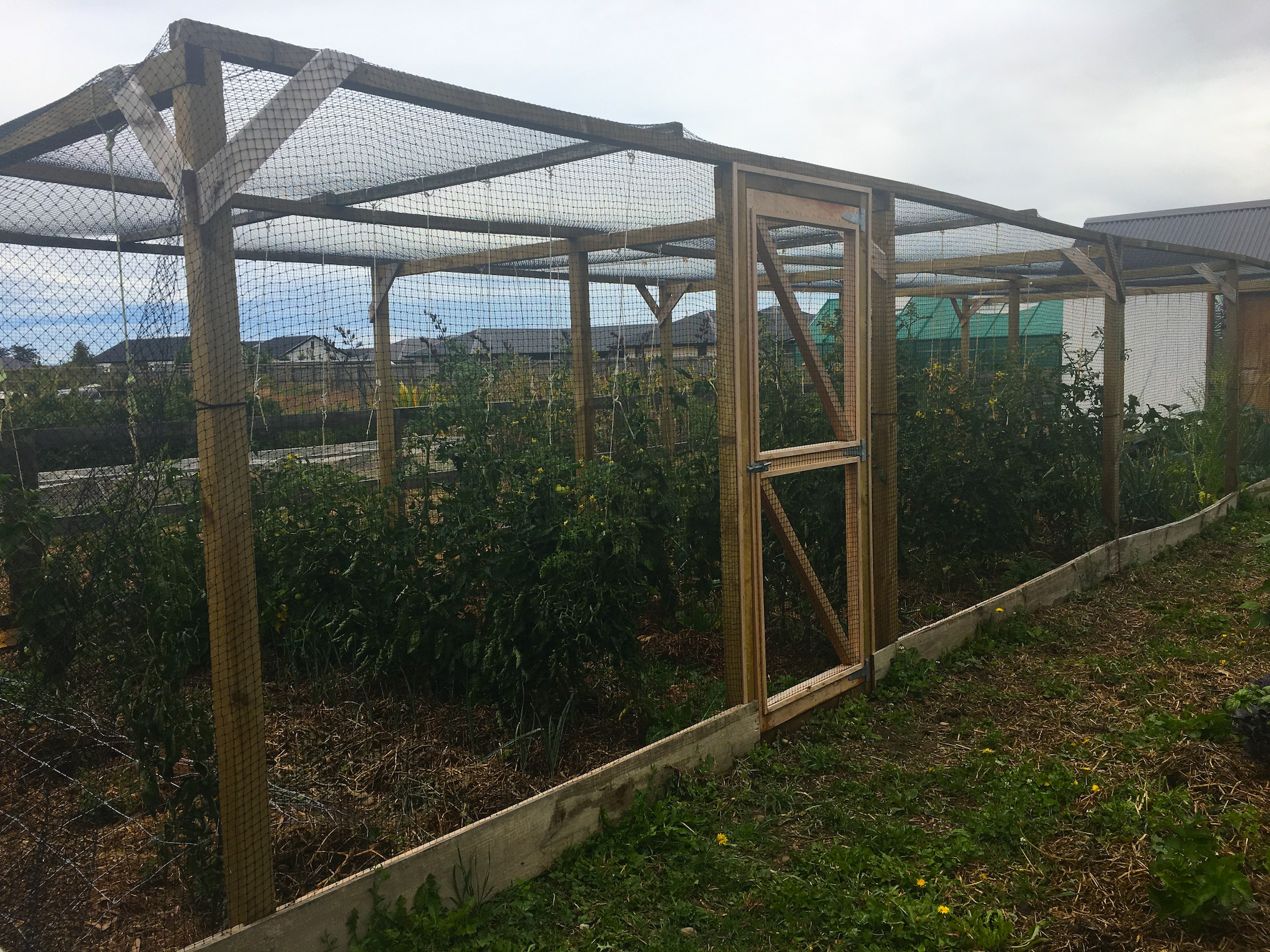
The netted ‘room’ is excellent at keeping birds out, but does nothing to thwart rats.
With a third of my garden protected with permanent bird netting this year, I was pretty smug about pests this spring. Silly me …
2023 may have been the year of the rabbit in the Chinese Zodiac, but in my garden it was year of the rat, and it seems to be continuing in 2024.
In the spring, rats ate all my pea seedlings … twice … On one of those occasions, they plundered the seedlings in the three hours the tray sat in the garden before I planted them out. I was working (planting other things) just metres away while the rat collected all the seedlings and tucked them away in its nest (I found them later when I uncovered the nest).
The rats also did good work on my first planting of corn, melons, cucumbers, and pumpkins, eating the seeds and uprooting the seedlings.
I went through three cheap rat traps (none of which actually caught a rat, and all of which quickly broke), before spending an excessive amount of money on a DOC 200 trap. This terrifying stainless-steel beauty caught its first rat within 24 hours. It has nabbed 3 rats, a hedgehog, and an English sparrow in the three months I’ve had it, which I’m quite pleased about.
Unfortunately, it has not solved my rat problem. Last week I discovered a rat (or rats) had tunnelled straight down my potato bed, eating nearly every potato in the entire bed, and damaging some plants so badly they were dying. Yesterday, I went to pick a gorgeous Black Brandywine tomato that was ripening on my now bird-protected tomato plants. I found the tomato on the ground, half eaten by little rat teeth.
I’m beginning to wonder if I will get anything off the garden this year. So far, the rats don’t seem to like courgettes or cucumbers, but my beans are planted right next to the compost pile where the rats seem to nest. Once they start plumping out, they’ll be primo rat food. And the corn? You know those rats will be scampering right up the plants to gnaw at the ears. Makes it hard to lure them to a trap when the garden is a smorgasbord of delicious food.
Makes me wish I still had a cat—the rats didn’t start to become a real problem until he was gone.
I’ve also got my first ever infestation of whitefly this year. Pretty embarrassing for someone whose Master’s degree was on greenhouse pest management. Whitefly wasn’t even on my radar, so I missed early signs of the infestation. They’re not only in the greenhouse, but outdoors as well. The key to effective integrated pest management is paying attention and catching infestations before they’re a problem, and I failed spectacularly at it. Now I’m playing catch up. My only consolation is that it looks like lots of other people are, too, because both suppliers of whitefly biocontrol agents in New Zealand are sold out. Serves me right, I guess.
So as we enter 2024, officially year of the Dragon, I’m wondering if there’s a dragon that eats rats …
Yesterday I wrote about strategies for preventing pest problems. If you’ve taken all the measures you can to prevent pests, but the pests arrive anyway, there are different questions to ask:
Centipedes are predators of many garden pests.
Do I need to worry? Low levels of pests aren’t a big deal. A few aphids, a caterpillar here or there, the odd bite out of a leaf—these things aren’t going to have a big impact on the quality or quantity of your harvest. Just keep an eye on them to be sure the problem doesn’t get worse.
Can I physically remove them? I’m a huge fan of squishing and hosing pests off plants. For example, I have problems every spring with aphids on my roses. If I do nothing, the plants become completely covered, and the blooms are destroyed. So in spring, I keep an eye on the plants, and once the aphids start reproducing, I hose the plants down once a week, knocking off most of the aphids. Usually I only have to do this about three times before the aphids’ natural enemies build up enough to keep them under control without my help.
Can you disrupt a critical part of your pest’s life cycle? Is there a life stage that can be easily killed, or has specific requirements you can disrupt? For example, I keep a close eye on my brassica seedlings, looking out for cabbage white butterfly eggs on the undersides of the leaves. All it takes is a quick swipe of the thumb across the bottom of each leaf to squash the eggs and eliminate future problems with caterpillars. Another example is my recent problems with slaters in my greenhouses. Discovering that the slaters are congregating between cement blocks stacked beside the greenhouse, I’ve started regularly checking and squashing all the slaters in those blocks. (I could also have moved the blocks, to eliminate the slaters’ shelter, but since the population was quite high, I thought squishing a whole lot of them would be more effective for now. Later I will probably move the blocks to make the area around the greenhouse less attractive to slaters).
Can I make use of them? Pest-covered plants, grass grubs and slugs all get thrown over the fence to my chickens, who turn them into beautiful eggs for me and save me from the disgusting task of squishing the bugs.
Can I pull out badly infested plants? If there’s a couple of plants badly infested, but the pests haven’t spread much, rip out those infested plants and destroy the pests on them. You’ll lose a few plants, but you’ll protect the rest of your crop.
Pest-gobbling chickens.
In an IPM system, you don’t consider any sort of chemical control until you’d exhausted all the possibilities above. In practice in my garden, I almost never need anything else. Occasionally, if I’ve missed an aphid infestation on a crop that can’t handle a strong spray of water, I’ll use a soap solution to kill aphids. That’s the extent of my chemical control. But if you do need to resort to chemicals, it’s important to choose the right one. The more specific it is to your pest, the better. Many modern pesticides are narrowly focused, and target specific pests, and that’s great. With a narrow target, the pesticide is less likely to kill beneficial insects or harm people and pets. Stay away from broad spectrum pesticides. Also, if you do use pesticides, be sure to follow the label directions carefully, wear protective gear, and dispose of leftover product and empty containers properly.
It’s nearly spring, so naturally my thoughts turn to the subject of pests. Our big pest-related project in the garden this year is bird netting a third of the vegetable garden, so we don’t lose most of our tomatoes and peas to the feathered rats.
Aphids–the one on the right is healthy, the one on the left has been parasitised by a wasp, one of the many natural enemies that keep aphids under control in the garden.
As an entomologist whose research focused on Integrated Pest Management, I always have a lot to say about pests. And it’s an important topic—globally, 30-40% of crop yield is lost to pests (interestingly, this figure didn’t change with the advent of chemical pesticides—insect pests are incredibly quick to evolve pesticide resistance). That’s a lot of wasted food!
For home gardeners, fighting pests is a daily task. Every place I’ve gardened has its own unique pest problems. Growing up in Lancaster Country, Pennsylvania, I remember the rabbits munching through the garden. In State College, Pennsylvania it was flea beetles that shot so many holes through my eggplants’ leaves they never had a chance to grow, and the squash bugs that clustered in masses under the leaves of my zucchinis. In Panama, leaf cutter ants could strip a plant bare in no time.
In my first garden in New Zealand, aphids and rabbits were my main problems. When we first arrived on the property, there were so many rabbits I wondered if I’d be able to grow anything. A rabbit-proof fence was the first garden project there.
In my current garden, birds are my worst enemy—mostly English sparrows and European blackbirds. They strip seedlings bare, eat tomatoes, pull out onions, and scratch away mulch and soil, leaving plant roots to dry out (never mind the amount of chicken feed they snarf down every day!).
Fortunately for me (and unfortunately for the pests), my masters degree focused on Integrated Pest Management (IPM), so I’m well-armed when it comes to tackling pest problems.
IPM is often called common sense pest control. In IPM, the goal isn’t to eliminate pests, but to minimise the damage pests cause, while choosing the most environmentally-friendly control methods that do the job.
To successfully use IPM, you must first know your enemy. What conditions does it like? What’s its life cycle? What are its natural enemies? How does it find your plants, and how does it travel? Books and the internet can tell you a lot, but careful observation of the pests in your garden is key. The particular conditions in your garden will affect how pests behave, and where their weaknesses are. If you know exactly where pests are and what they’re doing in your garden, you can begin to tackle them more effectively. For example, I know that in my current garden, there are particular varieties of squash the aphids like. By keeping an eye on those particular plants, I can catch aphid infestations early and deal with them before they spread to more plants.
Bird netting protecting pea seedlings
Once you know your pest’s habits, you can begin to consider control methods. Questions to ask:
Can you time your plantings to avoid the damaging stage of the pest’s life cycle? For example, I don’t grow brassicas during the summer here—I have an early spring crop and a winter crop. By avoiding brassicas in summer, I eliminate bad problems with cabbage white butterflies, which tend to reach damaging levels around Christmas. I still have to be on the lookout for butterfly eggs on my seedlings, but once the plants are growing, they easily stay ahead of the caterpillars.
Can you exclude the pests from your crops during critical time periods? For example, psyllids can transmit disease to potatoes and tomatoes, leading to poor growth and damaged tubers. By covering the plants with a fine mesh cloth, I can keep the psyllids out for most of the summer (until the plants are too big for the covers, by which point the psyllids don’t seem to be much of a problem). I do the same for my peas and lettuces—netting out birds until the plants are large enough to handle losing a few leaves. I also net my berry crops and olives before the fruits start ripening, so the birds don’t pick them before I do.
Can you plant varieties the pests don’t like as much? For example, I plant mostly red varieties of lettuce, because the aphids take longer to discover them than they do the green ones. Usually, by the time the aphids find my red lettuces, they’re bolting and ready to pull out anyway.
Can you plant a ‘trap’ crop that the pests like more than your favourite vegetables? I haven’t done this explicitly, but as I mentioned earlier, there are certain varieties of plants I know are particularly tasty to pests, and I closely monitor them and kill the pests on them before they can spread to other crops. A true trap crop is something you’re willing to pull out entirely when it is infested by your pest, in order to destroy the pest.
Can you prevent pests from finding your crop? Interplanting different crops can help disrupt the spread of pests, because they struggle to find new plants to feed on. It can also help you make the most of the space in your garden. For example, I sometimes plant summer lettuces in the shade of my sweetcorn—not only does the shade help prevent the lettuce from bolting, it also seems to hide the lettuce from aphids.
Can I encourage the pests’ natural enemies? Many pest insects are preyed upon or parasitised by the larvae of beetles , flies and wasps. The adults often eat pollen and nectar, so planting herbs and flowers is a great way to encourage many pests’ natural enemies.
All six of the questions above will help you avoid a pest problem in the first place. They are changes in the way you plant or grow your crops that make it less likely you’ll have pest problems. Tomorrow, I’ll look at what you can do once you’ve discovered pests in your garden.


 Robinne Weiss