Am I Weird?

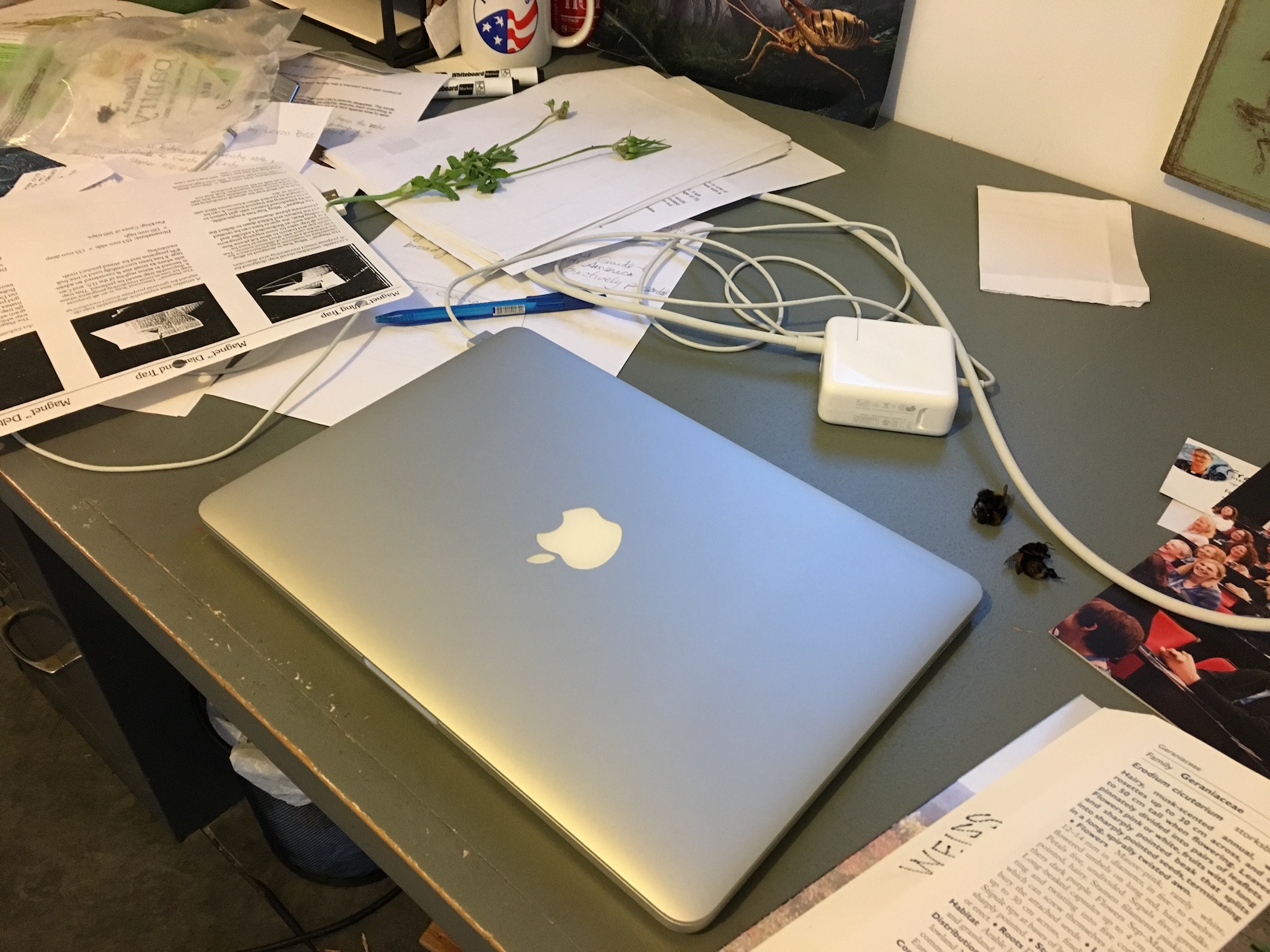
Stepping into my office the other morning, I had a moment of clarity, in which I saw my desk as a stranger might.

It was pretty scary.

The most obvious thing was the computer. Okay, that’s normal. But that’s where normality ended.

Strewn around the computer there were papers. There were notes for a non-fiction book proposal that included calculations for the intrinsic rate of increase of pea aphids, notes about parthenogenic reproduction, and a list of potential titles, many of which included the word ‘alien’. There were also a smattering of papers and notes from the workshop I attended last weekend, a note about my son’s shoe size, and the beginning of a short story set in New Zealand’s not so distant future.

That’s not too weird, though the story is a little bizarre…

Making a lump under the papers were three D&D dice. I use them for my students–they can roll the dice to choose a random writing prompt from the list of 500 prompts I’ve made for them. Honestly, I don’t roll the dice to see if a character lives or dies in a story (though that could be fun). The dice sit on my desk between classes because they’re fun to roll around in my hands while I’m thinking.

Well, that’s not too strange…

Also on the desk was a stem of the storksbill I’d blogged about the day before. It was still there, though I should have thrown it on the compost when I was done with it. It was interesting to look at…

And nearby was the Weeds of New Zealand book that I’d used for reference when blogging about the storksbill. I’d gotten sidetracked after the blog post was written, and spend a good half an hour perusing information about weeds. I left it sitting out because, you know, everyone needs a weed book on their desk.

And here’s where the tableau on the desk got…um…interesting…

Two dead bumblebees nestled together near one corner of the computer. They’d been there for days–ever since I found them on the floor and noticed that one of them had a drop of venom on her stinger. I put it under the microscope at the time for a photo shoot, but then kept the bees on my desk as…as…well, for no good reason really, other than that I enjoyed looking at them, especially as their parasites (mites) started to abandon their dead hosts and crawl all over my desk, questing for a new bee.

That’s not weird, right?

Over on the other side of the computer was a dead German wasp in a plastic bag. She was in the bag because I’d just taken her out of the freezer. Um…yeah. She was clearly a queen looking for a good nesting site (and she was a non-native pest that I’m deathly allergic to), so when I found her in the house, the only sensible thing to do was to kill her. But there was no point in wasting her. I popped her into the bag and into the freezer to kill her without damaging her, thinking I’d pin her later and keep her for teaching.

That’s definitely not weird. Everyone stores bugs in the freezer, right?

And thankfully out of sight inside a folded piece of paper was the dead mosquito I’d brought back from Auckland because it was a species I don’t see much of here, and when I saw it land on my ankle to bite me, I thought it would be a good specimen to keep.

Weird?

*Sigh*

It was definitely time to clean the desk before someone came to visit.
Beech Forest Hiking

I’m particularly fond of hiking in early spring. It’s not for the spring weather, which is often raw and windy, or for spring flowers, which aren’t particularly abundant in the bush. No, it’s for the lack of German wasps.

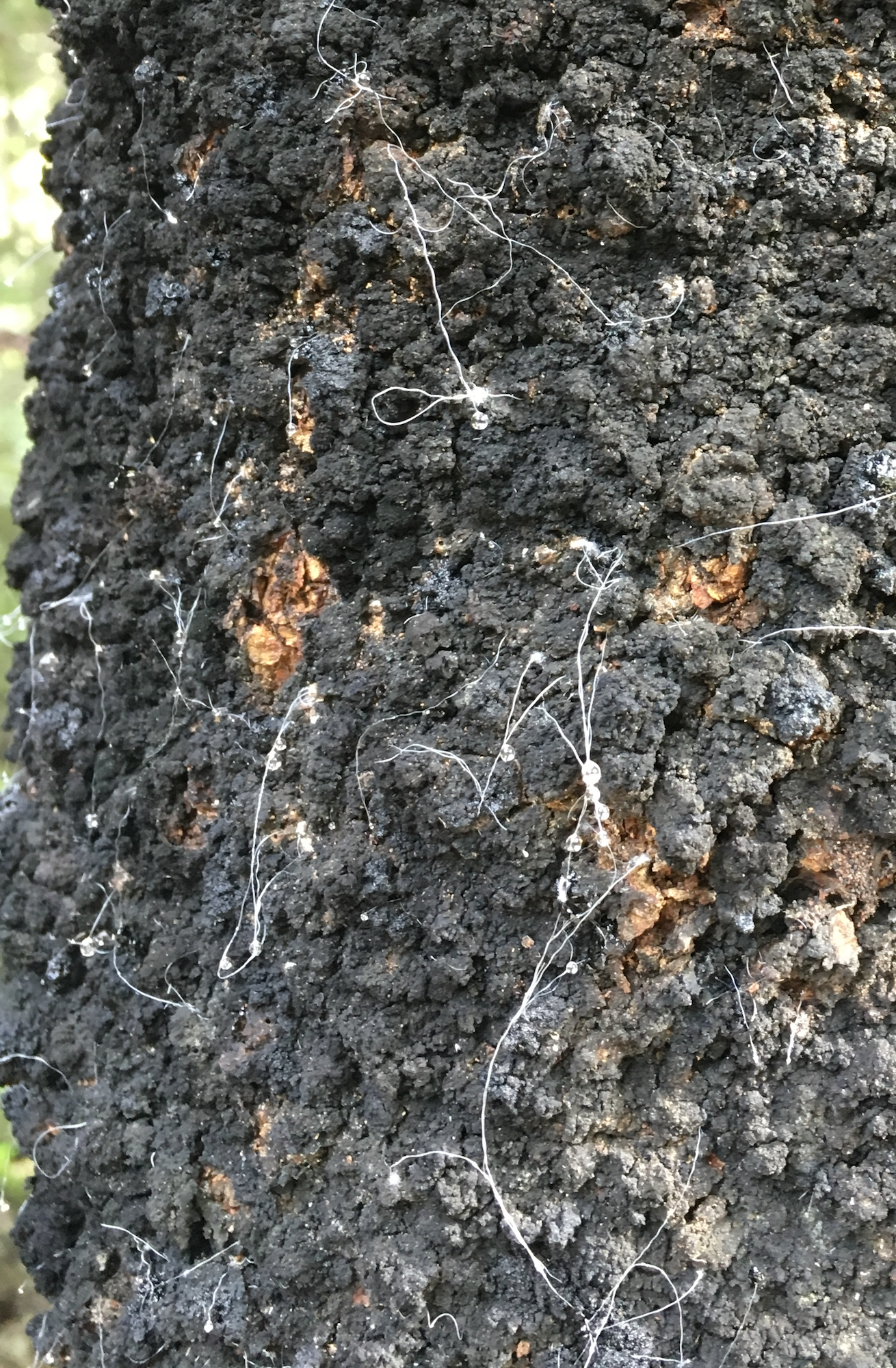
Much of the forest we hike through is dominated by beech (not the northern beech, but several species of Nothofagus). Beech is host to a fascinating ecosystem which has been invaded by non-native wasps.

Throughout much of its range, beech is infested by scale insects. The scales live in the bark of the trees, feeding on sap. Because sap is low in nutrients and high in sugar, the insects need to excrete the extra sugar. Each insect has a long anal tube through which it ‘pees’ concentrated sugar water called honeydew.

Drops of honeydew form on the tips of the anal tubes and fall to the ground, tree, trunk, and branches around the insects. The entire area ends up coated in sticky sugar.

Sooty mould grows on the sugar coated surfaces, turning trees and forest floor black, and giving the beech forest a distinctive smell. The sooty mould is eaten by a variety of insects, including moths and beetles.

But not all of the honeydew simply drops to the ground. Native birds and insects (and hikers) drink the drops of water on the tips of the scales’ anal tubes. For wildlife, honeydew is an important winter food, when flower nectar is scarce.

German wasps enjoy honeydew, too, but only in the summer.

By mid-summer, the beech forest hums with the sound of millions of wasps collecting honeydew. For me—allergic to wasp stings—it means a hike requires constant vigilance lest I grab a tree trunk for balance and end up in anaphylactic shock. But in springtime, the wasps aren’t yet out and about, and I can enjoy the sticky smell of the beech ecosystem without worry.

A Look at Larvae

They’re just midges. If anyone pays attention to them at all, it’s to note how irritating they are when they swarm by the millions, here near Te Waihora/Lake Ellesmere. They are annoying at times, swarms so thick you can’t breathe without sucking in a few.

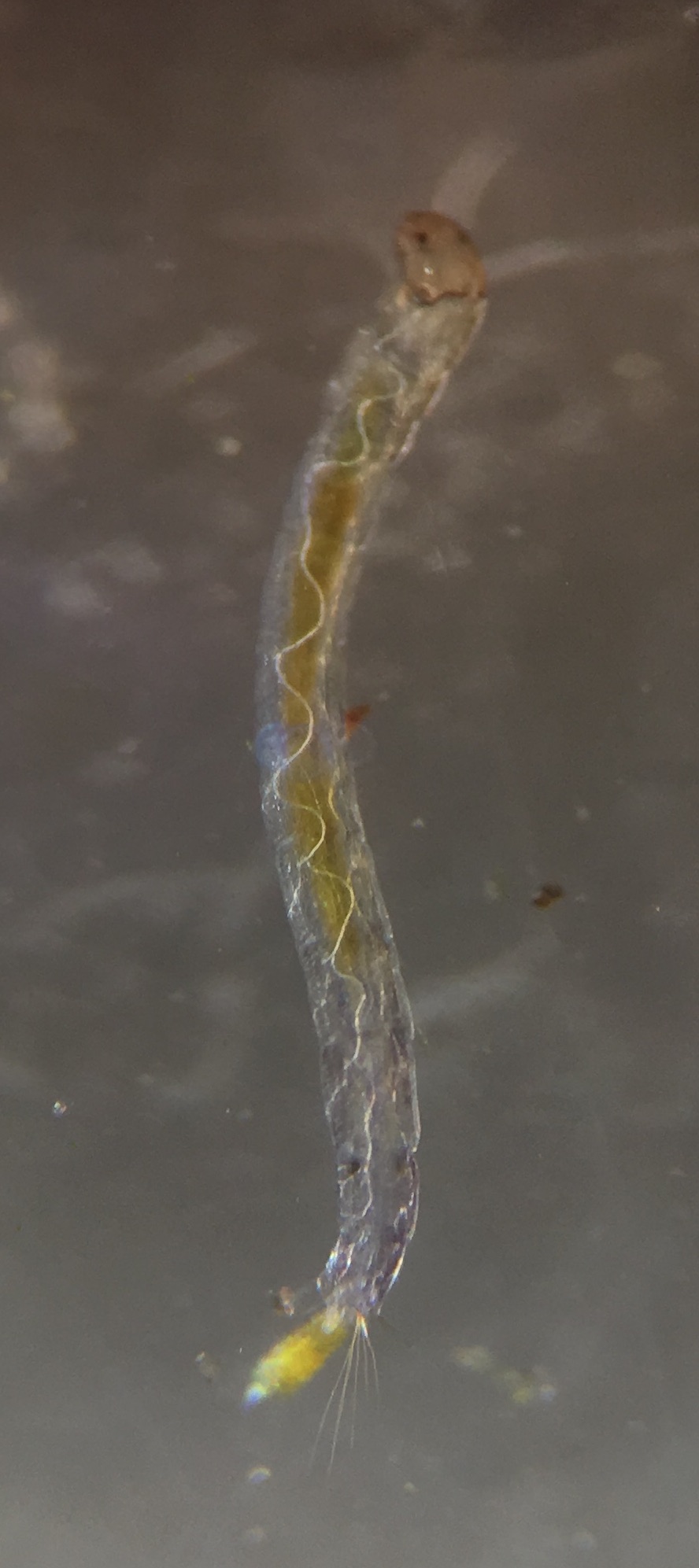
But there are few adults flying at this time of year. Most are still waiting out the winter as larvae underwater. Midge larvae are fun to look at under the microscope, as their exoskeletons are clear, allowing a great view of the inner workings of their bodies.

Seeing the inside of an insect larva helps one appreciate the job a young larva is tasked with—eat. Eat as much as you can and grow as fast as you can. A larva is little more than a mobile digestive system. The brownish streak you can see running the length of this midge larva is the animal’s gut, filled with the algae and other debris it has eaten. At the tail end, you can see, this little larva is having a poo.

Also at the tail end is a wee snorkel of sorts. These midge larvae can survive in low-oxygen water by sucking air from the surface using their snorkel. The silver lines meandering the length of the body are trachea that carry oxygen to all the insect’s cells.

This midge larva was tiny—about two millimetres long—it still has a while to grow before it’s ready to become an adult. But there are lots of other larvae out there getting ready to emerge with the upcoming warm days of spring.

Upcoming release: Backyard Bugwatcher

The final proof…

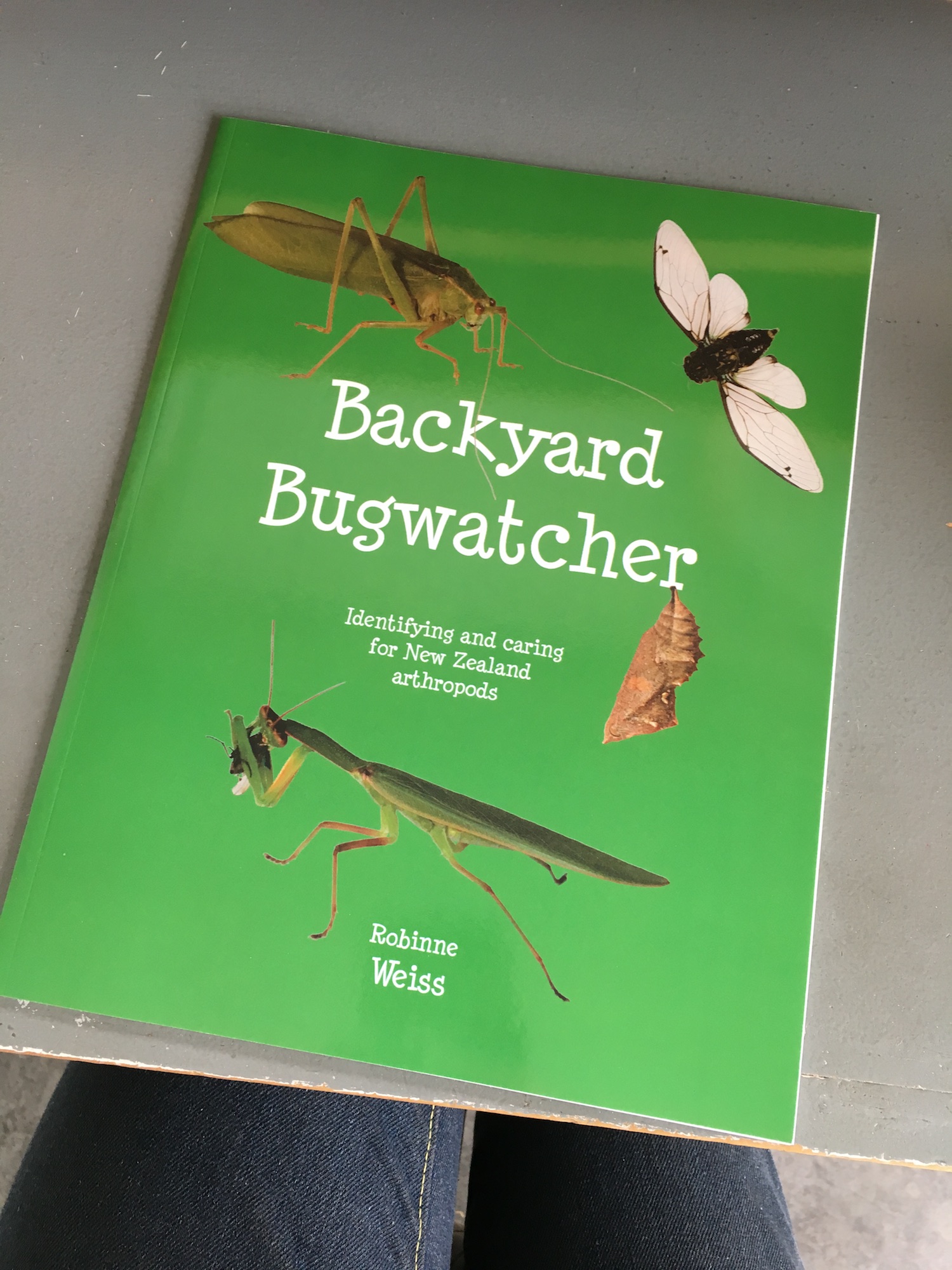
I’m excited to announce the upcoming release of Backyard Bugwatcher. This kid-friendly book includes all the cool information and identification keys from Insects in the Classroom. A great addition to any bug-lover’s library, this guide complements insect guides like Which New Zealand Insect? and Life-Size Guide to New Zealand Insects, giving you additional background information on a broad range of New Zealand arthropods, and providing keys that can help you learn to quickly categorise creepy crawlies for identification.

Contact me to order your copy, or order on Amazon.com 

Geeky Pruning

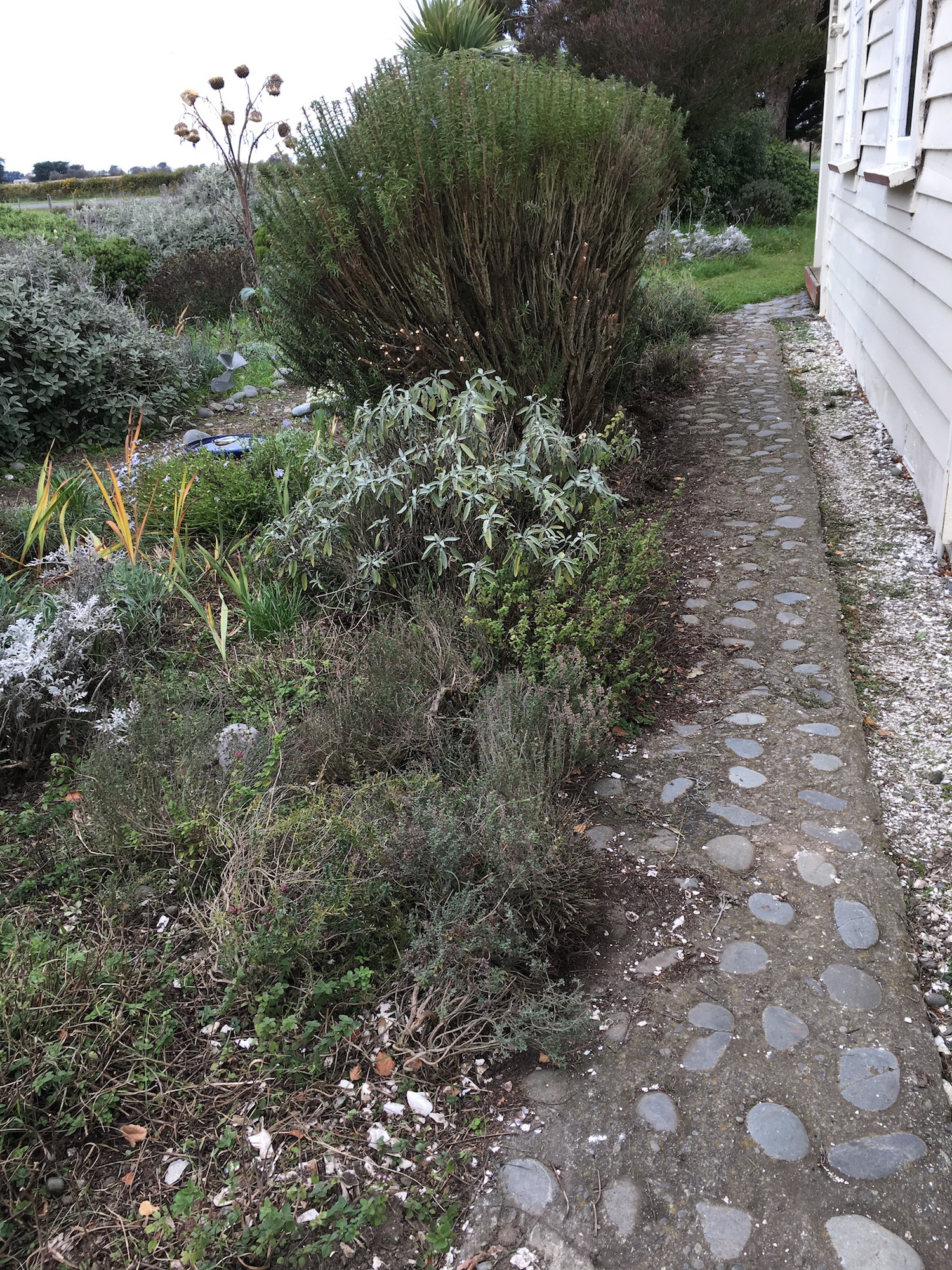
The newly cleared path and scalped rosemary.

The job had been hanging over me for two years. Every time I went to trim the rosemary bushes by the side of the house, I found them being heavily used by insects and couldn’t bring myself to disturb them. I finally had to admit that there was never going to be a good time to prune them.

So this weekend, when I found I could no longer use the path between rosemary bushes and house, and the bushes were nearing two and a half metres tall, I decided it was time to prune.

Pruning the rosemary is never a fun job—the wood is hard as nails, and every branch seems to need a different size pruning tool than the last one. To make it worse, this time the job took twice as long as it might have, because I checked every branch for preying mantids and mantid egg cases.

I shifted six adult mantids to other plants and collected eleven egg cases by the time I was done. I’m sure I missed some, but I’ve tucked the egg cases into a cage to protect them over winter, and when they hatch out in springtime, I’ll release them back to the rosemary.

A bit geeky? Yeah, I suppose it is. But there was never any question about me being an entogeek. This way, I get my path back, and I get to keep my bugs. Everyone’s happy.

Wool Sower Gall

Visiting America is always a rewarding experience from a naturalist’s point of view. Though New Zealand has some spectacular wildlife, it simply doesn’t have the sort of diversity one finds in North America.

This visit’s best find so far has been the wool sower gall.

This spectacular fuzzy ball, found on the twigs of white oak trees, is caused by the tiny wasp, Callirhytis seminator. The structure of the gall is reminiscent of a fluffy seed head of a plant. Small ‘seeds’ inside the fluffy exterior house wasp larvae.

Galls are fascinating structures. They are made by the plant in response to chemicals produced by an insect or mite. Galls are incredibly diverse in structure and location on the plant, but all provide food and protection to the insects or mites as they grow and develop. Essentially, the insect has hijacked the plant’s biology to create a perfect home with a built-in food source.

Gall-making evolved several times in different groups of insects and mites; it’s clearly a successful survival strategy.

But the plants aren’t entirely defenceless. In response to the gall insects, many plants produce chemicals that attract predators to eat the damaging insects.

In turn, some gall-inducing insects can turn off these chemical defences in their host plants. Host and insect are constantly evolving, each trying to get the better of the other. The galls are a spectacular result of their arms race.

Completing the Cycle

Back in early December last year, I posted an update on the preying mantids on my rosemary bushes that I’ve been following since mid-winter, when they were eggs.

Well, I haven’t forgotten them, and I’m pleased to report that they are all grown up now, and laying eggs of their own.

On the one hand, I’m thrilled (as I am every year) to watch the entire life cycle play out in the garden.

On the other hand, I’m getting a little worried.

Last winter, I didn’t prune the rosemary bushes because the bees depend on their flowers in late winter. Then in the spring I couldn’t prune them because the preying mantids hatched out. All summer I waited and watched the mantids grow. The rosemary plants grew, too, engulfing a bench on one side, and the path on the other.

And now the mantids are laying their eggs on the very branches I need to prune off…

We may soon see just how big rosemary can grow here.

Ecological Weeding

A parasitised aphid (the bloated brown one), and an unparasitised one (the green)

A parasitised aphid (the bloated brown one), and an unparasitised one (the green)

As much as I enjoy weeding, I can’t possibly keep up with them all. There are always weeds on the property.

In truth, I don’t try to eliminate all the weeds. I take a ‘live and let live’ approach with many of them. I also recognise the utility of many of the weeds on the property–or at least their utility to other organisms.

Except in the vegetable garden where they are, literally, a pain, I allow nettles to reside in the yard. They provide food for our native yellow admiral butterflies and, in a pinch, can be used to make rennet for cheese making. Even in the vegetable garden, I don’t mind seeing them–they hate dry soil, so they’re a good indicator that I’m watering the garden enough for the vegetables.

Weeds like yarrow, clover, and dandelions are good food sources for beneficial insects, so they, too, are allowed to grow wherever they’re not in direct competition with crops.

Weeds are also sometimes good ‘trap crops’, attracting pests to plants (themselves) I don’t mind pulling out and destroying to get rid of the pest.

Sometimes, though, the ‘trap crop’ idea backfires on me. Today I noticed that a sow thistle I’d allowed to grow was covered in aphids–it was a great opportunity to destroy thousands of pests. Except that as I bent to pull the weed, I noticed that a large number of the aphids were parasitised by wasps. I depend upon these wasps to deal with my springtime aphid problems. Short of painstakingly picking off every parasitised aphid and caring for them until the wasps hatch, killing the aphids on the weed is going to kill the wasps, too. What to do?

So the weed has gotten a temporary stay of execution. I’ll keep an eye on it. When the wasps have emerged from the parasitised aphids, I’ll pull it and kill the remaining aphids.

Thirsty Bees

img_3051When my husband created a pond in the yard, I expected the damselflies, mayflies, midges, diving beetles, and other aquatic insects to show up. I even expected the heron who occasionally drops by to sample the goldfish.

I didn’t necessarily expect the honey bees.

I wasn’t surprised when they showed up, though. What surprised me was the sheer numbers that have shown up this summer. The edge of the pond has been humming for weeks as hundreds of bees jostle for space on the best perches.

Honey bees, like all animals, need water–at least a litre a day per hive. The bees don’t just drink the water; they also use it to dissolve honey that has crystallised, dilute honey for larval food, and to cool the hive on hot days.

When scout bees find a good water source, they mark it with pheromones that tell the other bees it’s a good spot. I reckon by now, the edge of our pond is sticky with pheromones (or at least stinky with them), because there’s always a crowd there.

And after yesterday’s 31°C (88°F) temperatures and 130 kph (81 mph) wind, the pond was extra crowded today.

I’m happy to oblige the bees. I need them to pollinate my vegetables, and they’re not aggressive when they’re foraging away from the hive, in spite of the potentially frightening crowds. The arrangement is a win-win situation for all of us.