Belated Poetry Day

I missed World Poetry Day last week, so here’s a belated poem in honour of the day, inspired by the little spider who has built its web over the kitchen window.

David and Goliath

Honeybee caught
In a spider web
Buzzes murder to
All eight-leggers,
Stinger stabbing at
Offending silk.

Alerted,
Out rushes
The tiny spider,
Dwarfed
By its angry prey.

Dart in,
Avoid the sting,
Dart out.
Throw silk with
Frantic hind legs.
Tangle wings, tangle legs.
Dart in.
Avoid the sting.
Bite.
Dart out.
More silk.
More silk.

Bee’s wings are stilled
Though she still buzzes
A warning,
As though through
Gritted teeth.

More silk.
More silk.
Dart in.
Bite again.
Dart out.

The bee’s movements slow.
Abdomen goes slack.
Legs twitch once.
Twice.

More silk.
More silk.

David slays Goliath.

Green Orb Weaver

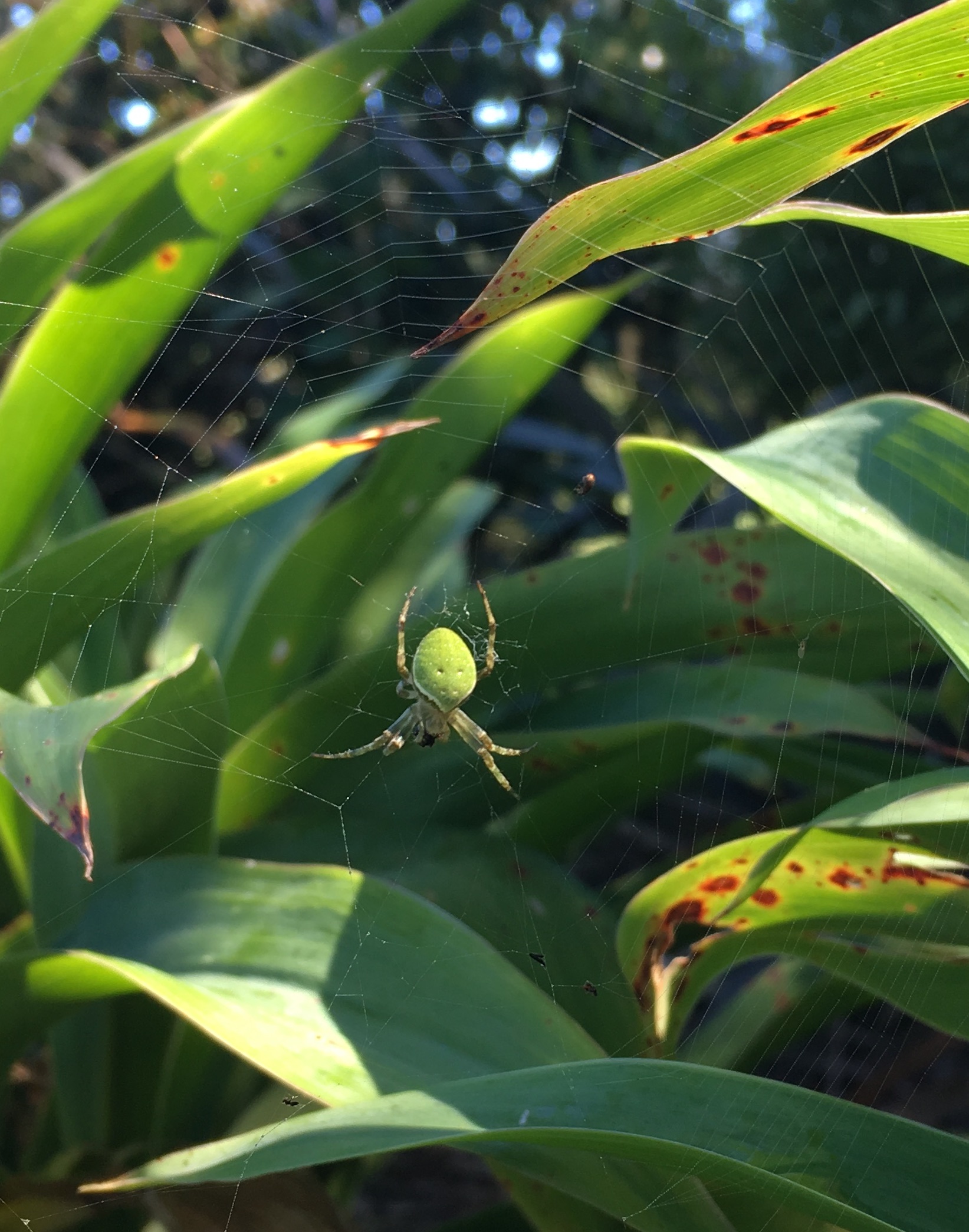
This year has apparently been good for the green orbweb spider (Colaranea viriditas); I usually see them only rarely, but I’ve run across quite a few this summer.

These beauties are pale green with a kelly green leaf-shaped mark covering the abdomen.

As the name implies, these spiders make orb webs—the spiral-shaped webs everyone’s familiar with. Though they’re primarily nocturnal, I’ve regularly seen them hanging out in the middle of their webs during the daytime (often snacking on an insect). These sharp-looking spiders apparently like a tidy web; they rebuild their webs nightly, and the webs are always as attractive as their residents.

The green orb weaver’s main predator is the native potter wasp, which paralyses the spiders with a sting and stuffs them into its nest for its larvae to feed on. However, the green orb weaver appears to be better at hiding from potter wasps than the non-native Australian orb weaver (at least on our property). Earlier this summer, the potter wasps decided that the screw holes in the bottom of the dining room table were perfect nest holes—every one of the dozens of orb weavers they crammed into the table was an Australian orb weaver.

I enjoy finding these little green gems in the garden. They’re as beautiful as they are helpful.

Magpie Moths

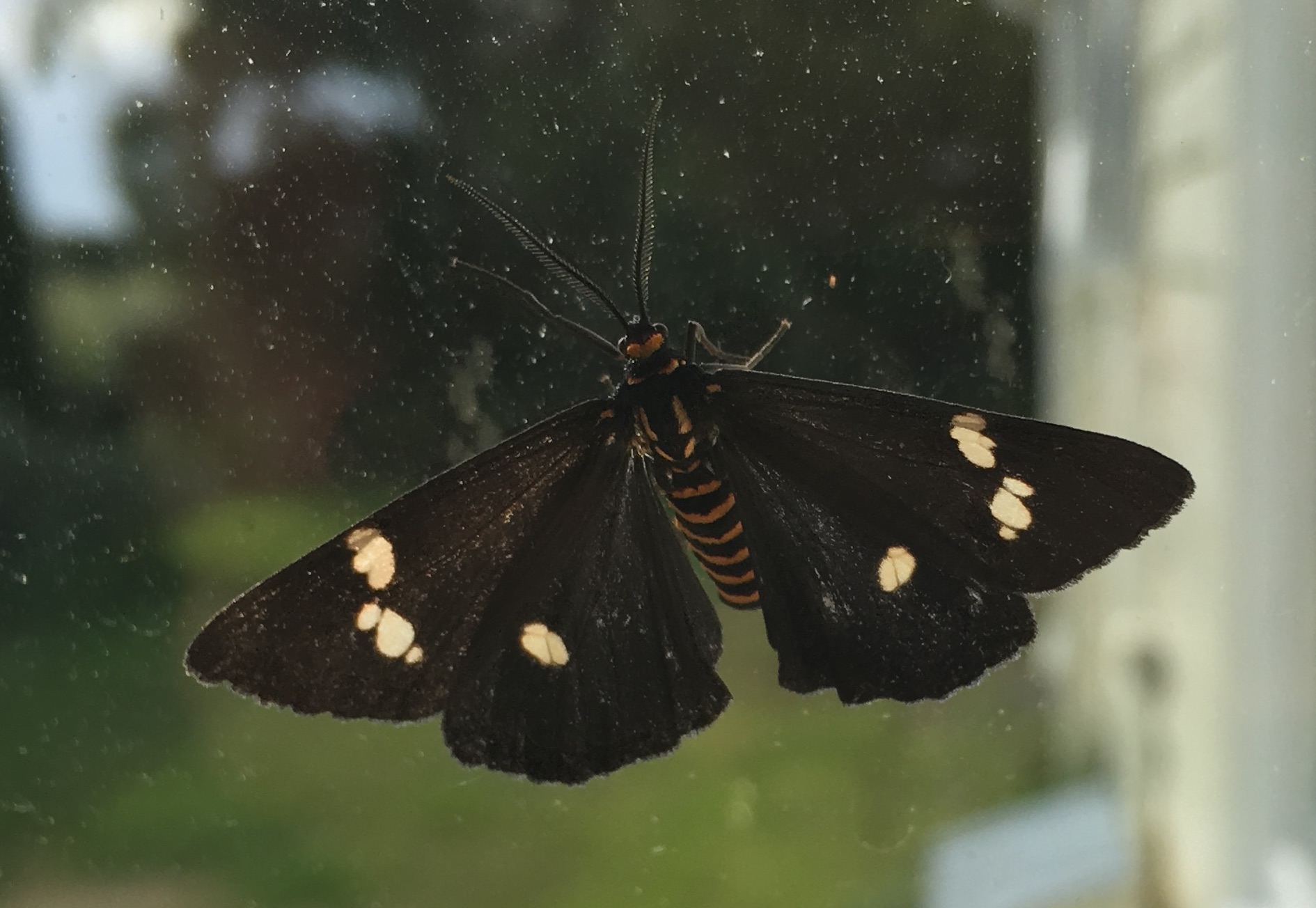
It’s the time of year when one of my favourite moths emerges—the magpie moth (Nyctemera annulata). Magpie moths are in the family Arctiidae—a family including many brightly coloured day-flying moths that threaten to blur the line between moth and butterfly. N. annulata is endemic to New Zealand, though it has a closely related Australian cousin, N. amica, with which it can interbreed.

Magpie moth caterpillars eat plants in the daisy family, especially in the genus Senecio. Common host plants include groundsel (Senecio vulgaris), ragwort (Senecio jacobaea), and cineraria (Jacobaea maritima, formerly Senecio cineraria).

We have large quantities of groundsel, and a few sizeable cineraria on the property, so we always have a healthy population of magpie moths. The caterpillars are black with orange ‘racing’ stripes, and somewhat hairy.

As you can guess from their colouration, magpie moths are poisonous. As caterpillars, they sequester toxins from the plants they eat. These toxins deter most predators. The shining cuckoo, however, is apparently quite fond of magpie moth caterpillars. It avoids the poison by eating only the insides of the caterpillar, leaving the bitter-tasting exoskeleton behind.

In addition to eating weeds like groundsel and ragwort, the magpie moth is a beautiful, colourful addition to the garden. It always makes me smile.

Ushering in Autumn


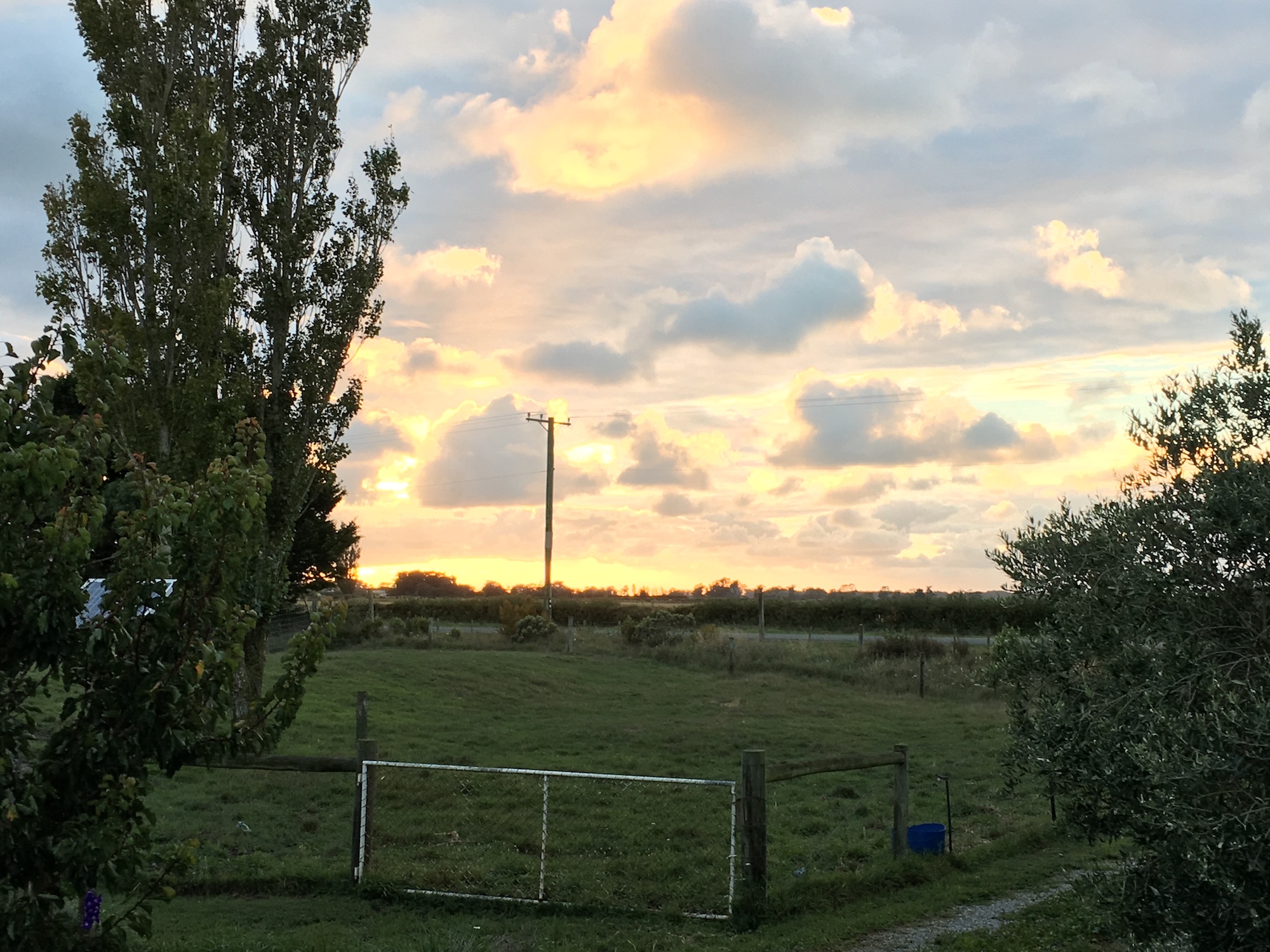
Thursday’s dawn farewell of Gita.

Gita blew through earlier this week, dumping 96 mm (nearly 4 inches) of rain on us. She also seems to have ushered in autumn. Sultry summer heat has given way to crisp air in Gita’s wake. The sun is still hot, but the nights have been chilly. The crickets sing their welcome to a new season. Even the garden has taken on an early autumn look, tired plants beginning to look tattered and yellow. Before Gita, I had ordered my firewood for the winter. It seemed too early at the time, but now, I’ll be happy to see it arrive.

Summer fruits and vegetables should still roll out of the garden for the next six to eight weeks, but the end is in sight. We’ll enjoy it while it lasts.


How To Eat a Whale

Melinda Mae took eighty-nine years to eat a whale, according to Shel Silverstein. How’d she do it? “…she started in right at the tail.” and “She took little bites and she chewed very slow, / Just like a good girl should…”

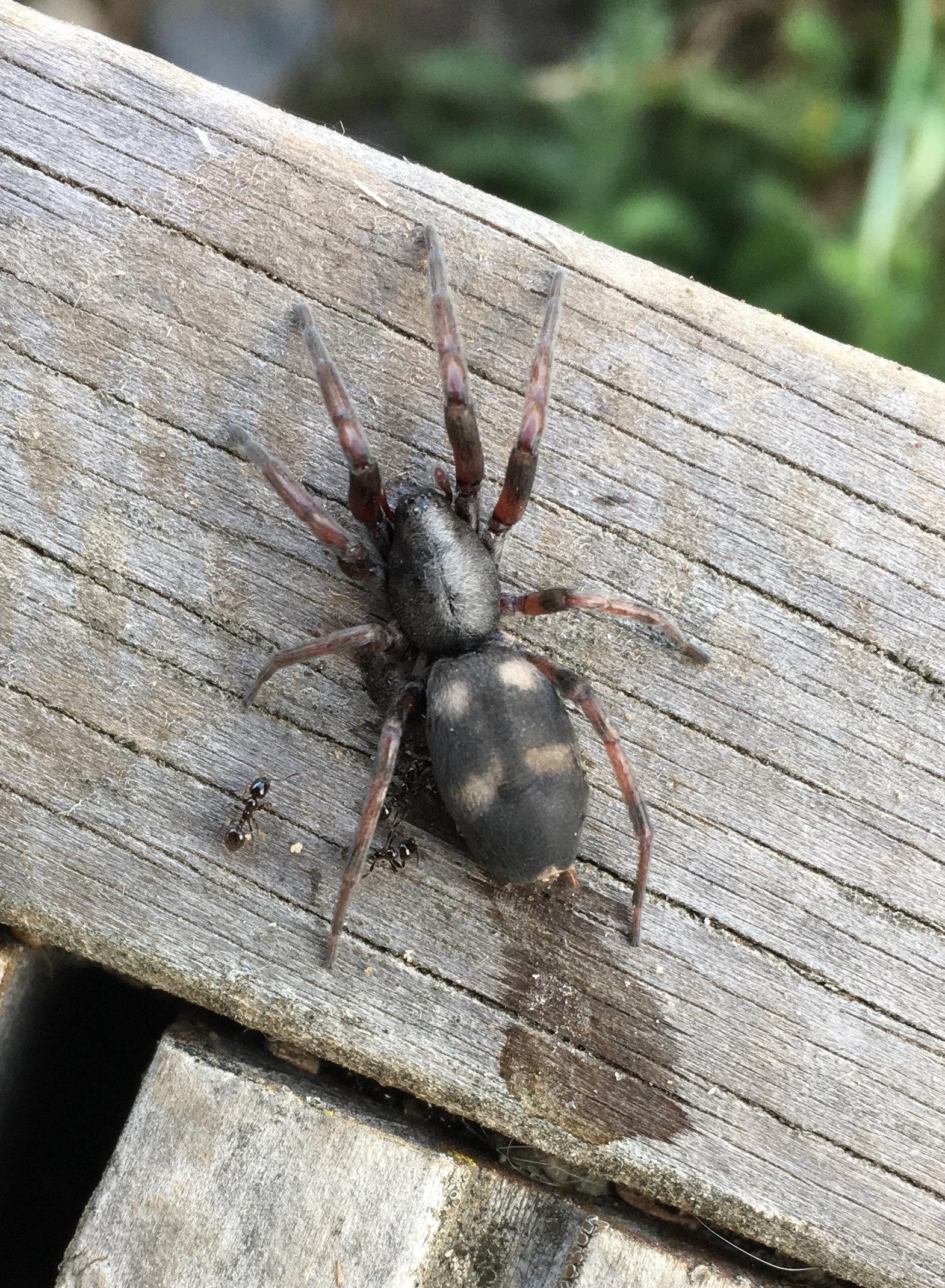
This morning I found this adult female white-tailed spider on my office deck. I don’t know what killed her—she’d dragged herself about 20 cm across the deck oozing hemolymph before succumbing to whatever it was—but by the time I saw her, the ants had found her.

At first, they swarmed over her body, biting at her legs, tugging at hairs. I looked closely with a hand lens—they’d made not a mark on her exoskeleton. Melinda Mae was lucky whales’ skeletons are on the inside.

Eventually, the ants stopped swarming, and I assumed they’d given up eating their ‘whale’.

But a few hours later, I checked again and noticed an ant slip underneath the spider’s body. Another photograph revealed the spider was shrivelling.

Some of the shrivelling would be from dehydration, for sure. But as I watched, I saw a steady stream of ants slipping in under the spider, then slipping out again. Something had punctured her, killing her. The ants had found the hole and were using it to access the soft bits inside.

I expect these ants will accomplish their task much more quickly than Melinda Mae did, but then, they’re working as a team.

So how do you eat a whale?

Well, if it’s got an exoskeleton, the answer is, from the inside out. And if you want to finish before you grow old, get some friends to help.

Currant Clearwing

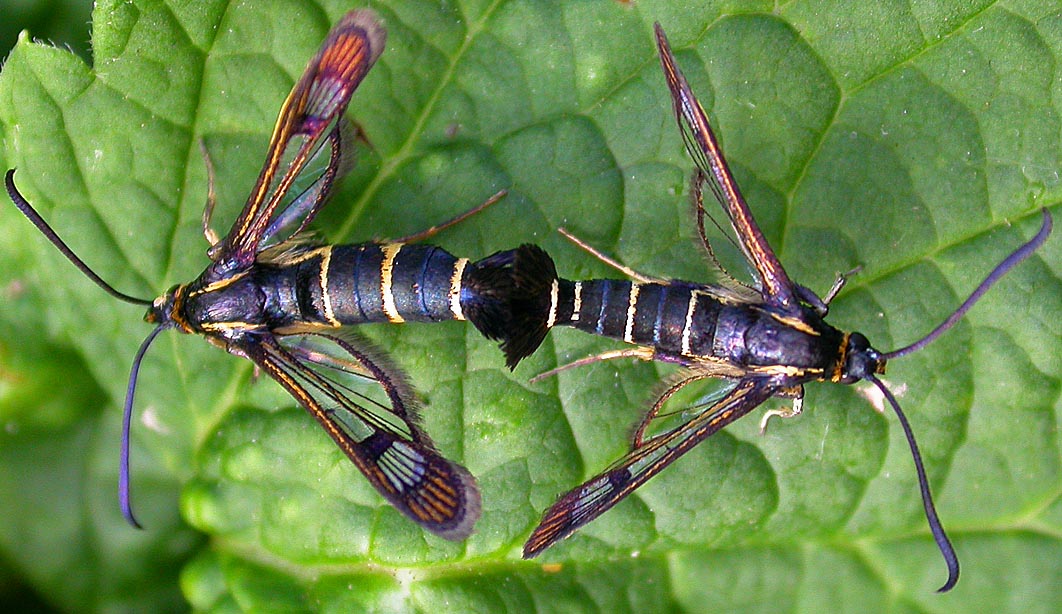
Mating currant clearwings. Photo: Plantsurfer, public domain

They’re the most beautiful pests in the garden. Currant clearwings are moths, but they would like you to think they’re wasps, with their clear, narrow wings and yellow stripes. The deception deters predators who don’t want to tangle with a dinner that stings.

Adults emerge in early summer. They lay their eggs on the growing tips of currants and gooseberries. The caterpillars hatch out and burrow into the stems, killing them.

We’ve had the occasional currant clearwing in the past. Mostly, I let them go, because there were few of them, and I do like the way they look.

But this year there are many, many more than usual. I’m squishing all that I see. They leave gold dust on my hands when I do.

Hopefully, my efforts will be effective, and we’ll go back to just a few currant clearwings next year, so I don’t have to kill so many of these beauties.

Summer Rock Concert

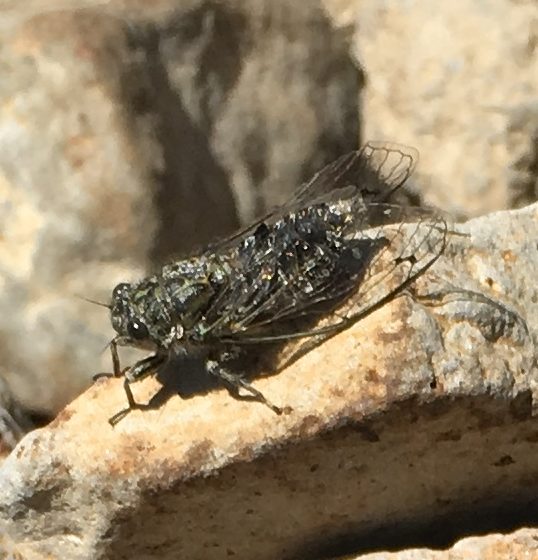
It’s a cicada; it must be summer.

The main cicada season doesn’t really start until the chorus cicadas (Amphisalta zealandica) come out after Christmas, but two weeks ago, we found a few chirping cicadas (Amphisalta strepitans) on the rocks around Okains Bay.

Cicadas are largish, as insects go, but they’re well camouflaged. Usually, you find them by sound. As with most insects, it’s the males that do the singing. The main part of a cicada’s song is made by flexing plates (tymbals) on top of the body. Built-in amplifiers (opercula) pump up the volume to an astonishing level. Cicadas are noisy. I don’t know if any of the New Zealand species have been tested, but the calls of some North American cicadas are over 105 decibels at a distance of 50 cm. That’s nearly as loud as a rock concert (115 decibels). When the chorus cicadas here in New Zealand come out in large numbers, they can be so loud in some places that it’s impossible to carry on a conversation.

Some New Zealand cicadas add an extra feature to their song—a bit of drumming called clapping. The cicada snaps the leading edge of its wings against a branch to make a sharp click. Females also clap, and I’ve read (though I’ve never tried it) that you can call the males to you by snapping your fingers.

There are about 2500 species of cicada worldwide. Because of their size and volume, they seem to be culturally important wherever they live. They are eaten as food in many areas, and sometimes used as fish bait. Growing up, my siblings and I used to collect the shed exoskeletons of cicadas and attach them to our clothing like jewellery. When I lived in Panama, the children would catch cicadas and tie strings to their feet, then carry them like helium balloons, flying on the end of the string.

Wherever they live, they mark the seasons. Here in New Zealand, and in America where I grew up, summer hasn’t really started until the cicadas sing.

Loud singing? Drumming? Must be a summer rock concert!

Wasp 1: Cleaning 0

I try to keep a clean and tidy house, but sometimes it’s just not possible.

I was going to dust this weekend, but the first spot I ‘dusted’ was the dining room windowsill. It’s a big window and, for some reason, most of the insects that get into the house seem to end up there when they die.

Next thing I knew, I had a handful of dead insects in a petri dish and was looking at them through the microscope. Most were insects I was familiar with—old friends I was catching up with—but this lovely lady was new. A tiny parasitic wasp, but I couldn’t quite place her family. Several hours, a couple of taxonomic keys, and a stack of entomology books later, I still wasn’t certain, but I tentatively put her in the family Pteromalidae.

Oh, and the cleaning was entirely forgotten.

Spittlebugs

Spring is spittlebug season. Just about the time I want to start picking and dehydrating the perennial herbs, the spittlebugs descend upon them. In bad years, it makes harvesting herbs a slimy task.

Spittlebugs are also known as frog hoppers. As adults, they are cute, squat, dun coloured insects with spectacular leaping abilities. They really do resemble frogs (with a little imagination).

It’s the nymphs that have the disgusting habit of spitting. Well, it’s actually not spit at all. The foamy slimy ‘spittle’ is a combination of fluid from the insect’s anus, and slimy gunk from glands on the insect’s abdomen. The insect sits head downward on the stem of a plant and exudes the ‘spittle’, letting it pour over its body and cover it completely. The resulting mass keeps the young insect protected from enemies and from drying wind and sun. Gross, but effective.

Like humans, who usually stop blowing bubbles in their milk as adults, spittlebugs leave off spittle production when they grow up. As adults, they use their hopping ability to avoid predators.

Some species of spittlebug can become significant agricultural pests, stunting the growth of herbaceous plants and some forestry trees, but in the home garden, they’re usually not much more than a minor nuisance.

A New Weed!

I found a new weed in the garden the other day. I don’t know whether to be excited or dismayed.

This one is beaked parsley, also known as bur chervil (Anthriscus caucalis). This weed is native to Eurasia, where it appears it is pretty much ignored. It’s listed by the UK Department for Environment, Food, and Rural Affairs as an indicator species for high value arable margins, but beyond that, it rates little mention in its homeland. It is apparently neither particularly tasty, nor poisonous. It is apparently not used for any medicinal purposes. It’s just a plant that’s neither particularly common, nor particularly rare.

Nor is it mentioned often in the many countries where it is a weed. If it is mentioned at all, it’s usually lumped with its close relative, wild chervil (Anthriscus sylvestris), which appears to be more of a problem. It apparently prefers riparian zones, but is quite happy to live in drier areas, too.

The seeds are covered in curved spines and hairs that cling to fur. The plant almost certainly arrived in New Zealand on the back of an imported sheep.

With so little information about the plant available, I am naturally intrigued. What secrets is this unassuming plant harbouring? Its family–Apiacea–includes such well-known plants as carrot, poison hemlock, fennel, parsley, coriander, dill, caraway, parsnip, celery, anise, lovage, and many others. Many of these plants produce defensive compounds, some of which are incredibly toxic to humans, and some of which are sequestered by caterpillars in the genus Papilio (swallowtail butterflies) for defence.

So I can’t help thinking that bur chervil might harbour some interesting chemistry and ecological connections, if only someone would have a look.