Happy Mother’s Day

Trig M, where every table has a panoramic view.

Advertising media has been exhorting us to do all sorts of things for our mothers today—buy her flowers, make her breakfast, take her out to a fancy restaurant, buy her diamonds…

We have a rather different take on Mother’s Day at our house.

After the usual Sunday morning routine where I get up before everyone else, light the fire, feed the animals, and bake something lovely for breakfast, we headed to the hills.

It was two hours of uphill slogging to our lunch spot. One of the best restaurants around, Trig M has spectacular views. No need for a reservation, even on Mother’s Day (we were the only ones there). The ambiance was great, if a little chilly today. The thirteen year-old chef made us an excellent lunch of cheese sandwiches and apples, with chocolate bars for dessert.

A lovely Mother’s Day. I hope yours was / is as nice as mine.

Nīkau Palm Gully

img_3044-smWe spent the weekend on the Banks Peninsula. Saturday we kayaked around Akaroa Harbour all day, and today we hiked out to Nīkau Palm Gully.

The track out to Nīkau Palm Gully is easy walking, as it follows a farm track. It’s pleasant, but not exactly wilderness. The views out over Akaroa Harbour, however, are spectacular. And at the end of the track is the steep drop down into Nīkau Palm Gully.

The gully is a tiny V of land, hemmed in by cliffs, and sporting one of the few remaining remnants of original Banks Peninsula forest.

Most notable among the trees are the palms which give the valley its name. The nīkau palm is the southernmost palm in the world, and New Zealand’s only native palm. It is found in coastal lowland areas, and the Banks Peninsula is as far south as it ranges on this coast. There are nīkau scattered around the Peninsula, but the population of them in Nīkau Palm Gully is impressive.

Nīkau palms are slow-growing. They begin as clusters of leaves growing on the forest floor. It may take forty to fifty years before they begin to form a trunk, and up to two hundred years to reach their maximum height of 10-15 metres. There are individuals of all sizes in Nīkau Palm Gully.

People have been visiting the gully for many years. One tree still bears the mark of a visitor who carved the year–1907–onto its trunk. A pair of amusing (to a reader over 100 years later) letters in the Akaroa Mail in 1909 indicate that the gully was, even then, considered a special place. In the first article, a member of the Beautifying Association writes a scathing indictment of the Akaroa Boating Club for having cut down several palms in the gully to use as decoration for an event. In a subsequent issue of the Akaroa Mail, a member of the Boating Club explains that they only removed a few leaves, not whole trees. The letter writer then goes on to accuse the Beautifying Association of removing entire plants (seedlings) from the gully for their gardens.

Thankfully, the landowners whose farm once encompassed the gully understood its significance, and gifted it to the Department of Conservation (in exchange for one 10-cent stamp presented to them on behalf of Her Majesty the Queen). It is now protected as a scenic reserve, and has been linked to other patches of native vegetation through a number of land covenants on adjacent properties.


The Backcountry Hut Experience

Black Hill Hut

Black Hill Hut

The hut nestles amidst scrubby sub-alpine vegetation. As you emerge from the trees onto a rocky hillside, you see it across the valley. Dark beech forest laps at the hut on one side, and cliffs rise on the other. A kea calls. A stream rushes far below. You are not the first at the hut—a thin wisp of smoke rises from the chimney. You smile and look forward to warming your hands and drying your socks by the fire.

As each hiker arrives at the hut, they are greeted by those already resident.

“G’day. Did you come of from Sharplin Falls this morning?”

“Going to Woolshed Hut tomorrow, or all the way out?”

“Where are you from?”

“Oh, you’re from Southbridge. My mother lives there. Do you know her?”

“Is this your first visit to New Zealand?”

“Do you do much tramping?”

As afternoon wears on, the hut fills up. Locals, tourists, couples, solo hikers, and families with kids. A dozen or more strangers bunking together, cooking and eating together. There are no cell phones to divide you. You are all present in this place together. You share matches, hot water, chocolate, and reading material. As the evening wears on, a bottle of scotch might be passed around. You talk about your homes, previous travels, and your current aches and injuries. You tell stories. You laugh. You wish each other good night.

In the morning, some carry on downhill while you toil up Others, you know you will see again at the next hut. You bid them all a cheerful farewell, feeling like old friends.


When I first came to New Zealand, I found the idea of backcountry huts a bit odd. I didn’t have to hike with a tent? I’d just bunk with other hikers in a hut provided at just the right spot? I was used to hiking in the US, and for me backpacking (tramping) meant getting away from other people and setting up my tent in a place of complete solitude. I was dubious.

Twelve years and many backcountry huts later, I’m sold on the hut system. Not only is it lovely to not have to carry a tent, I’ve come to enjoy the social aspect of the hut experience.

That’s not to say I enjoy listening to half a dozen strangers snore next to me all night, or that I don’t sometimes wish my hut mates were less talkative, but on the whole, the people I’ve met and the things I’ve learned—about other places, other cultures, and sometimes even about my own neighbours—far outweigh the negatives.

A Delightful Day Hike in Canterbury

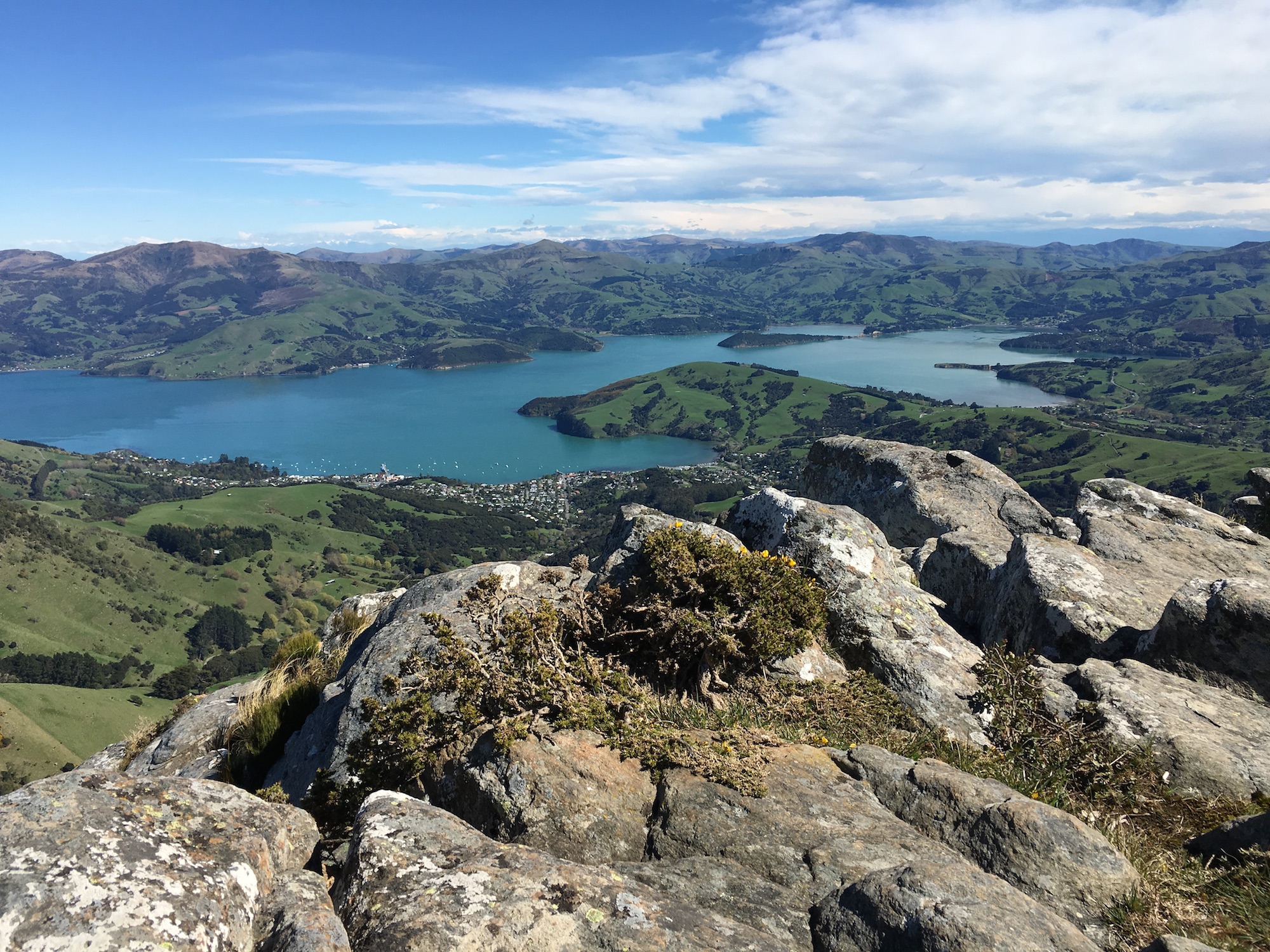
Looking toward Akaroa from Stony Bay Peak.

Looking toward Akaroa from Stony Bay Peak.

With the kids on school holidays, we took the day to go hiking. My daughter chose our destination—the Skyline Circuit, which starts and ends in Akaroa.

It’s an 800m climb to Stony Bay Peak, and down again, and makes a nice day walk.

It’s a typical Banks Peninsula track, climbing mostly through paddocks to a rocky gorse-covered peak. Not exactly a wilderness experience, but varied enough to be interesting, and there are some lovely pockets of native vegetation along the way.

You wouldn’t want to do this walk if the tops were shrouded in cloud—it’s the view from the top that makes the steep climb worthwhile. This morning was clear, and we could see all around the Banks Peninsula and across the plains to the Southern Alps.

Much of the downhill is on Stony Bay Road. I’m not generally fond of hiking roads, but Stony Bay Road isn’t much more than a nice wide gravel path that snakes down through a picturesque patchwork of bush and paddocks.

We ate lunch at the top, and were ready for an afternoon snack by the time we made it back to Akaroa. And, of course, that’s where the beauty of the walk becomes particularly clear—you can end it with a beer and chips at a café in Akaroa (we were even treated to live piano music on the waterfront today).

The clouds rolled in as we left Akaroa, and it was raining by the time we got home, but it was the perfect spring hike.

Throwback Thursday: Tramping the Abel Tasman

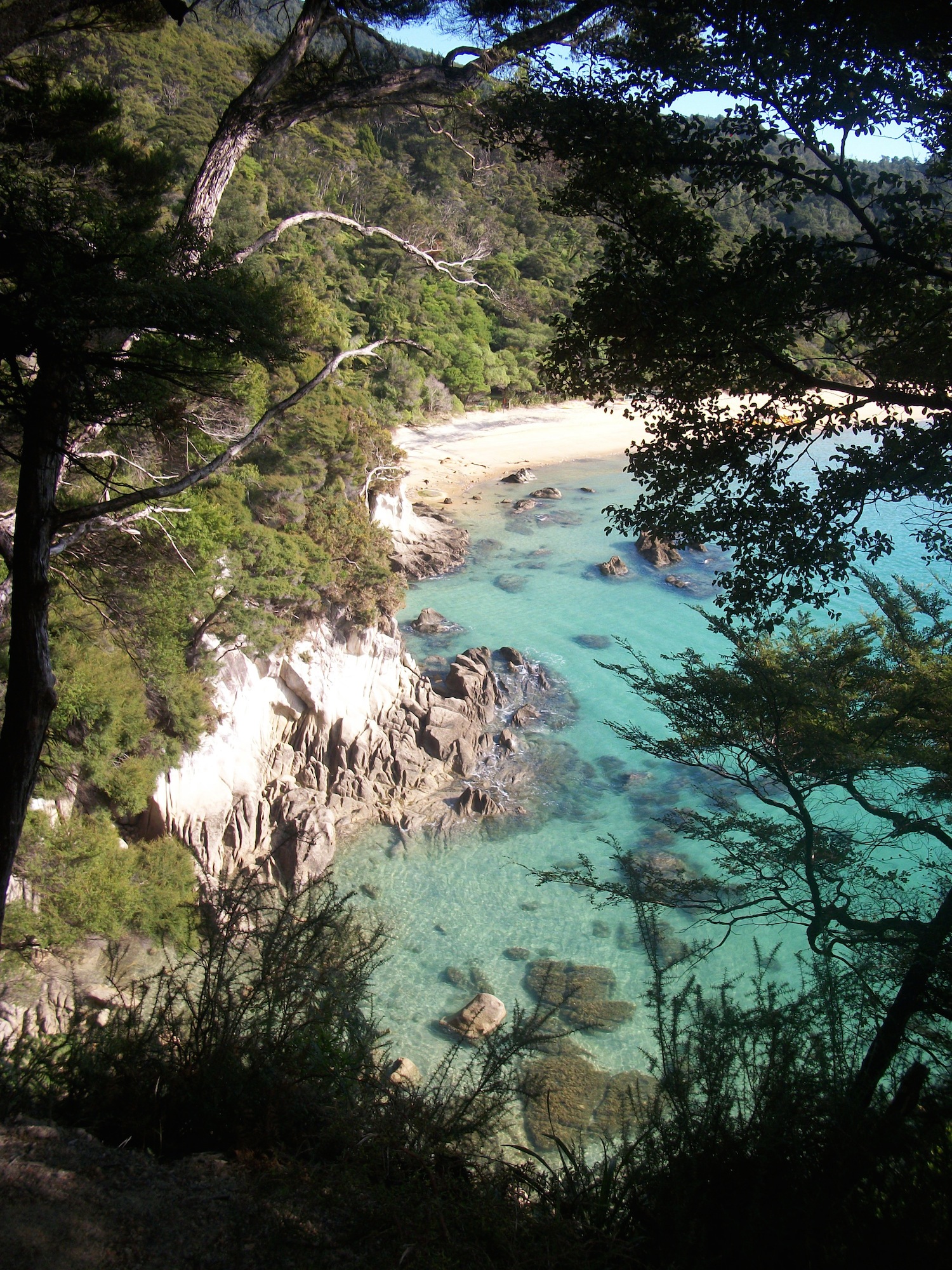
100_1198 smThe Abel Tasman was our first Great Walk as a family. It was also our first family tramp longer than two nights—the kids were still at the stage where they sometimes needed a prod to get to the top of a hill (or more accurately, the promise of chocolate at the top).

The Abel Tasman was the perfect trip—long enough to give the kids a ‘real’ adventure, and easy enough that they didn’t struggle with it. The distances between huts were short enough that the kids could spend hours playing on the beaches along the way and still get to the hut by mid-afternoon.

I’ve heard that the track is miserable in bad weather—all those exposed beaches can’t be fun in the wind and rain—but we were blessed with perfect sunny days. Though it was April, the weather was warm enough for lots of swimming along the way, and the whole experience felt more like a frolic than a tramp.

For me, the best part about the trip was gaining a greater appreciation for tides. The surges of water, so different from the normal waves, that fill the estuaries, bringing schools of fish and rays with them. The rippled and exposed mud flats of low tide. The twice-daily rhythm of inundation and exposure of the coast.

It wasn’t a wilderness experience—the huts were filled to capacity, and boats stopped at most of the beaches—but it was a beautiful chance to explore a rich and dynamic coastline.


Otira Valley

2016-03-25 10.41.03 smWe spent the past three days on the West Coast. On the way over the mountains, we stopped for a hike up the Otira Valley.

The track goes through stunning, diverse alpine vegetation, much of which was in seed at this time of year—lots of weird and wonderful berries to be seen! Though we were lucky to avoid being rained on ourselves, there had been recent rain, so the track was wet, and every little rivulet was running. The Otira River roared below us.

The day was moody, and low clouds shrouded the mountain tops around us.

2016-03-25 11.19.21 HDR smI love the alpine environment. One of the most wonderful things about it is that its beauty lies both in the minute plant life clinging to the rocks, and in the grand vistas—one must view the landscape at both scales to fully appreciate it. We spent our time divided between marvelling over some tiny plant, and admiring the peaks and waterfalls around us.