Frost Heave–Moving Mountains

Sometimes it’s the littlest things…

I enjoy winter hiking—I enjoy the crisp air, the opportunity to hike without sweating too much, the snow on the peaks. 

One of my favourite winter phenomena is frost heave. This is when moisture in the soil freezes. Since water expands when it freezes, the ice crystals push soil and rocks upward. We get frost heave at home, but in the mountains, where there is both more water and colder temperatures, the phenomenon can be spectacular.

On a cold Matariki morning a few weeks ago, I snapped a photo of five-centimetre-long ice needles near Foggy Peak. Each needle was topped by gravel—the whole top centimetre or more of the sloping surface lifted. As the sun rose and melted the ice, every rock fell a few centimetres downhill from where it started. I imagine this process happening daily all through winter—a slow-motion conveyor belt shifting the mountain downhill. 

Meanwhile, higher up on the mountain, water seeping into the cracks in rocks and then freezing shatters them day by day into smaller fragments to be added to the icy conveyor belt.

It is such a small thing, frost heave. But its slow action has a big effect. 

The Southern Alps are rising at a rate of 10 to 20 millimetres per year—some of the fastest rising mountains in the world. If no erosion had ever occurred, the mountains would currently stand over 20 kilometres tall. Our tallest mountain, Aoraki Mount Cook, is 3754 metres tall. 

Of course, when we think of erosion, we think of the big events like landslides and rock avalanches. These events can be spectacular. 

On 14 December 1991, a rock avalanche on Aoraki lowered the summit by 10 metres over the course of a few hours. Fourteen million cubic metres of rock and ice tumbled down the mountain at speeds of up to 300 kilometres per hour. The shock waves from the landslide were recorded on seismographs as far as 58 kilometres away.

But without frost heave, the 1991 Aoraki rock avalanche might never have happened. Frost heave slowly weakened the rocks, slowly snapped them into smaller and smaller pieces, slowly shifted their weight. Centimetre by centimetre, those little ice needles brought the mountainside down.

I like to think of frost heave as a metaphor. Each of those tiny ice crystals, by itself, can move a pebble, and together they bring down mountains.
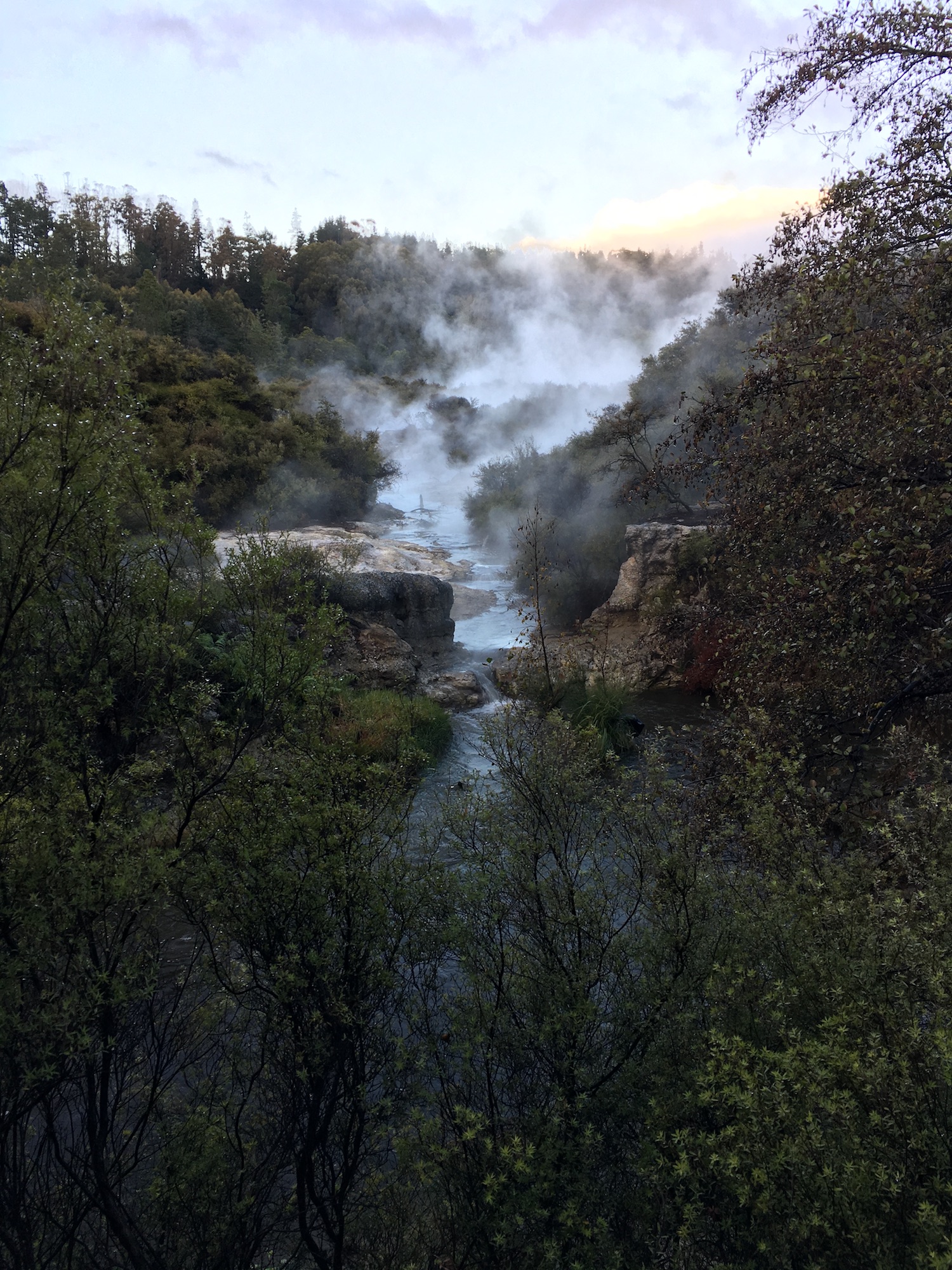
Rotorua: a not-so-cool place to be

A steaming stream in Rotorua.

I spent the weekend in Rotorua at GeyserCon, the national science fiction and fantasy convention.  I had a great time hanging out with other writers and learning new things about writing, but being a science geek at heart, the one thing I can’t stop thinking about is a presentation by Peter Brownbridge, the Rotorua Lakes Council Geothermal Inspector.

For those unfamiliar with New Zealand, Rotorua is a town on the North Island known for its extensive geothermal activity. And when I say extensive, I mean extensive. The whole town bubbles and steams and smells of sulphur. There are geysers, boiling mud, hot pools, and hot springs all within the township. In some places, the footpaths are broken, gently steaming, and crusted with mineral deposits.

As you might guess, Rotorua sits inside a volcanic crater. The volcano’s last major eruption happened about 240,000 years ago, and molten rock still lurks below, heating rocks and the aquifers above them. 

It makes for some unique urban planning and maintenance issues.

Peter spoke about the ongoing need to monitor existing and new hot springs and geysers. He spoke about how the layers of ash and sediment overlaying the old magma dome are prone to erosion by hot gassy water, leading to huge underground holes that need to be filled before they become giant sinkholes. He talked about the challenges of repairing ageing geothermal bores when the pressure in them can be as high as 200psi. He mentioned the need to use alternate materials for underground pipes to avoid damage by corrosive gas. He talked about having to evacuate homes and schools due to poisonous gases belched out by hot springs. He described a median strip in the middle of town that spontaneously catches fire every summer because of highly flammable gas oozing from the ground there.

But what I found most remarkable was, after Peter described all the crazy things the city has to do to maintain services, he said, “Yeah, we’ve pretty much got it under control. The only thing we struggle with is delivering cold water to some homes.”

Think about that for a moment. Let it sink in.

I’ve been to Rotorua several times, and have visited stunning hot pools and geysers, but that one little fact has given me an entirely new appreciation for the nature of the earth beneath the town.