Vilma’s Marinated Eggplant

vilmas eggplantsmVilma was the sister of our host mother during Peace Corps training in Costa Rica. Her partner was a tall Italian with as fiery a temper as Vilma’s; they argued a lot, and Vilma regularly came to stay with her sister when she and her partner weren’t on speaking terms.

While at her sister’s, Vilma would cook, and Ian and I loved her for it. Our host mother’s cooking was often only barely edible. She believed in cooking vegetables well, and in saving time by boiling several days of vegetables at one time, and just keeping them in the pot on the stove. They got mushier and mushier every day, until it was all we could do to choke them down.

Vilma must have learned some culinary skills from her partner, because she made wonderful Italian food. One of her specialties was marinated eggplant. She brought a jar of it with her almost every time she came, and while it lasted we were in heaven.

We never thought to get the recipe from her, so we spent years afterwards trying to recreate that eggplant. Eventually we managed, and now Vilma’s marinated eggplant is a summer staple in our kitchen. It’s simple to make, and tastes great on bread or crackers.

2 small to medium eggplants

1 clove garlic, crushed

½ cup red wine vinegar

½ cup extra virgin olive oil

salt and pepper to taste

Peel eggplants and slice very thin (1-2 mm). Steam until the slices are tender and limp (but not falling apart completely). Whisk all the other ingredients together in a small bowl, and toss them gently with the hot steamed eggplant. Refrigerate at least an hour before serving (the longer the better, as the eggplant will soak up more marinade).
Landscape Shaped by Food

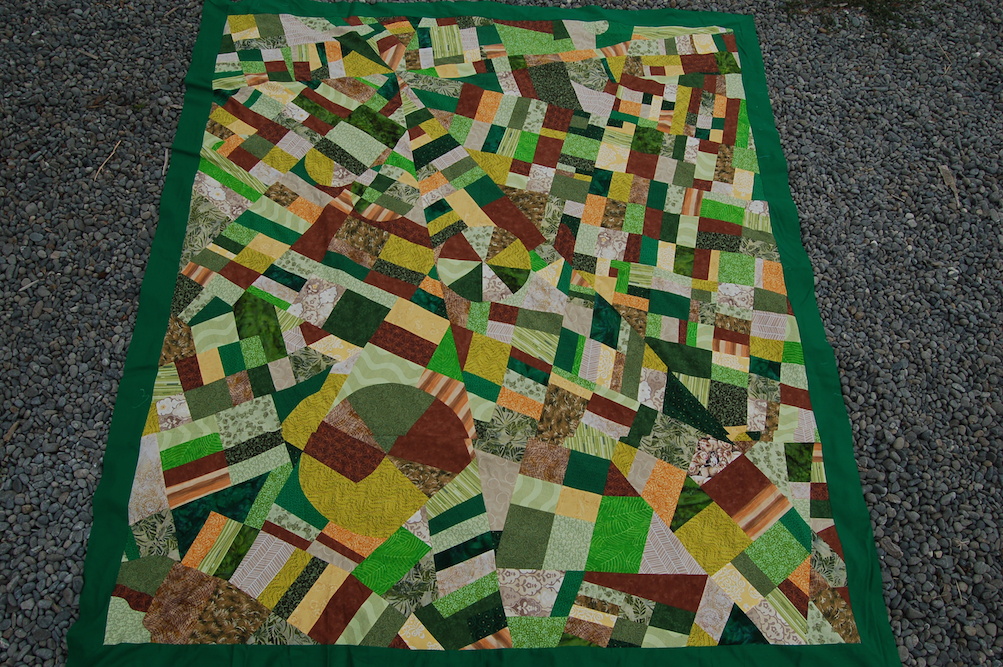
DSC_0007 smI’ve thought a lot about the Canterbury landscape over the past year. I’ve been piecing a quilt of the plains inspired by the September 4 2010 earthquake. The huge jog the quake created in the otherwise dead-straight Telegraph Road made me think about its effect on the aerial view of the entire area—all those straight fence lines and hedges shifted. It took a few years for the ideas to come together enough to execute, but last year I began to work on it. I took a satellite image of the area I wanted, projected it onto my living room wall, and traced the landscape onto a quilt-sized piece of paper. Every field was numbered and mapped on a reference sheet—six hundred and two pieces, each one different. Along the Greendale Fault, I cut and shifted the quilt, exaggerating the real break a bit, and creating a subtle disruption in the patterns.

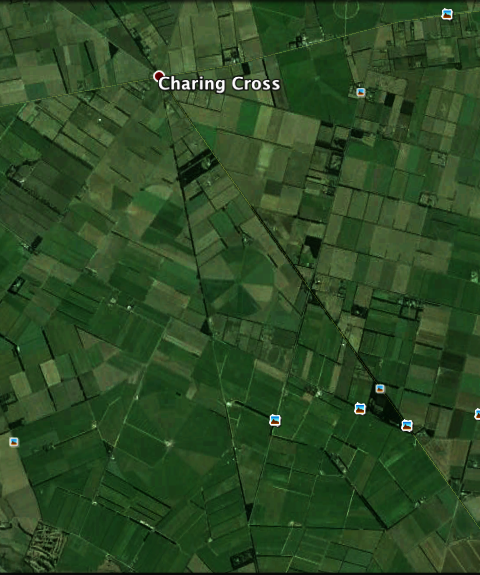
Though the quilt began with a focus on the quake, as I worked on it, I thought more and more about the agricultural landscape itself. For over 100 years, sheep and grain have been the staples of the region. They have left their impression on the landscape. The wedges formed by intersecting roads at Charing Cross were sliced by straight fences and hedges, forming paddocks and fields for sheep, oats, and barley. Today, dairy cows and the centre pivot irrigators that keep the cows’ paddocks lush have overlaid circles on the straight lines of the past. You can see places where the centre pivot has obliterated the geometry of the past, and others where the straight lines limit or slash through the centre pivot. The push and pull of the past and the present.

Satellite photo of the real thing.

Satellite photo of the real thing.

This landscape has fed people for over 600 years. When the first Maori arrived, the native forest provided food like moa and pigeons. As the forests were felled, the region’s rivers and wetlands continued to provide abundant fish and waterfowl. When Europeans arrived in the 1870s, they brought livestock and crops, which thrived on the plains. Though the landscape has changed dramatically, the use we make of it remains. Today, this landscape of food feeds not only locals, but also people in far-flung places like China, Europe, and the Americas. No doubt the landscape will change in the future. New lines will erase the old. But chances are good the new lines will be shaped by food.