Use it and Lose it

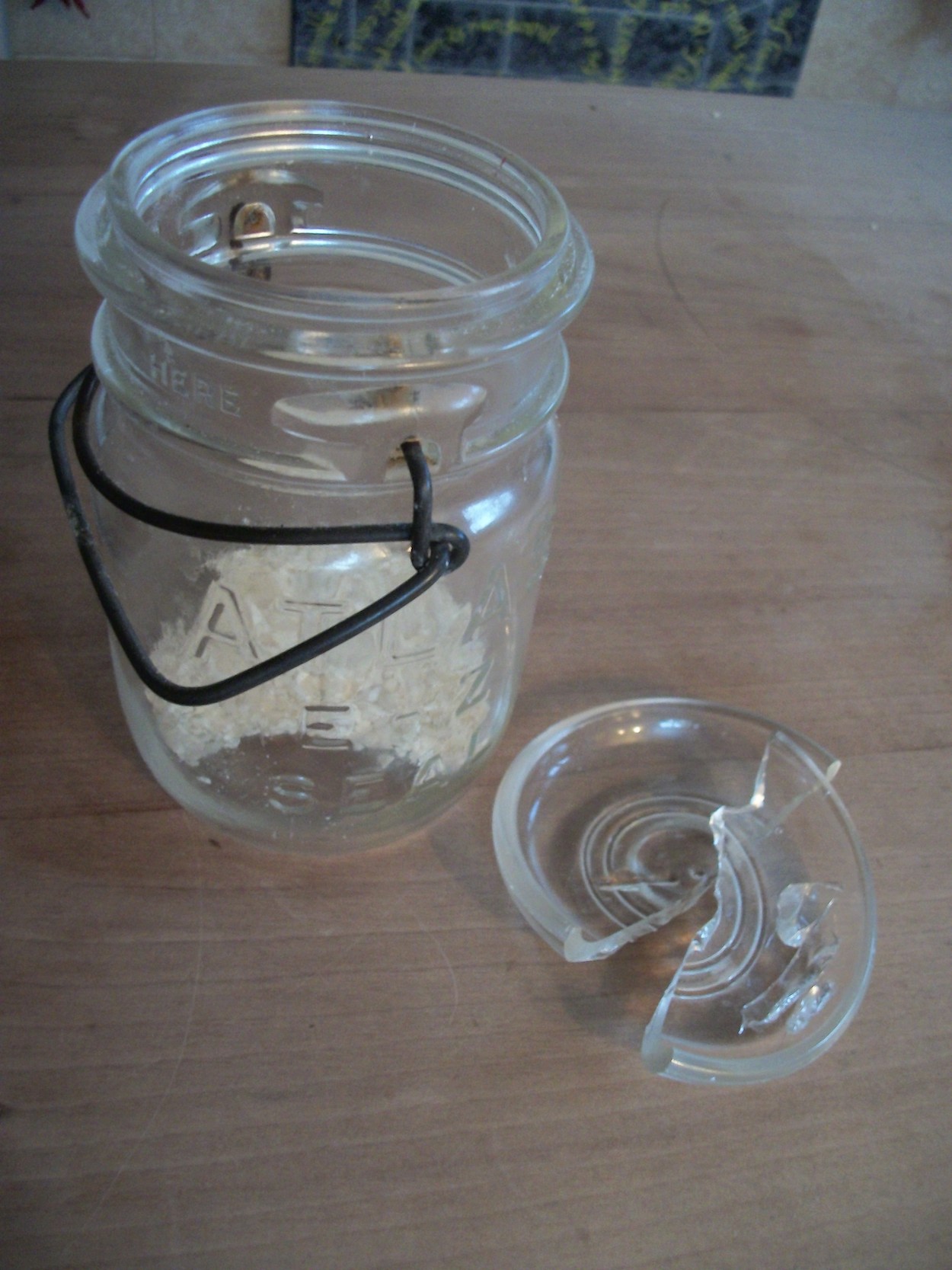
100_3629 smI opened the jar of sesame seeds this evening, and the glass lid slipped from my hand, fell to the floor, and broke. I closed my eyes and took a deep breath. Another one of my favourite antique jars was gone. There is only one left now.

I don’t know how old these lovely Atlas jars are, but they are certainly older than me, possibly much older. I should probably not be using them at all. But they are beautiful and useful—it would be a shame to pack them carefully away to preserve them. Better to let them live out their lives as useful kitchenware, as they were meant to.

I believe in using the things that I enjoy. So I use those antique jars, the 150 year old steamer trunk, the antique chairs, the collection of early 20th century teacups.

The quilt that I spent seven years embroidering goes on the bed every summer, and the newest quilt (over a year in the making) serves us all winter.

The result is, of course, that things break, fade, and wear out. Slowly these little treasures disappear, no matter how much care we take with them.

But I like to think of these objects as having a life, a presence that is tied intimately to their utility. If they are not used, they cease to exist as they were meant to. By using them, and ultimately breaking them, I keep them alive. And when I wrap the broken shards in newspaper and inter them in the rubbish bin, I know that they have lived and died well.

I hope I can say the same of myself when I reach the same point in my life.

Klim Diplomacy

Kitchensm

All the kitchen you need for making ricotta!

I ran across this lovely article about unofficial Peace Corps cookbooks, and it brought a smile to my face.

There was no Panama Peace Corps cookbook when my husband and I were there, but there were plenty of recipes shared in the Peace Corps newsletter. I still have a few of them—ragged pieces of paper torn from the newsletter, smelling ever so faintly of mould.

The best Peace Corps recipe ever was for ricotta cheese made with powdered milk.

Fresh milk was impossible to come by in our village, as there was no electricity, and hence no refrigeration. Dairy of any sort just wasn’t part of the diet. But you could buy cans of powdered milk (marketed by Borden as Klim…the most uncreative name ever).

Today, with my goat milk, I am quite precise with temperature when I make ricotta, but the Peace Corps recipe was written for the Volunteer cooking over a three-rock fire with nothing more than a pot and a spoon.

The recipe went something like this:

Mix up two litres of milk from powder.

Heat to just below a boil.

Add ¼ cup of vinegar.

Skim off the cheese curds as they form.

This little recipe made surprisingly good ricotta, even from powdered milk. With it, we managed lasagne, pizza, and all manner of other cheesy treats over our little fire. It was a delightful break from unending days of rice and yuca.

Excited by our ability to make foods from home, we shared our pizza with the neighbours.

They thought it was disgusting.

But we all laughed and enjoyed the chance to talk about and compare our different cultures and cuisines.

One of the goals of Peace Corps is to foster understanding and exchange between cultures. Food is an important part of that exchange for all Peace Corps Volunteers. Even when the various parties can’t agree on what tastes good, food opens dialogue, it makes people smile, it is a common language.

Perhaps the world would be a more peaceful place if we all tried a little Klim diplomacy.

Soft Pretzels

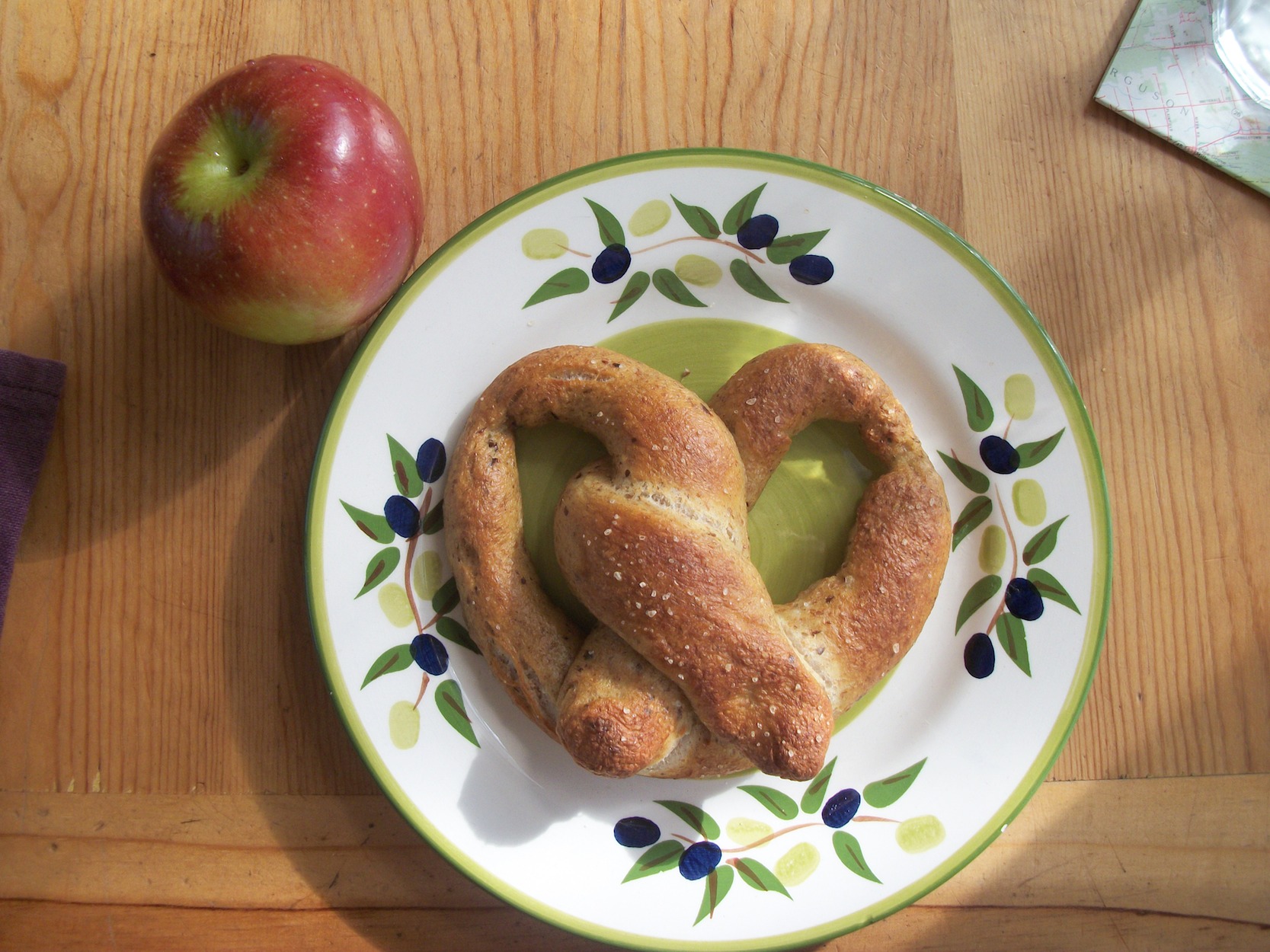
100_3556 smHaving grown up in central Pennsylvania, I consider pretzels their own food group.

So it was a great disappointment to discover that there are NO pretzels in New Zealand. Oh, you can get small bags of expensive, imported pretzels, but the variety and quality are very poor.

And soft pretzels—the pinnacle of pretzel evolution—are nonexistent.

Thankfully, soft pretzels are easy and fun to make!

I make soft pretzels from a light whole wheat bread dough—any relatively light dough will work fine.

Once your dough has finished its first rise, divide it into 100g (3.5 oz) pieces. Roll each piece into a long snake, then twist into a pretzel shape and place on a well-greased baking sheet (You can make other shapes, but keep them compact or they will break apart when handled). Cover and let them rise until about doubled in bulk.

Now comes the part that turns them into pretzels.

Bring to a boil a mixture of 4 cups of water and 5 tsp baking soda (I use a large pot and need to double this amount to get a reasonable depth of water). Drop the pretzels carefully into the water (you may only be able to put 1 or 2 into the water at a time—my big pot fits 3) and allow them to boil for about 1 minute, until they float to the surface (I gently turn them over once they’ve reached the surface so that both sides boil relatively evenly). With a large slotted spoon, take them out and place them back on the greased baking sheets.

Sprinkle with coarse salt and bake at 230°C (450°F) for 12 minutes or until nicely browned.

Eat them hot, slathered in mild mustard!

Diverse cultures, diverse food

Three unnamed ducks. Photo: Eric Weiss

Three unnamed ducks. Photo: Eric Weiss

I was delighted by this post on the Peace Corps Facebook page. The post and the hundreds of responses showcase the wonderful diversity of the human diet.

Food in Panama is generally not so…leggy as it is in many places around the world, but cow brains and chicken feet were regular menu items in our village.

Our landlord, Julián, loved to tease us about our vegetarian diet by introducing us to the carnivorous aspects of Panamanian cuisine.

One day he walked carefully down the path between our houses with a plate in his hands and a wicked smile on his face. As he grew close, we could see that, on the plate was the head and neck of a large duck, plucked and cooked, but expertly posed, as though it was casually resting on the plate while the remainder of its body went for a nice swim.

Julián explained that stuffed duck head was prepared for pregnant women near their due date. The dish was supposed to facilitate an easy delivery.

When Julián had returned home with his duck head, my husband and I turned to each other in horror, exclaiming in unison, “That was Dave!” Dave was a drake who frequented the drainage ditch by our porch. He had an unmistakably gnarled face.

We never named another duck again.

Oh, what a taste!

Beer, anyone?

Beer, anyone?

You would think that, taste being such a fundamental part of human culture and survival, we would know all about it.

Not so!

When I was a child, we were taught that there were four tastes: sweet, salt, bitter, and sour. Later, scientists discovered the taste, umami—the taste of glutamates, inosinate and guanylate–found in many foods, including meat, vegetables and dairy products, and often added to Asian foods in the form of MSG.

Now, scientists have discovered a sixth taste—oleogustus, or fat. Like bitter, fat is a flavour that, by itself, is disgusting. It is only in mixing with other flavours that fat becomes palatable (think chocolate—by itself, it is almost inedibly bitter, but add sugar and it’s delicious).

This sixth taste makes sense to me. The best foods combine all the flavours, and I’ve always maintained that a little fat goes a long way to making food taste good. Vegetable soup made by simply boiling the vegetables is flat. But sauté the onions first, adding a little fat, and suddenly the soup tastes rich.

The best foods include all the tastes. Think about the worldwide popularity of tomato sauces. Tomatoes are themselves an incredible mixture of sweet, sour and umami. Add to them some sautéed onions for a little fat, a handful of bitter herbs like oregano and rosemary, and a little salt, and you’ve got a sauce that excites all the senses. Serve it with a grating of Parmesan cheese (with fat, salt, and umami), and it doesn’t get much better.

And, of course, it explains why a beer begs for peanuts and pretzels alongside it—the sour and bitter of the beer need the fat, salt, sweet and umami in the peanuts and pretzels to join them!

Rosemary

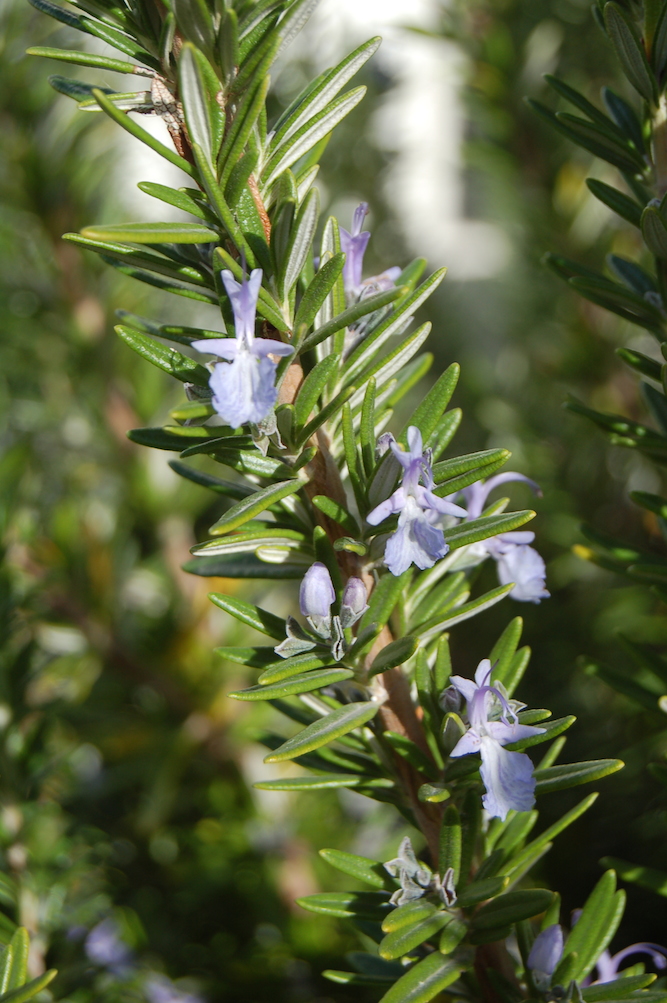
Rosemary1 smIn Minnesota, I grew rosemary in pots and brought it indoors for the winter, lest it be killed by the cold. Here in New Zealand, I grow my rosemary in the garden, and have to hack it back twice a year to keep it from growing taller than I am.

Rosemary is one of my favourite herbs, whether in dinner, in the garden, or in a flower arrangement. It is decorative as well as delicious.

Rosemary was named by Pliny in the first century. Ros (foam) mare (sea)—meaning that it grew so close to the sea that the foam sprayed on it. The Greek gods supposedly valued a rosemary wreath more highly than one made of gold (think how much I could make selling my biennial rosemary trimmings to Zeus!).

Rosemary was first used medicinally and culturally. It entered the kitchen in the Middle ages as a way to disguise the saltiness of salt-preserved meat. I’m told it goes well with lamb, pork, and game. As a vegetarian, I like rosemary with potatoes, pumpkin, and in Italian tomato sauces. And I love to brush the bushes with my hands as I walk past, so I can bring that lovely smell with me wherever I go!

Lentils

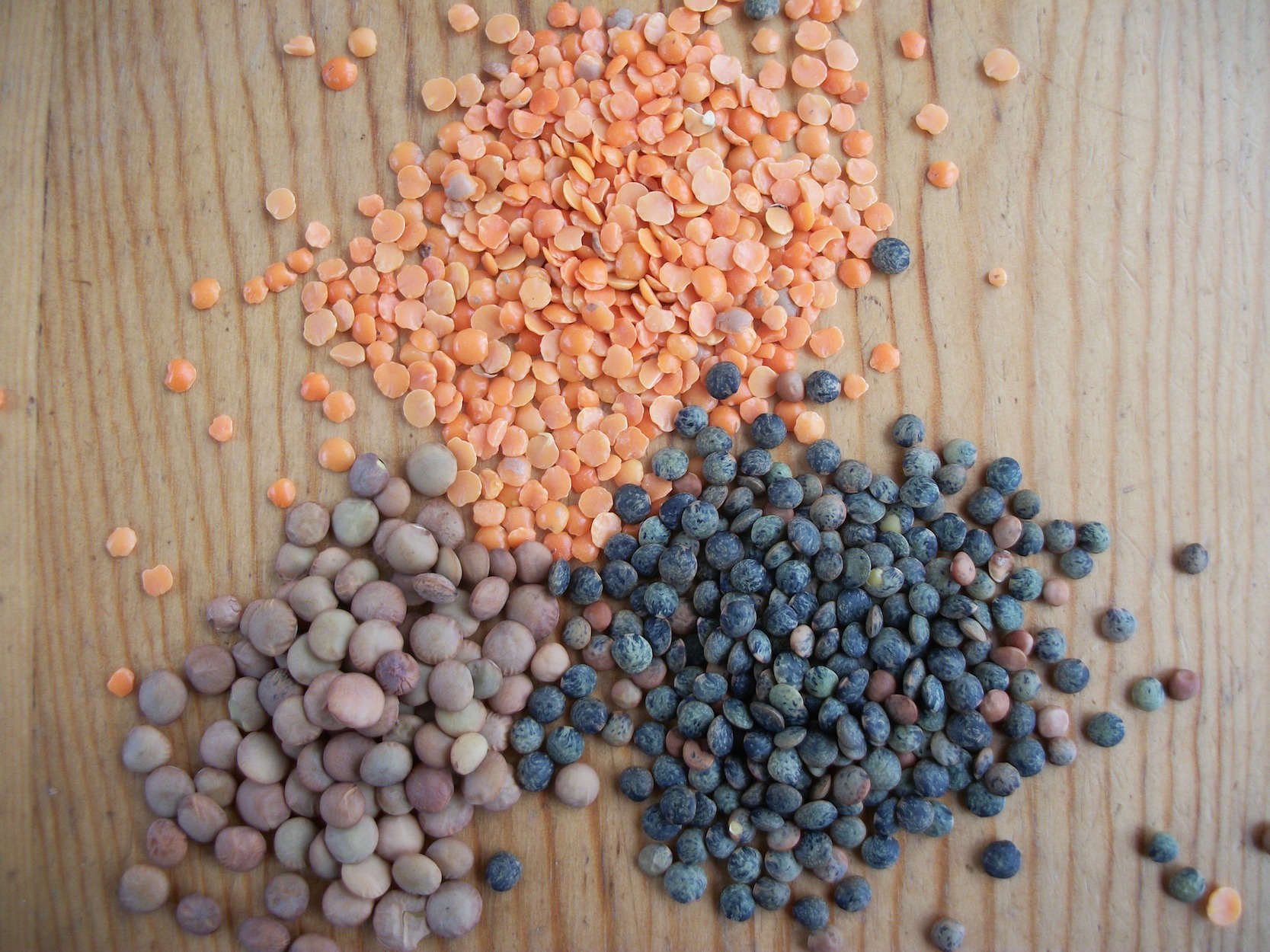
100_3491 smEver since our stint in the Peace Corps, we’ve eaten lentils at least once a week, often several times. Lentils and rice was a staple meal in Panama, and it has since become a comfort food. And since lentils feature in many cuisines, they find their way to our table in many guises.

As a gardener, I found lentils intriguing. They show up in none of the seed catalogues, yet they can be grown in a wide range of conditions and locations. The two biggest lentil producing countries are Canada and India. If they grow in these disparate climates, surely I could grow them here!

With this in mind, a couple of years ago, I took a handful of lentils purchased at the grocery store and tested their germination—100%. Hooray! I was in business! I planted two types of lentils—brown and French green—at the same time I planted my beans. They sprouted well and grew vigorously. Their feathery leaves were a beautiful and intriguing addition to the garden. Patiently I watched them grow, flower, and set seed.

When the plants died back and the seed pods dried, I harvested whole plants, laden with pods.

Then I discovered why home gardeners don’t grow lentils.

Each pod contained only one or two seeds. If the plants were sufficiently dry, many of the seeds could be extracted from the pod by rubbing the plant between my hands. But even dry, a lot of seeds had to be picked individually out of the pod. And rubbing the dry plant left a lot of chaff mixed into the lentils. The chaff and the lentils were about the same weight, so blowing the chaff off also blew off many of the lentils.

After hours of painstaking work, I had enough lentils for, maybe, two meals. From the same garden space, and for a lot less work, I could have produced a year’s worth of dry beans.

I don’t regret growing lentils, and I’m pleased to know I can grow them. I’m also quite content to let someone else grow them (and harvest them mechanically) for me.

Wedding Bowls

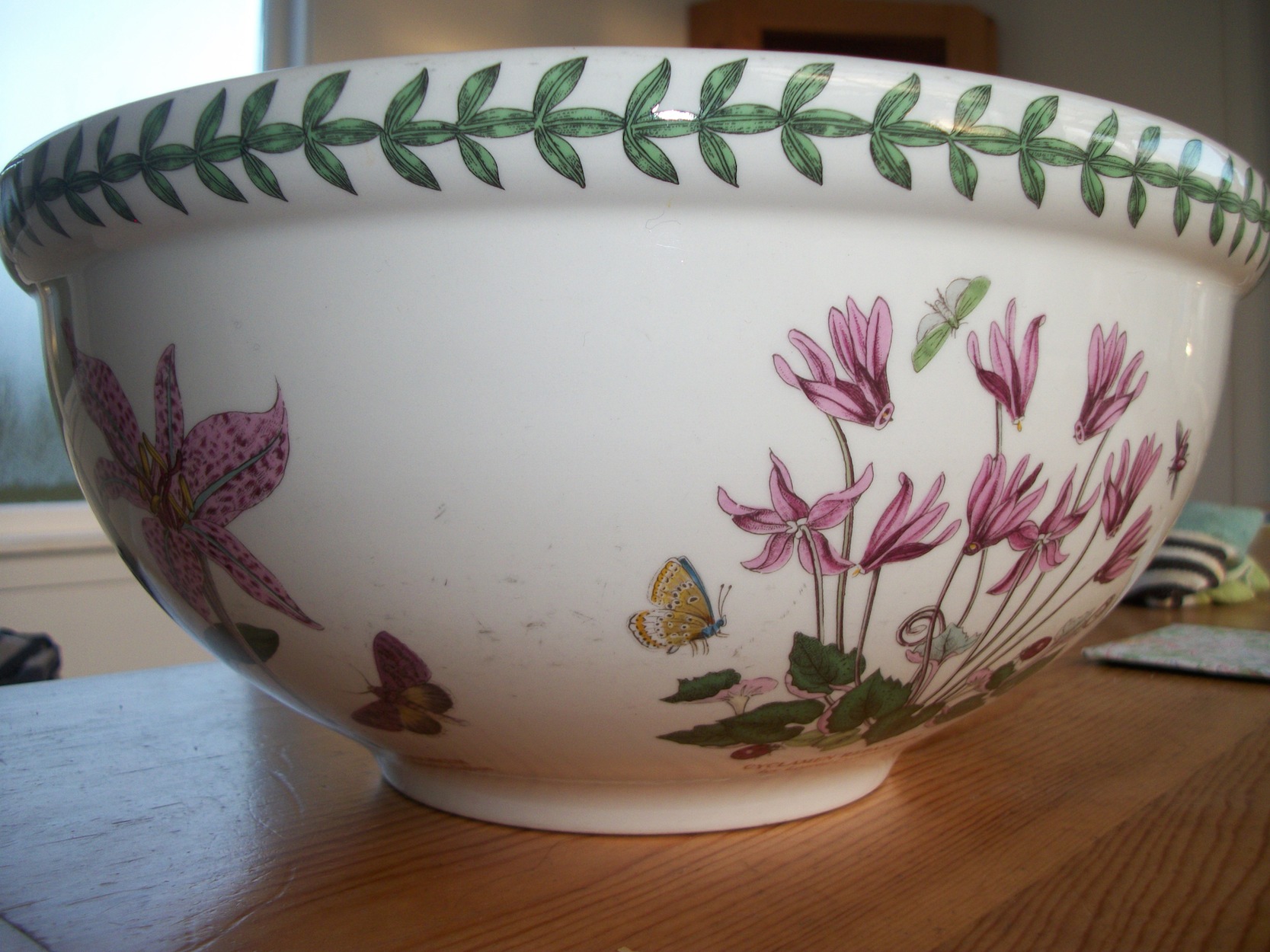
100_3483 smTwenty-three years ago, when Ian and I got married, a whole lot of people gave us gifts. Most of those gifts were kitchen items. In addition to pots, pans, and knives, we acquired 23 bowls that day–ceramic mixing bowls, stainless steel mixing bowls, hand-blown glass serving bowls, artistic pottery bowls, wooden bowls… You name it, we got it.

We could have broken one a year for every year of our marriage so far. But most of those bowls are still with us, 23 years later. All are well-used, and remind us even now of the people who gave them to us all those years ago.

So, thanks everyone! Our wedding bowls ring daily!

Fresh Eyes

Endangered dolphins? Nothing unusual to see...

Endangered dolphins? Nothing unusual to see…

Travelling around this week with friends from the U.S., I am seeing things with fresh eyes. The strange pronunciations, the shockingly changeable weather, the casual acceptance of road closures, spotting endangered species from the roadside…all those things I now just accept as normal. I’m reminded of how foreign they were to me once.

Coming from the land of restaurant chains, they were surprised by the abundance and quality of local cafés. Coming from a place of certainty, they remarked on the number of times I said, “This has changed completely since I was last here.” Coming from a land of freezing winters, they marvelled at fresh vegetables from the garden at the winter solstice.

It has highlighted for me just how much I have ‘gone native’. How much I have accepted, adapted to, and embraced this place. It has become me, and I have become it. There are many times when I still feel foreign, even after ten years here, but having visitors here helps me realise just how much I have come to belong.