Sitting ‘Round the Cauldron

tamalesboilingBubble, bubble, toil and trouble

Fire burn and cauldron bubble!

It’s the third weekend in a row I’m standing over my 20 litre stock pot filled to the brim with something to be canned or frozen. Maybe I need a proper cauldron…

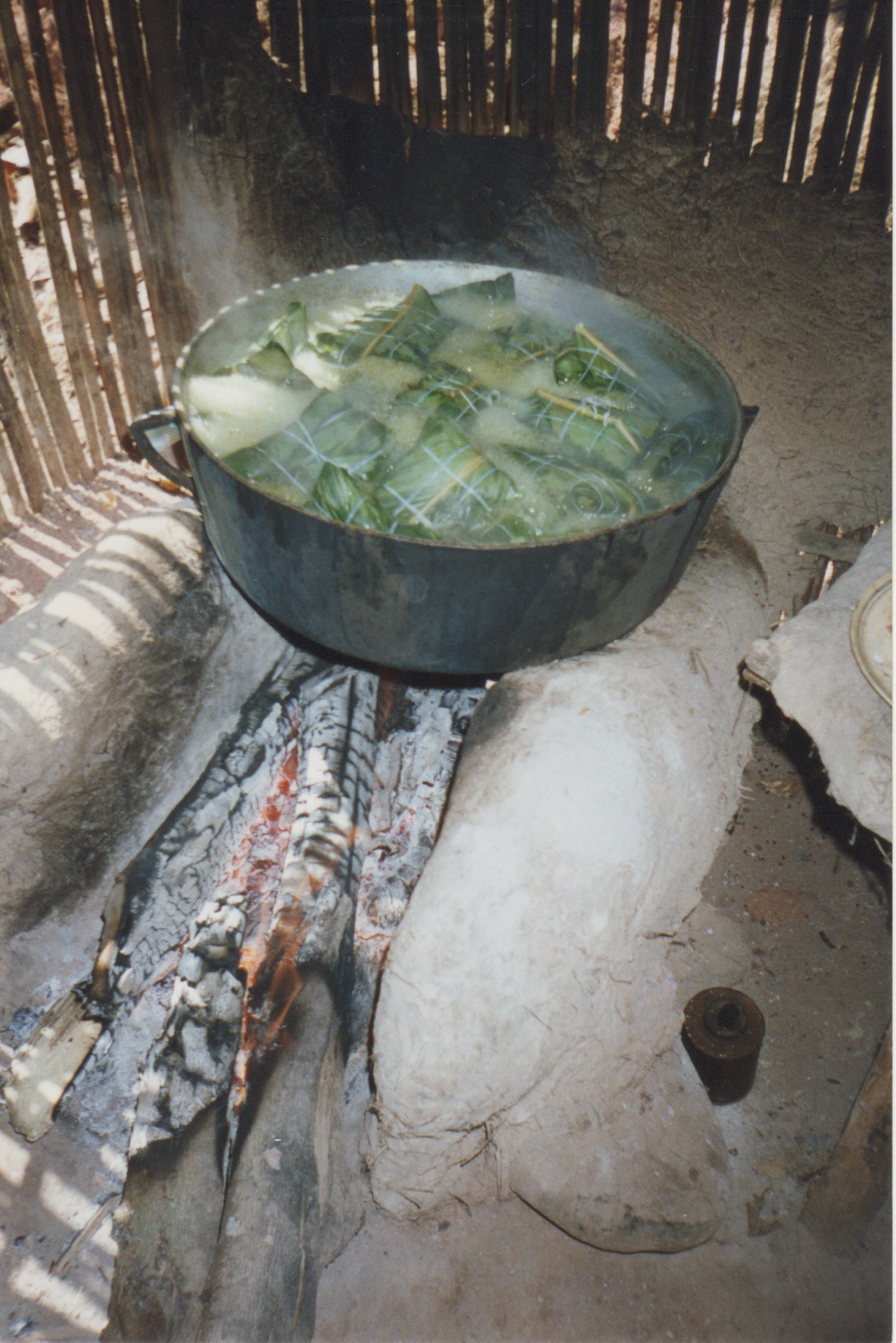
The women I worked with in Panama had incredible cauldrons. Cauldrons that made my 20 litre stock pot look like a mere saucepan. The big cauldrons didn’t necessarily get used every day, but they came out for the making of tamales when the corn was ready.

MakingtamalesAnaMagallonandLaurianaSoto'sdaughterPaulaTamales were a favourite fundraiser for the Amas de Casa group I worked with. We’d gather at one of the women’s houses, each bringing ingredients. We’d spend the whole day grinding corn, plucking chickens, cutting vegetables, and forming the tamales. Tamales are a mixture of meat, onions, and “guisos” (flavourful things like celery and cilantro), surrounded by a thick corn mash. The mass is wrapped in a leaf and boiled to set the corn into a dense, polenta-like cake. That’s where the making tamalesSebastianagiant cauldron came in. We’d cook dozens of tamales at once in one of those vast pots, set over a raging fire.

Once the tamales were finally in the pot, one of the women would produce a small bottle of seco (distilled from cane sugar, and clocking in at 70 proof), and pass it around. It was the only time I ever saw the women drink—sitting around watching the big cauldron boil.

Hmm…now there’s an idea! Sure would make stirring this tomato sauce more pleasant…

Granola

granola2 smThe kids laugh at me, because I eat the same breakfast almost every day. It’s not that I don’t appreciate breakfast, but I guess I’ve found what works for me. Why change? True, I’d rather be eating pancakes, scones and muffins every day for breakfast, but who has time to bake every morning? I usually eat breakfast standing up in the kitchen while I pasteurize milk, make lunch, and wash dishes, so it’s got to be something easy.

Homemade granola fits the bill perfectly. Top it with unsweetened yogurt or whole goat milk, and just a little bowl can get me through the whole morning. It took me years to come up with the perfect granola. It was the addition of puffed grain that made the difference for me—before, I always felt my granola was too heavy, like I may as well have been munching on the grain I feed the goats.

So here it is, my daily breakfast granola. This recipe makes a lot—keeps me going for weeks, but it stays fresh in a tightly closed container.

6 cups old fashioned rolled oats

4 cups puffed wheat (unsweetened)

1 cup sunflower seeds

1 cup barley flakes (rolled barley)

1 cup rye flakes (rolled rye)

1 cup shredded or flaked coconut (unsweetened)

1 cup walnuts, chopped

¼ cup vegetable oil

½ cup honey

1 cup dates, chopped

1 cup raisins

Mix oats, puffed wheat, sunflower seeds, barley, rye, coconut and walnuts in a large bowl. Combine oil and honey, and microwave for 30 seconds (I measure them directly into a glass measuring cup that I can microwave in), no need to actually mix them, just warm them. Pour oil and honey over the grains and mix well. Spread into two jelly roll pans and bake at 180°C (350°F) for about 30 minutes, stirring every 5 minutes or so, until the grains are lightly browned. When the pans come out of the oven, while still hot, sprinkle dried fruits on top. When completely cool, store in an airtight container.

Cheese Magic

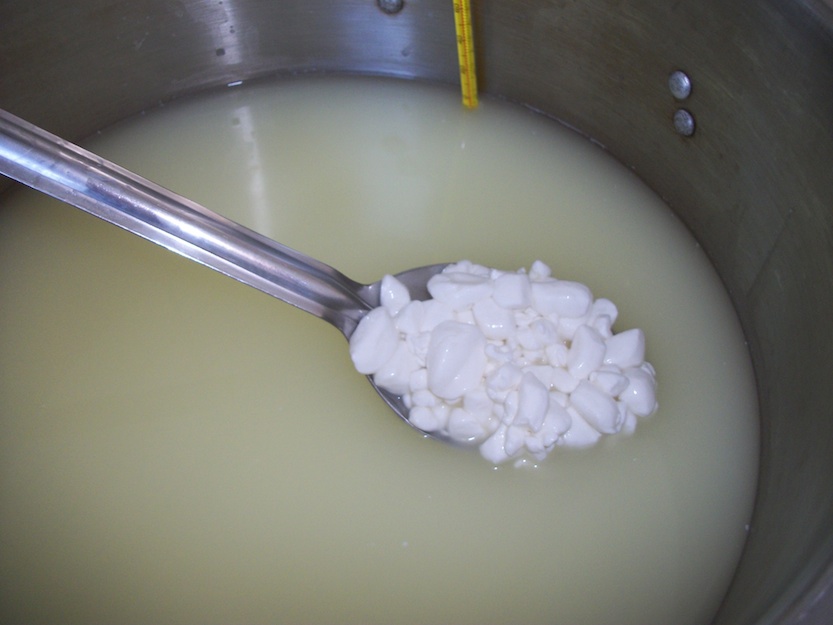
Curds and whey

Curds and whey

To be honest, until I had dairy goats, I don’t think I knew at all how cheese was made. Oh, I knew it was made from milk, but beyond that, I had no clue. I loved cheese, and I ate quite a lot of it, but how it came to be on the supermarket shelves, I didn’t know.

Truth is, cheese making is magic.

Well, OK, not really. It’s a simple matter of coagulating proteins, and the whole process is governed by the laws of chemistry. But it feels like magic.

Slow and painstaking magic, that is. Ignore for a moment the six months of planning and animal husbandry required to produce the milk itself, and let’s focus on the actual cheese making process. The process to make a simple farmhouse cheddar, one of the least time-intensive hard cheeses I make, usually starts at about 6.15 am. Two hours of heating the milk and adding cultures and rennet, and the first of the magic happens—liquid milk becomes a solid mass of cheese curds. I carefully cut the curd into small cubes, marvelling at its beautiful silky firm texture. Then I tediously stir for almost an hour and a half while I heat the milk to expel liquid from the curds. The curds finally go into the press at about 10 am. The “green” cheese doesn’t come out of the press until 11 pm. A week later, once the surface of the cheese has dried, it is waxed, and left to age for at least 4 weeks.

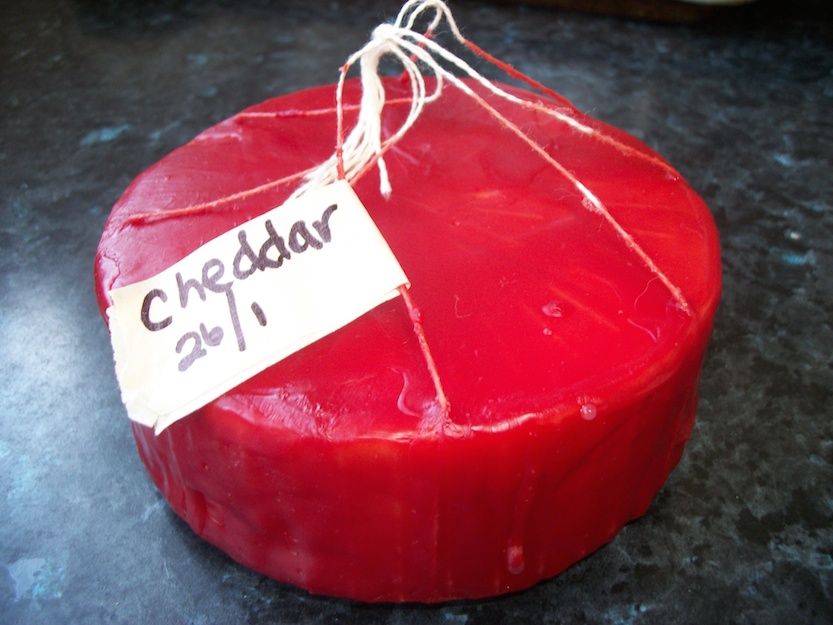
cheddarsmSo, the fastest of cheeses is almost 5 weeks in the making. Other cheeses require much more active processing, and a much longer aging period (parmesan needs a minimum of 10 months, and is best after a year). Some cheeses aren’t waxed, and need daily or weekly washing for their entire aging period to avoid mould.

But once a cheese is ready, the second bit of magic happens, and it is my favourite part of cheese making–opening a new cheese. Only at this point do I know for certain how the cheese making months before actually went. Is it the right texture? Is it properly salted? Has it aged enough? Was I able to prevent unwanted mould growth? The whole family is drawn to the opening of a cheese. Everyone gets a slice, and weighs in on how good it is. This magical moment, standing around in the kitchen with the family is worth all the tedious stirring and waiting.

There Will Be No Blog Today…

DSC_0001 copy4.26 pm.

I sit, finally, to blog.

Do I blog of the cheese I made this morning, pressing on the kitchen counter? Do I describe the magical beauty of liquid milk congealing to a smooth, firm solid? The hours of tedious stirring? The firm, almost live feel of a new cheese?

Do I blog of the ten quarts of tomatoes, onions, peppers, tomatillos and spices I boiled down into ketchup today? Do I write of the bees that swarmed the kitchen when the vinegar was added, inexorably drawn to the sharp, spicy smell?

Do I blog of the corn and soybeans still awaiting me in the garden? Of the hours of steaming pots, and dirty dishes that still await me today?

No. I am weary of the kitchen. I am sick of its tantalizing fragrances and its steamy dishwater. I am irritated by the bees, who, once inside, can’t find their way out, and force me to watch every step for fear of ending my day with a trip to the hospital.

So there will be no blog post today, of the lingering smell of cloves and allspice, no detailed description of the art of cheese, no reminiscing of childhood afternoons shelling soy with my sister.

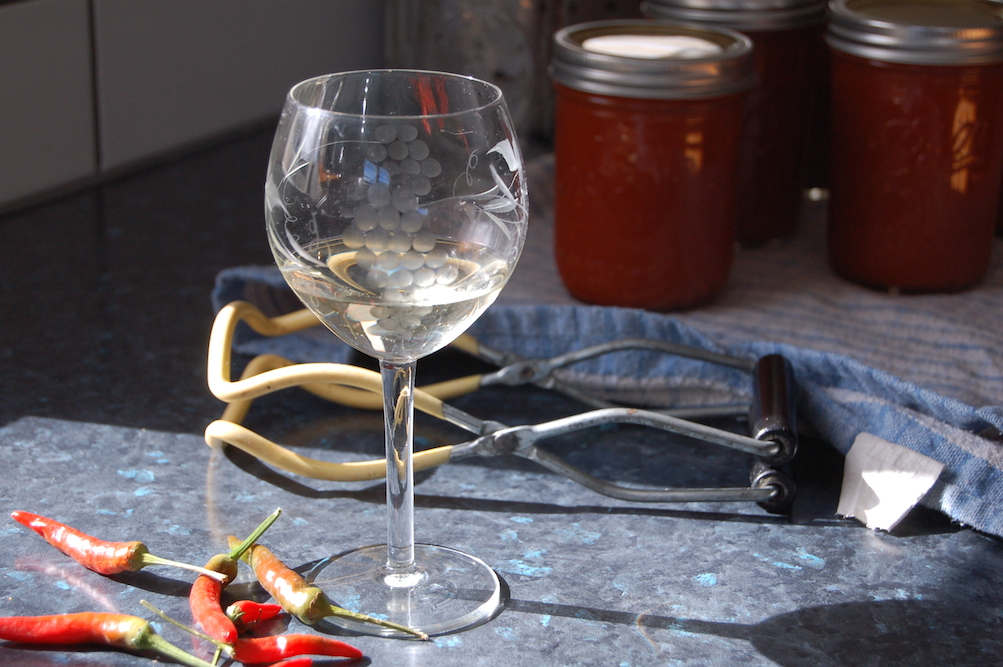
No. Instead, there will be 15 minutes of rest. A glass of wine. And then back into the fray.

The Exuberant Kitchen

messykitchensmMy kitchen is a mess.

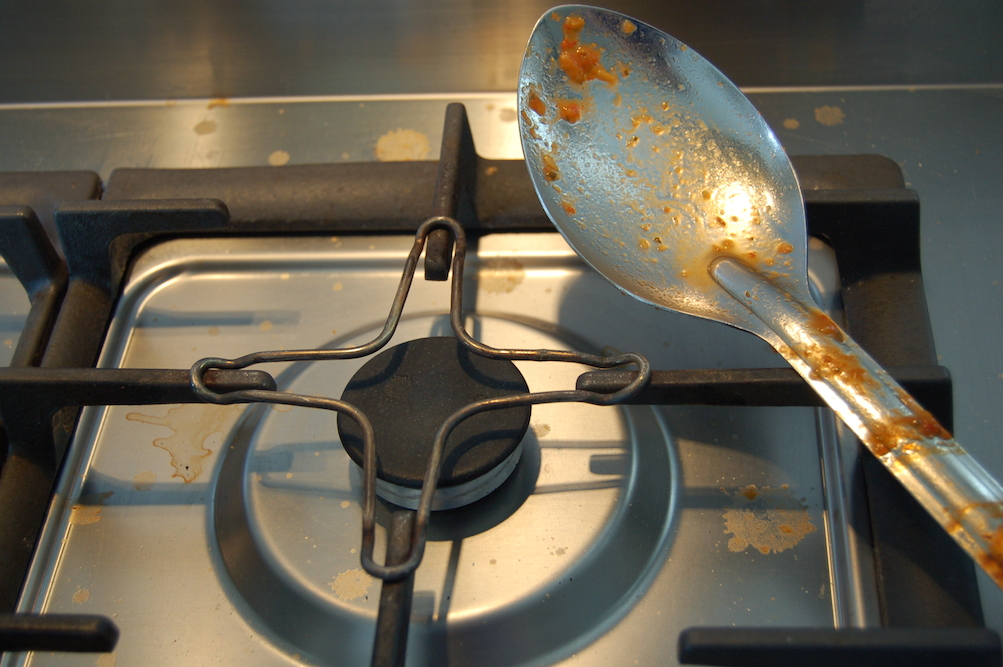
The stove, and the wall behind it is splattered with tomato sauce. The floor is littered with bits of onion skin, lost basil leaves, and sesame seeds. The backsplash behind the sink is splattered with dirt.

It’s not that I don’t clean. In fact, I’m a bit obsessed with cleaning. I’ve been accused (rightly, I’m afraid) of preferring to stay home and mop the floors rather than go out on a Friday night.

But I can clean constantly, and still have a messy kitchen, because the kitchen is in near-constant use. It’s a working space, and I’ve learned to accept it as such. Right now there is a vat of pasta sauce boiling down on the stove, and an hour ago, the kitchen was the scene of a massive vegetable preparation operation. There will necessarily be dirt, vegetables and tomato sauce everywhere. Earlier, it was being used for pasteurising the morning’s milk and for making mayonaise. Later, it will be covered in flour as I roll out homemade pasta.

Flipping through a Home and Garden magazine, you could be forgiven for thinking that kitchens are meant to be gleaming, spotless backdrops for perfect flower arangements. Ours, however, is usually a grubby setting for a pile of dirty dishes.

Our kitchen works hard. All five burners on our stove are regularly going at once, and some days, I swear we wash every pot, bowl and spoon twice. A space hosting so much activity can only be truly clean for brief moments—say, between midnight and 2 am on every fouth Tuesday.

But a kitchen like ours is also a scene of laughter, life, and love. It is steeped in delicious odours, and tantalizing flavours. It is where the produce of the garden is transformed into the fuel for our bodies and the treats for our celebrations. It’s not a messy kitchen, it’s an exuberant one.

The Harvest Hangover

The morning after

The morning after

I woke this morning with a headache. It was one I recognised—the Harvest Hangover. It’s a combination of fatigue and dehydration that comes after a day of picking and preserving vegetables.

Back in the years B.C. (Before Children), I used to lose 10 pounds during harvest season. I’d forget to eat and drink as I picked and processed mountains of tomatoes, zucchini, eggplant, beans, etc. Ironic, eh? After a night of canning, I’d wake with a Harvest Hangover. I’d stumble to work grumpy and groggy, as though I’d been out carousing all night.

As I age, I’m more moderate in my preserving. Instead of weeks of late-night canning sessions, I do two or three a year. It helps that I can’t grow the quantity of tomatoes I used to during the hot summers in Pennsylvania, but I’ve also rationalised my preserving. Here, where winters are mild, I can grow cool-weather crops year round, so winters aren’t the fresh vegetable desert they are in a harsher climate. If I don’t have 50 quarts of tomatoes in the cupboard for winter, it doesn’t matter—we can eat something else instead. I preserve only what I know we’ll eat, so I’m not throwing away old canned goods every summer. I’ve learned to better manage my planting so that I’m not completely overwhelmed with any one crop (usually). And I allow myself to simply give away extra produce when I am overwhelmed.

Perhaps it’s a sign of aging that I don’t wake with Harvest Hangovers very often any more, but I like to think of it as a sign of wisdom. As they say, know your limits!

Summer Soup

There’s no set recipe, but this year it went something like this…

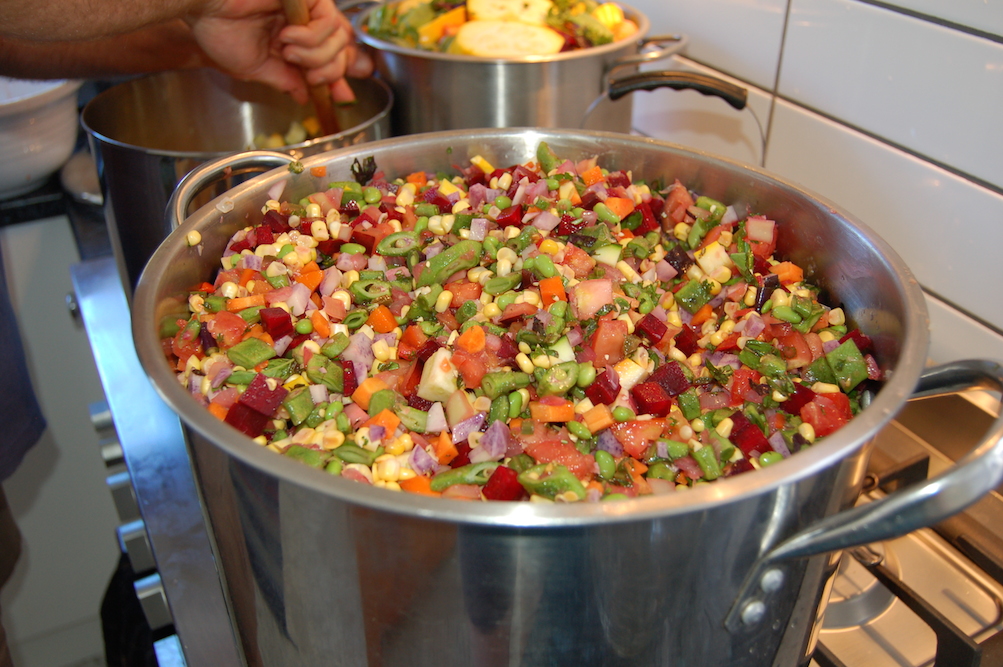
After a hearty breakfast, assemble the family. Equip half with knives and cutting boards in the kitchen. Send the other half to the garden with buckets, colanders and knives to pick vegetables and ferry them in to the cutting crew. Pick and chop the following:

1 head garlicDSC_0027 copy

12 ears sweet corn

7 onions

8 sweet peppers

8 jalapeño peppers

5 Thai hot peppers

3 large beets

12 carrots

3 cups fresh shelled soy beans

8 stalks celery

8 quarts tomato

10 bay leaves

3 cups herbs (basil, parsley, rosemary)

8 cups green beans

12 small boiling potatoes

5 medium zucchini

5 oyster mushrooms

As you chop, put all the good stems, peels, and over mature vegetables into a pot. Top with water and put on a back burner to simmer for stock.

Take a break for lunch, then send the kids outside to play.

DSC_0035 copyIn an enormous pot, sauté onion, peppers and celery until onion is translucent. Add garlic and cook another couple of minutes. Add remaining ingredients and enough water to call it soup. Bring to a boil. Meanwhile, prepare 24 quart jars and the pressure canner.

Separate off enough soup for dinner. Boil the rest 5 minutes.

Send your husband outside to play.

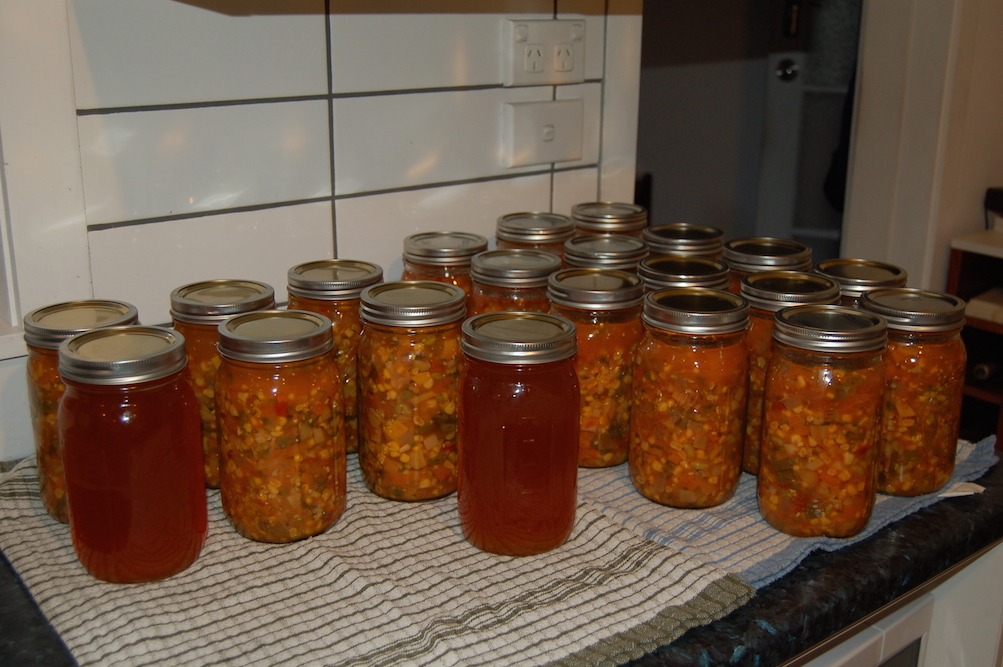
Pressure can the remaining soup. Strain the stock and can it, alongside the soup. Plan on 4 canner loads. While the third batch is in the canner, reheat the soup for dinner.

Sit down to soup for dinner, but don’t forget to keep an eye on the canner.

While the last batch is processing, pour a glass of wine, and blog.

Almost done...just a few more jars in the canner.

Almost done…just a few more jars in the canner.

Pull the last batch out of the canner at 9.30 pm.

Go to bed and dream of all the wonderful canned summertime lined up in jars in the kitchen, waiting for those dark winter days when everyone comes home late and hungry.


Convergence of Chocolate

DSC_0001 smA few days ago, I made chocolate mint wafers—thin, heavily chocolaty refrigerator cookies with a hint of mint extract. Two days ago, Ian made chocolate ice cream. Yesterday, I discovered a small tub of leftover ganache from last week’s cake. What could we do but put them all together?

Gifts from the Soil

DSC_0001 smAccording to Wikipedia, the price of porcini mushrooms (Boletus edulis) ranges from $20-$80/kg in the U.S., though it’s been known to rise to over $200/kg (wholesale) in years when it is scarce.

Porcini is expensive because of its ecology. It is a mycorrhizal fungus, meaning it lives in association with the roots of plants. This is a mutualistic relationship—the plant provides sugar, and the fungus provides nutrients. Neither one can grow properly without the other. Porcini’s mycorrhizal partners are oak trees. In order to grow porcini, you have to grow oak trees, so it is difficult to cultivate. The result is that porcini is largely collected from the wild, and is subject to wide fluctuations in production.

Sitting down to a picnic lunch today (in a location that shall remain secret), Ian and I picked 730g of porcini. It’s very early in the mushroom season, and quite dry, so we were surprised to see it, though Ian regularly finds it nearby. Ian manages several hundred dollars worth of porcini foraging in the autumn, even calculated by the lowest prices. It’s a delicious and welcome gift that is overlooked by thousands of passersby.

Porcini is a firm and meaty mushroom. Strongly flavoured, a little can go a long way when it needs to. But in autumn when the porcini are fruiting, we need not skimp, and a meal can easily include half a kilo of mushrooms. I dry the excess for use over winter in soups and stews. It goes well with thyme and rosemary, and lends a deep earthy flavour to dishes.

So, thanks to whoever brought these two non-native organisms—oaks and Boletus edulis—to New Zealand. Their presence is a gift to our table.