Gardening and Community

blooming daffodils
Blooming daffodils cover a multitude of sins (aka weeds) in spring.

The local veggie gardening group had our first Monday evening gathering for the season last night. And what a lovely gathering it was!

I hosted, which is always a bit nerve-wracking. You don’t want the place to look like it’s been abandoned or neglected, and in early spring, weeds are often more prominent than crops. And some of the group members have absolutely stunning gardens and are way better than I am at growing food. 

But we all have weeds. And we all have different challenges in our gardens and in our lives. And everyone comes in a spirit of community. Once people begin piling out of their cars and strolling the garden, any nervousness is forgotten as we all share our successes and failures so far this season, and catch up with each other’s lives outside the garden.

Conversations ebb and flow as the group wanders, breaking into subgroups around particular plants, garden structures, pest outbreaks, or other items of interest. 

Because we’re not quite on daylight savings time yet, we ended our garden stroll as daylight faded. But like any good gathering, we weren’t done yet—it was time for kai and a cuppa.

artichoke bud
Artichokes are on their way!

Last night, the party broke down on gender lines, as it often does (for no real reason … we laugh at ourselves all the time for this tendency to segregate)—the guys lit the brazier outside and commandeered the cheese and crackers to accompany some home brew. Indoors, the ladies had tea and cookies. 

Without the garden in front of us, the conversation diversified—and we’re such a diverse group outside our interest in growing plants, that you never know what might be under discussion on any given day. Crafts, books, digger operation, food, business interests, travel, rock collecting, climate change … you name it, we’ve probably discussed it. Garden group conversations are always intriguing and full of laughter.

When our guests headed home for the evening, the fire was still burning merrily in the brazier. The night was unseasonably warm, and the sky was clear and washed with stars. For an hour, my husband and I ignored the dirty dishes and sat in the dark by the fire, sharing what we’d both learned from the gathering.

While we sat there, a few thoughts occurred to me:

tomato seedlings
Tomato seedlings in the greenhouse.
  1. We don’t enjoy our garden enough. And by ‘enjoy’, I mean just sit or stroll and appreciate the beauty. Not that we don’t do this at all, but we could be doing it a whole lot more.
  2. We are absolutely blessed to be part of the local gardening community. I’m a total introvert, and being with groups of people where there are multiple non-stop conversations going on is exhausting for me. But I love this crowd of generous, community-focused people, and I look forward to each of our get togethers.
  3. Finding common ground with people can be as simple as sharing excess lemons or cuttings from your favourite herbs.

There is something humanising about gardening. The very act fosters community, brings people together. Reading the daily news, I can quickly begin to think the worst of the the entire human race. The garden group reminds me that there is beauty, not only in the garden, but in the ones who tend it.

Thankfulness

Today is Thanksgiving in the United States. Since we’ve been in Aotearoa New Zealand, we don’t celebrate the holiday—who has a harvest festival in springtime? Add to the seasonal disconnect the dumpster fire that is world politics at the moment, and you could be forgiven for not feeling terribly thankful this Thanksgiving.

But it’s good to set aside all the frustrations in life (like the frost that has hit the vegetable seedlings every single night since our ‘frost free’ date), and reflect on the good things.

This Thanksgiving, I am thankful for a multitude of things …

  • My coworkers at my day job—teachers, teaching assistants, and support staff—who are all absolute legends, working under stressful conditions for lousy pay, usually without any recognition of the amazing work they do.
  • The fellow authors in various author communities I’m a part of, who are supportive of all writers and work together to support, encourage, and promote authors, books, and reading. You are rock stars!
  • The members of my local garden group, who share freely of their gardens, knowledge, and experience. You are inspiring!
  • My garden. Maybe it is weird to be thankful for it, because it doesn’t just happen—my husband and I have worked hard to turn this sad paddock into an oasis of food and flowers. But I am thankful for all the plants and soil organisms that have worked with us to make our efforts pay off.
  • My husband, who is my best friend, greatest fan, and partner in all things.
  • My kids, whose passion for the people and the world around them remind me that all is not lost yet.

Do you notice the pattern? It’s all about communities—of people, of living things. 

I don’t know what’s going to happen in the world over the next few years. Much of it will be pretty bad, I’m guessing. But there are communities around us working for good. There are people who want all our tamariki to be able to read, to have healthy food to eat, clean water to drink, health care and mental health support. There are people around us who don’t think in terms of ‘us’ and ‘them’, but embrace humanity as a whole, in all its diversity. There are people everywhere who care about the people and the world around them.

I am so thankful that these people exist. I am thankful to be part of some of the communities who put this caring into practice in their daily lives. 

So, while the world burns around us, I give thanks for the small communities that work tirelessly to put out the fires.

Sharing Gardens

It’s easy to feel like the world is going to hell in a hand basket these days. You can readily believe that there is no kindness left in the world. That no one cares about the earth or community. That values such as integrity and selflessness are dead. That people’s only motivation is money.

Of course that’s not the case, and I’m reminded of that regularly.

I am blessed to be part of a community of vegetable gardeners—people who can restore my faith in humanity. I’ve written about gardeners in the past, but it bears saying again. These are people who have a deep sense of community. They pay attention to the effects their actions have on the land. They give of their time and are generous with food, seeds and plants, sharing what they have with others.

They organise local food pantries and community gardens. They raise funds for charities. They give away produce to those in need. They share their knowledge and skills freely with others. One gardener I know even hands out jars of jam to strangers.

And when those gardeners get together, they can make a difference in communities. Here in New Zealand, it is common for houses in towns to be surrounded by high wooden fences. But in the nearby town of Akaroa, fence heights are restricted, so that people share their gardens with the street. What a difference it makes to the entire feel of the community! It actually feels like a community, and not a collection of houses. I love walking the streets and enjoying everyone’s beautiful gardens.

In the past couple of weeks, I’ve turned to my own garden to escape the drumbeat of depressing news from around the world. The flowers and vegetables transcend politics, war, economics and societal dysfunction. They centre me and give me a respite from the troubles of the outside world.

And as a gardener, I feel compelled to share that respite with others. 

So I invite you to come on a brief tour of some of my garden. Stop and smell the roses. Enjoy the scent of the herbs as you brush past them. Munch on some early produce from the vegetable garden. Say hello to the chickens. Bask in the warmth of the greenhouses. Take a moment to unwind and relax.

And most of all, stay safe, stay hopeful, and look after one another.

Guerrilla Art

We spent a night in Wanaka last week before our tramping trip. While wandering around town looking for a likely spot for dinner, we came across some poems stuck onto a bridge railing. 

Like a Banksy painting, the poems were certainly not ‘legal’ and were no doubt frowned upon by the local authorities. But also Banksy-like, they made passersby smile and think.

Years ago, when my husband and I lived in State College, Pennsylvania, we regularly took our walks in the agricultural fields near the edge of town. Along the path, shortly after leaving the neighbourhood, someone had installed a tiny section of sidewalk. Embedded in the concrete was the poem ‘Where the Sidewalk Ends’ by Shel Silverstein. There was no indication of who had installed the poem, and it was tucked away beside the field as though it had been surreptitiously installed in the dead of night. 

There are municipally sanctioned examples of Guerrilla art—art that appears in unlikely places. The poetry among the rocks along Wellington’s waterfront is one example. But there’s something particularly delightful about the non-sanctioned art—the amazing sand sculptures people create on the beach, the sidewalk chalk drawings that proliferated during lockdown, the splash of graffiti on train cars. It’s an expression of life and spirit, a proclamation of something uniquely human, a statement about human lives.

I think we all could use a little more guerrilla art in our lives. Thanks to the Brownston Street Bard for your lovely contribution. May the ink continue to flow from your pen.

Looking back, looking forward

On 26 March 2020, New Zealand went into a nationwide Covid-19 lockdown, and my family moved into a shed. It wasn’t exactly ideal, being homeless during lockdown …

From the comfort of the new home we finally moved into at the end of June, we’ve been reliving that time as we hit milestone after milestone. 

A year ago today, our month-long nationwide lockdown was extended at least two weeks. We were simultaneously devastated and heartened by the news. Covid cases were dwindling—our efforts were working, but would take a while longer.

That day I posted the following poem on the fence:

The storm rages ‘round us
We’re soaked to the skin
Our ship pitched and tossed in the waves.
The captain barks orders,
Hand firm on the wheel.
She knows the relief her crew craves.

But she cannot allow us
Our petty desires,
As much as she longs for them too.
To weather the storm
We must all pull together
Or the tempest takes many, not few.

I don’t think I really understood how true those words would turn out to be. As the world collectively registered over 3 million Covid-related deaths this week, I reflect once again on how different our experience here in New Zealand has been from the rest of the world. Once again I am grateful for the incredible leadership we have in dealing with this crisis, and the collective commitment New Zealanders have shown to doing what needs to be done to protect everyone here.

Yesterday, we reopened our border to Australia, allowing families and friends to reunite, and tourists to travel. It raises our Covid risk as we expand our national ‘bubble’, but both countries have proven quick to respond to the virus, and I believe we will continue to pull together to keep everyone safe.

Ghosts of Christmas Past

Christmas day dinner–no cooking required.

Much of the world has entered the holiday season under the threat of Covid. Holiday gatherings, a highlight for many, are necessarily smaller or cancelled altogether.

For some, a Christmas without parties and large family gatherings will seem … well, not like Christmas at all. 

I’ve been thinking about this as I talk to my family about their holiday plans, and there’s a lot of similarity in what they are going through to what my husband and I have gone through as expats. We’re used to holidays far from parents, grandparents, siblings, aunts, uncles and cousins. We know how the ghosts of family-filled Christmases past haunt the table set for two on Christmas eve. We’ve learned how to fill the holidays with meaning even if we can’t fill them with loved ones. I imagine most other expats have done the same.

It occurred to me that the lessons we’ve learnt are applicable to those stuck at home due to Covid. So here are some musings on how we’ve navigated (and come to love) solo holidays.

  • Treat yourself the way you’d treat guests. Do you usually make a special dinner Christmas Day? Cook it for your household, even if that’s only two people. Do you stay up late partying to ring in the new year? Well, put on the stereo and dance, no matter how few you are.
  • If the previous idea raises too many ghosts for you, create new ‘traditions’ instead. Throw out the holiday rulebook. Instead of a party, go for a hike with your household. Instead of buying a live tree, get creative and make one with your immediate family out of whatever’s lying around the house. Instead of a formal meal in the dining room, have pizza and popcorn while watching a movie on the couch. The more different the new tradition, the less likely those Christmas ghosts will show up. Just make the new plan as much of a treat as the old (not simply your usual routine). 
  • Dress up. Staying home? Put your party clothes on anyway. It will make the day feel special, even if all you do is lie around reading books.
  • Share with family and friends far away. This is so much easier today than it was 27 years ago when my husband and I had our first Christmas overseas. Then, I wrote letters describing our Christmas punch and mailed photos of our tiny Christmas tree. These days, we share via telephone, Skype, Zoom and FaceTime. It’s not the same as being there, I know, but I am thankful for the opportunities we have to be ‘together’ for the holidays.
  • Focus on what you can gain, not what you’re losing. Quiet time with your partner and/or children. Time alone to do what you want, not what the whole gang wants. Freedom from the intense cooking, cleaning and planning that go into hosting holiday events. A chance to re-think your holiday traditions. A reprieve from that loud uncle who always drinks too much and starts talking politics … I’m sure there are plenty of things you’ll happily miss out on this year.

No question about it, this year’s holiday is going to be different from normal for most people. But that doesn’t mean it has to be bad. Make the most of the opportunities to try something different this year. Who knows? Maybe something you do this year will become part of your holiday traditions for years to come.

Combating Seasonal Exhaustion

The days are long now, and our summer has officially begun. Weeds crowd crops in the garden, and the harvest of spring fruits and vegetables is in full swing.

End of the school year events crowd people’s schedules, and children are restive and eager for the upcoming summer holidays.

Retailers remind us there are only so many shopping days until Christmas. The house still lacks decorations.

The 2020 goals list dares me to get just a few more tasks ticked off, and everyone wants things done and dusted in the next two weeks.

There’s hardly a moment to sleep, and the long summer days encourage us to stay up late and get up early to accomplish our ever-lengthening to-do list.

Add the stress of a year of chaos, disruption and fear, and everyone is suffering from seasonal exhaustion.

I sit down to compose a blog post, and am distracted by an incoming e-mail with an urgent request. I write the day’s to-do list, and promptly lose it in the shuffle of random items cluttering my desk. I have to set alarms on my phone so I don’t forget meetings. I try to do a little editing, and can hardly keep my eyes open.

I see fatigue in the eyes of coworkers and students, of friends and family. I hear it in e-mails from colleagues. We’re all suffering from seasonal exhaustion compounded by a dumpster-fire of a year.

We all need kindness and understanding right now.

Which is why I’ve decided to go on a pay-it-forward spree until Christmas. I’m sure that in the next few weeks at work, I’m going to visit the cafe next door more frequently than usual for a pick-me-up coffee. I’ve decided that every time I get a coffee for myself, I’ll buy one for the next person in line. Hopefully, it will make them smile. Maybe it will inspire them to do the same. Maybe a whole string of exhausted coffee-drinkers will get more than a caffeine hit, but a lift to their spirits as well, as they both receive a gift from the person before them and give one in return. 

And with smiles on their faces, maybe they’ll say a kind word to someone, and that person will pass on the kindness to someone else, who will in turn pass it on to another person.

And maybe I’m being overly optimistic about the impact of giving a cup of coffee to a stranger.

But maybe I’m not.

I’m willing to take that risk and do my best to spread kindness. We could all use it right now.

Part-Time Ducks

Ordinarily, I’d be annoyed if the neighbour’s livestock made a habit of hanging out in my garden. At the old house, a mob of sheep would occasionally take a detour into the yard while being driven past. And I remember a bunch of cows grazing their way through the vegetable garden once when I was a kid. Those experiences were always destructive.

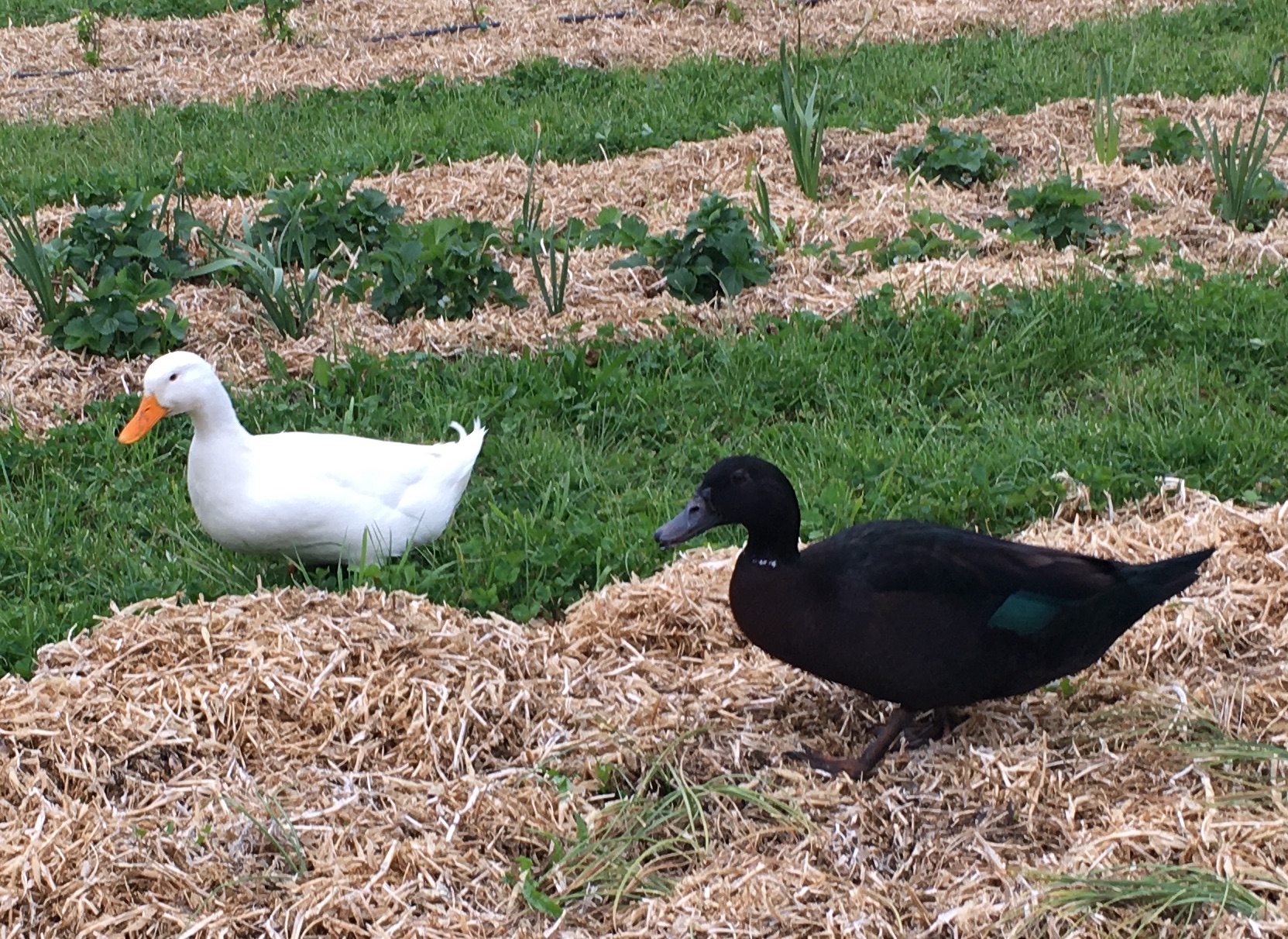
But one of the neighbours at our new place lets her livestock roam the neighbourhood, and I find it quite pleasing. They are a perfect pair of ducks—one all white, one all black (I’ve dubbed them Ebony and Ivory, of course). Watching them cruising the neighbourhood somehow makes me happy. Their owner occasionally comes out to the road to shoo them back home, but most of the time, they roam freely. 

For a long time, they avoided our place, waddling around next door, across the street, down the road … But this week, they discovered the wealth of slugs in our garden. They’ve been spending a few hours every day waddling up and down the rows of perennial crops, probing the mulch and quacking contentedly to one another.

I appreciate their gentle pest control operations in our garden, particularly since they come with no obligations on my part. I’ve seriously considered getting ducks in the past, primarily for slug control, but I never followed through. In the end they were always just more animals to have to care for. So part-time ducks are exactly my sort of livestock. They show up for work, put in a few hours, then head off to someone else’s yard. 

I hope they’re giving their owner lots of eggs.

A Shaky Decade

Today marks 10 years since we were shaken out of bed at 4.35 am by the M7.1 earthquake that started the Canterbury earthquake series. Those quakes ultimately took 185 lives and changed downtown Christchurch forever.

A decade on, the scars remain—half-crumbled buildings, hastily repaired roads, a generation of anxious children …

At the time of the first quake, I knew my relationship with the earth below my feet had changed, but I couldn’t know how lasting that change would be.

Ten years later, I’m still primed for earthquakes, sensitive to every vibration. If a big truck rumbles down the road, I have to pause until I’m sure it’s not a quake. Every distant train is a quake until proven otherwise. And large construction works set me on edge.

I have no trust in buildings any more, especially multi-storey ones. Just three days ago I was in Christchurch’s new central library, Tūranga, when I felt a tremor through my feet. Tūranga was constructed post-quake and includes the latest technology for earthquake resistance. Any vibrations I was feeling were likely coming from inside the building, not outside—someone running down the stairs, probably. I knew this, but it didn’t prevent the spike of adrenaline that zipped through my body.

I don’t trust my new house, either. The old one proved itself through quake after quake, riding the waves like a sturdy ship, coming through every quake virtually unscathed. The new house, though certainly scoring higher on any quake-worthiness measure than our 135 year-old villa did—is untested. Its foundation may crack, its bricks will almost certainly tumble in any large shake. Until I know for certain how it fares, I cannot trust it.

Any building I enter, I scan for earthquake hazards, safe places, and exits. Every track we hike, I consider rocks that could be shaken loose, hillsides likely to collapse. Anywhere I drive, I take note of power poles that could fall across my route home and waterways whose banks might slump, taking the road with them.

I wouldn’t say I’m afraid of another large quake—I know one will happen, and I’m okay with that—but I am still more on edge than I was ten years ago. I’m more aware of the earth underfoot, more wary of the danger of living on the Pacific Ring of Fire where Earth flexes her joints, more observant, more in-tune with the planet.

That’s not a bad thing.

So today I’ll listen for the pulse of the planet, double check I am prepared for another quake, and simply enjoy life in this beautiful place.

Kia kaha, Christchurch. 

Loving Leftovers

We christened the new house last weekend with a celebration party for one of my husband’s students who just finished his PhD. As I suspected (hoped?), visitors gravitated to the kitchen, congregating beside platters of finger food under the warm glow of cafe lights. 

Food-wise, we went Mexican for this party—quesadillas, empanadas, corn chips, guacamole, salsa, bean dip, and biscochitos (anise-flavoured cookies from New Mexico, not Mexico, but …) for dessert. Great finger food and perfect or standing around the kitchen grazing all evening.

As usual, we made enough food for twice as many people as we invited. Now we’re blessed with party leftovers for lunch.

Yesterday I had a generous plate of homemade corn chips smothered in cheesy bean dip, salsa, guacamole and sour cream. Today I’m considering toast with beans and salsa (because we devoured all the chips and guacamole). Tomorrow, who knows what I’ll come up with? Plus, there are extra beans in the freezer for dinner later in the week. All that extra party prep pays off in easy, delicious meals afterwards.

A great excuse for a party!