I used to live in St. Paul, Minnesota. It frustrates me to be unable to join the protests, the singing throngs in the streets of Minneapolis. To be on the other side of the world with a heart this heavy. Kia kaha Minnesota. Let your outrage bleed all the way to Washington DC.
Renee and Alex took the shots But we all bleed out. Out of homes and businesses, Humanity puddles on icy pavement, Floods the streets in protest.
When one bleeds out, We all bleed out. Compassion spills from keyboards Into the flow Of online vitriol. Humanity seeths, Bristles with outrage.
My pen writes in blood Blood spilled Blood boiling Blood coursing through A heart A heart A heart That bleeds out.
I’ve been folding origami bats this week in preparation for the trick-or-treaters who will be arriving at our door on the 31st.
Although I can’t get into the Halloween spirit like I used to do in the northern hemisphere, I’ve decided Halloween in Kirwee is a chance to let my weird show.
Each year I write a poem on the driveway inviting trick-or-treaters to the door.
Of course I dress up. And I’m a stickler for the kids to be in costume too. If they show up at my door with no costume, I make them perform a trick for me.
I’ve had on-the-spot original rap performances, rugby moves, and songs. Some of my regulars now clearly prepare their trick in advance, whether they’re in costume or not.
I hand out candy, as is expected, but last year I gave one of my books for my favourite costume of the evening. The girl who got it was over the moon.
So this year I’ve leaned further into the weird. I wrote a special spooky story for kids, printed it (white on black) onto squares of paper, and folded the squares into bats to hand out along with the candy.
I hope the kids like my spooky story bats as much as I do!
When my husband and I designed our current house, we did it with solar power in mind. The house faces north, the roof pitch is steep for better solar gain, and we had it pre-wired for solar.
Five years later, we’ve finally had the panels installed. And while I’ve been itching to have it done for years, I’m glad we waited.
Weaning ourselves off fossil fuels, the biggest impact we could make for ourselves and the environment was to get an electric car. So that purchase came first. We love the Leaf we bought, and it costs us about a quarter of what we were spending on petrol. Those fuel savings helped us save up for solar.
Additionally, the technology has both improved and gotten cheaper over the past five years, so what we are able to afford today is much better than what we could have gotten when we built the house. I’m sure if we waited another five years, we’d see more technological improvements.
But with so many people switching to electric cars these days, New Zealand’s electricity suppliers are more frequently firing up the coal and gas generators as our current renewables production falls behind consumption. So I’m thrilled to have our own solar array, for our own benefit, and for the benefit of the planet.
Last weekend I had the pleasure of participating in a mini bioblitz at the University of Canterbury’s Cass Mountain Research Station.
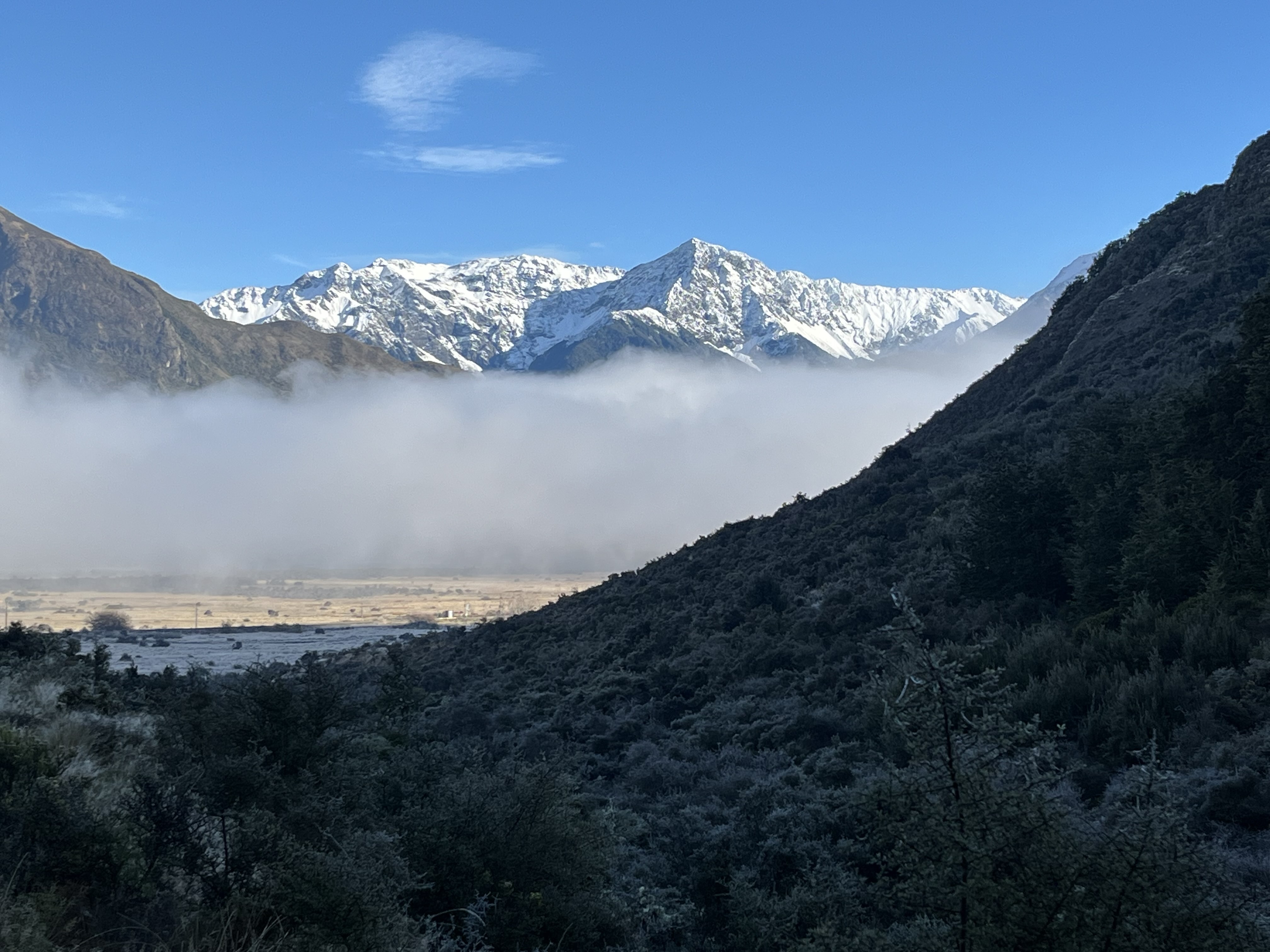
Eleven of us descended on the station on the frosty Saturday morning. Fog enshrouded the mountains, but blue sky above promised a glorious day.
We set a goal for the weekend of increasing the number of iNaturalist observations at Cass to 4,000 and the number of species observed there to 800. Then we embarked on forays into the bush and across the outwash fan to search for life.
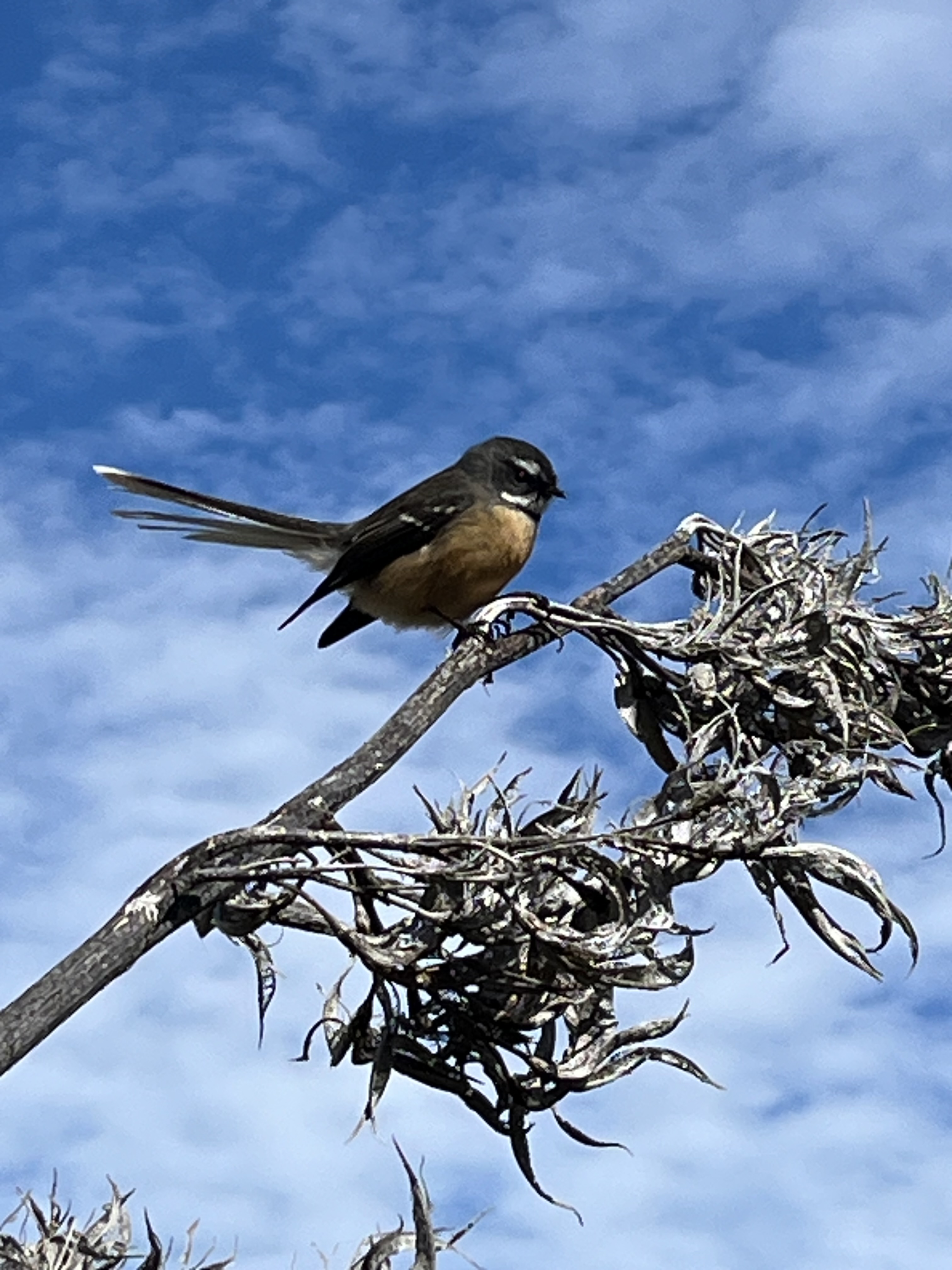
I was stuck near the station, because my knee hadn’t yet healed from the previous week’s tramp. But my geographical constraints didn’t prevent me from plenty of discoveries. Instead, it forced me to focus on the small and overlooked species. Mites, springtails, slugs … all manner of life abounds nearby and underfoot.
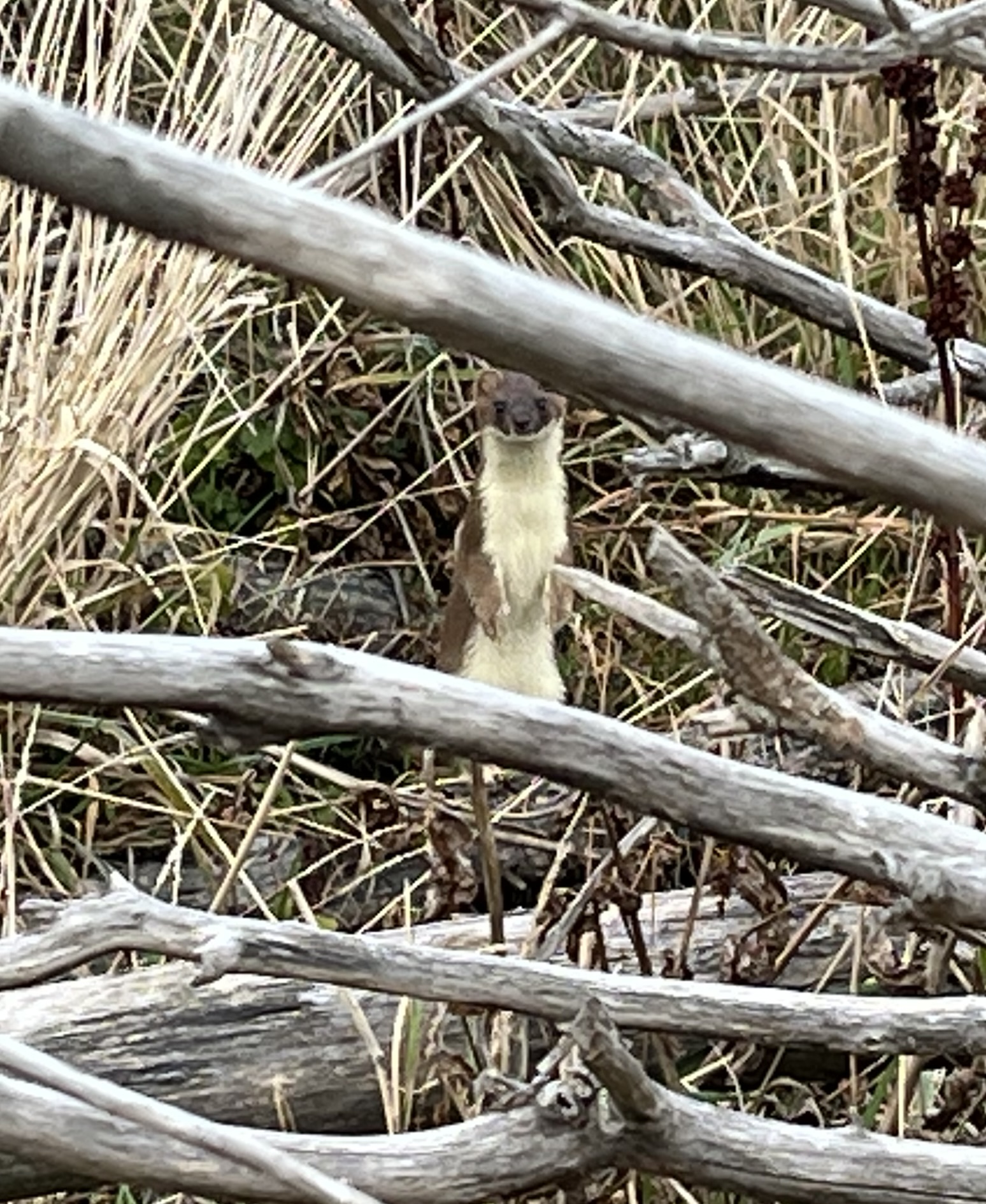
And because I was spending much of my time quietly turning over stones and picking apart rotting logs, larger organisms came to investigate me, including a pair of curious stoats who spent five minutes scurrying around me and popping up out of the vegetation to spy on me. In spite of the fact stoats are terrible pests here, and I would happily kill them, the encounter was pure magic.
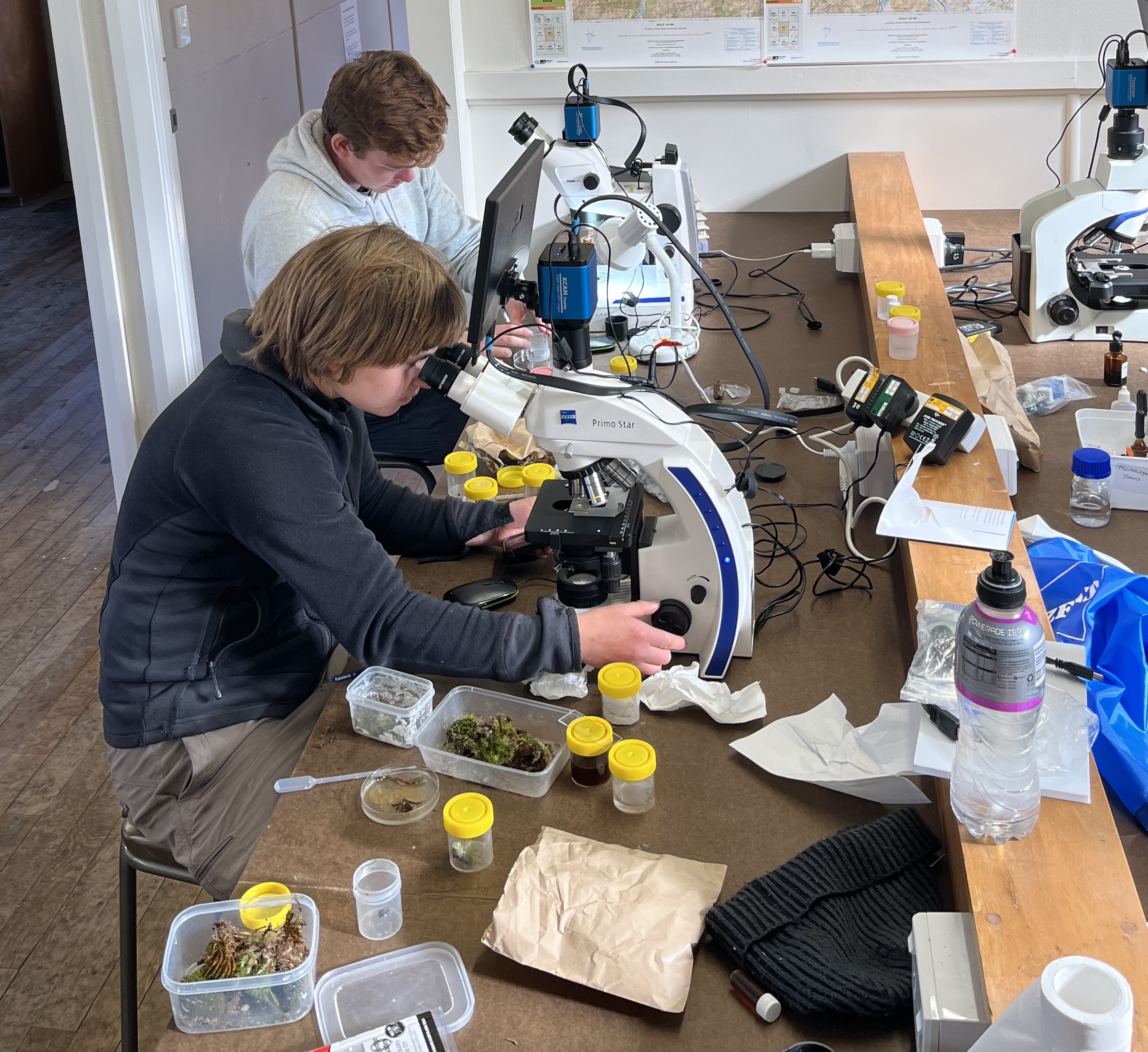
As people returned to the station laden with stories, photos and samples, we moved to the microscopes in the lab, where the geek factor was cranked to 11.
“Oh wow! Look at this!” was a common refrain, as we crowded around the microscopes to examine the smaller finds. As dusk fell, we set up light traps for flying insects, to be checked later in the night.
On Sunday, a group ventured into the bush in search of the giant springtail, which was found at last year’s bioblitz. The quest was successful, and although it didn’t add a new species to the list, it was a highlight of the weekend for many.
In early afternoon, after a busy morning, and a lunchtime spent uploading observations to iNaturalist, we headed home, where we continued to upload our observations from the weekend.
When all was done and dusted, the 11 participants made 871 observations of 321 species. Almost 1 out of 3 observations were of organisms new to the Cass list, bringing the totals for Cass Research Station to 4484 observations of 869 species! An amazing result from a spectacular weekend!
The event reminds me again how important university field stations are for fostering science in general. The people at the two bioblitzes I’ve attended at Cass might never have collaborated or shared ideas in their everyday research life, but the research station brought them together in an atmosphere that fosters collaboration. The research station is a place where scientific curiosity can flourish, where scientists can explore the connections among disciplines and research projects. What an incredible asset for the university!
It’s been a difficult week for me and technology. On day two of my two-week break from my day job, my ten-year-old laptop died. I’d hoped to finish the first draft of the novel I’m working on during my break. No such luck.
This week’s entertainment.
On the same day that my laptop died, my phone had to be recharged four times, because the battery was draining completely every couple of hours, even when I wasn’t using it.
So it’s been a very expensive and frustrating week, and now I have a new phone and a new laptop. I will admit it is nice to not have to carry an extra battery for the phone with me all the time, and it’s nice to have a computer with a fully functioning keyboard, but the upgrades have been quite disturbing, too.
Having not updated my devices for a decade, all my apps were old versions. The new ones have a zillion more features than I’m used to. Almost none of the new features increase the apps’ functionality. The ‘upgrades’ are primarily aimed at urging me to consume more advertisements on my device and making it easier for me to spend money. I find it quite depressing.
The rebellious part of me has decided that, in response to the upgrades, I’m going to do my best to spend even less time on my devices. The computer is pretty well unavoidable, because of my occupation, and I’ve never been one to spend personal time on the computer. But the phone tends to be what I grab during my leisure time. I admit, I have six different e-reader apps on the phone, and I read tons of ebooks, which is what occupies most of my phone time. But I also play a couple of games on the phone, and I read the news. I’m easily sucked into social media on the phone, too. So there’s lots of room to limit my phone use.
First job was to delete the games. I’d already deleted one, several weeks ago, because I realised I was using it to procrastinate, and I didn’t even really like it. I haven’t missed it at all. So the other two games have now gone.
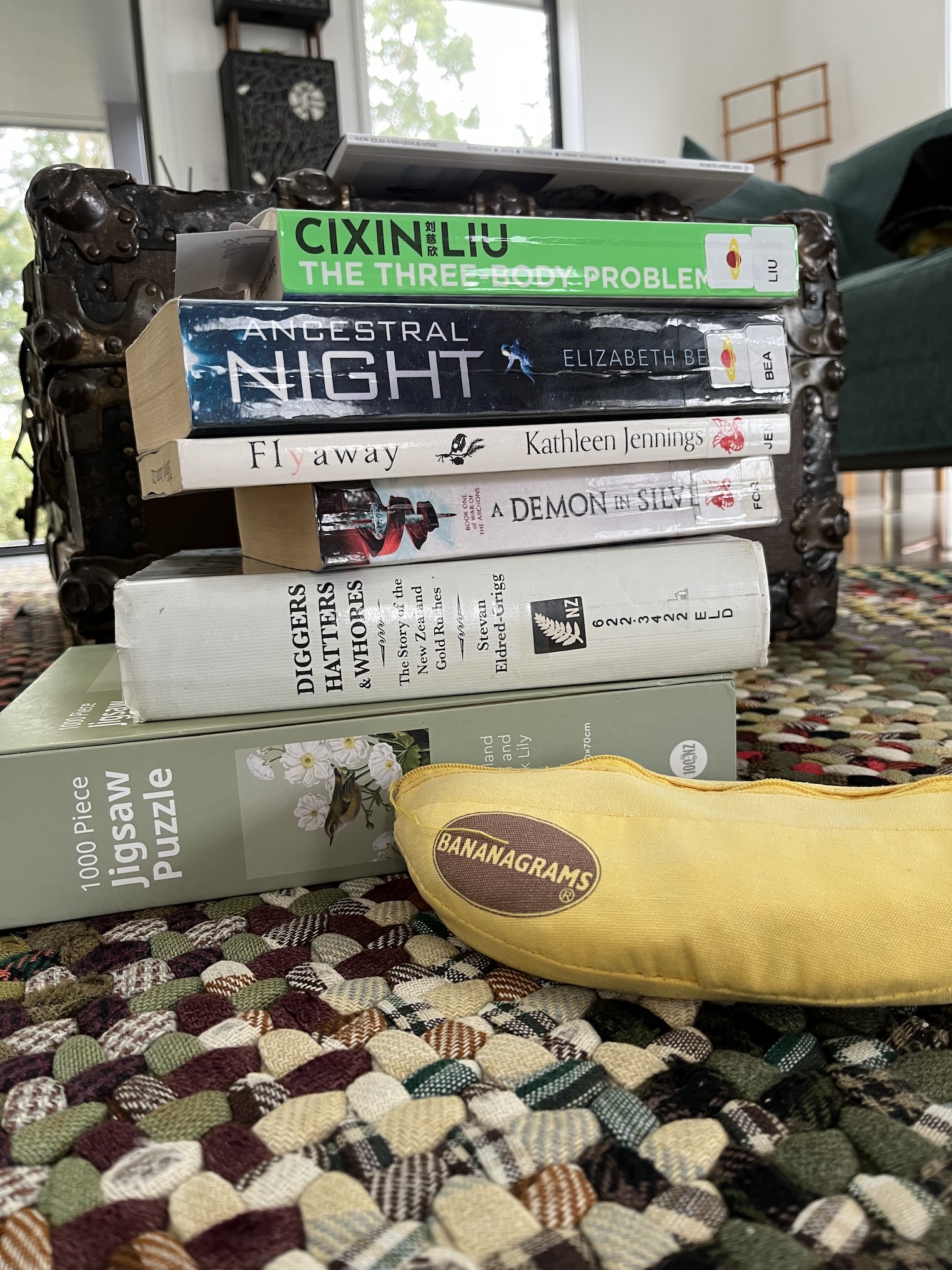
Then, while I was out and about this morning, I stopped by the library. I checked out an armload of books, and also a jigsaw puzzle. Books are fantastic, but I do need the brain rest that those games on the phone or scrolling social media provide. Jigsaw puzzles will serve the same purpose, with the bonus that a jigsaw comes without advertisements and auto-play videos, and invites others to join in the fun.
I also need to remember my love of playing solitary Bananagrams. It’s not as fun as facing off in a frenetic game with my daughter, but I enjoy coming up with different challenges. Last night I tried making the densest board I could, with nearly every letter forming part of two words. Way more rewarding than scrolling through Facebook trying to find posts by my actual friends between drifts of advertisements.
Will I still read the newspapers on my phone? Yep. And I’ll still carry it with me, in order to stay in touch with my family and take photos. And I’ll maintain my presence on social media (not that I use it much in the first place). But I reject my new apps’ insistence that I share more information with them so they can feed me advertisements. I reject Apple Pay. I reject the notion that my phone is there for the purpose of selling me more and more and more things I don’t need. I reject the assumption that I will blindly agree to be nothing but a source of income for corporate executives.
My entertainment is going analog.
Will my stand have any impact on the Mark Zuckerbergs of the world? Nope. But it will have an impact on me.
Some years still feel summery at the equinox, but this year, the weather is decidedly autumnal. Monday, we hit our highest temperature of the summer—a blustery nor’westerly day that had my students wilting by 10 in the morning. It was 31 degrees at 5 pm when we left work. Dinner was a summer feast of sweet corn, soybeans and zucchini.
We slept with the windows open, covers kicked aside on Monday night.
Tuesday morning, I went out in the dark to water the plants at about 5.30. It was still 23 degrees. As I watered, the wind shifted.
By the time I left for work an hour and a half later, the temperature had dropped to 16, and rain spattered the windshield in fits and starts.
By ten o’clock, the skies had opened up. Wind drove the rain in sheets, and the temperature continued its slide downward.
Driving home from work, the temperature registered 11 degrees. Traffic moved slowly through the downpour, wind rocking the car and thrashing trees alongside the road. When I got home, I stripped off my rain soaked cotton clothes and replaced them with cosy wool. We had potato soup for dinner.
We woke on Wednesday morning to full autumn. Summer had been scoured away by over 40 mm of rain, and stripped bare by gale force winds.
A dramatic entrance for the season. But the truth is, autumn was already well underway. Our first frost came weeks ago, on 6 March. I picked the pumpkins last weekend. And the zucchini, tomatoes and other summer-loving plants were all showing signs of being nearly done for the season.
And, of course, squirrelly me has been in autumn mode for weeks, preserving everything I can in preparation for the dark days ahead.
Today we step into the dark side of the year. Although I very much enjoyed our last couple days of hot summer sun (and today promises some beautiful sunshine), I’m looking forward to all that the dark side has to offer.
This year was something of a milestone—it was the first year in about 16 that we didn’t do a pre-Christmas backpacking trip with the kids. It was bound to happen sometime soon, since the kids are all grown up now and doing their own things.
Instead, my husband and I had a post-Christmas hike all on our own. Let me say right now that I loved tramping with the kids, but doing the Christmas hike with just my husband was REALLY nice—just like old times … except that we’re a lot older. It was nice hiking at 54-year-old pace (instead of being dragged along by impatient 20-something kids), and we could also go places that appealed to us, without considering if the kids would enjoy it.
So we stayed relatively close to home, but took a route we hadn’t ever explored.
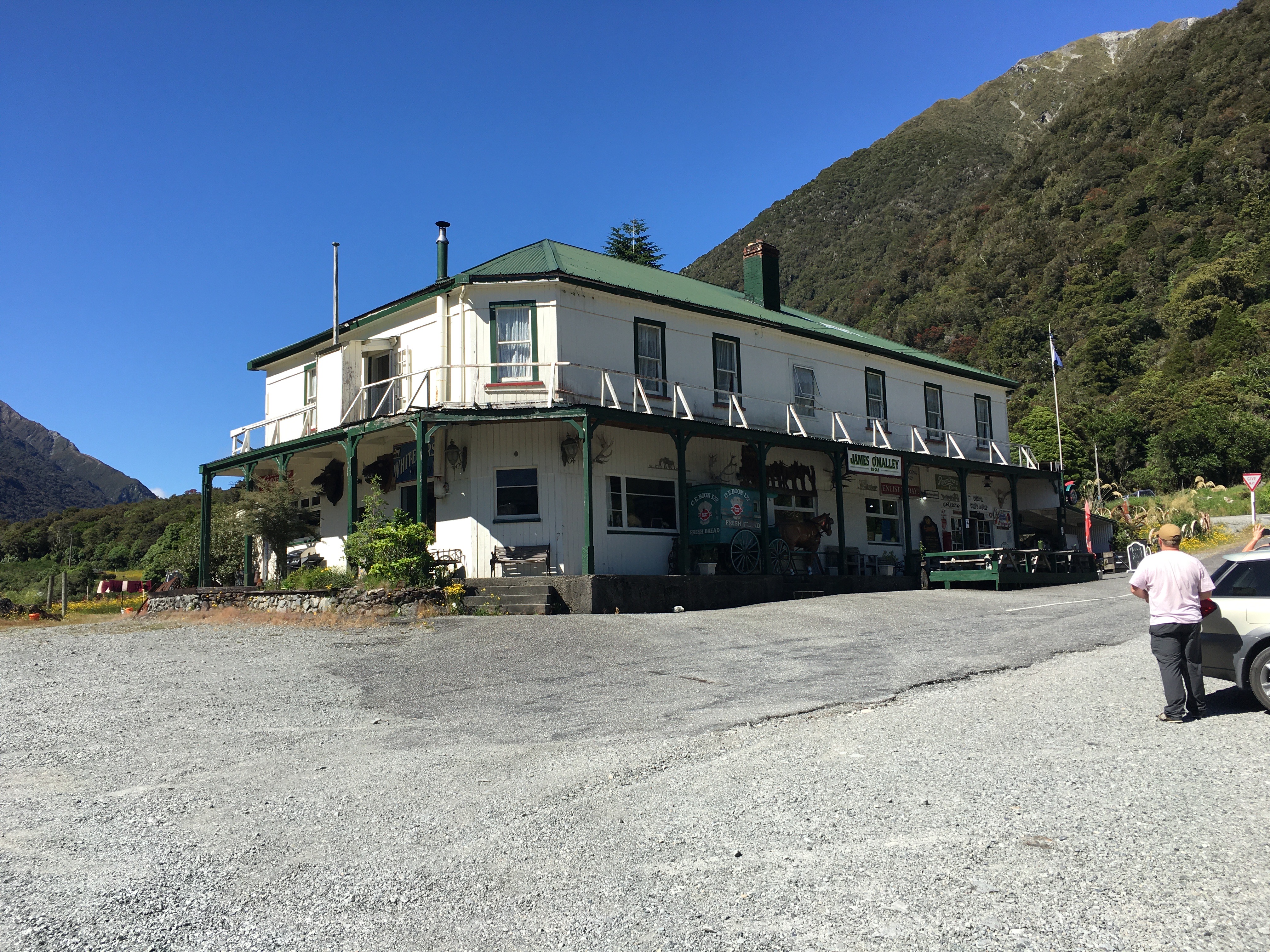
Day one began with dropping a car at the far end of our hike, near Kelly Creek. There was a bit of faffing around to charge the electric car (with the charger in Arthur’s Pass out of order, and the one in Otira busy), but it gave us an excuse to have a coffee at the Otira Hotel, which is an experience of its own.
Then we drove back to the Waimakariri River, parked car number two at Klondyke Corner, and hiked up the Waimakariri to Carrington Hut.
This hike is a bit of a slog and involves crossing the river a couple of times. In fact, the first river crossing comes within the first five minutes of hiking, which was fine—we were going to spend four and a half days walking rivers. There was no way we were going to have dry feet.
In spite of the dull nature of the actual hiking up to Carrington Hut, the scenery is fabulous, and only improves as you go further up the watershed. We were lucky to have a tern hunting the river alongside of us for a while, and we scared up a pair of banded dotterels, too.
After passing Anti Crow Hut, we left the riverbed to follow a track over a couple of roche moutonnée—rocky mounds left behind by glaciation. A series of tarns on the mounds give them a magical sort of quality, and the short break from river walking is nice.
The last time we were at Carrington Hut, it was incredibly crowded and unpleasant, so we carried a tent this time, just in case. But the 36-bunk hut housed only five of us that night, and we barely saw one another.
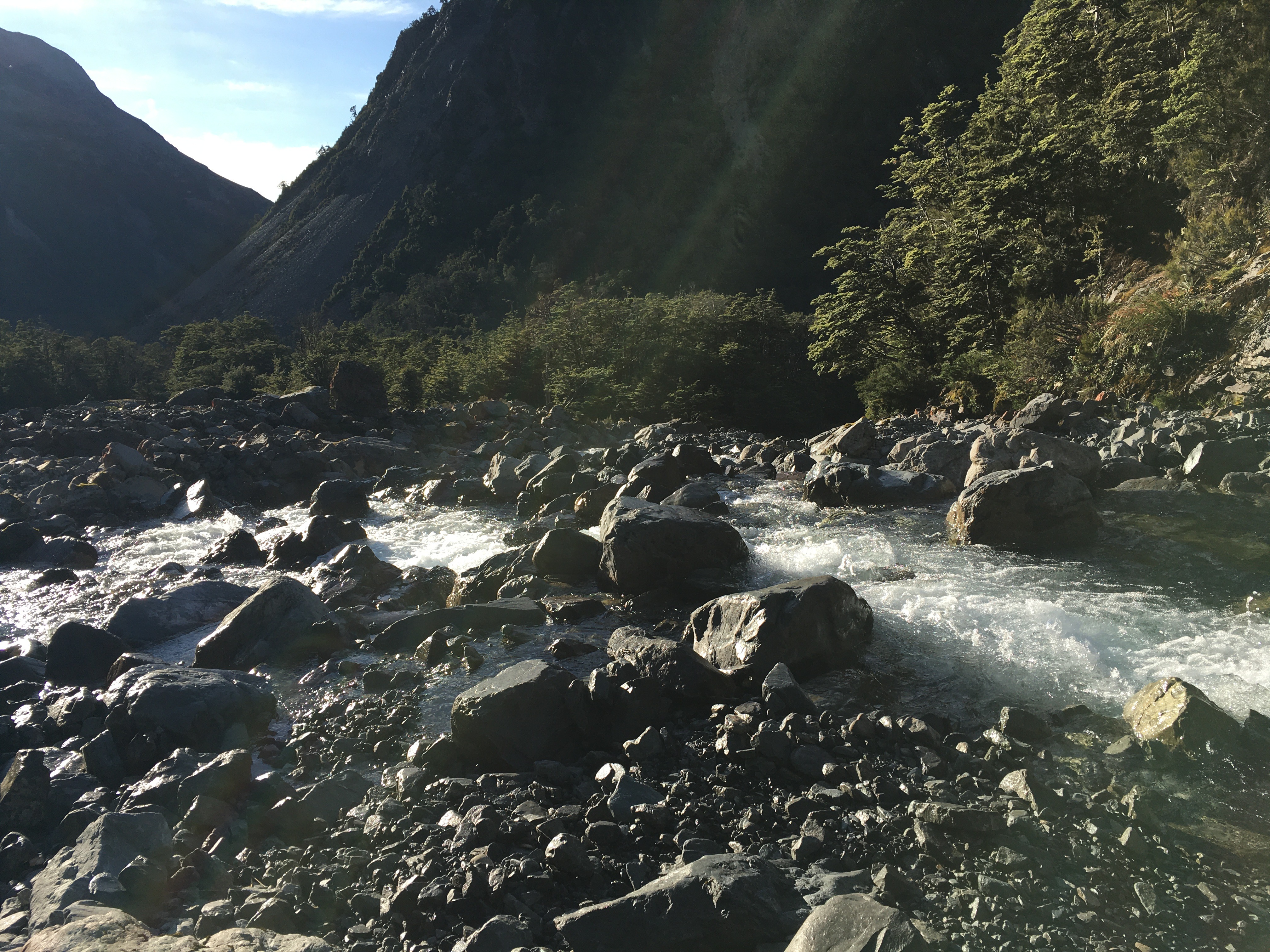
Day 2, we hiked over Harman Pass—up the Taipoiti River (click here for a video), then down Mary Creek. Again, the first act of the day was crossing a river, and then it was river crossings all day, back and forth across the Taipoiti as it rushed through a narrow valley which at times could be more properly called a gorge. It was another fabulous day, weather-wise, and the scenery was spectacular. So were the alpine plants. It seemed like EVERYTHING was in flower, and it was a slow hike up to the pass, because we were photographing all the way.
At the pass, we took a little jaunt up to see some tarns higher up, and then hung out for a while with a curious kea (click here for a video). Kea are an odd mix of highly endangered (there are 1,000-5,000 of them left), and incredibly pesky, thanks to their intelligence, curiosity and a beak shaped like a giant can opener (their peskiness is unfortunately part of the reason they’re endangered). The world’s only alpine parrot, it’s common to encounter them at elevation near Arthur’s Pass, but it never gets old.
Mary Creek was more of the same—river crossings, beautiful scenery, endangered birds. We spent some time watching a pair of whio (blue ducks) having a nap on a rock in the middle of the stream. There are only 3000 whio left and unfortunately the population is skewed strongly to males, because females are vulnerable to introduced predators when sitting on the nest. We were lucky enough to encounter two pairs on our trip.
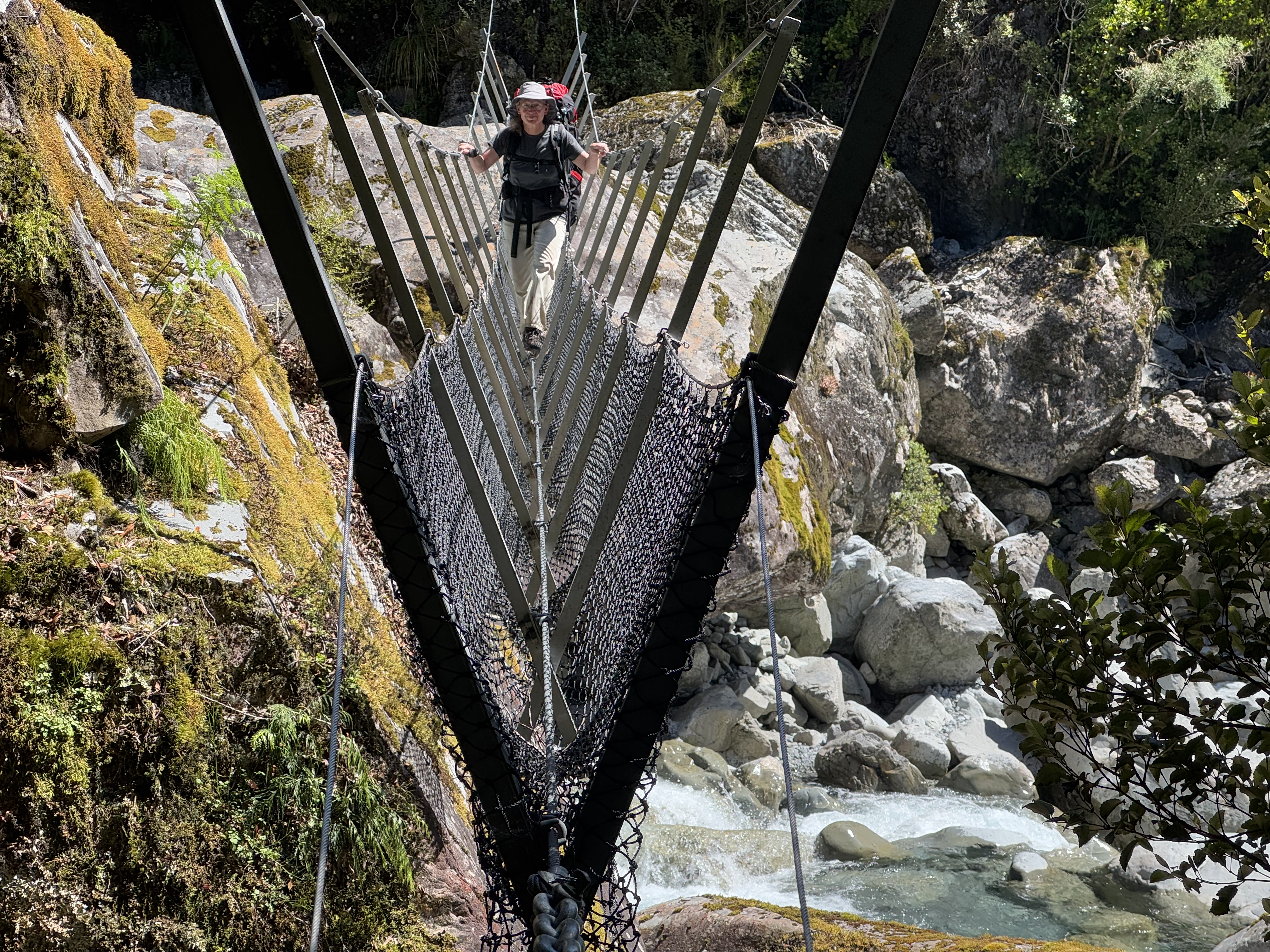
After a 3-wire bridge crossing at the bottom of Mary Creek, we arrived at Julia Hut. The hut is relatively small, and with another couple there already, we decided to tent. After setting up the tent and settling in, we had the rest of the sunny afternoon to explore. A natural hot spring was our destination. Only five minutes walk from the hut, next to the icy, swiftly flowing Julia Creek (click here for a video), the hot pool did not disappoint. It was initially too hot to sit in, and we had to redirect some river water into it to temper the heat.
After a sweaty hike, I have to say I wasn’t all that interested in sitting in a hot pool, but I took a dunk in the river first, and then the hot pool was pretty nice. You couldn’t fault the setting—two days hike from a road, on an absolutely stunning mountain stream in the bush. It beat Hanmer Springs by a mile!
There is clearly a lot of geothermal activity in the area—the smell of sulphur was prevalent all along Julia Creek—and I suspect if you fossicked around, you’d find more hot pools.
Day 3 was a lot of river walking (again), punctuated by a couple more three-wire bridges. We hiked down Julia Creek and the Taipo River to Dillon Hut. Well, we intended to stay at Dillon Hut, but when we arrived we were informed by a very cute four-year-old that there were ‘no more mattresses’ (Dillon hut is only a 2-hour hike from the road, and is clearly a great destination for a short family hike). So we moved on to Dillon Homestead Hut, just 500 metres down the track.
Dillon Homestead Hut is just that—an old homestead. Built of hand-hewn timber and clad in whatever the original owners could scrounge, it is quite the historical experience to spend the night there. It’s clearly beloved by local four-wheel drivers and dirt bikers, but is in sore need of some upkeep. Still, it was shelter when the skies opened up and dumped rain all night, and if it had been cold, there was a big open fireplace surrounded by three tatty, 1950s-era armchairs. And once you brushed the rat droppings off the sleeping platforms, tables and chairs, it had everything you needed to spend the night.
Fortunately the rats weren’t as active inside the hut as I had feared, and we spent a reasonably comfortable night (if a bit smelly) in the hut. In the morning, however, I trudged out to the long drop through soaking wet, waist-high grass. The loo is as old as the hut, and was stocked with three mouldy, rat-poo-festooned rolls of toilet paper. I didn’t stop to investigate the myriad spider webs (there may have been some interesting native spiders), but in retrospect I should have inspected my surroundings a bit more. Leaving the door open for light and ventilation, I dropped my pants to do my business.
A scuttling overhead was all the warning I got before a rat leapt out of the rafters and landed on my head. I may have sworn. But the four-letter word had barely left my lips before the rat was off again, leaping for the toilet seat and then the floor before racing off into the bush.
So, a warning to you—the Dillon Homestead Hut loo is guarded by an attack rat.
After that exciting start, the rest of Day four was a hard climb. From Dillon Homestead Hut, we followed Seven Mile Creek briefly to a track that climbs steeply through dense west coast forest up to the Kelly Range. It was dark and humid in the forest. At one point, the track passed through a narrow gorge that was almost tunnel-like. It felt like we were crawling uphill, and often it was literally true, as it took both hands and feet. Pīwakawaka kept flitting around us, taunting us with their darting flight and chittering voices—what was so difficult about this slope, they seemed to ask.
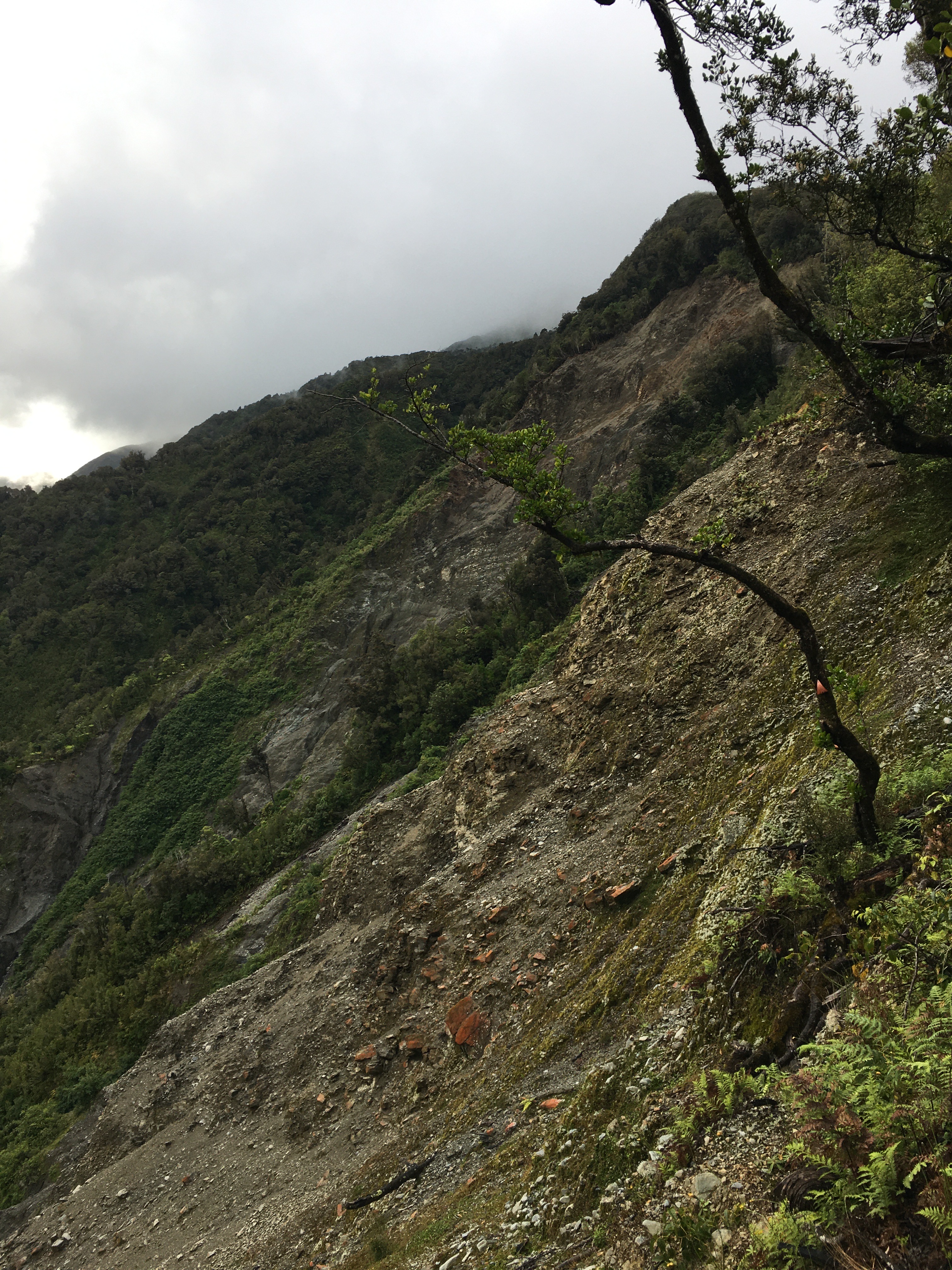
At one point, the track met a huge slip hundreds of metres across and hundreds of metres tall. A blaze remained on a lone tree suspended at the top of the slip. The rerouted track scrambled precariously around the top of the slip, and I breathed easier once we were past it.
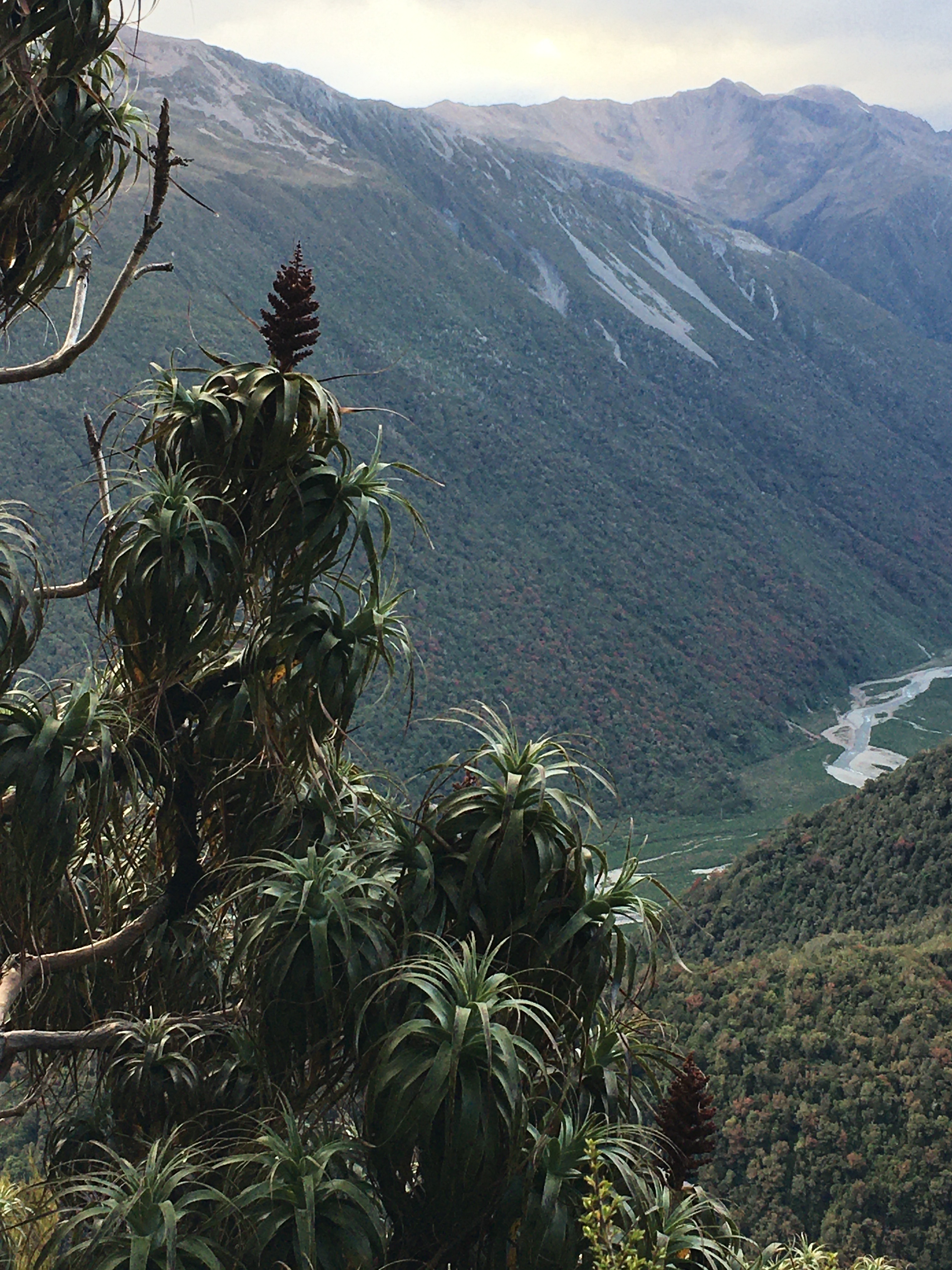
After 700 metres of elevation gain, we reached tree line and got a view back down to where we’d come from that morning—it was a long way down, and we still had more climbing to do.
The tops were dotted with tarns, and even where there wasn’t standing water, it was wet. We walked through fields of sundew plants, and took our breaks amid alpine orchids and daisies.
Clouds prevented us from having great views, but turned the views we did have into a dramatic, ever-changing landscape. By the time we’d reached the top of our climb—a thousand metres above Dillon Homestead Hut—the clouds were swirling around us.
A relatively short descent brought us to Caroll Hut just as the first raindrops began to fall. We had a late lunch of soup and peanut butter crackers as the wind picked up and the rain lashed the hut.
We shared Caroll Hut with a UK expat who lives in Wellington, a pair from Whanganui, and a fellow from Adelaide. It was a great mix, and we had a nice afternoon and evening chatting with them all. The best of hut life.
All night the wind howled, and I was thankful for the steel cables tethering the hut in place. Although the rain ended before dark, the wind continued through to morning, so it was a cold and windy start to Day 5. An early morning treat at the hut was a family of weka with fluffy chicks fossicking around the hut.
Day 5 was a short (hour and a half) jaunt out to the road from Caroll Hut. The ‘jaunt’ involved a good 800 metre elevation change, steeply downhill, but not bad going, with some nice views from time to time. And just when we thought we were done with wet boots, there was a stream crossing in the last 20 metres.
We were home by lunchtime, wet and tired, but having had an excellent five days. It was a fabulous way to spend the Christmas-New Year gap.
Today is Thanksgiving in the United States. Since we’ve been in Aotearoa New Zealand, we don’t celebrate the holiday—who has a harvest festival in springtime? Add to the seasonal disconnect the dumpster fire that is world politics at the moment, and you could be forgiven for not feeling terribly thankful this Thanksgiving.
But it’s good to set aside all the frustrations in life (like the frost that has hit the vegetable seedlings every single night since our ‘frost free’ date), and reflect on the good things.
This Thanksgiving, I am thankful for a multitude of things …
My coworkers at my day job—teachers, teaching assistants, and support staff—who are all absolute legends, working under stressful conditions for lousy pay, usually without any recognition of the amazing work they do.
The fellow authors in various author communities I’m a part of, who are supportive of all writers and work together to support, encourage, and promote authors, books, and reading. You are rock stars!
The members of my local garden group, who share freely of their gardens, knowledge, and experience. You are inspiring!
My garden. Maybe it is weird to be thankful for it, because it doesn’t just happen—my husband and I have worked hard to turn this sad paddock into an oasis of food and flowers. But I am thankful for all the plants and soil organisms that have worked with us to make our efforts pay off.
My husband, who is my best friend, greatest fan, and partner in all things.
My kids, whose passion for the people and the world around them remind me that all is not lost yet.
Do you notice the pattern? It’s all about communities—of people, of living things.
I don’t know what’s going to happen in the world over the next few years. Much of it will be pretty bad, I’m guessing. But there are communities around us working for good. There are people who want all our tamariki to be able to read, to have healthy food to eat, clean water to drink, health care and mental health support. There are people around us who don’t think in terms of ‘us’ and ‘them’, but embrace humanity as a whole, in all its diversity. There are people everywhere who care about the people and the world around them.
I am so thankful that these people exist. I am thankful to be part of some of the communities who put this caring into practice in their daily lives.
So, while the world burns around us, I give thanks for the small communities that work tirelessly to put out the fires.
I was cleaning out my purse this morning and noticed I had two notebooks in there. It seemed excessive, even for me. So I paged through them both to see which had more empty pages. As I did, I happened across this little gem of a poem, scribbled down at some point. I don’t remember when. Most of my on-the-road scribbles are just kernels of ideas and need lots of work or fleshing out, but I thought this was pretty good for an on-the-fly poem.
It was certainly better than the sticky old mints that had fallen out of their package and were lying at the bottom of the purse …
So I thought I’d share the poem (the mints went into the rubbish).
Late night on the Interstellar Highway
Twin lights glitter
Down the long corridor of black
You are not alone, then.
Or you are more lonely than before,
Screaming through the void
Of interstellar space.
The long road trip
Without a yellow line.
Without the neon
Of a late-night diner.
Without a single signpost
Saying Earth 2 million km
Keep left.
You hail the approaching ship--
Regulation words
Generated by your onboard computer,
Acknowledged by the other ship’s computer.
No life forms involved.
You blink and they are gone,
Not even the friendly spray of gravel
To crack your windshield.
And you remember fondly
The stifling days of youth
When you chafed
Under Mum’s touch.
The embraces you shrugged off
Were priceless.
The currency of the traveller
Light years from home.
Today is Thanksgiving Day in the U.S. Although my husband and I don’t celebrate the day here with a gathering of friends and family, pumpkin pie out of season, and imported cranberry sauce like some American expats, I still like to take the day to give thanks.
Today I’m particularly thankful for a number of things. I’ve been home sick all week. Today is day nine of this miserable head cold and it’s getting really old. After more than a week of all the joys a bad cold can offer, I am incredibly thankful for the luxury of taking time off work when I’m sick.
I’m thankful for the riotous display of flowers outside my office window, which made me smile in spite of feeling crummy. I am also thankful for the vegetable garden’s springtime bounty, which allowed me to hole up at home without need for a trip to the grocery store. I’m thankful for the neighbour who brought me lemons, knowing I was sick. I’m thankful for the warm sunshine I sat in at lunchtimes this week.
Today, wild wind and rain are pounding the garden and house. So today I am thankful for the rain—it was much needed. I am also thankful for a roof that doesn’t leak, and snug windows and doors through which the southerly wind can’t whistle.
Those are the little things, of course. With the drumbeat of war and disaster in the news, I’m also keenly aware of and thankful for the safety and stability of my life. My easy access to food and water. My ability to plant a garden and expect to be able to harvest it. The opportunity to live in a culture in which most people embrace diversity and treat others with respect.
So, while I’ve had plenty to grumble about this week, I’ve also been blessed in thousands of immeasurable ways, for which I am grateful every day, not just on Thanksgiving.
May your day be filled with things to be thankful for.










 Robinne Weiss