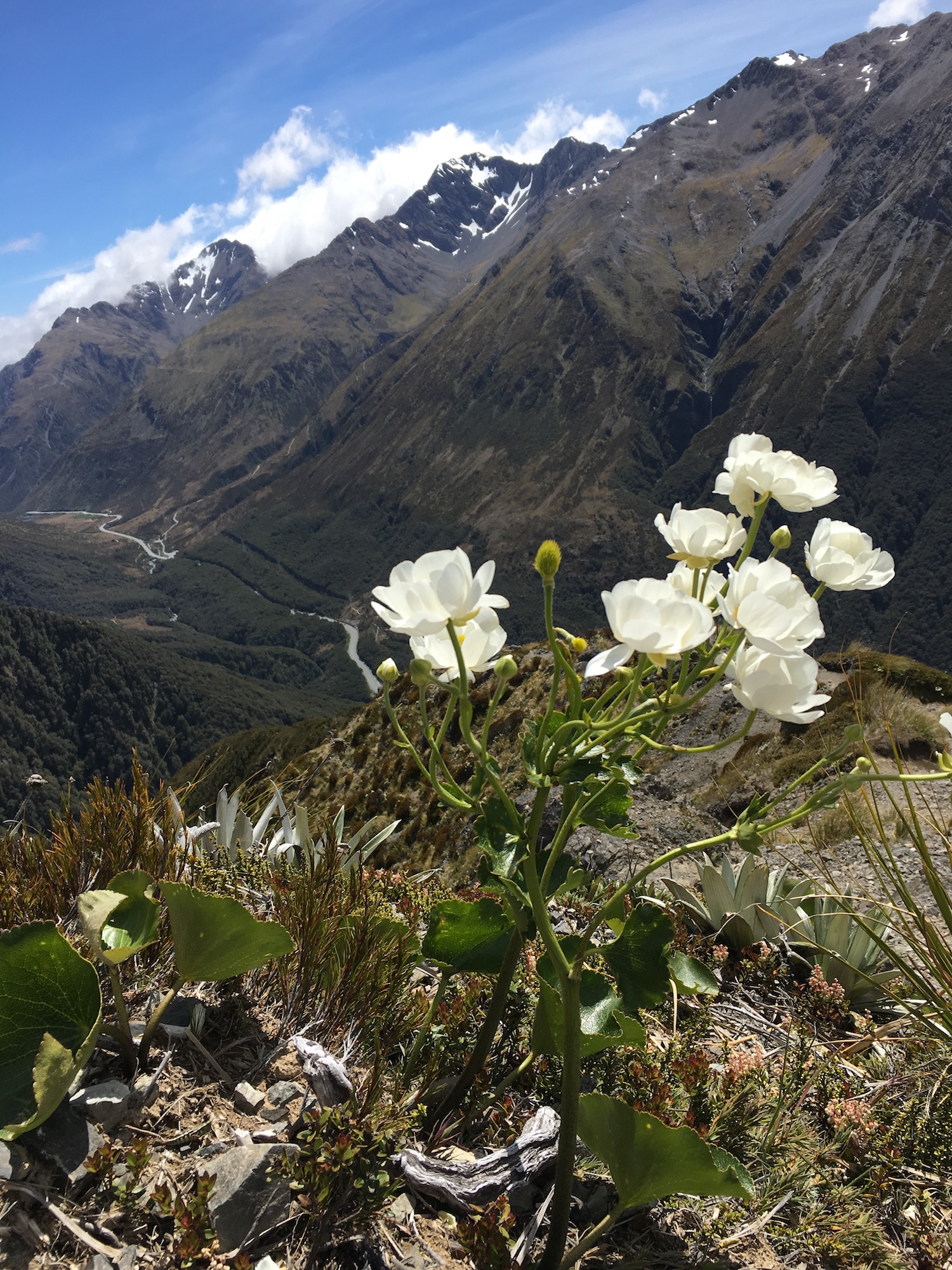
Alpine Delights

The family spent a delightful hour on the Dobson Nature Walk in Arthur’s Pass National Park on Wednesday. The track is an easy one, and hiking it quickly takes about 20 minutes. But it’s not a walk you want to do quickly, especially in summer. It winds through alpine and sub-alpine vegetation, including some beautiful tarns, and in summer, so many plants are blooming, it’s hard to take five steps without finding another lovely orchid, daisy, or hebe in bloom.

For me, the best part of the walk is the abundance of sundews in the tarns. As an entomologist, I’m naturally drawn to carnivorous plants like sundews. Sundews catch insects on the sticky hairs you can see glistening in this photo. The hairs are sensitive to both touch and taste, and when they sense a struggling insect, they fold inward to further entangle their prey. Enzymes exuded by the hairs then digest the insect, and the leaf takes up the nutrients in order to grow in the nutrient-poor alpine wetlands. 

These sundews were just beginning to flower—many plants had flower buds, but none had yet opened. The flowers sit above the leaves—an important adaptation, since the plant needs to be pollinated by the very insects it eats.

The alpine summer is short, so when these plants are done flowering, the leaves will slowly shrink into a structure called a hibernaculum that sits near the soil surface and protects the plant through the winter.

Christmas Baking

When I was a kid, my mother would start her Christmas baking just after Thanksgiving. She’d bake dozens of kinds of cookies and freeze them. For weeks before the big day, there would be a big platter of cookies—a few of each of the types she’d made—out for eating. It was a child’s dream. I don’t remember her making anything but cookies for holiday desserts. We certainly didn’t need anything else, with all those cookies available.

Before moving to New Zealand, my holiday baking was similar (though with only one child eating cookies, I didn’t make quite so many as my mother did—she had three young cookie eaters). But it’s changed a lot since then.

Cookies are made with ingredients that store well—flour, butter, sugar, nuts—that’s great for winter baking, when fresh ingredients are hard to come by. But Christmas falls at the height of the summer fruit season here—it’s no wonder the traditional Christmas dessert here is pavlova—a meringue ring filled with fresh fruit (Unfortunately, I’m really not fond of meringue).

At the moment on our property, we are harvesting black currants, red currants, gooseberries, raspberries, strawberries, cherries, and blueberries. With as much as 10 kilograms of fruit coming in every two days, much of that harvest goes into jam, sauces, chutney, or simply gets frozen for later use. But it would be a shame not to bake with that fruit, in favour of cookies, which I can make any time of the year.

So we’ve been enjoying strawberry shortcake, currant pie, and gooseberry crisp. For breakfast, we’ve been eating waffles smothered in fruit, and muffins studded with fruit. For snacks, and with every meal, we’ve been eating fresh fruit—whatever hasn’t gone into baking or the freezer.

Oh, there are cookies, too (why not?). But it’s the fruit I snitch while walking through the kitchen, and it’s the pie I crave for dessert.

Some day I’ll dispense with the cookies entirely … Maybe I’ll even learn to like pavlova.

Catlin’s River Walk—a little bit of magic

My family and I were in the Catlins last week, in the southeast corner of the South Island. It’s a wild and remote area, home to more penguins and fur seals than humans. No urban adventures here—it’s a place for outdoor recreation.

One of the things we did was to hike part of the Catlins River Track (we didn’t have time to do the full track). It was unlike any other place I’ve been in New Zealand.

In fact, it reminded me most of eastern Pennsylvania, in spite of the fact that it shares not a single common species of plant or animal.

The track follows the Catlins River, a beautiful waterway that cuts through layers of limestone in one little cascade after another. Swing bridges cross the river several times, providing great aerial views of the water (and a little excitement for those who don’t like heights). The forest is old-growth beech which provides habitat for myriad native birds, carefully protected by intensive predator control. 

In addition to the beech, we were delighted to see two species of orchid on the forest floor, red-flowered mistletoes in the treetops, several species of slime mould, some lovely mushrooms, and a beautiful native harvestman. The birdlife was noisy and varied, but we weren’t lucky enough to see any endangered mohua. And, amazingly, there wasn’t a single sandfly! 

The whole effect was one of an enchanted forest. We were certainly enchanted.

The track is relatively flat—easy hiking for kids or those who can’t face the usual Kiwi hiking track going straight up a mountain, and because there’s no “goal” to reach, you can simply walk as far as you’d like, and then return. The entire length is 12 km one-way, with a return loop option through forestry land away from the river. 

I highly recommend this track. I’ll certainly be going back when I have enough time to do the whole thing.

Knickers for Posterity

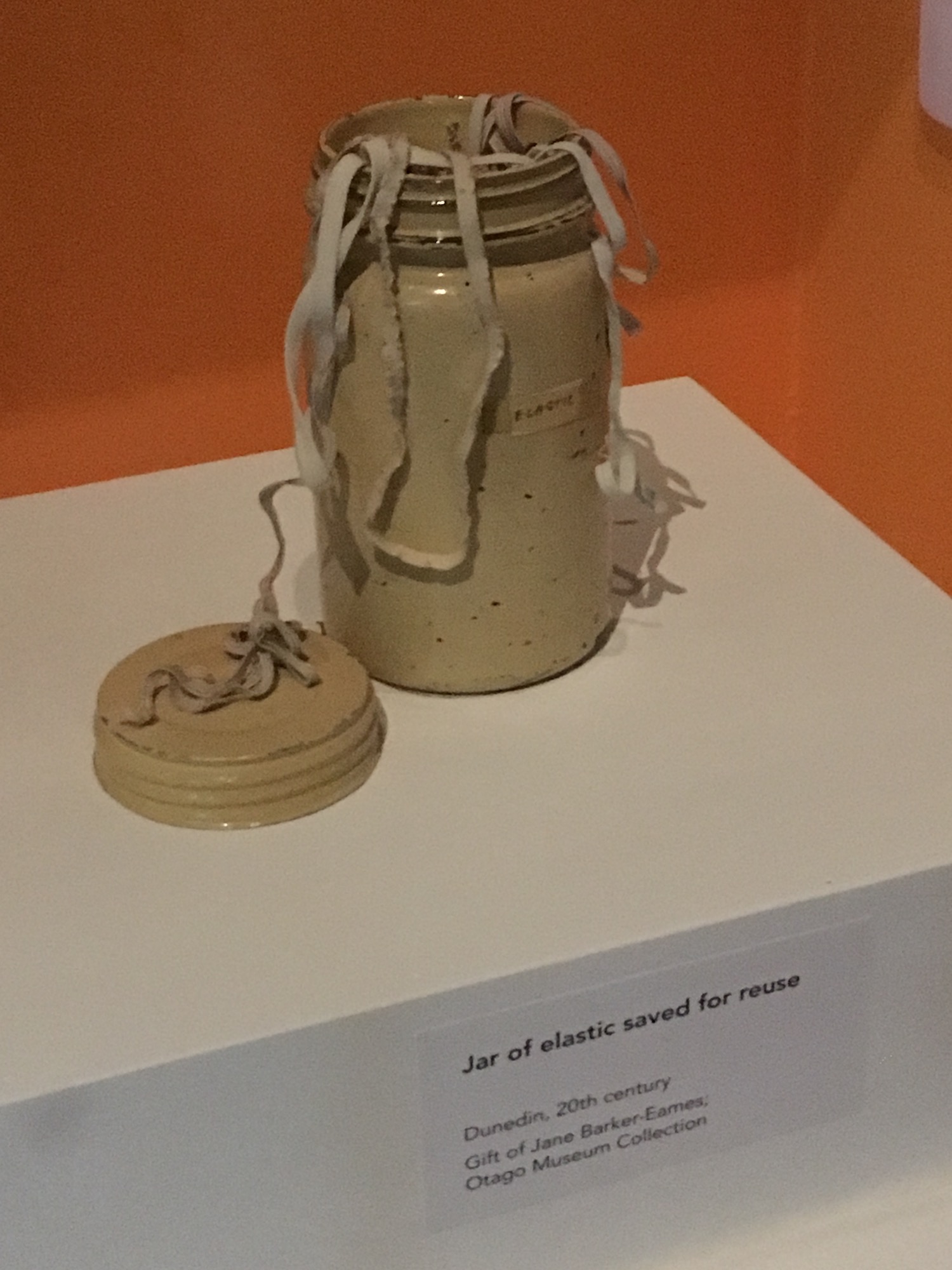
I visited the Otago Museum a few days ago. Among the many artefacts on display, two in particular caught my eye.

The first was a jar of elastic, saved for reuse and donated to the museum by one Jane Barker-Eames. I immediately thought of my grandmother. Every day for at least fifty years, she’s had the paper delivered to her doorstep. Every day she’s taken the rubber band off the rolled-up paper and carefully saved it. By my calculations, that’s over 18,250 rubber bands, dutifully saved for reuse. No doubt many of those rubber bands went on to perform useful tasks elsewhere, but they added up, filling multiple coffee cans (reused, of course), and forming small drifts in kitchen drawers. 

When Grandma recently moved into a rest home, my mother threw away her large rubber band stash (don’t tell Grandma!).

I suspect Jane Barker-Eames was the daughter of a Mrs. Barker, careful re-user of elastic, and that at some point, she faced my own mother’s conundrum—what do do with Mum’s stuff?

Maybe she didn’t even know that jar of elastics was there, tucked inside a sagging cardboard box in the attic along with a dozen empty thread spools, a moth-eaten sweater, and a small tin of safety pins—the entirety of Mum’s estate was packed off to the Otago Museum. Maybe they could figure out what to do with it.

And upon passing through the museum’s doors, Mum’s stuff was instantly elevated from rubbish to artefact, never to be used again.

I think Mrs. Barker would be disappointed her elastic stash wasn’t used in a new pair of knickers.

And speaking of knickers, the second item that caught my eye was a scrap of woven textile identified as a loincloth. It made me think about the pair of underwear I recently tossed out—the elastic had failed and they no longer stayed up (Where was Mrs. Barker’s elastic when I needed it?). I wondered if the loincloth in the museum had been similarly discarded at the end of its useful life. Little could its wearer have imagined that their dirty old knickers would someday sit enshrined in glass to be ogled at by thousands of people, most of whom would be mortified to have their own underwear similarly on display.

It made me wonder if, someday, my underwear might be displayed alongside Mrs. Barker’s jar of elastic as a lesson in frugal living—for want of a piece of used elastic, this poor 21st-century woman went bare-bottomed. Mrs. Barker, on the other hand, always kept her knickers firmly in place.

Hang on to your elastic, ladies.

The Ghost of Christmas Trees Past

Growing up, my parents had an artificial Christmas tree. It was hauled out of the attic the weekend after Thanksgiving and assembled and decorated, ushering in the Christmas season.

I remember one year having a real tree—I loved the smell in the closed-up winter house.

When my husband and I married, we spent a few years finding our Christmas tree tradition. For the first two years, we had an eight-inch tall artificial tree in our mud house in Panama. After we returned to the US, we wanted something bigger. So we spent months making a six-foot papier-mache tree, binding on raffia needles and painting bark on the branches. It was a labour of love, and we used it until we had to move across the country, and knew it wouldn’t survive the experience. 

Then babies happened, and for a few years, our Christmas trees were real trees—there was no time or energy for creativity in those early years.

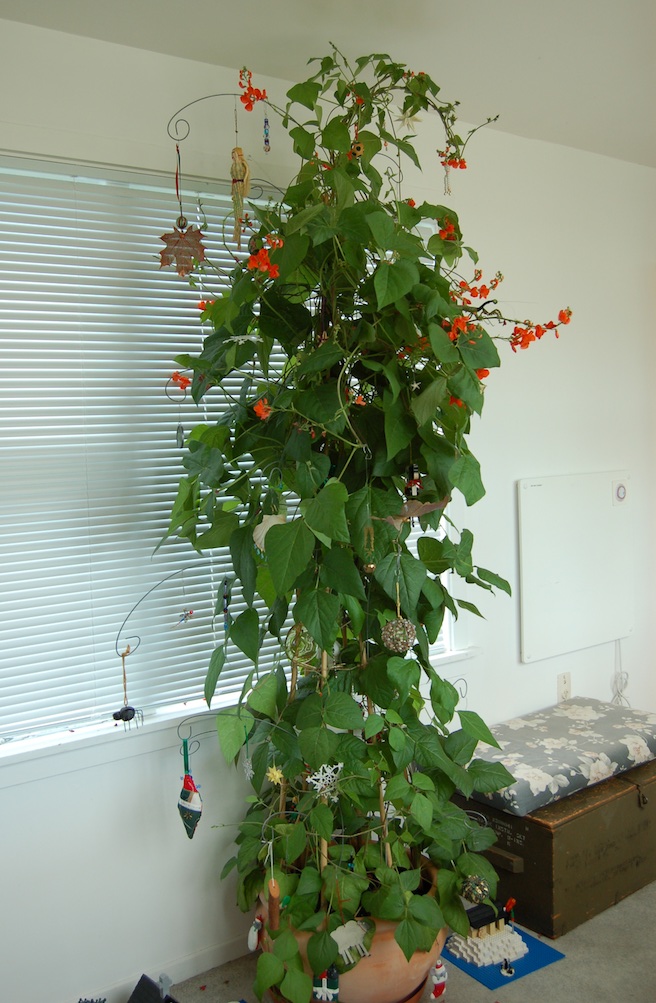
By the time we moved to New Zealand, we were settled into the parent routine enough to be creative again. And summer Christmases invited creativity. We fashioned trees out of driftwood, dead branches pruned off trees in the yard, an old fishing net, fencing wire and flax stalks, copper plumbing, live runner beans—most trees were inspired by what was lying around the property at the time.

Last year, we fashioned a DNA strand as a Christmas tree. Elegant and simple.

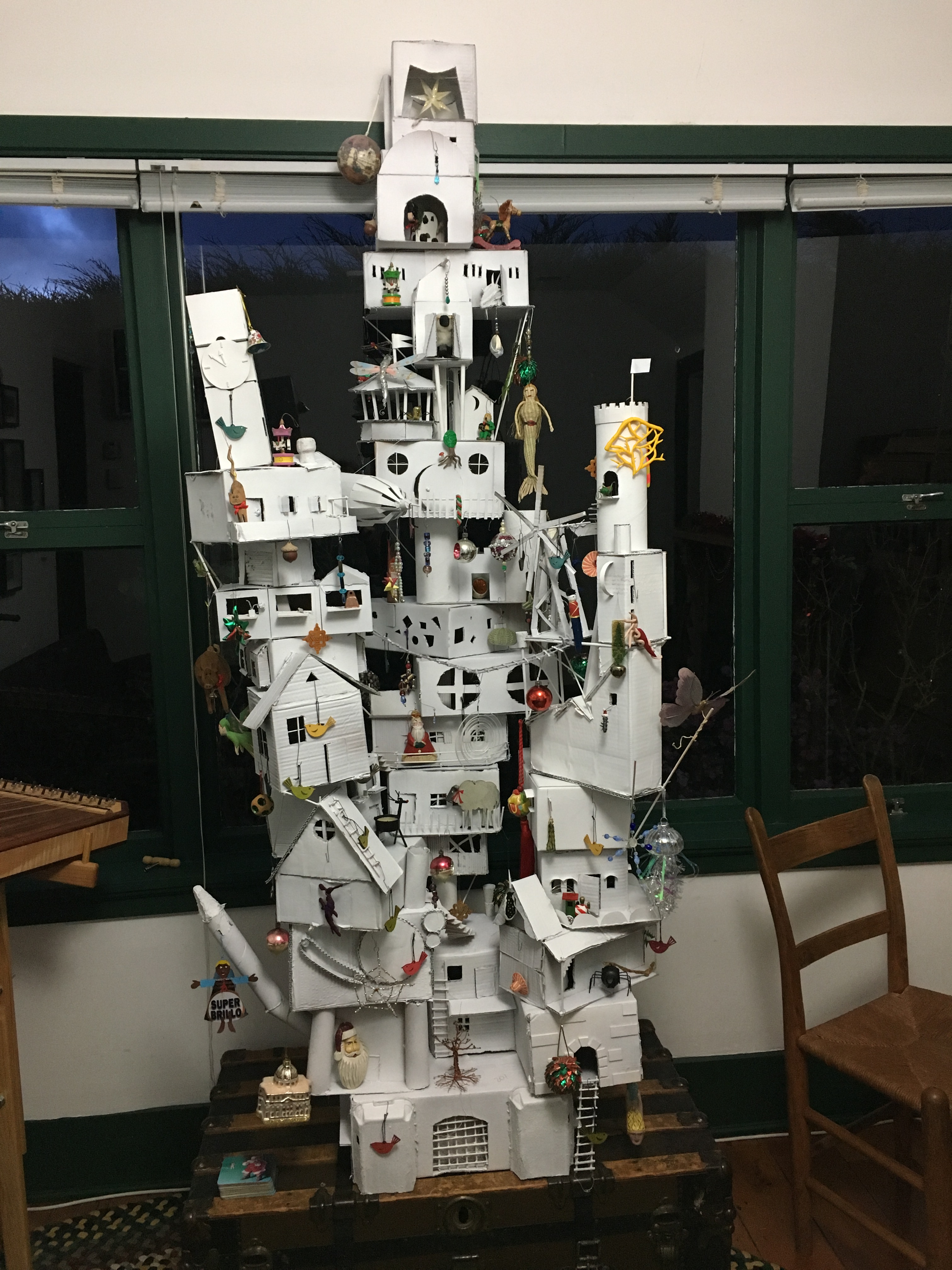
This year, we went for crazy, creating an architectural monstrosity from cardboard boxes.

You might wonder what the point is—wouldn’t it be easier and more, well, Christmasy to do a more traditional tree? Yes. But what is a Christmas tree for?

I view a Christmas tree as a focal point—somewhere for family to gather. Our trees have always been decorated with ornaments that have a history—maybe they were made by someone special, or given by a friend, or came from an exotic location. Decorating the tree has always been a time to celebrate the family stories behind the ornaments.

Why shouldn’t that family activity extend to making the tree itself? This year’s tree took a lot of time to make, and we spent several evenings as a whole family working on it—making a tremendous mess of the living room, laughing, and enjoying each other’s company and creativity. That’s exactly what Christmas traditions should do.

So, perhaps our trees don’t meet the traditional definition of a Christmas tree, but I think they embody the spirit of the season.

Summer?

It’s been decidedly un-summer-like recently. We’ve had an exceptionally wet two weeks—there’s a puddle in the yard, Coes Ford is flooded, and weeds and mushrooms are sprouting everywhere.

Fortunately, that hasn’t stopped the strawberries. When my daughter braved the rain to pick, she found a surprising number of slug-bitten but delicious ripe fruits.

Strawberry shortcake for dessert, strawberries on my morning muesli, strawberries every time I walk through the kitchen…it must be summer!

Now, if only we’d see the sun…

A Bird in the Hand

I’ve had two funny encounters with birds recently. Two birds in-the-hand, so to speak.

A few weeks ago I was in town, doing some writing in Hagley Park, because it was a beautiful spring day. I sat down on the grass with my lunch and my laptop.

A few minutes later, I noticed a male European blackbird eyeing me up. He hopped closer, stopping when I met his gaze, but then, deciding I was no threat, sidling even closer. My lunchbox sat open between us, and I knew he was sizing it up.

Well, I don’t feed wildlife in general, and I certainly wasn’t going to feed a non-native invasive bird. Besides, I wanted to eat that lunch myself. I finished off my sandwich and started in on my apple.

The bird watched my every move. When I set the apple into the lunchbox to type, he rushed in. I clapped my hand over the box, and he backed off.

The bird was undeterred. When I brought the apple to my mouth again, he lunged for it. He flew up and took a bite out of it while I was biting the other side. His wingtips brushed my cheeks, he was so close.

Well, how could I refuse after that? I gave him the rest of the apple (which wasn’t much more than core at that point, anyway). 

But I made him work for it.

I put it back in the lunchbox, and set the box next to my leg. And that cheeky bird perched on the lunchbox and ate the rest of the apple. Other birds came to see what he had, but none were brave enough to come close, so he had it all to himself. He was terribly smug about it—quite pleased with himself, I’m sure.

My second recent bird encounter happened last weekend. My husband was mowing the lawn, and there was a fledgling magpie in the way. The magpie wouldn’t move out of the mower’s path, so I tried to shoo it away. It still wouldn’t budge, just cheeped at me, as if to say, “Yeah. What do you want?”

So I gently picked it up to pop it over the fence, out of the way. It gave one alarmed squawk, and suddenly its parents were arrowing straight for me from where they had been feeding in the neighbouring paddock. They swooped and screeched as I walked away, and I had to wave my arms over my head to avoid being pecked. The fledgeling, meanwhile, hopped away as though nothing had happened. I could almost hear him chuckling.

So, yeah, I’ve been had by two birds recently. A human in the beak is worth two in the bush, apparently.

Awesome Alpine Plants

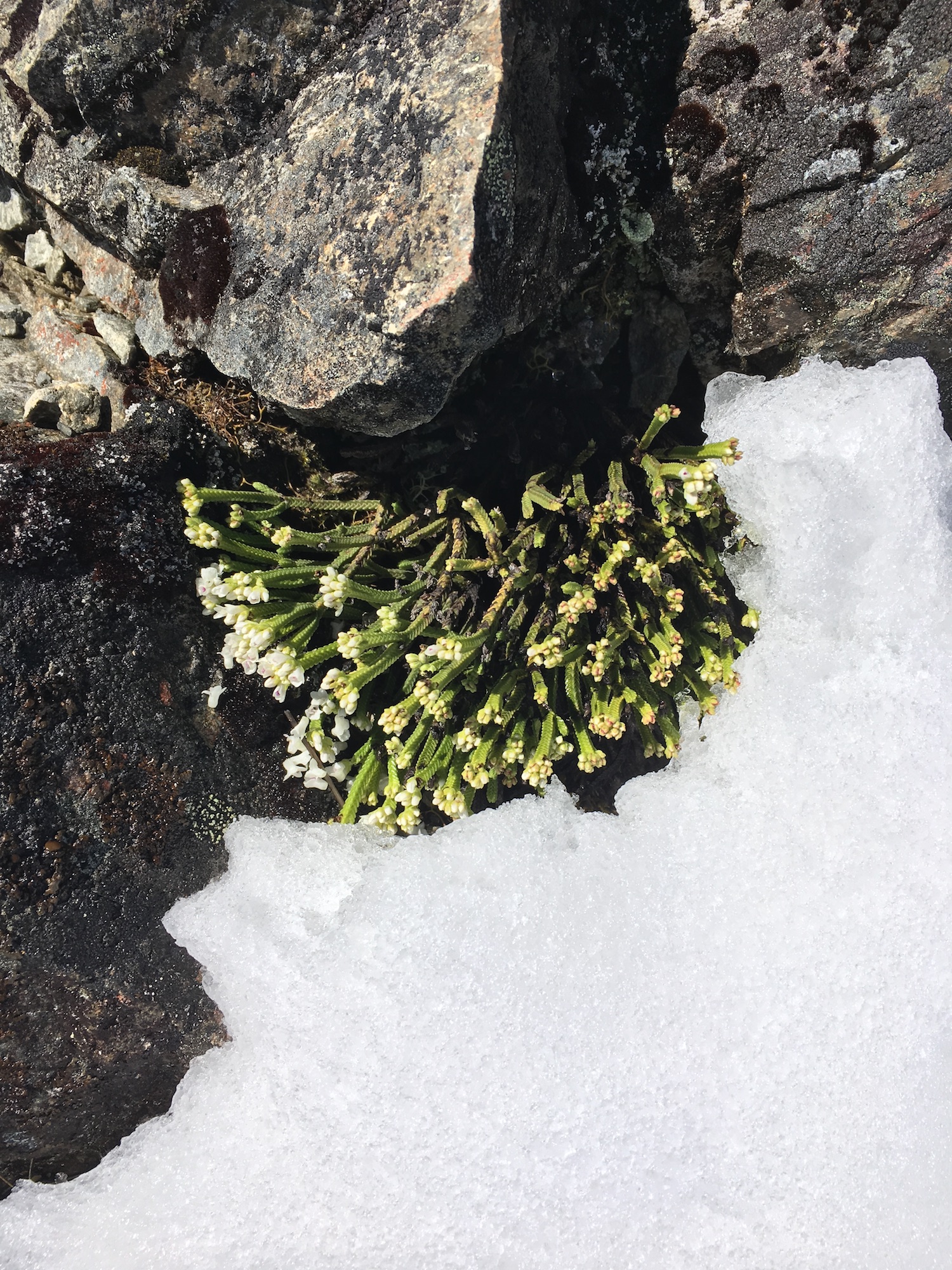
Whipcord hebe flowering in the snow

My daughter and I went for a hike on Saturday after being cooped up in the house all day Friday by a rip-roaring southerly storm. The storm lashed us with rain and hail, but in the mountains, it brought snow. Saturday morning, the beech forest at Cragieburn Forest Park was a winter wonderland.

Climbing up out of the forest into the alpine areas, the intensity of the storm was clear—thigh-deep drifts filled the path in some places, while other areas had been blown clear down to the scree. Every tussock had a long train of sculpted snow on its leeward side, so you could almost feel the howling wind and the sting of blowing snow, in spite of it being a clear calm day.

Nestled among the rocks, we found this lovely whipcord hebe, flowering in spite of its slowly melting blanket of snow. And there were other plants peeking out of the snow, clinging to the scree.

Alpine plants are some of the toughest organisms around. They have to cope with intense sun, wide temperature fluctuations, drought, wind, and ice and snow. They have evolved a variety of adaptations in order to combat these dangers.

Short, cushion-shaped growth: A tight ball of branches and leaves resists damage and drying from fierce wind. The pinnacle of this growth form has to be plants in the genus Raoulia. Known as ‘vegetable sheep’, they form hard, tight masses of tightly packed leaves (akin to the texture of a head of cauliflower). Inside the mound, dead plant material builds up around the branches and acts like a sponge, soaking up rain when it’s available. Adventitious roots on the plant’s branches tap into this reservoir of water when the weather is dry.

Long roots: Unstable rocks and shifting scree make it difficult for alpine plants to stay put, and water is often far below the surface. To cope, they have long roots that anchor them deep into the rock. Some are also able to regrow from their roots if the top of the plant is snapped of by rockfall.

Drought-resistant leaves: Many alpine plants have leaves that are fuzzy on the underside, where the stomates (the breathing holes) are located. The hairs trap a layer of calm air against the leaf surface, slowing down water loss from the stomata. Other plants have narrow, vertically-oriented leaves that minimise exposure to the intense alpine sunshine, reducing evaporation.

Sunscreen: A waxy coating on many alpine plant leaves protects against intense sunlight and high temperatures.

Antifreeze: Ice crystals forming inside a living cell break the cell walls and kill it, so organisms living in cold environments have to somehow avoid freezing. Alpine plants protect themselves from freezing by manufacturing antifreeze from proteins in their tissues. The antifreeze prevents ice crystals from forming in the plant’s cells.

Energy conservation: The growing season in alpine areas is short, and nutrients are scarce. Many alpine plants respond by not reproducing every year. Instead of producing low-quality seeds that may not survive, they hoard resources until they have accumulated enough to reproduce successfully.

All these adaptations give most alpine plants a similar look—low, mounded, small-leaved and tough. But one plant in particular stands out as oddly showy and out of place.
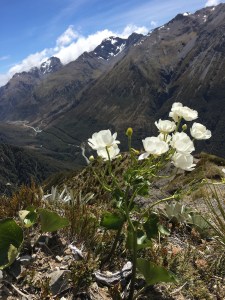
Mount Cook buttercup (Ranunculus lyallii)

The Mount Cook buttercup (aka Mount Cook lily), is an unusual alpine plant, in that it has big leaves and large, showy flowers. But even so, it is well-adapted to the alpine environment. Most plants have stomates on the underside of their leaves, because the underside is generally shaded and cooler, leading to less water loss. But in the alpine environment, sun-warmed rocks radiate heat, making the underside of the leaves warmer than the upper side on sunny days. The Mount Cook buttercup and its relatives have evolved stomates on the upper side of the leaves, in addition to the ones on the underside. The stomates on the top open when the underside of the leaf grows too warm.

Kaitorete Spit: An Overlooked Gem

Earlier this week, my daughter and I hiked onto the Banks Peninsula from Birdlings Flat. The walk afforded us gorgeous views of Kaitorete Spit.

Kaitorete Spit is only about 6000 years old, but is an important natural and cultural resource. Te Waihora / Lake Ellesmere, formed by the spit, is home to or visited by 166 species of birds and 43 species of fish which support commercial fisheries, recreational fishing and hunting, and traditional food gathering. In spite of its harsh, exposed environment, Kaitorete Spit is home to a remarkable number of threatened plants and animals, including pīngao (a native sand sedge prized for weaving), a flightless moth, and the katipo spider. A variety of lizards also flourish on the spit. The lake and spit have been important sources of food and fibre for Māori since they arrived in the area. Fragments of the oldest known Māori cloak were uncovered on the spit, dating to around 1500 AD, and many other signs of early Maori use of the spit have also been found there.

In pre-European times, Māori used the spit as a convenient highway as they travelled up and down the island. Unfortunately, the shifting gravel of the spit and the regular opening of the lake to the sea mean the spit isn’t passable in anything but the most capable of four-wheel drive vehicles. Today, travellers make the long trek all around the lake, so our home near the pointy end of the spit is a 40-minute drive from Birdlings Flat, just 25 km away on the fat end of the spit. But I’m happy to leave the spit to foot traffic—it helps protect the unique plants and animals that live there.

On a windy, wet day, Kaitorete Spit is a miserable, exposed place to be, but visit it on a warm sunny day, and you’ll see why it is an overlooked gem.

5 Simple Things You Can Do to Help Conserve Species

It’s Conservation Week here in New Zealand. Fittingly, one of the kōwhai trees we planted years ago has chosen this week to flower for the first time.

Conservation week is a good time to talk about backyard biodiversity. I’ve blogged more than once about biodiversity issues. It’s a topic near to my family’s heart, and something we strive to improve all the time.

Our yard is, unfortunately, home to a wide variety of non-native weeds, but it also sports native plantings (and even a fair number of native ‘weeds’). Here are just a few of the simple things we’ve done to improve the habitat value of our back yard for native organisms. You could do these, too.

  1. Plant natives instead of non-natives. Here in New Zealand this is especially important, but it’s a good rule of thumb wherever you live. Native vegetation will best support native wildlife, because they evolved together. Choose plants that provide food and shelter for local wildlife—shrubs with berries for birds and lizards to eat, dense grasses that provide hiding spots for invertebrates, and flowers that provide food for insects.
  2. Create lizard refuges. A pile of rocks or a stack of broken terracotta pot shards makes a nice refuge for lizards—the rocks and terracotta warm up in the sun, making a convenient basking spot for the lizards, and the little cracks between ensure a quick, safe get-away when predators appear.
  3. Just add water. Birds, insects, and other animals all need water to survive. Provide a bird bath, a small pond, or an attractive water feature, and you’ll find many more animals drawn to your yard.
  4. Kill non-native predators. Less important in some places, but here in New Zealand, protecting native birds and lizards requires controlling invasive predators. Trap out possums, stoats, and rats to give native birds a chance to nest successfully. Put a bell on your cat and keep it indoors around dusk and dawn when the birds are most vulnerable.
  5. Learn what you’ve got. No matter how small, your yard teems with species. Look closely, and you may be surprised at the diversity. Though our yard tends to be quite dry, we’ve discovered half a dozen species of moisture-loving slime moulds on the property. Once you know you an organism is present, you can tweak your planting and maintenance to protect and encourage it.

And that brings me back to the kōwhai tree, finally blooming. It’s not enough, yet, to attract bellbirds or tūī, across the vast stretches of agricultural land between us and the nearest populations, but someday, our kōwhai and flaxes, along with the neighbours’, may very well support a healthy population of native birds. All it takes is for each of us to care for our own backyards, and collectively we can improve the habitat for all our native species.