I’m thrilled to announce that the Draconic Search and Rescue ebook is now available for preorder on many online retailers!
Nathan McMannis is bored. His friends have gone on to new adventures, while he’s stuck at the Alexandra Institute doing correspondence school. All he wants is more excitement, less maths homework.
But you know what they say: Be careful what you wish for.
A huge earthquake strikes, and emergency services are overwhelmed, unable to rescue the thousands of people in danger. To make matters worse, the weather turns deadly.
Against his father’s orders, Nathan flies away with his draconic partners, Foggy Bottom and Rata, to rally the dragons. The Draconic Search and Rescue Team descends upon isolated and endangered towns to ferry people to safety. But the task might be too big, even for the dragons.
If they fail, thousands will die.
Will the fragile peace between people and dragons hold in the face of disaster? How far are the dragons willing to push themselves to save the humans who persecuted them for centuries?
Another wild, dragon-filled adventure set in modern day New Zealand! This standalone adventure can also be read as Book 5 of the Dragon Defence League series.
Yesterday marked 15 years since the M7.3 earthquake here in Canterbury. I doubt there’s been a single day since then that I haven’t, at some point in the day, thought about earthquakes. I even sleep under a quilt inspired by the 2010 quake.
Working on the quake quilt. Wow! Look how little grey hair I had back then!
Earlier this year, I took a friend, who was visiting from overseas, to Quake City, the museum dedicated to our earthquakes in 2010-2011, which devastated Christchurch. I thought I would be okay visiting the museum, since the quakes were so long ago. But facing that exhibition, everything about those days, weeks, and months came rushing back. At one point, my friend turned to me and said, “You talk like this happened yesterday.”
It felt like it had happened yesterday.
The quakes changed me, changed everyone who was here at the time.
The quakes made me a New Zealander. In the aftermath, when communities were rallying together to help everyone, I realised that this was the place I wanted to be. When the world came crashing down, I wanted to be in a place where university students mobilised a massive volunteer force to dig liquefaction from people’s houses, where farmers airlifted food into the city, where ordinary people organised the collection and distribution of blankets and other homewares for people who had lost everything, where spaces left empty in the city by demolished buildings were turned into temporary parks and places of joy.
The Famous Grouse in Lincoln, post quake.
This week I got the beta reader comments back from my next book, Draconic Search and Rescue, in which the Alpine Fault ruptures, so earthquakes have been on my mind a lot. None of my beta readers experienced the Canterbury quakes—most of them hadn’t even been born yet. Writing the book, I worried that I would frighten my readers (8-13 year-olds are my target market) with a book about the Alpine Fault rupture. When it happens (and it will), the consequences for the whole country will be huge, and some towns are likely to be entirely destroyed. Researching for this book kept me awake at night, inspired me to be even more particular about my own earthquake preparedness, and reminded me that I’m not entirely crazy to ensure that, wherever I go, I’m prepared to walk home (hi vis vest and water bottle in the car, check, comfortable shoes, check, jersey, check).
But my beta readers wanted more danger, more fear. For them, it isn’t real. The rumble of a large truck doesn’t have them pausing to listen, make sure it’s just a truck. They don’t look for the emergency exits every time they enter a room. They don’t mentally assess the construction date of every building and consider whether it will collapse in the next quake.
So this week, I’m ratcheting up the danger in my book. Shoving my characters closer the destruction, maybe breaking a limb or two. And if I’m a bit jumpy for the next week or so, you’ll know why.
Less than two weeks until the Tamariki Book Festival, and preparations are just about done. Last month, we had a little get-together with all the authors and, seriously, you don’t want to miss this year’s festival. The authors have gone above and beyond with their creative ideas for festival activities! Among the many activities, we have author Marc Meaney, who is bringing a real sailboat that kids can hop into and pretend to sail (I also hear he’s giving away a sailing lesson as a prize to a lucky reader). Author Sue Heazelwood will be decorating hundreds of cupcakes with kids to accompany her absolutely gorgeous recipe-lated storybooks. Author Sandra Isaacs will be leading an i-spy activity in a rock pool to promote her beach-themed books. I’ll be there with my dragon name selection spinners and a bit of origami using pages from my books. And there will be so much more from all the other participating authors!
In addition to the authors’ activities, we’ve got lots of fun stuff to do related to our Books Take Flight theme. A selfie station with dress-up wings to wear, a chance for you to make your own writing take flight (literally), a model airplane to assemble, and flight-themed prizes for our author scavenger hunt!
There will also be author readings, spot prizes for those dressed as their favourite book characters, and a prize draw for those who post their selfie-station photos on social media.
If a noisy festival isn’t your cup of tea, visit between 3.30 and 4 pm for our quiet time–no music or loud announcements, quiet voices, and smaller crowds.
Come prepared to find your new favourite books, too! Pick up signed copies directly from the authors themselves! Be sure to bring some cash, as not all authors will have eftpos facilities.
Did I mention the workshops?
Our incredible authors are also running writing and illustration workshops for ages 6- 17. Workshops cost $10, but all participants will receive a $10 voucher to be spent at the festival, so they’re essentially free! Budding authors and illustrators should register soon, or all the spaces will be gone!
Four weeks from the Tamariki Book Festival, and my life has been taken over by festival preparations. We’re thrilled to have 14 authors and illustrators attending the festival this year, writing everything from picture books to young adult novels.
This year’s theme is Books Take Flight, and we’ve collaborated with the Air Force Museum of NZ to bring festival goers all sorts of fun flight-themed activities and prizes.
With so many participating authors and fun activities, we’ve nearly outgrown our space in Tūranga. So this year, we’re running our workshops on Saturday 12 July, and the festival on Sunday 13 July.
If you’re in Canterbury, with kids ages 3 to 17, I highly recommend checking out the festival and festival workshops!
Meet Katie Cochrane, budding restauranteur. She has no idea what she’s in for when her crazy Aunt Rachael gifts her the burnt out Rifton Pub for her birthday. Before long, it’s clear that renovations are the least of her worries. She always knew running a restaurant would be challenging, but she never expected it to involve witchcraft.
This cosy urban fantasy can be read as a standalone, but, Rifton being a small town, it includes many of the characters from book 1 of the series. I was excited to have a chance to spend more time with the quirky ladies of the Rifton garden group and Rifton’s demonic felines.
So pull out your gardening gloves and secateurs, and pop on down to the Rifton pub for some supernatural fun!
Preorder today, and be the first to read Demonic Summoning for the Modern Gardener!
Release date is 31 January, so you won’t have to wait long!
I’m pleased to show you the cover for the next book in the Rifton Chronicles! I’m loving the bright colours of these cosy urban fantasy covers!
Available: one pub. As is, where is.
Who buys a burnt out pub for their niece’s thirtieth birthday? Katie Cochrane’s aunt, apparently. Faced with the decrepit building, Katie does the only logical thing—starts her own restaurant.
But the Rifton Pub has issues, and fire damage is the least of them.
Patrons who haven’t even had a drink start showing up ‘drunk’ around Rifton, and Katie’s liquor license is suspended.
When the Rifton Garden Group takes notice, Katie is forced to concede that the ‘demon drink’ isn’t responsible for her troubles, but another sort of demon altogether. And it’s going to take all of Rifton’s witches to banish what has taken root.
Another cosy urban fantasy set in Rifton. You might never look at your garden the same way again. Perfect for fans of Legends and Lattes!
I recently participated in ALLI’s SelfPubCon, which focused on the business side of writing. There were sessions on using social media, monetising YouTube, website design, using AI for marketing … I watched video after video that made my brain turn off. Video after video teaching me how to cash in on the advertising deluge we all suffer from online. How do you get those irritating ‘commercials’ into your YouTube videos (so you can make money on them)? How do you use Facebook Ads? How do you cash in on third-party advertising on your website?
Ugh!
I hate the constant bombardment of ads for crap no one needs. Do I really want to be a part of that, even if it can make my writing business profitable? Is that really why I write—so people’s interest in my writing can sell salad spinners, ‘miracle’ weight loss pills and erectile dysfunction products?
I despaired until I stumbled across a session on selling physical books. The panelists in this session talked about selling books at markets and fairs, doing school visits, exploring unusual sales outlets like tourist destinations, how to encourage people to buy your books face-to-face.
Yes! This was my kind of marketing. The kind of marketing I’ve been focusing on in the past year. Talking to people, talking about my books, being in the same physical space with potential readers, watching how people interact with my books. Getting that personal connection with readers in the real world.
Start talking to me about SEO, CTR, and ACOS, and my eyes glaze over. But throw me into a room with a bunch of potential readers, and I’m all over it. Watching the session on physical book marketing, I finally realised that it’s not that I can’t understand the online marketing game, it’s that I don’t want to.
Making money from random pop-up ads in my online content goes against my values. Putting my own random pop-up ads in someone else’s online content goes against my values. Bombarding potential readers online every day goes against my values.
And that’s okay.
I don’t have to participate in that madness.
And, yes, perhaps if I had to pay all my bills with my writing, I would feel differently, because god knows it’s hard to make a living selling books at markets. But I like my day job. And while I would love to write full-time, I know that I gain a lot of writing benefit from my day job. I would be a poorer writer without it.
And if making art is about expressing yourself and your values, then why wouldn’t your marketing reflect that as well?
Indeed, how could I, in good conscience, make money from plastic widgets advertised on my website when my books and stories contain so many environmental themes?
So I will continue to trot out my books at local markets, beside other local artists. I’ll continue to work on the board of the Tamariki Book Festival to help other authors do the same. I’ll chat with readers, listen to grandparents talk about the sorts of books their grandkids like to read, discuss dragons and my favourite dragon books with kids, hand out stickers and bookmarks, visit schools and tell children how hard writing is even for me. And I will sell a few books, sign people up for my newsletter (people who actually want to hear from me), and probably end up spending half what I’ve earned buying art from others.
Is that so bad?
Sounds perfect to me, because it is much more aligned with my values. It values personal connections and supporting others. It recognises the value in the art itself, rather than measuring the value of the art in terms of what else can be marketed alongside it.
And maybe I won’t ever be able to support myself with my writing. But I will be true to myself.
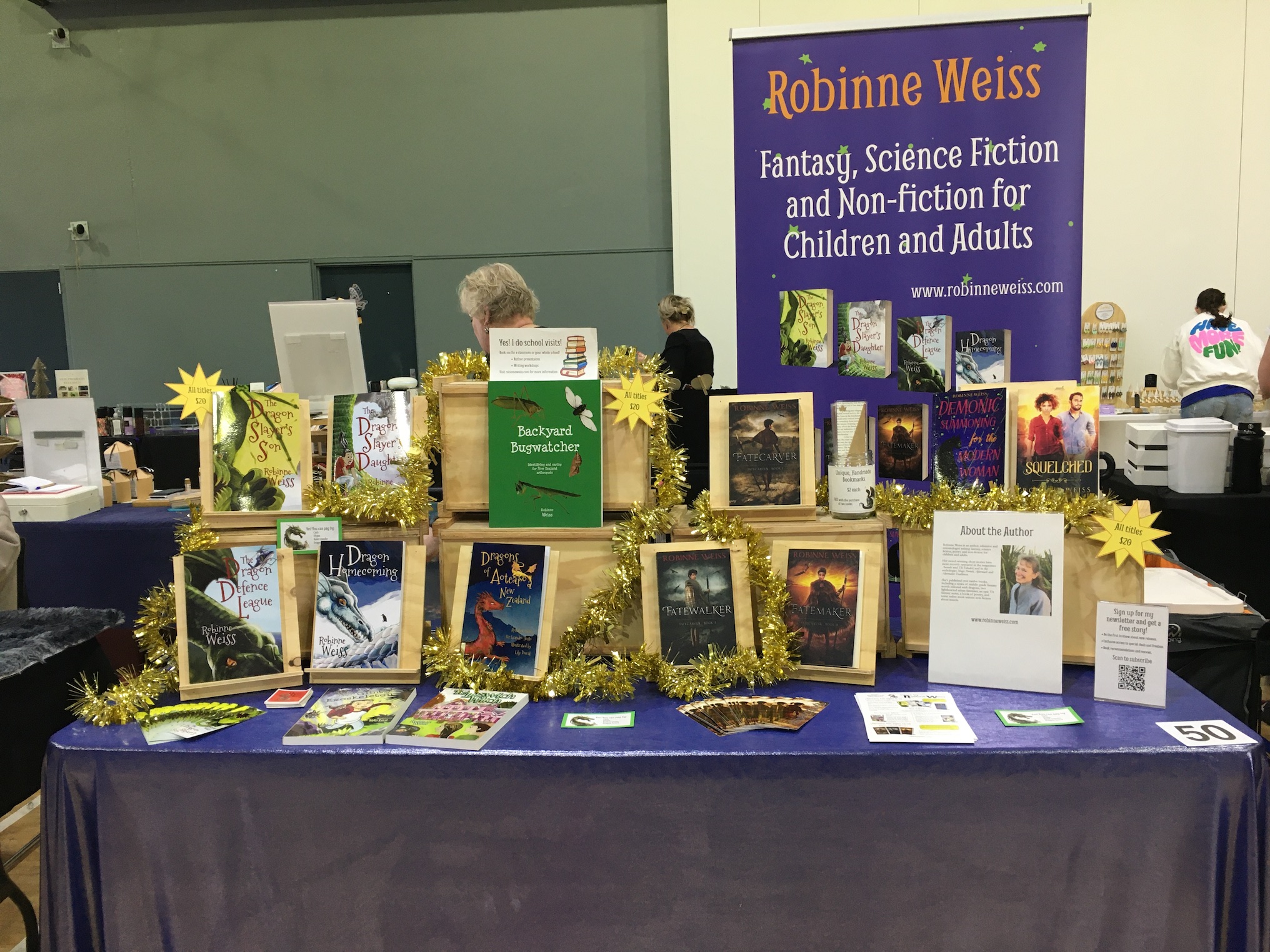
And … um … not to deluge you with marketing, but if you happen to be in the area, come say hello and pick up some Christmas gifts at these upcoming markets:
I took another step on my quest for the perfect carrot cake icing on Sunday. This variation on cream cheese icing is made into a fluffy confection with the addition of quite a lot of cream, slowly beaten into the already fluffy cream cheese.
I had my doubts. I’m not overly fond of a straight whipped cream topping. Would the cream cheese flavour come through enough? Would there be enough tart zing to it to offset the sweet?
The answer was no.
Don’t get me wrong, this icing is GOOD! There’s enough cream cheesy goodness to give it body and depth of flavour. And the addition of cream means it gets away with having half as much sugar as other cream cheese frostings. The texture is divine—smooth and creamy, with a lightness you don’t often get in a cream cheese frosting. It’s delightful on the lemon and blackberry cupcakes I used it on.
But is it the perfect carrot cake icing? Not quite.
So, the first icing was great on flavour, lousy on texture. This one is amazing for texture, not right for flavour. I can work with that. Trial number three will be a fusion of the two, hoping for that perfect balance.
It’s a tough job, but somebody’s got to do it. 😉
Meanwhile, I do recommend frosting #2. I think it would be spectacular on chocolate cake, and absolutely stunning rolled up in a bûche de Noël. Here’s the recipe if you want to give it a go:
170 g cream cheese 3/4 cup icing sugar (confectioner’s sugar), sifted 1 1/2 tsp vanilla 1 cup heavy cream
Beat the cream cheese until fluffy. Add the sugar and vanilla and beat until smooth. With the mixer on low, slowly pour in the cream. Then turn the mixer on high and beat until stiff peaks form.
Because of the quantity of cream in this frosting, I recommend storing cakes with this frosting in the fridge.
I’ve recently sent out my next book, Demonic Summoning for the Modern Gardener, to beta readers. It’s a more fleshed out tale than my husband read and commented on last month. A few weeks ago, I mentioned on the blog that my husband had requested more carrot cake in the story. In my rewrite after his comments, I made chasing the perfect carrot cake a sort of running gag/tiny subplot through the book.
Then I decided I should include the perfect carrot cake recipe in the back of the book.
I had already developed the perfect carrot cake recipe, so that was easy to include. But the frosting … I’ve made some very good carrot cake frostings, but I can’t say I’ve hit on the perfect frosting. Everyone agrees, of course, that carrot cake must be frosted with a cream cheese frosting, but there’s a lot of variation among cream cheese frostings. I’ve had them too sweet, too grainy, too dense …
No better excuse for baking!
So last night I whipped up a carrot cake and tested out a new variation on cream cheese frosting. This one has no butter—just cream cheese as the fat. It also contains lemon zest and lemon juice for a bit of added tartness. Lots of potential to be awesome!
Flavour-wise, it’s good … the texture, not so much. It’s too gummy. Not fluffy enough. Definitely not the perfect frosting.
But never fear, we’ll suffer through this almost perfect cake (have I mentioned that I’ve had two pieces of it already, and it’s been only 12 hours?), and then I’ll make another!
Because I couldn’t let my readers down with sub-standard carrot cake, now could I?
If you have a favourite cream cheese frosting, let me know—maybe I’ll try it out. How many cakes do you think it will take to reach peak frosting?
As a writer, I tend to focus on plot. I love a good action scene, and I also enjoy writing dialogue (probably stems from loving to talk, myself. LOL!). Over the years, I’ve developed a method for outlining my novels that’s sort of a mash-up of different methods I’ve read about.
I start with a good old-fashioned plot mountain diagram—the kind I introduce to my primary school students. On the plot mountain, I pinpoint major plot targets. Where does the story start? Where does it end? What is the climax point? What are the key events that lead to the climax? What are the key points in the main character’s arc?
If there’s a lot going on in the plot, or a complex set of character arcs in the story, I’ll then map the key plot targets onto a story flow chart drawn onto a large sheet of newsprint. On the flow chart, I’ll add more details about how the action will progress, what characters will think and do when faced with the challenges I present them, and how various plot threads will intertwine and interact.
From the flow chart, I’ll break the story into chapters. For each chapter, I’ll write a one-paragraph summary of what needs to happen in the chapter. What plot points need to be reached? What character development needs to occur? What information do I need to withhold so it can be introduced later? The chapter summary is focused on plot and character. I don’t really consider where or how the action will take place, only what must happen in that chapter.
From the chapter outline, I write my first draft. The outline keeps me on track and ensures I don’t forget things or muddle timelines or plot threads. It makes it much easier to write the first draft, because I can focus on one chunk at a time, without worrying that I’m forgetting something.
Unfortunately, it also enhances my tendency to write sparsely in my first draft. It encourages me to race from plot point to plot point, character development point to character development point.
In the words of an editor years ago, my early drafts need more ‘tea and biscuits’. They have too much plot, not enough setting. I was reminded of the tea and biscuits comment last week, when my alpha reader (my husband, a wonderfully brutal critic), told me I needed more carrot cake in my current work in progress. He also encouraged the addition of a full chapter of nothing but cleaning and tidying. LOL! He was right. The cake and the cleaning are both vehicles for fleshing out settings and characters, revealing the depths and complexity of both so my readers feel like they are experiencing the plot themselves.
In the past week, I’ve added over 7,000 words to my manuscript. That’s a whole lot of tea and biscuits! And I’m sure there are more to be added.
Should I change my outlining method to include tea and biscuits? I’ve considered it, but the truth is, I’m always daunted by that first draft. Knowing I’ve got a yawning stretch of 30 chapters standing empty ahead of me is terrifying. I find it one of the most difficult and unpleasant tasks in the writing process. My outlining method eases me into the task, breaks it into easily accomplished chunks.
And once I have the first draft down, the fun begins. A fellow writer, who writes lush, emotionally charged stories, once mentioned that they layer in the emotions after the first draft is finished. That they have different editing passes to address different aspects of the story. The idea has stuck with me. The story doesn’t have to be fully fleshed out in the first (or second, or third) draft. I’ve learned to enjoy layering in the details that make a story complete, and I can only really enjoy adding those details when I know that the structure I’m adding them to is solid. It’s fun to go back to a story and add some cake, some tea and biscuits. It’s fun to take a conversation and ground it in the place in which it happens, to establish a character’s motivations by showing them in action in a mundane task.
And so the theme for my week’s work is, let them eat cake.




 Robinne Weiss