Living With Earth

Coes Ford–open…just.

Nature is bigger than we are.

That’s been clear from world events the past few weeks—flooding in Indonesia, earthquake in Mexico, multiple hurricanes in the Atlantic.

We can pretend the natural world doesn’t affect us. We can do our best to engineer human structures and our daily lives so that, most of the time, we forget we are an integral part of Earth. But I think this is a terrible mistake.

On my way to and from town every day, I cross the Selwyn River. Normally, I do this at a spot called Coes Ford.

The Selwyn River floods. It’s simply part of the hydrology and ecology of the river. The low bridge over the Selwyn at Coes Ford acknowledges flooding. The bridge was never meant to allow passage over the river during a flood. It was meant to survive floods intact, and provide passage during low water.

The ford has been closed for several weeks, but reopened yesterday. The bridge itself is still underwater, but it’s passable.

To me, there is something right and good about an infrastructure that acknowledges the forces of nature and doesn’t try to control them. It is good for us to accept that, while we have great influence, we are not masters of the planet. At Coes Ford, we will be inconvenienced by floods. This is part of the natural order. It is part of what it means to live here. And if we are inconvenienced by floods, we will notice when the pattern of flooding changes. We will feel that something is amiss. Hopefully, we will do something about it. It’s not a coincidence that when the Selwyn stopped flooding and dried up last summer, the focus of the worry was at Coes Ford—that’s where the locals understand the river’s pulse the best.

If we are separated from the rhythms of the planet, we won’t notice when something is wrong, locally or globally. When we are separated from the rhythms of the planet, we may not notice problems with our life-support system until it is too late. Separated from, and ignorant of the rhythms of the planet, it’s easy to deny that there are any problems.

And so, I embrace the inconvenience of Coes Ford. I thank the engineers who chose to accept the Selwyn River for what it is. I hope that, as human technology advances, we continue to remember our interdependence on the natural systems of Earth. We must live with the earth, not on it.

An Egg-cellent Harvest

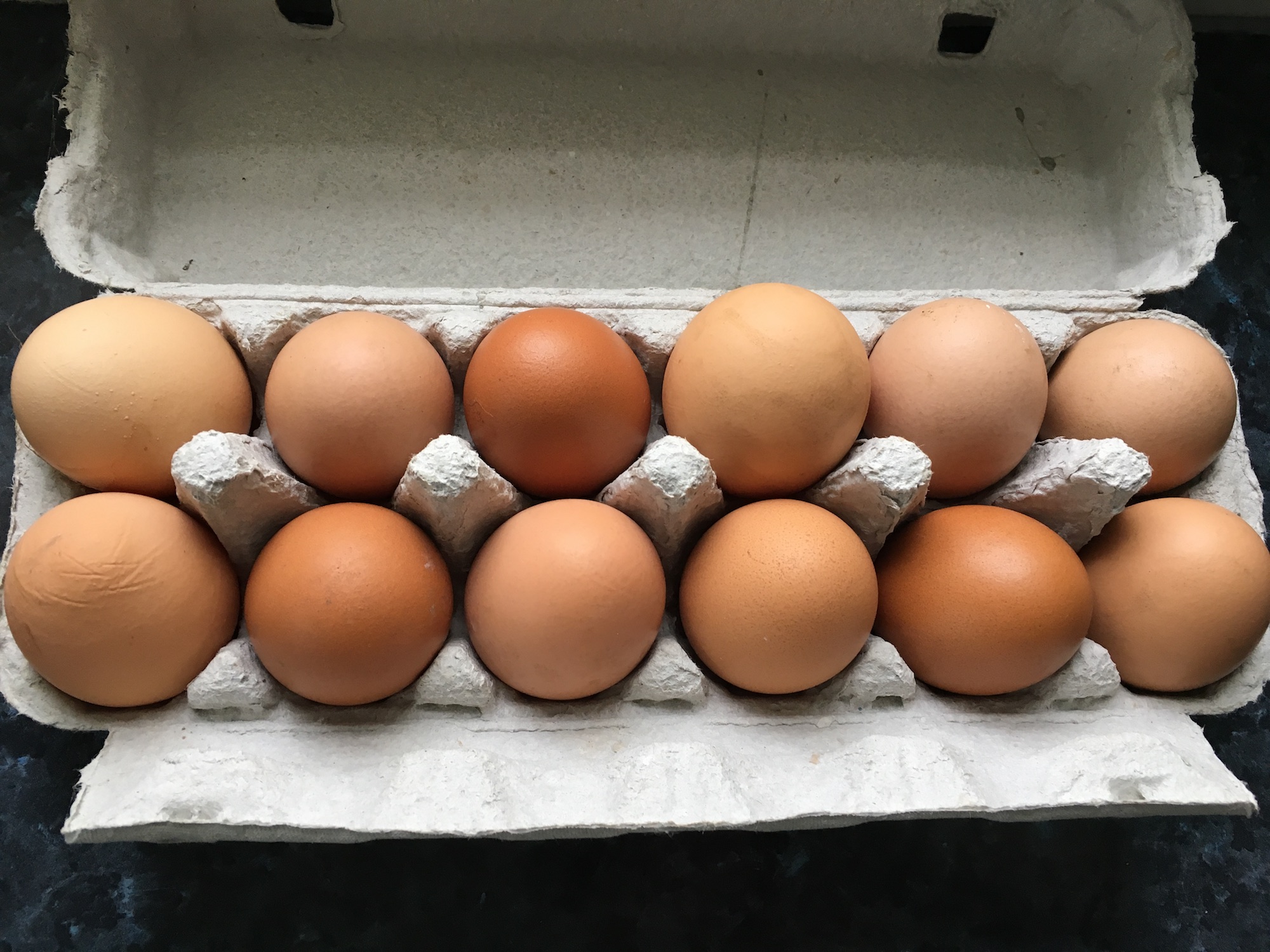
A few months ago I bought three new chickens because my old girls were no longer laying. I was convinced it wasn’t just a winter slump, because they really were getting on in years (for chooks), and they’d stopped laying long before winter.

But I think they’re trying to one-up the new chickens, because now that all three new ones are laying daily, the two remaining old ones have started laying again.

So now I’m getting five eggs a day–way more than we’re used to eating.

And that’s just fine by me. It’s a sparse time of year in the garden, so a few extra eggs are welcome in our diet. And if we can’t eat them all, eggs make great gifts. One of the things that makes rural life seem like such a luxury is seasonal abundance. There may be little left in the veggie garden beyond a few old beetroots, but we can still spread around our rich harvest of eggs.

Stay Sharp

It’s the time of year when I have too much to do in the garden. It’s a race to get the garden beds prepared before the vegetables are ready to go out into them. It’s a race to keep ahead of the weeds in the perennial beds. It’s a race to get the finished compost out of the bin before I need the space for fresh material.

I hate to waste my garden time. I hate to take breaks, because every minute I’m not out there is a minute for the weeds to get ahead of me.

But I’ve learned that some breaks are not a waste of time. Sharpening the hoe is one of those breaks that pays for itself. When I’m using the hoe a lot, I stop every couple of hours to sharpen it. It takes just a few minutes, and it makes the job much easier and faster.

A nicely sharpened and well-maintained tool can make all the difference between back-breaking drudgery and a job efficiently completed.

It pays to stay sharp.

Nettle Season

It’s stinging nettle season and, as I’ve mentioned before, my garden is host to an irritating quantity of nettle—quite literally.

But though it is a stinging weed, I’ll admit to a certain fascination with nettle. Look at the stinging hairs (trichomes) under the microscope, and you’ll find beautifully wicked structures like fine hypodermic needles. Those syringes are full of an irritating mix of acetylcholine, histamine, serotonin, moroidin, leukotrienes, and formic acid to irritate your skin.

But the triggering mechanism for the trichomes depends upon turgor (water pressure), so once a nettle wilts, it can’t sting.

And once it wilts, nettle is an incredibly useful plant. It is edible and quite nutritious for both humans and livestock. The cooked greens are used in traditional dishes throughout the Northern Hemisphere where it is native.

It can be used to make a vegetarian rennet for cheesemaking, and is used to flavour and decorate some cheeses. I’ve made nettle rennet myself as a substitute for commercial rennet when I’ve run out.

Nettles can be used to make tea, cordial and beer.

The fibrous stems can be used to make linen-like textiles. The roots can be used to make a yellow dye.

Fed to chickens, nettle is an effective egg colourant, which may explain the deep orange colour of my chickens’ egg yolks at this time of year.

All in all, stinging nettles don’t deserve their bad reputation. Like many of our weeds, they’re useful plants that we’ve forgotten how to use.

Aggravation or Aurora

I was frustrated all day with the internet, or rather, the lack of it. Being on rural broadband, we’re used to lousy internet speeds, and frequent outages. But today was particularly frustrating. I’d load a page with no problem, then be unable to load the next. Five minutes later, all would be well again. All day this went on, and I was tearing my hair out.

Then this evening, my son mentioned we’re supposed to have a spectacular aurora tonight.

Ah. That explains the internet, then.

And now I’m terribly excited that I had dodgy internet today. I can’t wait for daylight to fade fully so I can enjoy the aurora.

Funny how understanding the why makes all the difference…

Zombie Cat

A hapless zombie cat victim.

At this time of year, birds and small mammals are distracted. They’re busy fighting over territories, building nests, and mating. There are young, naive animals fluttering, scurrying and hopping about.

So it’s no surprise the cat catches more prey in spring. English sparrows, mice, rats, rabbits–he brings almost all the major vertebrate pests home and leaves them on the porch for us.

I don’t mind, really. It doesn’t bother me to have to dispose of his kills–I’m not squeamish about it, and I’m happy he’s dealing with at least some of the animals that destroy my garden and wreak havoc in the sheds.

But there’s something that worries me.

I’m afraid the cat is a zombie.

Rodents, birds, rabbits…they all show up headless. The cat doesn’t seem interested in eating anything except the head. Even on a succulent rabbit, he ignores the meaty legs and flank, and goes straight for the head.

Maybe it’s just the crunch he likes, but I think it’s more sinister than that.

Now every time he gives me his wild-eyed look, I can almost hear him say, “Braaaaaaaaaaaains.”

Spur-winged Plovers

Almost every year, a pair of spur-winged plovers (Vanellus miles, known as the masked lapwing in Australia) establishes a territory in the goat paddock. A few days ago, I was taking food to the goats, and noted where the plovers were making a ruckus at the other end of the paddock.

This afternoon, I took a walk out there. The plovers were nowhere to be seen, and I was worried–they’re not always successful nesters here. There are simply too many predators around our property.

I nearly turned around, but I decided to take a look anyway.

I was rewarded with the perfect plover nest. Two eggs, a little dried grass, and some rocks.

The spur-winged plover self-introduced from Australia in 1932. Since then, its population has grown dramatically. No surprise when you consider it likes open habitat, and is quite happy to set up house in paddocks, parks, and road verges (we once had a pair nesting in the middle of an intersection nearby).

It has done so well since it arrived in New Zealand that its protections as a native bird were removed in 2010 due largely to the problems it was causing for aircraft (airports are lovely habitat for it). It is one of only two native birds to not be protected under the Wildlife Act (the other is the black backed gull).

I enjoy the plovers. I love their harsh night-time cry, and their indignant posturing while defending territory and nest. I love the fact they cheekily nest wherever they want and expect everyone else to stay out of their way.

I’ll be watching these eggs closely. Fluffy plover chicks are even more fun to see than plover eggs.

Happy Spring

It’s the first day of spring!

Naturally, it’s cold, windy and rainy–day to be curled by the fire with a cup of tea, not a day to be out in the garden enjoying the flowers.

So I braved the rain to pick flowers and bring them inside.

Forget the weather. It’s spring indoors.

It’s Show Time!

We got the annual schedule for the Ellesmere A&P Show the other day. For those of you not familiar with the term, A&P means Agricultural and Pastoral–Farm Shows they’re called in the US.

I grew up enjoying the local Farm Shows, entering bad art projects into the competition, and admiring the rows of cattle on display. As an adult, I was lucky enough to live for several years mere blocks from the Minnesota State Fair–the Farm Show to end all Farm Shows. I even entered a quilt there–won second prize in a category in which I was the only entrant. A feat worthy of mention in the News from Lake Wobegon, if you ask me.

Farm Shows/A&P Shows are a defining cultural experience, but the truth is, you don’t even need to go to the show to have a cultural experience. Reading the show schedule is almost as good.

For example, in the little old Ellesmere show, there are 95 different sheep classes in which one could enter one’s woolly livestock. That doesn’t include the children’s pet classes or the wool classes. And then, of course, there are the shearing and sheep dog competitions. Sheep farming may be on the decline in New Zealand, but it’s still king in Ellesmere.

Dairy has boomed in recent years, and there are quite a large number of dairy classes in which aspiring farmers can enter their bovines. The lucky winners of many of the dairy classes will receive semen as their prize. Doesn’t that just make you want to enter?

Semen certainly beats the poor dairy goat farmers, who pay $5 to enter a goat, and can only hope for, at best, $5 for first prize.

If you’ve got a dairy animal, it might just win Best Udder (Judged both full and empty–I expect no saggy udders need apply). Now there’s something to aspire to.

One of my favourites is the calf fancy dress class. Nothing like a bunch of calves in tutus and tuxes to make you smile.

And I noticed a new category I never knew existed–Donkey Challenge, judged on ‘willingness, style and accuracy over four challenges’. Now, that’s a competition I may have to make sure I see this year.

But of course, like any rural event, the real excitement is simply the hustle and bustle on the day. The hot chips and mini-donuts, the carnival rides, running into neighbours and people you haven’t seen for months, and celebrating the importance of agriculture in our lives and culture.