Get The Ipswich Witch and lots of other books FREE from 26 October to 1 November.
Check it out, and pick up some great books.
Get The Ipswich Witch and lots of other books FREE from 26 October to 1 November.
Check it out, and pick up some great books.
I was excited to find a new weevil on our property the other day. At least until I identified it.
Meet Otiorhynchus sulcatus—the black vine beetle—pest on a wide range of garden plants, including grapes, black currants and strawberries (all common in my garden).
I admit, I have a weakness for weevils—no matter how much of a pest they are, I think they’re cute. And this one is no exception. She’s lovely, in spite of her diet. And I’m certain she’s a ‘she’, because no males of this species have ever been found. The black vine beetle reproduces parthenogenetically, producing viable eggs without the need for fertilisation by males.
This ability is the result of a bacterial symbiont in the genus Wolbachia. When researchers in California eliminated Wolbachia in black vine beetles (by giving the beetles antibiotics), the beetles’ unfertilised eggs were no longer viable. It’s a clever little ploy by the bacterium to ensure its own reproduction—only infected insects can reproduce, and they can do so without the trouble of finding a mate (I wrote more about this fascinating relationship in Putting the Science in Fiction and on Dan Koboldt’s Science in Fiction blog).
Another cool feature of the black vine beetle is that it is flightless. It’s not uncommon to find flightless insects and birds here in New Zealand, but it’s a little unusual to see it in invasive pests like the black vine beetle. Native to Europe, the black vine beetle is now distributed all around the world. Pretty impressive travelling for a 6 mm-long flightless insect.
Apparently black vine beetles can cause significant damage to plants. The larvae eat roots in the soil and do the most damage, particularly in potted plants, where root growth is limited. I’ve decided not to worry about them at the moment. I’ve got more damaging pests to worry about, and to be honest, I wouldn’t mind seeing them again. They are awfully cute.
I enjoy springtime for its warmer temperatures, flowers and the opportunity to get outdoors more frequently. But it’s the bump in our standard of living that I enjoy most.
Garden excess comes early, in the form of artichokes and asparagus. Add in some home grown oyster mushrooms, spinach, leeks and herbs, and I begin to feel like we have unlimited wealth. Like we’re in the ‘one percent’.
Except, I doubt the one percent gets vegetables as fresh as ours.
And I expect they don’t have the pleasure of strolling among head-high artichoke plants, breathing in their earthy scent and picking twice as many as they need, because, well, why not?
And I know they don’t enjoy passing their excess vegetables on to the neighbours, spreading and sharing riches that cannot be saved, banked, or invested.
So I feel sorry for them, in springtime; they are so poor, and I am a queen.
My daughter and I went for a hike on Saturday after being cooped up in the house all day Friday by a rip-roaring southerly storm. The storm lashed us with rain and hail, but in the mountains, it brought snow. Saturday morning, the beech forest at Cragieburn Forest Park was a winter wonderland.
Climbing up out of the forest into the alpine areas, the intensity of the storm was clear—thigh-deep drifts filled the path in some places, while other areas had been blown clear down to the scree. Every tussock had a long train of sculpted snow on its leeward side, so you could almost feel the howling wind and the sting of blowing snow, in spite of it being a clear calm day.
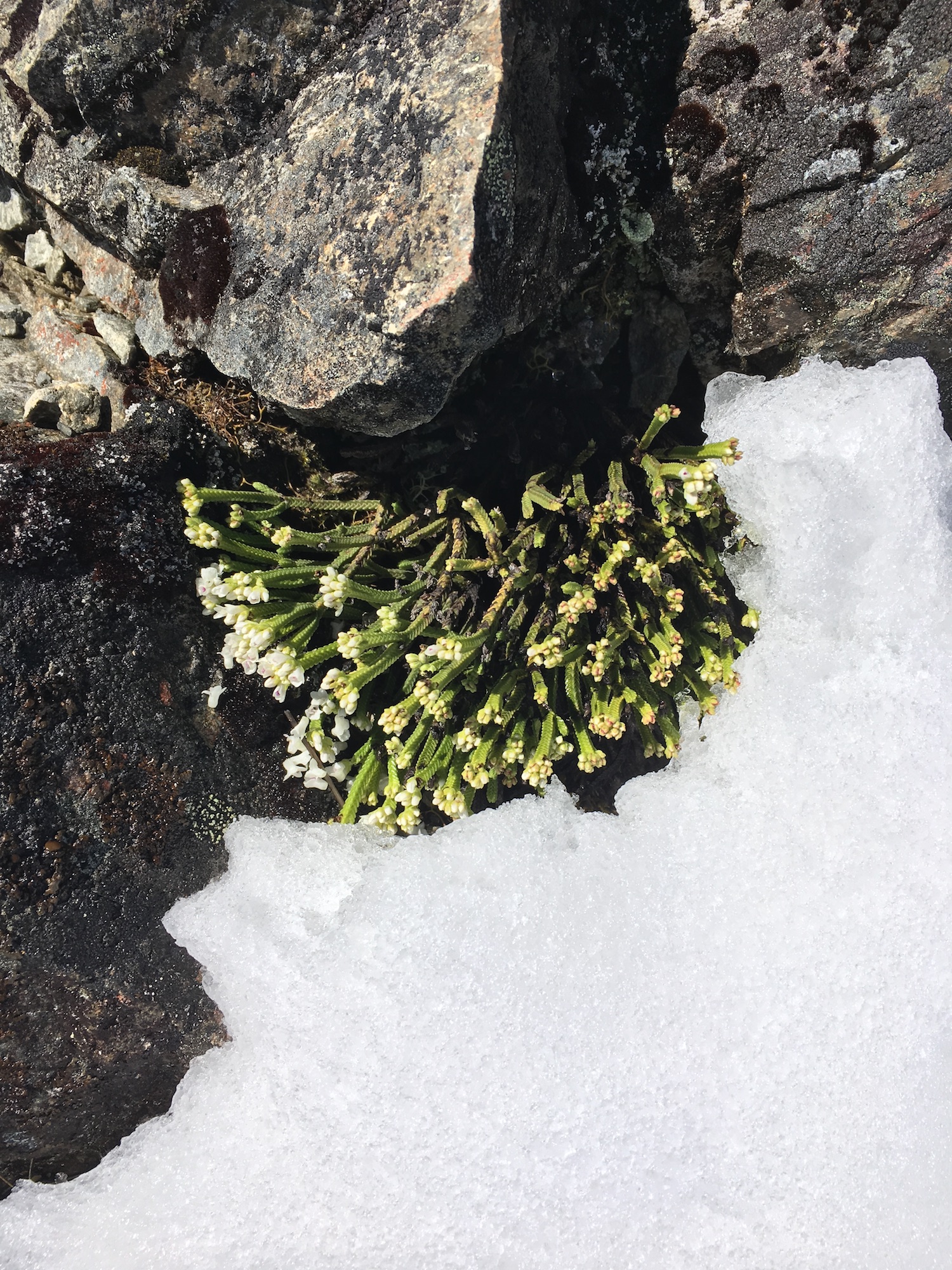
Nestled among the rocks, we found this lovely whipcord hebe, flowering in spite of its slowly melting blanket of snow. And there were other plants peeking out of the snow, clinging to the scree.
Alpine plants are some of the toughest organisms around. They have to cope with intense sun, wide temperature fluctuations, drought, wind, and ice and snow. They have evolved a variety of adaptations in order to combat these dangers.
Short, cushion-shaped growth: A tight ball of branches and leaves resists damage and drying from fierce wind. The pinnacle of this growth form has to be plants in the genus Raoulia. Known as ‘vegetable sheep’, they form hard, tight masses of tightly packed leaves (akin to the texture of a head of cauliflower). Inside the mound, dead plant material builds up around the branches and acts like a sponge, soaking up rain when it’s available. Adventitious roots on the plant’s branches tap into this reservoir of water when the weather is dry.
Long roots: Unstable rocks and shifting scree make it difficult for alpine plants to stay put, and water is often far below the surface. To cope, they have long roots that anchor them deep into the rock. Some are also able to regrow from their roots if the top of the plant is snapped of by rockfall.
Drought-resistant leaves: Many alpine plants have leaves that are fuzzy on the underside, where the stomates (the breathing holes) are located. The hairs trap a layer of calm air against the leaf surface, slowing down water loss from the stomata. Other plants have narrow, vertically-oriented leaves that minimise exposure to the intense alpine sunshine, reducing evaporation.
Sunscreen: A waxy coating on many alpine plant leaves protects against intense sunlight and high temperatures.
Antifreeze: Ice crystals forming inside a living cell break the cell walls and kill it, so organisms living in cold environments have to somehow avoid freezing. Alpine plants protect themselves from freezing by manufacturing antifreeze from proteins in their tissues. The antifreeze prevents ice crystals from forming in the plant’s cells.
Energy conservation: The growing season in alpine areas is short, and nutrients are scarce. Many alpine plants respond by not reproducing every year. Instead of producing low-quality seeds that may not survive, they hoard resources until they have accumulated enough to reproduce successfully.
All these adaptations give most alpine plants a similar look—low, mounded, small-leaved and tough. But one plant in particular stands out as oddly showy and out of place.
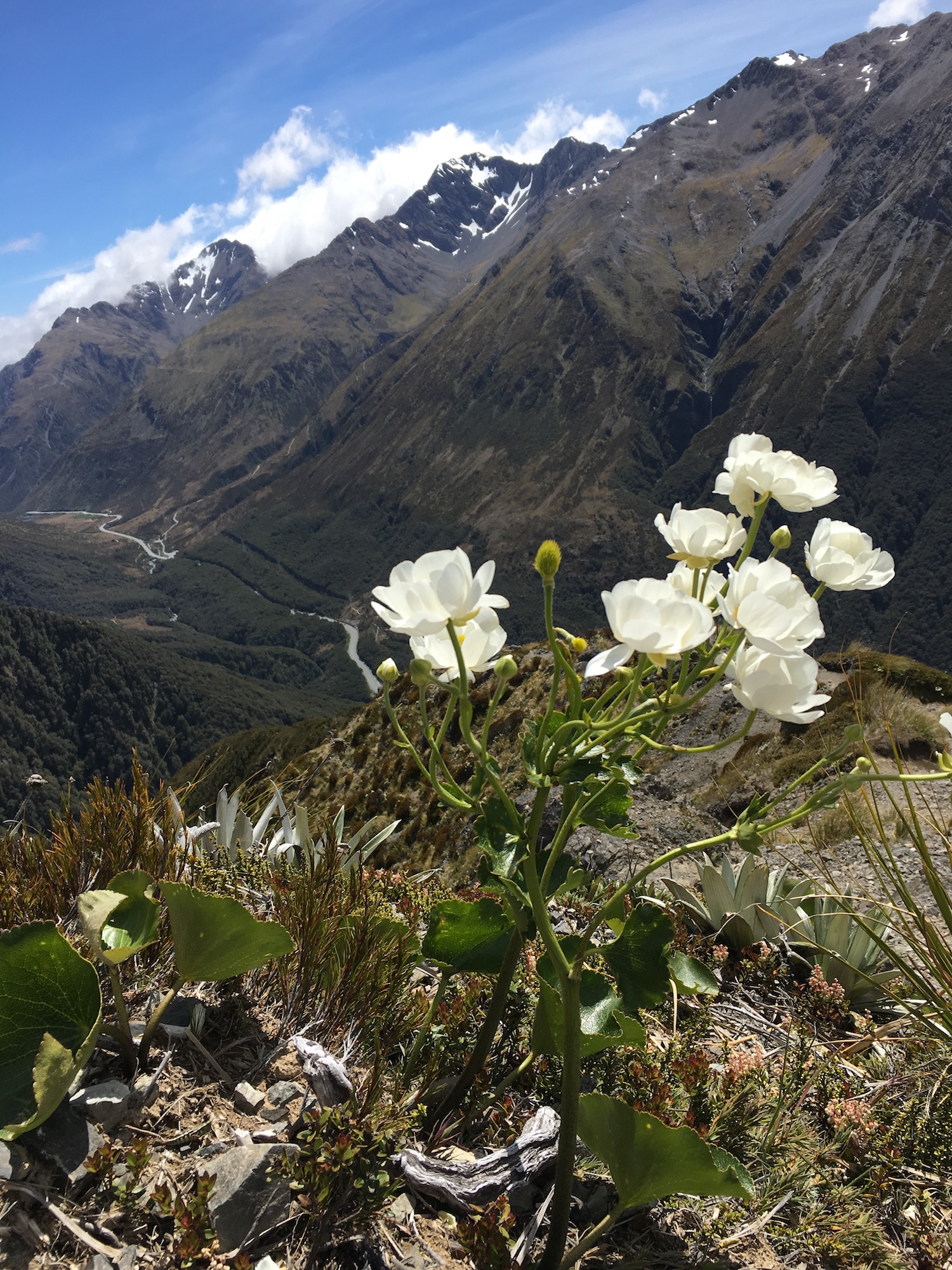
The Mount Cook buttercup (aka Mount Cook lily), is an unusual alpine plant, in that it has big leaves and large, showy flowers. But even so, it is well-adapted to the alpine environment. Most plants have stomates on the underside of their leaves, because the underside is generally shaded and cooler, leading to less water loss. But in the alpine environment, sun-warmed rocks radiate heat, making the underside of the leaves warmer than the upper side on sunny days. The Mount Cook buttercup and its relatives have evolved stomates on the upper side of the leaves, in addition to the ones on the underside. The stomates on the top open when the underside of the leaf grows too warm.
Random Acts of Poetry Day was apparently the 3rd of October. I didn’t know about it until the following day, but it seems to me that it’s even more fitting to celebrate Random Acts of Poetry Day on some other, random, day. And since I’m feeling random today, here is a poem for you all.
Chaos Theory:
Sammy Sandoval meets Sargent Shriver and Edward Lorenz in a young brain on a narrow footpath after dark.
The base beat
of Sammy’s accordion
faded into the night
like a heartbeat
after a long run.
Silence
save for the tap of rubber sole on packed earth,
the trill of the tropical screech owl,
the whisper of moth wings.
Those tiny wingbeats,
creating a tornado,
not on the other side of the world,
But here.
Inside.
Peeling back the roof to expose the beams,
rearranging the furniture,
toppling trees across the path,
hurling the neighbour’s car into my kitchen,
shattering mirrors,
slamming the door to the past.
And the folded bellows
of the future
breathed in and out,
humming in my ears,
masking the click
of the lock behind.
The slam of a screen door—a quintessential part of summertime in the United States.
But not here in New Zealand. Most houses have no screens in windows or doors.
Why? Because we don’t have arthropod-borne diseases (of humans) here.
The ubiquitous window screens and screen doors in the US are a direct result of the efforts to eliminate malaria in the early 1900s. In some areas, screens were mandated by local government. They caught on, even in areas where they weren’t required, and remain popular today, in spite of the fact malaria is no longer endemic to the United States.
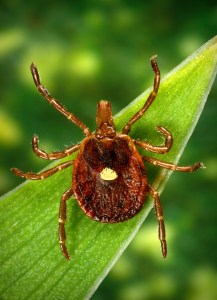
Lone Star Tick–transmits ehrlichiosis and a carbohydrate that can trigger meat allergies. (Centers for Disease Control and Prevention, Dr. Amanda Loftis, Dr. William Nicholson, Dr. Will Reeves, Dr. Chris Paddock)
Arthropod-borne diseases have shaped human cultures, changed the course of wars, and stymied economic development throughout the world for millennia. Malaria alone kills 400,000 people annually, and hundreds of millions of people worldwide suffer from other arthropod-borne diseases like Chagas disease, yellow fever, dengue and leshmaniasis.
Arthropod-borne diseases are transmitted from one person to another by, you guessed it, an arthropod—often a mosquito, fly, or tick. These arthropods (just the females, in the case of mosquitoes) feed on human blood. They draw up the disease from a sick person with one meal, and transmit it to another person with the next. The disease—a virus, protozoan, plasmodium, flatworm, or other organism—often has a complex life cycle, requiring specific hosts and specific vectors in order to complete each stage of its life. Combating these diseases requires an understanding of every part of the life cycle of both the disease and the vector.
Though humans have been battling malaria for the entirety of recorded history, new arthropod-borne diseases emerge regularly, challenging public-health systems worldwide. With increased air travel, infected people and vectors can quickly spread diseases to new places. And diseases don’t necessarily act the same when transplanted into a different population.
Zika is a great example of the complex interactions between host, vector and disease that make arthropod-borne diseases so scary and difficult to combat. Zika was first identified in humans in 1952, after first being found in monkeys. It was confined to Africa and Asia until 2007. Only 14 cases were documented, though testing indicated people had wide exposure to the virus. Symptoms were usually mild, and it wasn’t considered a major problem.
The first large Zika outbreak occurred on the island of Yap in Micronesia in 2007. Further outbreaks in the Pacific Islands in 2013 and 2014 brought the first information connecting Zika with congenital malformations like microcephaly and severe neurological complications.
Then, in March 2015, Zika appeared in Brazil. Because Zika was unknown in Brazil, the outbreak wasn’t identified as Zika until May. In October, Brazilian health officials reported a dramatic increase in microcephaly, which was linked to the Zika outbreak.
By the end of 2015, Zika outbreaks had been reported all over Central and South America.
In February 2016, the World Health Organization declared Zika a Public Health Emergency of International Concern. Emergency plans were enacted to control the spread of the virus by eliminating the suspected vector mosquitoes, Aedes aegypti, and to study how to manage the complications of the disease.
The disease and our understanding of it moved rapidly throughout 2016. The virus was found in another species of mosquito. It was proven to also be transmitted through sex and through blood transfusions. It was discovered to cause a much wider range of neurological problems than first thought. Vaccine development began. Travel advisories were put in place. Innovative new mosquito control strategies were launched.
Still, Zika spread and infected over 180,000 people. By November 2016, it was clear Zika was here to stay, and needed to be managed on an ongoing basis, not as an emergency. In the space of 18 months, Zika had invaded the world.
The full timeline of Zika can be found on the WHO’s website: http://www.who.int/emergencies/zika-virus/history/en/
The WHO also has great information about other arthropod-borne diseases: http://www.who.int/campaigns/world-health-day/2014/vector-borne-diseases/en/
All the real-life science of arthropod-borne disease can make for exciting fiction. Fancy writing a story? Here are a couple of ideas to get you going:
1. A cluster of people in a small town in Iowa fall ill with an unusual rash that progresses to a deadly autoimmune disease. Doctors are stymied until one of the women mentions she’s just returned from a trip to Africa. Blood tests confirm she is carrying antibodies to a rare arthropod-borne disease not seen outside of Sub-Saharan Africa before.
2. A government wants to unleash a new arthropod-borne virus to wipe out a rival nation (Don’t laugh, Japan tried to do this during WWII, breeding up disease in prisoners of war and releasing cholera-infected flies and plague-infested fleas in China, killing more people than the atomic bombs on Hiroshima and Nagasaki).
And don’t forget to get yourself a copy of Putting the Science in Fiction, to be released on October 16! This is a great resource you don’t want to miss!
Science and technology have starring roles in a wide range of genres–science fiction, fantasy, thriller, mystery, and more. Unfortunately, many depictions of technical subjects in literature, film, and television are pure fiction. A basic understanding of biology, physics, engineering, and medicine will help you create more realistic stories that satisfy discerning readers.
This book brings together scientists, physicians, engineers, and other experts to help you:
Putting the Science in Fiction collects articles from “Science in Sci-fi, Fact in Fantasy,” Dan Koboldt’s popular blog series for authors and fans of speculative fiction (dankoboldt.com/science-in-scifi). Each article discusses an element of sci-fi or fantasy with an expert in that field. Scientists, engineers, medical professionals, and others share their insights in order to debunk the myths, correct the misconceptions, and offer advice on getting the details right.
Go in the draw to win a FREE copy of Putting the Science in Fiction
Earlier this week, my daughter and I hiked onto the Banks Peninsula from Birdlings Flat. The walk afforded us gorgeous views of Kaitorete Spit.
Kaitorete Spit is only about 6000 years old, but is an important natural and cultural resource. Te Waihora / Lake Ellesmere, formed by the spit, is home to or visited by 166 species of birds and 43 species of fish which support commercial fisheries, recreational fishing and hunting, and traditional food gathering. In spite of its harsh, exposed environment, Kaitorete Spit is home to a remarkable number of threatened plants and animals, including pīngao (a native sand sedge prized for weaving), a flightless moth, and the katipo spider. A variety of lizards also flourish on the spit. The lake and spit have been important sources of food and fibre for Māori since they arrived in the area. Fragments of the oldest known Māori cloak were uncovered on the spit, dating to around 1500 AD, and many other signs of early Maori use of the spit have also been found there.
In pre-European times, Māori used the spit as a convenient highway as they travelled up and down the island. Unfortunately, the shifting gravel of the spit and the regular opening of the lake to the sea mean the spit isn’t passable in anything but the most capable of four-wheel drive vehicles. Today, travellers make the long trek all around the lake, so our home near the pointy end of the spit is a 40-minute drive from Birdlings Flat, just 25 km away on the fat end of the spit. But I’m happy to leave the spit to foot traffic—it helps protect the unique plants and animals that live there.
On a windy, wet day, Kaitorete Spit is a miserable, exposed place to be, but visit it on a warm sunny day, and you’ll see why it is an overlooked gem.
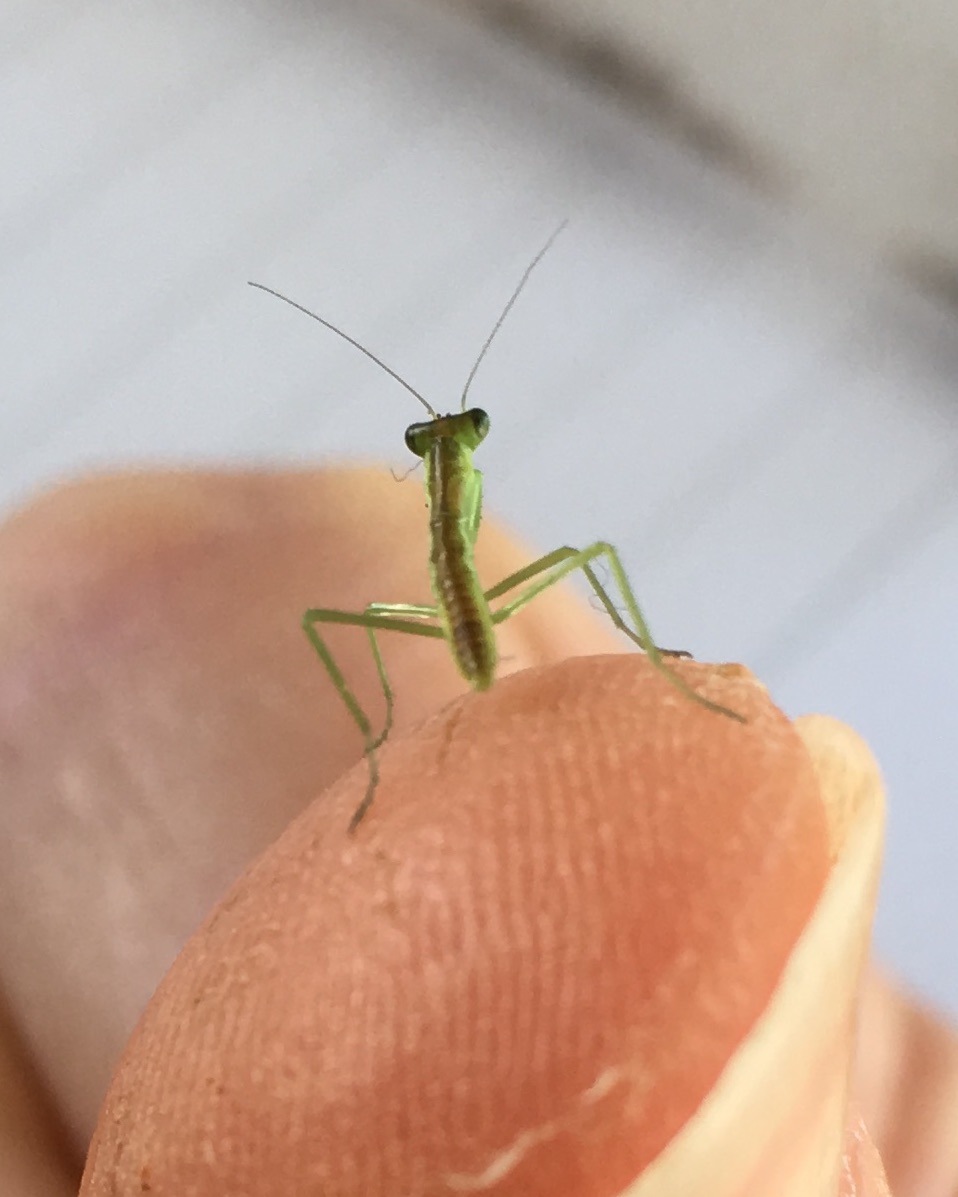
It’s that time of year again! The preying mantis egg case I collected in the autumn is hatching.
Because these mantids were in the warm office for half the winter, they’re early. Mantids in the egg cases outdoors haven’t yet emerged. So they need a little extra care. As the babies emerge, I transfer them to a large tank where they’ll be warm and well-fed for a few weeks while the weather improves. Eventually, I will release most, keeping only a few for use in educational programmes.
I never tire of this annual event. I love watching the newborn mantids stretch their legs and catch their first meal. And I’m always amazed that so many insects can emerge from such a small egg case. The current one, just 15 mm long, has disgorged 35 mantids so far, and only half the case has hatched. The mantids don’t all hatch at once—hatching seems to progress from one end of the egg case to the other over the course of a few days. In the wild, I suspect most of the later hatchlings are eaten by the early ones—it’s a mantid-eat-mantid world out there. It happens in my tanks, too, though I try to minimise cannibalism by spreading them out as much as possible and giving them plenty of hiding spots. I used to raise each individual in its own peanut butter jar, but that gets to be pretty time and space-consuming when there can be 70 mantids in each egg case.
Everyone’s heard the sensational ‘fact’ that female preying mantids eat the males after mating. It does happen, sometimes, in some species, but not as often as you might think. Mantids are creatures of instinct, and one of their most powerful instincts is to capture prey. In fact, this urge is so strong that, even when their digestive system is completely full, and they can’t actually eat anything else, they will continue to capture prey.
So it’s no surprise that a female mantid might snack on her mate, especially since she’s bigger than he is. In species where the females are significantly larger than the males, there’s a higher incidence of cannibalism after mating. Among New Zealand mantids, cannibalism at mating is rare—females are only slightly larger than males, and so the males have a good chance of fighting off the females. I’ve seen this in action in captivity—one of my females had a go at her mate, but he was every bit as feisty as she, and their tussle ended with both alive and unharmed.
My little babies won’t have to worry about mating cannibalism for a while yet, but there are plenty of other dangers out there—other predators, parasites, pathogenic fungi, freezing weather, and careless gardeners all take their toll. Of the maybe 70 mantids that will hatch from my egg case, only one or two are likely to survive to adulthood.
I’ll give my babies the best start I can, and then they’ll be on their own. Watching them now, catching gnats like pros, I think they’re well-equipped.
I spent the weekend at the National Writers Forum, where I had opportunities to meet lots of other writers and attend sessions on many aspects of the craft and business of putting words on paper to be read by others.
One of the highlights for me was a keynote address by John Marsden, author of Tomorrow When the World Began and many other popular young adult books.
Marsden had many words of wisdom for writers, but two things in particular I thought were actually great advice for life in general, not just for writing.
Marsden encouraged us to take risks, to not write the mundane, the predictable.
Should we not also take risks in life in general? Not the stupid kind like robbing banks or snorting cocaine, but risks that force us to grow. I think about some of the risks I’ve taken in life—serving in the Peace Corps, moving to New Zealand, starting my own business, closing my business in order to write. Every one of those risks taken has caused me grief—emotional, financial, physical—and every one of those experiences has forced me to grow and learn and improve myself.
Even small risks are important to take. For me, going to an event like the writers forum is a terrifying proposition. As an introvert, I have to force myself to attend. I have to plan what I will say to people, come up with a list of questions I can ask well in advance of the event. It takes enormous energy for me to mix and mingle with strangers, and I have to take time out sometimes—take a walk, sit in a quiet corner, or retreat to a toilet stall. This past weekend, the effort took its toll—I slept poorly and have returned emotionally shattered and with a head cold. But I learned a lot and made contacts with other writers. Once I catch up on sleep and the head cold clears, I’ll be a better writer for having gone.
So, where should risk taking be leading us?
Marsden touched on this, too. He said great writing chases the truth but doesn’t reach it.
And a great life chases the truth, recognising we will never reach it, and will always be learning and growing.
Take risks. Chase the truth. Repeat.
It’s Conservation Week here in New Zealand. Fittingly, one of the kōwhai trees we planted years ago has chosen this week to flower for the first time.
Conservation week is a good time to talk about backyard biodiversity. I’ve blogged more than once about biodiversity issues. It’s a topic near to my family’s heart, and something we strive to improve all the time.
Our yard is, unfortunately, home to a wide variety of non-native weeds, but it also sports native plantings (and even a fair number of native ‘weeds’). Here are just a few of the simple things we’ve done to improve the habitat value of our back yard for native organisms. You could do these, too.
And that brings me back to the kōwhai tree, finally blooming. It’s not enough, yet, to attract bellbirds or tūī, across the vast stretches of agricultural land between us and the nearest populations, but someday, our kōwhai and flaxes, along with the neighbours’, may very well support a healthy population of native birds. All it takes is for each of us to care for our own backyards, and collectively we can improve the habitat for all our native species.