My story, Mannequin, was published in Work Literary Magazine today. A small success, but it makes me smile. 🙂
Author: Robinne Weiss
There’s No Place Like Home
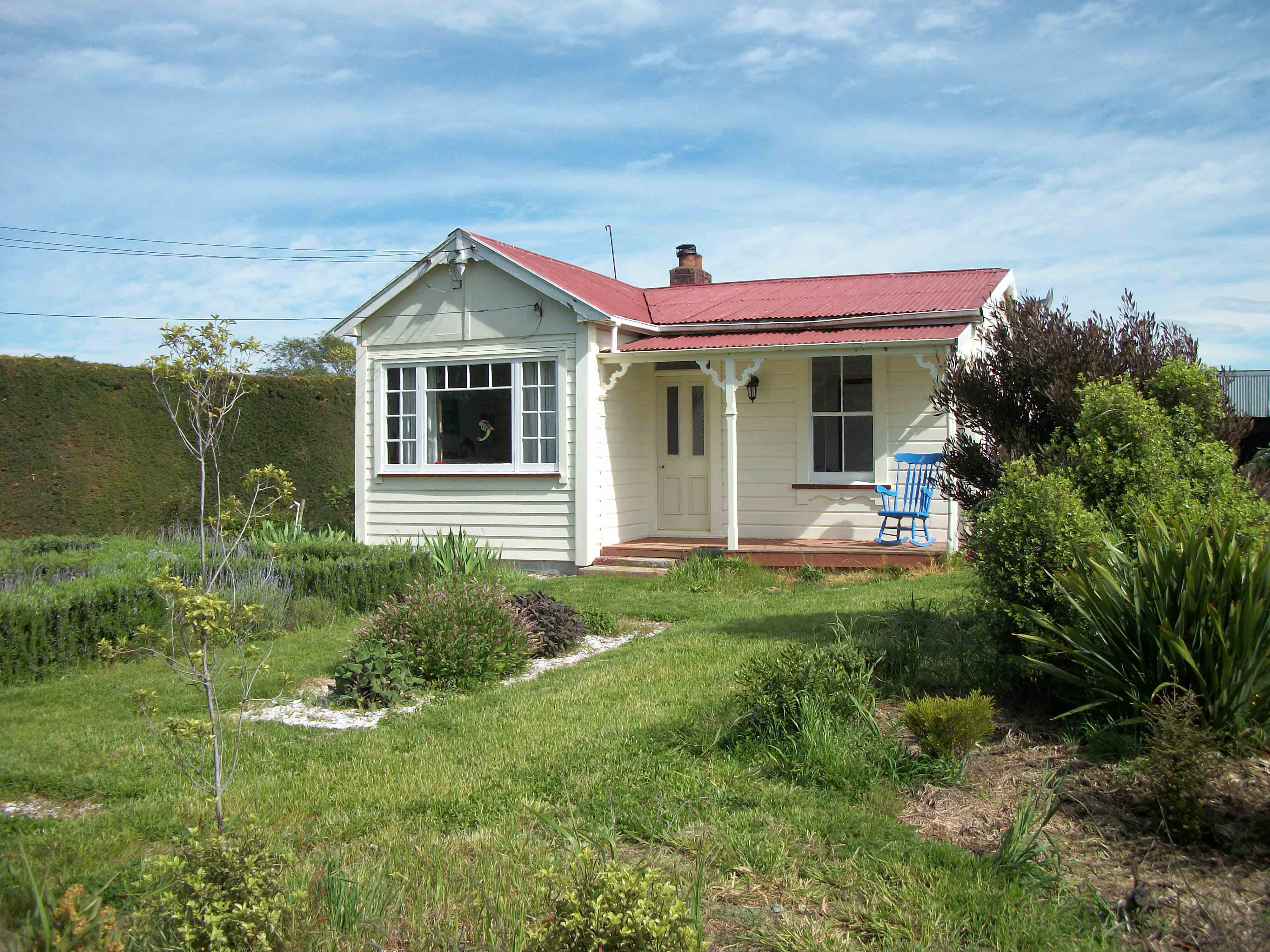 The best part of going away is coming back home.
The kids and I had a great time visiting friends and family in the US the past two weeks. We got a chance to do many things that aren’t possible here—picking wild blueberries; riding roller coasters; seeing deer, wolves and eagles; hearing whippoorwills pour their hearts out into the dark. We visited some of my favourite people in the whole world.
But as Dorothy so succinctly put it, there’s no place like home.
Returning home, the house feels small, the garden shabby. The car looks decrepit and filthy. Wind blows in through the windows and cracks in the floor.
But returning home, the wind also feels fresher. The fire is cosy. I know where everything belongs in the kitchen. The things around me are familiar and comforting.
At home I have responsibilities. Things to do. I am needed.
Though I didn’t feel uncomfortable away from home, now that I am back, I can feel the tension draining away. I feel like I am on vacation, moving through my daily chores with pleasure.
So, like Dorothy, I am glad to be home, regardless of how small and shabby that home might be.
There’s no place like home.
Saturday Stories: Glint
 I’m afraid I’m too tired and jet-lagged to muster a blog post today. So, here’s an excerpt from the beginning of A Glint of Exoskeleton for today’s Saturday Stories.
The Girl Who Talked to Insects
Four
Crick peered into her dollhouse, though she didn’t much like dolls. She was looking for something.
“Oh, there you are!” she exclaimed in her sing-song, four-year-old voice. “You don’t have to hide. I won’t hurt you.”
The object of her attention crept cautiously out from under the loose carpet in what Crick called the yellow bedroom. Its antennae waved busily in Crick’s direction. Crick cocked her head to one side and furrowed her brow.
“Are you some sort of beetle?”
“Not a beetle. I’m a cockroach. An American cockroach.” The animal had a raspy voice like an old transistor radio with bad reception, but the scratchy sound was cheerful and friendly.
“Hi Mister Cockroach! My name’s Crick. That’s short for Cricket, and that’s short for Christina Marie Stolzfus, which is my real name. But you can call me Crick. What’s your name?”
“Pleased to meet you, Crick. I’m Periplaneta americana. I suppose you could call that a nickname, too.”
“What’s your real name?”
“It’s hard to say. Cockroach names are actually smells.”
“Smells?” Crick laughed. “That’s weird!”
“Not for us. We have very sensitive noses, and not so good ears. Smell is easier for us.”
“Oh! Well, I think I’ll call you Peri.”
Peri chuckled. “That would be fine.”
“Do you like my dollhouse?” Crick asked. “I saw you in it yesterday.”
“Yes, it’s quite nice, particularly this loose yellow carpet.”
Crick frowned. “I don’t really like it. I’d rather have a hamster, but mom says I’m not allowed. She says they stink and remind her of rats. Gramma gave it to me for my birthday. That’s when I turned four!” she continued proudly. “How old are you?”
“Well, I’m a lot older than four!” chuckled Peri. “I’ve been alive since 1943. That makes me…let’s see…fifty-three years old.”
“Whoa! That’s old,” replied Crick gravely. Then her brow furrowed. “I didn’t know insects lived that long.”
“Most of us don’t, but I’m…special.”
“How?”
“I’m a leader for my species—something called an über. It’s a bit like a…like a president.”
“Are presidents really old, too?”
“Compared to most insects they are. But insect leaders don’t get old like other insects. We just keep on living.”
“You won’t ever die?”
“I can be killed—I’m not invincible. But I won’t die of old age.”
Just then, Crick’s bedroom door opened and her mother poked her head in.
“Who are you talking to, dear?” she asked. “Oh! You’re playing with your dollhouse! That’s nice.”
“Well, not really. I was talking to my new friend, Peri. He’s going to live forever,” she said brightly, “unless he’s killed. He lives in the dollhouse. He likes the yellow room ‘specially.”
“That’s nice,” responded her mother, a little uncertainly. “Which one of your dolls is Peri?”
“Oh, he’s not a doll. He’s a cockroach.”
Within minutes, Crick’s mother had hauled the dollhouse out onto the lawn and sprayed it with fly spray. Crick kicked up such as fuss about it, screaming and crying, that her mother had to lock her in her room until the deed was done. Crick was screaming and pounding on her door so loudly, it was several minutes before she heard Peri’s voice.
“Crick! Crick! Don’t worry. No harm done. I’m over here.”
“B…b…but you were in the dollhouse,” she sniffed, tears streaking her face.
“I scuttled out as soon as you mentioned I was a cockroach.”
“Why?”
“I’ve been around long enough to know that when most people hear the word cockroach, they don’t react well.”
The dollhouse was returned to Crick’s bedroom a few days later, but Peri didn’t return to the yellow room. Crick made a house for him from an empty cereal box and hid it under her bed. Peri declared it to be the nicest house a cockroach could want.
Winter Blooms
 I miss a good northern winter, with snow, but there is something to be said about the mild winters we have here.
One of the things I appreciate about our winters is the flowers that bloom then.
There aren’t many—allysum, calendula, and pansies flower year-round and grow largely as weeds in my garden (though I usually weed around them, and try to avoid pulling them out).
Camellias and snowdrops bloom in late winter. They provide lovely winter flower arrangements.
And then there’s the mystery iris. This plant wasn’t apparent in the yard until well after we thought we had discovered all the bulbs planted by generations of owners before us. It sprang up in an area we had cleared of plants, and I nearly pulled it out.
I’m glad I didn’t. This beautiful little plant is mostly foliage, but produces short blue flowers all through winter. Another lovely bloom for winter flower arrangements!
Fighting Over Firewood
 I don’t know whether to count myself lucky, or to be disappointed.
My kids love to split firewood and kindling.
They’ve enjoyed this for several years, but now they’re actually old enough to do a decent job of it. And they jostle with one another to be the one to do it.
The problem is, I enjoy doing it, too. There’s something satisfying about swinging an axe and watching a log split in two under your blow. It warms you up on a cold day, and is appreciated by everyone as we sit by the fire in the evenings.
Now that the kids do the job most days, I have more time to do other things. That’s great, but it leaves me with no excuse to avoid the chores I don’t enjoy doing. It would be much better if the kids would start doing the really lousy chores like cleaning the bathroom, scrubbing the floors, and mucking out the animal sheds. Hmm…wonder how I can get them to do those…
This Shouldn’t Work
 Our family is vegetarian, but we don’t go in for veganism. We like our cheese, eggs and milk. A lot.
But sometimes, curiosity gets the better of us.
My husband made hummus the other day, and tried something really weird with the water he boiled the chick peas in.
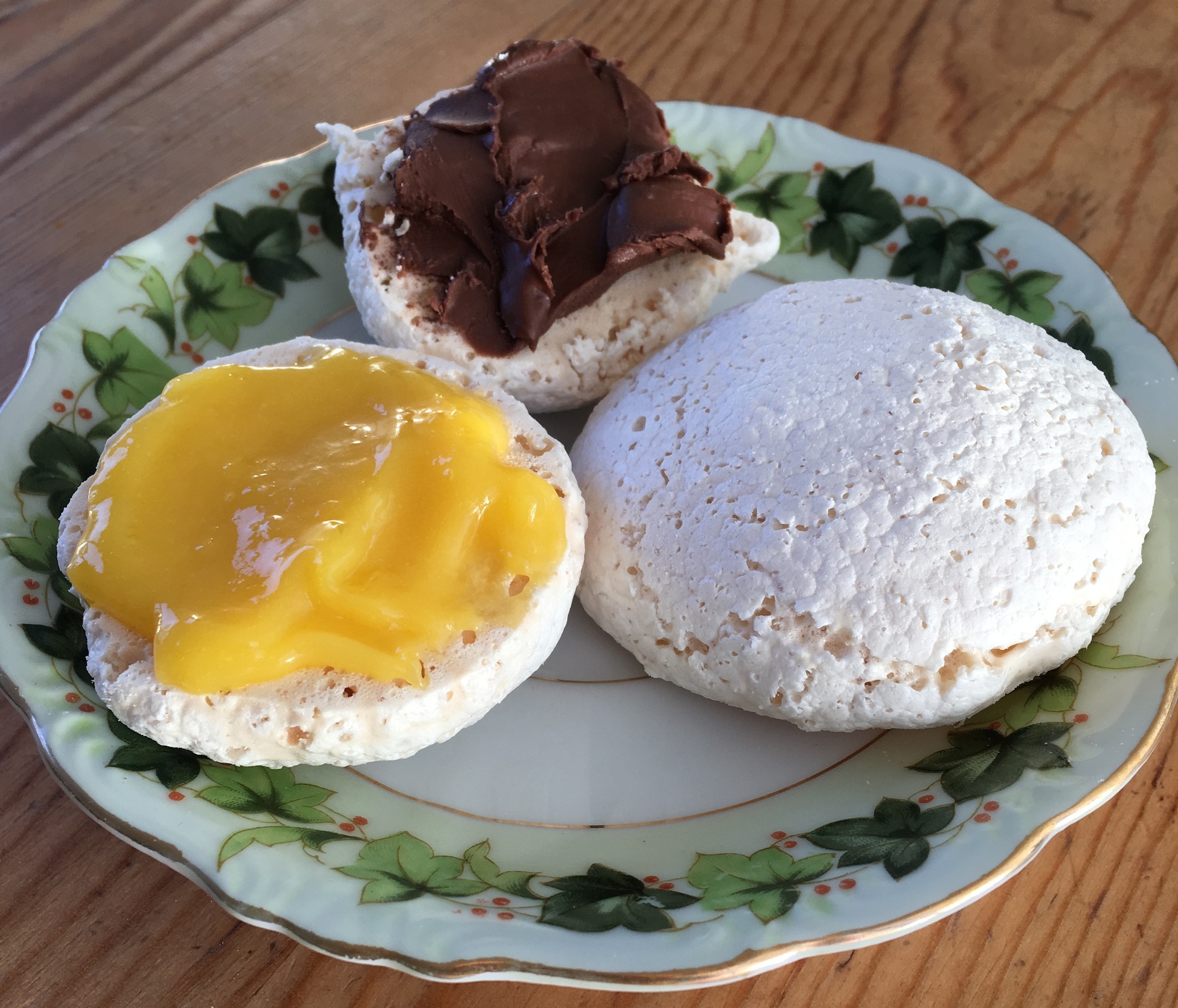
He made meringues with it.
Yep. Meringues. Who’d have thought.
Turns out, the bean water (call it aquafaba if you want it to sound gourmet) foams up when beaten, just like egg whites do.
The meringues came out crisp, and melt in your mouth just like a meringue should.
There is a slight beany aftertaste to them, but I prefer it to the eggy aftertaste of egg-based meringues. In fact, I dislike meringues as a rule, because of the egg flavour, so these were a real bonus for me. And spread them with lemon curd or Nutella, and that bean flavour is covered up nicely.
Completely crazy, and absolutely wonderful!
If you want to try your own bean-water meringues, there are lots of recipes on line. My husband was inspired by this article and recipe in Slate.
Where Grass is King
 One of the things I’m struck with every time I return to the US is the prevalence of the expansive lawn. I don’t know if that’s all of the US, or just Pennsylvania, but there’s a lot more acreage in lawn here than there is back in New Zealand.
I appreciate a good lawn—for picnics and games, nothing beats it. But I also believe in making good use of land, and I believe there is such a thing as too much lawn—especially in Pennsylvania where much of the lawn covers land that was once highly productive farmland.
How much energy and effort are put into the maintenance of vast expanses of grass that no one so much as steps foot on except to mow? What if those expanses were used instead to grow vegetables or were restored to native habitats? How much space in our suburban environments could we use more productively by eliminating the lawn? How much expenditure of fossil fuels and fertilisers could we avoid? How many native plants and animals could we benefit?
I don’t have answers to these questions, but my gut feeling is that in a world with an ever-increasing population, wasting space growing unappreciated Kentucky bluegrass is not sustainable.
At Crazy Corner Farm, we try to make the best use of the entire property, and much of it is devoted to food production or native plantings. We also have a sizeable lawn, but that grassy area is heavily used by the kids for all manner of play. Once the kids are gone, the grass will almost certainly give way to something more productive. We are forever looking to make more efficient use of the space we have. I think in future, we are all going to have to do the same.
Pennsylvania Green
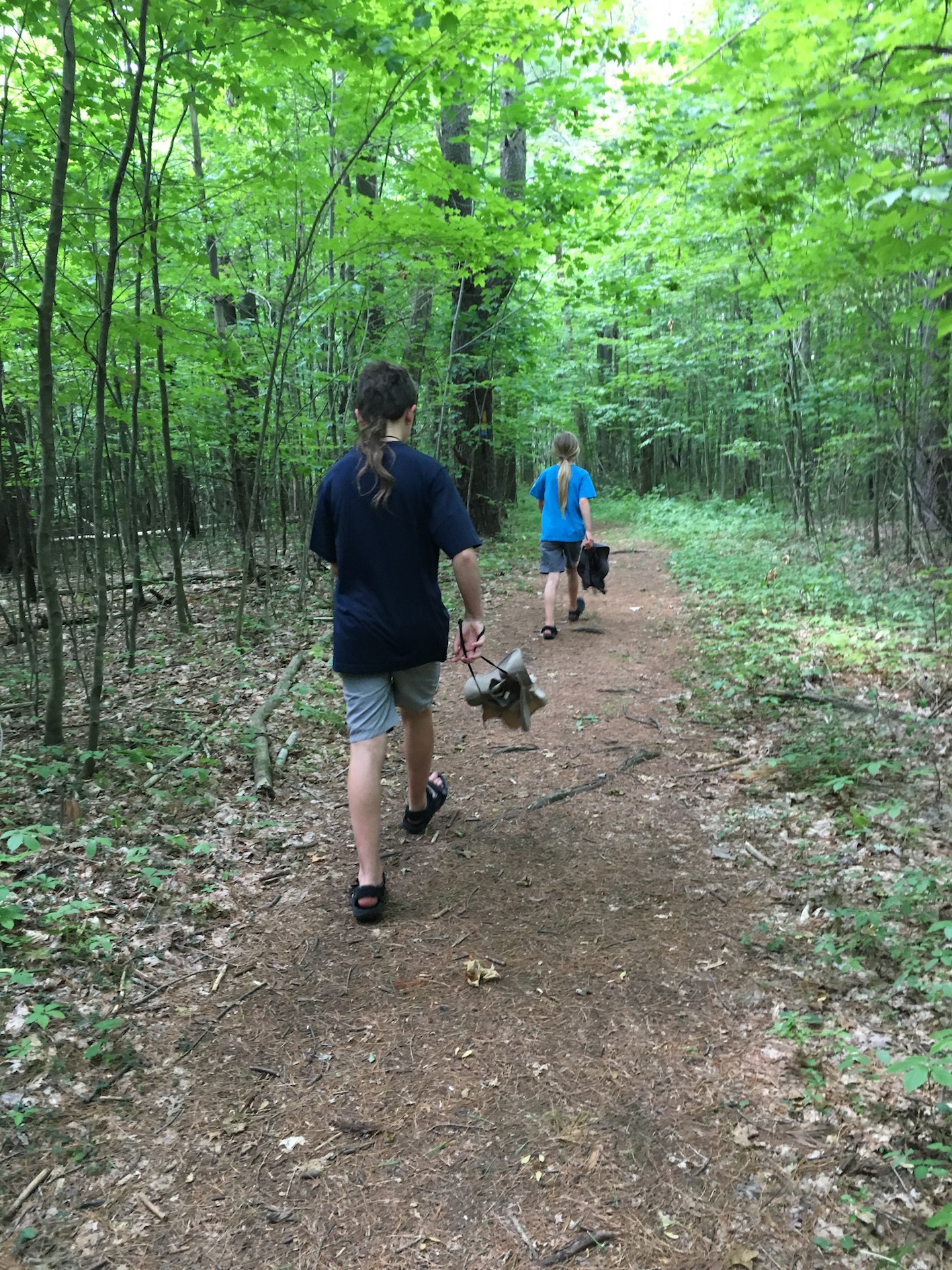 Crayola needs a new colour—Pennsylvania Green.
There is something about the shade of Pennsylvania forests that’s different from every other place.
I know, I know. It’s not actually possible. The forests don’t follow state boundaries. New York, West Virginia, Ohio, and Maryland have similar greens. But for me there’s nothing like Pennsylvania Green.
We spent a delightful weekend enjoying that green with friends in the middle of the state. A soothing and cool colour for a hot summer weekend.
Hooray for North American Wildlife!
 New Zealand may have some of the more unique and awesome animals on the planet, but for sheer variety, North America is the winner.
For my kids, squirrels, chipmunks, and turtles are amazing sights. Bright cardinals, drumming woodpeckers, and colourful butterflies are exotic treasures.
To come across a deer in the woods is the event of a lifetime.
Even the forest floor is teeming with exotic creatures.
Here is one of my favourites—Apheloria virginiensis. Sometimes called the almond bug, this large bright millipede uses cyanide compounds to protect itself from predators, giving it an almond smell. Most millipedes use chemical defenses, so it’s nothing out of the ordinary in the millipede world, but who could resist the charm of this lovely creature?
Of course, spraying cyanide at your enemies isn’t particularly charming. Though they are harmless to handle, do wash your hands afterwards, because the poison can be quite irritating if you get it in your eyes.
Saturday Stories: How the Albatross Got its Wings

Photo: Peter Weiss
“Grandma! I dreamt last night that I could fly!”
“Yes, child. Of course you did. All those born of our ancestors do.”
“Why is that, Grandma?”
The old woman sighed. “Because once, we could fly.”
“Fly? How could we fly?”
“Many, many years ago, before I was born, before my grandma was born, before even my grandma’s grandma was born, the People had wings. We spent all day in the sky.”
The girl gazed upward while the old woman continued. “We soared with the kettles of broad-winged hawks in the autumn and kept the arctic tern company on her long migrations. We flitted with the chickadee amidst the winter-bare branches, and swooped silently with the owls in the night.”
The old woman chuckled. “We challenged the peregrine falcon to races—and always lost. We danced with the woodcocks in the air. We explored every bit of this land, from mountain to sea. We followed the Great River to its source in a small trickle welling up from the ground, and then to its wide mouth at the sea.”
The ancient eyes no longer looked at her granddaughter—their vision was focused far away.
“Then the Flightless came, with their treasures from the earth—gold, silver, precious gems. They worshipped these treasures, and taught the People their value. The Flightless showed us how to dig and mine, how to extract these treasures for ourselves. We forgot the sky. The silver ribbon of a river glinting in the sun was replaced by silver chains. The glitter of the northern lakes was lost to the glitter of polished stones. The golden rays of sunset gave way to the gold sheen of metal.
“We fashioned jewellery from these treasures. Bird-shaped earrings, necklaces of delicate feathers, pendants showing our own forms with wings outstretched. But we forgot what those wings were for. The tern flew alone, and the falcon raced only the wind. We dug and we delved into the dark earth, forgoing the sky.
“We began to crave the bright treasures. Those who found more than their share hoarded them jealously. Those who found less, stole.”
“When Albatross came to ask for our wings, we gladly cut them off our own backs. Wings were in the way in the underground mines. We could dig much easier without them.”
“Albatross took our wings and put them on his own back. He flew off, never to return to land again. He soars forever now over the sea, exploring the world, and landing only when he must. He lives with ease and dies with a sigh of contentment, for he has seen the wonders of the earth. Meanwhile, we live in toil, and die with our bodies and spirits spent. Rarely do we even look to the skies. We have forgotten the wind and the sun, the pull of stars, the sight of all the world spread out below us.”
Grandma smiled wistfully and sighed. “I suppose it is just a legend…a legend of flight.”
“But, Grandma…I know I flew last night! I went up and up until our house was just a speck, and the fields were wrapped around it like the quilt on my bed. And the forest was so dark and cool-looking, and I could even see the sea off in the distance, and the sun sparkled off the waves, and…Oh Grandma, it was so beautiful!”
“Yes, child. Don’t ever forget it.”
 Robinne Weiss