Ginger cream scones are a classic, but I rarely have cream on hand. So Sunday morning, with a hankering for ginger scones, I made up a new recipe.
Taking inspiration from an excellent ginger muffin recipe, I included oats in the scones. A touch of vanilla rounded out the flavours for a thoroughly delicious breakfast. In fact they were so good, they all vanished before I thought to take a photo of them. (the photo here is of some previous scones I made–honestly they look just like the ginger scones.)
Here’s what I did, in case you’d like to try it too.
1 1/2 cups all purpose flour 1 cup quick cooking rolled oats 1/2 tsp salt 3 Tbs brown sugar (next time I’ll use just 1 1/2 Tbs—this was a bit too sweet for my taste) 2 tsp baking powder 100 g cold butter 1/2 cup crystallised ginger, finely chopped 1 egg 1/2 cup + 1 Tbs milk 1 tsp vanilla
Combine the flour, oats, salt, sugar and baking powder in a large bowl. Cut the butter in with a pastry knife until the mixture looks like coarse meal. Stir in the crystallised ginger.
Whisk together the egg, milk and vanilla in a small bowl, and then combine with the flour mixture. Knead gently a few times until the dough comes together in a ball. On a floured surface, pat the dough into a disk about 1.5 cm thick.
Bake at 210℃ for about 15 minutes until nicely browned.
Making and canning vegetable soup used to be a whole family activity, with the kids pitching in from a young age, picking and chopping vegetables alongside my husband and me. My husband would cook the soup while the kids and I washed dishes, and then I would can (bottle) it up.
We called it Summer Soup, because we made it at the height of the summer vegetable season (which ironically always falls in early autumn). On the cold rainy nights winter we could open a jar and enjoy a bowl of summer.
When the kids were young, they delighted in recounting which vegetables they chopped, proud of their part in feeding the family. These days, making summer soup is a mostly solitary activity for me, the kids being all grown up. It hasn’t stopped me from making a vast quantity of soup. Last Sunday I designated as Summer Soup day because I had heaps of tomatoes, green beans, sweet corn, zucchini, and other vegetables to put in it.
Because it was Sunday, I started off at 5.30 am by making muffins for breakfast. While the muffins baked, I began chopping vegetables …
My husband had planned on baking bread on Sunday, but unfortunately he woke with a terrible cold that morning. He’d started his sourdough sponge the night before, so with instructions from him, I made up his bread dough after breakfast and set it to rise as I continued to chop vegetables.
The mixing bowls began to fill up in the kitchen as the morning progressed. After several hours and a few trips to the garden to pick more vegetables and dump scraps on the compost pile, I took a short break from chopping to divide the bread dough for loaves. Thankfully, my husband felt well enough at this point to form the loaves and get them started on their second rising, because I really wanted to finish chopping vegetables by lunchtime.
I finished the final chopping shortly after the focaccia came out of the oven. We sat down to enjoy fresh focaccia for lunch.
My break was short, because after lunch I began processing all those chopped vegetables. It was clear I wasn’t going to be able to fit everything into one pot, so I pulled out both my 20-litre stock pots and divided the vegetables between them. While the soup heated up, I prepared my jars and the pressure canner. I also filled my 12-litre stock pot with vegetable scraps and water and set it on the stove to simmer for a few hours for vegetable stock.
Much of the time commitment in making and canning vegetable soup is in the canning process. Each batch of seven jars has to be processed for an hour and 15 minutes, and then there’s the waiting time while the canner cools down enough to remove the jars before putting in the next batch.
While I was waiting for the canner to do its thing, I started in on the apples that needed to be processed. I peeled and sliced a mountain of apples. Once I’d emptied the soup out of one of the 20-litre pots, I refilled it with apple slices and cooked them up into apple pie filling—enough for three generously filled pies. The pie filling went into the freezer.
The soup seemed to never end. Even after separating off two meals worth of soup for eating this week, I ran three full canner loads (21 quarts) of soup and one full load (7 quarts) of stock. The last jars came out of the canner at 9.15 pm.
I’m glad I only make summer soup once a year, but I’m thrilled to have all that summery goodness squirrelled away in the pantry. Bring on the rain and cold of winter—I can already taste the soup (followed by a slice of apple pie, of course!).
It’s been hot here lately, with blue skies and temperatures in the upper 20s most days—summer at its height.
But when I wake at five in the morning it is dark, and there is no working in the garden until nine in the evening anymore, unless it’s by head torch. The days are growing shorter, and there’s a feel to the air that speaks of the autumn to come.
The cricket chorus has grown over the past few days—the summer’s crop of insects maturing to mate and lay eggs before winter. The early apples have been harvested, and pumpkins are swelling on the vines. I harvested most of my dry beans last week, too.
Of course the summer crops—tomatoes, zucchini, eggplants, peppers, and beans—are still going strong, and will be for a while.But the seasons are turning.
I love it.
My husband and I lived for two and a half years in Panama back in the early 1990s, so we got to experience living almost on the equator. The daily temperature variation in Panama is greater than the yearly variation, and the day length variation is virtually imperceptible. The only seasonality is in rainfall—it rains from mid-March to mid-December, then stops entirely until mid-March again.
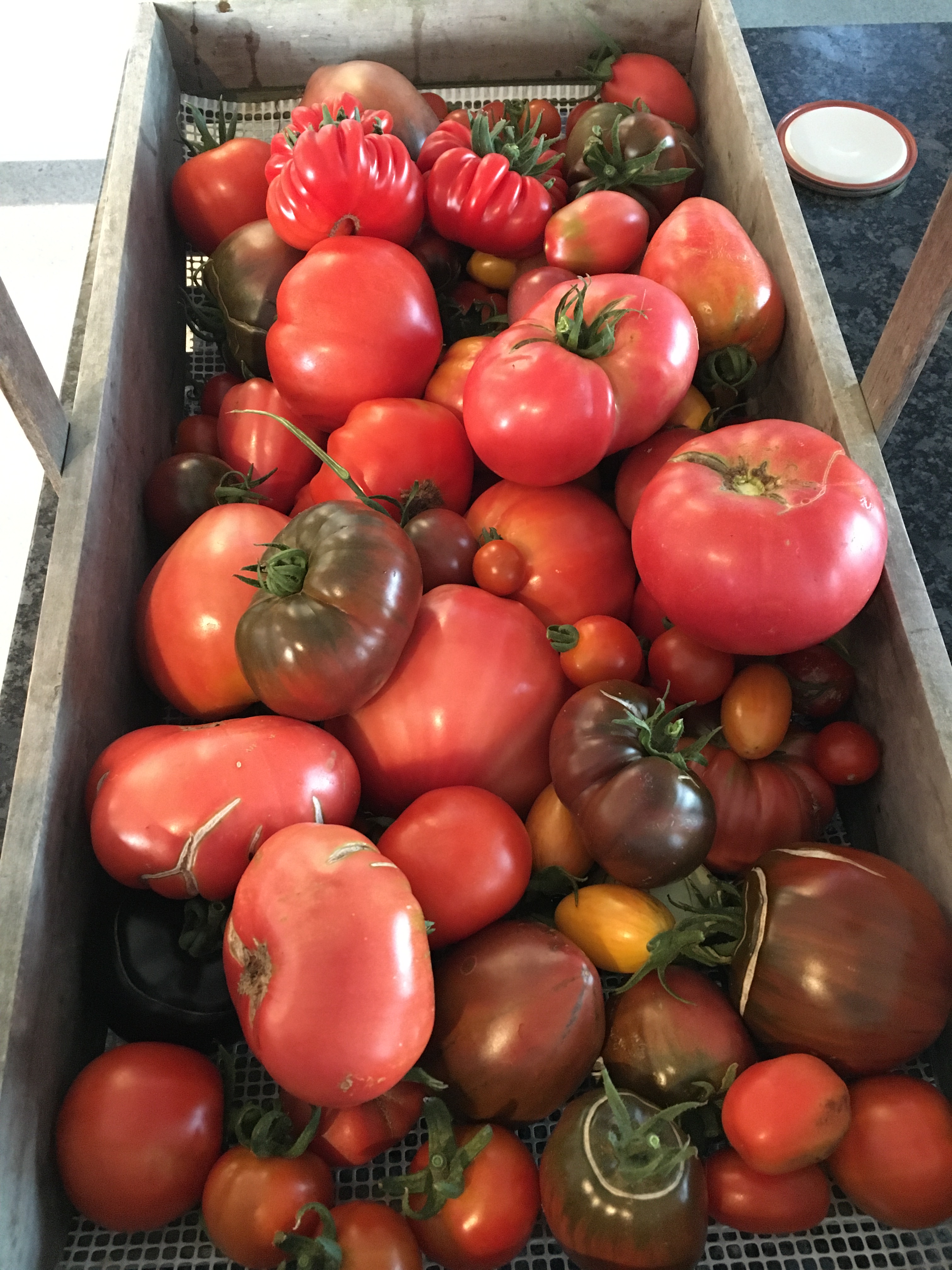
Tomato sauce made from yesterday’s harvest
After living in Pennsylvania, Michigan and Ohio for the first 22 years of my live, Panama was … well … boring from a seasonal perspective. I missed the annual markers of the Earth’s progress around the sun. Of course we had heat, but I missed the long days and drawn out sunsets of a high-latitude summer. In Panama, the sun leaps into the sky in the morning and drops like a stone below the horizon in the evening, and it does so with such precision and consistency, you can practically set your watch to it.
I missed the cold of winter, the dark days and long nights perfect for curling up with a book or sitting by the fire (though to be fair, Panama nights sometimes seemed long, because we had no electricity, one small table to sit at, and only a lopsided wooden chair and a tree stump to serve as seating).
I missed spring, for its slow unfurling of green, rising from the herbs on the forest floor to the tops of the trees as the season progressed. I missed autumn for its splash of yellows, oranges, and reds, the rime of frost on crisp mornings. I missed the bite of icy wind, the smell of snow.
New Zealand doesn’t get the extremes of seasonality I enjoyed in the northern United States. Our climate is heavily moderated by the vast Pacific Ocean in which we sit. And our native plants are largely evergreen, so green is the dominant colour all year round. But where I live, at a similar latitude to St. Paul, Minnesota (but of course on the other side of the equator), we have decent seasonality, and I love the changes throughout the year. People often ask what my favourite season is, and I have to say it’s all of them. Each season has something new and exciting to offer, and there’s no point in mourning the loss of long summer evenings, because they’ll be back. Instead, I welcome the short days, the excuse step away from the garden in the evenings. I look forward to bringing in the autumn harvest and filling the pantry with the fruits of summer.
So bring on the shorter days. Variety is the spice of life, after all—time for some spice.
The cake was ugly even before the jelly layer was added on top…
The girl turned 20 this week, but she hasn’t outgrown crazy birthday cakes. Her response when I asked her what she wanted this year was: How would you feel about making a hornwort (Anthocerophyta not Ceratophyllum)?
Well, that’s a gauntlet thrown, for sure. Hornworts’ thin, jelly-like ‘leaves’ and tall, narrow sporophytes do not lend themselves to buttercream icing. This called for a new technique.
I immediately thought of agar agar (a vegetarian gelatine substitute, for those who don’t know), which has the right sheen for a hornwort, and which I knew could be made into thin, textured sheets (I knew this because I’ve used it for creating texture on fake wounds … yeah, I do a lot of weird stuff.)
As I was looking up a good water:agar ratio for the consistency I wanted, I stumbled across the world of jelly cakes. I was immediately hooked. They look totally disgusting to eat (I hate jelly/jello, won’t use gelatine because it’s not vegetarian, and I think agar tastes like seaweed), but visually they’re amazing.
So when I found that my thin agar leaves were fiddly and a bit too floppy, I decided I would do a jelly cake and create my hornwort using jelly cake techniques.
And the jelly added extra special ugliness.
I spent two hours practicing with the jelly last week, making sure I could do it without all the specialised equipment the professionals use. Then I made the other components of the cake over the weekend. I first made the actual cake (because no way was I going to have only jelly cake to eat) using a new recipe. This turned out so awful, I made a second cake with a tried-and-true recipe because there was no way I could use the first. I made the fake moss (using a new technique I hadn’t used before), chocolate tree bark (again, something I hadn’t made before), and the icing (using an unusual recipe I had never used before).
Then, on the girl’s birthday, I made the jelly hornwort and assembled the whole thing.
The result? Pretty ugly, and not very hornwort-like. Or bark-like, or moss-like. And the icing set up like glue …
But hey, you’ve got to try new things, right? On the plus side, I learned about jelly cakes. I learned that the specialised equipment the professionals use is probably necessary to do it well. I learned how to create a decent jelly from agar agar (I mean, as decent as any jelly can be—yuck!), which I could now use to create moulded shapes or other embellishments for future cakes. I learned how not to make chocolate tree bark, and that a certain cake recipe and icing recipe can be discarded. The fake moss was definitely more moss-like than previous techniques I’ve tried. It’s one that’s probably worth playing with and refining.
Trying new things can pay off…
So I learned some things. And I got to eat cake. It may not be pretty, and the icing texture is simply wrong, but the flavour’s good.
And I have to remind myself that sometimes trying something new does work. Remember the octopus cake? Better luck next time.
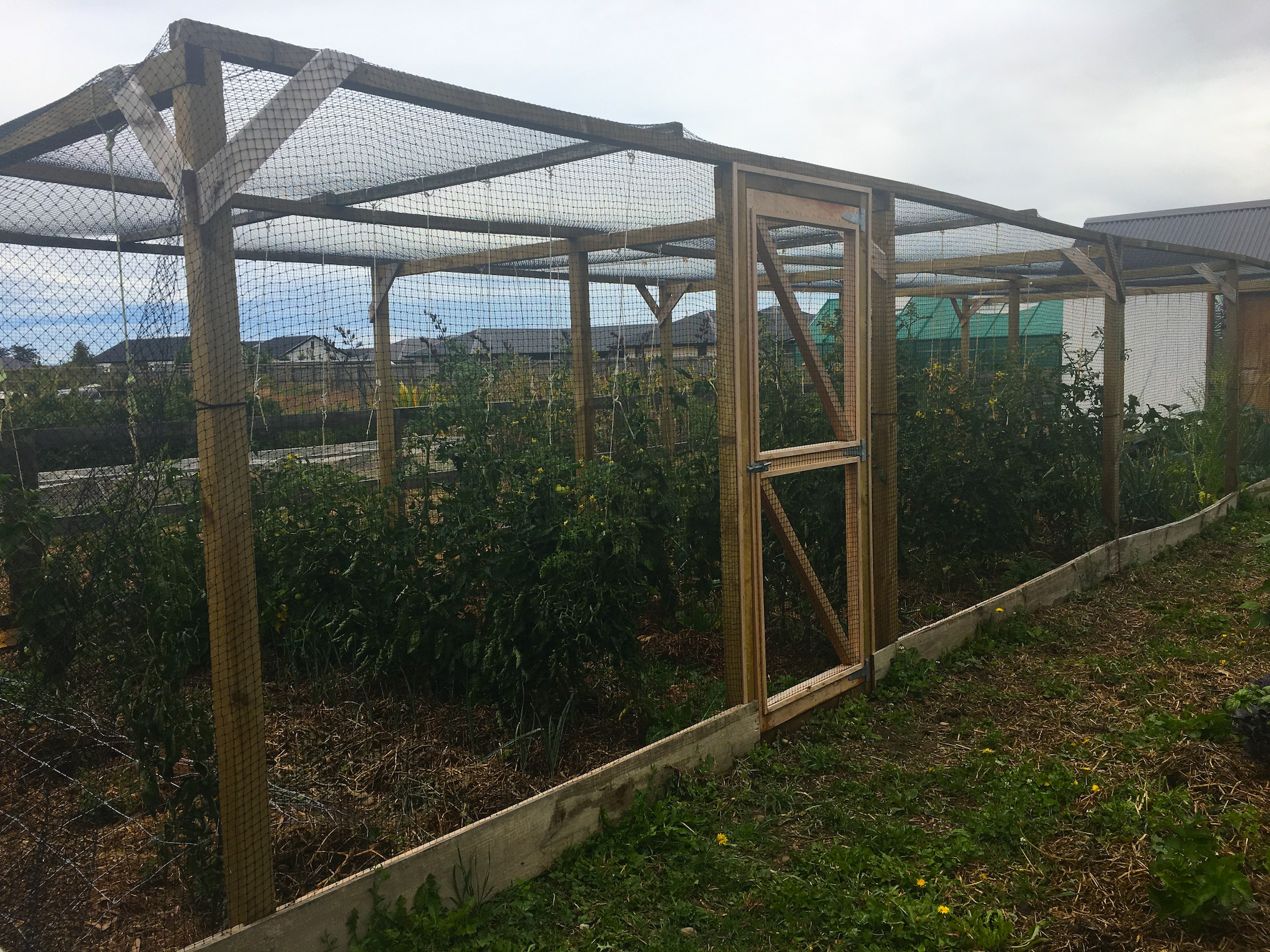
The netted ‘room’ is excellent at keeping birds out, but does nothing to thwart rats.
With a third of my garden protected with permanent bird netting this year, I was pretty smug about pests this spring. Silly me …
2023 may have been the year of the rabbit in the Chinese Zodiac, but in my garden it was year of the rat, and it seems to be continuing in 2024.
In the spring, rats ate all my pea seedlings … twice … On one of those occasions, they plundered the seedlings in the three hours the tray sat in the garden before I planted them out. I was working (planting other things) just metres away while the rat collected all the seedlings and tucked them away in its nest (I found them later when I uncovered the nest).
The rats also did good work on my first planting of corn, melons, cucumbers, and pumpkins, eating the seeds and uprooting the seedlings.
I went through three cheap rat traps (none of which actually caught a rat, and all of which quickly broke), before spending an excessive amount of money on a DOC 200 trap. This terrifying stainless-steel beauty caught its first rat within 24 hours. It has nabbed 3 rats, a hedgehog, and an English sparrow in the three months I’ve had it, which I’m quite pleased about.
Unfortunately, it has not solved my rat problem. Last week I discovered a rat (or rats) had tunnelled straight down my potato bed, eating nearly every potato in the entire bed, and damaging some plants so badly they were dying. Yesterday, I went to pick a gorgeous Black Brandywine tomato that was ripening on my now bird-protected tomato plants. I found the tomato on the ground, half eaten by little rat teeth.
I’m beginning to wonder if I will get anything off the garden this year. So far, the rats don’t seem to like courgettes or cucumbers, but my beans are planted right next to the compost pile where the rats seem to nest. Once they start plumping out, they’ll be primo rat food. And the corn? You know those rats will be scampering right up the plants to gnaw at the ears. Makes it hard to lure them to a trap when the garden is a smorgasbord of delicious food.
Makes me wish I still had a cat—the rats didn’t start to become a real problem until he was gone.
I’ve also got my first ever infestation of whitefly this year. Pretty embarrassing for someone whose Master’s degree was on greenhouse pest management. Whitefly wasn’t even on my radar, so I missed early signs of the infestation. They’re not only in the greenhouse, but outdoors as well. The key to effective integrated pest management is paying attention and catching infestations before they’re a problem, and I failed spectacularly at it. Now I’m playing catch up. My only consolation is that it looks like lots of other people are, too, because both suppliers of whitefly biocontrol agents in New Zealand are sold out. Serves me right, I guess.
So as we enter 2024, officially year of the Dragon, I’m wondering if there’s a dragon that eats rats …
I was cleaning out my purse this morning and noticed I had two notebooks in there. It seemed excessive, even for me. So I paged through them both to see which had more empty pages. As I did, I happened across this little gem of a poem, scribbled down at some point. I don’t remember when. Most of my on-the-road scribbles are just kernels of ideas and need lots of work or fleshing out, but I thought this was pretty good for an on-the-fly poem.
It was certainly better than the sticky old mints that had fallen out of their package and were lying at the bottom of the purse …
So I thought I’d share the poem (the mints went into the rubbish).
Late night on the Interstellar Highway
Twin lights glitter
Down the long corridor of black
You are not alone, then.
Or you are more lonely than before,
Screaming through the void
Of interstellar space.
The long road trip
Without a yellow line.
Without the neon
Of a late-night diner.
Without a single signpost
Saying Earth 2 million km
Keep left.
You hail the approaching ship--
Regulation words
Generated by your onboard computer,
Acknowledged by the other ship’s computer.
No life forms involved.
You blink and they are gone,
Not even the friendly spray of gravel
To crack your windshield.
And you remember fondly
The stifling days of youth
When you chafed
Under Mum’s touch.
The embraces you shrugged off
Were priceless.
The currency of the traveller
Light years from home.
A couple days ago, I sat down at my desk, knowing I had a lot of ‘business’ to deal with. I was determined to complete these necessary but uninspiring tasks (cashbook marketing, etc.) quickly, so that I could get on to the writing I wanted to do.
First job was to check my email.
And this was the first message I opened:
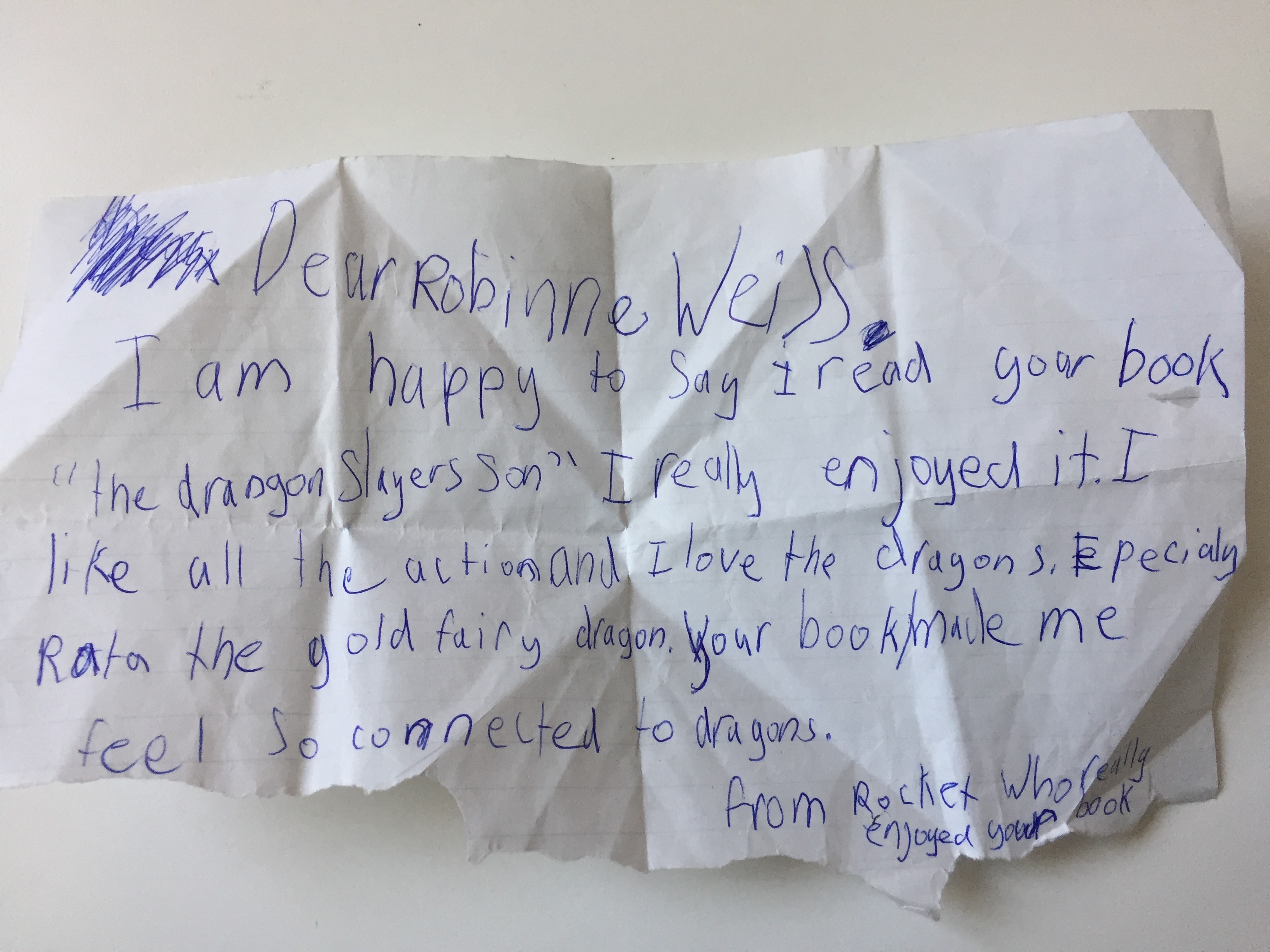
Hi there Robinne I bought your whole Dragon Defence League Series at the Spencer Park Market and you personalised one of the books for my son Mathew. I just wanted to write to let you know that he absolutely loves the first book and is over half way through and keeps telling us all about what is happening in the book. We have never seen him so glued to a book before and he never tells us what is happening so it has made a massive impression on him so thank you so much for writing them.
Well, there’s no better way to start your day than that! This is exactly the sort of thing I live for as a writer. To make an impression, to capture the imagination of a reader is the whole point of writing. And to have my book be the book that opens a child’s mind to the wonder of stories is something special, indeed.
It reminds me of the real reason I write. Oh, I would love to be able to make a living at this. The validation of a living wage would be amazing.
But it’s not why I write. I write to connect with others through words. There’s something magical about having an impact on a reader you have never met.
And I’m regularly reminded that I’m not the only writer who has to fund their passion with other endeavours. On a recent episode of Writing Excuses (a writing podcast I highly recommend), the topic of the week was how to fund the writing life. The whole point of the episode was that it’s okay, normal, and totally possible to purposely engage in money-making activities to support your writing habit, and that choosing activities that feed into your writing is the key to making the most of your time.
So, yeah, I teach three days a week in order to support the two days a week of writing. And because I teach students within my target audience, I know what my audience likes to read, know what sorts of life experiences they have, understand how current events resonate (or don’t) with them. I have an eager and ready population of beta readers at my fingertips, and a ready source of story inspiration.
It’s no different from when I was running the Bugmobile, my science outreach programme for schools. Bugmobile fees barely covered my costs, though I was charging schools as much as I possibly could. So I funded the Bugmobile by doing much more lucrative heritage interpretation consulting for various local and national agencies and organisations. The consulting work was interesting, but not my passion. But the skills to do both were similar, and it was a way to ensure I could continue to run the Bugmobile.
I will admit I ended 2023 feeling guilty for ‘wasting’ so much time, money and effort writing books and stories that don’t pay the bills. But I’m launching 2024 with a different attitude. And with a new realisation.
Back in 2005, when I first developed the idea for the Bugmobile, I wrote a mission statement. I don’t remember it exactly, but it was something along the lines of connecting people with the amazing nature found in their back yards and encouraging people to explore the world around them. I have realised that I’m still doing that as a writer. When I closed the Bugmobile and started writing, I felt like I’d cut off an arm. How could I stop interpreting the natural world?
The answer is I never did stop. I just don’t think I realised it. My Dragon Defence League books, which captivated Mathew, are a celebration of the landscapes and natural history of Aotearoa New Zealand. Yes, I’ve put dragons in there, but only to illuminate our relationship with the natural world and how it’s evolving over time. Only to give me a tool to envision a different way we might think of the natural world and our place in it. Digging deeply into all my stories—fantasy, science fiction, climate fiction, horror—they all contain elements of heritage interpretation.
The truth is, while I believed I was building a business, first with the Bugmobile and interpretation consultancy, and now with the writing, I’ve actually been building a life. A life with meaning and direction.
I still have to make sure I’m paying the bills, and I still need to spend time worrying about marketing, but putting my writing in the larger context, and reminding myself of the larger goals I have for my life, helps me to let go of the feeling that net profit from the sales of my books and stories is the primary measure of success.
But that doesn’t mean you shouldn’t buy my books. They’re great! Fun reads, and full of environmental themes … Go on, you know you want to.
January is quite possibly the best month in the garden. Seemingly overnight, the vegetables double in size. Summer crops begin ripening. Weed growth slows, and the vegetables are large enough to compete with all but the most aggressive weeds. Garden work switches from planting and weeding to picking and processing. The frenzy of December berry crops is over, and the cupboard is bursting with jam.
January is a time to enjoy the fruits of my labour. Not that there isn’t work to do, but the rewards of all my work are beginning to outweigh the effort. It’s a great way to start the new year.
Another great way to start the year is with the giant plant tags Santa Claus made me for Christmas. They’re not the most efficient markers for the garden, but they’re adorable and add a touch of whimsy.
With luck (and a lot of hard work by my husband), by the end of January, I’ll also have a nice new garden shed for storing tools and potting up plants. There will be a bit of whimsy in the shed, as well, inspired by a leaded glass window we found for it. I can’t wait to have that bit of the garden plan complete and functional!
I hope your January is full of things to enjoy and to look forward to.
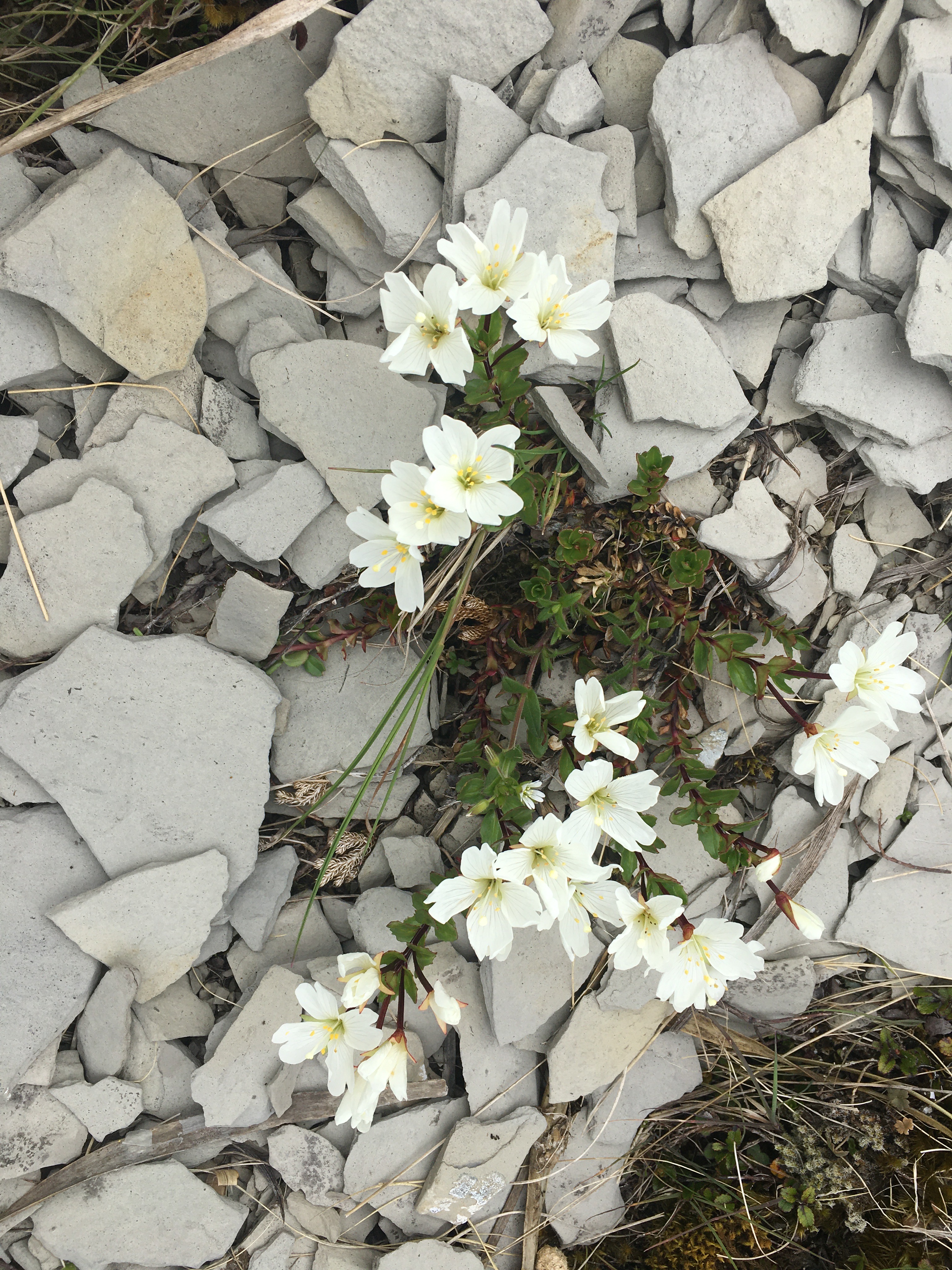
The family’s pre-Christmas tramping trip this year was to the Thousand Acre Plateau in Kahurangi National Park.
Last time we were in Kahurangi National Park was to hike the Kepler, our pre-Christmas tramp a few years ago. On that trip, it poured relentlessly, and we hiked with few breaks, for fear of hypothermia.
This trip was exactly the opposite. With sunshine and temperatures reaching 29℃ (84℉), we took lots of breaks, for fear of heat stroke.
The Needle
Our original plan had been to hike an hour to the Lake Matiri Hut on day one. After a leisurely start and five hours driving, it seemed reasonable not to plan too much hiking. But when we reached the first hut, none of us was ready to stop—we’d only just begun, after all.
The DOC time to Poor Pete’s Hut, on the plateau, was listed as 3 hours. It was only four o’clock, and it was the summer solstice—there was plenty of time to push on to Poor Pete’s.
Unfortunately it was straight up to Poor Pete’s, and the temperature remained stubbornly high. By the time we finally crested onto the plateau I was questioning our decision to push on in the heat. But the plateau was painted gold by the evening sun, and our first glimpse of the remarkable limestone landscape was truly spectacular. We reached Poor Pete’s Hut at 8 pm, enjoying the final 20 minutes of flat-ish hiking as the sun set.
Poor Pete’s Hut is a sweet little 2-bunk hut. Unlike last year’s two-bunk huts that our family of four crammed into, Poor Pete’s has a spacious covered porch area that was brilliant for sleeping, so we snoozed in style as the noisy weka and ruru did their best to keep us up all night. And I can’t discuss Poor Pete’s Hut without mentioning the long drop, which isn’t the standard modern DOC vault toilet. Rather it is an old-style wooden box set atop one of the many deep crevices in the Thousand Acre Plateau landscape. And to make a trip to the loo exciting, the path down to the facilities crosses the crevice in an awkward fashion. I nearly slipped in my first time. Classic.
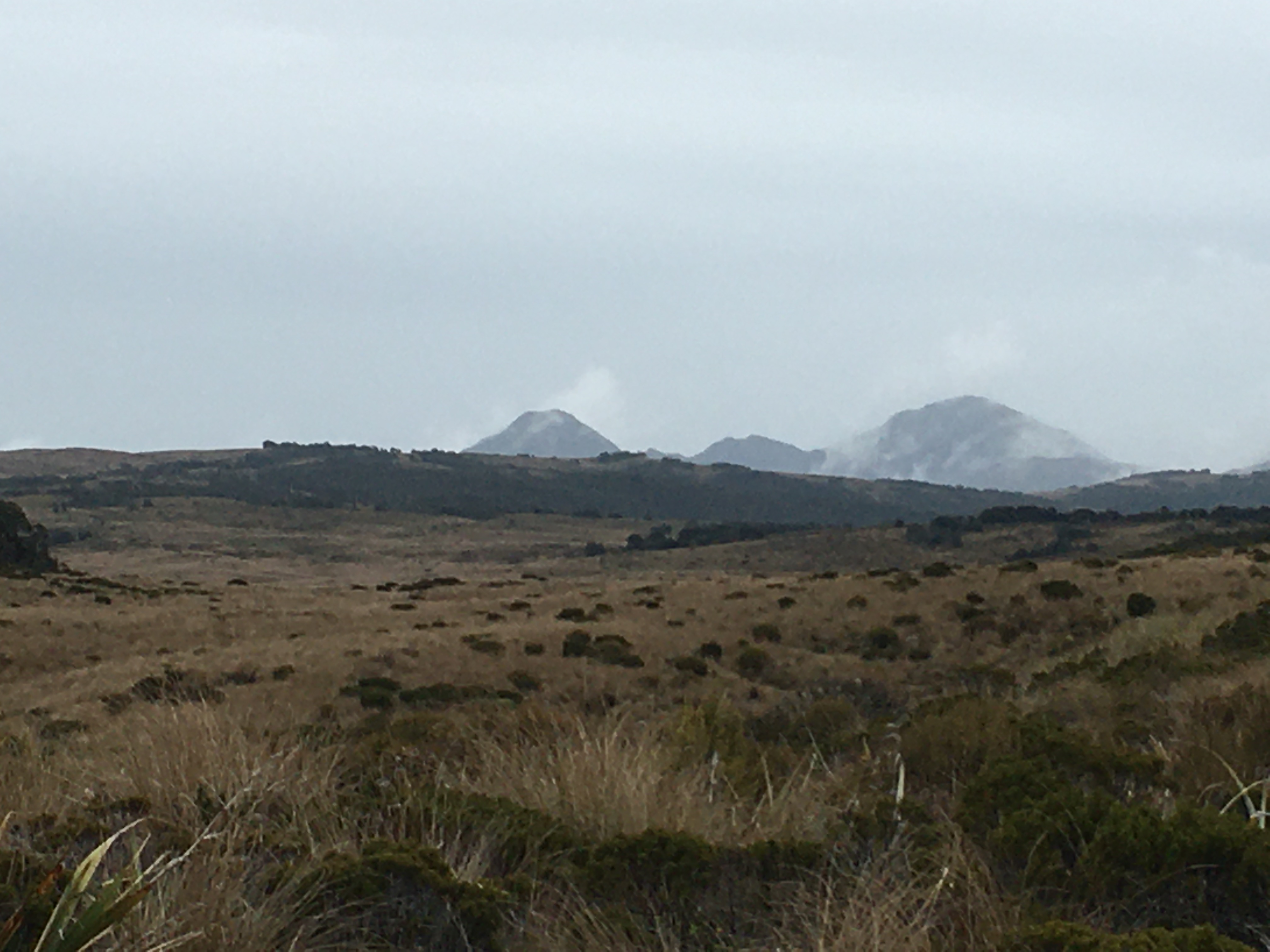
On day two, we hiked across the rolling landscape of the Thousand Acre Plateau to Larrikin Creek Hut. Compared to the first day, it was an easy stroll, but I can imagine in wetter weather it could be an absolute nightmare. The plateau is mostly wetland, with lots of tarns and wet, mossy and muddy ground. Entries in the hut book at Larrikin Creek Hut mentioned ending up waist deep in some of the boggy holes. We managed it with mostly dry feet.
The Hundred Acre Plateau, as seen from the top of The Needle
It was only 9.30 am when we reached Larrikin Creek Hut, nestled at the edge of the forest near the base of The Haystack, a gravelly limestone ridge that kept shedding rock, even in the still and sunny weather. We had a brief rest, dropped most of our gear, and headed up to the top of The Needle, which looks like a child’s drawing of a mountain. There is no official, marked route to the top of The Needle, and it’s a bit of a scramble up Spaniard-infested scrub to get there. I decided there is no good way up, only less bad ways. But the view from the top is fabulous.
The limestone of the plateau is fractured and crumbling, and with landslides clattering down The Haystack, it wasn’t hard to imagine how the entire plateau will eventually tumble into the valleys below.
Evening at Larrikin Creek Hut was filled with birdlife—a cheeky weka kept us vigilant as it eyed up our boots and snacks. A kea called from somewhere on The Haystack, but thankfully didn’t descend to plunder our gear. Weka, bellbirds, and tūī kept up a cacophony until dark, when the ruru joined the weka (do those birds ever sleep?) for the night shift.
On Day three, we took an early morning jaunt down Larrikin Creek to the point where it plunges off the plateau. There were a couple of lovely pools near the edge, which would be fabulous swimming spots on a hot day (day three dawned coolish and drizzly, so no swimming for us, though we did all take a dip the day before in some shallower pools upstream). Walking across water-smoothed slabs of limestone in the creek bed, we saw lots of fossils and some interesting aquatic invertebrates.
After our stream scramble, we hefted our packs and began the return journey. Lunch at Poor Pete’s Hut in the rain was a real treat—that covered porch working its magic again. The descent off the plateau was not quite as bad as the ascent had been, but the earlier rain only served to make the forest hot and humid, so it was almost as sweaty.
The real treat on the descent was a flock of kākā calling in the treetops, keeping pace with us for a while.
We spent the night at the heavily sandfly-infested Matiri Hut, which we shared with a group of three others who were on their way up. The sandflies drove us out early on day four, and we were back at the car by shortly after 7 am. A nice little tramp in a spectacular landscape!
The traditional Christmas celebrations and decorations involving twinkling lights, snowflakes, snowmen, warm drinks and roaring fires make no sense here in Aotearoa New Zealand. But there’s plenty to celebrate at this time of year.
I always know it’s time to start thinking about the holidays when the strawberries and gooseberries ripen. I know it’s time to decorate when I can stroll through the garden, grazing on peas, gooseberries, raspberries, boysenberries and strawberries. When I can fill a colander with red and black currants. When the supermarket fruit begins to look old and nasty by comparison to what’s tumbling off the bushes at home. When it’s hard not to pick too much lettuce for the day’s salad.
Food is an important part of holiday celebrations, and for me half the celebration is the ability to eat my way through the garden. Finally in December, picking vegetables for dinner doesn’t feel like scrounging for whatever’s left from the winter crops. At some point during the month, the question of ‘what is there to cook for dinner’ shifts to ‘what needs to be eaten today’ (or processed and preserved). Jam making is my Christmas ‘baking’. Fresh berries replace the traditional bowl of mixed nuts put out for munching. Fruit ice creams and cordials are our figgy pudding and wassail.
As we make our way toward the summer solstice, the long days provide plenty of daylight for picking and processing fruit. And because it’s the Christmas season, those long days (and nights) in the garden and kitchen feel more like a celebration than a chore.
Is there holiday stress because of the increase in garden work? You bet—I can’t tell you how many times I’ve sat in the car, bucket between my knees, shelling peas on the way to the beach so I can get the work done and still have time for fun stuff. And keeping up with the weeds is a struggle while many of the vegetables are still small. Then there’s the inevitable broken tap or pierced irrigation line you find the first time you need to water (which usually happens this month). And the constant struggle with the thieving birds, who want to partake of the garden’s bounty, too.
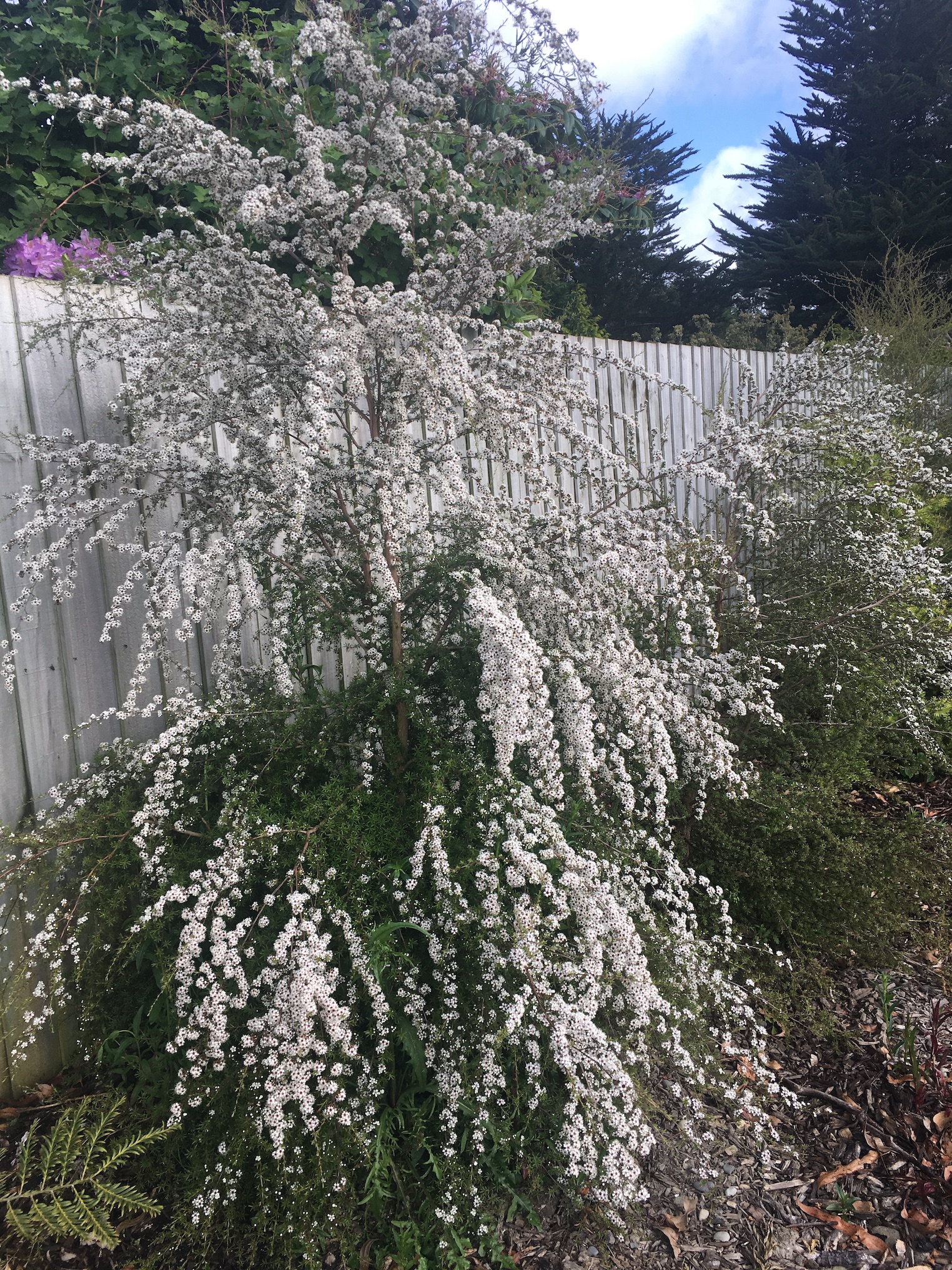
We may not have snow, but the kānuka flowers are a spectacular substitute.
But overall, the holiday season is a time to celebrate the garden’s summer bounty. It’s a time of fresh fruit and vegetables, and long days outdoors. Next week marks the end of my work year, with schools letting out for summer, and this weekend will be my first jam-making weekend of the season. Let the celebrations begin!











 Robinne Weiss