Winging it–Quince and walnut rolls

Sometimes, you try something new in the kitchen (like using an entire quart jar of black currants in a recipe for cupcakes), and it’s edible, but not something you particularly want to repeat. Then there are times you make something up and it just works.

On Saturday I made a cake that used all the eggs in the house and most of the butter. It didn’t leave me much to work with for Sunday breakfast. (This blog is not about Saturday’s cake, but it was amazing—the Brown Sugar-Spice Cake from King Arthur Flour’s Whole Grain Baking book—it’s what you’d get if gingerbread and pound cake had a baby together, and it was raised by carrot cake.)

So I figured I’d make a yeasted bread for Sunday breakfast. My initial thought was cinnamon rolls, which we do for Christmas breakfast every year. But I wanted something different—cinnamon rolls are for Christmas, not everyday. 

I started off by looking at recipes for various traditional fortified breads, but all of them either had eggs or lots of butter in them. 

So I decided to wing it.

Saturday evening, I combined two cups of warm milk, some yeast, about two tablespoons of butter, some salt, a spoonful of honey and enough flour (half wholemeal (whole wheat) and half high grade (bread flour)) to make up a nice bread dough. It rose beautifully, and after two hours, I rolled it out into a large rectangle. I spread it with about three quarters of a cup of quince paste, then sprinkled on some cinnamon and a generous handful of chopped walnuts. Then I rolled it into a log and cut the log into twelve thick slices, which I arranged, cut side down, in a greased 9 x 13-inch baking tin. 

I popped the pan in the fridge overnight, and the rolls were beautifully risen by 5 this morning. I gave them 30 minutes in a 210℃ oven, pulling them out when they were nicely browned.

While they were still warm, I drizzled a simple glaze over them—1/2 cup icing sugar (confectioners sugar), about 1/2 tsp vanilla, and enough milk to make a thick, pourable consistency.

It’s really too bad I didn’t actually measure most of the ingredients, because the result was excellent. In fact, I think it’s worth running out of eggs and low on butter purely to have an excuse to make these rolls. Maybe next time I’ll measure my ingredients so I can give you all a recipe—it’s definitely one worth sharing.

In the meantime, if you’re adventuresome and would like to give my loose winging-it recipe a go, I highly recommend it. If you can’t get quince paste, I reckon apple butter or a thick apple sauce would work nicely, too, though it’s hard to beat quince for flavour. 

Good luck, and happy experimenting!

Gardening for the Future

As my regular readers all know, I spend a lot of time in the garden. I also spend a lot of time thinking about gardens, looking at gardens, planning gardens …

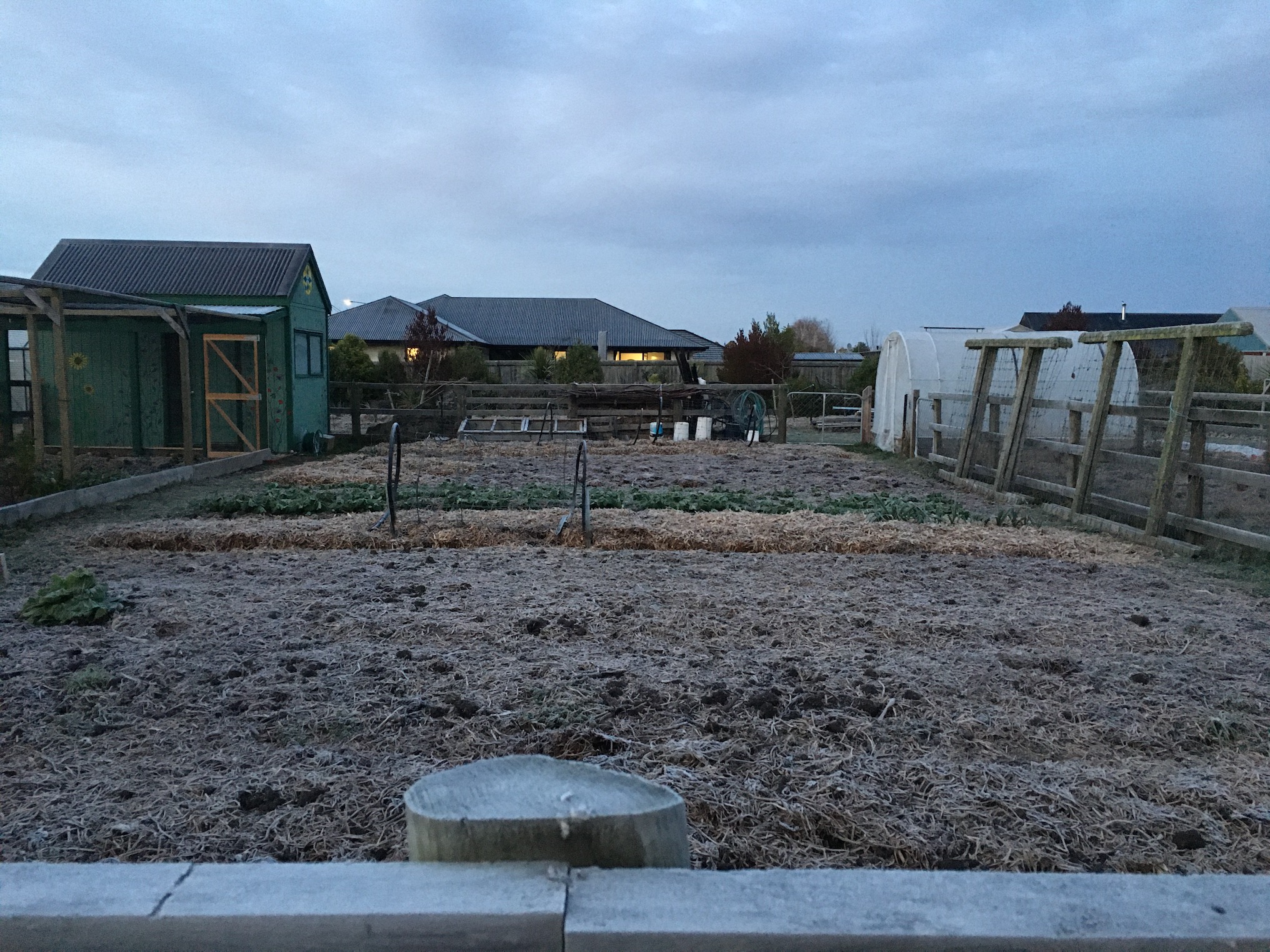
The bare paddock: former forest, future garden

I am fortunate to be part of a local group of keen vegetable gardeners. Of course, we don’t just grow vegetables—everyone has perennial food crops like fruit trees and berry bushes, and ornamental plants as well. All of us take pleasure in planting and maintaining our gardens, as well as relaxing in and enjoying them. Some of us are in the early stages of establishing our gardens, and others have spent decades cultivating one place. But we’re all focused on the future.

I’m reminded of the quote I copied years ago from the book 1491: New Revelations of the Americas before Columbus, by Charles C. Mann:

“Gardens are fashioned for many purposes with many different tools, but all are collaborations with natural forces. Rarely do their makers claim to be restoring or rebuilding anything from the past; and they are never in full control of the results. Instead, using the best tools they have and all the knowledge that they can gather, they work to create future environments.

If there is a lesson it is that to think like the original inhabitants of these lands we should not set our sights on rebuilding an environment from the past but concentrate on shaping a world to live in for the future.”

I look at the 3000 square metres of land my husband and I own. For thousands of years, this land was covered in forest and periodically scoured by the Waimakariri River, which deposited around 300 metres of rock and clay here on top of the bedrock. When Māori arrived in the region, they burnt the forest to flush out moa and other game birds. European settlers later brought in sheep and cows and planted European pasture grasses. From the mid 1800s to 2019, our little block of land was used to pasture sheep, and later, dairy cows. When it was subdivided to develop as residential housing, the topsoil was scraped off, leaving bare, highly compacted clay studded with rocks. Even weeds grew poorly (in places where we have done nothing to improve the soil, there are still bare patches, where nothing has been able to grow in the past 5 years).

Flaxes provide food for native birds, currents provide food for us.

There was no restoring or remaking what was once here, but when we bought the land, we envisioned a place rich in native plants that might attract native lizards, birds and insects. We envisioned a place full of plants that would provide food—an orchard, berry crops, nuts, herbs and vegetables. We envisioned a place that was beautiful, and bright with flowers. 

A volunteer lancewood.

We cannot erase the fact that the soil here has been sorely abused for nearly two hundred years. We can’t erase the fact that we sit over an old river bed full of rock and clay. Not everything we plant flourishes, and other plants have done so well, they’ve become weeds. Some insects and birds have returned, but glaring absences remain, and non-native pests still dominate.

But like all gardeners, we look to the future, our imaginations filling the gaps in what we see today. We do our best to collaborate with the natural forces at work here in order to shape a little pocket of plenty for ourselves and others.

Upcoming release: Dragons of Aotearoa New Zealand

Less than three months until Dragons of Aotearoa New Zealand is released! I’ve had so much fun working on this book, and I can’t wait to share it with you. I’m especially excited about the awesome illustrations created for me by the amazing Lily Duval. Look for a cover reveal in June, and the release of the book in July at the Tamariki Book Festival!

A world-first guide to dragons, written in consultation with the dragons themselves.

Hidden for centuries, Aotearoa New Zealand’s dragons step out of the shadows in this unique and informative guide. 

Here you will find information about:

  • All eight dragon species found in Aotearoa
  • Dragon biology and evolution
  • Dragons’ unique culture and customs
  • New Zealand Draconic language
  • The history of dragon slaying in New Zealand
  • Dragon conservation
  • How to stay safe in dragon country

With a foreword by the founding members of the Dragon Defence League, and special commentary by the dragons Rata and Foggy Bottom.

A must-read for dragon lovers! 

Autumnal Beauty

Here in Aotearoa New Zealand, most of our native trees are evergreen, so we don’t have the same spectacular autumnal colours I remember growing up in North America. There are, of course, plenty of European non-native trees planted in parks and gardens, so we do get some autumnal colour, but here in Canterbury, where summers are dry, the overwhelming landscape colour in autumn is green, as cooler temperatures and increased rainfall lead to a flush of grass growth.

In the vegetable garden, however, there’s plenty of colour. Much of it is subtle, but it speaks of autumn nonetheless.

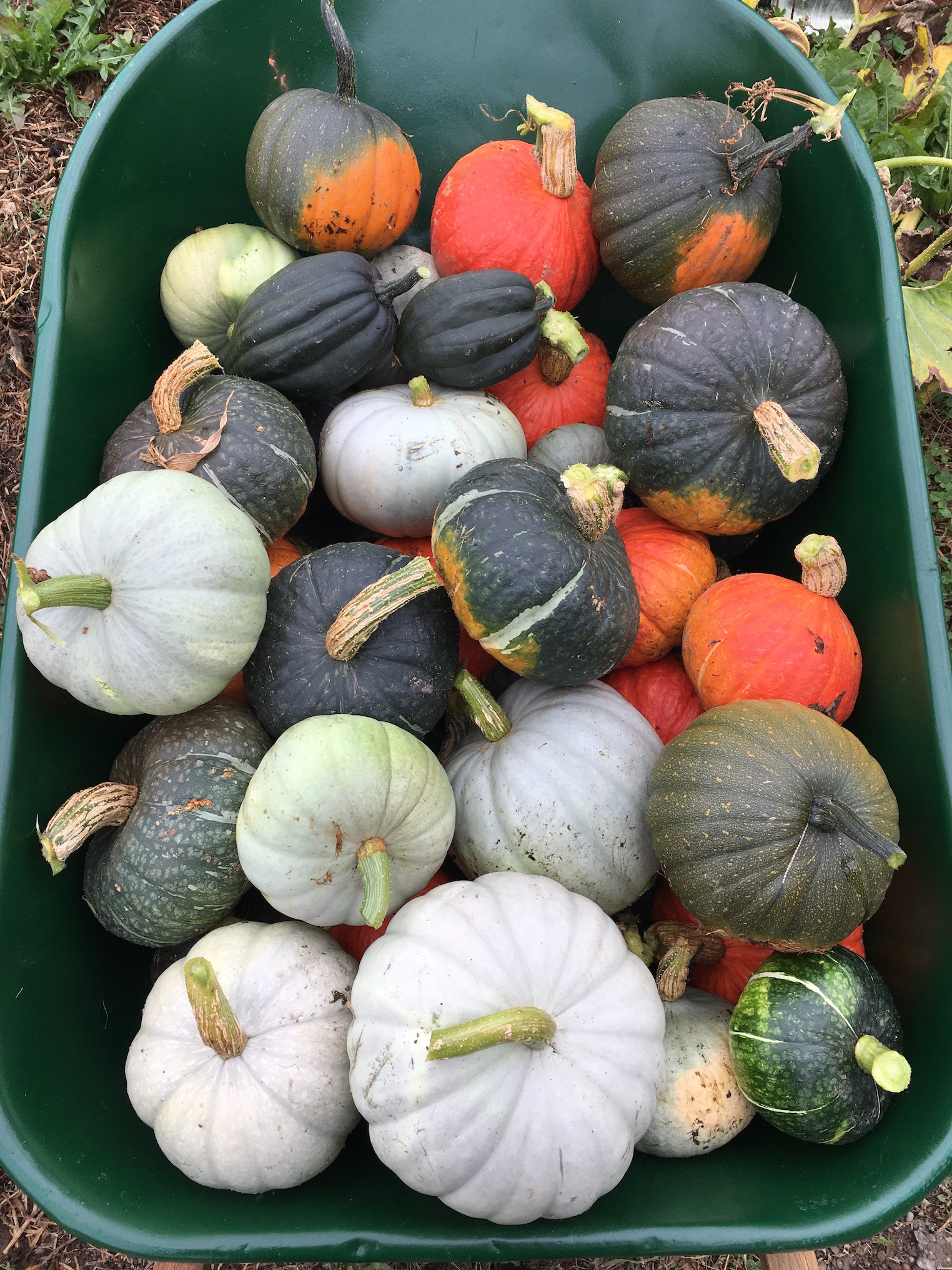
Winter squashes offer deep green, heathery grey, and orange, first in the garden, and then in the laundry room where they adorn every available surface at the moment. They’ll also offer beautiful orange in dinners throughout the coming year as we work our way through them.

Dry beans also provide colourful beauty at this time of year. Trays of drying beans on the porch make me smile: Blue Shackamaxon’s glossy black, Bird’s Egg’s speckled spheres, and Cherokee Cornfield’s riotous mix of colourful varieties.

Then there’s the flint corn. This year, I planted Strawberry Popcorn, which produces deep red kernels, and Glass Gem, with its glittering multihued kernels. Husking corn is like opening a box of crayons.

In the greenhouses, summer still reigns, offering red tomatoes, multicoloured peppers, and purple eggplants.

On top of the colourful vegetables, there are plenty of autumnal flowers in bloom: dahlias, heliopsis, and chrysanthemums provide bright splashes of yellow, orange, pinks and reds. They also attract colourful butterflies like yellow admirals, red admirals and monarchs.

So while we may not have the colourful autumn leaves, there is plenty of brightness to enjoy, even as the days grow short and dark. 

2024 Garden Stocktake

Autumn is well underway, so it’s time to take stock of the summer season’s garden successes and failures.

Strawberry popcorn

The biggest success this past season was in the soil. All winter last year, I incorporated fresh cow manure and composted horse manure into the garden beds. Every single bed got one or the other, in addition to my own compost in the spring. And finally my efforts to improve the soil over the past four years have begun to show. There’s still a long way to go, and a lot more compost and manure to haul, but this summer most of my crops grew well, and nutrient deficiencies weren’t obvious until late in the season. A huge improvement over previous years.

Particularly nice crops this year included:

  • Strawberry popcorn—This was my first year to plant this corn. I admit I was dubious when I opened the rather expensive packet of seed to find only 15 seeds. It was clear the corn was marketed as a fun thing for kids to grow. However, every seed germinated, and the plants grew to well over 2 metres tall, dwarfing all the other varieties of corn I grew. Each plant yielded two large ears (much larger than the photo on the packet indicated they would be—very un-strawberry-like), and a few even had a third, smaller ear. I was thoroughly impressed by how much popcorn so few plants produced. Of course, the proof of the variety’s worth will be when we pop it. The Glass Gem corn I love so much is marketed as a pop corn, but we’ve found the popping to be poor. It will be a few months before we know if the Strawberry popcorn was worth it.
  • Dwarf bean Xera Select—I had decided not to plant dwarf green beans anymore, because the runners produced more, better beans over a longer season. But I still had seeds for a few varieties, so I planted them, thinking I simply wouldn’t buy more. But Xera Select grew beautifully—long, uniform pods, and lots of them. I might just have to plant them again next year.
  • Bicolour sweetcorn—This year we managed to have side-by-side comparisons of the flavour of two varieties of sweetcorn, and we found Bicolour to be much sweeter than Florida Supersweet. The plants didn’t seem quite so resistant to drought, though, so I might plant both varieties again next year. They were both good and produced good crops despite water and nutrient stress.
  • Cherry tomato Rosella—Oh. My. God. This is possibly my new favourite tomato. This black cherry tomato has so much flavour in each little fruit, it’s addictive. Definitely one to plant again!
  • Cherry tomato Cherry Berry—I normally stick with heirloom tomatoes, but this F1 hybrid was amazing this year—excellent flavour, and SO MANY FRUITS! Outstanding value for the space.
  • Tomato Black Brandywine—Brandywine flavour in a dusky tomato. These ripened earlier than the Brandywine Pink, which was a bonus.
  • Tomato Black Oxheart—Big, fleshy, heart-shaped fruits. These were a winner in my book for sauces and drying.
  • Melon Topaz—Honeydew in texture, with flesh the colour of a cantelope, and a flavour somewhere in between the two. These were delicious. Definitely one to plant again.

Crops that were a bit meh:

  • Tomato Costoluto Fiorentino—These tomatoes are interesting, but the fruits were smallish, and so ridgy they were a pain to deal with in the kitchen. The flavour was pretty average. At some point, I simply stopped picking them.
  • Pea Shiraz—I was excited to plant a purple snow pea this year, but the variety disappointed. A poor yield of unattractive pods that matured quickly and weren’t terribly tasty. Back to the standard snow pea for me next year.

Absolute disasters:

  • All the carrots—This year’s carrot disaster had nothing to do with the varieties I planted, and everything to do with the slugs that ate nearly all seeds, and then the birds that uprooted the few plants that managed to evade the slugs. I planted carrots three times, and ended up harvesting about 6 carrots.
  • All the potatoes—As with the carrots, the near complete failure of the potatoes had nothing to do with the plants and everything to do with pests. The rats, who had a field day in the garden all summer, tunnelled down the row of potatoes and ate every tuber. I managed to snatch a few out of their greedy jaws, but only a few.

If not for the pests, it would have been a spectacular year in the garden. Even so, nearly every preserving jar is full, the freezer is at capacity, and I’m still bringing in the pumpkins and dry beans, so I can’t really complain.

The well stocked pantry

Everything In Its Place

When my husband and I planned our new garden four years ago, a shed in the corner of the veggie patch was a must. We left a space in the garden fence where the shed would go.

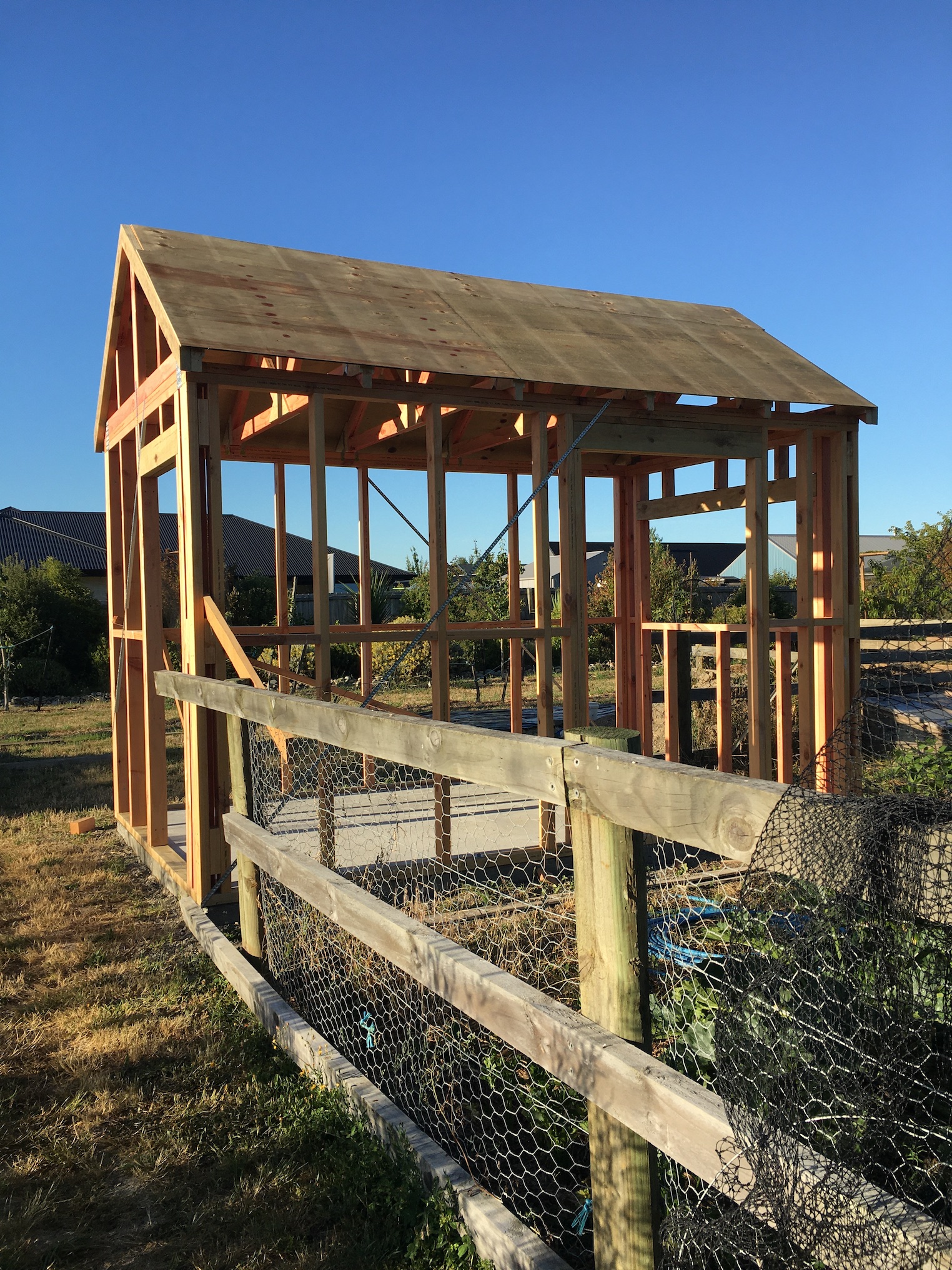
The shed’s humble beginnings…

Unfortunately for the shed project, there were more pressing concerns than a shed—establish the tree crops, berry crops and native border; haul in compost and pea straw to improve the soil; build structures to support the bird netting we discovered was necessary here … There was always something more urgent.

About eighteen months ago, we were finally ready to think about the shed. What would it look like? Would it just be for storage, or would it have a potting bench? Did we want to be able to raise seedlings in it? What, exactly, would be stored there? So many questions! 

We went through many different plans ranging from the bare minimum storage closet to a full greenhouse with attached head house.

What we realised through the process was that we needed a second greenhouse. (Okay, we wanted a second greenhouse, let’s be real here.)

So last summer we built a greenhouse instead of a shed (because we still couldn’t decide on what the shed needed to do for us, but at least now we knew we didn’t need it to include greenhouse space).

Finally, this past summer was it. Time to build the shed. Perhaps we started off with modest plans—a shed just big enough for a potting bench, tools, and the lawnmower—but you know what they say about the best laid plans …

When we visited the local salvage yard looking for a door and a window, our modest plans blew up.

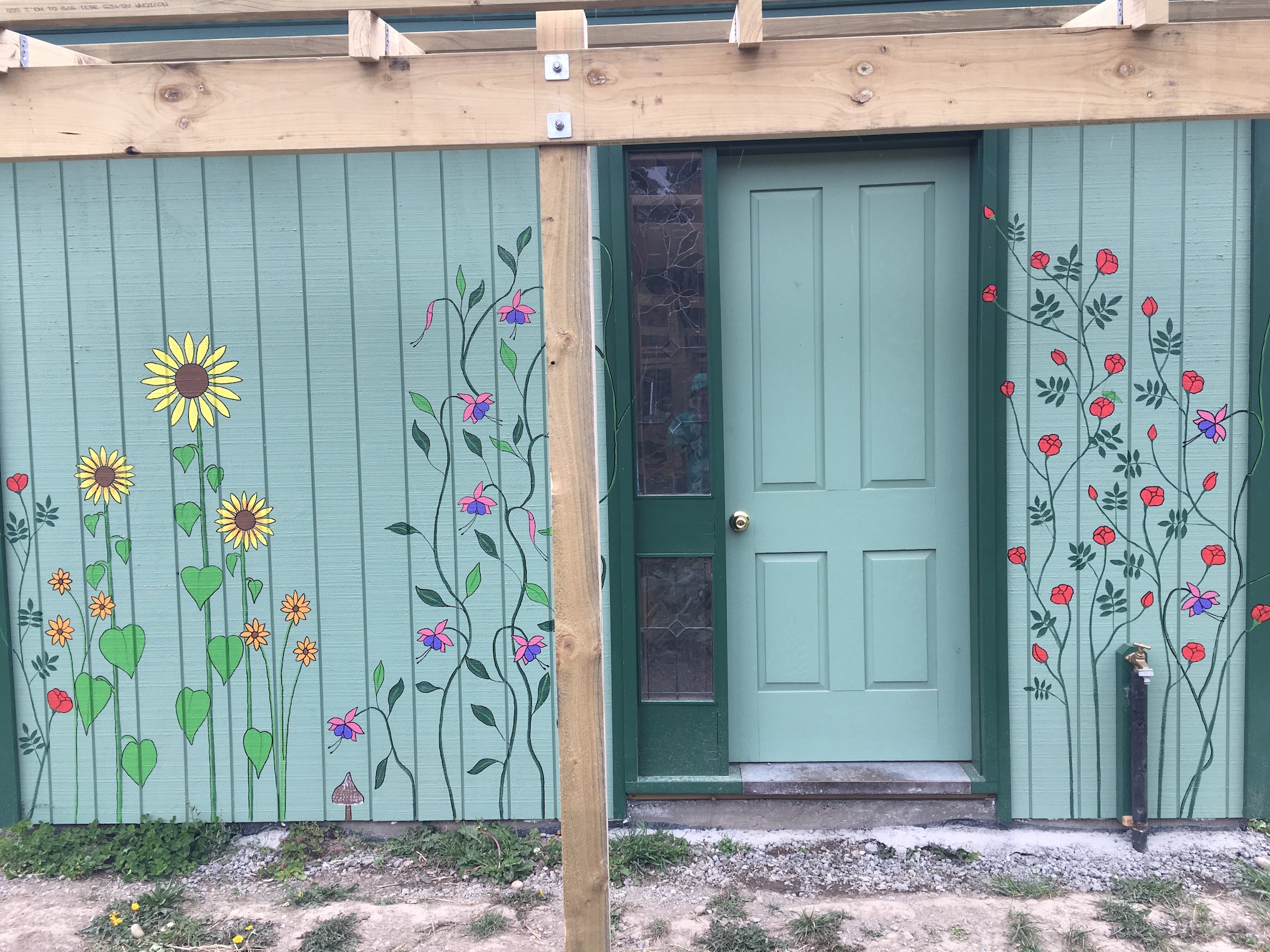
We found The Door.

It had obviously come from an old villa—a wooden door beside a tall leaded glass window with an art deco fuchsia motif. It was the perfect embellishment for a garden shed, never mind that such a glorious door belonged on a much grander building.

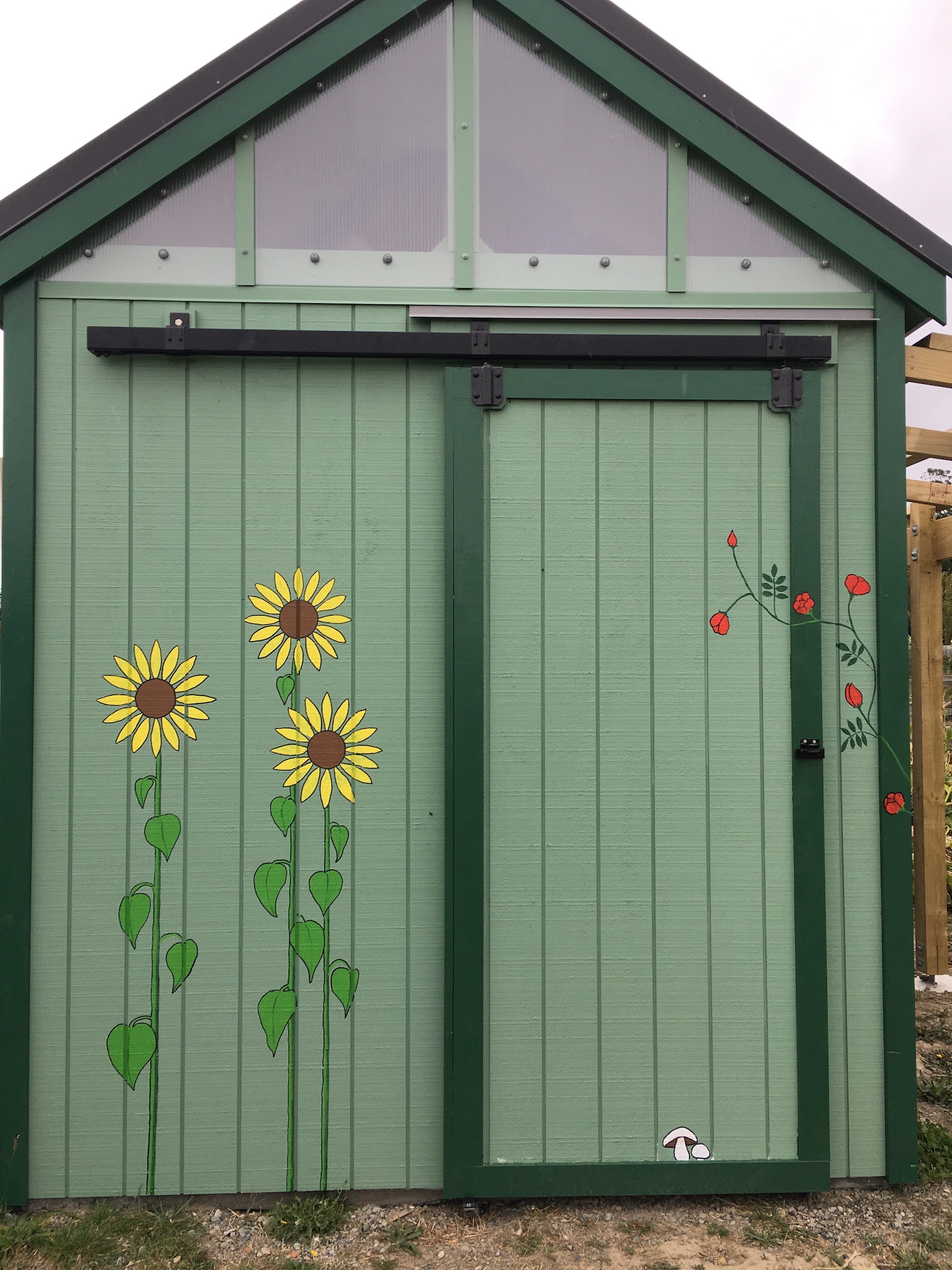
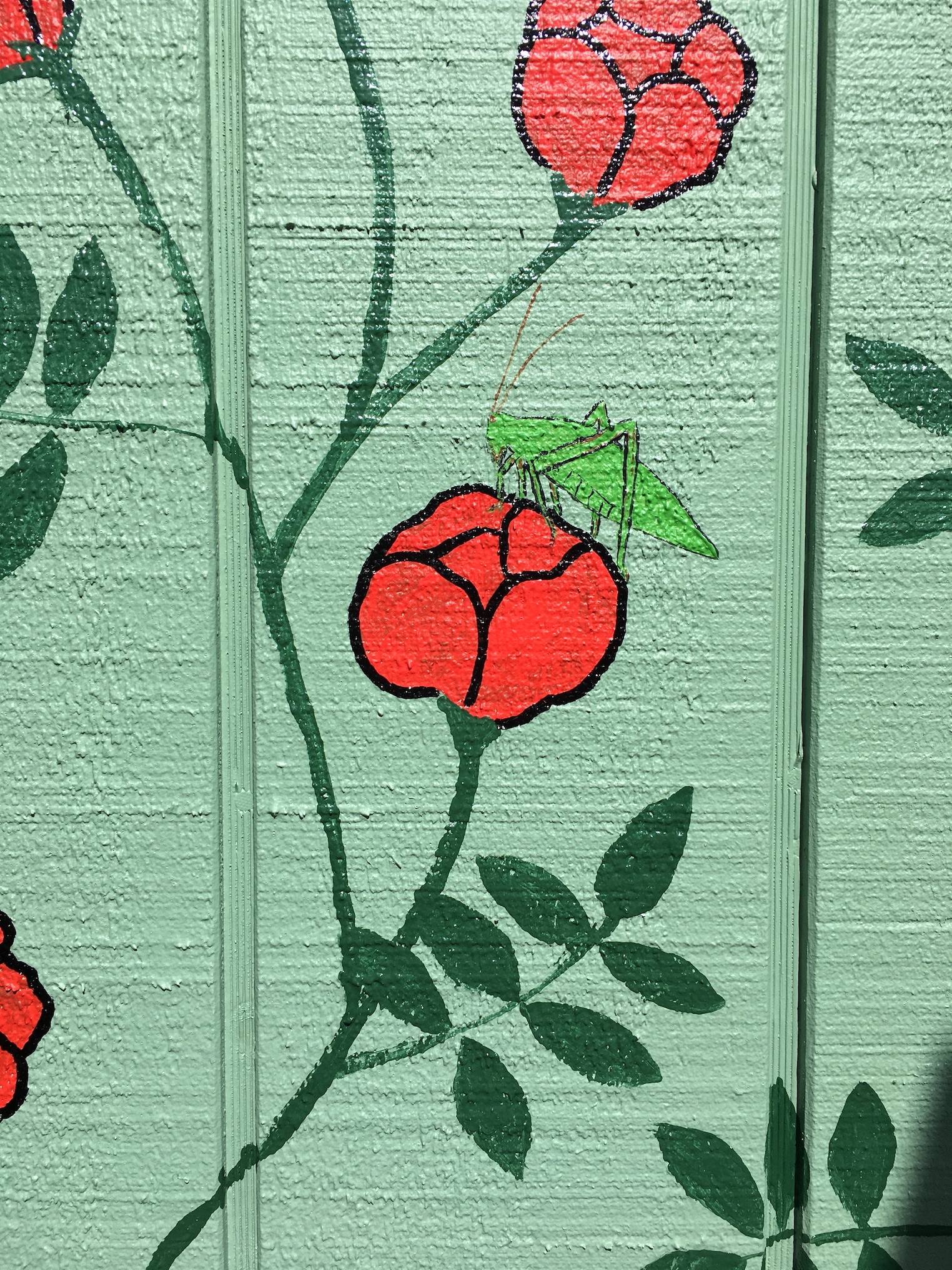
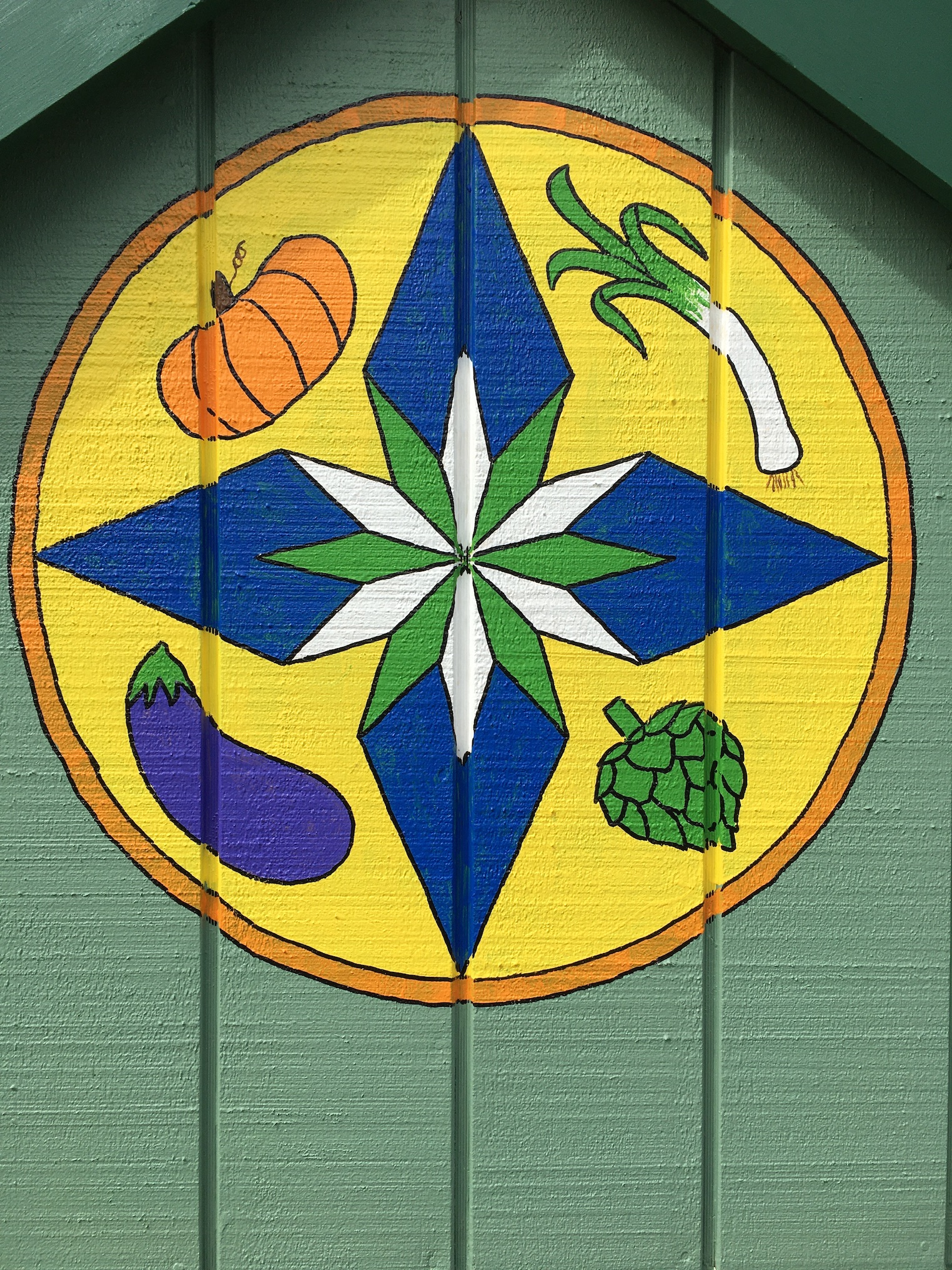
Once we had a door like that, things began to spiral out of control. Wouldn’t it be cool to echo those stained-glass flowers on the outside of the shed? I bought a handful of paint test pots and began designing floral motifs. And if I was painting flowers on the shed, maybe it needed a Pennsylvania Dutch hex sign too.

A shed that colourful on the outside should also be bright on the inside, especially since we decided that it did need to have a potting bench in it. So we whitewashed the interior and included a greenhouse panel on one gable end to let in more light.

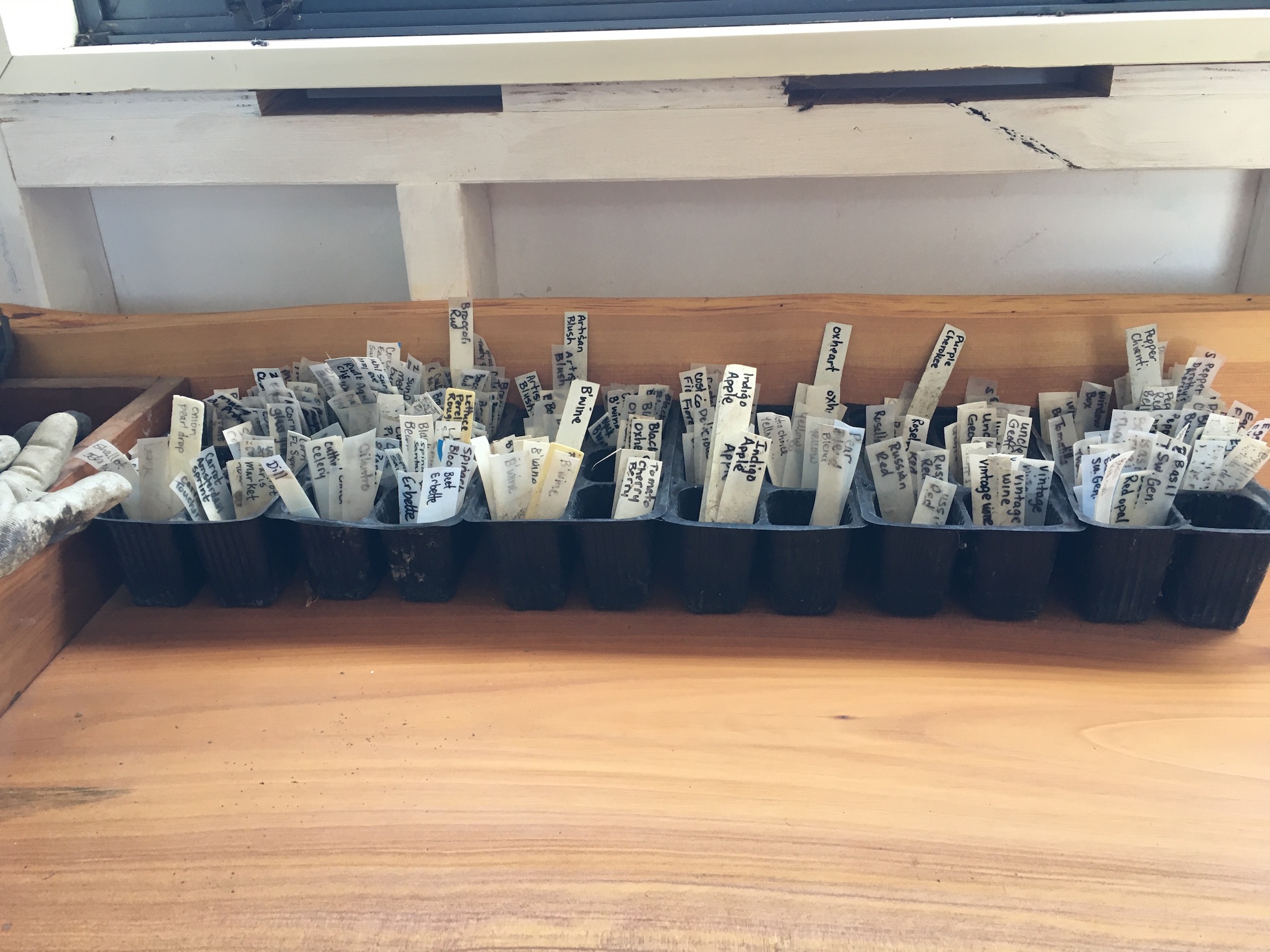
For the potting bench, we’d hoped to use a piece of flooring that was once my office desk, but it was too short. However, we happened to have some big slabs of macrocarpa a neighbour had given to us. It made sense to use the material we had on hand, rather than buying new.

The result, by the time my husband was done, was a veritable work of art—a live edge potting bench with a backsplash and some gorgeous butterflies to stabilise a crack. How am I going to do my potting on that? I’ll feel horrible the first time I get it dirty.

Then of course there was the French cleat tool rack. Because why bang a few nails into the walls when you could have a beautiful rack that makes use of every available inch?

Then it needed a porch, and of course it needed a tap … Give us credit for the restraint it took not to add a small outdoor sink.

It might have become a bit of a folly, but when I moved in all the tools and gardening supplies, it was absolutely perfect. Now everything is handy and tucked into its place. I can’t wait until August when I can stand at my beautiful potting bench looking out over the vegetable garden while planting seeds.

And in the meantime, every time I have to retrieve a tool (now all convenient to the garden), I smile at the ridiculous whimsy of the building. Fit for purpose and lots of fun at the same time.

Ginger Scones

Ginger cream scones are a classic, but I rarely have cream on hand. So Sunday morning, with a hankering for ginger scones, I made up a new recipe.

Taking inspiration from an excellent ginger muffin recipe, I included oats in the scones. A touch of vanilla rounded out the flavours for a thoroughly delicious breakfast. In fact they were so good, they all vanished before I thought to take a photo of them. (the photo here is of some previous scones I made–honestly they look just like the ginger scones.)

Here’s what I did, in case you’d like to try it too.

1 1/2 cups all purpose flour
1 cup quick cooking rolled oats
1/2 tsp salt
3 Tbs brown sugar (next time I’ll use just 1 1/2 Tbs—this was a bit too sweet for my taste)
2 tsp baking powder
100 g cold butter
1/2 cup crystallised ginger, finely chopped
1 egg
1/2 cup + 1 Tbs milk
1 tsp vanilla

Combine the flour, oats, salt, sugar and baking powder in a large bowl. Cut the butter in with a pastry knife until the mixture looks like coarse meal. Stir in the crystallised ginger.

Whisk together the egg, milk and vanilla in a small bowl, and then combine with the flour mixture. Knead gently a few times until the dough comes together in a ball. On a floured surface, pat the dough into a disk about 1.5 cm thick.

Bake at 210℃ for about 15 minutes until nicely browned.

Summer Soup 2024

Making and canning vegetable soup used to be a whole family activity, with the kids pitching in from a young age, picking and chopping vegetables alongside my husband and me. My husband would cook the soup while the kids and I washed dishes, and then I would can (bottle) it up.

We called it Summer Soup, because we made it at the height of the summer vegetable season (which ironically always falls in early autumn). On the cold rainy nights winter we could open a jar and enjoy a bowl of summer. 

When the kids were young, they delighted in recounting which vegetables they chopped, proud of their part in feeding the family. These days, making summer soup is a mostly solitary activity for me, the kids being all grown up. It hasn’t stopped me from making a vast quantity of soup. Last Sunday I designated as Summer Soup day because I had heaps of tomatoes, green beans, sweet corn, zucchini, and other vegetables to put in it.

Because it was Sunday, I started off at 5.30 am by making muffins for breakfast. While the muffins baked, I began chopping vegetables …

My husband had planned on baking bread on Sunday, but unfortunately he woke with a terrible cold that morning. He’d started his sourdough sponge the night before, so with instructions from him, I made up his bread dough after breakfast and set it to rise as I continued to chop vegetables.

The mixing bowls began to fill up in the kitchen as the morning progressed. After several hours and a few trips to the garden to pick more vegetables and dump scraps on the compost pile, I took a short break from chopping to divide the bread dough for loaves. Thankfully, my husband felt well enough at this point to form the loaves and get them started on their second rising, because I really wanted to finish chopping vegetables by lunchtime.

I finished the final chopping shortly after the focaccia came out of the oven. We sat down to enjoy fresh focaccia for lunch.

My break was short, because after lunch I began processing all those chopped vegetables. It was clear I wasn’t going to be able to fit everything into one pot, so I pulled out both my 20-litre stock pots and divided the vegetables between them. While the soup heated up, I prepared my jars and the pressure canner. I also filled my 12-litre stock pot with vegetable scraps and water and set it on the stove to simmer for a few hours for vegetable stock.

Much of the time commitment in making and canning vegetable soup is in the canning process. Each batch of seven jars has to be processed for an hour and 15 minutes, and then there’s the waiting time while the canner cools down enough to remove the jars before putting in the next batch.

While I was waiting for the canner to do its thing, I started in on the apples that needed to be processed. I peeled and sliced a mountain of apples. Once I’d emptied the soup out of one of the 20-litre pots, I refilled it with apple slices and cooked them up into apple pie filling—enough for three generously filled pies. The pie filling went into the freezer. 

The soup seemed to never end. Even after separating off two meals worth of soup for eating this week, I ran three full canner loads (21 quarts) of soup and one full load (7 quarts) of stock. The last jars came out of the canner at 9.15 pm.

I’m glad I only make summer soup once a year, but I’m thrilled to have all that summery goodness squirrelled away in the pantry. Bring on the rain and cold of winter—I can already taste the soup (followed by a slice of apple pie, of course!).

Summer Heat, Autumnal Vibes

It’s been hot here lately, with blue skies and temperatures in the upper 20s most days—summer at its height.

But when I wake at five in the morning it is dark, and there is no working in the garden until nine in the evening anymore, unless it’s by head torch. The days are growing shorter, and there’s a feel to the air that speaks of the autumn to come. 

The cricket chorus has grown over the past few days—the summer’s crop of insects maturing to mate and lay eggs before winter. The early apples have been harvested, and pumpkins are swelling on the vines. I harvested most of my dry beans last week, too. 

Of course the summer crops—tomatoes, zucchini, eggplants, peppers, and beans—are still going strong, and will be for a while.But the seasons are turning.

I love it.

My husband and I lived for two and a half years in Panama back in the early 1990s, so we got to experience living almost on the equator. The daily temperature variation in Panama is greater than the yearly variation, and the day length variation is virtually imperceptible. The only seasonality is in rainfall—it rains from mid-March to mid-December, then stops entirely until mid-March again.

Tomato sauce made from yesterday’s harvest

After living in Pennsylvania, Michigan and Ohio for the first 22 years of my live, Panama was … well … boring from a seasonal perspective. I missed the annual markers of the Earth’s progress around the sun. Of course we had heat, but I missed the long days and drawn out sunsets of a high-latitude summer. In Panama, the sun leaps into the sky in the morning and drops like a stone below the horizon in the evening, and it does so with such precision and consistency, you can practically set your watch to it.

I missed the cold of winter, the dark days and long nights perfect for curling up with a book or sitting by the fire (though to be fair, Panama nights sometimes seemed long, because we had no electricity, one small table to sit at, and only a lopsided wooden chair and a tree stump to serve as seating).

I missed spring, for its slow unfurling of green, rising from the herbs on the forest floor to the tops of the trees as the season progressed. I missed autumn for its splash of yellows, oranges, and reds, the rime of frost on crisp mornings. I missed the bite of icy wind, the smell of snow.

New Zealand doesn’t get the extremes of seasonality I enjoyed in the northern United States. Our climate is heavily moderated by the vast Pacific Ocean in which we sit. And our native plants are largely evergreen, so green is the dominant colour all year round. But where I live, at a similar latitude to St. Paul, Minnesota (but of course on the other side of the equator), we have decent seasonality, and I love the changes throughout the year. People often ask what my favourite season is, and I have to say it’s all of them. Each season has something new and exciting to offer, and there’s no point in mourning the loss of long summer evenings, because they’ll be back. Instead, I welcome the short days, the excuse step away from the garden in the evenings. I look forward to bringing in the autumn harvest and filling the pantry with the fruits of summer. 

So bring on the shorter days. Variety is the spice of life, after all—time for some spice.

Crazy Cake Season 2024—well, that was a fail

The cake was ugly even before the jelly layer was added on top…

The girl turned 20 this week, but she hasn’t outgrown crazy birthday cakes. Her response when I asked her what she wanted this year was: How would you feel about making a hornwort (Anthocerophyta not Ceratophyllum)?

Well, that’s a gauntlet thrown, for sure. Hornworts’ thin, jelly-like ‘leaves’ and tall, narrow sporophytes do not lend themselves to buttercream icing. This called for a new technique.

I immediately thought of agar agar (a vegetarian gelatine substitute, for those who don’t know), which has the right sheen for a hornwort, and which I knew could be made into thin, textured sheets (I knew this because I’ve used it for creating texture on fake wounds … yeah, I do a lot of weird stuff.)

As I was looking up a good water:agar ratio for the consistency I wanted, I stumbled across the world of jelly cakes. I was immediately hooked. They look totally disgusting to eat (I hate jelly/jello, won’t use gelatine because it’s not vegetarian, and I think agar tastes like seaweed), but visually they’re amazing.

So when I found that my thin agar leaves were fiddly and a bit too floppy, I decided I would do a jelly cake and create my hornwort using jelly cake techniques. 

And the jelly added extra special ugliness.

I spent two hours practicing with the jelly last week, making sure I could do it without all the specialised equipment the professionals use. Then I made the other components of the cake over the weekend. I first made the actual cake (because no way was I going to have only jelly cake to eat) using a new recipe. This turned out so awful, I made a second cake with a tried-and-true recipe because there was no way I could use the first. I made the fake moss (using a new technique I hadn’t used before), chocolate tree bark (again, something I hadn’t made before), and the icing (using an unusual recipe I had never used before). 

Then, on the girl’s birthday, I made the jelly hornwort and assembled the whole thing.

The result? Pretty ugly, and not very hornwort-like. Or bark-like, or moss-like. And the icing set up like glue …

But hey, you’ve got to try new things, right? On the plus side, I learned about jelly cakes. I learned that the specialised equipment the professionals use is probably necessary to do it well. I learned how to create a decent jelly from agar agar (I mean, as decent as any jelly can be—yuck!), which I could now use to create moulded shapes or other embellishments for future cakes. I learned how not to make chocolate tree bark, and that a certain cake recipe and icing recipe can be discarded. The fake moss was definitely more moss-like than previous techniques I’ve tried. It’s one that’s probably worth playing with and refining.

Trying new things can pay off…

So I learned some things. And I got to eat cake. It may not be pretty, and the icing texture is simply wrong, but the flavour’s good.

And I have to remind myself that sometimes trying something new does work. Remember the octopus cake? Better luck next time.