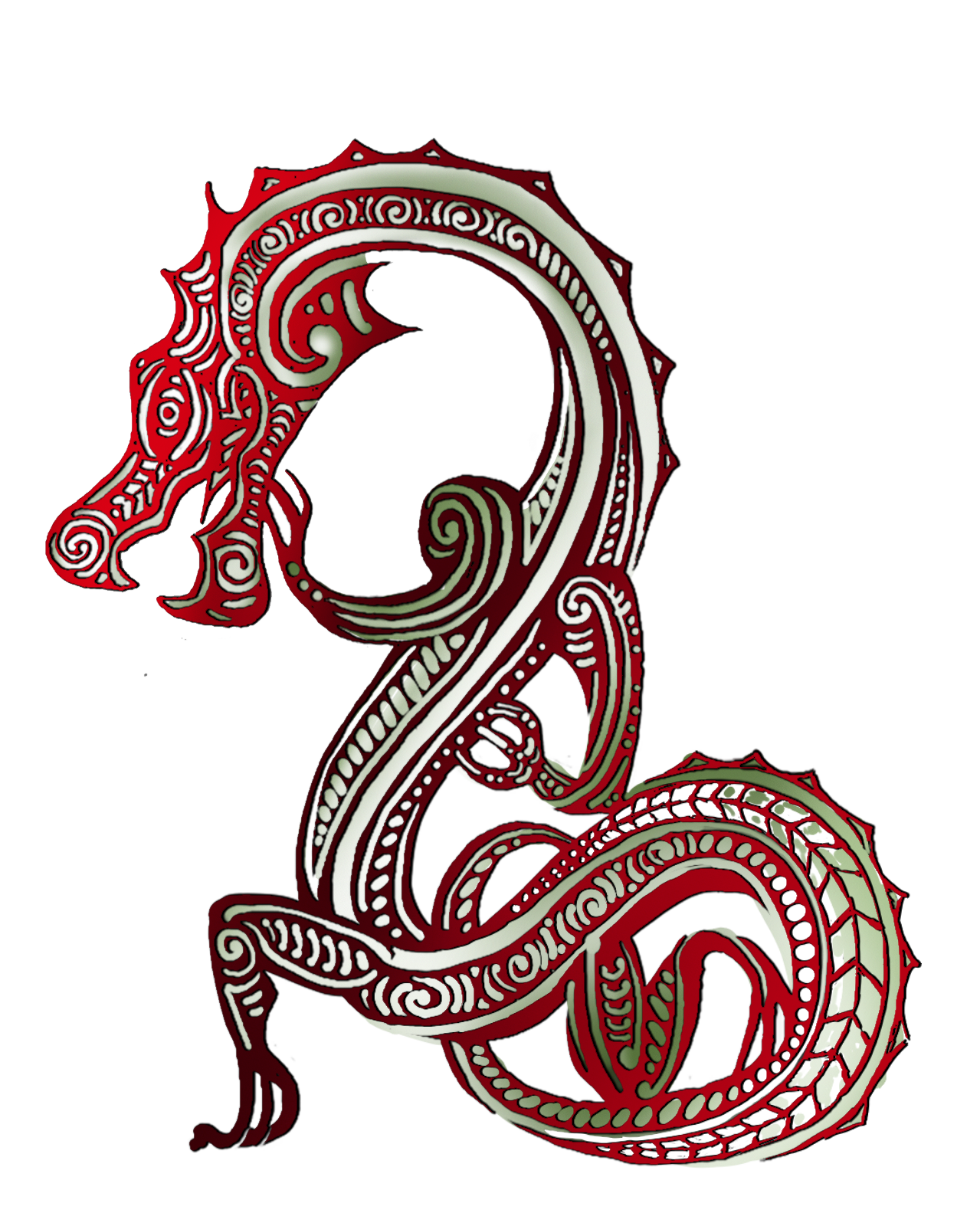
 Those of you who have read The Dragon Slayer’s Son will know that Sir Magnus is a former dragon slayer who works at the Alexandra School of Heroic Arts. This is the story of how his dragon slaying career ended.
Sir Magnus MacDiermont squelched along the sodden track whistling a tune. After three days of rain, the sun was finally out, and he was near his destination—the lair of a southern blue dragon that had been terrorising trampers on the South Coast Track for months. He hoped it wouldn’t take long to find her and kill her; he planned to get a little pig hunting in before he headed back home.
At forty-five years old, Sir Magnus was practically elderly for a dragon slayer. No one liked talking about it, but few dragon slayers survived past fifty. Once they began to slow down, their days were numbered. Magnus tried not to think about it, but it weighed heavily on him each time he was called out to deal with a dragon.
His current target wouldn’t be easy to kill. Southern blues weren’t the biggest dragons in New Zealand, but they could be nasty, particularly the females. This one had already eaten two trampers and injured half a dozen others. But Magnus was feeling good today. The sun gave him confidence. He’d dispatch this dragon quickly, then have a little fun.
He dropped off the track and onto the scrap of beach where most of the attacks had happened. The dragon’s lair must be somewhere nearby, in some crevice along the rocky coast. He started toward the tumbled cliffs to his left.
A roar sounded behind him, and Magnus whirled to see the dragon burst from the rocks on the other side of the beach. His expression grew grave as he assessed his adversary. She was big, for a southern blue—not a whisker under twenty metres long. And mean, too—a truck-sized ball of flame and fury, headed straight for him.
Magnus planted his feet and waited.
The dragon swept across the beach, scorching the sand with her flames.
Fifty metres away, and he could feel the heat billowing toward him.
Twenty metres away, and he began to sweat.
Ten metres, and he blinked against the searing blast.
Five metres, and the acrid smell of burning wool hit his nostrils, as the hair on his arms scorched off.
At the very last moment, Magnus stepped deftly to the left—the dragon’s right—and the dragon surged past, roaring in frustration. Magnus chuckled. That move worked every time. He reckoned one day he might come across a rare right-handed dragon, but most were left-handed and couldn’t steer well to the right. If you could stand the heat, that little side-step would put the dragon off-kilter long enough for you to assess it and make a plan. It also let the dragon know you were a dragon slayer, which made them a little more cautious and less likely to attack.
The southern blue banked. By the time she had made the turn, Magnus had his sword and shield out. The dragon landed on the sand just out of sword reach.
“Well, well, well…Magnus MacDiermont. Fancy meeting you here.”
Magnus laughed. He was pleased his reputation preceded him. “That’s Sir Magnus to you, vile worm. You’ve taken enough trampers now. It’s time for you to move on.”
Now it was the dragon’s turn to laugh. “Or you’ll do what? Prick me with your shiny toothpick? I’ll turn you to toast before you even get near me.”
Magnus smiled. It was the breeding season for southern blues, and he reckoned that this one had gone on a rampage because she was guarding eggs. It made them vicious, but also vulnerable. To incubate their eggs, the female dragon plucked off a patch of scales just over her fire stomach. It kept the eggs warmer, but it was a chink in her armour.
To hit that chink, though, he’d have to get close enough to be incinerated by flame and shredded by claw. His shield would be of no use that close, and it would prevent him from using his sword. It was a problem many dragon slayers had faced, and there were no good solutions. But Magnus had prepared a little experiment. If it worked it would be brilliant. If it didn’t…well, Magnus’ affairs were in order, and his family knew the risks he took.
He said to the dragon, “Ah! You’re probably right. What good is my sword against your scaly hide? Perhaps we can negotiate. I have something you might be interested in.” Magnus shrugged off his pack, careful to keep his sword at the ready, and then pulled something shimmery and silver from the bag. The dragon’s eyes widened as the supple cloth-like object streamed out.
“Ooooo! Pretty!” she said.
Magnus snapped the object to unfurl it completely. He was pleased with the dragon’s response. It was just what he had expected—he’d never met a dragon who could resist shiny things. He only hoped the shiny fire shelter was enough to protect him. It worked for firefighters; with luck, it would work for him.
“You like that?” he asked. “Well, you can have it, if you can burn me.” He dove into the shelter with his sword. The dragon didn’t waste a moment—she breathed a gout of flame over him. He laughed and told her she needed to try harder.
She stepped closer. Another flame, and Magnus jeered at her again.
Three times she breathed on him in that shelter, coming closer each time, before she was close enough. By then, Magnus was envisioning himself as a potato wrapped in aluminium foil baking on the campfire. The shelter offered protection, but it was still horribly hot inside. He didn’t know if he’d survive the next blast, but it was too late to change his mind. When he heard the dragon inhale in preparation for roasting him at point-blank range, he thrust his sword upward.
The tip of the sword ripped a gash in the fire shelter, and then rebounded off the dragon’s scales. He’d missed the bare spot. He’d gambled and he’d lost.
The torn fire shelter was now nothing but a liability. Without a moment to lose, Magnus slashed the hole larger so he could see the dragon’s underbelly. There was the bare patch. He stabbed the sword again, driving it home.
And now Magnus recognised the flaw in his plan. The dragon was mortally wounded, but she didn’t die immediately. A wounded dragon is more dangerous than a room full of tigers, and Magnus was tangled in a useless fire shelter between the dragon’s front feet. He dropped his sword and lunged away. The dragon pounced, catching Magnus’s right leg in her teeth. She lifted him and shook. A loud crack and a stab of searing pain, and Magnus knew his leg was broken. Every struggle of his, every movement of the dragon was a lesson in pain as the broken bone tore through muscle and skin.
The dragon took a few staggering steps, flapping feebly to try to return to her lair. She made it into the air, only to crash a moment later.
Magnus tumbled to the ground and blacked out.
He came to with a hiss of pain when a wave washed over his shattered leg. He blinked, trying to remember why he was lying on the sand, and why his leg hurt so much. As his vision cleared, the dragon came into focus. Her limp body was already being lifted by the tide and sucked seaward.
Magnus raised himself to sitting and grunted as his left arm seared with pain. Broken. It must have broken when the dragon dropped him.
Another wave licked his legs, and Magnus watched the water flow red with blood. His blood. His leg was a wreck.
Help. He needed help. Now. He scanned the beach for his pack. It was nowhere to be seen. It must have been carried away by the waves already. How long had he been unconscious?
Another wave washed over him. He needed to move. His pack was gone, along with the locator beacon inside. He would have to climb back to the track and hope someone came along soon.
He tried to stand, but the world went dark. Blood loss. Too much blood loss. He began dragging himself up the beach, inching along on his butt, with one arm and one leg. Every few metres he had to stop and let the pain subside as his body threatened to lose consciousness again.
He reached the rocky step up to the track. Two metres. It had been a short hop down, and would have been nothing to climb, if he hadn’t been injured. Magnus rested, his back against the rock, for a few minutes before attempting the climb. Then he took a deep breath, gritted his teeth against the pain, and pushed himself upright.
The world swam before him, but he braced against the rock until his vision steadied. There was a red smear of blood all the way up the beach. The dragon was floating freely now, rolling in the breakers.
Just a little further. Magnus turned to face the rock. He reached high and grabbed hold of a small knob with his good hand. He wondered if his injured leg could support any weight, then decided he didn’t want to even try. Hanging by his arm, he dragged his good leg up to a foothold, wincing as the broken leg crunched against the rock. This was going to hurt. Magnus took a breath and counted.
One.
Two.
Three.
He hurled himself up, heaving his upper body onto the track above. The impact forced a cry from him.
That was the last thing he remembered.
He woke in a hospital bed, his wife reading a book in a chair next to him.
“Karyn?” his voice was ragged and his throat dry.
Karyn looked up and closed her book. She leaned over him. “Magnus.” A tear slid down her cheek. She swiped it away and sniffed. “Well, it could have been worse.” She pulled an envelope from between the pages of her book and handed it to him. “They say that leg is never going to be the same.”
Magnus fumbled one-handed with the envelope. He looked up at Karyn and she smiled. She broke the envelope’s seal and pulled out two sheets of paper.
“Dragon Slayer Extraordinare,” she read. “This honor awarded to Sir Magnus MacDiermont in recognition of his services to humanity in the destruction of the rogue dragon, Bluezilla.” She looked up. “Was that her name?”
Magnus nodded.
Karyn dropped the paper on the bedside table and read the second sheet. “Honourable Discharge.” She looked up, a smile flickering on her face. “Owing to injuries obtained in the line of duty, we hereby discharge Sir Magnus MacDiermont from the Dragon Slaying profession. He retains full honours, and is commended for his faithful service.” Tension seemed to drain from her face, then shoulders. She hurled herself at Magnus and hugged him. He patted her back with his good hand.
“Honourable discharge.” His huff might have been a laugh or a sob. He’d never expected to survive to retirement. Never considered what he would do, who he would be, after dragon slaying. He was a dragon slayer. How could they take that from him? The news settled onto his shoulders like a weight, but as it soaked in with his wife’s tears, he felt it lift him up. He began to think about dreams he’d forgotten he’d ever had. Dreams for himself, his wife, his children.
Honourable discharge. He could live with that. Yes.
He could live.





 Robinne Weiss