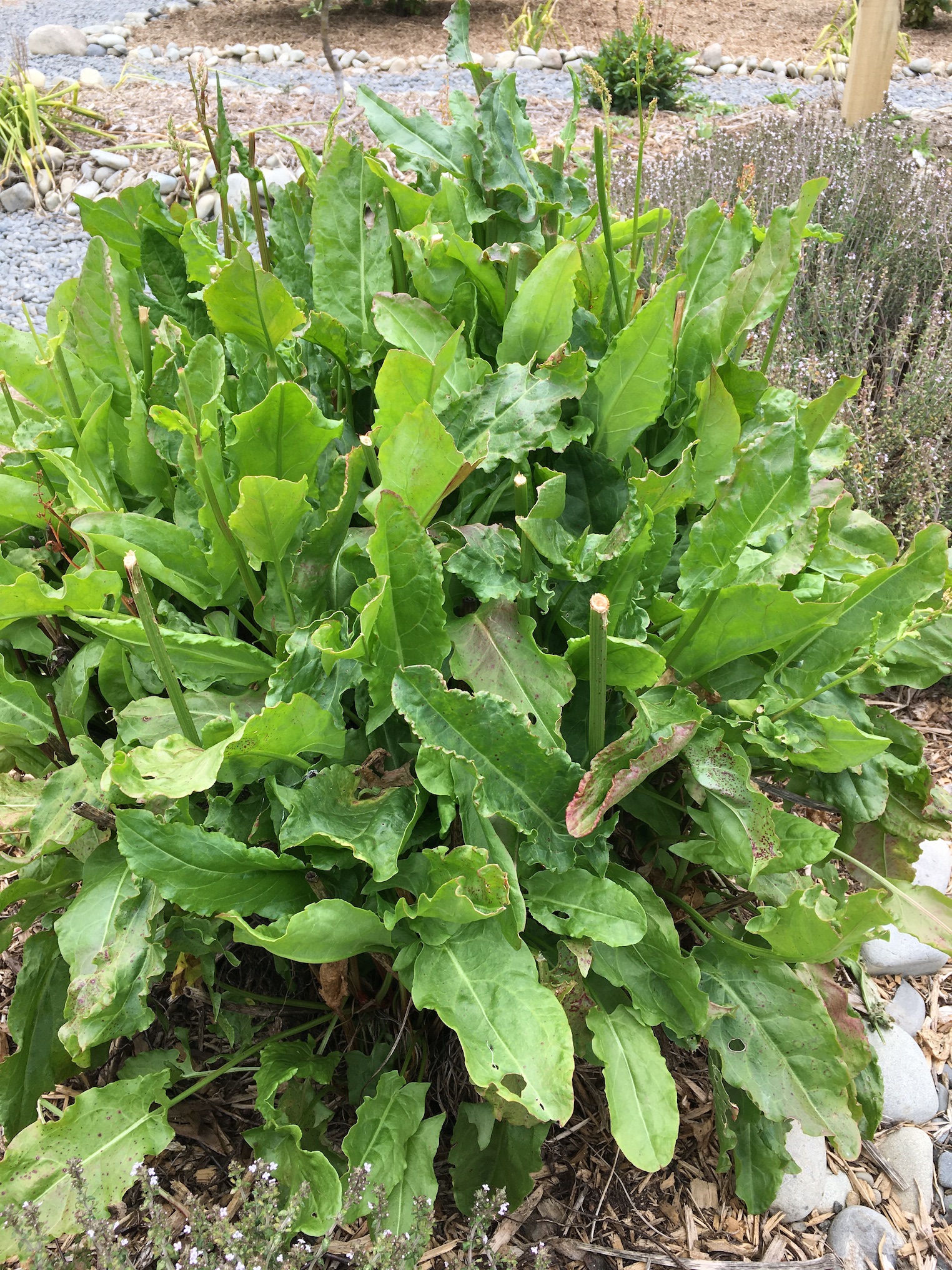
I love sorrel, with its succulent texture and bright sour flavour, but I don’t often think to use it. I occasionally use it to fill out early spring salads, when the lettuces aren’t quite big enough to make a full salad, and that’s generally about it.
But last night I wanted a salad to go with quiche. The spring lettuces are long since bolted, and the fall lettuces are still baby seedlings, so I turned to sorrel, this time to make the bulk of the salad.
I got inspiration from a few different sorrel salad recipes, but then simply used what I had on hand. The result was a spectacular salad—one I will definitely make again.
Here’s my ‘recipe’, for what it’s worth:
1 handful sorrel leaves, chopped into thin strips (maybe 2 cups, chopped) 1/4 cup walnut pieces, toasted in a 190C oven until aromatic and beginning to darken 6 small olives, chopped (I used my own olives, and they are quite small. If you’re using big commercial ones, you probably don’t need more than 2 or 3) 6 cherry tomatoes, cut in quarters (I would have used a lot more tomatoes, but this was all I had) 1 Tbs olive oil 1 Tbs balsamic vinegar 1 small clove of garlic, crushed dash of salt
Whisk together the oil, vinegar, crushed garlic and salt in a small bowl.
Place all the other ingredients in a bowl, and toss with the dressing. If you want a little less knock-your-socks-off fresh garlic flavour, strain the garlic out of the dressing first.
“Gardens are fashioned for many purposes with many different tools, but all are collaborations with natural forces. Rarely do their makers claim to be restoring or rebuilding anything from the past; and they are never in full control of the results. Instead, using the best tools they have and all the knowledge that they can gather, they work to create future environments. If there is a lesson it is that to think like the original inhabitants of these lands we should not set our sights on rebuilding an environment from the past but concentrate on shaping a world to live in for the future.”
–Charles C. Mann (1491: New Revelations of the Americas before Columbus)
Many years ago, I wrote this quote into a sticky note on my laptop. I look at it regularly, and it resonates with me every time. It expresses a mindset my husband and I employ on our little plot of land.
As I sit here on the porch on a warm summer afternoon, I can’t help but think back to what this section was like when we bought it—a bare paddock so devoid of nutrients that even the weeds were sparse. Sitting here today, I am surrounded by a mix of food crops, beautiful flowers and native plants. Five years ago, this plot of land could barely sustain the scraggliest of grass. Today it feeds us, provides food and shelter for native insects and birds, and is a welcome escape from all the ills of modern life. In time, as plants grow, it will hopefully become more sheltered, more resilient to temperature and rainfall extremes. In time, it will hopefully take less effort to maintain. In time, perhaps we will see native bellbirds and tūī as often as we see non-native blackbirds and starlings in the garden.
This is what we aim for. But, as Mann said, we’re not in full control.
Native skinks seem to have disappeared from the garden, despite the abundant food and shelter we’ve provided. Perhaps the influx of domestic cats is at fault. Or maybe some other factor outside of our control. Unwanted weeds continue to invade from neighbouring properties. Plant diseases take advantage of favourable conditions to decimate crops from time to time. Hail, floods, droughts, and wind all take their toll.
So the resulting garden is a compromise. What can we reasonably grow this year? What needs to be abandoned, either temporarily or permanently? What new opportunities are presented by quirks of nature or chance?
Guiding every decision is the question, what do we want the place to look like next year? In five years? Because, as Mann said, we’re shaping a world to live in for the future.
Incidentally …
If you haven’t read 1491, do it. It will shatter all those Eurocentric views of the world you’ve been steeped in since birth and change your whole attitude towards the history of the Americas.
This year was something of a milestone—it was the first year in about 16 that we didn’t do a pre-Christmas backpacking trip with the kids. It was bound to happen sometime soon, since the kids are all grown up now and doing their own things.
Instead, my husband and I had a post-Christmas hike all on our own. Let me say right now that I loved tramping with the kids, but doing the Christmas hike with just my husband was REALLY nice—just like old times … except that we’re a lot older. It was nice hiking at 54-year-old pace (instead of being dragged along by impatient 20-something kids), and we could also go places that appealed to us, without considering if the kids would enjoy it.
So we stayed relatively close to home, but took a route we hadn’t ever explored.
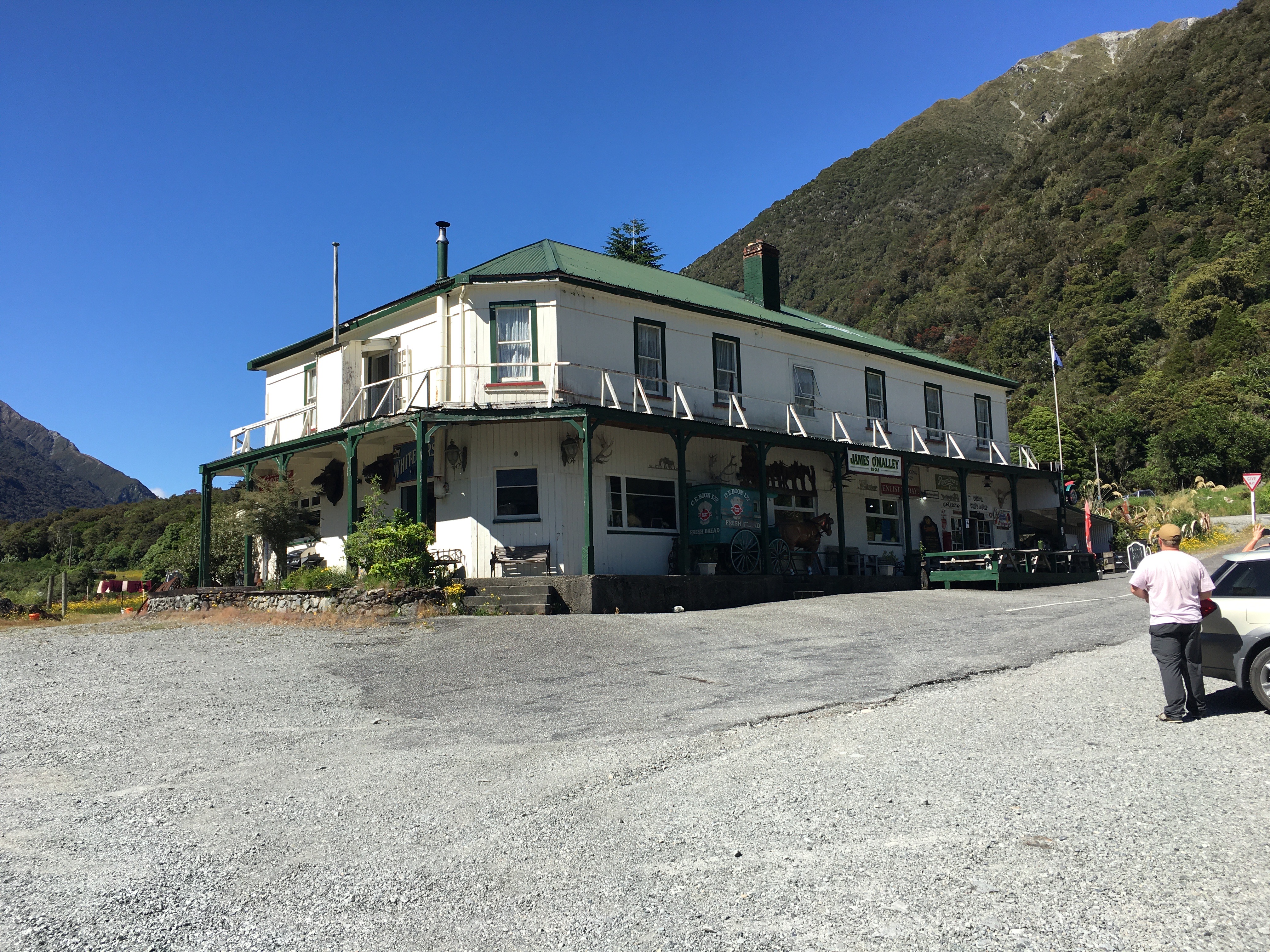
Day one began with dropping a car at the far end of our hike, near Kelly Creek. There was a bit of faffing around to charge the electric car (with the charger in Arthur’s Pass out of order, and the one in Otira busy), but it gave us an excuse to have a coffee at the Otira Hotel, which is an experience of its own.
Then we drove back to the Waimakariri River, parked car number two at Klondyke Corner, and hiked up the Waimakariri to Carrington Hut.
This hike is a bit of a slog and involves crossing the river a couple of times. In fact, the first river crossing comes within the first five minutes of hiking, which was fine—we were going to spend four and a half days walking rivers. There was no way we were going to have dry feet.
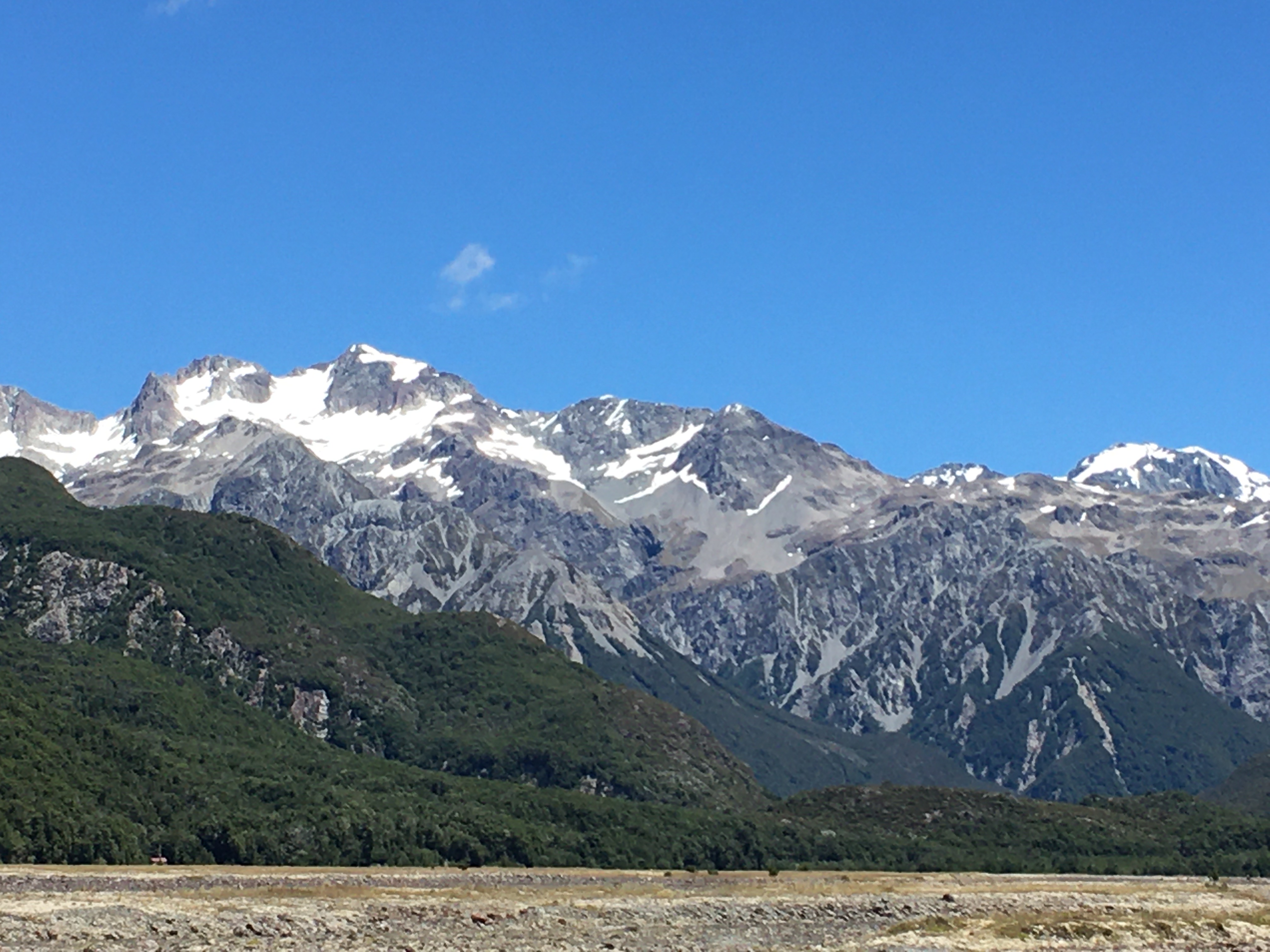
In spite of the dull nature of the actual hiking up to Carrington Hut, the scenery is fabulous, and only improves as you go further up the watershed. We were lucky to have a tern hunting the river alongside of us for a while, and we scared up a pair of banded dotterels, too.
After passing Anti Crow Hut, we left the riverbed to follow a track over a couple of roche moutonnée—rocky mounds left behind by glaciation. A series of tarns on the mounds give them a magical sort of quality, and the short break from river walking is nice.
The last time we were at Carrington Hut, it was incredibly crowded and unpleasant, so we carried a tent this time, just in case. But the 36-bunk hut housed only five of us that night, and we barely saw one another.
Day 2, we hiked over Harman Pass—up the Taipoiti River (click here for a video), then down Mary Creek. Again, the first act of the day was crossing a river, and then it was river crossings all day, back and forth across the Taipoiti as it rushed through a narrow valley which at times could be more properly called a gorge. It was another fabulous day, weather-wise, and the scenery was spectacular. So were the alpine plants. It seemed like EVERYTHING was in flower, and it was a slow hike up to the pass, because we were photographing all the way.
At the pass, we took a little jaunt up to see some tarns higher up, and then hung out for a while with a curious kea (click here for a video). Kea are an odd mix of highly endangered (there are 1,000-5,000 of them left), and incredibly pesky, thanks to their intelligence, curiosity and a beak shaped like a giant can opener (their peskiness is unfortunately part of the reason they’re endangered). The world’s only alpine parrot, it’s common to encounter them at elevation near Arthur’s Pass, but it never gets old.
Mary Creek was more of the same—river crossings, beautiful scenery, endangered birds. We spent some time watching a pair of whio (blue ducks) having a nap on a rock in the middle of the stream. There are only 3000 whio left and unfortunately the population is skewed strongly to males, because females are vulnerable to introduced predators when sitting on the nest. We were lucky enough to encounter two pairs on our trip.
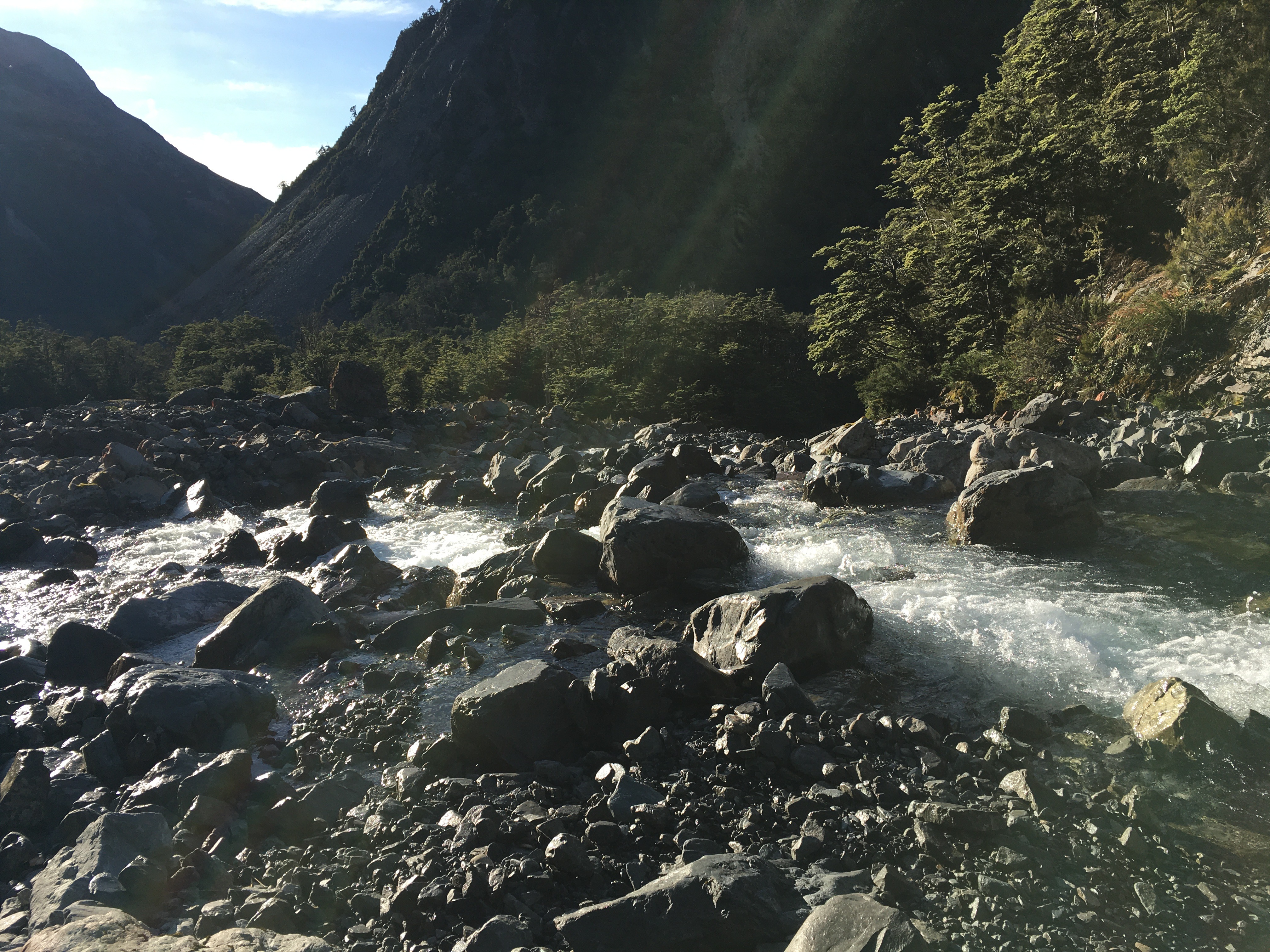
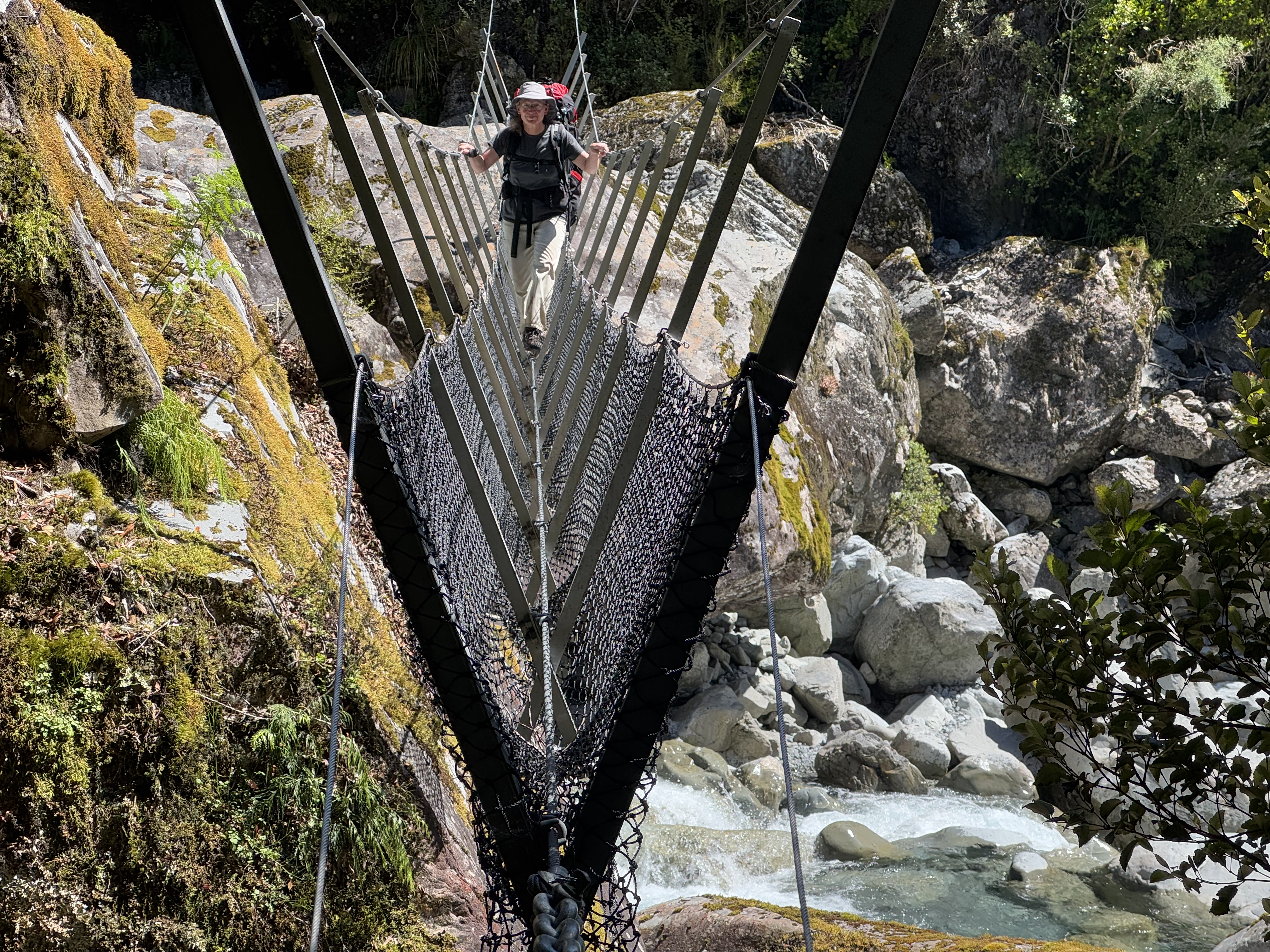
After a 3-wire bridge crossing at the bottom of Mary Creek, we arrived at Julia Hut. The hut is relatively small, and with another couple there already, we decided to tent. After setting up the tent and settling in, we had the rest of the sunny afternoon to explore. A natural hot spring was our destination. Only five minutes walk from the hut, next to the icy, swiftly flowing Julia Creek (click here for a video), the hot pool did not disappoint. It was initially too hot to sit in, and we had to redirect some river water into it to temper the heat.
After a sweaty hike, I have to say I wasn’t all that interested in sitting in a hot pool, but I took a dunk in the river first, and then the hot pool was pretty nice. You couldn’t fault the setting—two days hike from a road, on an absolutely stunning mountain stream in the bush. It beat Hanmer Springs by a mile!
There is clearly a lot of geothermal activity in the area—the smell of sulphur was prevalent all along Julia Creek—and I suspect if you fossicked around, you’d find more hot pools.
Day 3 was a lot of river walking (again), punctuated by a couple more three-wire bridges. We hiked down Julia Creek and the Taipo River to Dillon Hut. Well, we intended to stay at Dillon Hut, but when we arrived we were informed by a very cute four-year-old that there were ‘no more mattresses’ (Dillon hut is only a 2-hour hike from the road, and is clearly a great destination for a short family hike). So we moved on to Dillon Homestead Hut, just 500 metres down the track.
Dillon Homestead Hut is just that—an old homestead. Built of hand-hewn timber and clad in whatever the original owners could scrounge, it is quite the historical experience to spend the night there. It’s clearly beloved by local four-wheel drivers and dirt bikers, but is in sore need of some upkeep. Still, it was shelter when the skies opened up and dumped rain all night, and if it had been cold, there was a big open fireplace surrounded by three tatty, 1950s-era armchairs. And once you brushed the rat droppings off the sleeping platforms, tables and chairs, it had everything you needed to spend the night.
Fortunately the rats weren’t as active inside the hut as I had feared, and we spent a reasonably comfortable night (if a bit smelly) in the hut. In the morning, however, I trudged out to the long drop through soaking wet, waist-high grass. The loo is as old as the hut, and was stocked with three mouldy, rat-poo-festooned rolls of toilet paper. I didn’t stop to investigate the myriad spider webs (there may have been some interesting native spiders), but in retrospect I should have inspected my surroundings a bit more. Leaving the door open for light and ventilation, I dropped my pants to do my business.
A scuttling overhead was all the warning I got before a rat leapt out of the rafters and landed on my head. I may have sworn. But the four-letter word had barely left my lips before the rat was off again, leaping for the toilet seat and then the floor before racing off into the bush.
So, a warning to you—the Dillon Homestead Hut loo is guarded by an attack rat.
After that exciting start, the rest of Day four was a hard climb. From Dillon Homestead Hut, we followed Seven Mile Creek briefly to a track that climbs steeply through dense west coast forest up to the Kelly Range. It was dark and humid in the forest. At one point, the track passed through a narrow gorge that was almost tunnel-like. It felt like we were crawling uphill, and often it was literally true, as it took both hands and feet. Pīwakawaka kept flitting around us, taunting us with their darting flight and chittering voices—what was so difficult about this slope, they seemed to ask.
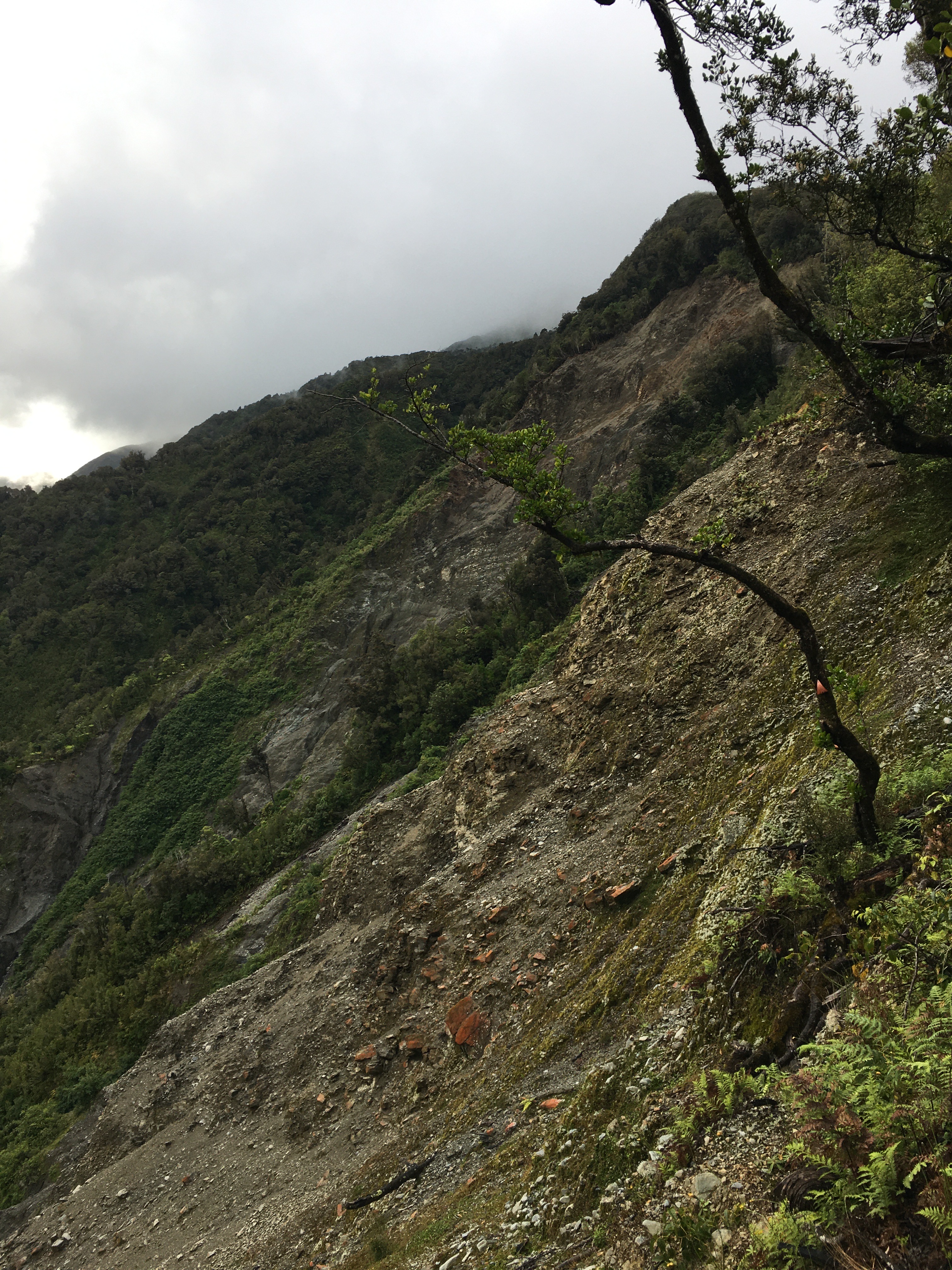
At one point, the track met a huge slip hundreds of metres across and hundreds of metres tall. A blaze remained on a lone tree suspended at the top of the slip. The rerouted track scrambled precariously around the top of the slip, and I breathed easier once we were past it.
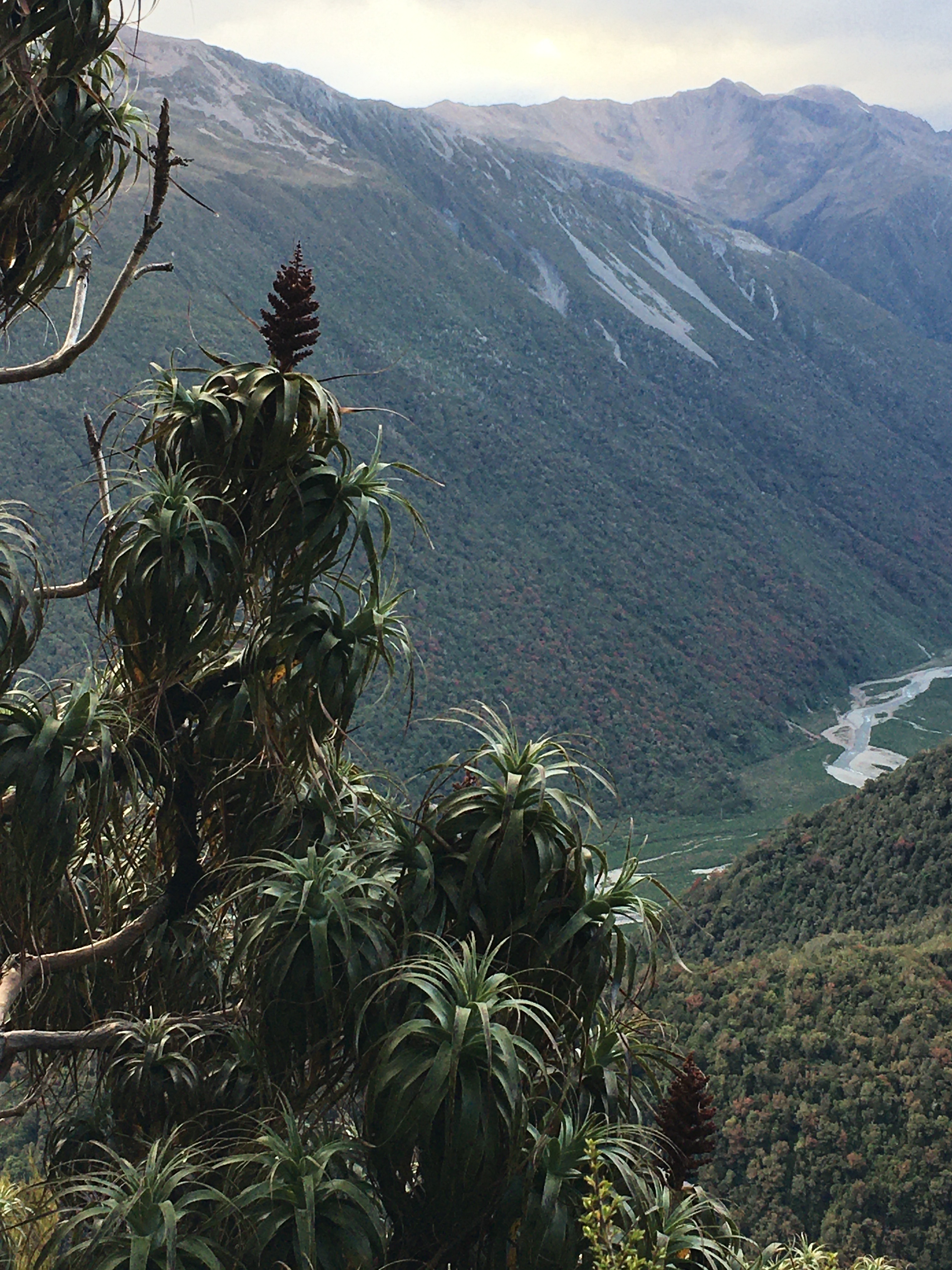
After 700 metres of elevation gain, we reached tree line and got a view back down to where we’d come from that morning—it was a long way down, and we still had more climbing to do.
The tops were dotted with tarns, and even where there wasn’t standing water, it was wet. We walked through fields of sundew plants, and took our breaks amid alpine orchids and daisies.
Clouds prevented us from having great views, but turned the views we did have into a dramatic, ever-changing landscape. By the time we’d reached the top of our climb—a thousand metres above Dillon Homestead Hut—the clouds were swirling around us.
A relatively short descent brought us to Caroll Hut just as the first raindrops began to fall. We had a late lunch of soup and peanut butter crackers as the wind picked up and the rain lashed the hut.
We shared Caroll Hut with a UK expat who lives in Wellington, a pair from Whanganui, and a fellow from Adelaide. It was a great mix, and we had a nice afternoon and evening chatting with them all. The best of hut life.
All night the wind howled, and I was thankful for the steel cables tethering the hut in place. Although the rain ended before dark, the wind continued through to morning, so it was a cold and windy start to Day 5. An early morning treat at the hut was a family of weka with fluffy chicks fossicking around the hut.
Day 5 was a short (hour and a half) jaunt out to the road from Caroll Hut. The ‘jaunt’ involved a good 800 metre elevation change, steeply downhill, but not bad going, with some nice views from time to time. And just when we thought we were done with wet boots, there was a stream crossing in the last 20 metres.
We were home by lunchtime, wet and tired, but having had an excellent five days. It was a fabulous way to spend the Christmas-New Year gap.
It’s Christmas Eve, and I suppose I should be in holiday mode, preparing for our upcoming tramping trip, baking or cooking something, doing last-minute gift wrapping …
But we had our family Christmas celebration on Sunday, because our daughter is already on her way to Southland for two weeks of climbing, and our son leaves tomorrow. So, with the gifts and fancy meals out of the way, I am ready to get back to work.
Not the day job—I still need a break from that—but writing work is calling me. Which means it’s not really ‘work’, I suppose.
I treat writing as a job that I go to two days a week. I put in long hours on my writing days, and there are certainly days on which it’s hard to keep myself at the desk, plugging away. But the fact I was at the computer typing away at 6.30 am on Christmas Eve tells me writing is more than a job.
As it should be. If I was writing to make a living, I’d be sorely disappointed. Turns out, I can’t not write. The past week, filled with family, celebrations and outings has been fun, but I’ve keenly felt the missed writing days. I’ve been snatching moments here and there (hence the 6.30 am writing session on Christmas Eve), but haven’t had a chance to spend long stretches in the writing zone.
Instead, I’ve been gathering experiences, watching people, squirrelling away ideas. When the holiday madness settles, I’ll be primed and ready to write.
In the meantime, I’ve got a new outdoor poetry chalkboard, made for me by my daughter, to fuel some quick writing exercises. I’m wondering how long I could sustain a poem a day, like I did during lockdown. Or maybe I should limit myself to one a week, in the interests of getting other stuff done, too. So many writing possibilities!
I hope you all have a lovely holiday season doing things that inspire you!
At this time of year, I love chatting with others about their holiday traditions. Every family’s traditions are unique—a combination of family history, ancestry, and geography all mashed together with individual preferences.
Trifle has mostly replaced cookies as my Christmas baking of choice.
And they evolve over time. The Christmas traditions I grew up with are not the ones I practise today. They took a dramatic shift twenty years ago when we moved to New Zealand from Minnesota—northern hemisphere traditions make no seasonal sense here, where Christmas and the summer school holidays coincide.
So my husband and I adapted. Like most Kiwis, our holidays involve travel—we have a tradition of a family backpacking trip the week before Christmas. I always carry a little stuffed reindeer, strapped to the top of my pack, as our holiday hike mascot. We pack Christmas cookies, and usually include one ‘fancy’ camp meal (especially if the tramp extends over Christmas Day).
Our Christmas tree isn’t a pine tree—a cut tree would last about three minutes in the summer heat and wind. Instead, we make our ‘tree’ each year out of whatever materials we have on hand. Making, then decorating the tree is usually a whole-family event.
The LEGO tree of 2019 was one of my favourites, with a motor powering moving parts.
Our big Christmas meal (if we’re not on the trail) is on Christmas Eve—calzones full of vegetables from the garden. We make extras, and enjoy the leftovers for lunch on Christmas Day.
The big day is meant to be a day of relaxation for everyone, so Christmas breakfast sticky buns are made the night before, and rise in the fridge overnight, to be popped into the oven in the morning. After a lunch of leftover calzones, dinner is a big salad accompanied by cheese and bread. Simple as. No slaving in the kitchen on a beautiful summer day.
Boxing Day is beach day for us—along with most of the population of New Zealand—a day to relax with the family and celebrate summertime.
It’s a long way from the hot cocoa, turkey dinners, and carolling of Christmases in my youth, but our traditions do what all good holiday traditions do—they provide opportunities to spend time with family while enjoying seasonal delights.
So happy holidays to you all, and may you enjoy your own traditions, whatever they are! Add a comment with your own traditions!
Today is Thanksgiving in the United States. Since we’ve been in Aotearoa New Zealand, we don’t celebrate the holiday—who has a harvest festival in springtime? Add to the seasonal disconnect the dumpster fire that is world politics at the moment, and you could be forgiven for not feeling terribly thankful this Thanksgiving.
But it’s good to set aside all the frustrations in life (like the frost that has hit the vegetable seedlings every single night since our ‘frost free’ date), and reflect on the good things.
This Thanksgiving, I am thankful for a multitude of things …
My coworkers at my day job—teachers, teaching assistants, and support staff—who are all absolute legends, working under stressful conditions for lousy pay, usually without any recognition of the amazing work they do.
The fellow authors in various author communities I’m a part of, who are supportive of all writers and work together to support, encourage, and promote authors, books, and reading. You are rock stars!
The members of my local garden group, who share freely of their gardens, knowledge, and experience. You are inspiring!
My garden. Maybe it is weird to be thankful for it, because it doesn’t just happen—my husband and I have worked hard to turn this sad paddock into an oasis of food and flowers. But I am thankful for all the plants and soil organisms that have worked with us to make our efforts pay off.
My husband, who is my best friend, greatest fan, and partner in all things.
My kids, whose passion for the people and the world around them remind me that all is not lost yet.
Do you notice the pattern? It’s all about communities—of people, of living things.
I don’t know what’s going to happen in the world over the next few years. Much of it will be pretty bad, I’m guessing. But there are communities around us working for good. There are people who want all our tamariki to be able to read, to have healthy food to eat, clean water to drink, health care and mental health support. There are people around us who don’t think in terms of ‘us’ and ‘them’, but embrace humanity as a whole, in all its diversity. There are people everywhere who care about the people and the world around them.
I am so thankful that these people exist. I am thankful to be part of some of the communities who put this caring into practice in their daily lives.
So, while the world burns around us, I give thanks for the small communities that work tirelessly to put out the fires.
It’s easy to feel like the world is going to hell in a hand basket these days. You can readily believe that there is no kindness left in the world. That no one cares about the earth or community. That values such as integrity and selflessness are dead. That people’s only motivation is money.
Of course that’s not the case, and I’m reminded of that regularly.
I am blessed to be part of a community of vegetable gardeners—people who can restore my faith in humanity. I’ve written about gardeners in the past, but it bears saying again. These are people who have a deep sense of community. They pay attention to the effects their actions have on the land. They give of their time and are generous with food, seeds and plants, sharing what they have with others.
They organise local food pantries and community gardens. They raise funds for charities. They give away produce to those in need. They share their knowledge and skills freely with others. One gardener I know even hands out jars of jam to strangers.
And when those gardeners get together, they can make a difference in communities. Here in New Zealand, it is common for houses in towns to be surrounded by high wooden fences. But in the nearby town of Akaroa, fence heights are restricted, so that people share their gardens with the street. What a difference it makes to the entire feel of the community! It actually feels like a community, and not a collection of houses. I love walking the streets and enjoying everyone’s beautiful gardens.
In the past couple of weeks, I’ve turned to my own garden to escape the drumbeat of depressing news from around the world. The flowers and vegetables transcend politics, war, economics and societal dysfunction. They centre me and give me a respite from the troubles of the outside world.
And as a gardener, I feel compelled to share that respite with others.
So I invite you to come on a brief tour of some of my garden. Stop and smell the roses. Enjoy the scent of the herbs as you brush past them. Munch on some early produce from the vegetable garden. Say hello to the chickens. Bask in the warmth of the greenhouses. Take a moment to unwind and relax.
And most of all, stay safe, stay hopeful, and look after one another.
I’m pleased to show you the cover for the next book in the Rifton Chronicles! I’m loving the bright colours of these cosy urban fantasy covers!
Available: one pub. As is, where is.
Who buys a burnt out pub for their niece’s thirtieth birthday? Katie Cochrane’s aunt, apparently. Faced with the decrepit building, Katie does the only logical thing—starts her own restaurant.
But the Rifton Pub has issues, and fire damage is the least of them.
Patrons who haven’t even had a drink start showing up ‘drunk’ around Rifton, and Katie’s liquor license is suspended.
When the Rifton Garden Group takes notice, Katie is forced to concede that the ‘demon drink’ isn’t responsible for her troubles, but another sort of demon altogether. And it’s going to take all of Rifton’s witches to banish what has taken root.
Another cosy urban fantasy set in Rifton. You might never look at your garden the same way again. Perfect for fans of Legends and Lattes!
I recently participated in ALLI’s SelfPubCon, which focused on the business side of writing. There were sessions on using social media, monetising YouTube, website design, using AI for marketing … I watched video after video that made my brain turn off. Video after video teaching me how to cash in on the advertising deluge we all suffer from online. How do you get those irritating ‘commercials’ into your YouTube videos (so you can make money on them)? How do you use Facebook Ads? How do you cash in on third-party advertising on your website?
Ugh!
I hate the constant bombardment of ads for crap no one needs. Do I really want to be a part of that, even if it can make my writing business profitable? Is that really why I write—so people’s interest in my writing can sell salad spinners, ‘miracle’ weight loss pills and erectile dysfunction products?
I despaired until I stumbled across a session on selling physical books. The panelists in this session talked about selling books at markets and fairs, doing school visits, exploring unusual sales outlets like tourist destinations, how to encourage people to buy your books face-to-face.
Yes! This was my kind of marketing. The kind of marketing I’ve been focusing on in the past year. Talking to people, talking about my books, being in the same physical space with potential readers, watching how people interact with my books. Getting that personal connection with readers in the real world.
Start talking to me about SEO, CTR, and ACOS, and my eyes glaze over. But throw me into a room with a bunch of potential readers, and I’m all over it. Watching the session on physical book marketing, I finally realised that it’s not that I can’t understand the online marketing game, it’s that I don’t want to.
Making money from random pop-up ads in my online content goes against my values. Putting my own random pop-up ads in someone else’s online content goes against my values. Bombarding potential readers online every day goes against my values.
And that’s okay.
I don’t have to participate in that madness.
And, yes, perhaps if I had to pay all my bills with my writing, I would feel differently, because god knows it’s hard to make a living selling books at markets. But I like my day job. And while I would love to write full-time, I know that I gain a lot of writing benefit from my day job. I would be a poorer writer without it.
And if making art is about expressing yourself and your values, then why wouldn’t your marketing reflect that as well?
Indeed, how could I, in good conscience, make money from plastic widgets advertised on my website when my books and stories contain so many environmental themes?
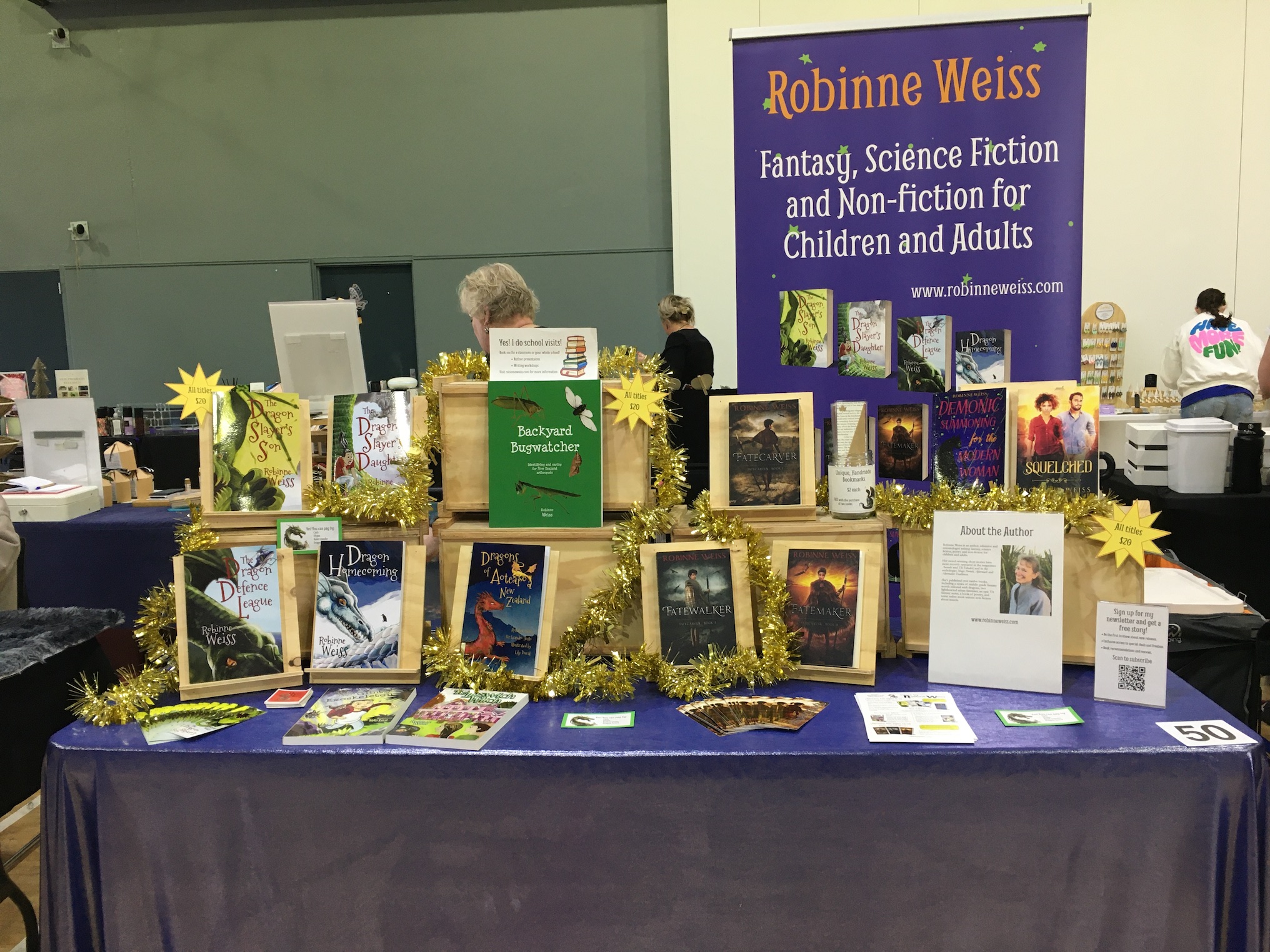
So I will continue to trot out my books at local markets, beside other local artists. I’ll continue to work on the board of the Tamariki Book Festival to help other authors do the same. I’ll chat with readers, listen to grandparents talk about the sorts of books their grandkids like to read, discuss dragons and my favourite dragon books with kids, hand out stickers and bookmarks, visit schools and tell children how hard writing is even for me. And I will sell a few books, sign people up for my newsletter (people who actually want to hear from me), and probably end up spending half what I’ve earned buying art from others.
Is that so bad?
Sounds perfect to me, because it is much more aligned with my values. It values personal connections and supporting others. It recognises the value in the art itself, rather than measuring the value of the art in terms of what else can be marketed alongside it.
And maybe I won’t ever be able to support myself with my writing. But I will be true to myself.
And … um … not to deluge you with marketing, but if you happen to be in the area, come say hello and pick up some Christmas gifts at these upcoming markets:
I’m part of a local group of keen vegetable gardeners who meet fortnightly throughout the growing season. Each meetup involves a tour around someone’s garden, and then a cup of tea, while we discuss our gardens and gardening, complain about the weather, and generally catch up with each other.
Our most recent gathering was at a garden just 200 metres down the road from our house. Bev’s been gardening there for over 20 years, and the property is beautifully sheltered by large hedges and mature plantings.
And even though we live only a three minute walk away from one another, our gardens grow remarkably differently.
Bev’s is almost always a week or two ahead of mine. And not just because she plants earlier than I do—her tree and berry crops leaf out, bloom and fruit before mine do. She plants out her tomatoes before I do, her carrots germinate more rapidly and grow more quickly, her peas outstrip mine within weeks of germination, her green beans produce pods a week ahead of mine. The differences are remarkable.
We are so close to one another, the temperature and rainfall on our two gardens is all but identical. But Bev has created an amazing microclimate for her plants with rich soil and excellent shelter.
Other women in the group have done similar wonders on their properties, creating striking pockets of abundance by carefully manipulating the microclimate in their gardens. In fact, my garden is sometimes behind other group members’ gardens in colder locations.
It’s something to aspire to. Having started with a bare paddock with no topsoil four and a half years ago, we’ve come a long way on our property, but we also have a long way to go. We are incredibly fortunate to have amazing gardeners nearby to inspire us to keep working towards our own pocket of abundance.
The natural microclimate of our property is apparently perfect for dandelions, because they are abundant and healthy everywhere.We haven’t managed a good microclimate for citrus yet, except in the greenhouse.We do manage to grow great broad beans!









 Robinne Weiss