Pumpkin Cinnamon Buns

Winter has definitely arrived this weekend, with squally rain, and chilly winds. The mountain passes have been closed by snow, and no doubt we’ll see some stunning snowy peaks when the clouds finally lift.

In response, I’ve been craving dense, high calorie food (never mind the fact I’ve been indoors most of the weekend and don’t need high calorie food in any way). 

Yesterday, I was contemplating today’s breakfast, and imagined pumpkin spice sticky buns. Was there such a thing? And if not, could I invent it?

The answer was, yes! I found several variations online. In my usual fashion, I mixed and matched, picking aspects I liked from a number of recipes to come up with my own take on the dish. 

The outcome was quite tasty. Here’s my recipe.

Dough:
3/4 cup milk, warmed to about 43℃ (110℉)
1/4 cup granulated sugar
2 1/4 tsp yeast
1 cup pureed pumpkin
1/4 cup butter, melted
1 egg
2 cups high grade (bread) flour
2 cups wholemeal (whole wheat) flour
1 Tbsp cinnamon
1 tsp cloves
1 tsp ginger
1 tsp allspice
3/4 tsp salt

Filling:
2/3 cup brown sugar
1 1/2 Tbs cinnamon
1/4 cup butter, softened
2/3 cup chopped walnuts

Glaze:
1/2 cup icing (confectioner’s) sugar
2-3 tsp fresh lemon juice

To make the dough, combine milk, granulated sugar and yeast in a small bowl and let sit until foamy. Combine pumpkin, melted butter and egg in a medium bowl. Combine flours, spices and salt in a large bowl.

Combine the yeast mixture with the pumpkin mixture and beat until smooth. Pour this mix into the flour, and stir until a dough forms. Turn the dough out onto a lightly floured surface and knead for about 10 minutes, until smooth and elastic. Allow to rise in a greased, covered bowl for 1-2 hours, until doubled in bulk.

Roll the dough into a large rectangle, about 35 x 40 cm (14 x 16 in). Spread the dough with the softened butter, leaving a narrow strip of dough on one of the shorter sides free of butter. Combine the brown sugar and cinnamon, and sprinkle over the butter. Sprinkle walnuts on top.

Starting at the buttery short edge, roll the dough into a log, pressing the unbuttered edge firmly to seal. With a sharp knife, slice the log into 12 rounds.
Place the rounds in a well-greased baking tin 23 x 33 cm (9 x 13 in)*, cover with a damp towel, and let rise about 30 minutes.**

Bake at 180℃ (350℉) for 25 minutes, until nicely browned.

Make the glaze by mixing lemon juice, a little at a time, into the icing sugar until the mixture is thick and pourable. Drizzle over the still-warm buns.

*Knowing this recipe makes enough for 2 breakfasts for my husband and me, I divided my rolls, arranging them into two 25 cm (11 in) round pans. I slipped one pan into the freezer, to bake another week.

**If you want to have these for breakfast, cover the pan with plastic wrap and refrigerate overnight. Allow to stand on the kitchen bench for about 30 minutes to warm up before baking.

A week later … PS: the buns I put in the freezer for a week were every bit as delicious as the ones baked right away. I moved them to the fridge the night before, then let them sit out for 45 minutes before baking. They took about 5 minutes longer in the oven than the first batch, but otherwise, you’d never know they had been frozen. Yum!

Pleasing Spaces, Pleasing Spouses

I’ve been gardening with my husband for almost 33 years now. Over the years, we’ve created many different garden spaces together. And even after all these years, we have different ideas about what our garden should look like. Each garden we’ve created has been a push and pull of our ideas, a creative collaboration, better for the different ideas we bring to the task.

I tend towards tidy, functional. My husband tends towards whimsical, aesthetic. I think about how I’m going to get a wheelbarrow into a space, how I’m going to weed it. He thinks about seating and art, lines of sight, and how we will enjoy the space. We joke that he builds gardens and I weed them.

The end result is beautiful gardens that are relatively easy to maintain. The end result is a garden that feeds us, but is also a place we regularly stroll with a glass of wine in hand, just to enjoy the beauty of it. The end result is beautiful spots to eat lunch, read a book, or write a blog post. The end result is a space that meets our physical, emotional and spiritual needs. 

And I can’t help but suspect that the collaborative act of gardening is one of the reasons we’ll be celebrating our 33rd anniversary next month. A lifetime of what are essentially team building activities can’t be bad for a relationship.

In fact, I see the same in many of the couples in our local garden group—spouses acting as teams, collaborating with one another to create spaces to nurture each other. I love to see the beautiful, supportive relationships between spouses in that group, and I have to believe that gardening together is a strengthening factor in those relationships.

One more reason (if you needed one) to get out there and garden—but do it with your partner.

Winter Gardening

It’s not quite winter here yet. There are a few more days until it officially starts. And the weather has been unusually warm. 

It’s a far cry from gardening in Minnesota, where I used to hack my parsnips out of the frozen ground in November and December, and the garden spent much of the winter under a blanket of snow.

Here, the garden is reduced and slow growing in winter, but there’s plenty happening.

We’re still picking tomatoes, peppers and eggplants from the greenhouses, though many of the plants are looking pretty sad. They will almost certainly give up in the next month.

The winter broccoli, cauliflower and cabbage are doing nicely. We’ve been enjoying plenty of these cool-weather crops over the past few weeks, and they will continue to give through winter. The leeks are gorgeous and ready to pick. They’ll provide onion flavour in dinners after the stored onions are gone, and before the first spring onions are ready in October. 

Leafy greens like Beet Erbette and Silverbeet (Swiss Chard) are in their prime through winter—they’ve been largely ignored through summer while so many other crops were available, but now they offer fresh greens to add to the frozen and bottled vegetables in winter dinners.

Weeds are slow growing in winter, and the vegetables require little work. Much of the vegetable garden is tucked up under mulch or green manures all winter.

But there’s a fair bit of maintenance to be done over winter. Perennial crops like berries and fruit trees need pruning, and winter is a good time to tackle the really pernicious weeds like twitch (couch grass), because the soil is soft and wet. Winter is also a great time to top up mulch and add compost to the soil, to mend fences and bird nets, to shift plants.

The beauty of winter gardening is that the urgency of the spring and summer gardening seasons is gone—there isn’t so much to do that you can’t enjoy a rainy day indoors, but you have a perfect excuse to be outdoors on those glorious sunny winter days.

And speaking of glorious sunny days … I think it’s time to get out of the office and into the garden.

Bioblitz Weekend

Last weekend I had the pleasure of participating in a mini bioblitz at the University of Canterbury’s Cass Mountain Research Station.

Eleven of us descended on the station on the frosty Saturday morning. Fog enshrouded the mountains, but blue sky above promised a glorious day.

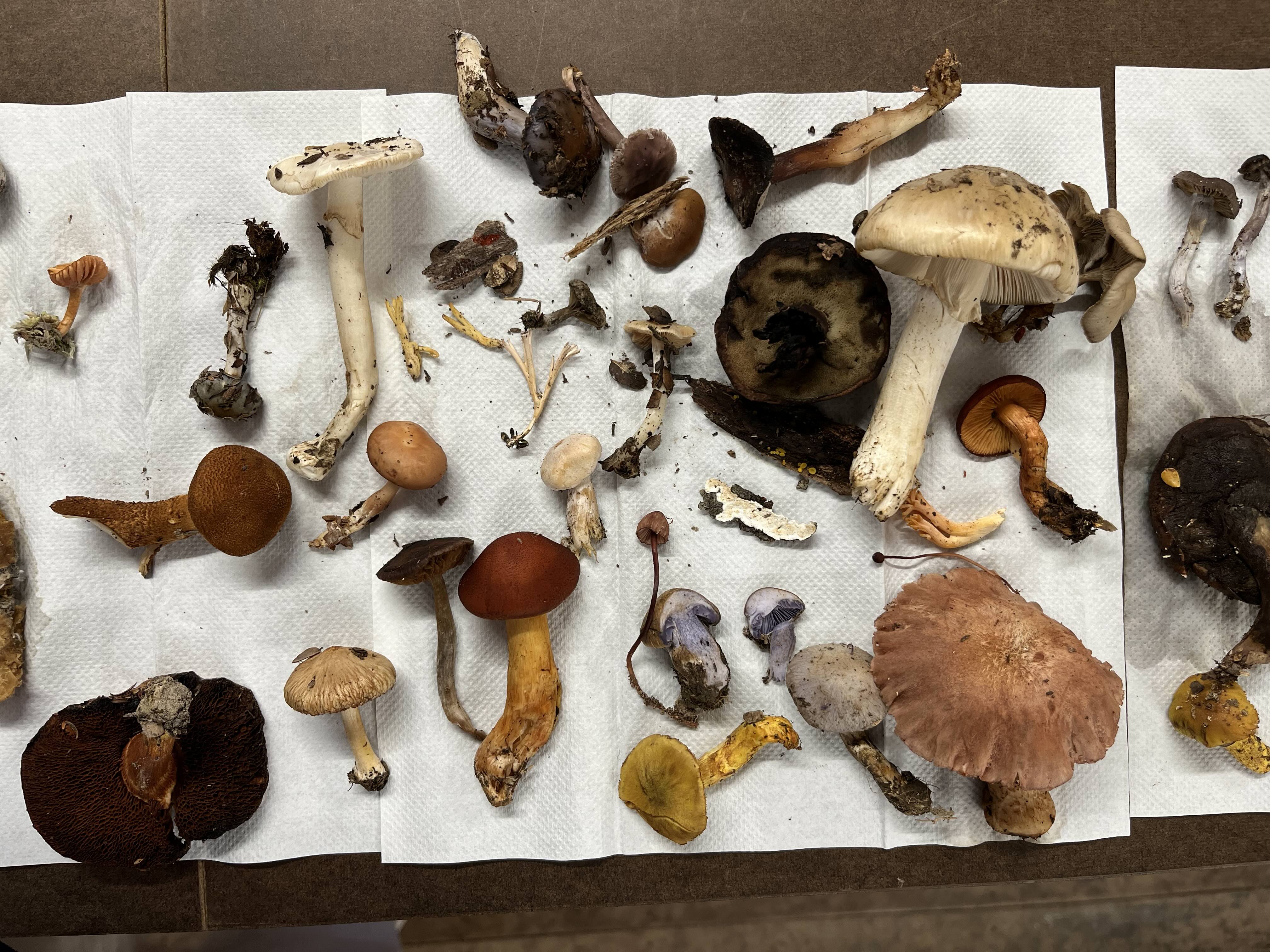
We set a goal for the weekend of increasing the number of iNaturalist observations at Cass to 4,000 and the number of species observed there to 800. Then we embarked on forays into the bush and across the outwash fan to search for life.

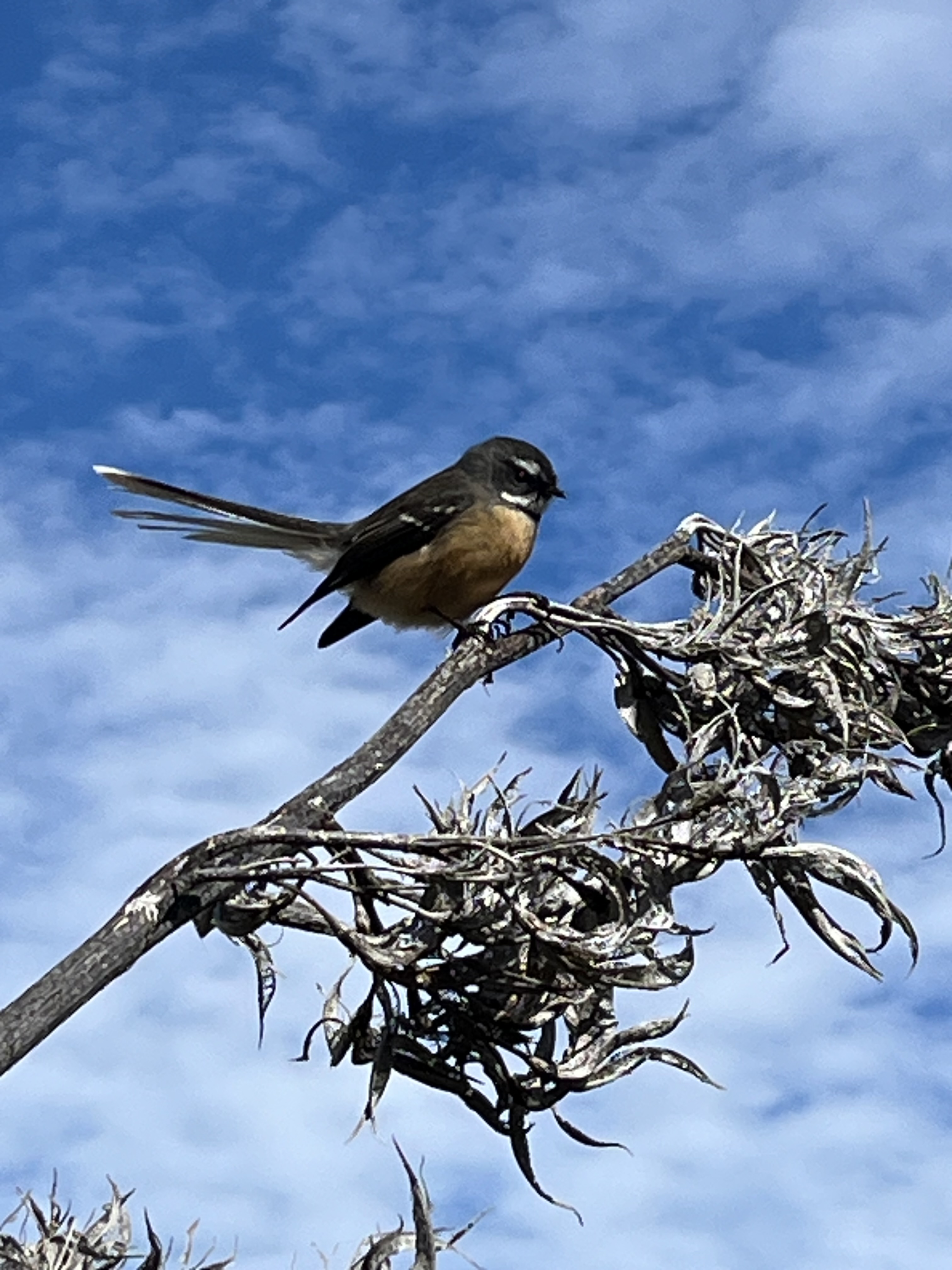
I was stuck near the station, because my knee hadn’t yet healed from the previous week’s tramp. But my geographical constraints didn’t prevent me from plenty of discoveries. Instead, it forced me to focus on the small and overlooked species. Mites, springtails, slugs … all manner of life abounds nearby and underfoot.

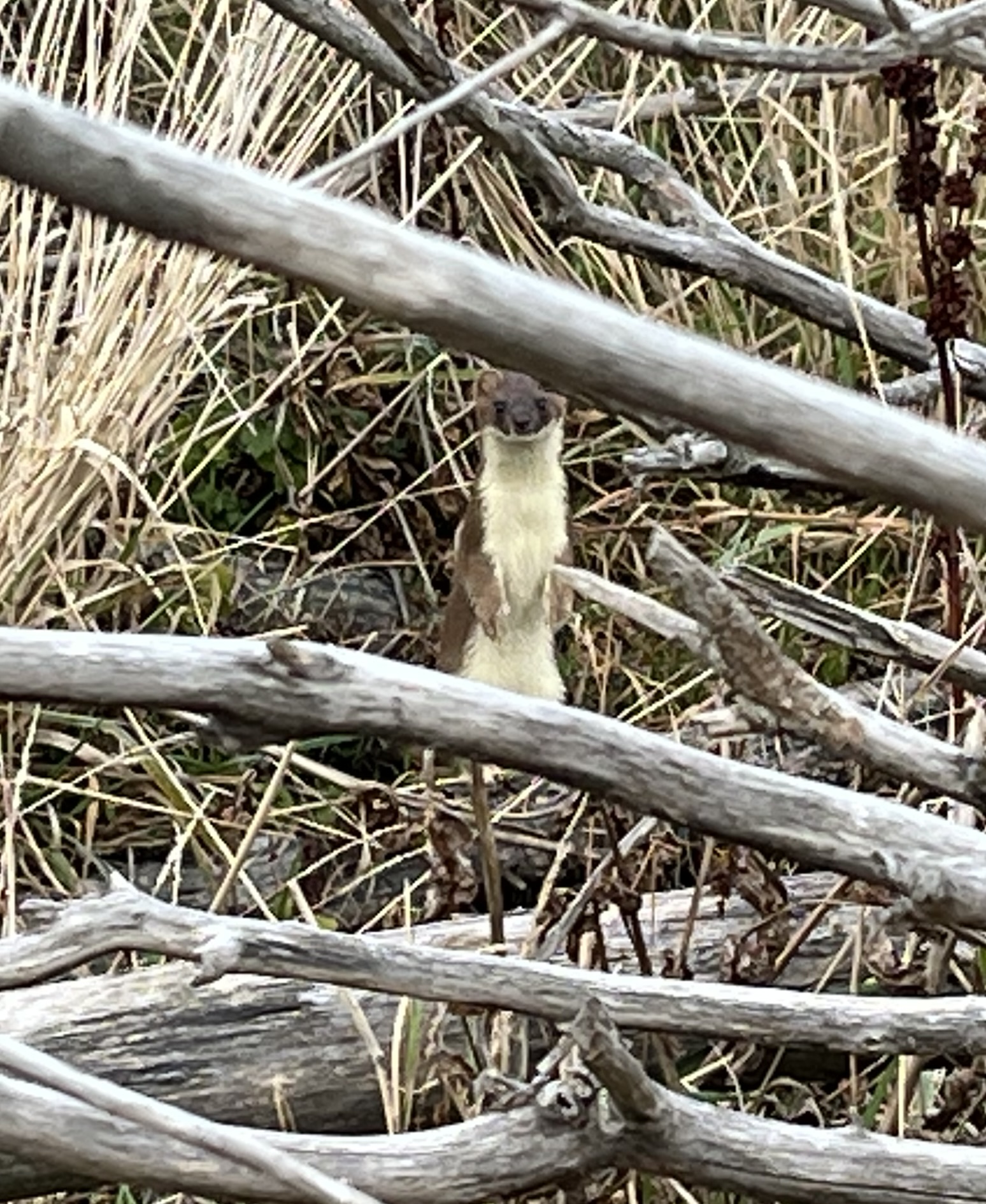
And because I was spending much of my time quietly turning over stones and picking apart rotting logs, larger organisms came to investigate me, including a pair of curious stoats who spent five minutes scurrying around me and popping up out of the vegetation to spy on me. In spite of the fact stoats are terrible pests here, and I would happily kill them, the encounter was pure magic.

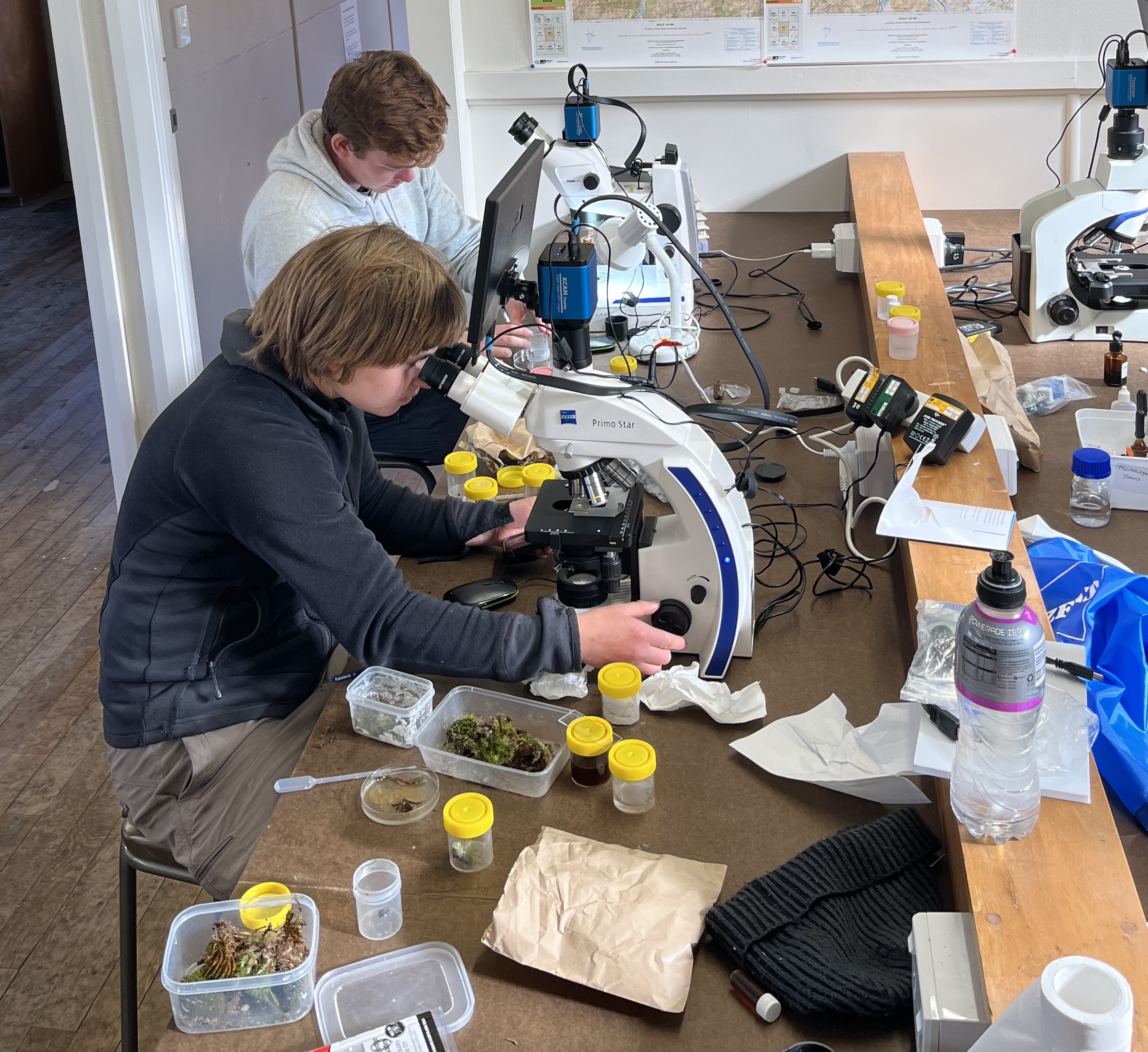
As people returned to the station laden with stories, photos and samples, we moved to the microscopes in the lab, where the geek factor was cranked to 11.

“Oh wow! Look at this!” was a common refrain, as we crowded around the microscopes to examine the smaller finds. As dusk fell, we set up light traps for flying insects, to be checked later in the night.

On Sunday, a group ventured into the bush in search of the giant springtail, which was found at last year’s bioblitz. The quest was successful, and although it didn’t add a new species to the list, it was a highlight of the weekend for many.

In early afternoon, after a busy morning, and a lunchtime spent uploading observations to iNaturalist, we headed home, where we continued to upload our observations from the weekend.

When all was done and dusted, the 11 participants made 871 observations of 321 species. Almost 1 out of 3 observations were of organisms new to the Cass list, bringing the totals for Cass Research Station to 4484 observations of 869 species! An amazing result from a spectacular weekend!

The event reminds me again how important university field stations are for fostering science in general. The people at the two bioblitzes I’ve attended at Cass might never have collaborated or shared ideas in their everyday research life, but the research station brought them together in an atmosphere that fosters collaboration. The research station is a place where scientific curiosity can flourish, where scientists can explore the connections among disciplines and research projects. What an incredible asset for the university!

Weekend Tramp in the Two Thumb Range

Looking up Bush Stream

Last weekend, my husband and I got out for a tramping trip in the Two Thumb Range, in Te Kahui Kaupeka Conservation Park. We parked on Rangitata Gorge Road at Forest Stream, then slogged two hours up the road to Bush Stream—not a very exciting start, but better then than at the end of the tramp. We followed Bush Stream Track up the stream to Crooked Spur Hut. The stream flows through some pretty spectacular scenery, and you ‘get’ to cross the stream quite a few times before a steep climb to the hut.

Crooked Spur Hut is one of several historic musterer’s huts in the area. It’s old and the walls are full of holes and rats. We opted to sleep in the tent, but we hung out in the hut, since we had it all to ourselves.

Kea on a cold tin roof.

On the approach to the hut, a kea came to investigate, watching us climb the hill. It must have invited its friends later, because shortly after dark, while I was reading in the tent, I heard the thump-thump-thump of a couple of kea bouncing around outside. I shooed them away, knowing their penchant for mischief, and eventually they got the hint and left.

But by morning the kea had mustered reinforcements. They started about 4 am, thumping around outside the tent, plucking at the tent strings, and calling loudly right by our heads. By 5 am, we were up out of a sense of self-preservation, retreating to the hut to start our day.

When I stepped out of the hut a few minutes later, there were three kea, each one working on pulling out a tent stake, and more calling in the darkness beyond. We quickly took down the tent in the dark, before the kea tore it to shreds.

We got the billy boiling to the sound of kea on the tin roof. They seemed to have multiplied. The noise was deafening, and grew louder as dawn approached. Our trips out to the loo were accompanied by no less than three kea, who then sat on the loo roof, peering in through the skylight to watch the show. 

Returning from the loo, I counted fifteen kea, most of them on the hut roof, picking at the roofing nails (which thankfully had been replaced with non-leaded ones, because the old lead nails kill kea), and sliding down the tin. It was the most kea I’d ever seen at once. And as obnoxious as the cheeky buggers are, it was the highlight of the trip.

Leaving the kea behind, on day two, we hiked up from the hut through frosty tussocks to a scree-covered saddle where we were treated to some new spectacular scenery—tussock, scree and craggy peaks all around. At Swamps Stream we scared up a herd of 28 tahr—a non-native pest, but cool to see nonetheless. We arrived at Stone Hut at lunchtime, and had a lovely meal next to the stream before carrying on to Royal Hut.

Interior of Royal Hut.

Royal Hut is similar in age and condition to all the old musterer’s huts, but has the distinction of having been visited by royalty. The accounts I’ve found differ in the details—it was either in the 1960s or in 1970, and the royals involved were either Prince Charles and Princess Anne, or Prince Charles and Princess Diana (Diana being highly unlikely, given the date range suggested for the event).

In any case, it is said the royals zipped in by helicopter for a ‘brief’ visit. I doubt they spent the night. With mice scrabbling over our packs within 15 minutes of our arrival at the hut, we opted for the tent again.

Frost heave on the track, with 4 cm-long ice needles.

The morning of day three was fine and frosty (with frost inside the tent!). The DOC signage indicated we had an 11-hour hike to the road, and with daylight only being 11 hours or so long at this time of year, we made an early start, as soon as it was light enough to see the track.

We warmed up quickly, with the first leg of the day being a climb to Bullock Bow Saddle.

By the time we reached the saddle, I knew I’d pushed too hard over the previous couple of days—my left knee was stuffed, and hurt with every step. 

It was a loooong 14 or 15 km from there to the road—the first few kilometres steeply downhill, then a long slog down the Forest Creek riverbed. 

Still, we made it to the car well before dusk, and enjoyed more spectacular scenery (and a few more river crossings) along the way.

Overall, a fun long weekend! Spectacular views, awesome wildlife, and some real character huts. And the weather couldn’t have been better.

Technology Woes

It’s been a difficult week for me and technology. On day two of my two-week break from my day job, my ten-year-old laptop died. I’d hoped to finish the first draft of the novel I’m working on during my break. No such luck.

This week’s entertainment.

On the same day that my laptop died, my phone had to be recharged four times, because the battery was draining completely every couple of hours, even when I wasn’t using it.

So it’s been a very expensive and frustrating week, and now I have a new phone and a new laptop. I will admit it is nice to not have to carry an extra battery for the phone with me all the time, and it’s nice to have a computer with a fully functioning keyboard, but the upgrades have been quite disturbing, too.

Having not updated my devices for a decade, all my apps were old versions. The new ones have a zillion more features than I’m used to. Almost none of the new features increase the apps’ functionality. The ‘upgrades’ are primarily aimed at urging me to consume more advertisements on my device and making it easier for me to spend money. I find it quite depressing.

The rebellious part of me has decided that, in response to the upgrades, I’m going to do my best to spend even less time on my devices. The computer is pretty well unavoidable, because of my occupation, and I’ve never been one to spend personal time on the computer. But the phone tends to be what I grab during my leisure time. I admit, I have six different e-reader apps on the phone, and I read tons of ebooks, which is what occupies most of my phone time. But I also play a couple of games on the phone, and I read the news. I’m easily sucked into social media on the phone, too. So there’s lots of room to limit my phone use.

First job was to delete the games. I’d already deleted one, several weeks ago, because I realised I was using it to procrastinate, and I didn’t even really like it. I haven’t missed it at all. So the other two games have now gone.

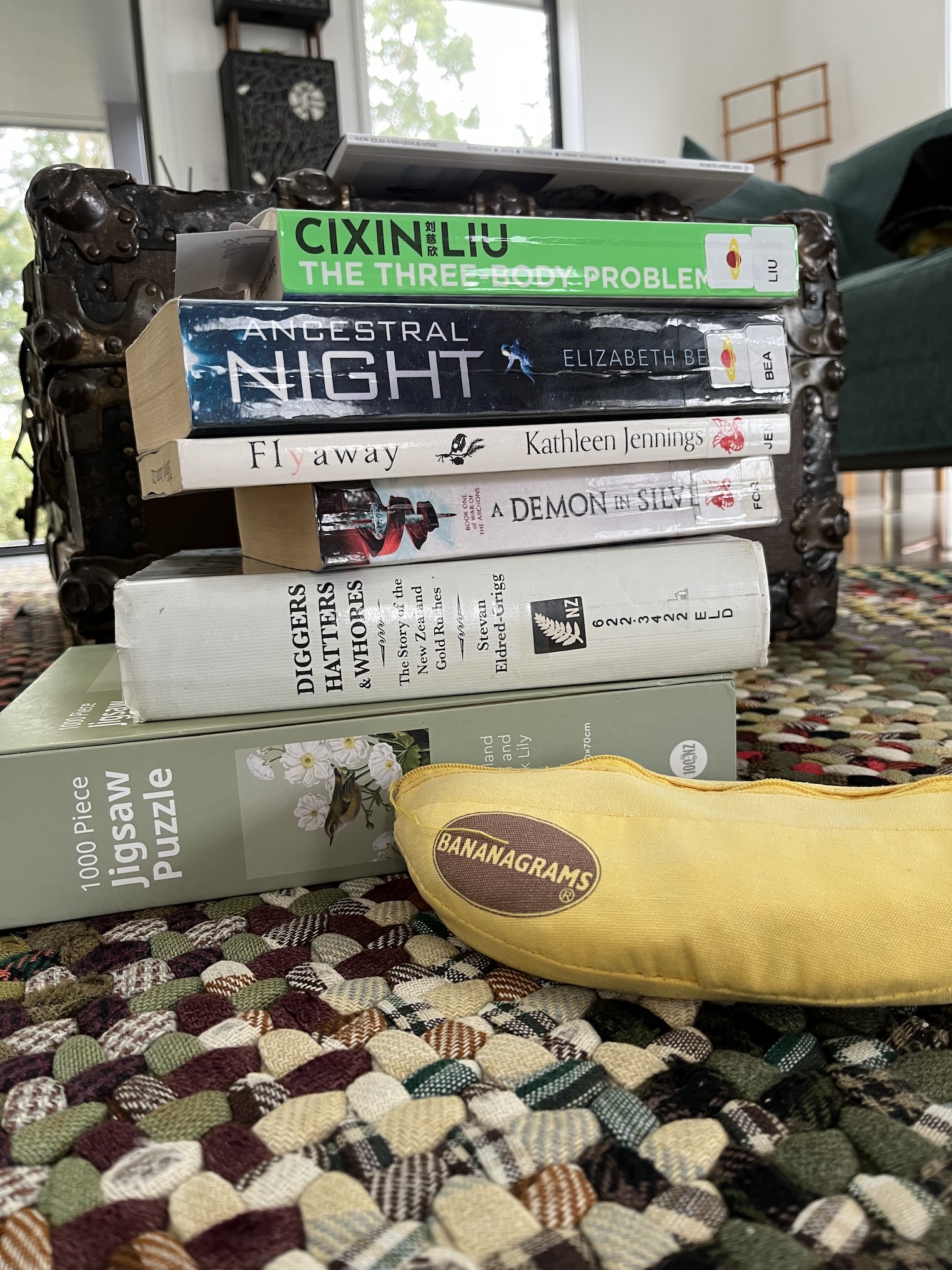
Then, while I was out and about this morning, I stopped by the library. I checked out an armload of books, and also a jigsaw puzzle. Books are fantastic, but I do need the brain rest that those games on the phone or scrolling social media provide. Jigsaw puzzles will serve the same purpose, with the bonus that a jigsaw comes without advertisements and auto-play videos, and invites others to join in the fun. 

I also need to remember my love of playing solitary Bananagrams. It’s not as fun as facing off in a frenetic game with my daughter, but I enjoy coming up with different challenges. Last night I tried making the densest board I could, with nearly every letter forming part of two words. Way more rewarding than scrolling through Facebook trying to find posts by my actual friends between drifts of advertisements.

Will I still read the newspapers on my phone? Yep. And I’ll still carry it with me, in order to stay in touch with my family and take photos. And I’ll maintain my presence on social media (not that I use it much in the first place). But I reject my new apps’ insistence that I share more information with them so they can feed me advertisements. I reject Apple Pay. I reject the notion that my phone is there for the purpose of selling me more and more and more things I don’t need. I reject the assumption that I will blindly agree to be nothing but a source of income for corporate executives.

My entertainment is going analog.

Will my stand have any impact on the Mark Zuckerbergs of the world? Nope. But it will have an impact on me.

Compost–a really rotten subject

Talk to a serious gardener for more than a few minutes, and you’ll probably hear about compost. We all have our own composting methods, and we’re all passionate about how well our methods work.

If you go on line and search how to make compost, you’ll find a range of suggestions, most of which involve building your pile with ‘green’ and ‘brown’ layers. There are lots of suggestions about what to, and not to, put in your compost, and how often to turn it. I find many of these suggestions take a lot more time and effort than I’m willing to put into my compost, and they don’t necessarily take into account the effects of climate on compost making.

I’ve made compost in Pennsylvania, Minnesota, Michigan, Ohio, Panama, and New Zealand. Every place I’ve done it, it needs to be done differently. Few of my compost piles have followed the ‘rules’, yet I’ve almost always gotten fine compost out of them.

In Panama, the compost pile needed to be protected from too much rain, or it would get waterlogged and go smelly and anaerobic.

At our first place in New Zealand, the compost pile needed to be watered regularly and covered with a tarp or it would dry out and not rot at all.

Our current location is a sweet spot for compost making—not too wet and not too dry. It’s almost impossible to avoid making compost, because plant material rots beautifully. But making a ‘proper’ compost pile speeds up the process.

I have two compost bins measuring 2 m by 2 m. One serves as a holding bin for plant waste while I use the finished compost from the other. When one bin is empty, I turn the material from the holding bin into the empty bin.

As I turn the compost out of the holding bin, I layer it with manure and give it a good watering to ensure that there aren’t dry pockets in the pile. I don’t follow the ‘green’ and ‘brown’ layer guidelines, but I do try to make sure that woody debris is well mixed with leafy green stuff, and that there’s a good amount of manure in the mix, too. I find the key is not so much the exact nature of each layer, but that I don’t end up with a thick mat of one hard-to-compost thing. The manure and the watering both give the pile a good kick to speed up decomposition, and in the days after the pile is turned, the smell of rotting vegetation can be strong, and the pile reduces in size rapidly.

As for the rules about what goes into a compost pile, I ignore them all. Cheese and other oily things go right in, as do non-recyclable paper products like butter wrappers, paper towels, greasy paper bags, and used baking paper. They all break down just fine, particularly because they form such a small component of the total pile. Do those things attract rats, as the composting guides suggest they will? Yeah, probably, but rats are also drawn to my vegetable garden, where they eat raw potatoes underground, pumpkins on the vine, and peas and beans off the plants. ANY vegetable material in the compost is going to attract vermin—I’m not sure a greasy butter wrapper is going to increase the number of rats attracted to the compost. I keep a trap next to the compost pile to snap up rats and hedgehogs as they arrive to feast. Any animals my trap catches go right into the compost pile, to give back whatever nutrients they’ve consumed from it. The neighbourhood cats also help keep the rodents in check. These rodent-control measures are necessary, but they’re no more than I’d already be doing, as rats and hedgehogs are a problem everywhere here.

I do try to make sure that plant material is chopped into short pieces before I put it on the compost. This not only helps it break down faster, it makes turning the pile much easier.

And there are a few things I won’t put in my compost pile. Thick branches take far too long to rot, so they get chopped into short pieces and spread under the trees in the native garden. And twitch (couch grass) gets put into black rubbish bags for about 18 months before going on the compost—otherwise it will sprout and grow through the compost, then plant itself all over the garden when I spread compost. Twitch is an aggressive weed that’s almost impossible to eradicate once established, so it’s worth keeping it out of the vegetable garden at all costs. I’ve learned this lesson the hard way over the years. My rule of thumb is that until the twitch has rotted enough that I can’t identify it, it could still grow. A year and a half tied up tightly in a rubbish bag seems to be what it takes to reach this stage.

Although the centre of my compost pile can get quite hot, not all of the pile reaches the high temperature needed to kill weed seeds, so I do have weeds in the compost. But I don’t particularly worry about weed seeds. All the weeds in the compost came from the garden in the first place, so I’m not introducing new ones, and aside from twitch, the weeds are manageable. I have considered sterilising small quantities of compost in the microwave for use in seed raising mix, where I don’t want any weeds, but have never tried it.

Overall, I think too much emphasis is placed on making compost the ‘right’ way, and it can scare some people off even trying. But decomposition is a natural process that happens whether we “compost” or not. By setting up even a small compost bin, and making sure the compost stays moist but not waterlogged, so bacteria, fungi and invertebrates to do their work, gardeners can reclaim nutrients from their plants and return them to the soil. It may take a little trial and error to find out what works best for your climate and your level of enthusiasm for compost management, but it’s well worth the effort.

Market Fun!

Just one more sleep until the Goode Market (Saturday 29 March, 10-3 at Pioneer Stadium), and then a week until Christchurch Armageddon (Saturday and Sunday, 5-6 April at Te Pae)!

To say I’m excited and nervous about these events is an understatement. 

Not that I haven’t had stalls at these events before—I know the drill. 

But this year, I have something new. Something I’ve been having fun with for the past couple of months.

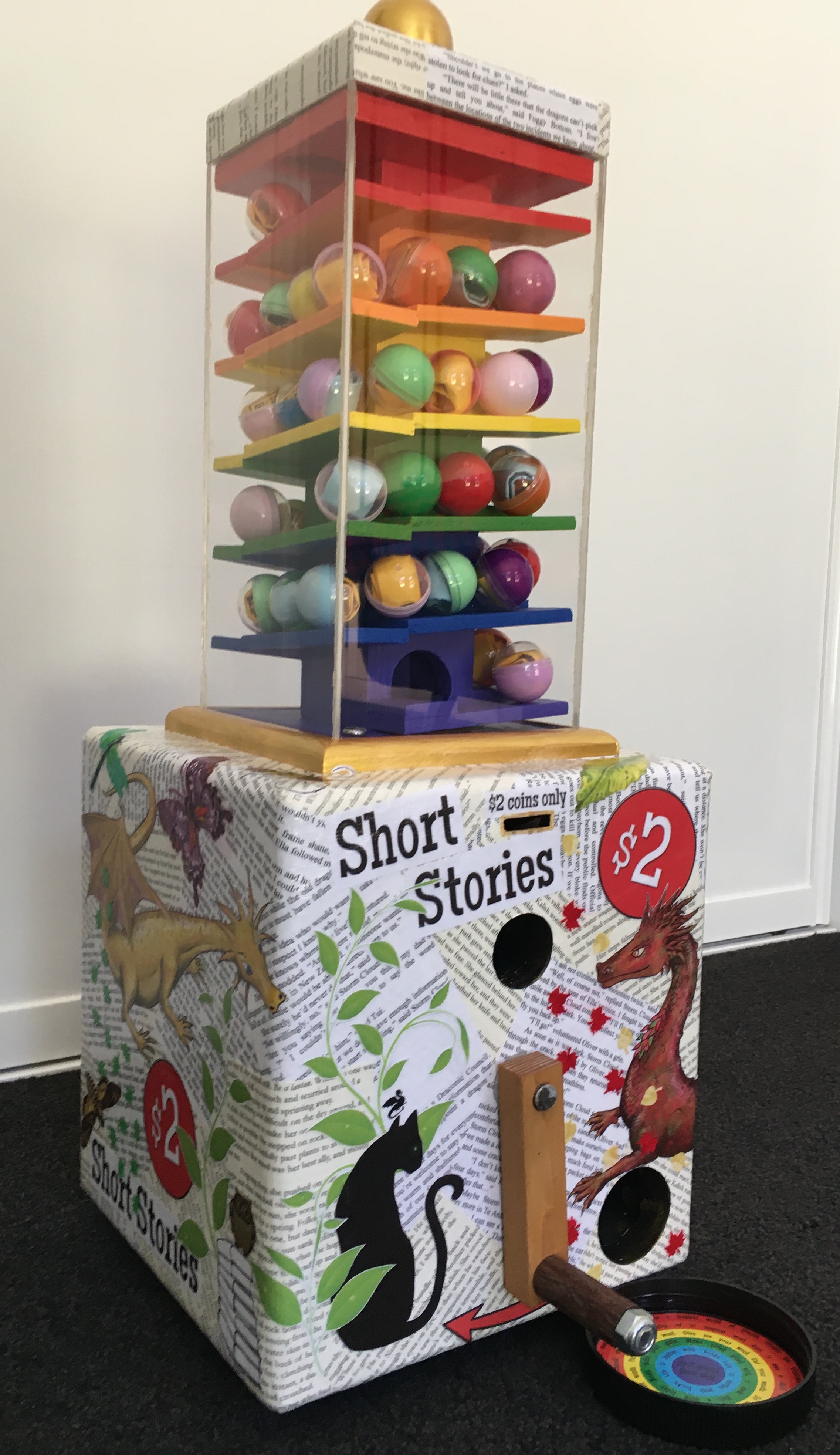
For some reason (I’ll never understand the strange workings of my brain) I decided I wanted to have a coin-operated story vending machine. After investigating the commercially available gumball machines, I decided I’d have to make what I wanted.

I roped my husband into the project, and he sorted out the inner workings and the fiendish physics of funnelling balls into a hole (Who would have thought it was so complex?).

Then I spent some fun and sometimes frustrating hours decoupaging and painting (my first-ever decoupage project … I probably should have practiced a bit more before launching into it).

Once we were confident the machine functioned, I got to work writing 500-word stories—the perfect length to print on a quarter-sheet of paper and fold up inside a small vending machine capsule.

As someone who normally thinks in novel-length stories, I had a HARD time writing 500-word stories. I wrote quite a few 1500 and 2000-word stories before I nailed the 500-word length. But it was so much fun! I got to explore different genres, different voices, different story structures—there’s a bit of everything among the vending machine stories. I’ve learned heaps while creating these stories.

Tomorrow’s market is the first time I’ll have the story vending machine. It’s loaded with a mix of twelve different stories for ages 8 and up, each one a bite-sized morsel of adventure. What better way to liven your day?

I’m nervous, because I’m so excited about the story vending machine, and I want my readers to be just as enthusiastic. I’m also nervous because there are still some technical glitches with the machine (those crazy physics of rolling balls again …), and I just hope it works smoothly when it’s put to the test.

Want to try out the story vending machine? Visit my stand at The Goode Market or Christchurch Armageddon! See you there!

World Poetry Day 2025

March 21 is World Poetry Day. Take a moment to enjoy your favourite poem or poems. Write a few of your own. I was inspired to write a poem about poetry today by one of my favourite poems—How to Eat a Poem, by Eve Merriam. This is just one of many favourite poems in the book, Reflections on a Gift of Watermelon Pickle…, (Scholastic, 1966).

What is a Poem?

It is
The hanging moment
before the roller coaster plunges.
The intake of breath
as you drop a dozen free range eggs.
The band around your heart
at a friend’s funeral.
The comfort
of rain on a roof that does not leak.
The burn in your thighs
as you reach the mountain peak.
The roar
of fans at the football game
The wind in your hair
on a Sunday drive to the beach.
The silence
of a starry night sky.
The rest
at the end of a long day.

Happy Autumnal Equinox!

Some years still feel summery at the equinox, but this year, the weather is decidedly autumnal. Monday, we hit our highest temperature of the summer—a blustery nor’westerly day that had my students wilting by 10 in the morning. It was 31 degrees at 5 pm when we left work. Dinner was a summer feast of sweet corn, soybeans and zucchini.

We slept with the windows open, covers kicked aside on Monday night.

Tuesday morning, I went out in the dark to water the plants at about 5.30. It was still 23 degrees. As I watered, the wind shifted.

By the time I left for work an hour and a half later, the temperature had dropped to 16, and rain spattered the windshield in fits and starts.

By ten o’clock, the skies had opened up. Wind drove the rain in sheets, and the temperature continued its slide downward.

Driving home from work, the temperature registered 11 degrees. Traffic moved slowly through the downpour, wind rocking the car and thrashing trees alongside the road. When I got home, I stripped off my rain soaked cotton clothes and replaced them with cosy wool. We had potato soup for dinner.

We woke on Wednesday morning to full autumn. Summer had been scoured away by over 40 mm of rain, and stripped bare by gale force winds.

A dramatic entrance for the season. But the truth is, autumn was already well underway. Our first frost came weeks ago, on 6 March. I picked the pumpkins last weekend. And the zucchini, tomatoes and other summer-loving plants were all showing signs of being nearly done for the season.

And, of course, squirrelly me has been in autumn mode for weeks, preserving everything I can in preparation for the dark days ahead.

Today we step into the dark side of the year. Although I very much enjoyed our last couple days of hot summer sun (and today promises some beautiful sunshine), I’m looking forward to all that the dark side has to offer.