Cardamom Pound Cake

I recently made an excellent cardamom pound cake. Half way through modifying a recipe from the book Sweet, I realised I’d already created a cardamom cake recipe, based on some other cake. But this one might actually be better. Rich, moist, and flavourful—what more can you ask for in a cake?

I now need to make both versions for side-to-side taste tests. Anyone want to join me for cake?

Here’s the new recipe so you can test them too.

110 ml milk
6 eggs
2 tsp vanilla
zest of 1 lemon
300 g all purpose flour
1 tsp baking powder
1/2 tsp salt
200 g caster sugar
1 1/2 tsp cardamom
250 g butter, very soft, cut in chunks
1 cup shredded coconut

Whisk together the milk, eggs, vanilla and lemon zest in a medium bowl.

Sift together the flour salt and baking powder in a large bowl. Add the sugar and cardamom. Add the butter and half the egg mixture and combine with an electric mixer until the dry ingredients are incorporated. Mix 1 minute more, then gradually add the remaining egg mixture. Stir in the coconut.

Spoon the batter into a greased 23 cm Bundt pan or 2 loaf pans. Bake 40-45 minutes at 195℃.

Cool in the pan for 10 minutes before turning out onto a wire rack.

Bread Day, revisited

It’s been a long time since I last blogged about a bread day. I reckoned it was time for a revisit.

For most of our married life, my husband has baked all our bread. When we moved to New Zealand, we applied for a permit to bring his sourdough starter, which was a bit of a family heirloom, having been passed to him by his father (who baked their bread when my husband was growing up).

Once we settled in New Zealand, in a rural location with some land, we built a wood fired bread oven. Our first oven was made of clay we dug from the property, empty wine bottles for insulation, and set atop two overturned concrete livestock water troughs. An oven on the cheap, because we didn’t have much money and weren’t sure we’d use it long term.

We loved it, so when the first oven began to fall apart, we were happy to buy materials for the second. And when we moved, we built a third one, on the new property as one of our first big projects.

A bread oven is different from a pizza oven. Unlike the pizza oven, which relies on a live fire, the bread oven bakes on stored heat.

A bread day starts the day prior, when my husband pulls the sourdough starter out of the fridge and makes his sponge—a wet slurry, more like batter than dough. The sponge bubbles away overnight.

On the actual bread day, the fires is lit early, usually before breakfast. My husband fills the bread oven with wood and lets it burn to coals, then repeats the process in order to ensure the mass of bricks soaks up plenty of heat.

While the fire burns, my husband makes up the dough, using around 7 kg of flour.

By about lunchtime, the dough is ready to be made into loaves, and by early afternoon, the second fire is burnt to coals, which get raked out of the oven. At this point, the oven is running at about gazillion degrees—way too hot for most breads. But each type of bread bakes at a different temperature, and each batch lowers the temperature of the oven.

The first bread in is focaccia—thin and flat, it is in and out of the oven in 5 minutes. Then we throw in a big tray of vegetables to roast. They take 10 to 15 minutes and bring the oven temperature down enough to bake narrow baguettes, which are also out within 10 minutes.

Then come the batards, and then finally the square loves.

At this point, I take over the baking. The oven is now at a good temperature for cakes and pies. I like to bake things like pound cakes on bread days, because they take so long to bake. It’s nice to be able to make them with the ‘free’ heat of the bread oven.

The oven is still quite hot (around 180℃) by the time the cakes are done (usually about dinnertime).

There are a whole bunch of things we’ve done with that heat: toast granola, roast pumpkins, make baked beans, dehydrate fruits and vegetables. As the oven cools further, we’ve made yogurt and dried herbs. There’s useful heat in the oven for a good 48 hours, if we have the time and inclination to use it.

Last weekend we found a new use for the residual bread oven heat—sterilising compost for seed raising mix (which I’m sure I’ll blog about later). I put about 40 litres of compost through in two lots, and I might have gotten a third batch through if I’d had it ready to go.

The final tally from last weekend’s bread day: 1 focaccia, 17 loaves of bread, 2 meals worth of roast vegetables, 2 weeks worth of breakfast granola, 2 cakes, a baker’s dozen of fruit tarts, and 40 litres of sterilised compost. Not bad for a bread day!

Check out this time lapse of a long-ago bread day.

Parsnip Cake

As spring nears, we’re working through the winter vegetables still in the garden. At this point, the remaining parsnips that I planted last spring are monster roots weighing in at nearly 1.5 kilograms. It’s past time to eat them.

So, when I found a recipe for parsnip cake, I had to make it.

The recipe was in the book Sweet, by Yotam Ottolenghi and Helen Goh (I seriously recommend this book, if you don’t already have it). Like many of Ottolenghi’s recipes, it includes flavour combinations and spices I don’t normally work with.

And as with most of Ottolenghi’s recipes, I didn’t have all the right ingredients to make the recipe as it was written, but with a few substitutions, I ended up with some delicious cake. As I often do, I baked the cake as cupcakes—they’re so easy to snag for lunch boxes, and they encourage us to eat less cake, because you can’t cut a big piece like you can with a proper cake.

I love the flavour combinations in this cake—parsnip, orange , nutmeg and aniseed. It’s a fantastic combination that I’m not sure I’ve ever used. 

Here’s my version of the Ottolenghi/Goh recipe:

150 g walnuts
450 g grated parsnip (the original recipe says this is 3 large parsnips, but it was only 3/4 of one of my parsnips)
100 g raisins
finely grated zest of 1 orange (approx. 1 Tbsp)
3 eggs
225 g caster sugar (I would cut this down next time—they’re quite sweet)
280 ml vegetable oil (I would cut this down next time—they’re a little too greasy for me)
190 g all purpose flour
1 tsp cinnamon
1 1/2 tsp baking powder
1 1/2 tsp baking soda
1 tsp nutmeg
1 tsp ground aniseed
3/4 tsp salt

Toast the walnuts in the oven for 10 minutes at 170℃. Cool and then coarsely chop. Combine the walnuts, parsnip, raisins and orange zest in a large bowl.

Beat eggs and sugar together in another bowl until thick and creamy (about 2 minutes). While beating, slowly pour in the oil until it is all combined. 

Sift together the flour, cinnamon, baking powder, baking soda, nutmeg, aniseed and salt in a bowl. Add these to the egg mixture and beat until combined. Fold in the parsnip mix.

Spoon the batter into cupcake tins (greased or lined with papers), and bake about 25 minutes at 210℃.

I found that these cupcakes didn’t rise much—the batter is mostly fruit, vegetables and nuts. If their flat look bothers you, I’d recommend topping them with a cream cheese frosting that includes grated citrus zest. I didn’t make special frosting for mine, but I had a little left over from a previous cake, and it was delicious on the cupcakes. It wasn’t at all necessary, however—they were fantastic with no embellishment at all.

Magpies in the dark

Photo: Eric Weiss

As though they know
What I need
When winter returns
On the eve of bud burst,
Magpies warble
On fence posts
In the dark.

Spring comes!
Spring comes!

Ten years ago I posted a blog titled, It Ain’t Over ’Til the Magpie Sings. The post was prompted by the first morning that a magpie warbled for an hour before dawn. At the old house, where the windows weren’t double glazed, the magpies were my alarm clock in spring and summer, warbling an hour or so before sunrise, urging me up to do the milking and make the most of the day. It’s harder to hear them in our new house, where the double glazed windows deaden outdoor sounds, but I’ve been tuning into the magpies for years.

And I’ve discovered that the magpies are remarkably predictable. Ten years ago, I heard the first pre-dawn magpie song on August 8th. Today (the 8th of August) I heard the first pre-dawn magpie song of the year.

And just like that day a decade ago, the first magpie song was followed by a winter lashing reminding us that, while spring was on its way, winter was still in charge. Today’s weather forecast shows the temperature dropping from a 4 am high (a balmy 12.3℃) all day, to 3℃. We can expect rain and icy wind for the next couple of days.

But in the dark, the magpies will keep singing.

Winter Hiking

I love hiking at any time of the year, but there’s something particularly enjoyable about winter hikes. 

Part of that enjoyment for me is that it’s the only chance here in Aotearoa New Zealand to walk in snow, because it rarely snows at lower elevations. To get to snow, you’ve got to hike to it. (Yes, you can hike to snow even in summer, but it’s easier to do so in winter, and there’s more of it.)

Last weekend, my husband, daughter and I headed to Red Hill, which sits between Lake Lyndon and Lake Coleridge. At 1640 metres, Red Hill is higher than nearby Porters Skifield, but lacks the snow making machines. So the snow was patchy, even at the top. 

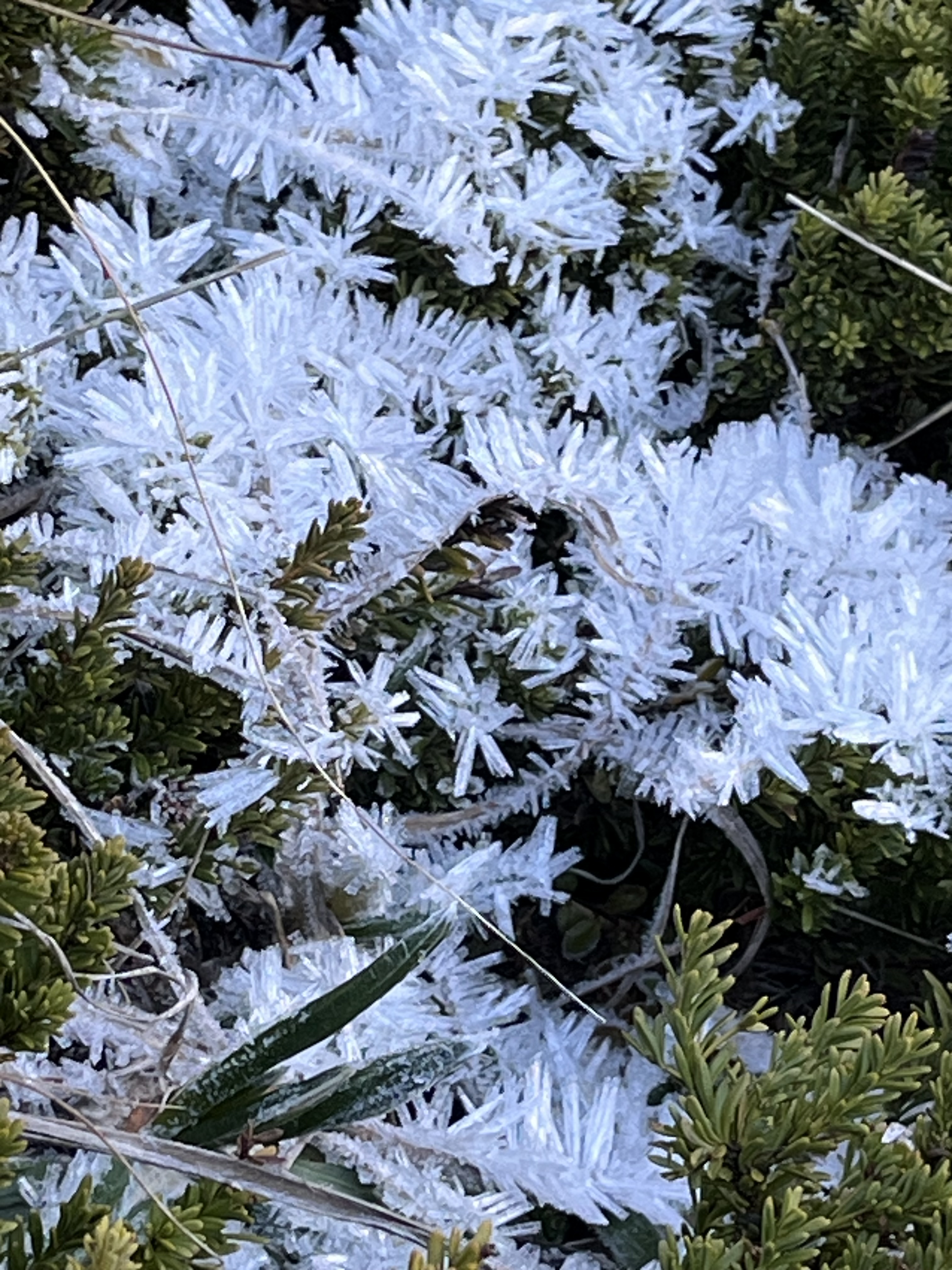
Still, winter hiking was in its full glory. On the way up, we hiked across crunchy frozen mud, pushed up by countless ice needles. We teetered on icy tussock mounds as we crossed a wetland. As we gained altitude, the wind increased and the temperature fell. We passed pockets of spectacular frost, with ice crystals so long, it looked like leaves. Snow in the shady hollows was wind sculpted and hard, more ice than snow.

By the time we hit the open tussock and scree-covered tops, the freezing wind was burning my cheeks, and I was thankful for my snood, which I pulled over my face to block the worst of the wind.

The view from the top was definitely worth the windburn. Winter mountains—covered in snow—stretched across the skyline. Down below us, the water of Lake Coleridge glistened blue in the sun.

The only bad part about winter hiking is that it’s often not pleasant to sit on the top for lunch, and last weekend was absolutely not a weekend to hang out on top of any mountain. After a quick look around and some photos, we hightailed it back down.

But one of the cool things about winter hiking is that, on a sunny day, you can start the hike in winter conditions, and end in spring or summer-like conditions.

Having donned all our warm layers at the top of Red Hill, we began shucking them as we descended. We went from thermals, jacket, hat and gloves to just t-shirts by the time we were back to the car. It was a balmy 17℃. Warm enough for a swim … according to our daughter. (We decided not to swim that day, but she did take a swim the following day after a hike with a friend.)

As someone with mediocre circulation, I struggle with overheating when I hike. I can be sweating, but still have numb fingers and toes, because my body doesn’t push the heat to my extremities. It turns summer hiking into a sweat-fest. But hiking during winter is much more pleasant. I can shuck my jacket to cool my core, but keep hat and gloves on to warm my extremities. It makes for a much more pleasant experience.

We’ve enjoyed some memorable winter hikes: Cragieburn under a freshly fallen 15 centimetres of fluff, a trek to Woolshed Creek Hut in fresh calf-deep snow, followed by barefoot wading in the stream at the top, a winter wonderland of wind-sculpted ice atop Mount Isobel … Winter landscapes are spectacular.

Hopefully, we’ll get out for a few more hikes before the end of winter. Gotta enjoy the snow while it’s there!