It is the last day of January here, my favourite month in the garden.
This January has been more difficult than many, with cold wet weather rather than the usual dry summer warmth. But the garden has still been a January garden.
December is a month of weeding, because my vegetables aren’t yet large enough to compete against most weeds. The weeding effort spans the entire month, and I always aim to have a weed-free garden on Christmas Day.
All that effort pays off in January, when, as if by magic, the vegetables are suddenly huge, crowding out the weeds and basically looking after themselves. I pull the occasional weed that manages to pop its head above the vegetables, and I keep the paths relatively clear, just so I can move easily through the garden. I water as needed. Otherwise, there’s little to do to as far as maintenance goes.
In January, the gardening effort switches from establishment and maintenance to harvesting, reaping the benefits of my hard work. It’s not that we don’t eat from the garden all year long, but the stretch from January to March is a magical one, where production vastly outstrips our ability to eat. In January, the freezer and the cupboards begin filling up with fruit and vegetables preserved for winter enjoyment. The squirrel in me chitters smugly as I stash away the fruits of my labour, already savouring the meals, snacks, and desserts to come.
It’s as much work as the establishment and maintenance phase of the year, but the reward is immediate and tangible. By mid-March, I’ll be exhausted by the harvest, tired of making sauces, jams, and preserves. Tired of having to deal with overflowing baskets of vegetables every day. But here in January, the novelty hasn’t worn off. The excitement of each new crop coming on is palpable. The thrill of lining up jars of preserved food on the shelves banishes any fatigue.
So I say farewell to January with reluctance and look forward to several months more of deliciously exhausting harvest. And I’ll take you on a tour of my January garden. Enjoy!
Meet Katie Cochrane, budding restauranteur. She has no idea what she’s in for when her crazy Aunt Rachael gifts her the burnt out Rifton Pub for her birthday. Before long, it’s clear that renovations are the least of her worries. She always knew running a restaurant would be challenging, but she never expected it to involve witchcraft.
This cosy urban fantasy can be read as a standalone, but, Rifton being a small town, it includes many of the characters from book 1 of the series. I was excited to have a chance to spend more time with the quirky ladies of the Rifton garden group and Rifton’s demonic felines.
So pull out your gardening gloves and secateurs, and pop on down to the Rifton pub for some supernatural fun!
Preorder today, and be the first to read Demonic Summoning for the Modern Gardener!
Release date is 31 January, so you won’t have to wait long!
Our daughter wanted to go to the west coast for professional reasons (to photograph mosses for a project she’s doing), so my husband and I happily agreed to accompany her for a weekend getaway.
We left Friday evening, stopping at Lake Pearson (Moana Rua) for a lovely picnic dinner, and then carrying on over the mountains to camp at Goldsborough Campsite near Kumara. We pulled into the campsite around eight o’clock and set up camp. With the light already fading, we decided to wander up one of the tracks that followed old gold mining tracks through the bush.
Old mining water race tunnelling through the hillside
We started up German Gully Track, thinking we’d just go up a little ways, then return. The track passed an old mining water race that looked like a cathedral-shaped tunnel as it snaked steadily up the hill. Soon we were close enough to the end of the track that, of course, we had to finish.
We popped out onto a broad, modern gold mining road. The sign at the road indicated that we could either return to the track the way we came (30 minutes, according to the sign), or return via Goff’s Track (65 minutes). It was 8.55 pm. To take Goff’s Track would, theoretically, have us arriving back at the campsite at 10 pm. After ascertaining we all had our head torches with us, we powered up the road towards Goff’s Track.
German Gully track–an old mining road
The west coast was unusually dry, for which I was glad as we picked our way down Goff’s Track in the gloom—while most of the track was easy going, the steeper sections would have been slick and no fun in low light.
Knowing we were racing the light, we kept the pace up, and didn’t even need to use our torches, arriving back at the campsite around 9.30. A nice little evening hike!
The following day, we got an early start and hiked up Mount French, near Lake Brunner. None of the track descriptions have much to say, except that the hike is a steady climb of over 1000 vertical metres. Telling, however, are the listed track length and times: 7 km return, 8 hours return. That’s a walking speed of only 875 metres per hour.
View from the top of Mount French towards the Tasman Sea
We did slightly better, making the 3.5 kilometre trip to the summit in 3 hours forty-five minutes, for a walking speed of 933 metres per hour. Most of the hike up is through dense west coast rainforest, so other than the forest itself, there’s not much to see. When we hit the alpine vegetation near the top, the views opened up and it was spectacular. At first we were a little worried we’d struggle to find our way across the multiple false peaks to the actual summit, because clouds obscured the tops. In hindsight, I’m glad the cloud was there, because when it did clear and we finally got a view of the summit, I was disappointed at how far away it still was. LOL! Though the elevational change from the bottom to the top is officially a bit over 1000 metres, there are several significant dips along the ridge, so I suspect the actual amount of climbing you do to reach the summit is more like 1200 metres.
Looking back down the ridge from the summit of Mount French
But we made it, and by the time we were on the summit the clouds had cleared entirely. We had stunning views to the Tasman Sea on one side, and to the mountains on the other. Lake Brunner glittered in the sun far below us.
We had lunch on the peak and spent a good bit of time enjoying the view and exploring the plants and insects at the top before tackling the descent.
Lake Brunner seen from the summit of Mount French
Going down was faster than going up, and we reached the car shortly after 3 pm, hot and sweaty and ready for a swim. After a quick dip in Lake Brunner, and a change of clothes, we headed to Hokitika for dinner and a short stroll on the beach.
All of us were in bed and asleep early Saturday night.
Sunday, we packed up camp and headed to Lake Kaniere to hike the Lake Kaniere walkway. We’ve done part of this walk several times. It’s a mostly flat, well maintained track that follows the entire western edge of the lake. There are multiple stony beaches to stop at along the way, and amazing lowland rainforest vegetation.
A reflective early morning Lake Kaniere
On Sunday, it was also really hot (28 degrees by early afternoon). And even on the flat, we were sweating. My husband turned back about a third of the way into the hike, in order to drive the car to the end of the one-way track. My daughter and I continued on, stopping for a quick skinny dip at Lawyer’s Delight beach, before meeting my husband walking back towards us from the far end, about a kilometre from the end of the track.
Carové’s giant dragonfly at Dorothy Falls
We had lunch, a stop a Dorothy Falls, and another swim in Lake Kaniere, then headed home.
The entire weekend on the west coast was hot and sunny, so it was a bit of a shock to hit Porter’s Pass and drive into drizzle and 12 degrees. It was a chilly 15 at home under overcast skies. Poor Canterbury—this summer has been anything but summery here. It’s no wonder the west coast was absolutely packed with vacationing families.
And now I have one week left before returning to the day job. My summer to-do list is getting shorter, but I will definitely not accomplish everything on it. But it’s been a good summer for getting out and hiking, so I can’t complain. Now I just need to knuckle down and get some writing in while I can.
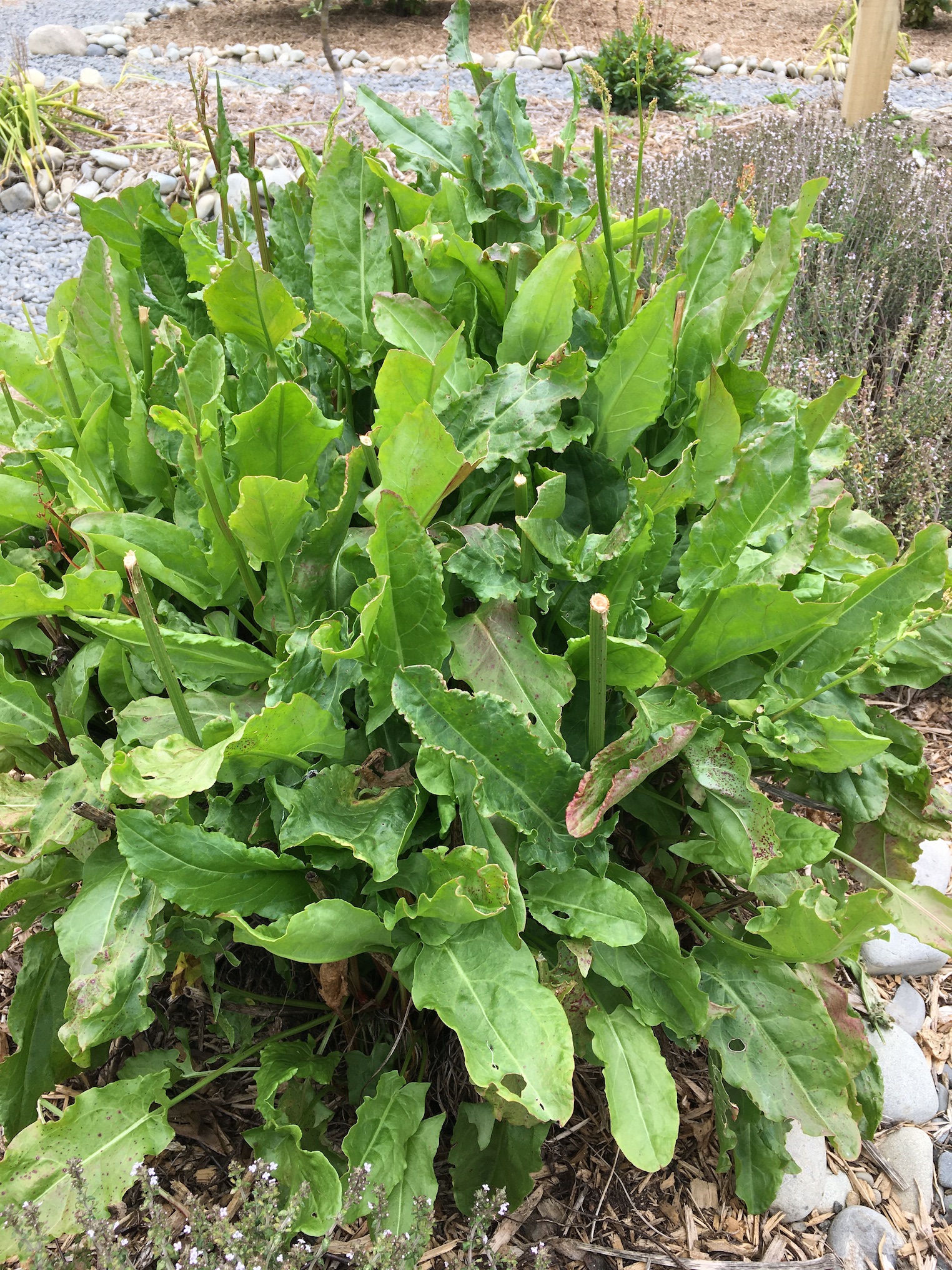
I love sorrel, with its succulent texture and bright sour flavour, but I don’t often think to use it. I occasionally use it to fill out early spring salads, when the lettuces aren’t quite big enough to make a full salad, and that’s generally about it.
But last night I wanted a salad to go with quiche. The spring lettuces are long since bolted, and the fall lettuces are still baby seedlings, so I turned to sorrel, this time to make the bulk of the salad.
I got inspiration from a few different sorrel salad recipes, but then simply used what I had on hand. The result was a spectacular salad—one I will definitely make again.
Here’s my ‘recipe’, for what it’s worth:
1 handful sorrel leaves, chopped into thin strips (maybe 2 cups, chopped) 1/4 cup walnut pieces, toasted in a 190C oven until aromatic and beginning to darken 6 small olives, chopped (I used my own olives, and they are quite small. If you’re using big commercial ones, you probably don’t need more than 2 or 3) 6 cherry tomatoes, cut in quarters (I would have used a lot more tomatoes, but this was all I had) 1 Tbs olive oil 1 Tbs balsamic vinegar 1 small clove of garlic, crushed dash of salt
Whisk together the oil, vinegar, crushed garlic and salt in a small bowl.
Place all the other ingredients in a bowl, and toss with the dressing. If you want a little less knock-your-socks-off fresh garlic flavour, strain the garlic out of the dressing first.
“Gardens are fashioned for many purposes with many different tools, but all are collaborations with natural forces. Rarely do their makers claim to be restoring or rebuilding anything from the past; and they are never in full control of the results. Instead, using the best tools they have and all the knowledge that they can gather, they work to create future environments. If there is a lesson it is that to think like the original inhabitants of these lands we should not set our sights on rebuilding an environment from the past but concentrate on shaping a world to live in for the future.”
–Charles C. Mann (1491: New Revelations of the Americas before Columbus)
Many years ago, I wrote this quote into a sticky note on my laptop. I look at it regularly, and it resonates with me every time. It expresses a mindset my husband and I employ on our little plot of land.
As I sit here on the porch on a warm summer afternoon, I can’t help but think back to what this section was like when we bought it—a bare paddock so devoid of nutrients that even the weeds were sparse. Sitting here today, I am surrounded by a mix of food crops, beautiful flowers and native plants. Five years ago, this plot of land could barely sustain the scraggliest of grass. Today it feeds us, provides food and shelter for native insects and birds, and is a welcome escape from all the ills of modern life. In time, as plants grow, it will hopefully become more sheltered, more resilient to temperature and rainfall extremes. In time, it will hopefully take less effort to maintain. In time, perhaps we will see native bellbirds and tūī as often as we see non-native blackbirds and starlings in the garden.
This is what we aim for. But, as Mann said, we’re not in full control.
Native skinks seem to have disappeared from the garden, despite the abundant food and shelter we’ve provided. Perhaps the influx of domestic cats is at fault. Or maybe some other factor outside of our control. Unwanted weeds continue to invade from neighbouring properties. Plant diseases take advantage of favourable conditions to decimate crops from time to time. Hail, floods, droughts, and wind all take their toll.
So the resulting garden is a compromise. What can we reasonably grow this year? What needs to be abandoned, either temporarily or permanently? What new opportunities are presented by quirks of nature or chance?
Guiding every decision is the question, what do we want the place to look like next year? In five years? Because, as Mann said, we’re shaping a world to live in for the future.
Incidentally …
If you haven’t read 1491, do it. It will shatter all those Eurocentric views of the world you’ve been steeped in since birth and change your whole attitude towards the history of the Americas.
This year was something of a milestone—it was the first year in about 16 that we didn’t do a pre-Christmas backpacking trip with the kids. It was bound to happen sometime soon, since the kids are all grown up now and doing their own things.
Instead, my husband and I had a post-Christmas hike all on our own. Let me say right now that I loved tramping with the kids, but doing the Christmas hike with just my husband was REALLY nice—just like old times … except that we’re a lot older. It was nice hiking at 54-year-old pace (instead of being dragged along by impatient 20-something kids), and we could also go places that appealed to us, without considering if the kids would enjoy it.
So we stayed relatively close to home, but took a route we hadn’t ever explored.
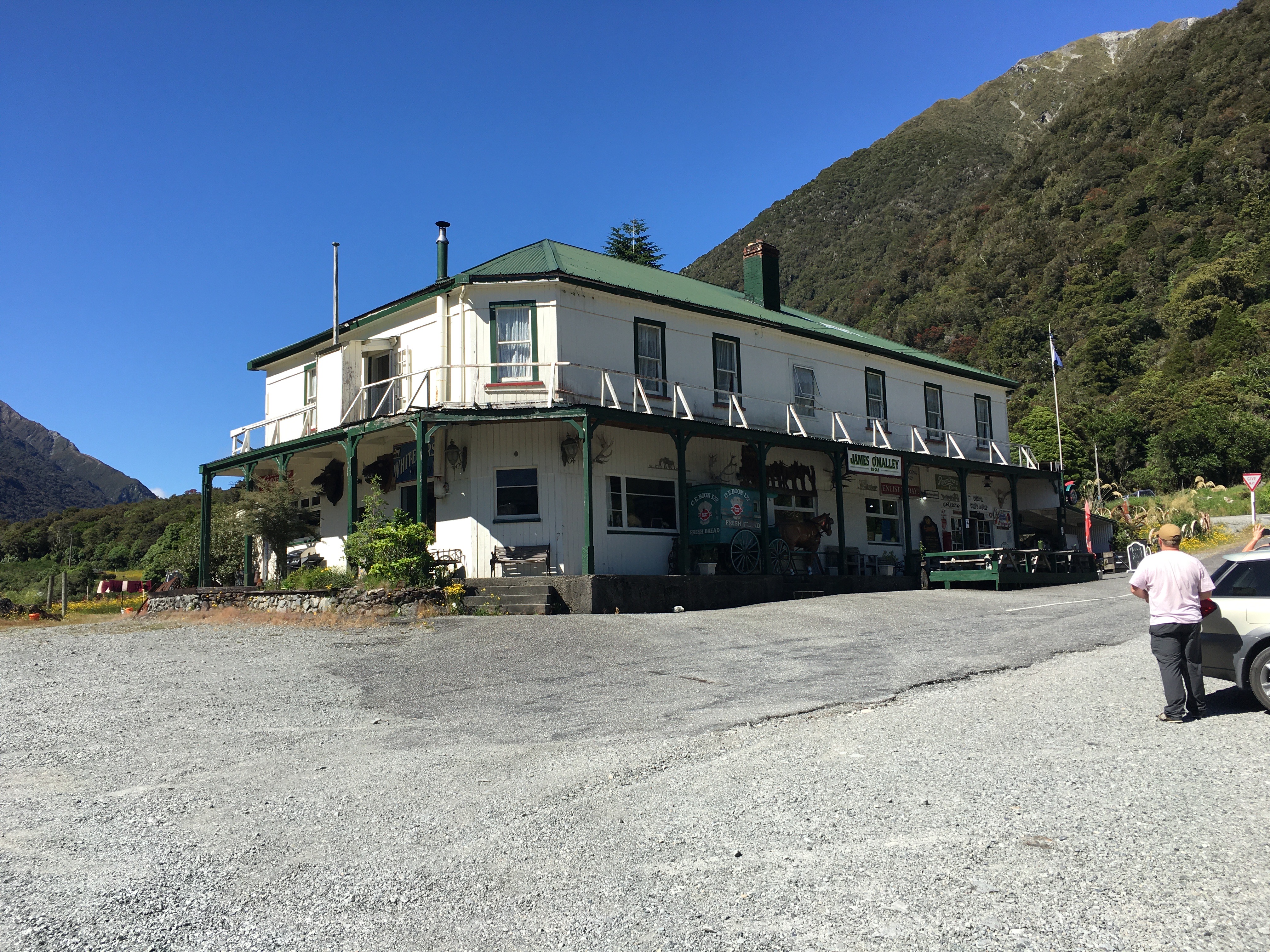
Day one began with dropping a car at the far end of our hike, near Kelly Creek. There was a bit of faffing around to charge the electric car (with the charger in Arthur’s Pass out of order, and the one in Otira busy), but it gave us an excuse to have a coffee at the Otira Hotel, which is an experience of its own.
Then we drove back to the Waimakariri River, parked car number two at Klondyke Corner, and hiked up the Waimakariri to Carrington Hut.
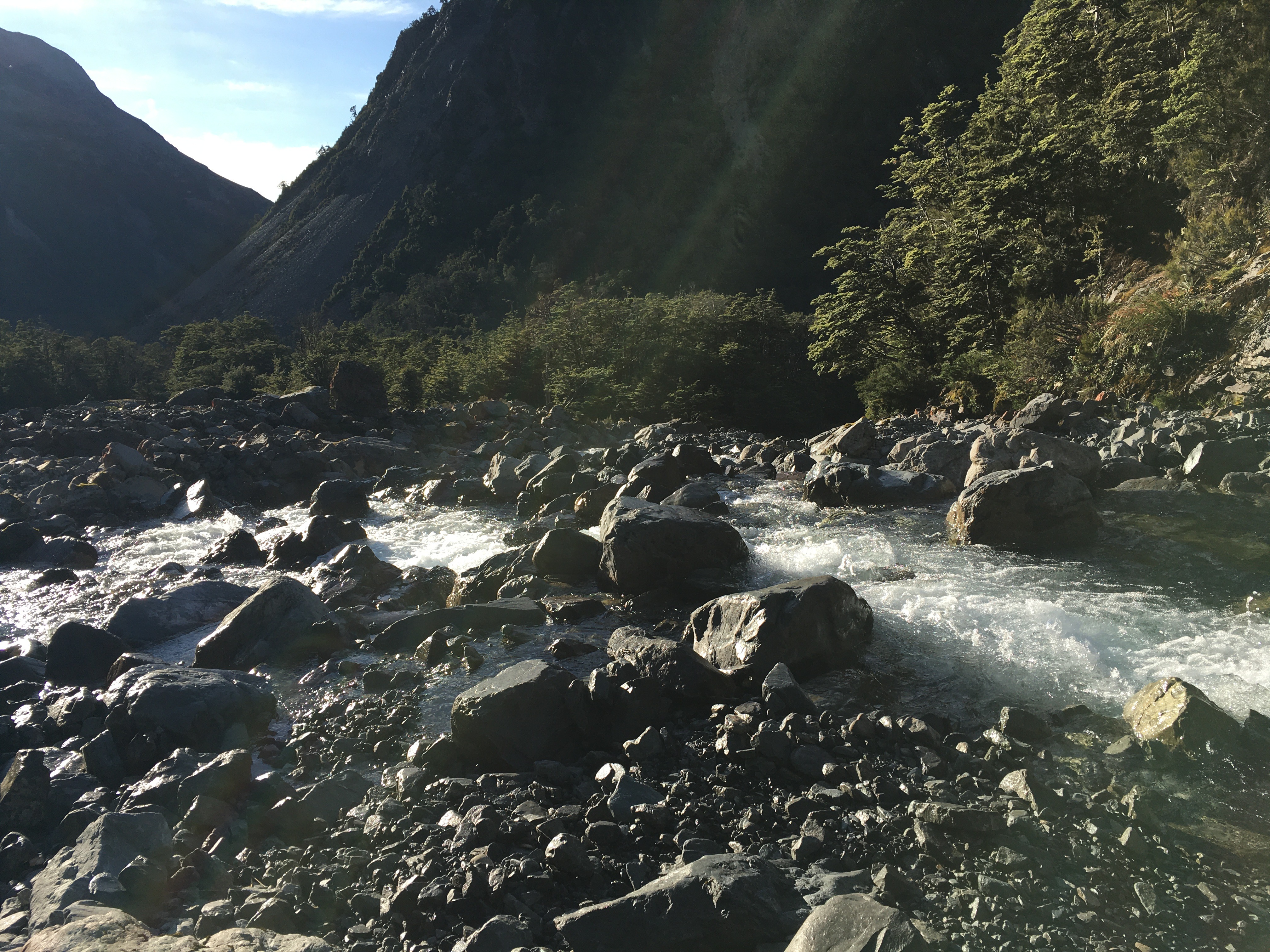
This hike is a bit of a slog and involves crossing the river a couple of times. In fact, the first river crossing comes within the first five minutes of hiking, which was fine—we were going to spend four and a half days walking rivers. There was no way we were going to have dry feet.
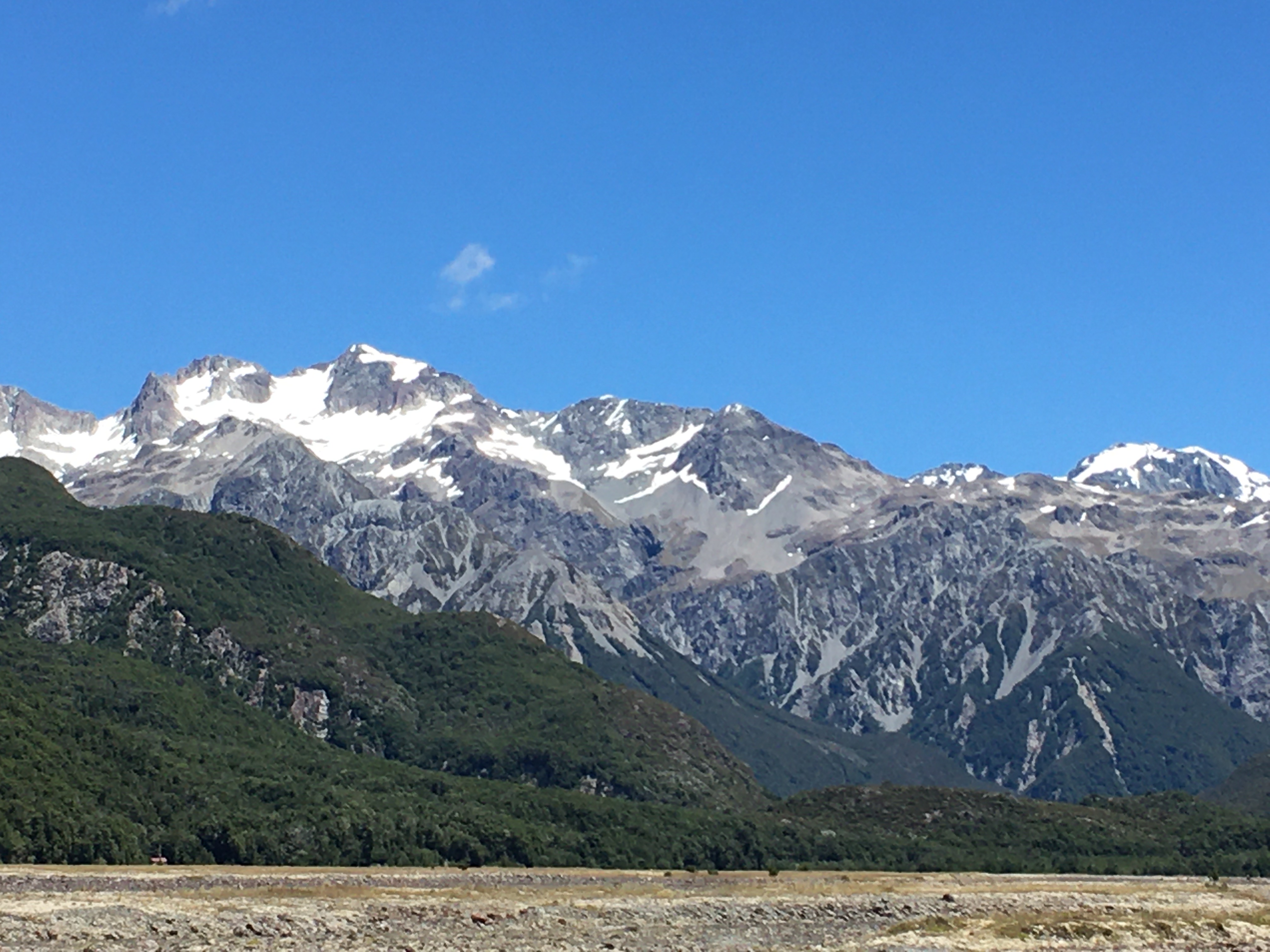
In spite of the dull nature of the actual hiking up to Carrington Hut, the scenery is fabulous, and only improves as you go further up the watershed. We were lucky to have a tern hunting the river alongside of us for a while, and we scared up a pair of banded dotterels, too.
After passing Anti Crow Hut, we left the riverbed to follow a track over a couple of roche moutonnée—rocky mounds left behind by glaciation. A series of tarns on the mounds give them a magical sort of quality, and the short break from river walking is nice.
The last time we were at Carrington Hut, it was incredibly crowded and unpleasant, so we carried a tent this time, just in case. But the 36-bunk hut housed only five of us that night, and we barely saw one another.
Day 2, we hiked over Harman Pass—up the Taipoiti River (click here for a video), then down Mary Creek. Again, the first act of the day was crossing a river, and then it was river crossings all day, back and forth across the Taipoiti as it rushed through a narrow valley which at times could be more properly called a gorge. It was another fabulous day, weather-wise, and the scenery was spectacular. So were the alpine plants. It seemed like EVERYTHING was in flower, and it was a slow hike up to the pass, because we were photographing all the way.
At the pass, we took a little jaunt up to see some tarns higher up, and then hung out for a while with a curious kea (click here for a video). Kea are an odd mix of highly endangered (there are 1,000-5,000 of them left), and incredibly pesky, thanks to their intelligence, curiosity and a beak shaped like a giant can opener (their peskiness is unfortunately part of the reason they’re endangered). The world’s only alpine parrot, it’s common to encounter them at elevation near Arthur’s Pass, but it never gets old.
Mary Creek was more of the same—river crossings, beautiful scenery, endangered birds. We spent some time watching a pair of whio (blue ducks) having a nap on a rock in the middle of the stream. There are only 3000 whio left and unfortunately the population is skewed strongly to males, because females are vulnerable to introduced predators when sitting on the nest. We were lucky enough to encounter two pairs on our trip.
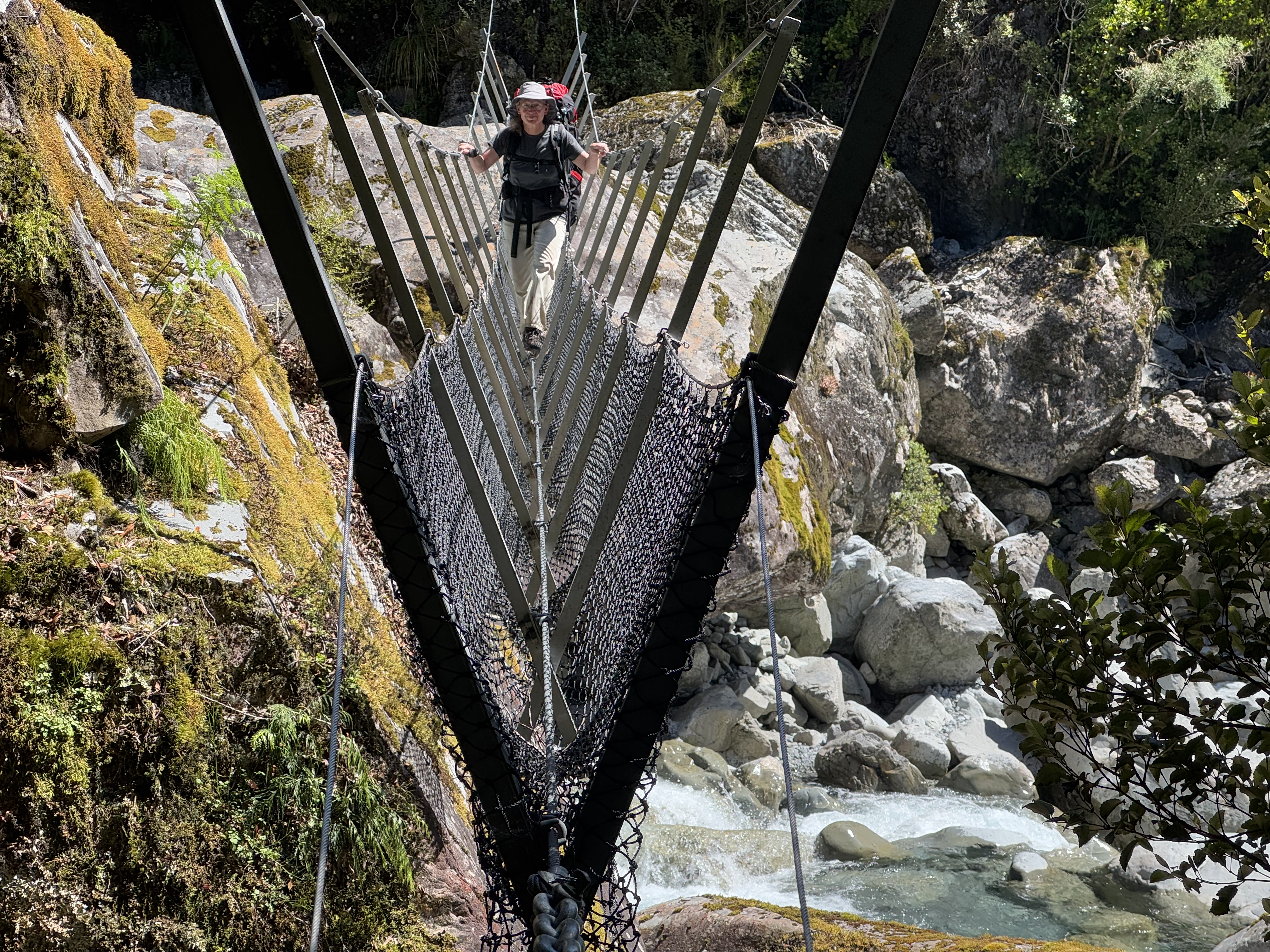
After a 3-wire bridge crossing at the bottom of Mary Creek, we arrived at Julia Hut. The hut is relatively small, and with another couple there already, we decided to tent. After setting up the tent and settling in, we had the rest of the sunny afternoon to explore. A natural hot spring was our destination. Only five minutes walk from the hut, next to the icy, swiftly flowing Julia Creek (click here for a video), the hot pool did not disappoint. It was initially too hot to sit in, and we had to redirect some river water into it to temper the heat.
After a sweaty hike, I have to say I wasn’t all that interested in sitting in a hot pool, but I took a dunk in the river first, and then the hot pool was pretty nice. You couldn’t fault the setting—two days hike from a road, on an absolutely stunning mountain stream in the bush. It beat Hanmer Springs by a mile!
There is clearly a lot of geothermal activity in the area—the smell of sulphur was prevalent all along Julia Creek—and I suspect if you fossicked around, you’d find more hot pools.
Day 3 was a lot of river walking (again), punctuated by a couple more three-wire bridges. We hiked down Julia Creek and the Taipo River to Dillon Hut. Well, we intended to stay at Dillon Hut, but when we arrived we were informed by a very cute four-year-old that there were ‘no more mattresses’ (Dillon hut is only a 2-hour hike from the road, and is clearly a great destination for a short family hike). So we moved on to Dillon Homestead Hut, just 500 metres down the track.
Dillon Homestead Hut is just that—an old homestead. Built of hand-hewn timber and clad in whatever the original owners could scrounge, it is quite the historical experience to spend the night there. It’s clearly beloved by local four-wheel drivers and dirt bikers, but is in sore need of some upkeep. Still, it was shelter when the skies opened up and dumped rain all night, and if it had been cold, there was a big open fireplace surrounded by three tatty, 1950s-era armchairs. And once you brushed the rat droppings off the sleeping platforms, tables and chairs, it had everything you needed to spend the night.
Fortunately the rats weren’t as active inside the hut as I had feared, and we spent a reasonably comfortable night (if a bit smelly) in the hut. In the morning, however, I trudged out to the long drop through soaking wet, waist-high grass. The loo is as old as the hut, and was stocked with three mouldy, rat-poo-festooned rolls of toilet paper. I didn’t stop to investigate the myriad spider webs (there may have been some interesting native spiders), but in retrospect I should have inspected my surroundings a bit more. Leaving the door open for light and ventilation, I dropped my pants to do my business.
A scuttling overhead was all the warning I got before a rat leapt out of the rafters and landed on my head. I may have sworn. But the four-letter word had barely left my lips before the rat was off again, leaping for the toilet seat and then the floor before racing off into the bush.
So, a warning to you—the Dillon Homestead Hut loo is guarded by an attack rat.
After that exciting start, the rest of Day four was a hard climb. From Dillon Homestead Hut, we followed Seven Mile Creek briefly to a track that climbs steeply through dense west coast forest up to the Kelly Range. It was dark and humid in the forest. At one point, the track passed through a narrow gorge that was almost tunnel-like. It felt like we were crawling uphill, and often it was literally true, as it took both hands and feet. Pīwakawaka kept flitting around us, taunting us with their darting flight and chittering voices—what was so difficult about this slope, they seemed to ask.
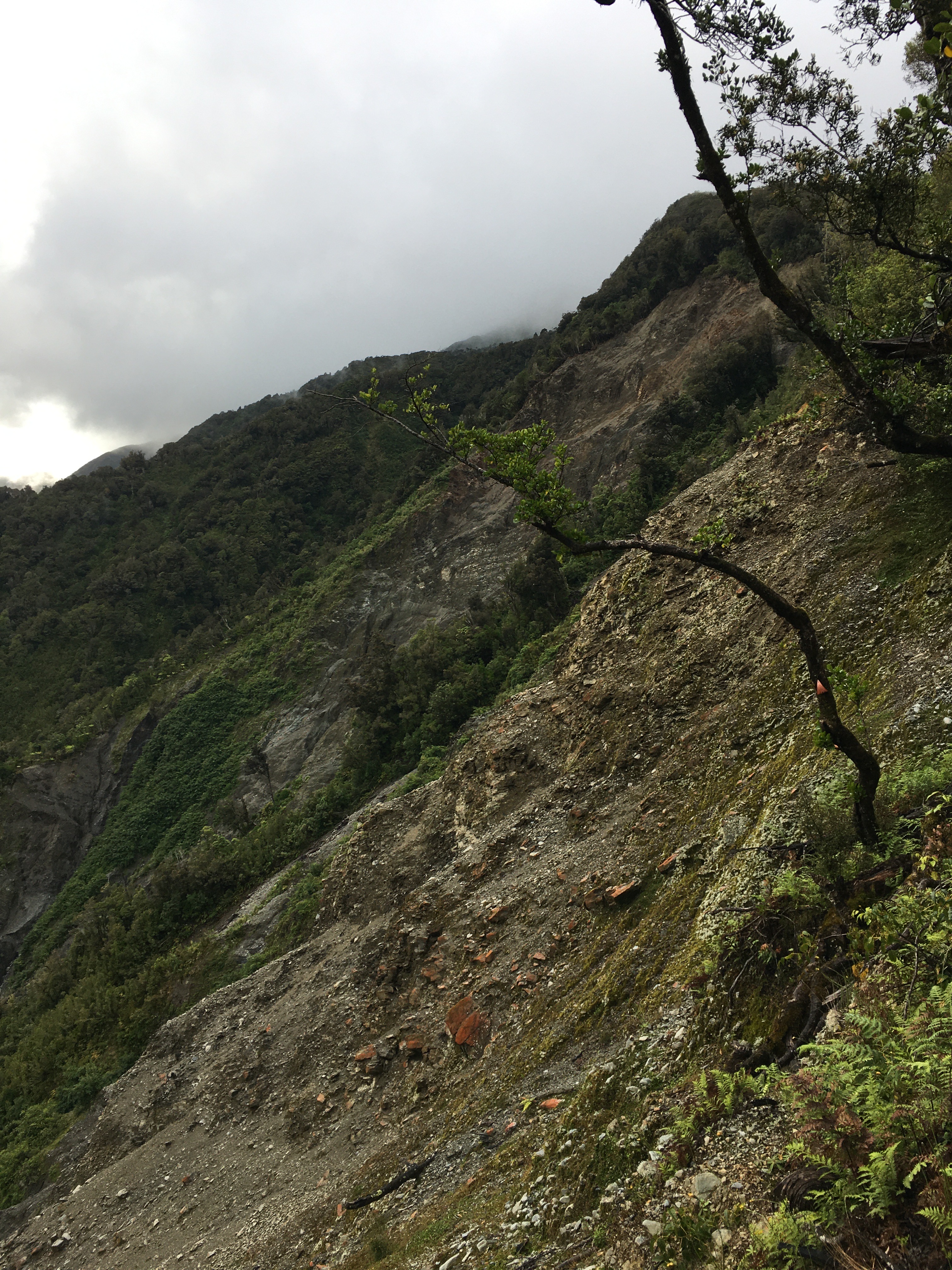
At one point, the track met a huge slip hundreds of metres across and hundreds of metres tall. A blaze remained on a lone tree suspended at the top of the slip. The rerouted track scrambled precariously around the top of the slip, and I breathed easier once we were past it.
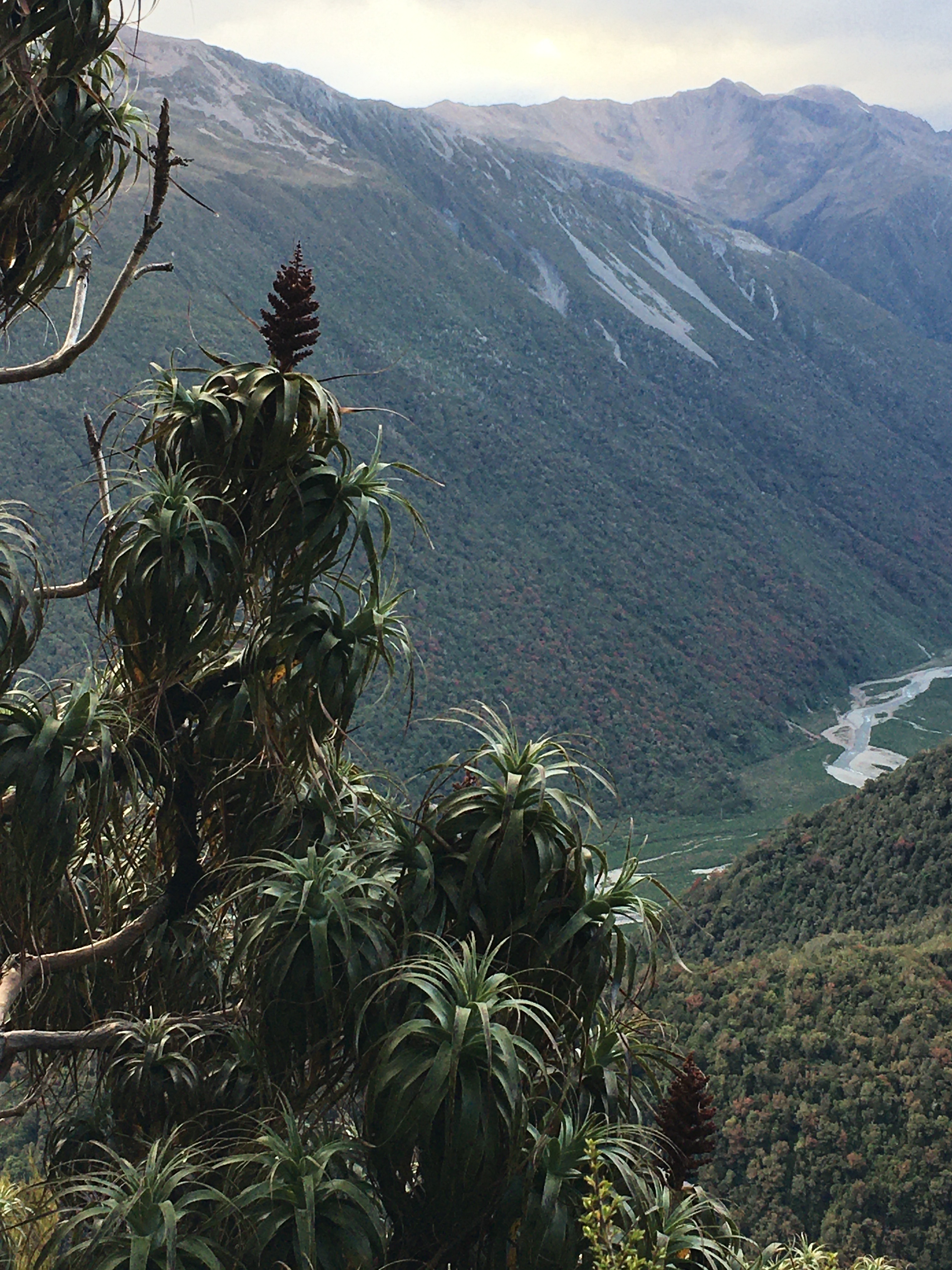
After 700 metres of elevation gain, we reached tree line and got a view back down to where we’d come from that morning—it was a long way down, and we still had more climbing to do.
The tops were dotted with tarns, and even where there wasn’t standing water, it was wet. We walked through fields of sundew plants, and took our breaks amid alpine orchids and daisies.
Clouds prevented us from having great views, but turned the views we did have into a dramatic, ever-changing landscape. By the time we’d reached the top of our climb—a thousand metres above Dillon Homestead Hut—the clouds were swirling around us.
A relatively short descent brought us to Caroll Hut just as the first raindrops began to fall. We had a late lunch of soup and peanut butter crackers as the wind picked up and the rain lashed the hut.
We shared Caroll Hut with a UK expat who lives in Wellington, a pair from Whanganui, and a fellow from Adelaide. It was a great mix, and we had a nice afternoon and evening chatting with them all. The best of hut life.
All night the wind howled, and I was thankful for the steel cables tethering the hut in place. Although the rain ended before dark, the wind continued through to morning, so it was a cold and windy start to Day 5. An early morning treat at the hut was a family of weka with fluffy chicks fossicking around the hut.
Day 5 was a short (hour and a half) jaunt out to the road from Caroll Hut. The ‘jaunt’ involved a good 800 metre elevation change, steeply downhill, but not bad going, with some nice views from time to time. And just when we thought we were done with wet boots, there was a stream crossing in the last 20 metres.
We were home by lunchtime, wet and tired, but having had an excellent five days. It was a fabulous way to spend the Christmas-New Year gap.







 Robinne Weiss