Flour tortillas–old dog, new tricks

A week or so ago, I ran across an article somewhere on the internet extolling the virtues of using boiling water in breads and pastries. I was curious, and a bit dubious (particularly in regards to the pastry) but they mentioned that in Mexico, flour tortillas are made with boiling water.

Hm. I’ve been making flour tortillas regularly for two decades. It never occurred to me to use boiling water.

So yesterday evening I gave it a go. Using my own tortilla recipe (see below), I simply replaced the water with boiling water.

As the article mentioned, the flour absorbed the boiling water much more quickly than cold water. The texture of the dough was more dry and crumbly than usual, and at first I was worried it wouldn’t roll out well.

But I was able to work each ball of dough into smoothness, and the rolling out went like a dream—I was able to roll the tortillas thinner, with little sticking or ripping.

They cooked as usual, and then came the real test—eating.

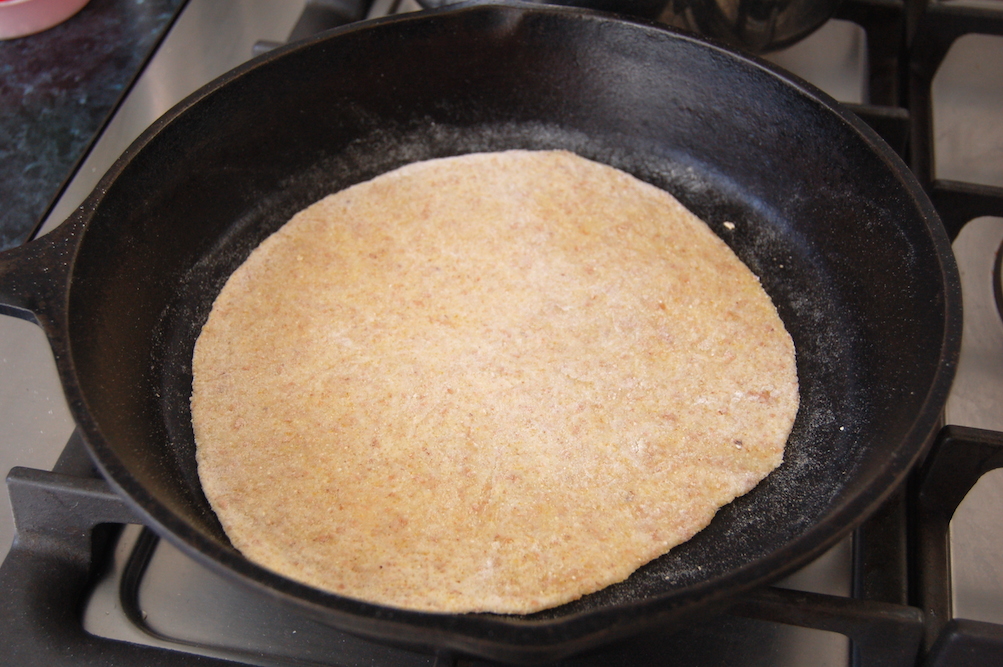
The finished tortillas were pliable and strong, and the flavour was definitely superior to the cold-water version—less floury, more cooked.

And just like that, my tortilla recipe changed… Who says you can’t teach an old dog new tricks?

Go ahead and try it for yourself.

1 cup all-purpose flour
1 cup wholemeal flour
1 cup cornmeal
3/4 tsp salt
2 tbs olive oil
1 1/2 cups boiling water

Heat a large heavy cast-iron skillet on high.

Whisk together the flours, cornmeal and salt in a bowl. Drizzle in the olive oil and mix. Add the water and stir until evenly moistened. Lightly knead until the dough comes together in a ball. Pinch off small balls of dough (about 5 cm (2-in) in diameter). Knead each ball lightly, then roll out on a generously floured board until they’re 1-2 mm (1/16-inch) thick. 

Lay the tortillas, one at a time, onto the preheated skillet. Flip after a minute or two—when the tortilla begins to bubble and the bottom is spotted with brown. Cook a scant minute on the second side, then stack inside a folded tea towel. Flip the whole stack over before serving (this helps equalise the moisture levels in the tortillas so the bottom ones aren’t too soggy, and the top ones aren’t too dry).

Looking back, looking forward

On 26 March 2020, New Zealand went into a nationwide Covid-19 lockdown, and my family moved into a shed. It wasn’t exactly ideal, being homeless during lockdown …

From the comfort of the new home we finally moved into at the end of June, we’ve been reliving that time as we hit milestone after milestone. 

A year ago today, our month-long nationwide lockdown was extended at least two weeks. We were simultaneously devastated and heartened by the news. Covid cases were dwindling—our efforts were working, but would take a while longer.

That day I posted the following poem on the fence:

The storm rages ‘round us
We’re soaked to the skin
Our ship pitched and tossed in the waves.
The captain barks orders,
Hand firm on the wheel.
She knows the relief her crew craves.

But she cannot allow us
Our petty desires,
As much as she longs for them too.
To weather the storm
We must all pull together
Or the tempest takes many, not few.

I don’t think I really understood how true those words would turn out to be. As the world collectively registered over 3 million Covid-related deaths this week, I reflect once again on how different our experience here in New Zealand has been from the rest of the world. Once again I am grateful for the incredible leadership we have in dealing with this crisis, and the collective commitment New Zealanders have shown to doing what needs to be done to protect everyone here.

Yesterday, we reopened our border to Australia, allowing families and friends to reunite, and tourists to travel. It raises our Covid risk as we expand our national ‘bubble’, but both countries have proven quick to respond to the virus, and I believe we will continue to pull together to keep everyone safe.

Books for gifted kids


As an educator teaching extension literacy and maths, and as parent of two gifted children, I have thought a lot about gifted education. As an author, I naturally write for kids like my own—my middle grade books have a fairly wide vocabulary and are long for middle grade, while still being subject appropriate for the 8-13 year-olds they’re aimed at.

I’m on a social media group for parents of gifted children, and the question of books comes up regularly. What books do you get for the voracious 9-year-old reader who is bored by ‘kids’ books, has read all the Harry Potter and Rick Riordan books, but is not yet ready for the subject matter of young adult books? 

So here’s a list of books my kids loved when they were in that 6-12 year-old range, and others I’ve read or seen recommended since then (my kids are now 17 and 19, so I don’t have their take on the more recent titles).

The Mysterious Benedict Society by Trenton Lee Stewart. This series of three books, with at least two companion books not directly in the series, is tailor-made for gifted kids. The books’ protagonists are all explicitly gifted children. All of them have different strengths, and all have weaknesses. They are all extraordinary in some way, but they need each other to accomplish their goals. Not only are the characters relatable to gifted kids, but the books are hefty, with riddles and puzzles throughout—they’ll keep even gifted children busy for a long time.

Skyward by Brandon Sanderson. Technically, this book is young adult, and there’s a little bit of romance (just crushes, really, nothing major), but at its heart, it’s a rollicking good adventure story about a girl who wants to fly and escape her world. And there’s a sentient space ship with a great personality. It’s a good book to introduce those upper middle grade readers to Brandon Sanderson, who has written lots of fabulous books for older readers.

A Wizard’s Guide to Defensive Baking by T. Kingfisher. I bought this book on the strength of the title alone, and was not disappointed. For kids with a quirky sense of humour, this is perfect. A girl whose magical abilities are limited to influencing dough must save herself and her city from someone trying to stamp out magicians and take over the city. Lots of creativity and laugh-out-loud moments.

The Warriors series by Erin Hunter. My children devoured these books when they were quite young. The main characters are cats, and there are all sorts of groups and alliances among them—sort of like a feline Game of Thrones (without the adult themes). Each book is short, but there are dozens of them in multiple series.

Wings of Fire by Tui T. Sutherland. This massive series (14 books, I think) is popular among my 8-12 year-old students, though I’ve never read any of the books. In the series, dragons are the main characters, and there’s lots of drama. Tui T. Sutherland is one of the authors who writes under the pen name Erin Hunter, so I imagine there are similarities between the Warriors series and Wings of Fire.

A Face Like Glass by Frances Hardinge. This is a strange sort of book about a society in which facial expressions are taught and strictly controlled, so that no one’s face expresses what they are thinking. The main character was never taught facial expressions, so her natural expressions shock people, and she wears a mask to cover them. She uncovers nefarious doings in the city, and works to free the people from a ruling class that treats them as slaves. Lots of twists and turns in the story to keep gifted minds guessing what’s going to happen next.

Great authors with books too numerous to list are Terry Pratchett, Neil Gaiman, Margaret Mahy (whose books range from picture books to young adult), and Tessa Duder (with both fiction and non-fiction books to her name).

And don’t dismiss the older ‘classics’—Alice in Wonderland, Heidi, the works of Charles Dickens, Shakespeare, Enid Blyton—many of these books are timeless, and because of their age, they introduce lots of interesting words and have a different perspective on life that gifted children can find fascinating.

And finally, I’ll put in a little plug for my Dragon Slayer series—set in a modern day New Zealand where Dragons are real and aren’t the enemy everyone thinks they are. The series follows the adventures of four children who ultimately form the Dragon Defence League to protect dragons and help people learn to live with them. There’s lots of adventure, some environmental themes, and plenty of colourful dragons.
Summer Stocktake

Mid-April, and it’s time to take stock of the summer’s garden. 

Compared with gardens at the old house, this year’s was a disaster—stunted plants that died off early, solanaceous crops decimated by viral disease, and heat and drought that I struggled to combat with irrigation.

But compared with what I expected, the garden was a huge success. I managed to provide the plants enough nutrients and water that they all managed to give us something. We had enough peas, corn and carrots to freeze some. We gorged on strawberries and melons. I gave away heaps of zucchini. The laundry room is piled with pumpkins. We’ve got more garlic and onion than we’ll be able to eat before it starts to sprout. And we’ve had a steady supply of tomatoes, eggplants and peppers. 

The stars of them all have been the carrots. Last spring I blogged about how well my carrots germinated this year—better than they ever had before, which was quite a surprise in the new garden. At the time, I reserved judgement—it was too much to hope the carrots would grow well in heavy clay soil studded with rocks.

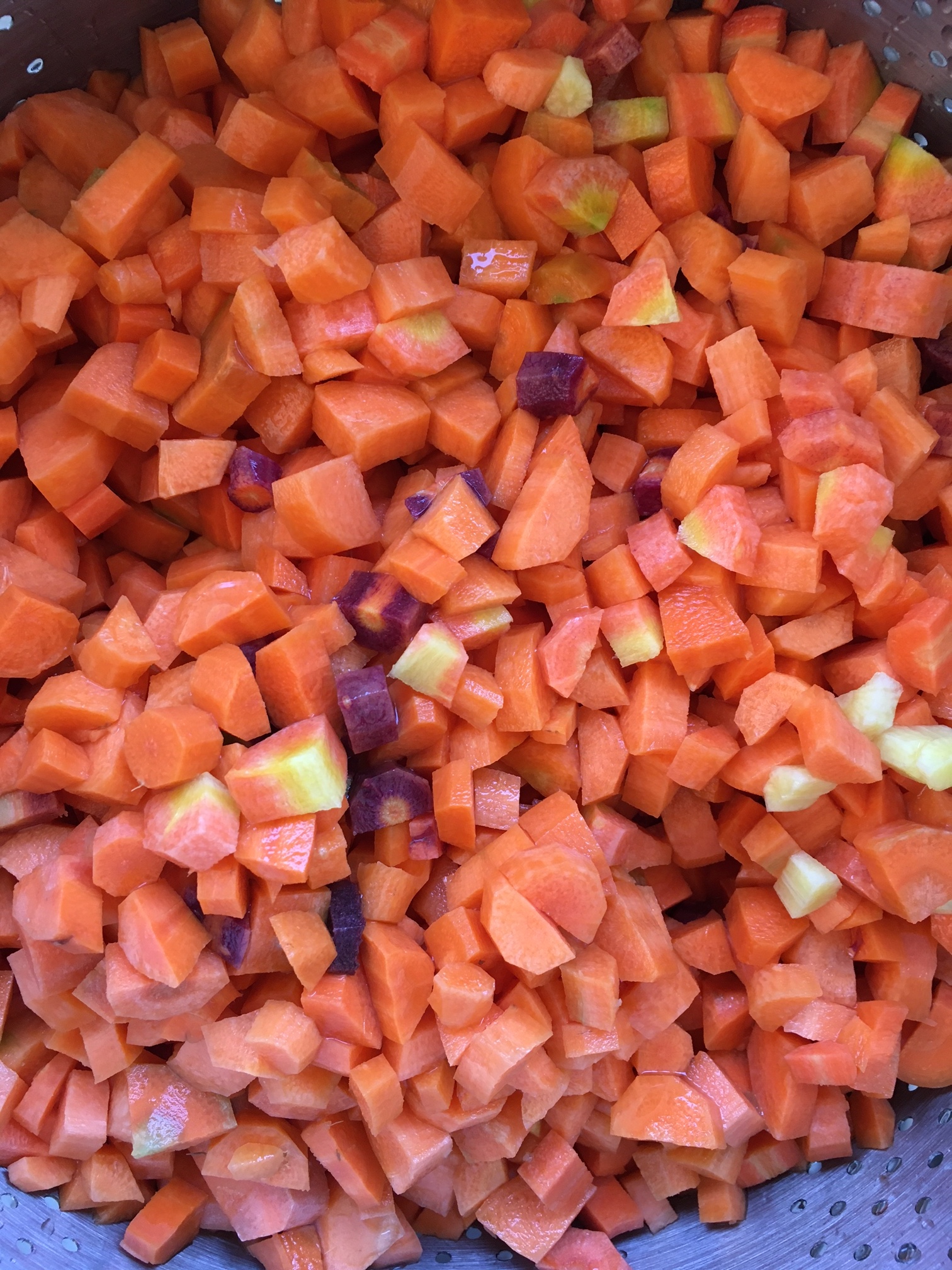
But all summer we’ve been eating beautiful carrots, and last week I harvested everything remaining in the bed, because the slugs and slaters were taking their toll. The fridge is packed with carrots now, and I blanched and froze several kilograms as well.

In spite of everything, it was one of the better years I’ve had for carrots. To be fair, the roots are small, compared to the old garden. Some are bent where they hit a rock, and many broke off when I tried to lift them—if they penetrated too far into the clay, they were nearly impossible to harvest.

But even the purple carrots grew, which is quite an accomplishment for me—in past years, the purple carrots have done well in early spring, but then have been decimated by aphids, so we only ever eat them as baby carrots. Last week I harvested quite a few nice big purple carrots.

Best of all were the Paris market carrots—little, super sweet round roots perfect for lunch boxes and snacks. Their shape made them easy to pick, so there weren’t any left when I harvested the lot last week, but they’ll definitely be in next year’s lineup as well.

Overall, I consider the summer’s garden to have been a success. It’s looking pretty bare out there now, and I’m hauling cow manure from the neighbour’s place and incorporating it into the soil, so by spring I hope to have a few more nutrients available for the plants. I’m already looking forward to next summer.