Brioche
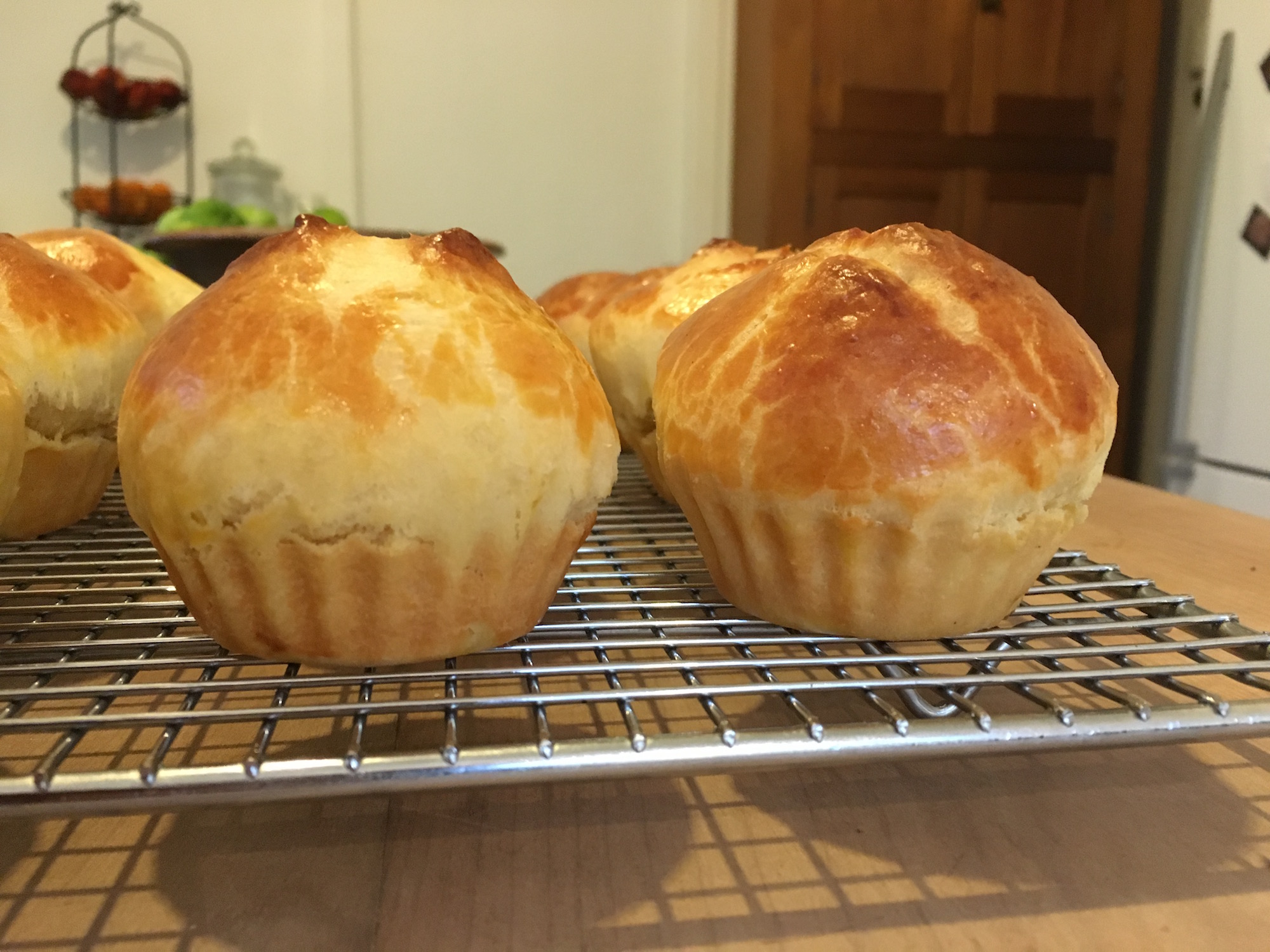
I’ve been threatening to make brioche for some time. Last time I made it was about seventeen years ago.
Not that I don’t like brioche–I love it–but I reckon that’s about how frequently one should eat it if one wants to live to a ripe old age. Three eggs provide most of the liquid, and 175 grams of butter give it that unbelievable silky texture. The butter and egg also make the dough incredibly sticky and difficult to work with, so it’s not something to make every weekend.
A cool, drizzly evening and the promise of a rainy day today made Sunday morning decadence sound like a good idea. I made up the dough after dinner Saturday and left it in the fridge overnight. This morning, it was a simple thing to roll balls of dough around chunks of intense dark chocolate and spoonfuls of sparkling red currant jam and pop them into little tart tins.
Half an hour later, these gorgeous little buns emerged from the oven. They were every bit as good as I remember them being seventeen years ago.
It may be another decade or two before I make brioche again, but something that decadent doesn’t need to come around too often. The memory is just as tasty as the real thing.
Love, Life, and Fart Jokes
Thank you to the World Busker’s Festival for allowing me to forget for a few hours what was happening in my homeland today. The fart jokes, the sexual innuendo (which my son now gets…oh dear), and lots of flaming torches being juggled at altitude were exactly what I needed.
It reminded me that daily life will go on these next four years. What that daily life looks like, and how it will change remains to be seen. The possibilities fill me with anxiety.
But there will also be love, life, and fart jokes. I, for one, will be clinging to those, and sharing as much of all three as I can, to help us all through what promises to be a rocky four years.
So, here’s your light-hearted interlude for today:
What do you call a person who never farts in public?
A private tutor.
Homemade Gifts
My daughter’s birthday is fast approaching, and I still felt I hadn’t come up with a gift idea that was truly from me. I have often made special things for the kids for their birthdays, but they don’t always go over as I’d wish. Three years ago, I made her this awesome jeans jacket. I found an okay commercial pattern and modified it to fit my daughter’s tastes and frame. I spent ages searching for the perfect cool hardware bits to decorate the front. Then I had to order a zip from overseas, because I couldn’t find exactly what I wanted in country (because it had to match the hardware, of course). In the end, I was quite pleased with the results.
She has never worn the jacket. Not once. Not even for a few minutes.
The same thing happened with the skirt I made her four years ago (because the girl needed something other than shorts and T-shirts to wear). She’s worn the skirt…once or twice when I forced her to wear it to a formal occasion, and every time it’s led to tears.
That’s okay. It really doesn’t bother me. I had a blast making every homemade gift I’ve given the kids. If the kids don’t like them, I know that I’ll be able to give them to someone else who will. And some of them have gone over extremely well (all the stuffed animals, the jerseys and parkas, the zip-off pants, the slippers, the fuzzy bathrobes, the wizard costumes…).
I’ve received my fair share of awkward and excellent homemade gifts from the kids too. Because we all give and receive homemade gifts, we all understand and appreciate the time and love that went into each item, even if we wouldn’t be caught dead wearing it. It makes each gift special, regardless of what the item actually is.
And we learn from past mistakes.
This year, the homemade gift my daughter will receive is something I’m pretty certain she’ll appreciate and use–a list of 500 writing prompts, written just for her and categorised by genre. As usual, I’m having a fabulous time making it, and if she doesn’t end up using it, I expect to find it handy, myself.
How is a Teenager Like a Shed?
I used to do creativity exercises with my university students. One of the activities was called ‘Forced Analogy’–take two random objects/ideas and come up with ways they are alike.
The exercise forces you to think in strange ways, and to examine the fundamental nature of each thing.
Using a handy online random word generator, I gave myself the following challenge today: How is a teenager like a shed?
- There are lots of different types of shed and teen, and each type is good at different things.
- A teenager, like a shed, can be gussied up. You can make it look nice on the outside, but inside it will always be a mess.
- You may know for certain you’ve put something into the shed (or the teen), but once in there, it’s lost forever.
- Keeping your shed and your teenager organised are both impossible.
- Sometimes, you find the most surprising things inside–a long-lost treasure, or something you never knew was there.
- Occasionally, both smell like dead rats.
- Neither one will ever thank you for cleaning.
- Both require regular maintenance.
- You can learn a lot about a family by closely observing their shed…or their teen.
- Everyone expects them to have a few blemishes.
- They tend to accumulate rubbish.
- After having one for a while, it’s hard to imagine life without one.
Postcard From New Zealand
We spent the day yesterday at the beach (along with the entire population of Canterbury and half a million tourists, judging by the crowds). It was a stellar beach day–hot and sunny. Perhaps a bit too windy at times, but heat and wind are almost inseparable here, so we just go with it. We managed to slip away from the crowds for a while by clambering over the rocks to Little Okains Bay. The water was cold, the sand was hot, the rock pools teemed with cool creatures, and the scenery was stunning, as usual.
The entire day was a full-colour glossy tourism ad for New Zealand. And it was just one of many similar days we’ve experienced recently.
I’m not saying that every day is a vacation–I put in 11-hour workdays (painstaking editing) all last week, and I pull a lot of weeds and have to clean the house and the chicken coop every week–but New Zealand does vacationing well.
All day, I kept coming back to one, glorious, humbling, beautiful thought–this is my home. My family and I are so blessed to have been welcomed into this amazing country. A place where we can stand on the top of a mountain one weekend, and swim in the ocean the next weekend. A place where Christmas/summer vacation lingers through the entire month of January; even once many people are back at work, the vacation mindset remains. A place that embraces a weird and wonderful mix of people from all over the world.
New Zealand has its problems–no human society doesn’t–but I feel honoured to be allowed to make my home here in such an incredibly beautiful place among such incredibly beautiful people.
So you all my Kiwi readers–thank you.
And to all my overseas readers–having a great time. Wish you were here.
Noddy’s Flycap
I was working in the garden this morning, and came across this stunning mushroom in the middle of the broad beans.
My first reaction was, “Oh, my! Fairies must have visited the garden.” I wondered if nature was trying to tell me I needed a little whimsy among the vegetables. I began to consider the possibilities. A few fanciful carvings on my trellises? Gargoyles atop the fence posts?
My next reaction was, “I’ve got to show this to my husband.” (He researches mycorrhizal fungi, and this looked to me a bit like an Amanita, which are usually mycorrhizal). He saw it, and said, “Oh!…Oh!…that’s a…no, wait…I won’t say anything until I’m sure…this could be important.”
He did some research and confirmed the mushroom as Noddy’s flycap–Amanita sp. 2–an unusual fungus recorded only from New Zealand, but thought to be introduced, as it is generally found among non-native vegetation. It has never been recorded this far south, and we’ve never seen it on our property before.
Geoff Ridley has written a nice blog post about this fungus and its odd distribution and mysterious origin.
And so, perhaps nature was, instead, telling me to keep my eyes open for scientific wonders, even in my own back yard.
And then, I learned that Noddy’s flycap is named for the Enid Blyton character, Noddy (and his pointy hat).
And at this point, the symbolism of this strange fungus in my garden got really weird. A whimsical-looking fungus of unknown origin, and not known to be present here, named after a character in a middle grade novel?
The message was loud and clear–this fungus has to show up in my next book. Excuse me while I go scribble down some ideas…
Insects in the Classroom
I’m pleased to announce the release of Insects in the Classroom!
This collection of insect information and activities is the only one of its kind written specifically for the New Zealand classroom. Special features include:
- Background information about insects and their relatives
- Instructions on how to care for live insects in the classroom
- A dozen buggy classroom activities
- Student-friendly identification guides designed for the New Zealand school yard
- Insect-themed colouring sheets and worksheets
The book is released in conjunction with a new outreach programme for schools–Bugs and Books–that uses science as the inspiration for writing.
The Art of Food (or Beauty and the Beets)
Twenty-seven years ago, when I became a vegetarian, I had no idea that doing so would be an artistic adventure, as well as a culinary one.
The dietary change came easily and quickly. Because I was actually thinking about my food, I ate much better than I had before–a lot less pre-packaged swill, and a lot more fresh ingredients. I never missed the meat.
The artistic change has come more slowly and has only really blossomed in the past two years of blogging about food. In the past, I concerned myself with the look of food only on special occasions. Most of the time, I didn’t pay much attention to the aesthetics of my meals.
Now, even meal preparation has become an artistic experience. I notice how water beads on the surface of a tomato or how yellow carrots contrast beautifully with the dark kitchen benchtop, I choose vegetables for their colour as well as their flavour, I appreciate the vision of my ingredients lined up in little bowls waiting to be cooked. Sometimes, I’ll pick the vegetables for dinner a little earlier than I have to, simply so I can enjoy seeing them heaped in colander in the kitchen.
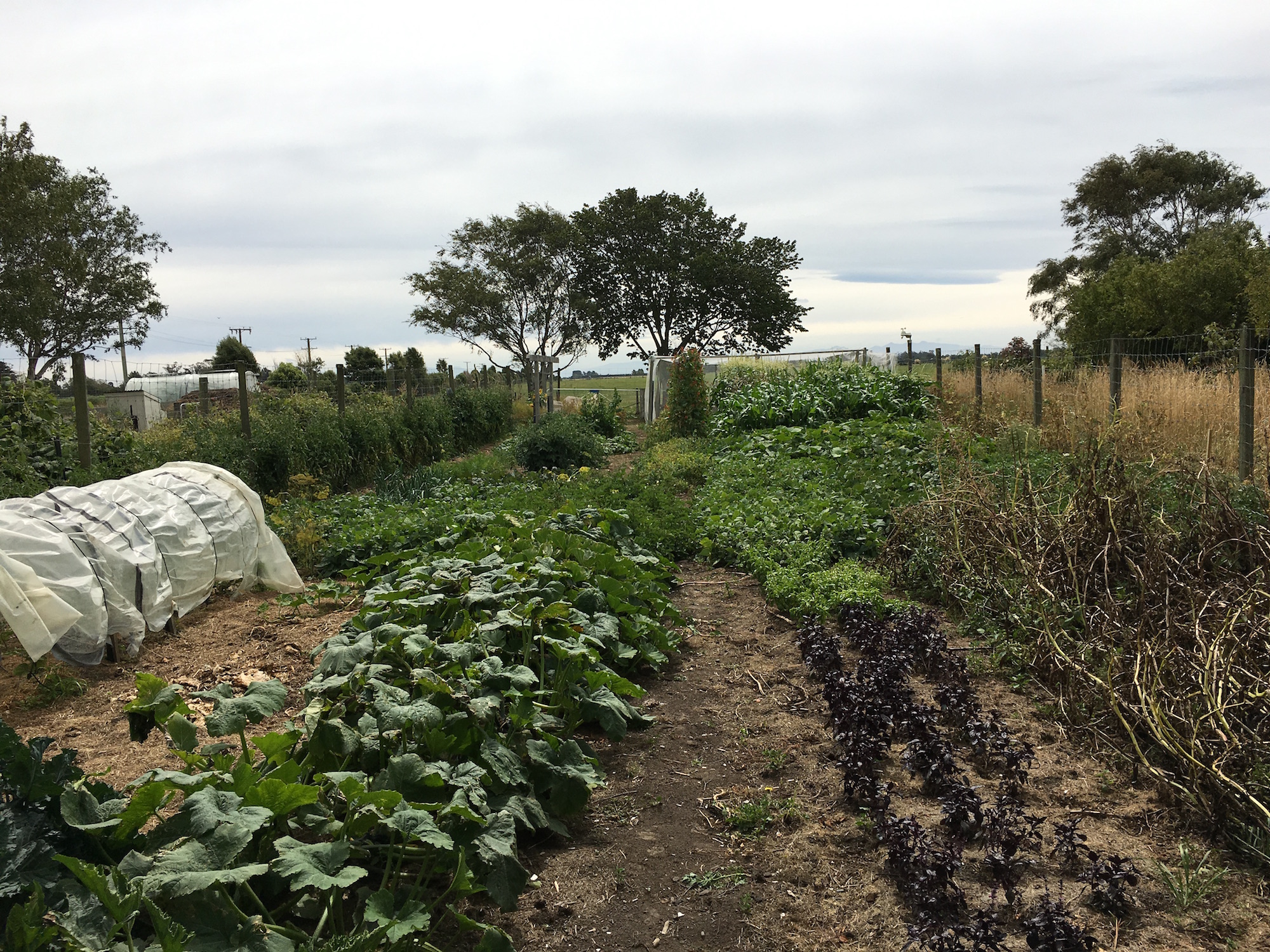
Being a gardener makes the aesthetics all the more rewarding to me–when the fruits of my labour are as beautiful as they are delicious, how can I help but be pleased? And, of course, I’m thinking about colours when I plant my vegetables too.
I say the aesthetics are part of the vegetarianism because I can’t imagine a raw chicken leg looking nice sitting on the kitchen bench. There’s something about the vegetables that’s pleasing, whether raw or cooked. Maybe it’s the colours. The vegetable palette is more varied and bright than the meat palette–snow white cauliflower, dark green spinach, deep magenta beets, bright green peas, sunny yellow squashes, scarlet tomatoes…Cooking with those vegetables is like dipping a paintbrush into the colours and creating a work of art.
No More Grammar
I’ve spent the last three days—11 hours each day—editing. I have no brains left to write a blog—they have all leaked out, stabbed by excessive punctuation, and strangled by curly quotes. If I see another comma, I will scream. I’ve had my fill of cut-and-paste errors. No dependent clauses can depend upon me this evening.
Instead, I will head to the garden, or to the piano. I’ll ignore infinitives, and banish adverbs. I will say whatever I please, and not worry about sentence fragments. Sentences without verb. Subject. Object.
- Do. Not. Care.
The English language can take a holiday this evening. Tell the Oxford Style Manual to stay home. I won’t answer the door. Come back tomorrow.