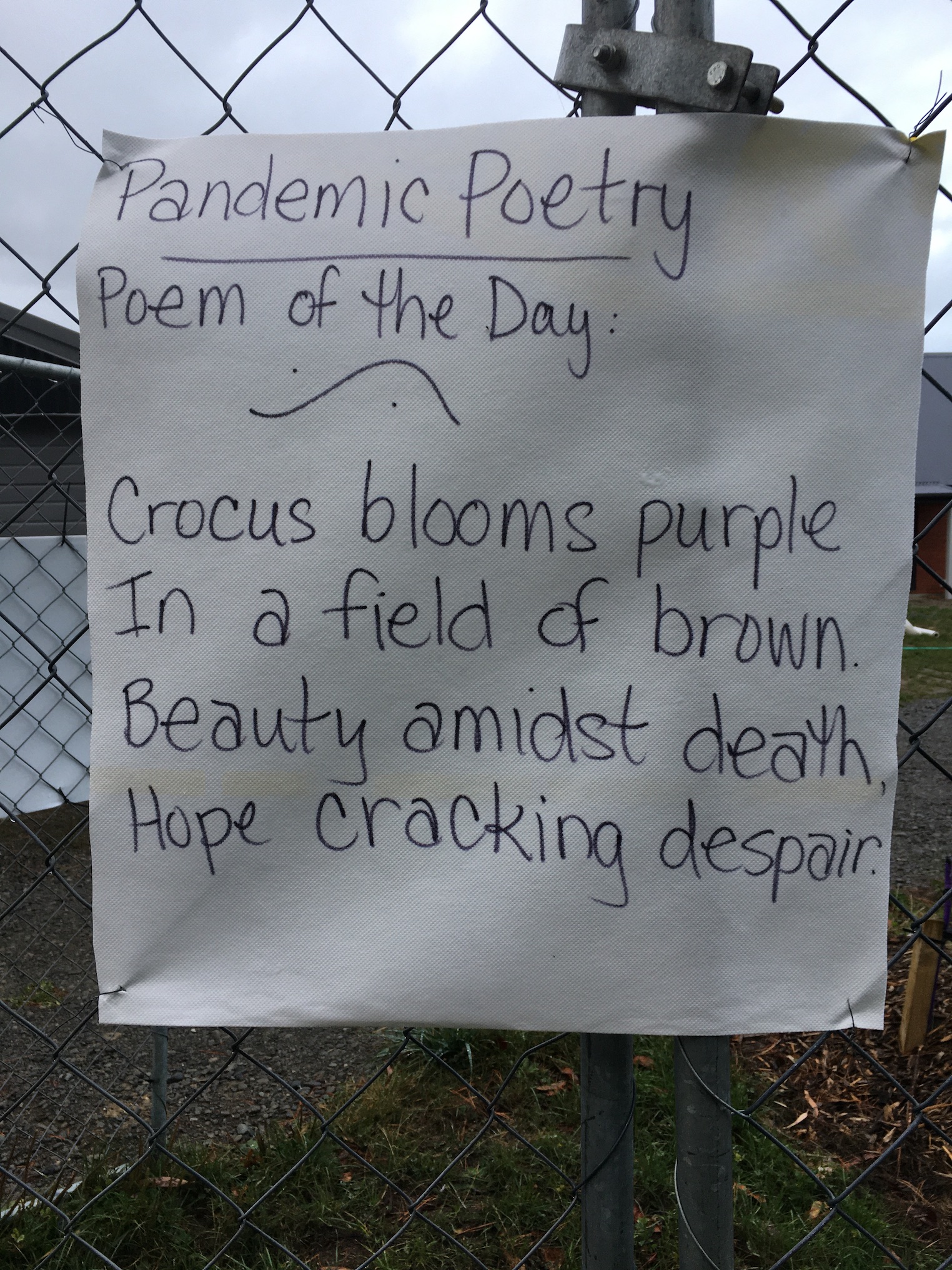
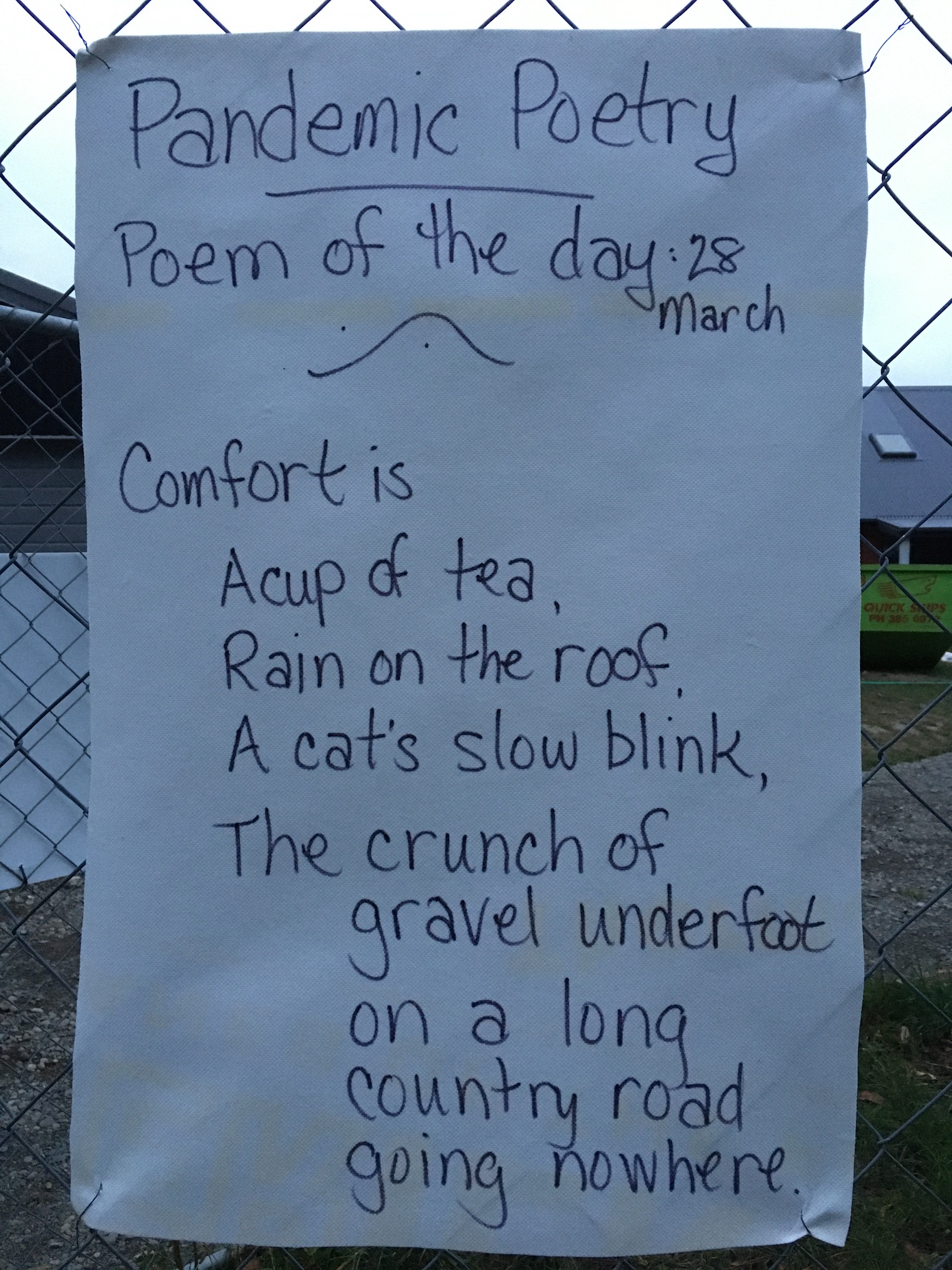
Pandemic Poetry: Poem of the Day, 26 March 2020

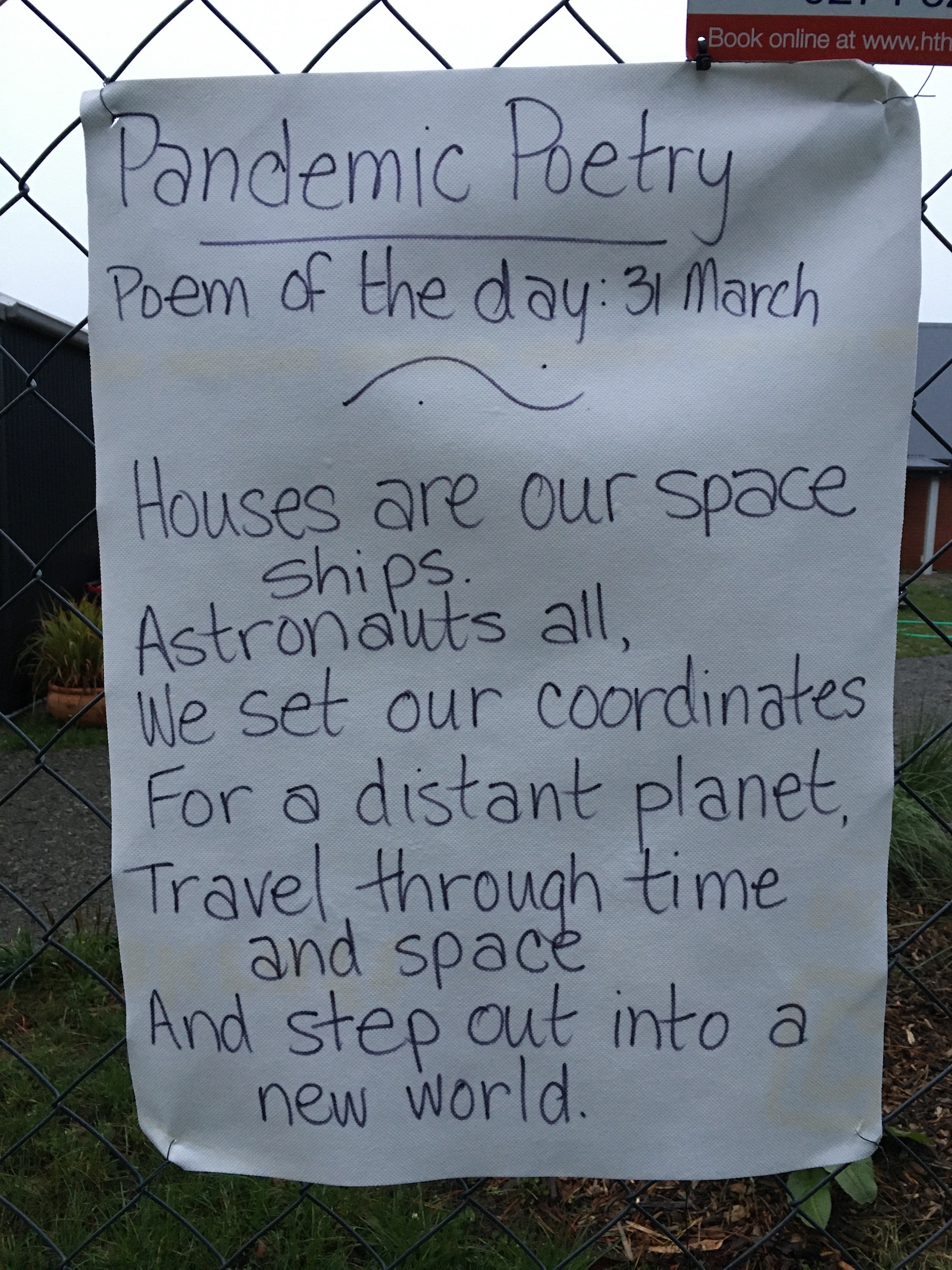
I’m starting a project today (day 1 of our national lockdown): writing a poem a day. Light, sometimes silly, sometimes thoughtful, and always with the aim to lift spirits. In the spirit of my own crazy living situation, I’m writing the poems on scraps of building paper the builders have left behind and posting them on the builders’ fence for our many dog-walking neighbours to enjoy. I’ll also be posting them here, on FaceBook and Twitter.

Stay safe everyone. Wash your hands, keep your distance, and be kind to everyone.

Appreciating the Small Things

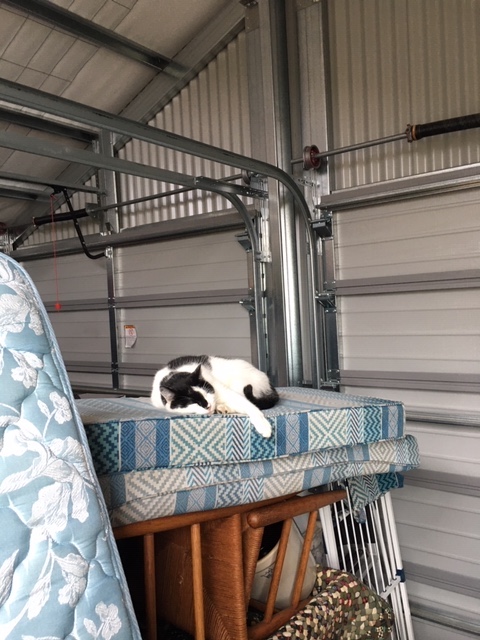
The cat has settled in and seems to enjoy the stacks of furniture.

So far I have ignored the elephant in the room in my blog posts. I’ve focused on the little joys—canning vegetable soup, baking cakes, making pasta. It has been a struggle to do so, some weeks, and today, hours from New Zealand’s total lockdown, it is impossible.

Today our house sale was finalised. Today we officially moved to our new home. Except our new home sits unfinished in the midst of a muddy, rubbish-strewn construction site. It will likely remain so for some time. We have crammed ourselves and all our possessions into the shed we built on the property last winter (when we foolishly believed we might have a new house by February). 

As you can imagine, it is cramped, a bit smelly, and very cold (last night was down to 4ºC). We had hoped to alleviate our stay in the shed by going out for dinner a lot, traveling a lot, spending time visiting fun places. That won’t be happening now. I had planned on doing my laundry once a week at the laundromat not far from work. That won’t be happening either. Today I hauled the washing machine to the back yard and hooked it up to the garden hose and an extension cord in order to wash a load. Every meal will be cooked on a camp stove outside.

We will spend the entirety of our lockdown essentially camping as we edge towards winter.

Much of the time it will not be fun.

And yet …

Nearly thirty years ago, my husband and I lived in rural Panama with no running water, no electricity. To get to the nearest phone took a half hour of walking and an hour’s bus ride. Our roof leaked, and and the cockroaches and rats living with us in our one-room mud house were legendary in size and number. I washed clothes in a 20-litre bucket, and used the same vessel to carry water to a small palm-leaf-and-stick stall for bathing. We cooked our meals in one pot over a three-rock fire. We dug our own latrine. The weekly shopping run took an entire day. By the end of each week, we were down to eating nothing but rice and whatever vegetables were coming out of the garden. In the evenings, I would write letters to family back home. Sometimes the letters didn’t make it to their destination, sometimes they were delayed by weeks. If I was lucky, the letters took a week to arrive, once I’d managed to post them. A full conversation could take months, and was usually irrelevant by the time the first letter arrived.

All of which makes months living in an unheated shed during a global pandemic seem like glamping, rather than a real hardship. Rather than thinking about what I don’t have, I’m enjoying what I do have—a vermin-free home with a concrete floor and sound roof, electricity (even if it is limited by what we can do with an extension cord), instant communication with loved ones far away, nearby grocery stores for when the rice and vegetables run out, and a mobile bathroom with a real shower and flush toilet.

And that is how I intend to pass every day as I navigate through the chaos of the next 12 months or so—thinking of what I have, counting my blessings, being thankful for those little things.
Make Marcella Hazan Proud

On Sunday my husband and I decided to make lasagne for dinner—and not just a meal’s worth, but enough to freeze for quick mid-week meals. With the garden full of late-summer vegetables, it was a great choice. We divided the work as we usually do—I would make the pasta and my husband would make the sauce.

Then I remembered I’d already packed up the pasta maker and taken it to the new house. How was I going to roll out the pasta?

I heard Marcella Hazan scoff from her grave. She never used a pasta machine. No good Italian would be caught with one of those.

It was time for me to learn to roll out pasta the ‘right’ way—by hand.

Thankfully, Ms. Hazan includes detailed directions in The Classic Italian Cookbook. With the book open on the benchtop, I began kneading and rolling my dough.

“I expected more swearing,” my husband commented ten minutes later. And there might have been, had I not had experience with pasta dough before. But the instructions were comprehensive and my dough compliant.

It still wasn’t easy—to stretch and coax the dough so thin without ripping it or letting it dry out was a challenge. It was also quite a workout—by the time I’d finished I was sweating and my arms were tired.

But it worked! My pasta sheets weren’t quite as thin as those I make with the pasta machine. And they were ragged oblongs instead of the neat rectangles that emerge from the machine. But they did well in lasagne. The thicker sheets had a nice toothsome quality. 

Marcella would be proud.

Still, I’ll be glad to go back to using the pasta machine in the future. 

Summer Soup 2020

No pandemic hoarding here, just the usual late season batch of Summer Soup. I’ve written about Summer Soup on numerous occasions (2015, 2016, 2018, and twice in 2019). We’ve been making it annually for at least a decade, and it has always been a family affair. In the early years, the children’s vegetable chopping efforts were more symbolic than helpful, but as their skills improved, their input became critical to the relatively rapid production of vast quantities of soup. 

This year, with our upcoming move, the garden output is less than in many years, and there’s so much to do, I wasn’t sure we would have a chance to make Summer Soup. In the end, I did it alone. Starting at 7.30 am, with many interruptions to help move furniture and tools, I began picking and processing vegetables. I pulled the final jars out of the canner shortly before 11 pm.

I listened to music and podcasts while I worked, and I got some brief help from my husband, but it wasn’t the same without the rest of the family there. Neither was the output—13 quarts of soup and 4 quarts of stock. 

I’m not disappointed—thirteen meals plus flavouring for four more will be lovely in the coming weeks and months—but I look forward to getting back to the family production of Summer Soup next year. It’s not just soup; it’s a celebration, and not nearly so much fun alone.

Problem or Inspiration?

The other day I planned on making roast potatoes for dinner. I brought in a colander full of spuds from the garden—more than enough for dinner.

Unfortunately, when I started cutting them I found many of them infected with zebra chip (caused by the bacterium Candidatus Liberibacter solanacearum), which turns the flesh brown. My planned dish of potatoes was looking pretty empty.

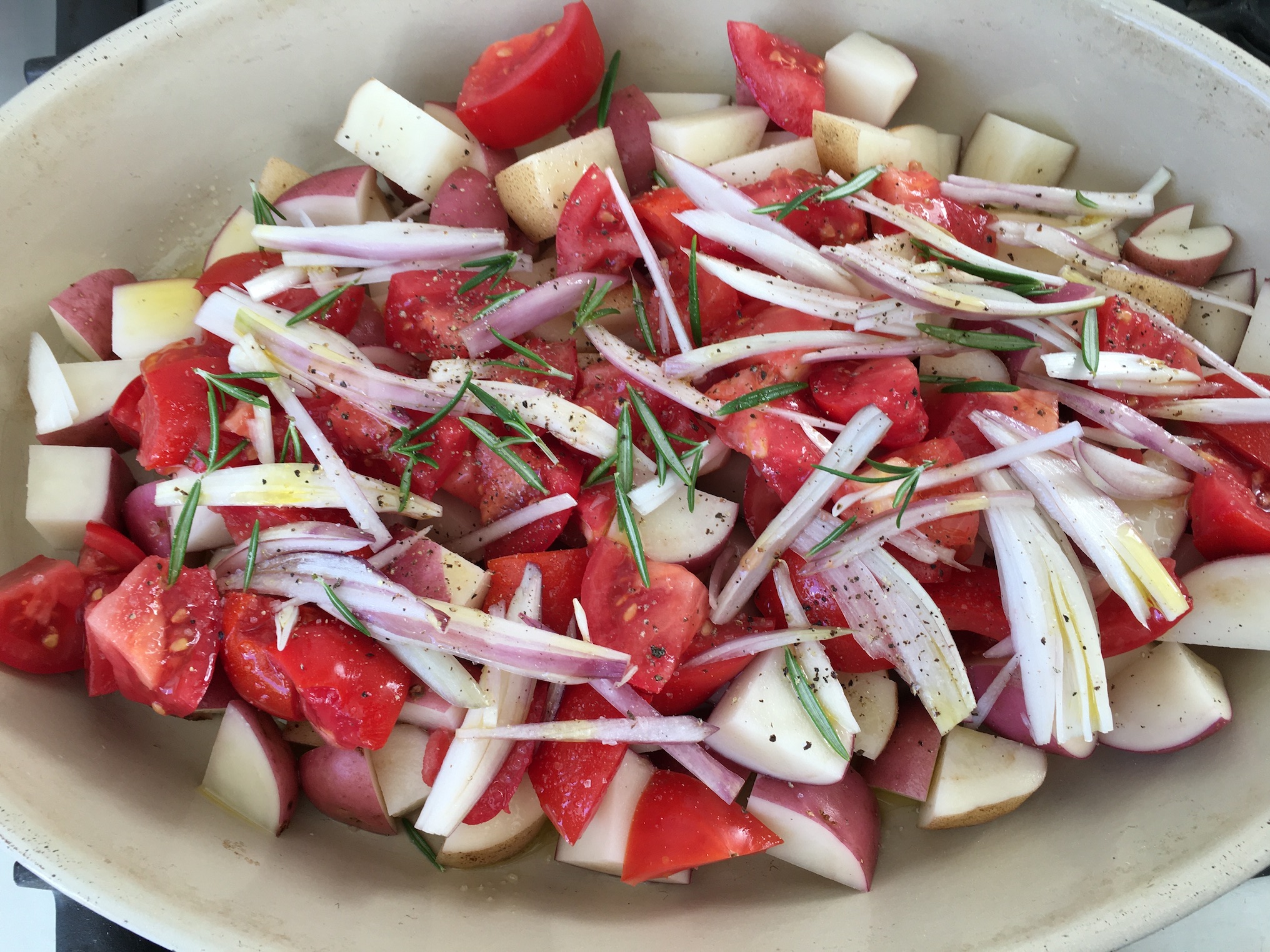
I could have gone out for more potatoes, but instead I took advantage of the resources on hand in the kitchen. I added a shallot and a few chopped tomatoes, sprinkled it with salt, pepper and rosemary, and popped it into the oven (at 210ºC for about 40 minutes for anyone interested).

The result was utterly satisfying and arguably better than the plain roast potatoes I’d originally planned. Instead of a problem, the rampant zebra chip became delicious inspiration.

Now, if I can only remember that for all the other problems in life …

Melon Season

I picked the first melons of the season the other day—a lovely watermelon and a small cantaloupe (rock melon). The watermelon could have used another couple of days on the vine, but it was sweet and delicious anyway. The cantaloupe was perfectly ripe and fragrant.

In fact, it was the smell that clued me in that the melons were ripening—I couldn’t even see this one amidst the tangle of foliage.

I’ve blogged previously about the smell of melons and the memories it evokes. Along with the odour of tomato and corn plants, it is the essence of summer. More than a seasonal fruit, melon is the season, all rolled into one fragrant ball.

So even though melons don’t start ripening here until it’s almost officially autumn, summer for me lasts as long as the melons do.

Crazy Cake #2–2020

My son, the budding architect, has always challenged my cake decorating skills with his annual birthday cake requests. A star destroyer, the city of Dale, Wellington … his requests tend toward angular, built structures difficult to sculpt in cake and icing. This year he asked for ‘a brick’. Just getting the colour right was going to be a challenge. And then I had to make the brick special in some way.

I thought maybe I’d cover it in lichens and moss (easy to fashion from frosting and Mexican paste). But a photo online caught my attention … I came up with a plan that I thought would tax my confectionery skills more than mere decoration would. A little maths, a little measuring, a little cutting, and …

There’s more to this brick than meets the eye.

Crazy Cake #1–2020

It’s birthday cake season again! This year, my daughter’s brief for me was a Kura Tawhiti bouldering theme, with ‘maybe a climber and some alpine plants’ done in chocolate and hazelnut flavours.

I think both of us had a vision of a grey boulder or boulders with climber, plants, etc. But as I started in on the cake, the vision changed.

I made one of my favourite devil’s food cake recipes (from Tartine) in a range of round layer sizes. I sliced each layer in half and filled it with my homemade Nutella, stacking the layers in a wonky boulder-like shape. 

Then I stood there and contemplated the decoration. My plan had been to make the standard quick icing I use for decorating, but the amazing rich chocolate cake with decadent Nutella filling really needed something better than quick icing. It needed ganache.

So that’s what it got—chocolate ganache covered with ground hazelnuts to get a more appropriate boulder colour. 

I added chunks of hazelnut praline for a more rocky appearance, and made some alpine plants and a climber from Mexican paste. A few small final touches with a simple sugar and milk icing, and the cake was finished.

It didn’t look anything like I thought it would when I started, but it tasted absolutely divine! No wonder—it contained over 400 grams of chocolate, two cups of hazelnuts, and a gloriously unhealthy quantity of butter and cream. In the end, no one was paying much attention to the look—we were too busy oohing and aahing over the taste.

The Apricots of Wrath

I should have listened to Fate. 

“Don’t can apricots today!” it told me the other day. “You have no sugar in the house.”

But I looked at the vast quantities of quickly ripening apricots in the kitchen and knew they wouldn’t wait.

I drove to the store to pick up sugar.

Back home, I made my sugar syrup, washed and heated my jars, got my canning water to a boil, and prepared seven kilos of apricots.

All was going well until I was packing the fruit into jars. I kept an ear on my canner, making sure it stayed at a boil while I worked. When the bubbling hiss faded and died, I knew the gas bottle was empty. Not now!

I left off my jar filling and raced outside to switch gas bottles.

Back inside, water, jars, and sugar syrup were cooling, but I finished packing the apricots in and poured sugar syrup over them …

Only to find I was about a cup short of syrup. Gah! I quickly made up a small batch to finish off the jars.

Into the canner went the jars, and I heaved a sigh of relief. It took longer than usual to bring it all back to a boil, but I shrugged it off. It’s always that way for a cold-packed fruit. 

Then a few minutes into the boil, the canner started boiling over—orange, chunky, foamy water spilled onto the stove. Darn! A jar had broken. It’s rare, but after 30 years of use, sometimes the bottom of a jar will pop off during canning.

So for 25 minutes, I fought the sticky water boiling over on the stove. When I finally pulled the jars out, they were all coated in slimy chunks of overcooked apricot from the broken jar, and the stove was an gooey mess.

The six remaining jars all sealed, though, which was good. Pity about the stove. Took forever to clean.

Later, once the water had cooled, I tackled the job of emptying broken glass and gunk from the canner. And the first thing I did was drop the remainder of the slippery broken jar onto the floor, where it smashed to pieces.

Then, just to add insult to injury, when I dumped the chunky sticky canning water onto the compost pile, it somehow funnelled through the pile directly onto my foot. 

Cleaning up the mess took almost as long as the rest of the process, and I questioned whether it was worth it, or if I should have simply thrown away a couple of kilos of fruit and called it a day before I started.

Then my daughter pointed out that we had the makings of six fruit desserts there, ready to pull out on a winter evening. She had a point—we’ll enjoy that fruit, and by winter, I’ll have forgotten the frustration of preserving it.

But, still, I keep thinking I could have sat on the porch with a good book instead …

Seeing is Believing

The Canterbury tree wētā (Hemideina femorata) is endemic to the lowland forests of Canterbury. Like other tree wētā, it is a sizeable insect and an opportunist when it comes to food, eating mostly leaves, but taking advantage of the protein in other insects it encounters.

Here in rural Canterbury, it’s rare to find tree wētā. Old timers talk about how you used to see wētā every time you trimmed the hedge, but in 15 years of trimming, I have seen no wētā. I’ve even put wētā houses (like bird houses, but designed to appeal to wētā) in the hedge, but have never found anything but spiders in them. 

Though I’ve never seen a study of their population changes, anecdotal evidence indicates Canterbury tree wētā numbers have dwindled with the intensification of agriculture and the increased use of chemical pesticides.

I have been fortunate to raise quite a few wētā in captivity, and in doing so, I’ve become familiar with the insects’ strong smell. This smell has been their downfall when faced with introduced mammalian predators—strong enough for even a human’s nose to perceive, it acts as a beacon to hungry rats, and stoats.

But it’s not just in my insect tanks I’ve smelled tree wētā. With some regularity in the early morning I can smell them in the hedge when I pass on my way to feed the chooks.

We humans have a poor sense of smell, as mammals go. We rely much more heavily on our sense of sight for identifying things. So for years now, I’ve doubted my nose, because I’ve never seen a wētā on the property or anywhere nearby.

But not long ago, on an evening walk with my husband, we found an adult tree wētā dead on the road.

Yes! I knew my nose couldn’t be deceiving me, though I was never confident enough to declare their presence based on smell alone. Now I am. I may not have seen them in my hedge, but if there are wētā being hit on the road a hundred metres from my house, I am willing to believe my wētā-scented hedge harbours them too.