The Evil of Summer Vacation

Who can resist when summer calls?

Who can resist when summer calls?

I know that many of my readers are in the Northern Hemisphere, and they’ll play their little finger-violins for me as they muddle through another dreary January day, but I’m facing the problem I face every year during summer vacation—I can’t go inside.

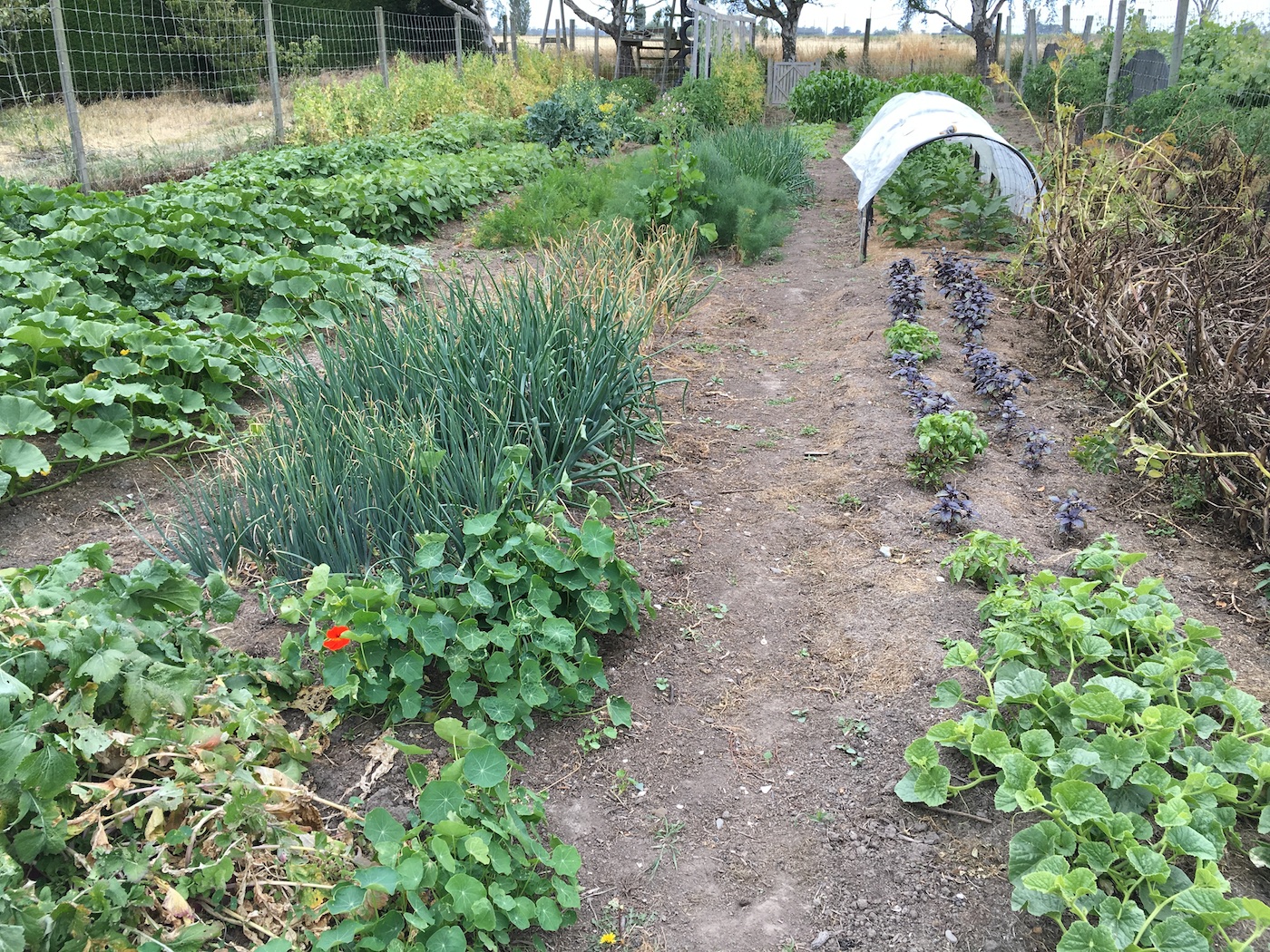
There is so much to do outdoors—weeding, unending DIY on this wreck of a house, mowing, animal care, harvesting—that I neglect indoor things. The weather doesn’t help—blue skies and warm breezes—because I think I need to take advantage of the good weather while it lasts.

And if by some miracle I feel like I’ve caught up on the outdoor tasks, well, that’s just an excuse to go to the beach!

So the house gets messier, the bathroom remains uncleaned, I forget to pay the bills, I ignore the shopping.

I blog mostly after dark (which is difficult, because the days are so long), and only read the news or check social media at times when I have no choice but to be indoors (like when I’m pasteurizing the day’s milk).

I actually look forward to days when the weather is poor so I can catch up on the indoor chores.

And so I was secretly pleased when the wind shifted this afternoon, and the hot sun turned to chilly drizzle. I retreated to my office to deal with paperwork, get the day’s blog finished, check my e-mail, and maybe (if the clouds remain) eve do a little sewing.

The house cleaning?

Well, I doubt I’ll get to that…it is still summer vacation, after all!

These Are a Few of My Favourite Things: Preying Mantids

DSC_0025 sm

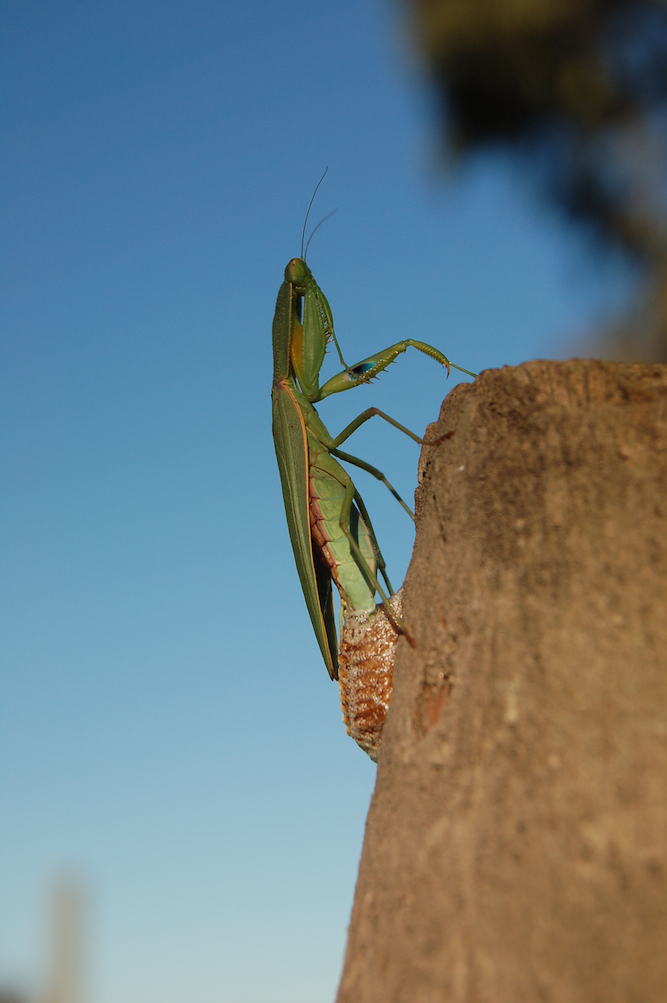
NZ mantis laying eggs

There’s no question why I’ve been known as The Bug Lady most of my life. I have a weakness for anything with more than four legs.

Preying mantids are some of my favourites. Not just because they eat pests in the garden, but because they are simply fun to watch.

How often can you watch a cheetah bring down an antelope in real life? Um…never. But it’s easy to watch a mantis snatch a fly—all the drama of the Discovery Channel, right in your back yard.

Sometimes the drama is a little too close for comfort.

When we lived in Panama, a beautiful 10 cm long green mantid with bright pink hind wings often came to our light at night. It would sit on our table and snatch moths attracted to the oil lamp. It was a cheeky insect, and had no compunctions about perching on our faces or arms to get a better vantage point for its nightly hunting. We laughed that it would follow us to bed some night.

We weren’t quite right, but one morning I slipped on my jeans, only to feel something enormous crawling up my thigh. With a yelp of surprise (and visions of scorpions, which were common in our house) I tore the jeans back off and peered down the leg to find our cheeky mantid scrambling out. It looked distinctly ruffled by the experience, but that didn’t stop it from returning to our light.

But from then on, we trapped it in a jar every night before we went to bed.

We are blessed with a healthy population of New Zealand mantids here at Crazy Corner Farm. Like most mantids, they enjoy hanging out on flowering plants, particularly herbs which attract huge numbers of flies and bees. Sometimes, I sit in the middle of the herb garden with my morning coffee, just to watch the mantids. I’m always surprised and impressed by the size of prey they can take down. I’ve even seen them snatch more than one fly at a time—one in each “hand”. Indeed, they will keep snatching prey as long as it keeps coming—even once they are fully sated and can’t possibly eat any more—their predatory instinct is so strong, they can’t stop themselves.

Of course, everyone has heard that female preying mantids eat their mates, and in species in which the female is much larger than the male, I’m sure it happens. But male preying mantids are just as fierce as the females, and they don’t go without a fight. The female New Zealand mantid is only slightly larger than the male, and I have kept males and females together in captivity. Only once did I see a female try to eat her mate. It was an epic struggle, worthy of the best wildlife documentary. It went on for at least fifteen minutes, and in the end, the male got away.

So turn off the TV. Get outside and watch the drama unfold!

Margaret Mahy Playground

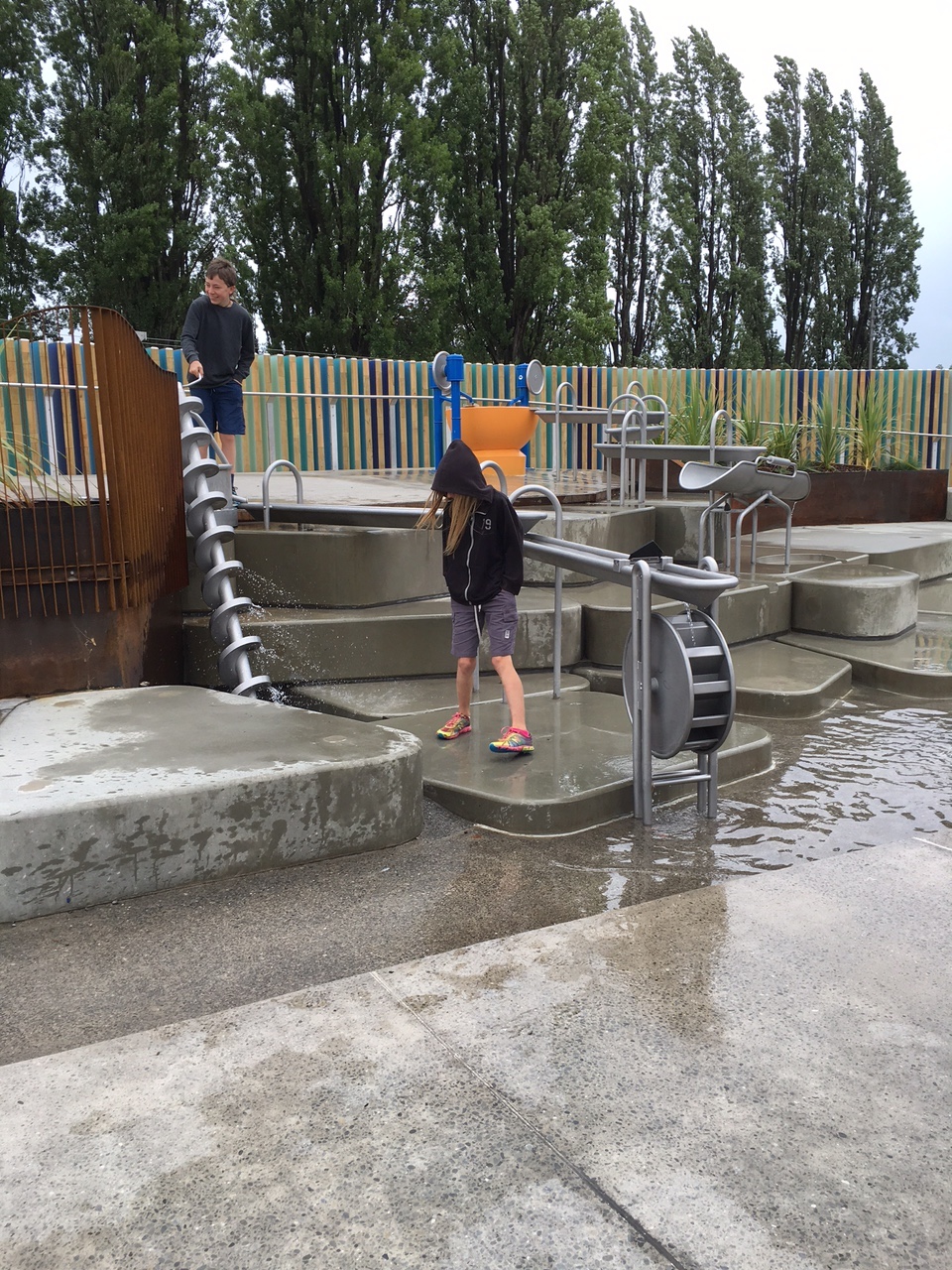
IMG_0072For those unfamiliar with Down the Back of the Chair, The Great White Man-Eating Shark, and The Man Whose Mother Was a Pirate, Margaret Mahy was a prolific author of children’s books and young adult novels. She lived just over the hill from Christchurch, in Governor’s Bay from the late 1970s until her death in 2012.

Her books are quirky, adventuresome, and often wildly creative.

The recently opened Margaret Mahy Playground is also quirky, adventuresome, and creative.

We don’t frequent playgrounds anymore—our kids are mostly past the age where they insist on playground stops—but when we were in town the other day to visit the (finally) reopened art museum, we decided to check out the new playground.

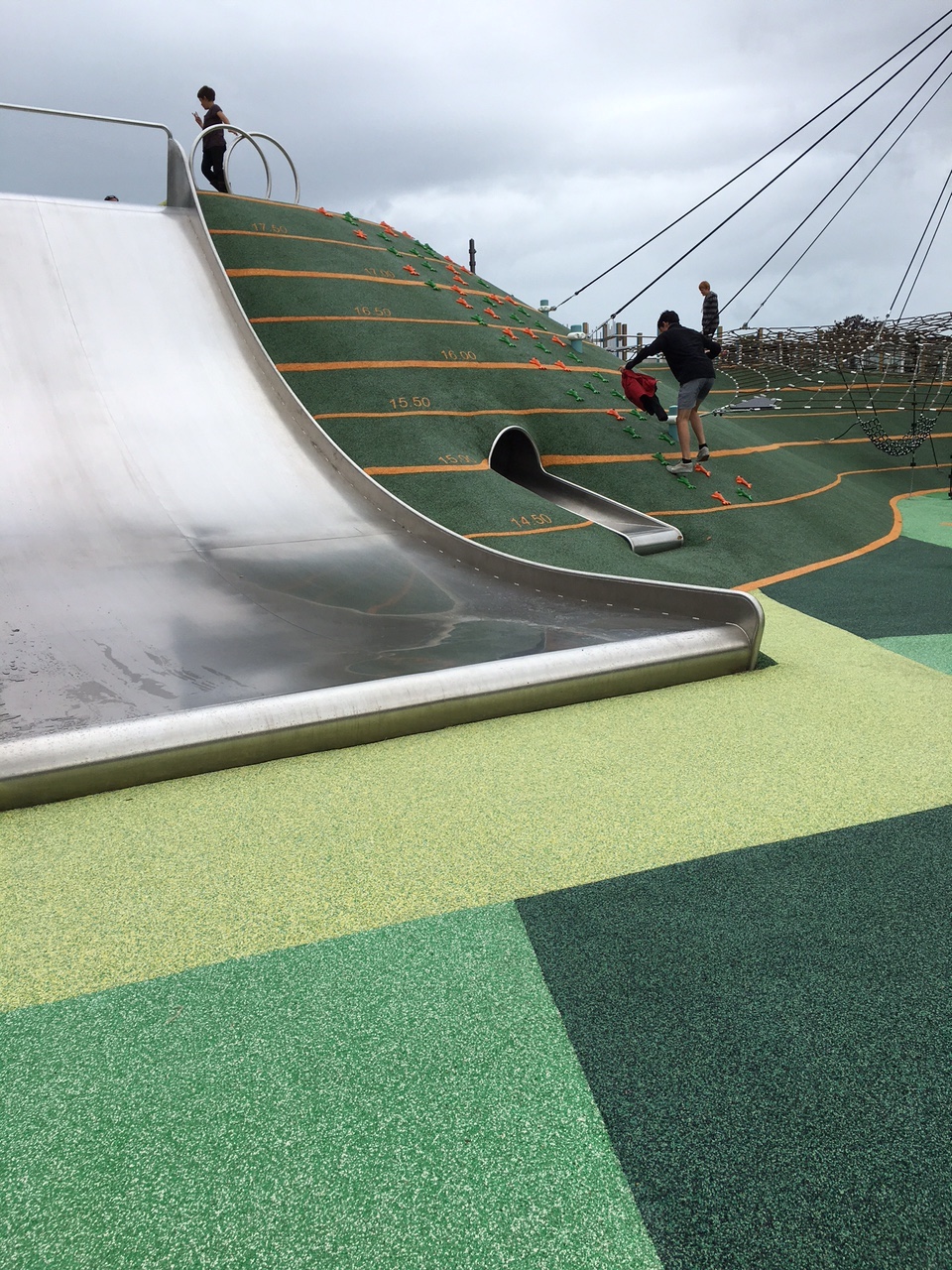
IMG_0084Water, sand, a flying fox, climbing structures, the “fastest slide ever” (according to my daughter who flew off the end of it like a champagne cork), and a hill marked with contour lines…Horrakapotchkin! The playground was awesome. Even my too-cool-for-playgrounds teenage son went down the slide (twice), sent water through the sluice system, and delighted to find the sensors that turned on sprays of water.

Best of all, there is a path out the back of the playground down to a dock on the river.

The only downside to the playground is that all the surfaces are concrete or rubber mat. A necessary choice of materials, I’m sure—even on the chilly, rainy day we visited, the playground was crowded. Grass would be trampled to death in a day.

One of the best playgrounds I’ve ever seen, and a great tribute to Margaret Mahy.

Sandcastles

2015-12-28 13.49.30 smMy kids inherited their father’s obsession with making sandcastles. No beach trip is complete without a major construction project. We take a full-size garden shovel when we go to the beach—that’s how serious they are about it.

Their creations can reach well over a metre tall and cover twenty square metres of beach.

Last week, there were some families with preschoolers on the beach with us. When castle construction halted for lunch, the kids came over to investigate. They splashed in the pools and admired the turrets and bridges. They spent ages enjoying my family’s creations.

Later, as people walked past, many stopped, or walked around the castle complex to get a better look. Some stopped to chat or comment. All of them smiled.

This is what art does.

Not that sandcastles on the beach are Art with a capital A, but they are a form of creative expression like all art. And art is meant to be appreciated and enjoyed.

Art can make people smile. It can encourage strangers to talk to one another. At its best, it encourages interaction—with the art, with each other. It inspires. It provokes.

Too often, we step out our doors and put on our uniform—our “normal” face and behaviour. This is good, to an extent (norms of behaviour are generally there to help us all live together without excess friction). But all that uniformity is cold and sterile. Uniformity doesn’t encourage us to smile and talk to one another. I think that if more people expressed their creativity openly in public for everyone to enjoy, the world would be a better place.


Daddy long-legs

daddylonglegs1cropsmThe name Daddy long-legs conjures images of swift, leggy creatures, but depending on where you live, the image you see in your mind may not be the creature pictured here. The name can refer to a particularly common house spider, a crane fly, or this delightful animal—a harvestman.

Harvestmen are arachnids, and are often confused with spiders—eight legs, roundish body, move quickly—but they are in a separate order from the spiders, and have important differences.

The most obvious distinction is the body shape. Spider bodies are divided into two sections, but harvestman bodies are just one section.

Most people are familiar with the European harvestman (pictured), but most harvestmen are much more fierce-looking than the European ones. They sport vicious-looking spines, oversized pincers, and bizarre body shapes and colours. Perhaps this is where they get their reputation as “the most poisonous spider on the planet”. The truth is that, unlike spiders, none of the harvestmen have poison glands.

Harvestmen are primarily scavengers—eating dead insects, and the occasional tiny, slow-moving live insect (the European ones are said to like aphids). They have no need for poison except in defence, and here they are well-endowed. Most harvestmen have small pores on their backs that exude a smelly substance that repels most predators.

So the worst a harvestman can do is smell bad.

Of course, every kid who’s ever tried to catch a harvestman knows they have another defence mechanism—legs that break off easily. A harvestman’s legs act as a quick get-away mechanism if it is snatched by a predator—the leg snaps off easily in the predator’s mouth, allowing the harvestman to escape. Harvestmen seem to get along quite well with seven, six, even as few as four legs (look closely and you’ll notice the one I photographed has only seven legs).

These shy, gangly creatures are some of my favourites in the garden and in the forest, where hundreds of species abound, many of which are still undescribed by science.

Secret Garden

Years ago, my husband installed a mirror in our hedge. I still catch myself wondering about the garden on the other side.


hedgemirrorsmThere is an arch in the hedge,

Dark and green,

And a gate.

It beckons.

Calls me to step through

To the secret garden

Beyond.


At work over here,

I glance up.

The far side is green,

Lush,

With clipped shrubs

And well-weeded flowers.


I wonder at the gardener

Who can maintain such beauty.

I struggle so on this side!


A bird flashes by,

Glimpsed through the arch,

I am sure it was red,

With a long tail.

What exotic creatures live over there

On the other side?


I stand, stretching my aching back.

I step closer to the arch.

Was there movement?

There is someone on the other side.

The gardener?

I would like to meet her.

Would she show me around her garden?

Boldly I approach the gap.

I see she, too, walks to greet me.

When I catch her eye,

I draw up short.

A slow smile spreads across our faces

As we recognise one another.


The hills are alive with the sound of music

I was in the garden, weeding as usual, when I heard the Star Wars theme wafting across the yard. It was my daughter, testing the new low register she was making for the flip-flop-o-phone.

What’s a flip-flop-o-phone, you ask?

It’s one of a number of musical instruments scattered around our yard. My husband believes in tantalizing all the senses in the garden. Music is an important part of that, so he builds instruments everywhere.
tubophone smIn the herb garden is the tubophone—galvanized electrical conduit cut to a C-major scale and played with a mallet—a DIY glockenspiel.

musicalbench sm


In the pond garden is a bench strung with strikable and pluckable piano strings—sort of a jug band sound.


drumkit1 smAnd nestled among the plants in the native garden are the garden drum kit (complete with wheelbarrow bass drum, bucket snare, and tyre hub high hat), and the flip-flop-o-phone.
flipflopophone1 sm


The flip-flop-o-phone is a set of pvc pipes (salvaged plumbing) that are struck on the end with an old flip-flop to make a (sort of) musical note.

The outdoor instruments are fun, interactive garden elements we all enjoy—one of the many elements of whimsy my husband adds to the landscaping.

2016 Blog Challenge

100_2118smNew year, new challenge. This year I’m going to stray from the table and the kitchen, though I’m sure I won’t leave the subject of food entirely.

This year I’m returning to my roots as an interpretive naturalist with my blog challenge—A Year Outdoors.

As I did with the 365 Days of Food challenge, I will interpret my theme broadly and explore a wide range of ideas and perspectives on the outdoors. I’ll range from garden to beach to mountaintop. I’ll look at microcosms and ecosystems, the tiny to the huge. I’ll explore outdoor work and play. Anything out of the confines of four walls and a roof is fair game.

Rain or shine, I’ll be out there. So grab your hat and come join me for another year!

365 Days of Food

100_3831 smHere I am at the end of my 365 Days of Food blog challenge. Reflecting on the year, I am pleased–and a little surprised–I’ve managed to blog every day. Yes, some days were…um…half-hearted at best, and some posts were written in advance, to be posted automatically on days when I had no internet access. So there was a little fudging, but only a little.

And what did I learn from this exercise?

DSC_0009 smI gained a heightened appreciation for how much of my daily life revolves around food—planting, caring for, harvesting, preserving, preparing, eating…and cleaning up from all of the above. There were times during the year when I felt that dealing with food was the only thing I was doing, and I wondered if I needed to get a life.

But what is more basic to life than food? What is more fundamental to human cultures than sharing food with friends and family? On the last day of the year, I come full-circle—back to my first blog post of the year:

DSC_0016 copy“[Food] feeds us physically and emotionally. It is an integral part of our celebrations, and is the scaffold on which our days are built.”

After a year of blogging about food, I would add that it underpins our economy, is woven into the fabric of human history, impacts the health of the planet, reflects our personal values, and is an inseparable part of our identity.

DSC_0015 copyThank you for reading and commenting all through the past year. Though it is the end of my 365 Days of Food challenge, it is not the end of my blogging. There will be more…maybe even a new challenge for next year.

Stay tuned!