Sticky Feet! The Eucalyptus Tortoise Beetle

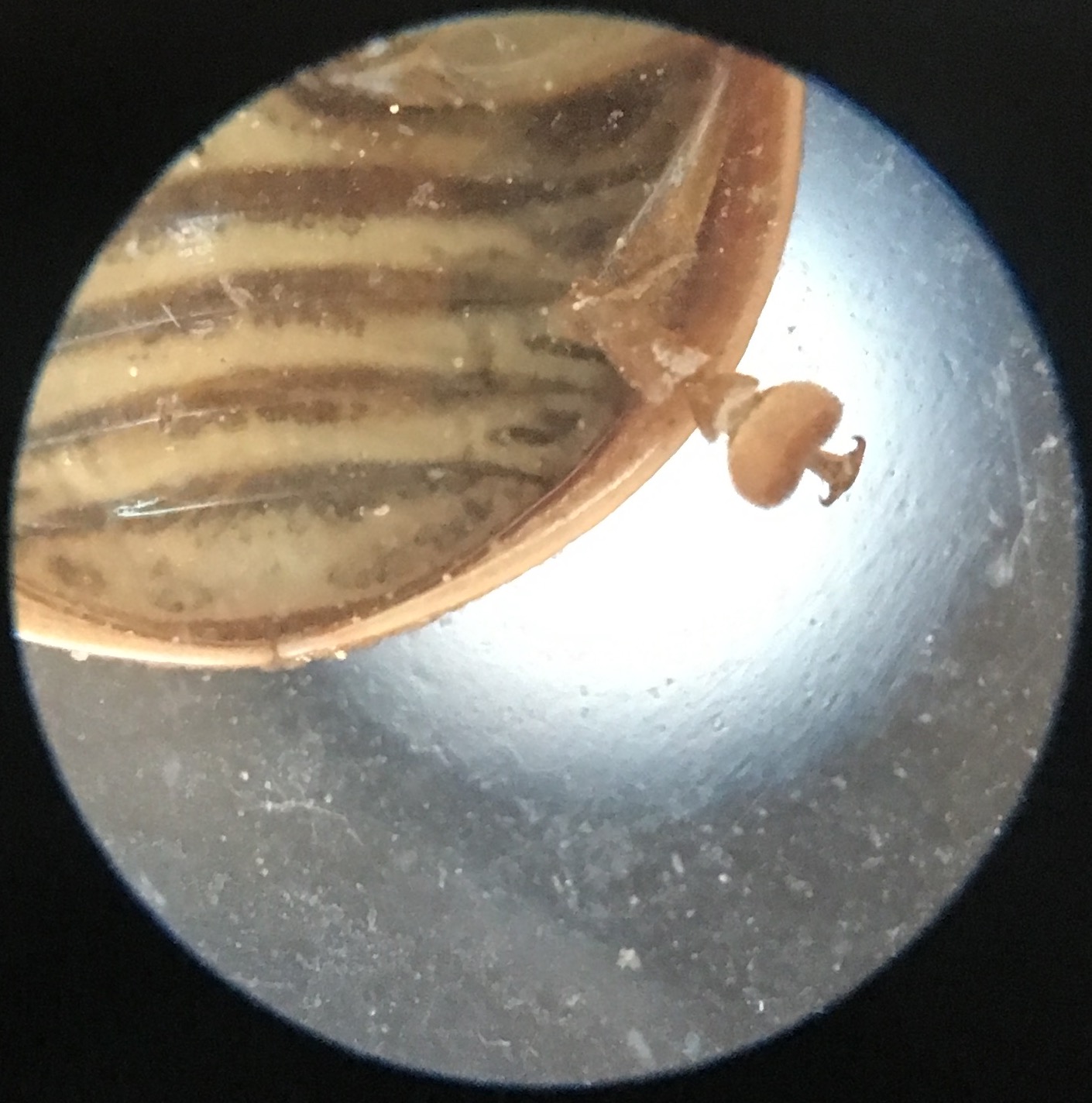
Hanging up the laundry this morning, I found this lovely beetle making its way along the washing line. It’s a eucalyptus tortoise beetle (Paropsis charybdis). I see them occasionally, but with only one eucalyptus tree in the yard, they’re not common.

I’m quite fond of tortoise beetles. This one isn’t much to look at, but many species are sparkling gold, and my first glimpse of them, as a kid, was a truly magical experience that I’ve never forgotten. What tortoise beetles have in common is their domed tortoise-like shape.

Their shape, combined with some pretty awesome feet is what keeps them safe.

Tortoise beetles have wide pads on their feet (this one obligingly sat on a clear surface and showed its feet under the microscope). The pads are covered densely in short hairs, like the bristles of a toothbrush. Each hair is moistened by oil, which helps it stick to the waxy surfaces of leaves in the same way two wet drinking glasses stick together if they’re nested. The oil bonds to both surfaces and acts as glue. When disturbed, the tortoise beetle presses its feet against the surface, employing as many as 60,000 sticky bristles (about 10 times more than other beetles have) to keep it attached. These sticky feet, combined with the dome-like shape make it difficult for predators to dislodge the beetle.

Entomologist Tom Eisner performed a series of elegant experiments with the palmetto tortoise beetle, attaching weights to the beetles to see how much force they could withstand before being pulled off a leaf. He found they could hold up to 240 times their body mass. Those are some seriously sticky feet!

So if their feet are so sticky, how do they walk? Eisner showed, by looking at palmetto beetle footprints on glass, that when they walk, they don’t let all the bristles on their feet touch the surface. Their full adhesive power is only deployed for defence.

I don’t think anyone has tested eucalyptus tortoise beetle grip strength, but it’s definitely impressive. I popped this one into a narrow jar, and it never hit the bottom—it reached out with one leg, like some movie superhero, and grabbed the smooth wall of the jar, arresting its fall. Then, when I tried to get it out of the jar, it stuck like glue to the side. I had to slide a stiff piece of paper under its feet, prying them up one by one. It was obliging for the photo shoot, but when I tried to let it go, it stuck itself to the paper. It took a few determined nudges, but eventually I got it to the edge of the paper and it dropped off.

The eucalyptus tortoise beetle is not native to New Zealand, and is considered a pest in the forest industry here. Still, I have to admire the beetles’ sheer tenacity, and am willing to share my eucalyptus tree with them for the opportunity to see those sticky feet in action.

Ice and Fire

One of the things I like best about springtime here is the juxtaposition of hot and cold, especially in the high country. The sunshine is warm, but winter lingers in the shade. I’ve gone hiking in shorts and t-shirt through 15 cm of snow in past years.

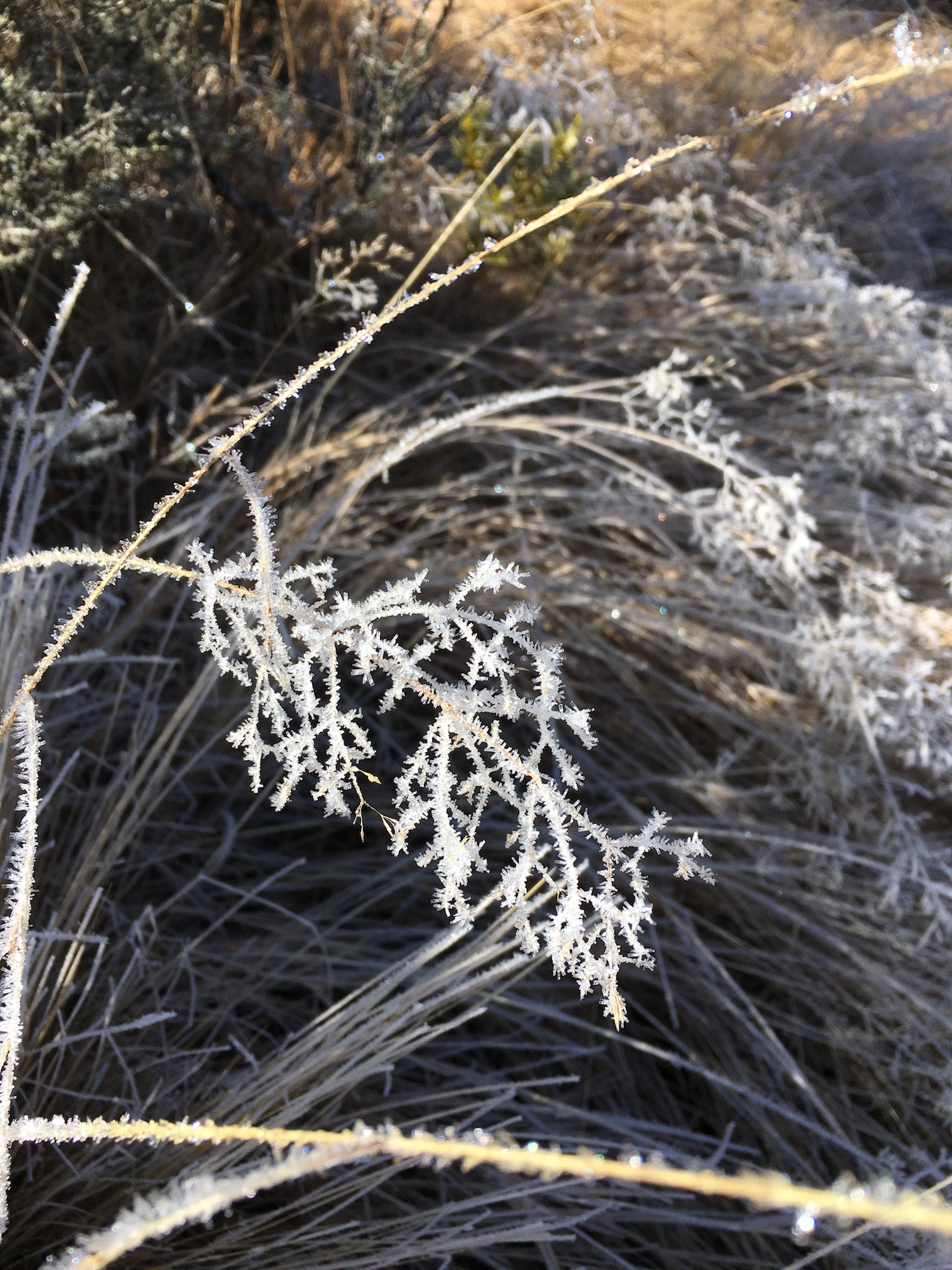
This weekend, we didn’t make it up to snow, but there was spectacular frost on our little Saturday jaunt. Hiking up the shaded side of a hill, we were treated to glistening plants as the first rays of the sun hit thick frost.

In addition to the frost, we crunched over a lot of needle ice. Needle ice can occur when the soil temperature is above freezing, but the air temperature is below freezing. Liquid water rises through the soil via capillary action and freezes on contact with the air. As more water is drawn upward, the ice needles grow in length. They’re common in the high country in springtime, when warm sun heats the ground during the day, but the temperature drops quickly after dark.

Ice needles are more than just a curiosity. They’re a significant factor in soil erosion, because they often push soil upward along with the ice. This loosens the top layer of soil, making it prone to erosion by wind and water.

The air was cold on Saturday morning, and as we started up the hill, we were well-bundled. But like all good tracks in New Zealand, this one started off by going straight up. Between the climb and the sun, we were soon stripped to our t-shirts, enjoying the crunch of ice underfoot and the warmth of the sun overhead.

The Pied Piper

I’m excited to announce that my short story, The Pied Piper, is out today in Andromeda Spaceways Magazine, along with a whole bunch of other great stories.

The Pied Piper was inspired by New Zealand’s Predator Free campaign, which has a goal of eradicating rats, stoats and possums from the entire mainland. A difficult goal, and one that might take a little extra help, if we dare …

You can get your very own copy here.

Quake Cities

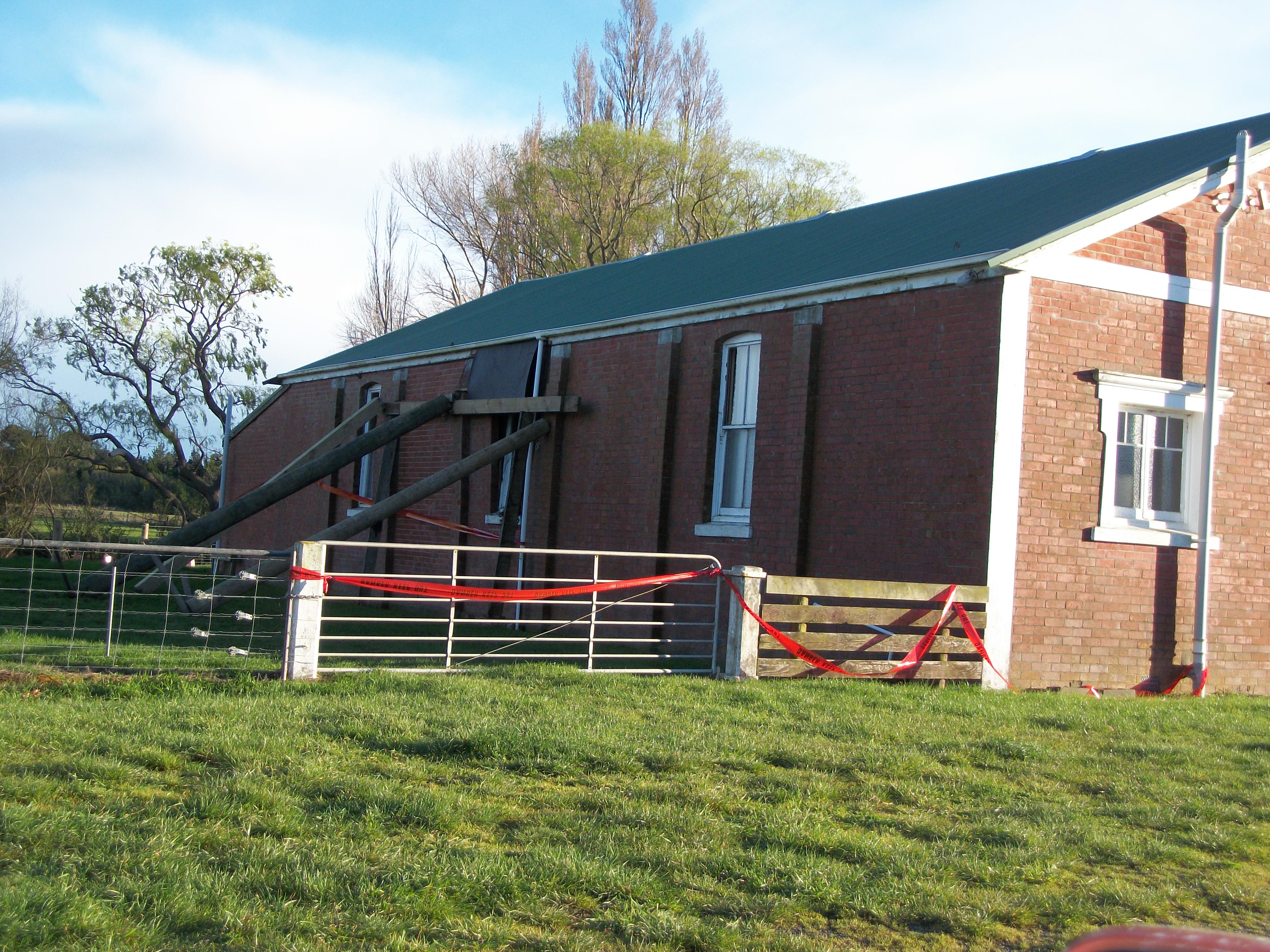
The old hall, post-quake.

It’s September 4. The daffodils are in full bloom, and I feel compelled to talk about earthquakes.

Eight years on from our M7.1 quake, the local hall is finally under re-construction. Its brick walls cracked and bowed in the quake, and it spent several years propped up by timber, then was razed completely. The site sat empty until about two months ago, when the walls began to rise again.

It’s a common refrain here. The damage done by the M7.1 on 4 September 2010 and the M6.3 on 22 February 2011, and the 15,000 or so lesser quakes in between and after is still visible. In the city, the Christchurch Cathedral still sits behind ‘temporary’ security fencing, it’s face crumbled away, weeds growing along the tops of jagged walls. A block of High Street remains closed, broken buildings frozen as they were when the shaking stopped. Throughout the region, churches remain truncated, their spires still gone. One church is still operating from a large tent. Houses are still undergoing repairs, and bare sections abound.

On a recent visit to Wellington, my son commented that Wellington seemed like such an older city than Christchurch, though they are nearly the same age. But Wellington hasn’t had a big quake since 1855. In that 1855 quake, many buildings were destroyed, and after that, most homes were rebuilt using timber, in the Victorian style popular at the time. Those Victorian houses give many Wellington neighbourhoods the quaint atmosphere they have, even today.

In Napier, the city-defining quake struck in 1931. The rebuild of that city followed the art-deco style popular at the time. The city retains the art-deco character today, and has become a popular tourist destination for its architecture.

Christchurch’s look has been affected by the 2010 and 2011 earthquakes, just as Wellington and Napier have been. Brick and stone have been replaced by wood, steel and glass. The new Christchurch includes more art, more open space (though some of those open spaces are slated to be filled with new buildings … eventually). Perhaps some day, visitors to Christchurch will view it as a product of the architectural styles of the 2010s.

Orange Cupcakes

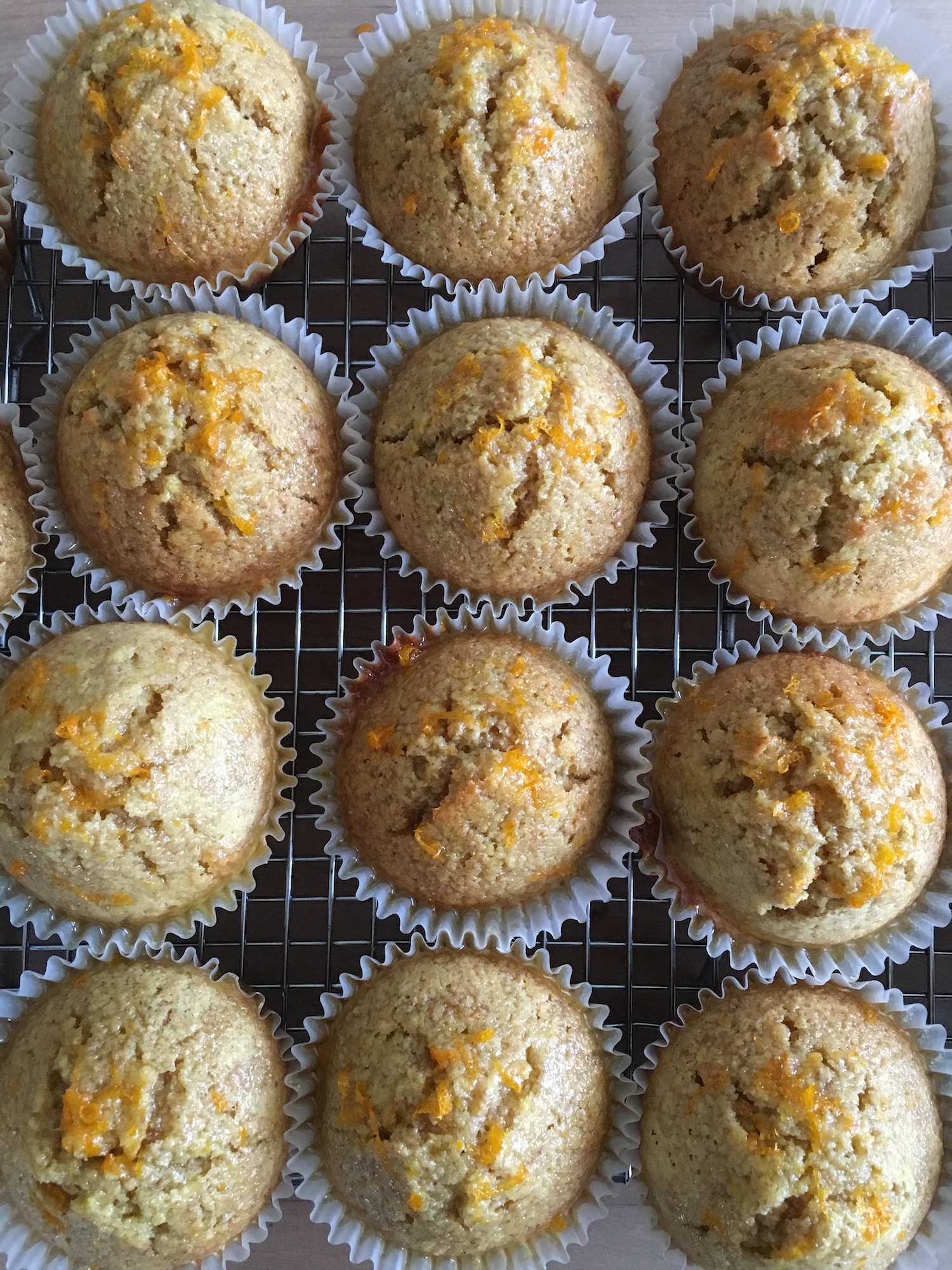
I’ve developed my own orange cake recipe, which I like a lot, and I’ve made a similar orange cake, based loosely on a recipe in King Arthur Flour’s Whole Grain Baking. Last week I finally made King Arthur Flour’s orange cake, as it’s written, except I baked it as cupcakes.

My orange cake uses barley flour, which gives it a delicate crumb. The recipe I made last week uses wholemeal (whole wheat) flour, leading to a more robust cake, with a lovely nutty flavour.

But the best part of the recipe was the orange glaze on top. The glaze did lovely things for the cupcakes, and made them taste a bit like the dense sticky orange cakes you find in cafes. (but a whole lot less involved to make).

Here’s the recipe for the glaze. Brush it on the warm cakes and let it soak in. Be generous with it!

1/2 cup orange juice
2 tsp orange zest
3/4 cup sugar

Combine all ingredients in a microwave-safe bowl and microwave for 1 minute. Stir until the sugar is completely dissolved.

A Decadent Brioche Breakfast

Sometimes you just have to go a little overboard. My over-the-top fun this weekend was making brioches for Sunday breakfast. Overly decadent and time-consuming to make, brioche is a rare treat for us. My usual Sunday breakfasts (scones, muffins, or whatever) can be made in the morning. Brioche had to be started the evening before.

My son, passing through the kitchen as I kneaded the gooey dough, peeked at the cookbook open on the table. His eyebrows rose.

“Make sure you wake me up for breakfast tomorrow.” This from the teen who usually doesn’t get up until long after breakfast is cleaned up.

The pressure was on. I had to make sure these brioches were worth losing three hours of sleep.

The dough rose overnight in the fridge, and I made up the buns in the morning. When they came out of the oven, I cut the top off each one, scooped out a little hollow inside, and filled each with a dollop of gooseberry jam and then a generous spoonful of whipped cream with lemon curd folded in.

Oh, my. These little butter bombs were delicious!

Happy National Poetry Day!

Octochaetus multiporus, a bioluminescent earthworm.

It’s National Poetry Day, and after my glowing garden find earlier in the week, I couldn’t resist a little poem inspired by sparkly worms.

Bioluminescence

Be
Like fireflies winking on summer nights,
Like fungi on rotting logs,
Like glowworms dangling from cave walls,
Like drifts of sparkling plankton washed up on the shore.

Bio      life
Luminescent      shining

A shining life.

Shine.

Shining in the Dark

Not much to look at in the light, but spectacular in the dark.

I’m a morning person. I’m rarely in bed past six o’clock, and am often up long before that. But I will admit that even I get tired of getting up in the cold and dark at this time of year.

Of course, sometimes the most amazing things happen before the sun is up.

Yesterday morning, I stepped into the chicken paddock feed ‘the girls’. It was still dark, with just enough starlight to see my way. I bent to tip a scoop of feed into their dish and froze.

Something glowed on the ground—the eerie glow of bioluminescence.

I’ve seen bioluminescence while feeding the chickens before—a tiny sea creature whipped up and blown in with a violent snowstorm—but this was different.

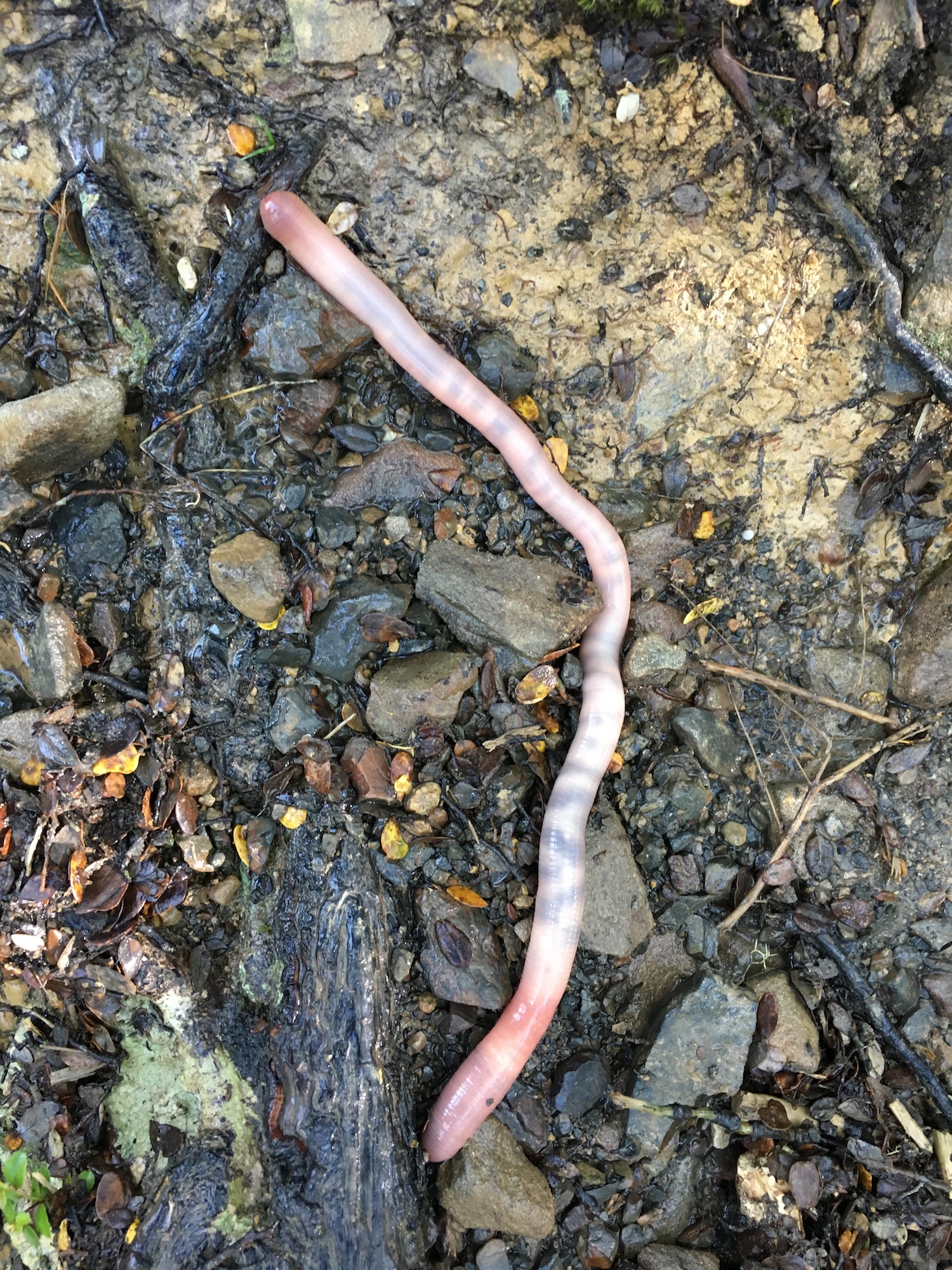
I flicked my light on and saw something pink glistening on the ground. When I tried to pick it up, I discovered it was the head of an earthworm.

A brightly glowing earthworm.

I couldn’t get it out of the ground in order to bring it in and identify it yesterday, but I took the spading fork with me this morning when I went to feed the chickens, and I collected a little glowing earthworm from where I’d seen one yesterday.

I already knew that at least one of our native earthworms is bioluminescent—Octochaetus multiporus, which I’ve blogged about before. But O. multiporus grows to enormous size, and I’ve never found any worms in the garden that match its description. Doing a little research, I found that bioluminescence is quite widely employed by earthworms, presumably as a deterrent to predators.

Most earthworms produce light in much the same way that fireflies do, with a chemical known as luciferin that reacts with oxygen-containing compounds in the presence of luciferase to create light.

So, what species is my little glowing worm? There are about thirty New Zealand species within the genera where bioluminescence has been recorded. I’ve found record of only two of those species being bioluminescent: O. mulitporus and Microscolex phosphoreus, a small worm considered native here, but widely distributed around the globe. My best guess is that it’s M. phosphoreus, but data on that worm’s distribution in New Zealand is almost nonexistent (it’s been recorded from only one location), and data about any earthworm in New Zealand is scanty. Perhaps my worm is M. phosphoreus, but it might also be a worm in which bioluminescence hasn’t been recorded. After all, most people aren’t out in the garden at night to notice glowing worms.

Hopefully, I’ll be able to have the worm identified by an expert. If not, well, I still think it’s the coolest thing I’ve seen in a long while! And I won’t be grumbling about getting up in the dark and cold tomorrow.

Springtime in the Office

And so it begins…

It’s been nearly a week since my last blog post, but I have a good excuse—I’ve been working very hard, and have just finished the first draft of The Dragon Defence League, book 3 in my Dragon Slayer series.

Spring has crept into my office, though, in spite of my focus on writing. Over the weekend, I started my first seeds for the season: peppers, eggplants, herbs, brassicas, onions, lettuce and spinach. I’ve been writing in a greenhouse the past two days, with the smell of moist potting mix mixing with the smell of my morning coffee.

Next week I’ll add another batch of seeds to the office, and before long I’ll be hauling newly-sprouted seedlings out to the greenhouse. And not long after that, those seedlings will be ready to set out in the garden.

So much excitement in spring! And now a new book to nurture along with the plants!

Nifty Nematodes

Nematodes under the microscope. Image: CSIRO

A week or so ago, during a writing break, I spent some time peering through the microscope in my ongoing quest to find tardigrades in our yard. I had no luck on the tardigrades, but as usual I came across lots of fabulous little invertebrates.

Perhaps the most common creatures under the microscope were nematodes. No surprise, really. Nematodes are the most common multicellular organisms on earth; there are several million in every square metre of soil here in New Zealand. Most are tiny (less than 3 mm). But not all are so minuscule; the largest, a parasite of sperm whales, can grow to 8 to 9 metres in length.

Nematodes can be free-living or parasitic on animals and plants. In fact, most animals (vertebrate and invertebrate) and plants are host to at least one specialist nematode parasite. Free-living nematodes eat bacteria, fungi, or small invertebrates (including other nematodes).

As you can imagine, nematodes are of huge importance ecologically, economically, and from a human health perspective.

Humans are host to about 60 species of nematode. Diseases caused by nematode parasites in humans include: ascariasis (an intestinal infection that can cause growth retardation and a variety of intestinal and other problems), hookworm (causing anaemia and developmental problems),filariasis (a lymph infection, causing swelling in many body parts, including elephantiasis of the legs), trichinosis (an intestinal infection causing diarrhoea, fever, and other symptoms). Many nematode infections are asymptomatic, and it’s likely most of us play host to nematodes for most of our lives.

The control of nematodes is important in agricultural systems. Worldwide crop loss to nematodes is estimated to be 12.3 percent of production (US$157 billion). Livestock and domestic pets are also susceptible to nematode infection, and millions of dollars annually are spent to control nematode infections including lungworm, hookworm, trichinella, heartworm, and many others.

But nematodes aren’t just doom and gloom. They’re integral parts of natural ecosystems, and critical components in nutrient cycling (especially nitrogen) and food webs. They regulate the bacterial population in the soil, and provide food for many organisms (including some fungi, which catch nematodes with lassos, like tiny cowhands). They can be useful, too. Some insect parasitic species are bred to help control insect pests—a highly species-specific, organic control method.

And like the tardigrade, nematodes are tough. A culture of live nematodes aboard the Space Shuttle Columbia were the only organisms to survive the re-entry breakup of the shuttle, making them the only organism known to survive unprotected atmospheric descent.