Happy Book Birthday!

As of today, all editions of The Dragon Defence League are available: print, e-book, and dyslexia-friendly print edition!

Bringing down an international dragon smuggling ring requires bravery, teamwork, quick thinking, and a touch of arson.

Do Ella, Nathan, Tui, and Oliver have what it takes, or will they become casualties in their own war against the smugglers?

This is book 3 of my Dragon Slayer series. I’m currently writing book 4–Taniwha.


The Indispensable Hoe

I was preparing the garden for my winter crops on Saturday when disaster struck. 

Okay, it wasn’t really a disaster, but it did effectively end my work for the day.

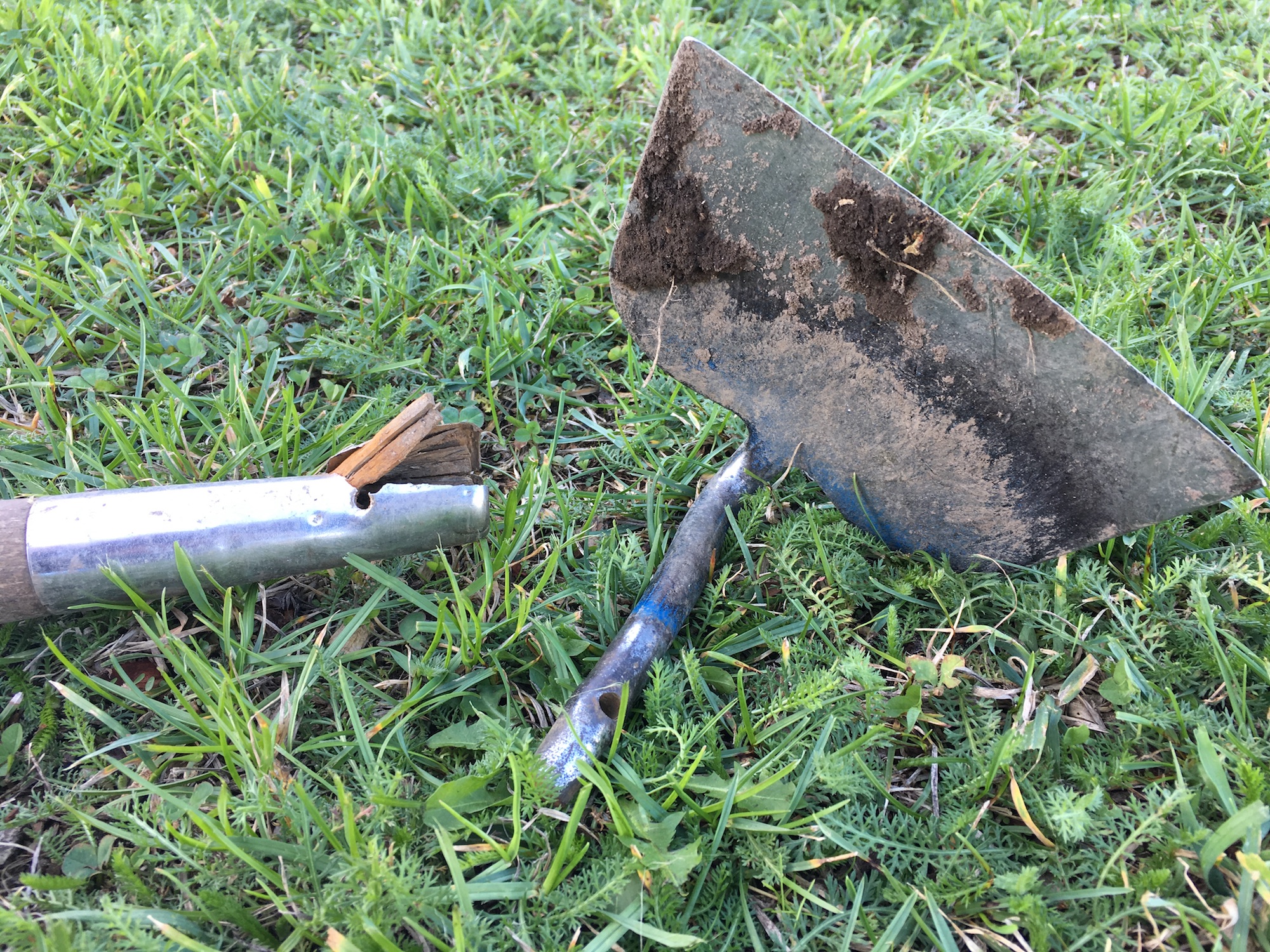
My hoe broke.

This has happened before. This particular hoe has been held together for years by duct tape after I cracked the handle on a particularly difficult clump of grass. Unfortunately, duct tape wasn’t going to fix this failure—this one was terminal, at least for the handle.

A few back-of-the-envelope calculations reveal that this hoe has done about 6,300 hours of work for me over its lifetime. It has measured and prepared garden beds, dug furrows for seeds, removed weeds, cleared paths, and mixed concrete. And it’s done all this with almost no maintenance—some sharpening, some cleaning, a little duct tape.

It’s no wonder the hoe is one of the oldest garden tools. The first evidence of hoes comes from cave paintings made in about 5000 B.C. Although there are many variations in hoe design, the basic idea has changed little for thousands of years; it’s a tried and true design that does the job well.

So this week I’ll find a replacement for my expired hoe. It’s not a tool I can do without.

Wear Your Hair with Pride

“Why do you have white hair?” asked the young girl, impertinent as only a seven-year-old can be.

“Because I’m getting old,” I replied.

“No, I mean why don’t you dye it?”

“Because my white hair is beautiful–it’s actually silver and sparkly.”

She wrinkled her nose. “It’s not silver. It’s white.” She snorted and stroked her own hair, brown and straight. “When I get that old, I’ll dye my hair.”

There was no point arguing with her. Silver hair is a beauty a seven-year-old can’t possibly appreciate.

But even beyond the fact that my silver hair has come in with body and curl that my youthful hair never had (it sat on my head like a wet dish rag), my silver hair is beautiful for what it represents.

Like ANZAC poppies that remind us to never forget those who died for our freedom, each silver hair is a reminder.

Lest we forget the struggles over which we have triumphed:

• As a parent, the screaming newborns, toddler tantrums and teenage rebellion
• Mental health lows
• Physical pain and illness
• Emotional pain—loved ones lost, relationships shattered
• Natural disasters and those made by humans
• The acts of violence against ourselves, against those we love, against our neighbours.

Every silver hair reminds me I have not only survived, but thrived. Every silver hair is a badge of honour, a challenge met, a goal surpassed.

Dye my hair?

Why would I ever hide my hard-won medals?

Strength.
Bravery.
Perseverance.
Patience.
Sheer bloody-minded stubbornness.

I wear these badges of honour with pride—my silver sparkling medals that streak my hair and remind me what I’m made of.

Vilma’s Eggplant–better late than never

I’ve blogged about Vilma’s Eggplant in the past, but it’s worth repeating a recipe this good.

This year’s eggplants took a long time to get going, and it’s only now that summer is over that they’re really giving well. But it’s never too late for Vilma’s Marinated Eggplant. This stuff could make an eggplant lover out of anyone.

Vilma was the sister of our host mother during Peace Corps training in Costa Rica. She was loud and fiery-tempered, and regularly stayed with our host family when she was fighting with her partner.

When she was with us, she cooked—glorious Italian food she’d learned to make from her partner. Her food was a flavourful gift in a house where vegetables were usually boiled to death and served plain. 

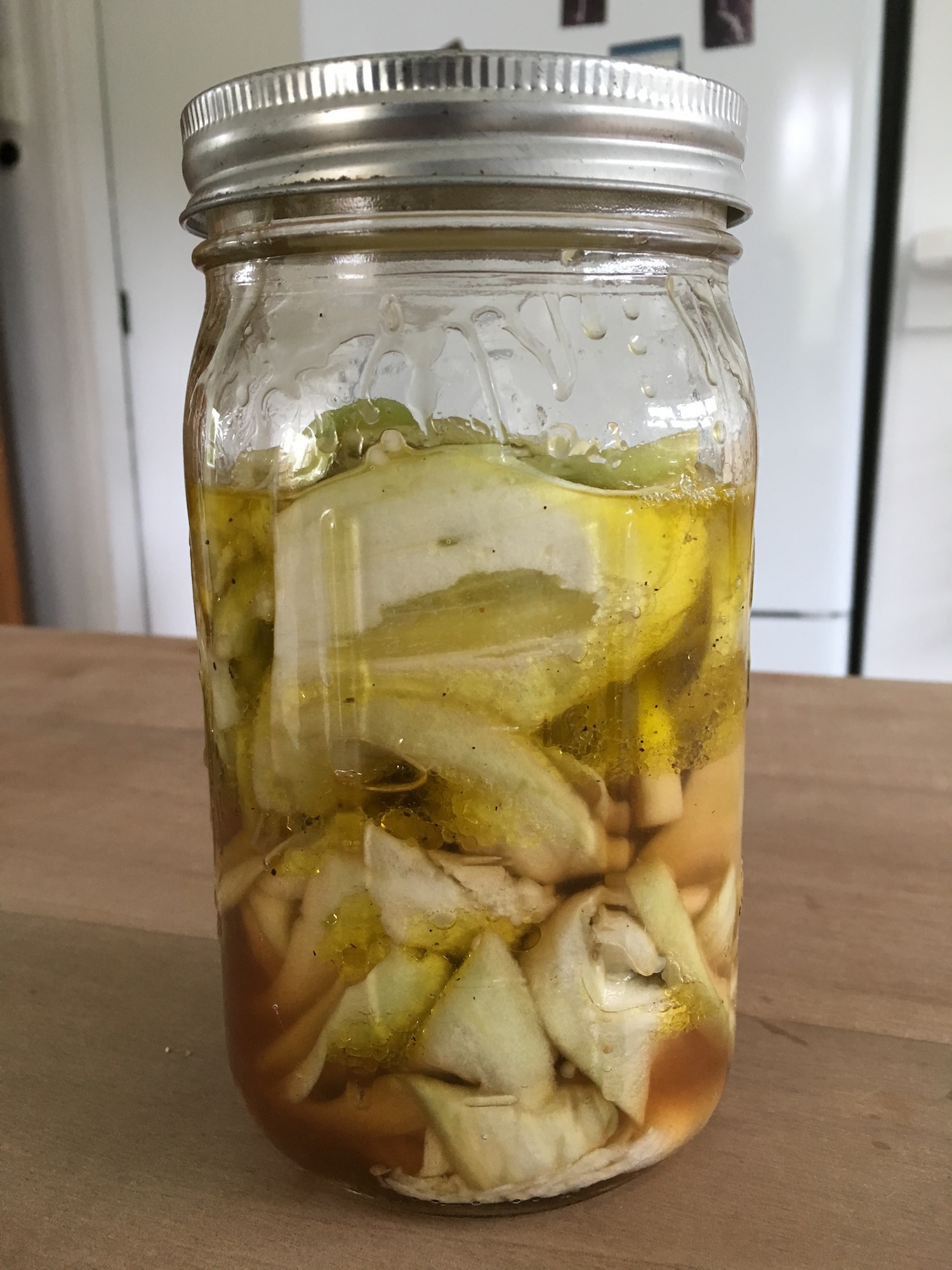
One of the most wonderful things Vilma made was thinly sliced eggplant marinated in garlicky vinegar. She’d leave a jar of it in the fridge when she left, and we would savour it for a week on our sandwiches or with our mushy, flavourless boiled vegetables.

I foolishly never asked Vilma for the recipe, but a bit of trial and error was all it took to recreate Vilma’s marinated eggplant. 

This recipe mostly fills a quart-sized jar. It keeps for a long time in the fridge and makes a lovely addition to sandwiches. Serve it on crackers for party appetisers—it’s not the prettiest food, but after one bite, none of your guests will care.

2 small to medium eggplants
1 clove garlic, crushed
½ cup red wine vinegar
½ cup extra virgin olive oil
salt and pepper to taste

Peel eggplants and slice very thin (1-2 mm). Steam until the slices are tender and limp (but not falling apart completely). Whisk all the other ingredients together in a small bowl, and toss them gently with the hot steamed eggplant. Refrigerate at least an hour before serving (the longer the better, as the eggplant will soak up more marinade).

Sand Dragon Competition Results

Thanks to the fabulous kids who made sand dragons and sent photos to me! Congratulations to Paikea Bennett who won the competition with his fantastic dragon that included driftwood wings, shell scales and teeth, and kelp fire. Well done! Great creativity!

While you all were making sand dragons at the beach, I was busy putting the final touches on The Dragon Defence League, Book 3 in the Dragon Slayer series. The official release date for The Dragon Defence League is 15 April, and it’s available for preorder now.

Embracing Autumn

Our summer has finally turned to autumn. Cooler temperatures and more rain mean the grass has begun to grow again, green shoots sprouting through rain-driven drifts of dead vegetation.

The tomatoes are browning, spent after summer’s excess, and while I mourn their loss, I welcome the fruits of autumn—pumpkin, wild boletes, black beans, apples and a return of leafy greens. I welcome warming soups and casseroles. I welcome the smell of baking pie, simmering beans, and sautéing mushrooms.

I welcome the reduced workload in the garden, too. There’s still plenty of harvesting to be done, and I’ll be clearing away dead plants throughout autumn and winter, but soon I’ll release the chickens into the garden to keep the weeds and pests in check until spring.

It’s time now to take stock. Plenty of summer soup, pickles and jam in the cupboard; strings of onions and garlic hanging in the kitchen; pesto, peas and corn in the freezer. Jars of popcorn and dry beans line the shelf, and a basket of apples sits in the kitchen. We will eat well this winter, food and effort stored in jars and freezer boxes to be released and enjoyed on dark, cold evenings. 

So I will savour the warmth and sun that remains, but embrace the cold to come.

Stand Together, Every Day

It has been a difficult few days for all of us here in Christchurch. Shock. Horror. Sadness. Fear. Anger. We have been through so many emotions, it’s hard to know what we are feeling at any given moment.

But one emotion has come to the fore—love. 

Even before we understood the full scope of the horror unleashed in our midst, ordinary people were mobilising to help. Within hours, there were community Facebook groups organising walking buddies and rides for those who felt unsafe on the streets. Other pages were organising meals for the families of victims. Donations poured in on multiple Give-a-little pages (when I went to one of them to donate, less than 48 hours after the attack, the total was already well over $3 million). The NZ Red Cross quickly announced they had plenty of blood after being inundated with donors. People from all over the city left flowers at the police cordons outside the mosques.

Everywhere, people stood together in love.

It’s something Christchurch is good at. We’ve had a lot of practice coming together in the face of adversity in recent years.

It’s tempting to focus on this outpouring of support, to acknowledge the love, and reject the attacker as the enemy. It’s tempting to look at the last three days and pat ourselves on the back for how we’ve responded.

But no matter how good we are at standing together in adversity, the fact is, we’re not good at standing together in the normal times.

We still speak of the Muslim community as though it is separate from the rest of the community. And it is. We need to ask ourselves why. What unacknowledged biases keep us apart? What unacknowledged prejudice prevents us from reaching out to one another in friendship in the good times? Why do we use our differences as an excuse to stay separate, rather than as an encouragement to enrich our lives by learning from one another?

Facing these questions may be uncomfortable—the answers will reveal things we may not want to acknowledge about ourselves—but we must confront them. The man who attacked on Friday may not have been a New Zealander, but there is no question the same attitudes are present here. They are fed by our separateness, fed by our unwillingness to stand up against the little things—the racist comments, the perpetuated stereotypes, the marginalisation of those who may look different to ourselves. These little actions nurture hate. Only by vocally and visibly standing together in the good times can we prevent this from happening again.

Today, wherever you are in the world, step out of your comfort zone. Reach out to someone different from you—make a new acquaintance, a new friend. Shut down an off-colour joke. Push back against a racist comment. Show your love. 

Kia kaha katoa.

Stay strong. Stand together, every day.

Beach Hangout

We nipped out to the beach after dinner on Saturday. We had a nice walk on our lovely, lonely bit of coastline.

But the beach was busy with youth hanging out (up to no good, probably). Some were alone, and some were in groups, strutting their stuff.

But these youth weren’t your usual crowd of city kids, they were juvenile spotted shags, Strictocarbo punctatus punctatus, also known as spotted cormorants, parekareka, and kawau tikitiki.

Shags were once heavily persecuted as pests. Fisherman believed they destroyed the fisheries, snapping up all the commercial fish and decimating their numbers. Research has shown, however, that their impact on fisheries is minimal. On the other hand, there is some evidence that, in our area at least, shag populations are hurt by commercial fishing. Spotted shag populations on the Banks Peninsula rose from 9,787 pairs in 1960 to 22,123 pairs in 1996 following a reduction in commercial fishing around the peninsula. Illegal shooting can also cause local population declines.

The spotted shag is a marine species, never venturing far from the sea and feeding in deep water up to 16 km from shore. They’re gregarious, breeding and roosting in colonies with up to 2000 birds. The groups of juveniles on our beach were small—a few dozen birds at most. These birds were probably born on cliffs around the Banks Paninsula, and when mature, they’ll head back to those cliffs to lay eggs and rear their young.

So they really were just hanging out on the beach, just like teenagers from Christchurch hang out on the beach on weekends, away from the adults, goofing off and getting takeaways.

Nifty Nigella

Late summer is harvest time for all sorts of crops. Nigella might be the most unusual one I harvested this week.

Nigella sativa goes by many names: nigella, kalonji, black cumin, fennel flower, nutmeg seed, onion seed, and black caraway. Added to this mess of often misleading names is Nigella sativa’s ornamental cousin, Nigella damascena, also known as nigella (or love-in-a-mist). You could be forgiven for being confused.

Culinary nigella is a lovely aromatic seed that looks confusingly like onion seed. Its flavour has been described as oniony or oregano-like. I’m not sure how I would describe it—I suppose onion and oregano come close, but the truth is it has its own warm rich flavour. It is traditionally used in naan and string cheese. It’s also apparently great with lentils and other legumes.

Because we rarely harvest much nigella, we’ve only used it in naan, where it imparts a lovely savoury note to the bread. 

But this year, conditions must have been just right for nigella; it grew luxuriantly. Consequently, I have a huge quantity of seeds, so I expect we’ll be trying it out in all sorts of stews and curries. I’m looking forward to the addition to our spicing options.