Astrobiology Fun

Not long ago, I attended a workshop on Astrobiology for teachers. I’m not sure which of my two jobs it was more useful for—teaching or writing.

Cool swag from NASA and Blue Marble Space!

My day job, though ever changing, often involves teaching science across years 3-8. One of the strands of the New Zealand science curriculum is Planet Earth and Beyond, so I regularly teach about our solar system and various features within our galaxy. Last year, I did a fun unit with the year 7 and 8 students in which students had to design spacecraft, habitat modules, and promotional campaigns for a colonising trip to Mars. 

I’ve rarely touched much on astrobiology, and the questions about life elsewhere in the universe, but the workshop made me think about all the ways that questions about life on other planets reflects on life on Earth. How these questions reflect on our actions as human beings—our treatment of other humans, our treatment of the planet and other living things on it. The presenters made a great case for using astrobiology as a way to dive into big philosophical questions about what it means to be alive on Earth today. 

What are our responsibilities to planet Earth and the life on it? What if we are alone in the universe? What if we’re not? Does it change our perspective on our own actions as humans? 

Sanjoy Son, from Blue Marble Science, spoke eloquently about how the teaching of astrobiology can give students valuable perspective on life, and how they can approach questions of personal differences, values, and civic responsibility. The take home message I got from his talk was that we are either the caretakers of the only life in the universe, or we are part of a vast, interstellar network of life. Either way, we are all ambassadors of planet Earth. What a great message for kids. What a great way for them to think about their roles as human beings.

As an author of fantasy and science fiction, of course I soaked up the cool facts about the gazillions of planets there are just in our galaxy, the weird ways life might have to adapt to wildly different conditions on other planets, the surprises that even our own solar system has produced in terms of planets and moons on which life could potentially survive, the physics of travel and communication through space. So many story ideas!

You’ll definitely be seeing more astrobiology creeping into my writing and teaching in the future!

A Fresh Perspective on a Changing Garden

blooming daffodils in formal garden beds

Twice a year, on (or near) the equinoxes, I clean the gutters. It’s not a job I enjoy, but it’s a necessary evil living downwind of the neighbour’s huge pines, macrocarpas, and gum trees. 

The one thing I do enjoy about the job is the excuse to spend a few hours up the ladder, peering down at the yard from a perspective I don’t normally have. 

So last weekend when I was cleaning gutters, I took my phone with me and snapped a few pictures from on high.

The last time I photographed the garden from this perspective was in September 2022. At that time, we’d just finished establishing and gravelling the paths in the front yard. Look what a difference three years makes! And what a fun perspective from which to view it.

Three years of change in the herb garden.

Preorder Draconic Search and Rescue

I’m thrilled to announce that the Draconic Search and Rescue ebook is now available for preorder on many online retailers!

Nathan McMannis is bored. His friends have gone on to new adventures, while he’s stuck at the Alexandra Institute doing correspondence school. All he wants is more excitement, less maths homework.

But you know what they say: Be careful what you wish for.

A huge earthquake strikes, and emergency services are overwhelmed, unable to rescue the thousands of people in danger. To make matters worse, the weather turns deadly. 

Against his father’s orders, Nathan flies away with his draconic partners, Foggy Bottom and Rata, to rally the dragons. The Draconic Search and Rescue Team descends upon isolated and endangered towns to ferry people to safety. But the task might be too big, even for the dragons.

If they fail, thousands will die. 

Will the fragile peace between people and dragons hold in the face of disaster? How far are the dragons willing to push themselves to save the humans who persecuted them for centuries?

Another wild, dragon-filled adventure set in modern day New Zealand! This standalone adventure can also be read as Book 5 of the Dragon Defence League series.

Gardening and Community

blooming daffodils
Blooming daffodils cover a multitude of sins (aka weeds) in spring.

The local veggie gardening group had our first Monday evening gathering for the season last night. And what a lovely gathering it was!

I hosted, which is always a bit nerve-wracking. You don’t want the place to look like it’s been abandoned or neglected, and in early spring, weeds are often more prominent than crops. And some of the group members have absolutely stunning gardens and are way better than I am at growing food. 

But we all have weeds. And we all have different challenges in our gardens and in our lives. And everyone comes in a spirit of community. Once people begin piling out of their cars and strolling the garden, any nervousness is forgotten as we all share our successes and failures so far this season, and catch up with each other’s lives outside the garden.

Conversations ebb and flow as the group wanders, breaking into subgroups around particular plants, garden structures, pest outbreaks, or other items of interest. 

Because we’re not quite on daylight savings time yet, we ended our garden stroll as daylight faded. But like any good gathering, we weren’t done yet—it was time for kai and a cuppa.

artichoke bud
Artichokes are on their way!

Last night, the party broke down on gender lines, as it often does (for no real reason … we laugh at ourselves all the time for this tendency to segregate)—the guys lit the brazier outside and commandeered the cheese and crackers to accompany some home brew. Indoors, the ladies had tea and cookies. 

Without the garden in front of us, the conversation diversified—and we’re such a diverse group outside our interest in growing plants, that you never know what might be under discussion on any given day. Crafts, books, digger operation, food, business interests, travel, rock collecting, climate change … you name it, we’ve probably discussed it. Garden group conversations are always intriguing and full of laughter.

When our guests headed home for the evening, the fire was still burning merrily in the brazier. The night was unseasonably warm, and the sky was clear and washed with stars. For an hour, my husband and I ignored the dirty dishes and sat in the dark by the fire, sharing what we’d both learned from the gathering.

While we sat there, a few thoughts occurred to me:

tomato seedlings
Tomato seedlings in the greenhouse.
  1. We don’t enjoy our garden enough. And by ‘enjoy’, I mean just sit or stroll and appreciate the beauty. Not that we don’t do this at all, but we could be doing it a whole lot more.
  2. We are absolutely blessed to be part of the local gardening community. I’m a total introvert, and being with groups of people where there are multiple non-stop conversations going on is exhausting for me. But I love this crowd of generous, community-focused people, and I look forward to each of our get togethers.
  3. Finding common ground with people can be as simple as sharing excess lemons or cuttings from your favourite herbs.

There is something humanising about gardening. The very act fosters community, brings people together. Reading the daily news, I can quickly begin to think the worst of the the entire human race. The garden group reminds me that there is beauty, not only in the garden, but in the ones who tend it.

Market Season

Next weekend I’ll be selling books at my stall at the Ōtautahi Crafter’s Market. It’s the first market of what I consider my Christmas market season. I know, I know, Christmas is AGES away, and I won’t start thinking about my own Christmas shopping until at least late November. But thankfully, lots of people start turning their thoughts to gift buying as early as September. Especially, the aunties and grandmas who buy books for their nieces, nephews and grandkids.

So I’ve booked in for a number of markets over the next few months, and I’ve come to realise that, in spite of being a socially awkward introvert who hates crowds and noise, I love selling at markets.

It’s EXHAUSTING, for sure. And it can be really depressing when you have a bad day and don’t even sell enough to cover the cost of your stall. But there’s so much to love about selling at markets.

  1. I love to meet my readers, or the parents/grandparents/aunties of my readers. Anyone who is browsing books at a market where they could instead spend their money on ice cream, hot chips, or cute garden gnomes is serious about books. They’re my kind of people. (Not that I don’t like ice cream, hot chips and garden gnomes, of course). I enjoy hearing what they like to read, who their favourite authors are, and why reading is important to them.
  2. Despite the crowds and noise, I appreciate the festival atmosphere of a market. Aside from the occasional spouse or young child who’s being dragged along against their will, people are there to have a good time. They’re happy. Shopping at a market isn’t like shopping for your groceries, that has to be done whether you want to or not. Market goers are willing victims—er, I mean—customers. And because they’re having fun, it’s easy for me to have fun.
  3. I love the excuse to browse other people’s stalls. I mostly frequent craft markets, and as an avid crafter myself, I love to see what other folks are creating. It’s a great way for me to get my Christmas shopping done, too.
  4. I enjoy the community of market goers. Go to enough markets, and you start to see the same vendors over and over. You say hello, ask how their day is going, whether they’ll be at the next market. For the vendors on either side of your stall, you practically become staff by the end of the day—looking after their stalls while they’re at the loo (and of course they do the same for you), and coming up with clever ways to hawk your own items and theirs together (Look! You can read my great books by the light of those beautiful handmade candles.)
  5. There’s nothing more satisfying than personally sending a copy of one of your books out into the world. Digital sales are fine, but there’s not the same feeling of success as when you actually hand your book to a reader yourself.
  6. I enjoy the creativity involved in creating my stall. Like many authors, I dabble in lots of other creative pursuits. A market stall gives me an opportunity to make use of my sewing, paper crafts, and other creative output to titivate my stall.

In spite of these positive things, I can’t deny that selling at markets can be exhausting and overwhelming. I’ve developed a few techniques to manage the stress that a day among so many people can induce.

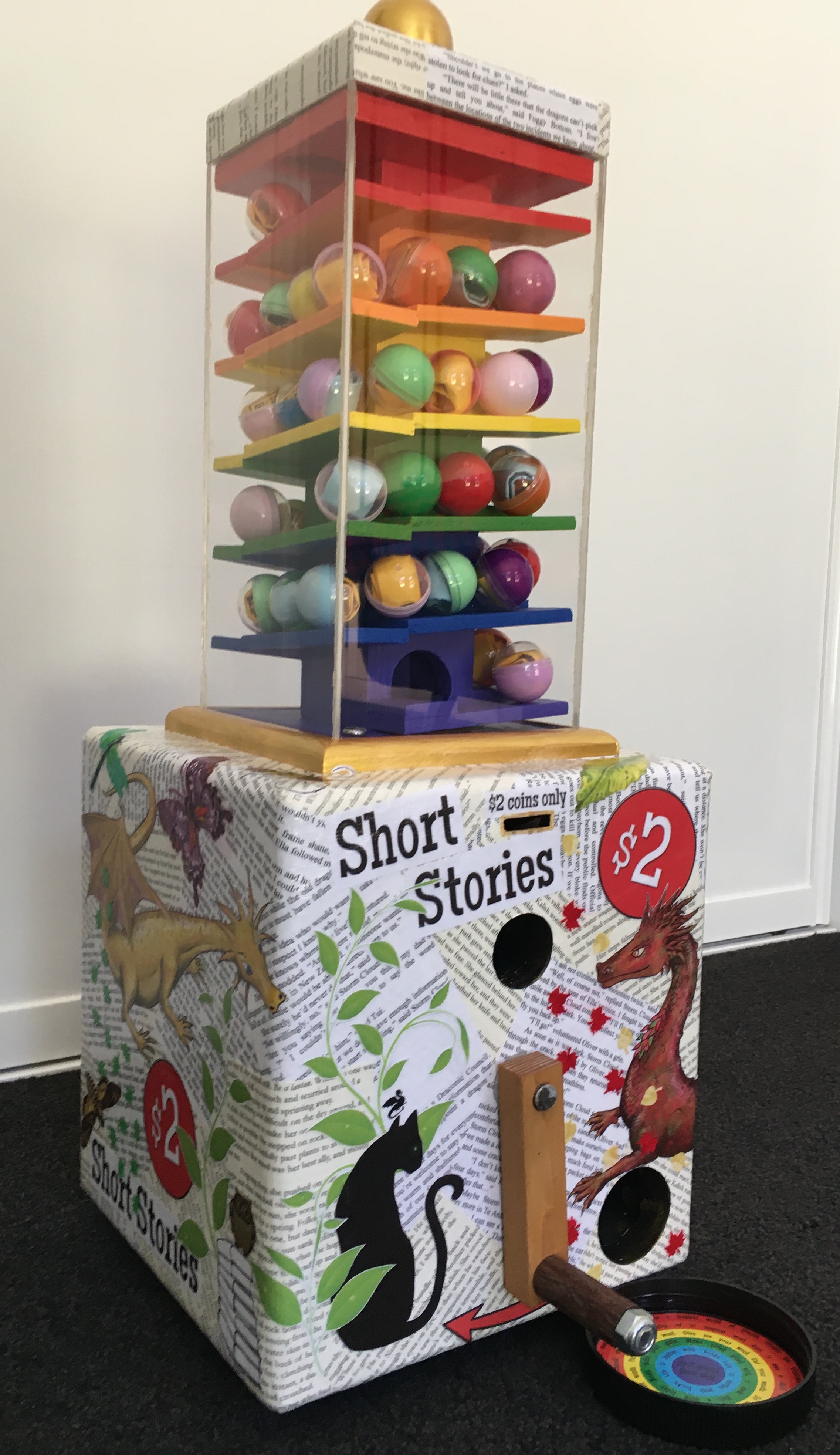
The story ball vending machine adds to my market day fun.
  1. Bring a healthy lunch. It’s so easy to think, “Oh, I’ll treat myself to something from a vendor for lunch.” But sugary, salty, greasy food leads to feeling depleted and icky by the end of the day. I take carrot sticks, fruit, and a sandwich—all prepared in bite-sized pieces so I can snatch a bite between customers throughout the day.
  2. Get there early, but not too early. I know how long it takes me to set up. To avoid being stressed about not being ready, and to avoid awkward standing around before the market starts, I time my arrival with just enough time to set up and use the toilet.
  3. Rehearse my spiel. I know what I want to say about each of my books, making it short and snappy. By thinking in advance, I don’t flounder awkwardly for the right words with a customer.
  4. Remember, books don’t sell themselves. I use this truth to my advantage when I need a social break. When I’m overwhelmed and don’t want to engage with anyone, I simply take a step back and stop talking to people. I smile politely, but if I don’t attempt to engage, most people won’t engage with me, and I get to take a break. 

I’m looking forward to the coming months, hawking my books to readers. Come visit me at these upcoming markets!

Ōtautahi Crafters Market—20 September, 10am – 5pm at South City Mall

Hokitika Christmas Market—16 November, 10am – 2pm at Seaview Lodge

Lincoln Twilight Market—28 November, 5 – 9pm at Lincoln Event Centre

The Goode Christmas Market—30 November, 10am – 3-pm at Pioneer Stadium, Christchurch 

Ōtautahi Crafters Market—20 December, 10am – 4pm at the Air Force Museum of NZ, Wigram

Writing Jitters

Yesterday marked 15 years since the M7.3 earthquake here in Canterbury. I doubt there’s been a single day since then that I haven’t, at some point in the day, thought about earthquakes. I even sleep under a quilt inspired by the 2010 quake.

Working on the quake quilt. Wow! Look how little grey hair I had back then!

Earlier this year, I took a friend, who was visiting from overseas, to Quake City, the museum dedicated to our earthquakes in 2010-2011, which devastated Christchurch. I thought I would be okay visiting the museum, since the quakes were so long ago. But facing that exhibition, everything about those days, weeks, and months came rushing back. At one point, my friend turned to me and said, “You talk like this happened yesterday.”

It felt like it had happened yesterday.

The quakes changed me, changed everyone who was here at the time.

The quakes made me a New Zealander. In the aftermath, when communities were rallying together to help everyone, I realised that this was the place I wanted to be. When the world came crashing down, I wanted to be in a place where university students mobilised a massive volunteer force to dig liquefaction from people’s houses, where farmers airlifted food into the city, where ordinary people organised the collection and distribution of blankets and other homewares for people who had lost everything, where spaces left empty in the city by demolished buildings were turned into temporary parks and places of joy.

The Famous Grouse in Lincoln, post quake.

This week I got the beta reader comments back from my next book, Draconic Search and Rescue,  in which the Alpine Fault ruptures, so earthquakes have been on my mind a lot. None of my beta readers experienced the Canterbury quakes—most of them hadn’t even been born yet. Writing the book, I worried that I would frighten my readers (8-13 year-olds are my target market) with a book about the Alpine Fault rupture. When it happens (and it will), the consequences for the whole country will be huge, and some towns are likely to be entirely destroyed. Researching for this book kept me awake at night, inspired me to be even more particular about my own earthquake preparedness, and reminded me that I’m not entirely crazy to ensure that, wherever I go, I’m prepared to walk home (hi vis vest and water bottle in the car, check, comfortable shoes, check, jersey, check).

But my beta readers wanted more danger, more fear. For them, it isn’t real. The rumble of a large truck doesn’t have them pausing to listen, make sure it’s just a truck. They don’t look for the emergency exits every time they enter a room. They don’t mentally assess the construction date of every building and consider whether it will collapse in the next quake.

So this week, I’m ratcheting up the danger in my book. Shoving my characters closer the destruction, maybe breaking a limb or two. And if I’m a bit jumpy for the next week or so, you’ll know why.

Cardamom Pound Cake

I recently made an excellent cardamom pound cake. Half way through modifying a recipe from the book Sweet, I realised I’d already created a cardamom cake recipe, based on some other cake. But this one might actually be better. Rich, moist, and flavourful—what more can you ask for in a cake?

I now need to make both versions for side-to-side taste tests. Anyone want to join me for cake?

Here’s the new recipe so you can test them too.

110 ml milk
6 eggs
2 tsp vanilla
zest of 1 lemon
300 g all purpose flour
1 tsp baking powder
1/2 tsp salt
200 g caster sugar
1 1/2 tsp cardamom
250 g butter, very soft, cut in chunks
1 cup shredded coconut

Whisk together the milk, eggs, vanilla and lemon zest in a medium bowl.

Sift together the flour salt and baking powder in a large bowl. Add the sugar and cardamom. Add the butter and half the egg mixture and combine with an electric mixer until the dry ingredients are incorporated. Mix 1 minute more, then gradually add the remaining egg mixture. Stir in the coconut.

Spoon the batter into a greased 23 cm Bundt pan or 2 loaf pans. Bake 40-45 minutes at 195℃.

Cool in the pan for 10 minutes before turning out onto a wire rack.

Bread Day, revisited

It’s been a long time since I last blogged about a bread day. I reckoned it was time for a revisit.

For most of our married life, my husband has baked all our bread. When we moved to New Zealand, we applied for a permit to bring his sourdough starter, which was a bit of a family heirloom, having been passed to him by his father (who baked their bread when my husband was growing up).

Once we settled in New Zealand, in a rural location with some land, we built a wood fired bread oven. Our first oven was made of clay we dug from the property, empty wine bottles for insulation, and set atop two overturned concrete livestock water troughs. An oven on the cheap, because we didn’t have much money and weren’t sure we’d use it long term.

We loved it, so when the first oven began to fall apart, we were happy to buy materials for the second. And when we moved, we built a third one, on the new property as one of our first big projects.

A bread oven is different from a pizza oven. Unlike the pizza oven, which relies on a live fire, the bread oven bakes on stored heat.

A bread day starts the day prior, when my husband pulls the sourdough starter out of the fridge and makes his sponge—a wet slurry, more like batter than dough. The sponge bubbles away overnight.

On the actual bread day, the fires is lit early, usually before breakfast. My husband fills the bread oven with wood and lets it burn to coals, then repeats the process in order to ensure the mass of bricks soaks up plenty of heat.

While the fire burns, my husband makes up the dough, using around 7 kg of flour.

By about lunchtime, the dough is ready to be made into loaves, and by early afternoon, the second fire is burnt to coals, which get raked out of the oven. At this point, the oven is running at about gazillion degrees—way too hot for most breads. But each type of bread bakes at a different temperature, and each batch lowers the temperature of the oven.

The first bread in is focaccia—thin and flat, it is in and out of the oven in 5 minutes. Then we throw in a big tray of vegetables to roast. They take 10 to 15 minutes and bring the oven temperature down enough to bake narrow baguettes, which are also out within 10 minutes.

Then come the batards, and then finally the square loves.

At this point, I take over the baking. The oven is now at a good temperature for cakes and pies. I like to bake things like pound cakes on bread days, because they take so long to bake. It’s nice to be able to make them with the ‘free’ heat of the bread oven.

The oven is still quite hot (around 180℃) by the time the cakes are done (usually about dinnertime).

There are a whole bunch of things we’ve done with that heat: toast granola, roast pumpkins, make baked beans, dehydrate fruits and vegetables. As the oven cools further, we’ve made yogurt and dried herbs. There’s useful heat in the oven for a good 48 hours, if we have the time and inclination to use it.

Last weekend we found a new use for the residual bread oven heat—sterilising compost for seed raising mix (which I’m sure I’ll blog about later). I put about 40 litres of compost through in two lots, and I might have gotten a third batch through if I’d had it ready to go.

The final tally from last weekend’s bread day: 1 focaccia, 17 loaves of bread, 2 meals worth of roast vegetables, 2 weeks worth of breakfast granola, 2 cakes, a baker’s dozen of fruit tarts, and 40 litres of sterilised compost. Not bad for a bread day!

Check out this time lapse of a long-ago bread day.

Parsnip Cake

As spring nears, we’re working through the winter vegetables still in the garden. At this point, the remaining parsnips that I planted last spring are monster roots weighing in at nearly 1.5 kilograms. It’s past time to eat them.

So, when I found a recipe for parsnip cake, I had to make it.

The recipe was in the book Sweet, by Yotam Ottolenghi and Helen Goh (I seriously recommend this book, if you don’t already have it). Like many of Ottolenghi’s recipes, it includes flavour combinations and spices I don’t normally work with.

And as with most of Ottolenghi’s recipes, I didn’t have all the right ingredients to make the recipe as it was written, but with a few substitutions, I ended up with some delicious cake. As I often do, I baked the cake as cupcakes—they’re so easy to snag for lunch boxes, and they encourage us to eat less cake, because you can’t cut a big piece like you can with a proper cake.

I love the flavour combinations in this cake—parsnip, orange , nutmeg and aniseed. It’s a fantastic combination that I’m not sure I’ve ever used. 

Here’s my version of the Ottolenghi/Goh recipe:

150 g walnuts
450 g grated parsnip (the original recipe says this is 3 large parsnips, but it was only 3/4 of one of my parsnips)
100 g raisins
finely grated zest of 1 orange (approx. 1 Tbsp)
3 eggs
225 g caster sugar (I would cut this down next time—they’re quite sweet)
280 ml vegetable oil (I would cut this down next time—they’re a little too greasy for me)
190 g all purpose flour
1 tsp cinnamon
1 1/2 tsp baking powder
1 1/2 tsp baking soda
1 tsp nutmeg
1 tsp ground aniseed
3/4 tsp salt

Toast the walnuts in the oven for 10 minutes at 170℃. Cool and then coarsely chop. Combine the walnuts, parsnip, raisins and orange zest in a large bowl.

Beat eggs and sugar together in another bowl until thick and creamy (about 2 minutes). While beating, slowly pour in the oil until it is all combined. 

Sift together the flour, cinnamon, baking powder, baking soda, nutmeg, aniseed and salt in a bowl. Add these to the egg mixture and beat until combined. Fold in the parsnip mix.

Spoon the batter into cupcake tins (greased or lined with papers), and bake about 25 minutes at 210℃.

I found that these cupcakes didn’t rise much—the batter is mostly fruit, vegetables and nuts. If their flat look bothers you, I’d recommend topping them with a cream cheese frosting that includes grated citrus zest. I didn’t make special frosting for mine, but I had a little left over from a previous cake, and it was delicious on the cupcakes. It wasn’t at all necessary, however—they were fantastic with no embellishment at all.

Magpies in the dark

Photo: Eric Weiss

As though they know
What I need
When winter returns
On the eve of bud burst,
Magpies warble
On fence posts
In the dark.

Spring comes!
Spring comes!

Ten years ago I posted a blog titled, It Ain’t Over ’Til the Magpie Sings. The post was prompted by the first morning that a magpie warbled for an hour before dawn. At the old house, where the windows weren’t double glazed, the magpies were my alarm clock in spring and summer, warbling an hour or so before sunrise, urging me up to do the milking and make the most of the day. It’s harder to hear them in our new house, where the double glazed windows deaden outdoor sounds, but I’ve been tuning into the magpies for years.

And I’ve discovered that the magpies are remarkably predictable. Ten years ago, I heard the first pre-dawn magpie song on August 8th. Today (the 8th of August) I heard the first pre-dawn magpie song of the year.

And just like that day a decade ago, the first magpie song was followed by a winter lashing reminding us that, while spring was on its way, winter was still in charge. Today’s weather forecast shows the temperature dropping from a 4 am high (a balmy 12.3℃) all day, to 3℃. We can expect rain and icy wind for the next couple of days.

But in the dark, the magpies will keep singing.