Strawberries

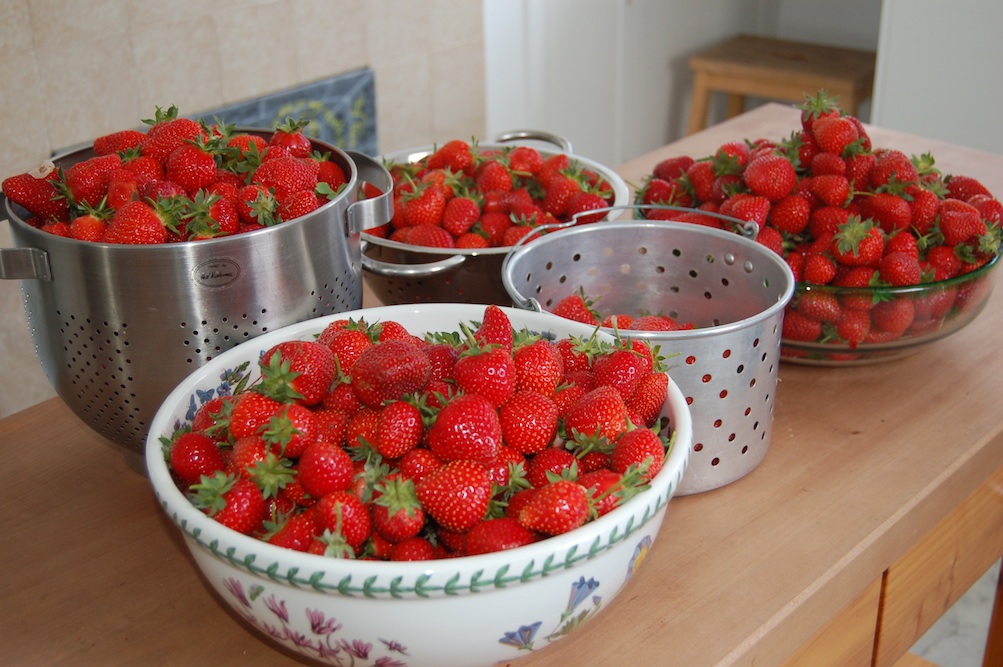
DSC_0003smI have always had an insatiable appetite for strawberries. At some point as a kid, I took over my mother’s strawberry patch—weeding, picking, selling, and eating large quantities of berries every spring. Here at Crazy Corner Farm, I also have a large strawberry patch. The original idea was that strawberries would be my cash crop—I’d sell lots of berries and support my gardening habit that way. It worked fine for a while…until I realised that, actually, we could consume every one of our berries without any problem at all, even when I was bringing in several kilograms every two days. I still sell some, and I give away plenty (they make spectacular Christmas gifts—who doesn’t want a punnet of strawberries?), but mostly we eat them.

The hardy, large-fruited strawberry we know today took many years to develop. Wild strawberries were cultivated in Europe as early as the 1300s, but it wasn’t until two New World species (Fragaria virginiana and Fragaria chiloensis) were imported to Europe that modern varieties were bred. The French accidentally pollinated the Chilean strawberry with the Virginia strawberry, and voila! They got a berry that was large, like the Chilean one, and hardy, like the Virginia one. Well, actually, it wasn’t that easy. After the French did it accidentally, the English spent many years crossing and recrossing these two species to develop a large, hardy strawberry. When these plants were shipped to America, most didn’t survive the colder North American winters, so more crosses had to be made.

Even then, strawberries wouldn’t grow everywhere and had incomplete flowers (only male or female parts), so they needed different varieties to cross pollinate them. It wasn’t until 1851 that James Wilson, from New York, developed a variety that was productive in almost any soil, and had perfect flowers, so it could be grown by itself. The commercial strawberry industry was born.

Since then, hundreds of varieties have been produced, some by professionals, many by amateur breeders who just loved strawberries.

I initially planted several different varieties in my strawberry patch. Those original plants are long dead, but have cross bred and sent out runners, so that today I have an intriguing mix of varieties. I can still identify some—Yolo and Strawberry Sundae are distinctive and easy to pick out. Many plants, though, have a mix of characteristics, and some even produce berries more like their wild ancestors. Every year, I nurture the ones I like and selectively weed out the ones that aren’t so great. Amateur strawberry growers all over the world do the same, I’m sure, giving us a wonderful range of sweet, tart, large, small, white-fleshed, red-fleshed, pointy and round berries. So many different types, I want to eat them all!

Best pie ever

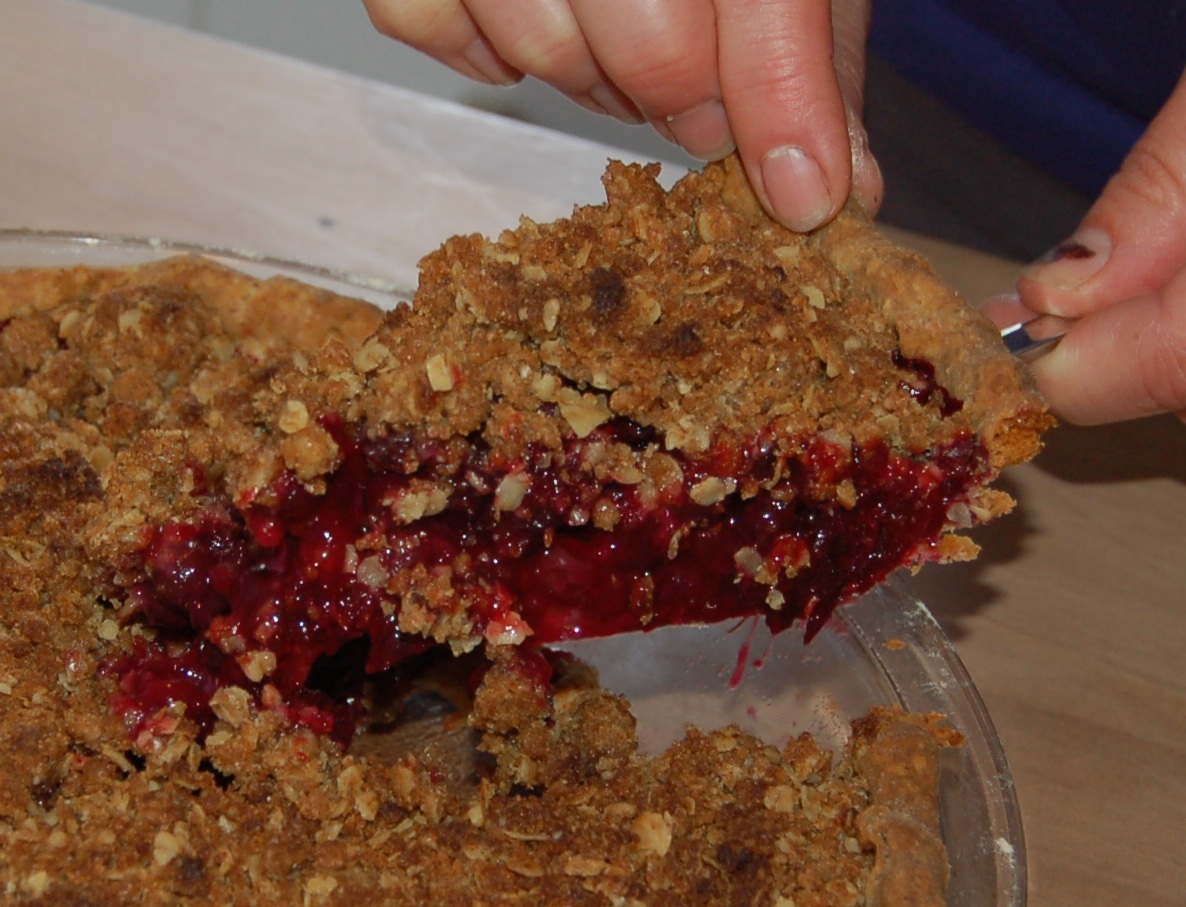
DSC_0011cropWe had an overabundance of blackcurrants this year, and in looking for interesting (and easy) things to do with them, I found some lovely pie recipes. I mixed and matched them, and came up with this divine concoction. So flavourful, you only need a little slice…so good you’ll want a big one!

I’ve been making it the day after making quiche for dinner—I make twice as much pastry dough as I need for the quiche, and put half in the fridge. With pre-prepared dough, the pie can then be assembled in minutes.

4 cups blackcurrants (fresh or frozen, thawed)

½ cup granulated sugar

2 Tbsp. all-purpose flour

Pastry for 9-inch pie

Wash and drain blackcurrants and remove stems. Mix with sugar and flour. Pour into the pie shell and top with pastry or streusel topping (see below).

Bake at 200°C (400°F) for 30 minutes, then reduce the heat to 180°C (350°F) and bake for another 25-30 minutes. Cool completely, and serve with whipped cream or vanilla ice cream.

Streusel:

5 Tbsp. melted butter

2/3 cup quick-cooking rolled oats (traditionally chopped nuts, but ‘easy’ is the whole idea here)

½ cup packed brown sugar

2/3 cup whole wheat flour

1 tsp. cinnamon

Mix ingredients with a fork until it resembles coarse crumbs.


Tastes Better Outside

Outdoor table settingsmLocation, location, location! True for real estate and for food. Where you eat is every bit as important as what you eat. Some of my best meals have been based on the where, not the what:

  • Lunch of stale crackers and peanut butter, eaten at about 1100 metres on a ridge in Fiordland, New Zealand on the summer solstice.
  • A spicy breakfast salteña, eaten on the streets of La Paz, Bolivia (and subsequently vomited in a public park in La Paz…but it was a great meal!)
  • Breakfast of one banana, bought from a local subsistence farmer on a day-long hike to a friend’s house in Panama.
  • Leftover burgers and strawberries, accompanied by warm beer on a remote beach on the Banks Peninsula, New Zealand.
  • Cold Pop Tarts on a large boulder in the White Mountains of New Hampshire.

It’s no accident that all these amazing meals occurred outdoors. I can’t think of a better dining room than one without walls or a roof! Doesn’t matter what I’m eating, it will taste better eaten in fresh air.

Where have your best meals occurred?

Once and Future Food

DSC_0006sm9.2 cubic metres.

7,000 kilograms.


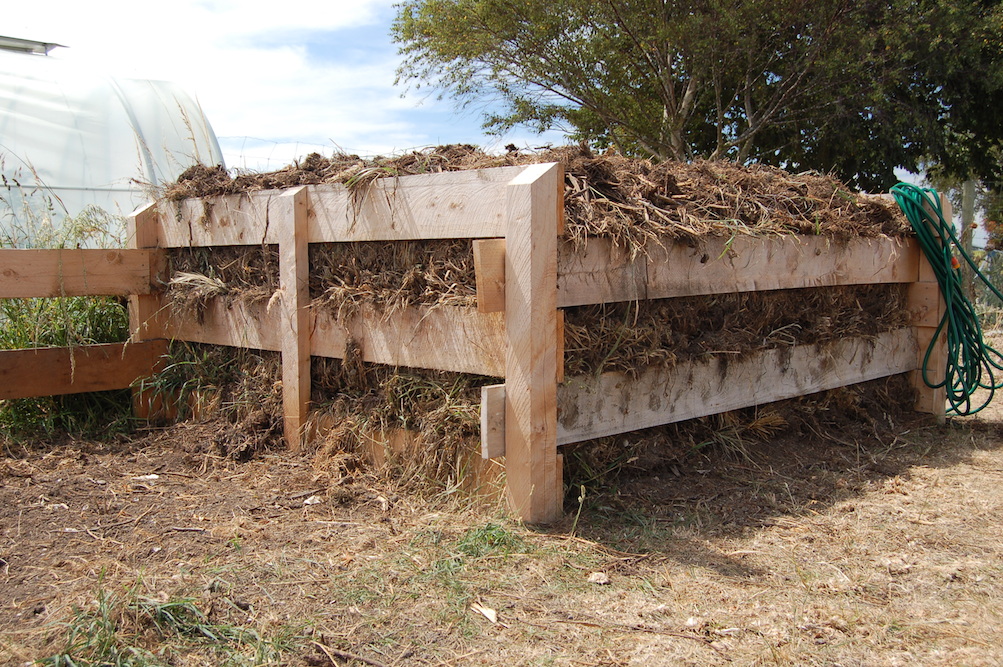
That’s how much compost I moved over the past two days. Carting it from the old compost area to the new compost bins my husband made for me. Turning the compost is an annual ritual—a compost pile that isn’t properly made and watered here turns into a dry mummy of weeds and kitchen scraps. This year’s turning was more difficult than usual, having to lift each forkful of weeds once into the wheelbarrow, then once more onto the new pile (rather than just tossing it next to the old pile). I dread the job every year—it’s one of those tasks I imagine exists in the level of Hell designed specially for gardeners (weeding thistles out of the gooseberry patch is another one of those jobs…I did that one earlier in the week).

But the job does have its moments. Uncovering a small pile of walnut shells—remembering the bag of walnuts our dentist gave us last April (also an avid gardener, we exchange produce at every dental appointment, and he once exchanged a filling for a block of homemade cheese). Bringing up the strata of last year’s tomatoes—salivating over the prospect of ripe tomatoes in less than a month. Yanking out a bean vine wrapped around jute—Liadan’s beautiful teepee of King of the Blues runner beans that fell over in a late summer storm. And finally, reaching last year’s broad bean plants, cut down a year ago, just after the last turning of the compost—remembering the final broad beans of this season, eaten just last week.

That mummified pile of plants represents the whole year in the garden. Turned and watered, it will soon become the food for next season’s crops. It fed us once, and will feed us again and again, as long as I keep turning that compost every year.

Team Cooking

Doing a little team cooking dance.

Doing a little team cooking dance.

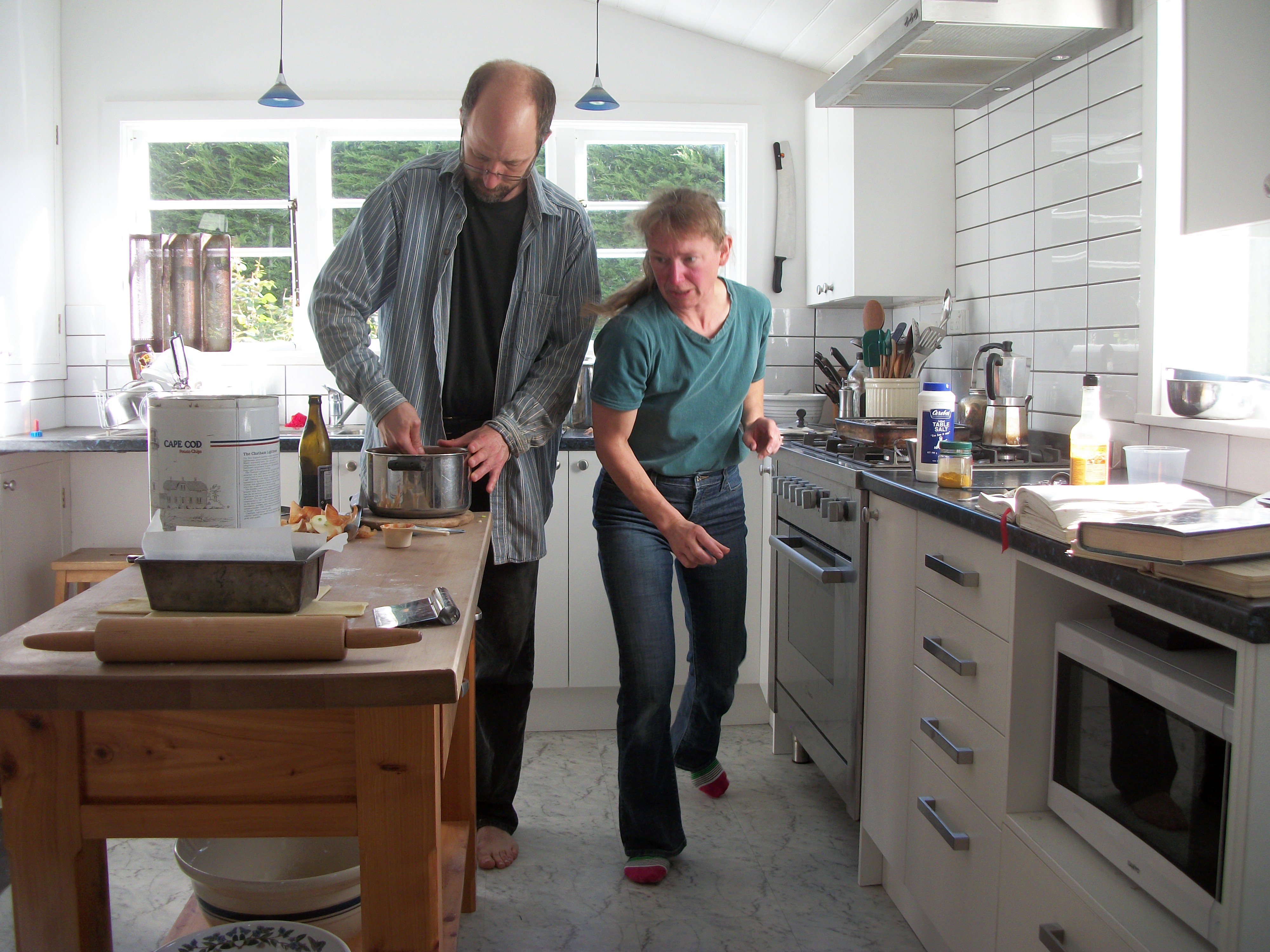
Ian and I met studying guanacos at the Detroit Zoo, but we became friends over food. I lived in a dorm, he lived in a house, and he treated me to home cooked meals when we met to work on the latest research project for our Animal Behavior class. It wasn’t long before we were cooking those meals together, and cooking together has been an important part of our relationship for over 23 years now. We intuit each other’s cooking style after so many years, and as with good ballroom dancers, we understand, for each dish, who “leads”. Like seasoned dancers performing a well-rehearsed number, we work in harmony, joyfully, anticipating what comes next, so that even tricky moves look effortless to bystanders.

So I suppose it isn’t surprising that, about a month ago, the kids decided they wanted to make dinner once a week. They know what a fun and fulfilling task it can be, and they want to be part of it.

Unfortunately pre-teen siblings who are often nervous around things like hot ovens and stovetops don’t work together quite so smoothly. Indeed, after the first week, when they ended up cross and irritated with one another making the simplest one-pot meal, we suggested they cook two dishes—that way each one of them can be “in charge” of one dish, and while the other will help them cook it, they’re in charge of decisions about the dish and how it is made.

And I suppose this is exactly what Ian and I have come to in the kitchen, though not by design. We each have our specialties. Ian bakes bread, and though I help, and am perfectly capable of making fine bread myself, he is in charge of bread. I bake desserts, and when Ian takes on a dessert himself, he defers to my judgement if he gets into difficulty. I make cheese, he makes beer. I make omelettes, he makes frittata. Yet we rarely do any of these things alone—the other is usually there, cleaning or cutting vegetables, washing dishes, testing spicing.

It works for the kids, as it does for us. Though they often need a helping hand from Mum or Dad, and though they may argue about what they’re going to cook, once they’ve divided the meal, they manage to work together reasonably well…for 10 and 12 year old siblings. They are already developing their “own” skills, becoming the “expert” in chopping carrots, or cracking eggs. And they’re learning how to accept each other’s expertise. What a huge lesson! To learn that someone (even your little sister) might know more than you do! And to learn to accept, seek, and value someone else’s skills and expertise.

So, while the kids’ Friday night dinners often end with a shocking mess in the kitchen, and sometimes the smell of something burnt hard to the bottom of a pan, they’re great training for all sorts of situations in life.

365 Days of Food

Food.

It feeds us physically and emotionally. It is an integral part of our celebrations, and is the scaffold on which our days are built. As a gardener, food is even more; it is a hobby, a lifestyle, a way of seeing the world and my place in it.

Over the next year, I will blog daily about food. Not a daily recount of what we ate, nor a recipe a day for a year (though there will be some of both), but an exploration of the role food plays in our lives–a look at life, the universe and everything reflected in the bottom of a stock pot.

So pull up a chair and fill your plate. There’s always room for one more at our table.

Worst Hostess of the Year

Just on their feet, the triplets Ariana, Albus and Ableforth.

Just on their feet, the triplets Ariana, Albus and Ableforth.

Our visitors were scheduled to arrive for lunch at 12:30—a colleague of Ian’s visiting from overseas and some members of her family. Lunch was in various stages of preparation at 12:15 when I got the call from my vigilant children that my goat Artemis was in labor. Leaving the production of meal entirely to Ian (with quick instructions as to what to do with the muffins when the oven timer went off), I dashed outside, pulling my boots on as I went.

It wasn’t long before our guests pulled in the driveway. I greeted them in my blood stained coveralls (from Ish’s kidding last week), leaving the paddock only long enough to explain my predicament and hand them over to Ian.

Back in the paddock, Artemis was looking decidedly uncomfortable. She leaned into my leg as I scratched her back. How Ian was getting on with lunch and guests, I didn’t know. After a while, her contractions seemed to slow, and I was starving, so I took a break for some food. Everyone was relaxing on the porch, food and drinks in hand. I raced to fill a plate and a glass, and sat down, apart from the group, where I had a view of the paddock.

Less than a minute later, I was up again, shrugging on my coveralls, lunch left mostly uneaten on my seat. The first kid was coming, but Artemis was lying down, and the big boy she was trying to deliver needed either gravity or me to do some pulling. Artemis refused to stand, so I pulled her first kid out and proceeded to wipe the mucous off him while she ponderously got to her feet to check him out. I called out his gender to my children, nervously waiting in the yard.

Number two (a girl) was already visible, but she was breach—coming out back feet first. She, too, needed some help. While Artemis licked one, I towelled the other. I called out the gender of the second kid to the children, and they cheered and raced to tell Ian (we’d been hoping for a girl from Artemis this year).

Artemis still looked awfully round, and I was pretty sure I could feel at least one more set of legs in her belly. Labor had stopped, though, so I ventured back to the house, covered in fresh blood and all manner of birthing fluids, to see if I could finish my lunch during the lull.

I had just enough time to finish my dried out bread and cheese and my wilted salad before kid number three made his appearance. He was out by the time I got to the paddock.

It took another hour or so before all three kids were on their feet and nursing well. I waved to our guests as they drove out.

When I finally stripped off my coveralls and washed up for the last time, I asked Ian, “So…who were those people?”