Garden Tally Half-year Check-in

We’re nearly at the summer solstice, so I thought it was time to do a check-in on the garden tally project I mentioned back at the winter solstice.

Since 21 June, we’ve been keeping a record of all the food that comes out of the garden. Whenever we bring something into the kitchen, we record it in a little notebook I’ve placed there for the purpose. The months of June, July and August include lots of days when we brought in nothing but eggs. No surprise, the dead of winter is a slow time in the vegetable garden. 

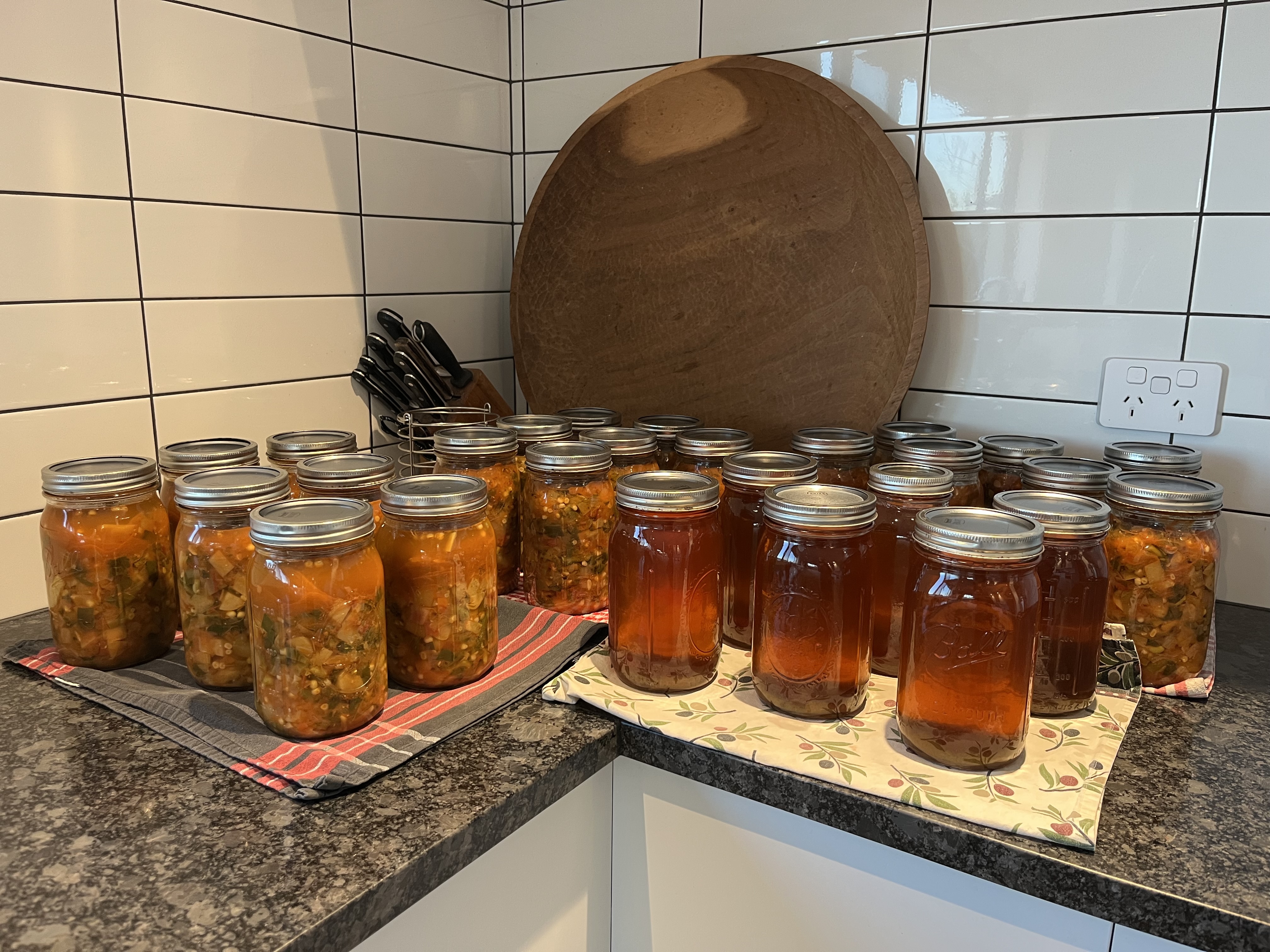
That’s not to say we weren’t eating from the garden. All winter we enjoyed the stored up bounty from last summer—tomato sauces, pickles, jams, chutneys, pesto, pumpkins, frozen corn and peas … There may have been little fresh coming in, but we didn’t lack for delicious vegetables and fruits.

Since September, the incoming volume from the garden has grown rapidly, and some of the half-year numbers are already staggering, despite the fact that the early onset of summer heat wreaked havoc on the spring crops.

If you ever wondered what 6.6kg of gooseberries looked like …

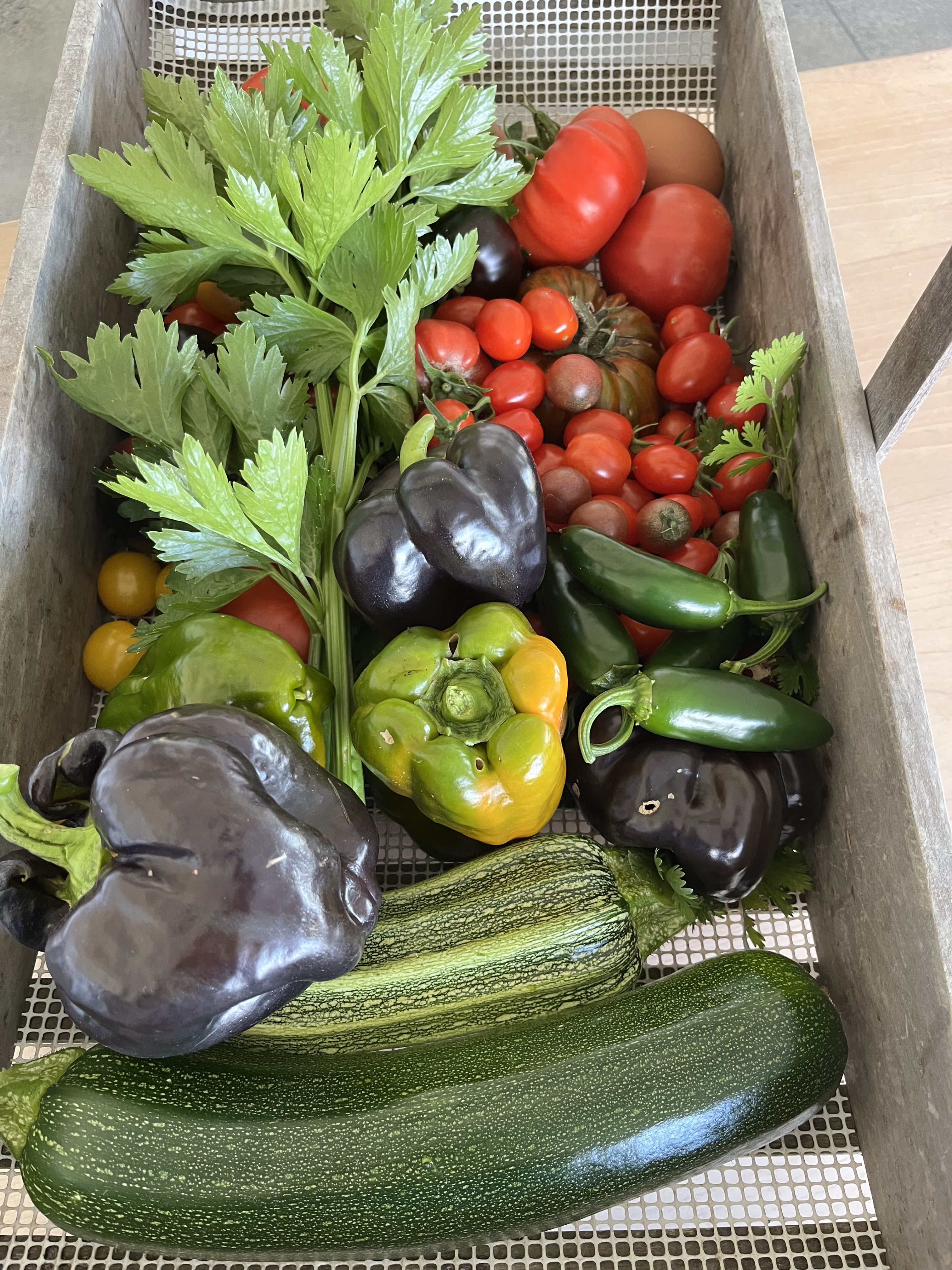
We’ve harvested over 56 kilograms of vegetables, 40 kilograms of fruit, and 335 eggs since the winter solstice.

Those 56 kg of vegetables only covered about half of our theoretical daily need, but that was the ‘lean’ season, when most of what we were eating was stored food from the previous season. Even as a vegetarian, I didn’t feel any lack of vegetables over winter.

There were also some stand-out individual harvests.

The final sweet pepper from last year’s crop was harvested on 2 August! For those of you in the northern hemisphere, that’s like harvesting peppers in early January. The new greenhouse is truly amazing for extending our growing season.

And it not only extends the later crops, it also gives them an early start. This year, I was disappointed, because the zucchini I planted early for the greenhouse never germinated. So the plant I stuck into the greenhouse was sown at the same time as my outdoor zucchini. Despite this, we harvested the first greenhouse zucchini on 13 December, well before my ‘zucchini by Christmas’ goal.

No matter how small, the first tomato is the best.

Oddly, however, the first ripe tomatoes have come from the outdoor tomato plants. These plants are currently less than half the size of the plants in the greenhouses, and honestly look like they’re only barely hanging on. Yet the Gold Nugget cherry tomatoes are already ripening out there.

All these stats make me eager to see what the second half of the growing year has in store. I was blown away by how much we’ve harvested during the leaner half of the year, but the real harvest has yet to begin.

I hope you all have a lovely solstice full of family, friends, and good food. 

Pickling onions, harvested in December, but we’ll eat most of them next winter.

Bountiful Berries–a Summer Celebration

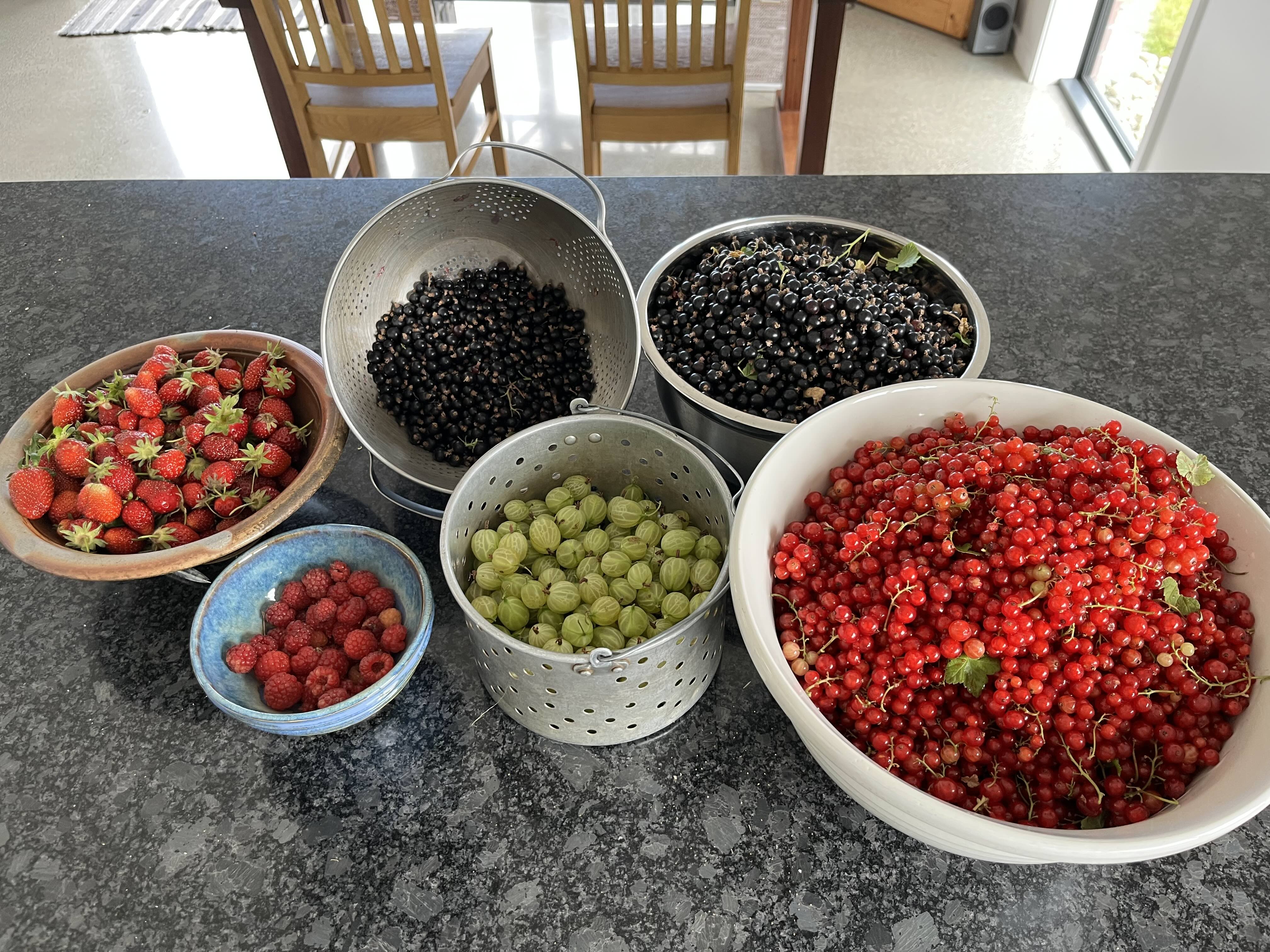
In the past two weeks, we have picked and processed (or eaten) 26.6 kg of fruit. Mostly strawberries, raspberries, black currants, red currants and gooseberries, but also a few cherries and boysenberries.

I have run out of half-pint sized jam jars, which is fine, because when you’re making jam with over 6 kg of fruit, you really want to put it in larger jars for the sake of your own sanity. The freezer, too, is beginning to fill with fruit, some of which will be taken out through the summer to combine with later crops in chutneys.

Still, the fruit keeps coming. Honestly, you can hardly tell I’ve picked currants at all. The next two weeks will likely see me pick at least another 20 kg of fruit.

And then it will be largely over. Christmas usually marks the end of the insane early summer harvest. Heading into the new year, the blueberries will begin to ripen, and raspberries, strawberries and boysenberries will continue to come in. But the obscene overabundance of berries will be over for the year. 

Although it is exhausting, there’s something magical about the December berry rush. Eating your way through the garden, having fresh berries on your breakfast cereal every morning, cramming your lunch box with fruit. Making trifle and fresh fruit ice creams. And the days are long—you can fit in a lot of picking and processing of fruit. It’s not unusual for me to be finishing a batch of jam at 10 pm. After all, it’s still light out, surely there’s time to get it done today. Never mind the clock, or the fact that it’s light before 5 am, and I’ll be springing out of bed at first light to pick more fruit before the day heats up.

Can this much work be a celebration? It feels like it. I weed, water, mulch, fertilise and prune all year, and then for a month the berries pour out their thanks. The work to gather it up is full of joy. By the end of the month, I’ve stored berries for the year. In the dark days of June, I’ll be able to make black currant tarts and enjoy the sparkling taste of the summer solstice. 

Spectacular Stick Insects

One of the first things we did when we bought our new property, even before we built the house, was to establish native plantings. Those plantings have grown spectacularly well, and many of the trees are four metres tall already.

Invertebrate life on the property has increased with the growth of our gardens. Our lush akeake attract katydids, the herb garden is alive with butterflies, native bees, and hover flies. Preying mantids stalk the flowers, snatching up prey. Jumping spiders of several species prowl among the foliage and rocks. And web-building spiders festoon the branches of nearly every plant.

But there are some notable absences. Species that aren’t good at dispersal.

One of those absences is stick insects. Our common native species here in Canterbury are particularly fond of kānuka and mānuka. The kānuka we planted in our gardens has grown beautifully, but is completely devoid of stick insects. 

But not for long …

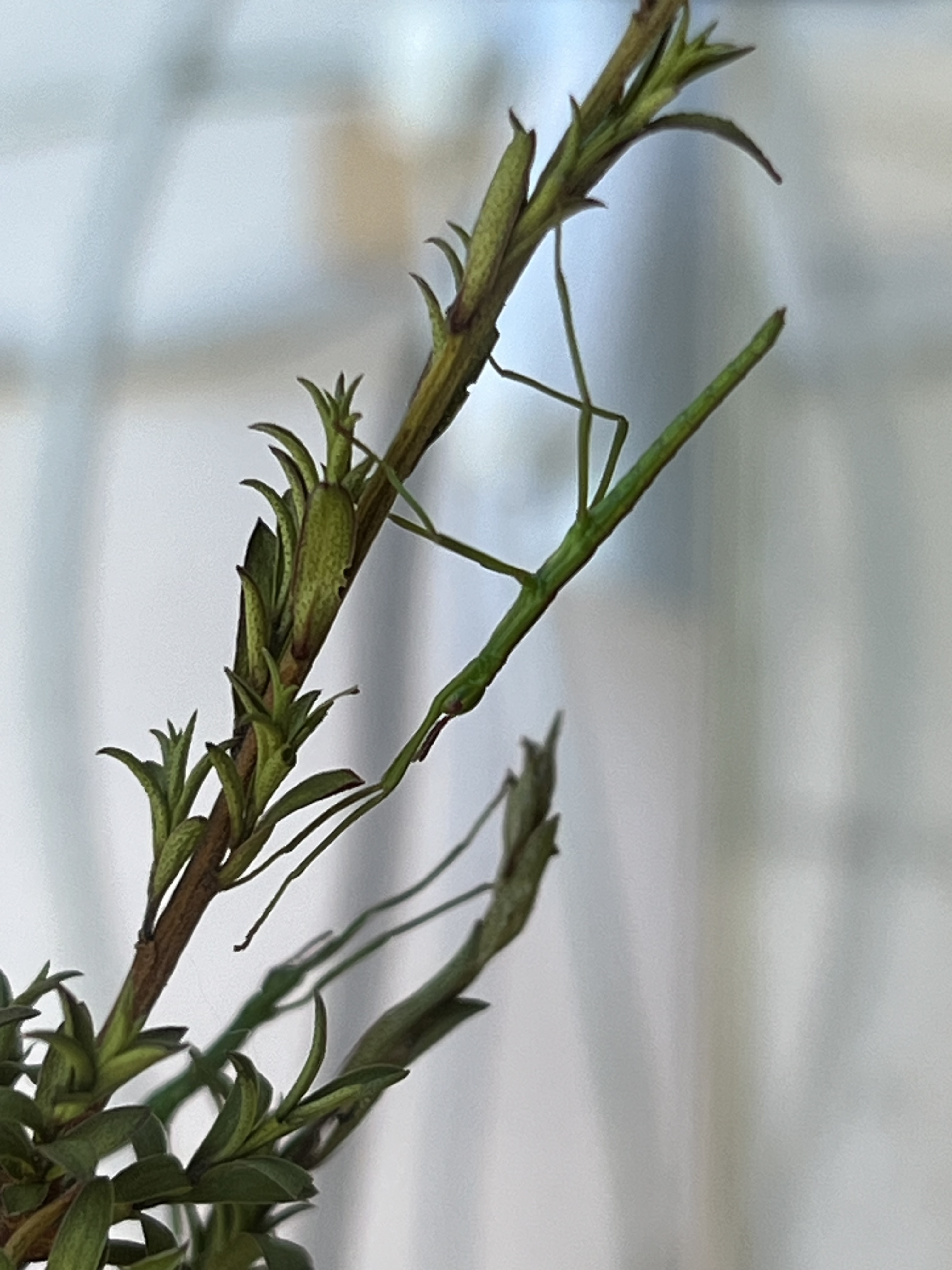
I was recently gifted some stick insect eggs from a researcher who is studying them. I set them up in an aquarium with some kānuka branches and eagerly awaited their hatching. The researcher warned the eggs were a bit old and might not hatch, but over the course of a few days, seven successfully emerged (a few more died in hatching). 

The seven stick babies are now happily munching kānuka in captivity. I’ll release them into our garden when they’re a little older and I’m more confident they’ll survive. For now, I’m enjoying watching them in their tank on my desk. 

Stick insects are some of my favourite bugs. I love their improbable shape. I love their crypsis-enhancing behaviours—sitting with their forelegs stretched out in front to make them look even more stick-like, and swaying in the ‘wind’ when disturbed. 

I also love the fact that many species are parthenogenic—the females can lay fertile eggs without mating with a male. In fact, there are some species of stick insect for which we’ve never found males.

This parthenogenesis is the result of a strange relationship many insects have with the reproductive parasite Wolbachia. Wolbachia is a genus of bacteria that is passed from female insects to their offspring. Because Wolbachia’s spread is only through the females of its host species, it’s in the bacterium’s best interest to eliminate males. It does this by a variety of methods, depending upon the strain of bacteria and the host species. The result is insects in which males are rare or nonexistent and females can reproduce parthenogenically. Its a cool and complex relationship that I find fascinating.

I look forward to establishing stick insects on our native trees. Hopefully my seven lovely babies will grow into a thriving population.

Franz Josef Glacier–Vanishing West Coast Wonder

My husband and I spent Canterbury weekend on the West Coast. We stayed in Hokitika, because I had a market there on Sunday, but on Saturday, we drove down to Franz Josef Glacier. 

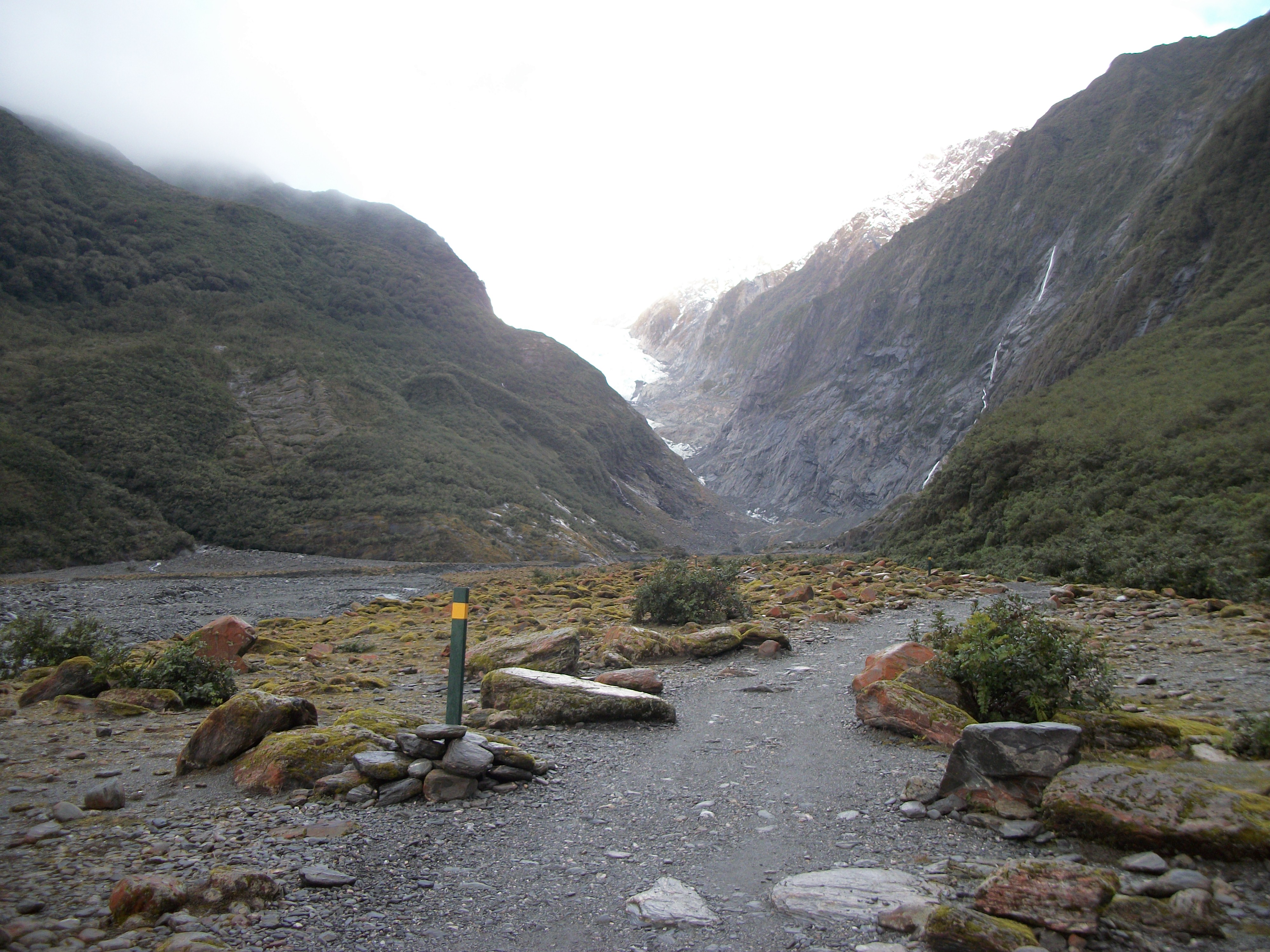
Franz Josef Glacier in 2009.

We hiked up to Alex Knob. This 17 km hike is a steady, occasionally steep climb of about 1000 metres. It’s not technically difficult, but it’s a good hike. It’s rated as 8 hours return, but we did it in about 5 1/2—it’s easy to speed on the way down. On our way up, we got glimpses of the glacier. Unfortunately, by the time we reached the top, where the view should have been spectacular, the whole top of the knob was in cloud, and a fierce wind was driving snow into our faces. Despite the wind, snow and cold, we tucked ourselves behind a tussock and had a snack, enjoying the sheer wildness of the weather, before driving hail hurried us down.

It’s been ten years since I’ve been to the glacier. What I saw on this visit was heartbreaking.

Sixteen years ago, I did some interpretation work for the Department of Conservation, researching and writing text for interpretive panels at Franz Josef Glacier and Fox Glacier. I also did some research around visitor behaviour at the glaciers and the effectiveness of various warning messages. At the time, the glaciers were easily accessible on foot. They were advancing and dropping deadly chunks of ice on visitors who ignored warning signs and crossed barrier ropes to get up close.

Franz Josef Glacier in 2015

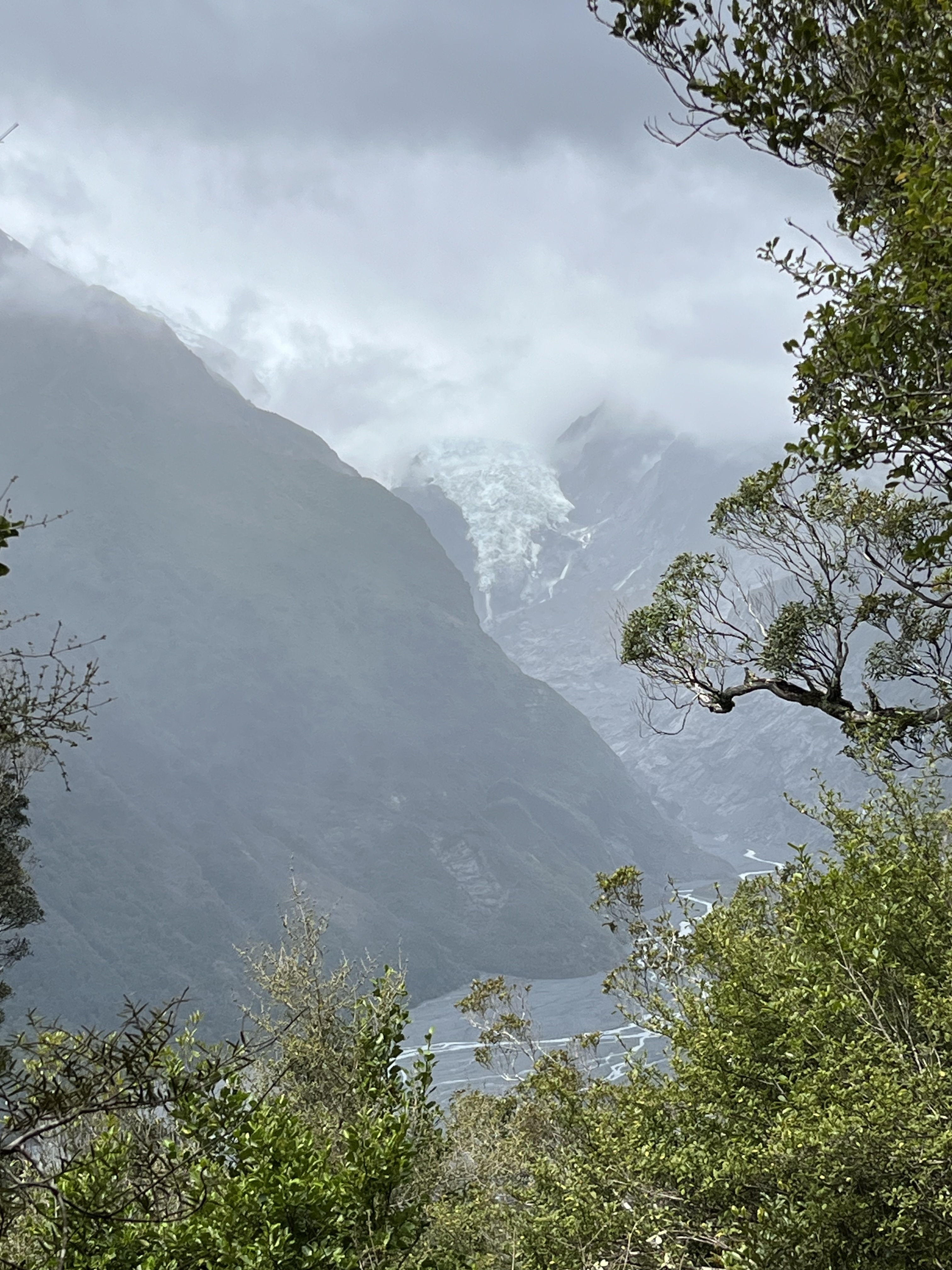
Today, Franz Josef Glacier has retreated so far, it is not possible to walk to it. Ironically, the only way to visit the glacier these days is by helicopter—further spewing the greenhouse gases that are killing the glaciers.

There were thousands of tourists in Franz Josef Township last weekend, and the glacier carpark and tracks were crowded. Many of these tourists were here for the lure of New Zealand’s spectacular glacial landscape. New Zealand used to be the only place on earth where you could see glaciers reaching down into temperate rainforest. Today the glaciers come nowhere close to the forest, and soon there will be no glaciers left at all.

Franz Josef Glacier in 2025

There are many other wonders on the West Coast—the rainforest, the mountains, wildlife and beaches—but the loss of the glaciers is tragic, not just because of their natural beauty, but also because of their role in water storage and release. Their loss will have long term consequences for all of New Zealand.

It may be another decade before I go to Franz Josef Glacier. I hope there is still a glacier to see when I get there.

Homemade Potting Mix

I’ve been frustrated with commercial potting and seed raising mixes in recent years. Not only are they expensive, but my vegetable seedlings languish in them, if they germinate at all.

The culprit is most likely clopyralid herbicide residues in the mixes. Even ‘organic’ compost may have traces of the herbicide in it, because the chemical doesn’t break down easily, and can be found even in manure from animals that have eaten plants sprayed by it.

So this year I decided to try making my own potting mix. The results have been encouraging.

My biggest hurdle to making good potting mix is ridding my compost of weeds. I don’t do hot composting. Though some of my pile will get to the temperature necessary to kill weed seeds, not all of it does. Fortunately, I have an effective way of sterilising compost—the bread oven.

This spring, every time we’ve fired up the bread oven, I’ve used the residual heat, after all the baking is done, to sterilise compost. 

I put moist, sieved compost into a restaurant steam tray (lidded) and/or a stock pot (lidded) and put it in the hot oven until the temperature in the centre of the compost reaches 82℃. This takes a couple of hours, as the oven is usually only around 150℃ by the end of baking. 

I mix my sterilised compost with coarse landscaping sand in a 2:1 ratio, and voila—my own potting and seed raising mix!

Sterilised soil is prone to fungal outbreaks, because there are no other microorganisms to keep the fungi in check, so when I use my mix, the first watering I give it is a slurry of soil from the garden. This inoculates the mix with the healthy mix of microbes from the garden and avoids excessive fungal growth.

And how did my mix do, compared to commercial mix? Spectacularly well! 

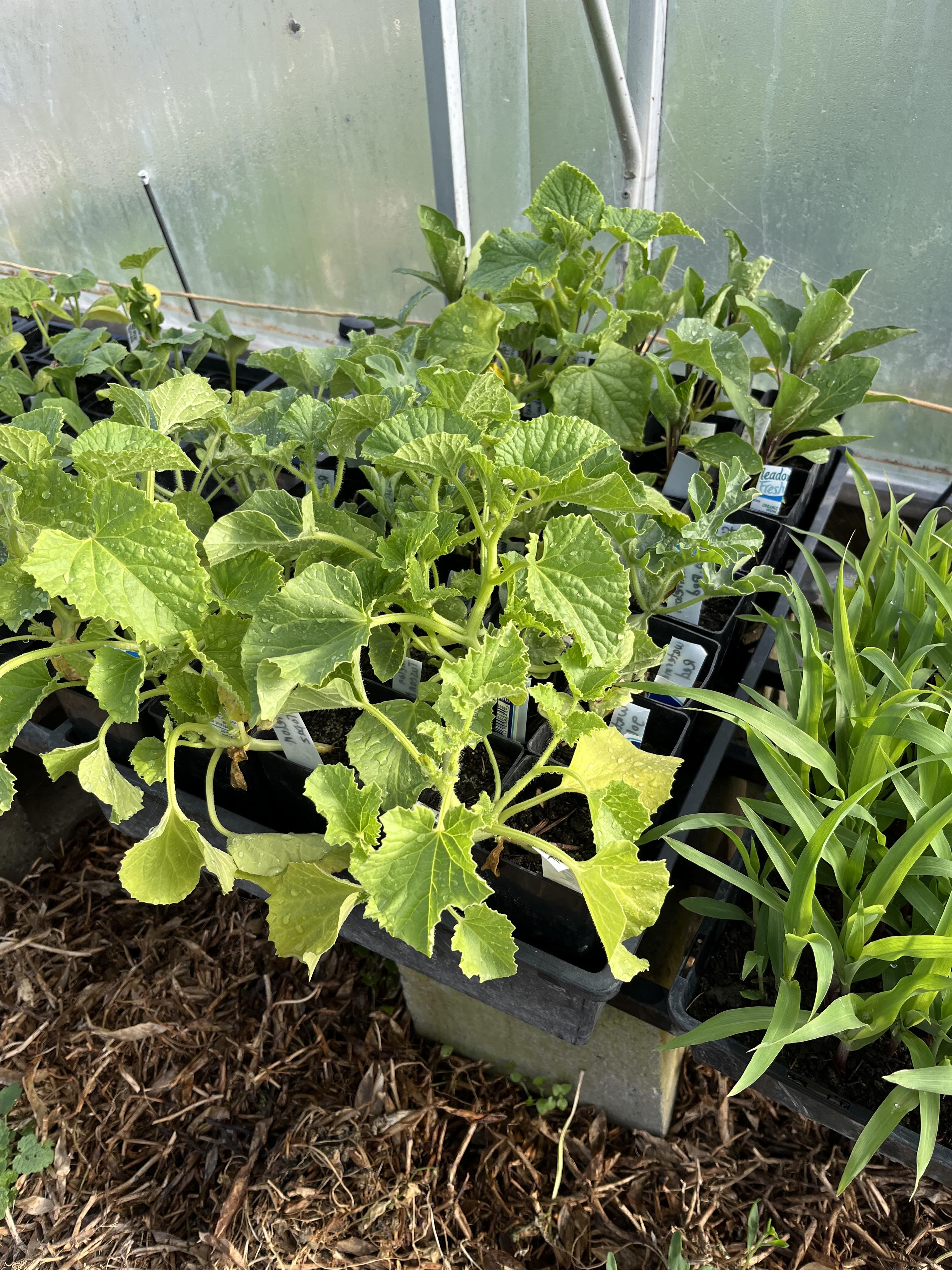
Because I didn’t decide to make my own mix until I actually needed it, some of my seeds were planted in commercial ‘organic’ mixes. Many of these seeds failed to germinate this year. Those that did germinate then sat without growing at all until I transferred them to my own mix.

Seeds planted in my own mix germinated well and grew vigorously.

I will definitely be making my own potting mix from now on.

Market Month!

The Christmas season is heating up, and with it my market schedule. This month, I’ve got a stand at three markets, the first coming up this Sunday in Hokitika. My husband and I are taking the market as an excuse to spend the long weekend enjoying the West Coast, so my office floor is currently piled with books and market swag to be loaded in the car tomorrow morning. I’m very excited to be selling my latest book (set largely on the West Coast) in Hokitika!

Come on out to a market this month and say hello!

The Carrot Conundrum

I love carrots. I love them cooked into everything from pasta sauce to burgers, and I love them raw in my lunch box. As a snack to get me through the day, they are unparalleled—crunchy, juicy and sweet, but not so sweet that they give me a sugar crash. And homegrown carrots are a million times more flavourful than commercial carrots, so growing good carrots is important to me.

Unfortunately, I rarely have luck with my carrots. Last year, I planted three times and got, maybe six carrots. This year, after my first planting failed entirely, and my second mostly failed, I decided to get serious about carrots. 

First, I evaluated why my carrots so often fail. It’s not just one problem that nails them. First, I probably plant my carrots a little too early. Not that they won’t grow at the cooler soil temperatures of early spring, but they take longer to germinate, leaving the seeds at risk of my other two problems: pests (mostly slugs and slaters) which eat the seeds and freshly germinated seedlings, and drying out.

Finally, even once my carrots germinate, they struggle with the heavy clay soil of my garden. If I lighten the soil by adding lots of compost, the slugs and slaters just eat the carrots before they can establish.

So, to try to address all these issues, I started by asking my husband to build me a raised bed. Into the bed we poured a commercial garden mix (half soil, half compost), combined with a sack of garden sand.

I watered the bed well before planting. Then I made my furrows deeper than necessary, so that even after covering the seed, the rows were lower than the surrounding soil. My hope was that the rows would stay moist longer after watering or rain if they were furrowed. 

I watered well after planting, then generously sprinkled the bed with slug bait (I use Quash (iron EDTA), which is also very effective against slaters, but is safe for most everything else). Then I mulched between the rows with grass clippings, and covered the whole bed with feed sacks laid right on the surface.

With the feed sacks on the surface, I didn’t need to water daily, but I watered every other day (with extra waterings on hot days).

Ten days later, I have excellent germination on my carrots!

Was my raised bed necessary? Maybe not, but by making the bed, I focused my effort on a smaller area than I usually plant in carrots. It gave me an excuse to work really hard in that small area to make it work.

Will it work again next year? I’ve had bumper carrot crops in the past, so I know that success one year doesn’t necessarily mean success every year. But I’m hopeful that I’ve hit on a technique that works consistently for me. Only time will tell. 

In the meantime, I’m doing my best to keep my newly sprouted carrot seedlings moist and free of pests. I can taste the carrots already…

Halloween–a time to be batty

I’ve been folding origami bats this week in preparation for the trick-or-treaters who will be arriving at our door on the 31st. 

Although I can’t get into the Halloween spirit like I used to do in the northern hemisphere, I’ve decided Halloween in Kirwee is a chance to let my weird show.

Each year I write a poem on the driveway inviting trick-or-treaters to the door.

Of course I dress up. And I’m a stickler for the kids to be in costume too. If they show up at my door with no costume, I make them perform a trick for me.

I’ve had on-the-spot original rap performances, rugby moves, and songs. Some of my regulars now clearly prepare their trick in advance, whether they’re in costume or not.

I hand out candy, as is expected, but last year I gave one of my books for my favourite costume of the evening. The girl who got it was over the moon.

So this year I’ve leaned further into the weird. I wrote a special spooky story for kids, printed it (white on black) onto squares of paper, and folded the squares into bats to hand out along with the candy.

I hope the kids like my spooky story bats as much as I do!

(Finally) Going Solar

When my husband and I designed our current house, we did it with solar power in mind. The house faces north, the roof pitch is steep for better solar gain, and we had it pre-wired for solar.

Five years later, we’ve finally had the panels installed. And while I’ve been itching to have it done for years, I’m glad we waited.

Weaning ourselves off fossil fuels, the biggest impact we could make for ourselves and the environment was to get an electric car. So that purchase came first. We love the Leaf we bought, and it costs us about a quarter of what we were spending on petrol. Those fuel savings helped us save up for solar.

Additionally, the technology has both improved and gotten cheaper over the past five years, so what we are able to afford today is much better than what we could have gotten when we built the house. I’m sure if we waited another five years, we’d see more technological improvements.

But with so many people switching to electric cars these days, New Zealand’s electricity suppliers are more frequently firing up the coal and gas generators as our current renewables production falls behind consumption. So I’m thrilled to have our own solar array, for our own benefit, and for the benefit of the planet.

Spectacular Spiders: Sooty Orbweaver

Anyone who knows me knows how much I love spiders. One of my favourite story books as a child was Be Nice to Spiders by Margaret Bloy Graham (never mind the subtle misogyny in this 1967 publication). Growing up, we called the big hairy jumping spiders in the basement “friend ‘pider”.

When I was bitten as a teen by a large wolf spider who’d taken up residence in one of my sneakers, my main concerns were: was the spider okay? (Yes, she appeared unharmed by me squishing my foot into ‘her’ shoe), and was wolf spider venom strong enough to do anything to humans? I was fascinated to find that, yes, my pinky toe, near the site of the bite, was paralysed for about fifteen minutes. Cool, right?

Having lived in Panama, a place with spectacular spiders, the relatively small and harmless New Zealand spider fauna was initially disappointing. But Aotearoa has some fun and quirky spiders. And though none of them rival the tarantulas and golden silk spiders in Panama, New Zealand wins the prize for the sheer volume of spiders. They seem to inhabit every nook and cranny here.

I’ve recently started a wee project to document the spiders on our property. Last Friday, I spent my morning tea break photographing a few.

One of the more common spiders I found on my stroll was the sooty orbweaver (Salsa fuliginata). Despite the name, these dainty arachnids are beautiful creatures, and quite variable in appearance. The three individuals in these photos were hanging out within 50 centimetres of one another—one brown, one rosy, and one yellow-hued. I always find them among the broad beans, capitalising on the heavy insect traffic around the aromatic blossoms.

The sooty orbweaver is native to Australia, and likely arrived in New Zealand from there around 2000.